
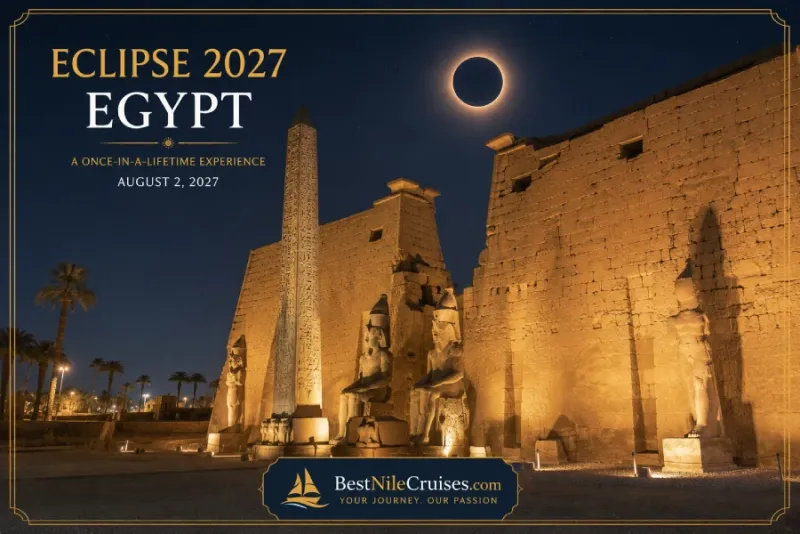
Egypt Solar Eclipse 2027 — The Complete Travel Guide
August 2, 2027 will be one of the most extraordinary days in Egypt's modern history. A total solar eclipse — the longest in 135 years — will track across North Africa and directly over the Nile Valley, plunging Luxor, Aswan, and Abu Simbel into totality for over six minutes. For context: the much-celebrated 2017 North American eclipse lasted a maximum of 2 minutes 40 seconds. The 2027 Egypt eclipse more than doubles that.
For travellers already planning an Egypt trip, this is a once-in-a-generation alignment of circumstances: the world's greatest concentration of ancient monuments, combined with the longest total solar eclipse of the modern era. No other destination on the 2027 eclipse path combines the eclipse with experiences of this magnitude.
Egypt Solar Eclipse 2027 — Exact Date, Time and Duration
Eclipse Path Map — Spain, North Africa & Middle East Overview

Map adapted by NationalEclipse.com from original at eclipse.gsfc.nasa.gov. Eclipse predictions courtesy of Fred Espenak, NASA/Goddard.
Upper Egypt in August has some of the lowest cloud probability of any eclipse location in the world. The desert climate means August skies over Luxor and Aswan are essentially guaranteed clear. Many prime eclipse viewing locations offer spectacular geography but significant weather risk — northern Spain and Morocco, for example, carry meaningful cloud risk in August. Egypt 2027 offers both the longest duration and the best weather certainty on the entire eclipse path.
Critical Planning Fact: Cairo and Alexandria are NOT inside the path of totality
The eclipse path of totality does not pass over Cairo or Alexandria. Travellers staying in Cairo on August 2, 2027 will see a partial eclipse only — visually interesting but completely different from a total eclipse. To experience totality, you must travel to Luxor, Aswan, or be on a Nile cruise between them. This is the single most important planning fact for the 2027 Egypt eclipse. Many visitors make the mistake of planning a Cairo-centred trip and missing totality entirely.
Eclipse Path Map — Northern Egypt (Cairo & Alexandria)
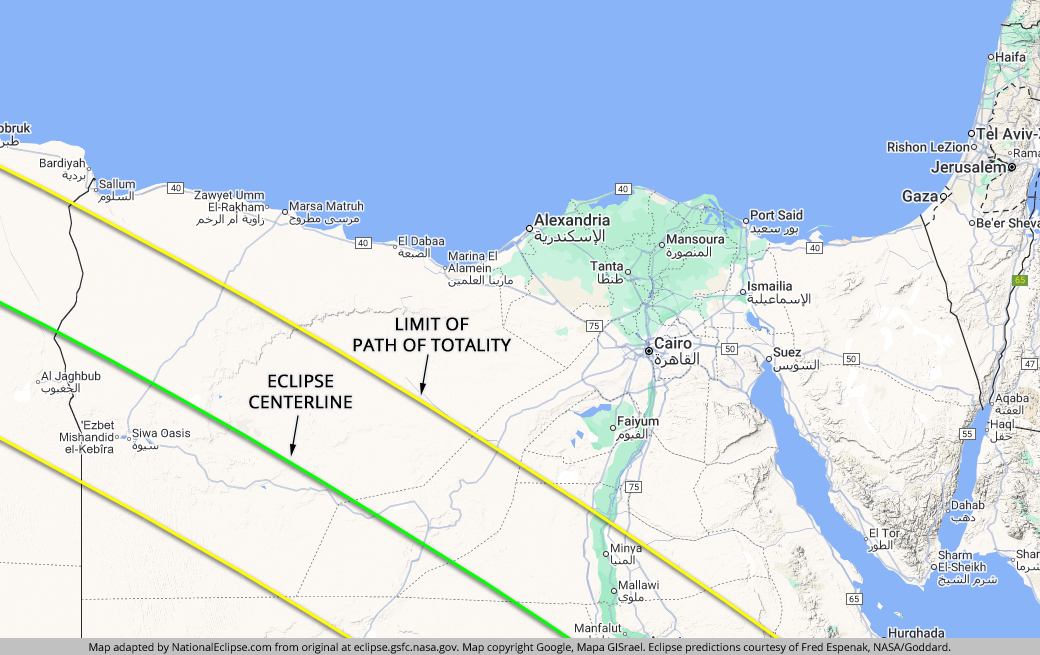
Map adapted by NationalEclipse.com from original at eclipse.gsfc.nasa.gov. Eclipse predictions courtesy of Fred Espenak, NASA/Goddard Space Flight Center.
Eclipse Path Map — Upper Egypt: The Nile Cruise Corridor
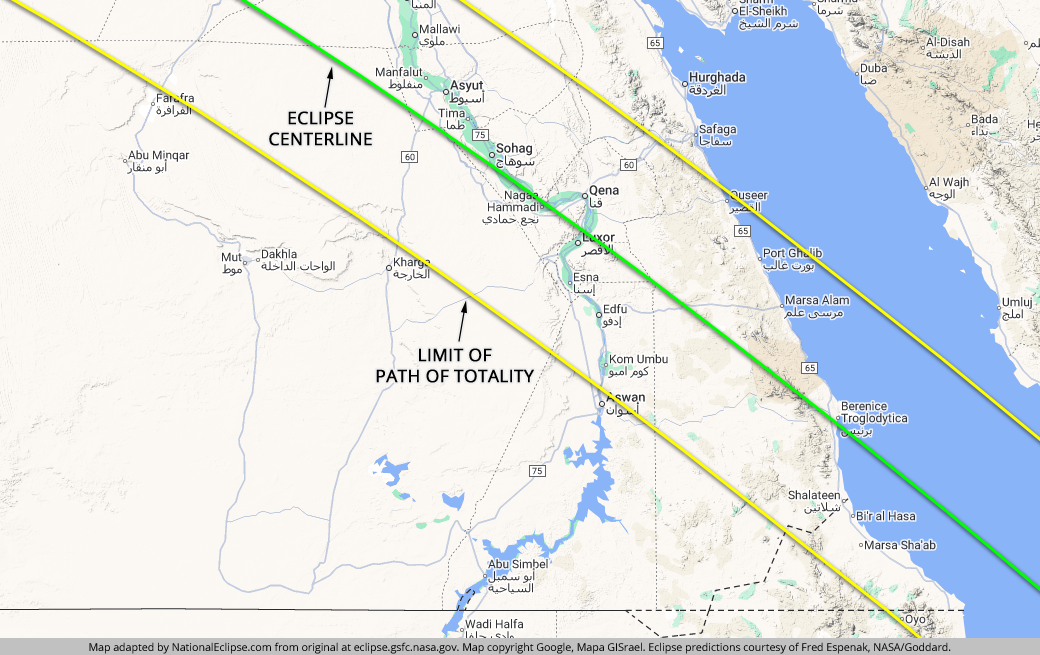
Map adapted by NationalEclipse.com from original at eclipse.gsfc.nasa.gov. Eclipse predictions courtesy of Fred Espenak, NASA/Goddard Space Flight Center.
- Luxor to Aswan Nile cruise route — entirely inside the path of totality. Every ship sailing this route on August 2, 2027 is an eclipse viewing platform.
- Cairo and Alexandria — clearly outside totality. Partial eclipse only. If you stay in Cairo on eclipse day, you will miss totality.
- Abu Simbel — inside totality (approx. 5 min 10 sec). Requires overnight stay or very early morning flight from Aswan.
- Hurghada and the Red Sea coast — on or just outside the eastern limit of totality. Do not rely on Hurghada for eclipse viewing.
- The eclipse centerline — passes approximately 60km west of Luxor in the desert. Maximum duration (6 min 23 sec) is here. Luxor sees 6 min 02 sec — barely shorter with infinitely better surroundings.
The Best Places in Egypt to Watch the 2027 Solar Eclipse
1. Luxor West Bank — Valley of the Kings (Best Nile Cruises' Top Pick)
Watching a total solar eclipse from inside or immediately outside the Valley of the Kings is a once-in-civilisation experience. The limestone valley, the royal tomb entrances, the silence of the desert — and then six minutes of totality. Stars visible at 10am. The temperature drops dramatically. The desert goes utterly silent. The corona of the sun blazes around the black disc of the moon above the same cliffs where the pharaohs were buried 3,300 years ago.
2. On the Deck of a Nile Cruise Ship
A Nile cruise ship positioned between Luxor and Aswan on August 2, 2027 gives 360-degree open sky viewing with the Nile Valley landscape in every direction. No fixed location, complete flexibility to position for the best view. The ship's deck becomes a private eclipse-viewing platform surrounded by desert cliffs and the river. This is our recommended viewing experience for travellers combining the eclipse with a full Nile cruise.
3. Karnak Temple, Luxor East Bank
The open-air courts of Karnak Temple provide a dramatic setting with the Great Hypostyle Hall columns as a backdrop to the darkening sky. The sacred lake will reflect the corona during totality. For astrophotographers, Karnak columns framing the eclipsed sun will be one of the defining images of 2027.
4. Aswan — Philae Temple or Nile Corniche
Aswan provides approximately 5 minutes 50 seconds of totality. Watching the eclipse from the motorboat deck approaching Philae Temple during totality is extraordinary — an island goddess temple in sudden darkness. The Aswan Nile Corniche, wide and open, also provides excellent viewing.
5. Abu Simbel
The facade of Abu Simbel — four 20-metre colossi of Ramesses II — under a total solar eclipse is an image that will circulate for decades. Totality here is approximately 5 minutes 10 seconds. Logistics are challenging: Abu Simbel has very limited accommodation and will be extremely crowded. Book at least 12 months in advance if this is your chosen location.
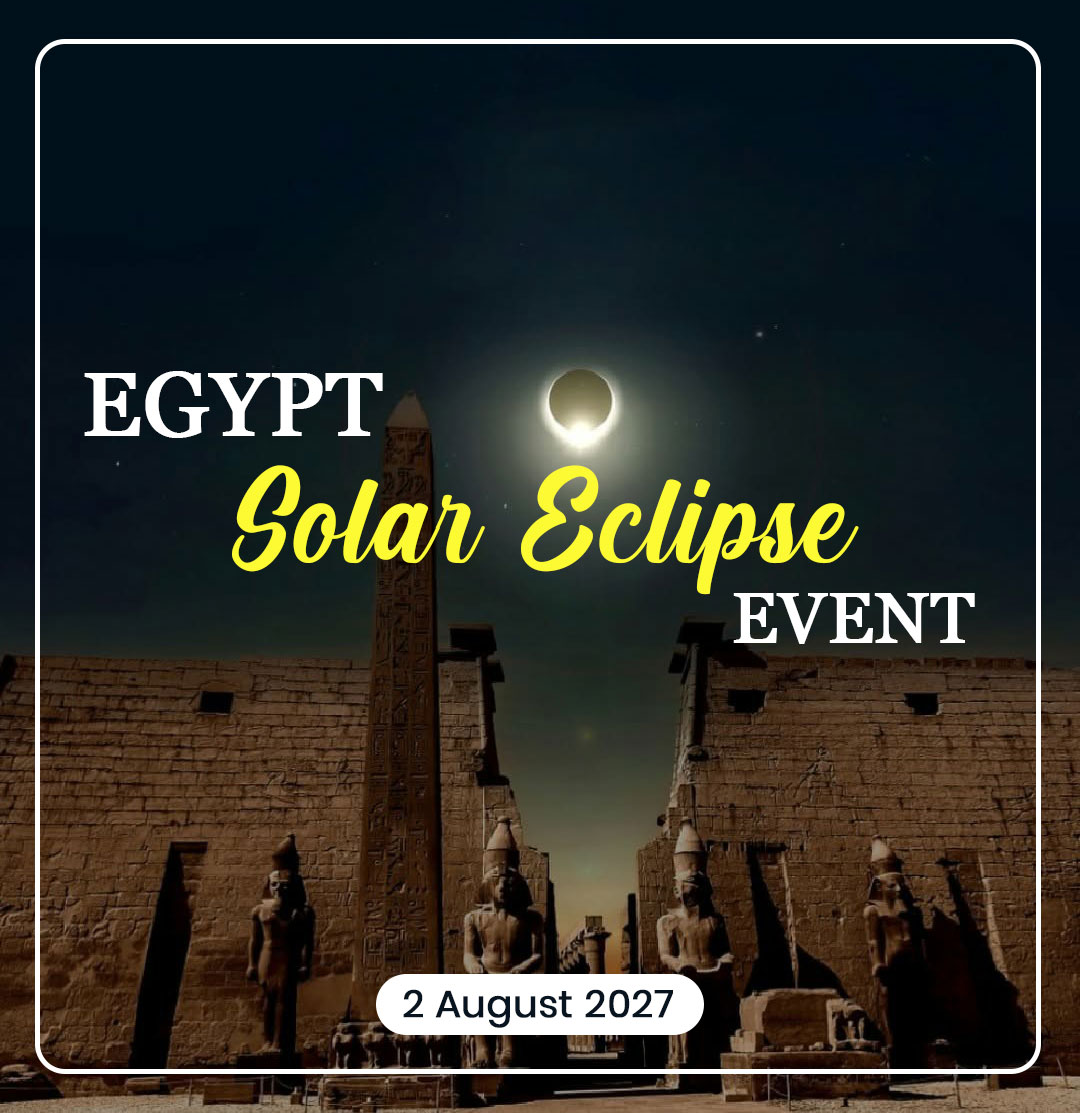
The total solar eclipse corona — the blazing white atmosphere of the sun, visible only during totality when the moon completely covers the solar disc. On August 2, 2027, this sight will be visible for over 6 minutes from anywhere along the Nile between Luxor and Aswan.
What the Eclipse Will Look and Feel Like
Most first-time eclipse viewers underestimate how different a total eclipse is from a partial eclipse or any photograph. Here is what you will actually experience:
Planning Your Egypt Eclipse Trip — Practical Guide
When to Book
Now — or as soon as possible. The August 2, 2027 eclipse will be the most-travelled astronomical event of the decade. Viking Cruises, Scientific American, and major international eclipse tour operators have already launched programmes. Luxor and Aswan hotel rooms are being reserved by eclipse tour groups right now. Nile cruise ships on the river on August 2 will be fully booked 12–18 months in advance. If you have a serious interest in being in Egypt for the 2027 eclipse, register your interest with us before the end of 2026.
The August Heat — Honest Assessment
August in Luxor and Aswan is extremely hot — typically 40–43°C (104–109°F) by midday. The eclipse occurs at approximately 10:00–10:15 local time, before the peak heat. Sun protection, hydration, and a plan to be in air conditioning before midday are essential. The eclipse itself brings a dramatic temperature drop during totality. All Best Nile Cruises eclipse programmes include vehicle and ship air conditioning between all viewing moments.
Eclipse Glasses and Equipment
ISO-certified solar eclipse glasses are essential for all phases except totality. Do not attempt to view partial phases without certified eclipse glasses — permanent eye damage occurs in seconds. Bring eclipse glasses from home rather than relying on local availability in Egypt. For photographers: a solar filter for your camera lens is essential for all partial phases. For detailed eclipse safety information, visit NationalEclipse.com — one of the world's leading eclipse authorities, featured by ABC, CBS, CNN and FOX.
The Recommended Egypt Eclipse Itinerary
- Days 1–2: Cairo — Pyramids of Giza and Grand Egyptian Museum
- Days 3–4: Fly to Luxor — Valley of the Kings, Hatshepsut Temple, Karnak Temple
- Days 5–7: Nile cruise Luxor to Aswan — Edfu, Kom Ombo, Philae
- Day 8 — August 2, 2027: ECLIPSE DAY. Position on the Nile between Luxor and Aswan on the cruise ship deck, or at the Valley of the Kings. Totality begins at approximately 10:05 local time.
- Day 9: Abu Simbel day trip by early morning flight from Aswan
- Day 10: Fly home from Aswan or Cairo
Frequently Asked Questions — Egypt Solar Eclipse 2027
When is the Egypt solar eclipse 2027?
August 2, 2027. Totality over Luxor begins at approximately 10:05 local time (UTC+2) and lasts approximately 6 minutes 02 seconds. Totality over Aswan begins at approximately 10:08 and lasts approximately 5 minutes 50 seconds. Cairo and Alexandria are outside the path of totality — partial eclipse only from those cities.
Is Egypt the best place to see the 2027 solar eclipse?
Egypt offers the best combination of long totality duration and near-guaranteed clear skies of any viewing location on the 2027 eclipse path. Upper Egypt in August has near-zero cloud probability — cloudless days are virtually certain. Combined with the extraordinary context of watching the eclipse over ancient monuments on a Nile cruise, Egypt is the undisputed premier destination for the 2027 eclipse.
Will I see the total eclipse from Cairo?
No. Cairo is clearly outside the path of totality as shown in the maps above. From Cairo, you will see a partial eclipse — the sun will appear as a crescent but will never be completely covered. To witness totality, you must travel to Luxor, Aswan, or anywhere along the Nile between them. If your itinerary has you in Cairo on August 2, 2027, contact us and we will restructure it so you are in the right place.
How hot will it be during the eclipse in Luxor?
At 10am in Luxor on August 2, temperatures will be approximately 36–38°C (97–100°F) and rising. Manageable for a 6-minute event with proper preparation: sun protection, hydration, light clothing, and air conditioning before midday. The eclipse itself brings a notable temperature drop during totality. All Best Nile Cruises eclipse programmes include full heat management logistics.
Can I combine the eclipse with a Nile cruise?
Yes — and this is our recommended approach. A Nile cruise positioned between Luxor and Aswan on August 2, 2027 places you inside the totality path with 360-degree open sky over the river and the Nile Valley cliffs as your backdrop. The cruise handles accommodation, meals, and logistics, leaving you free to focus entirely on the eclipse. Contact us to register your interest in our eclipse cruise programme.
How far in advance should I book?
Immediately. Quality Luxor and Aswan hotels are already reserved by eclipse tour groups from Europe and North America. Nile cruise ships on the river August 1–3 will be fully booked well before the eclipse. We recommend booking a complete eclipse programme no later than early 2027 — and ideally in the second half of 2026. Contact us to join our eclipse interest list.
Planning an Egypt Trip for the 2027 Eclipse?
Best Nile Cruises is building dedicated eclipse programmes for August 2027 — combining a Nile cruise through the heart of the totality path with prime eclipse viewing from Luxor or the ship's open deck. The maps above confirm: the entire Nile cruise route is inside totality. Register your interest now to be first on our availability list.
Register Eclipse Interest →Don't wait. The Egypt eclipse of August 2, 2027 will not come again.
The longest total solar eclipse in 135 years, directly over the greatest concentration of ancient monuments on earth, with near-guaranteed clear desert skies. This is a once-in-a-lifetime alignment of astronomy and history. Contact us here to register your interest, or browse our Nile cruise programmes and Egypt packages that can be built around the eclipse date.
For detailed solar eclipse safety information and global eclipse tracking, visit NationalEclipse.com — one of the world's leading eclipse authorities, featured by ABC, CBS, CNN and FOX. Eclipse path maps courtesy of NationalEclipse.com, adapted from eclipse.gsfc.nasa.gov. Eclipse predictions courtesy of Fred Espenak, NASA/Goddard Space Flight Center.
Written by Ahmed Emam — Egypt travel specialist since 2010, founder of Around Egypt Tours ,Egypt For Travel and Egypt Top Tours. All eclipse times and durations based on NASA eclipse data for the August 2, 2027 total solar eclipse. Times are approximate local times (UTC+2) and should be verified closer to the event date. Last reviewed and updated: June 2026.