
Pyramids of Giza — Complete Visitor Guide 2026
The Pyramids of Giza need no introduction — and yet no photograph, no film and no description prepares you for the moment you see them in person. They are larger than your mind allows. The Great Pyramid of Khufu, built around 2560 BC, stood as the tallest structure on earth for 3,800 years. It was not surpassed until the Lincoln Cathedral was completed in 1311 AD. The three pyramids together, rising from the flat Giza plateau with the Sahara Desert stretching endlessly behind them, form the most recognisable skyline in human history. This guide, written by Ahmed Emam with 15 years of taking international visitors to Giza, covers everything you need to make the most of your visit.
The Three Pyramids — At a Glance
What to See at the Giza Pyramid Complex
1. The Great Pyramid of Khufu
The Great Pyramid is built from approximately 2.3 million limestone blocks, each weighing 2.5 to 15 tonnes, assembled with such precision that a sheet of paper cannot be inserted between the joints. It was the tallest man-made structure on earth for over 3,800 years. The interior contains three chambers — the King's Chamber, the Queen's Chamber and the Subterranean Chamber — connected by ascending and descending passages. Entering the pyramid requires an additional ticket and involves a narrow, low-ceilinged ascending corridor. Claustrophobic visitors should consider viewing from outside only. Your private Egyptologist guide explains the construction theories, the astronomical alignments and the extraordinary engineering precision inside.
2. The Pyramid of Khafre and Casing Stones
The Pyramid of Khafre appears taller than the Great Pyramid because it sits on higher ground — it is in fact slightly smaller. Its most distinctive feature is the smooth white limestone casing stones still visible at the top, which show what all three pyramids originally looked like: completely smooth, gleaming white in the desert sun and visible for miles. The mortuary temple on the east face and the valley temple at its base are among the best-preserved temple complexes on the Giza plateau.
3. The Great Sphinx
The Great Sphinx — carved from a single outcrop of natural limestone bedrock — is 73 metres long and 20 metres high, making it the largest monolithic statue on earth. It faces due east to greet the sunrise each morning. The face is believed to represent Pharaoh Khafre, though the body of a lion may predate the pyramids by thousands of years. The Sphinx is viewed from a lower enclosure — your guide positions you for the best angle and explains the erosion debate, the missing nose (broken off centuries before Napoleon, contrary to popular myth) and the underground passages theories.
4. The Panoramic Desert Viewpoint
The panoramic viewpoint — a 15-minute drive from the main entrance — is the only spot on the plateau where all three pyramids are visible in a single frame, aligned in their correct diminishing sequence with the desert stretching behind them. This is the photograph you have seen a thousand times. Your guide takes you there first thing in the morning before the tour buses arrive. The view at sunrise, with the sky turning orange behind the pyramids, is one of the most extraordinary sights in Egypt.
5. Grand Egyptian Museum (GEM)
Located 2 kilometres from the pyramids, the Grand Egyptian Museum opened in 2024 and is the world’s largest archaeological museum — housing over 100,000 artifacts including the complete collection of Tutankhamun (his golden mask, throne, chariots and 5,000 objects previously split across multiple museums). Allow 3–4 hours. Included in all Cairo and Nile cruise packages.
Practical Information
Ahmed Emam's Insider Tips
- Arrive at 8:00 AM exactly — the first hour is magical. The site is quiet, the light is golden and the temperature is comfortable. By 10:00 AM the tour buses have arrived.
- Do the panoramic viewpoint first — your guide drives you to the desert viewpoint before the main entrance. This photograph, taken without crowds, is the image you will use for the rest of your life.
- Ignore the camel handlers — they will approach you persistently. Agree a price before mounting or photographing. Your guide manages this so you are never pressured.
- Entering the Great Pyramid is optional — the interior is a narrow, steep, hot corridor with little to see except the empty granite sarcophagus. Many repeat visitors skip it. First-timers may want the experience.
- The Solar Boat Museum is underrated — a 4,600-year-old intact cedar boat found buried beside the Great Pyramid in 1954. One of the most remarkable ancient objects in existence, and most visitors walk past it.
- Save 3 hours for the GEM — visiting the Pyramids without the Grand Egyptian Museum means missing the context. The GEM explains what the pharaohs who built these monuments believed, valued and left behind.
How to Combine the Pyramids with a Nile Cruise
The Pyramids of Giza and a Nile cruise between Luxor and Aswan are the two defining experiences of any Egypt trip — and they fit together naturally. Our Cairo and Nile cruise packages spend 2 days in Cairo (Day 1: Pyramids and GEM, Day 2: Saqqara and Old Cairo) before flying to Luxor to board the cruise. The Pyramids day and the Nile cruise are managed by the same private Egyptologist guide throughout, ensuring continuity and depth. Packages start from $899 per person and include all entrance fees, domestic flights, hotel, guide and transfers.
Frequently Asked Questions
How long does it take to visit the Pyramids of Giza?
Allow 2–3 hours for a thorough visit to the pyramid complex and Sphinx with a guide. Add 3–4 hours for the Grand Egyptian Museum. A full Giza day (Pyramids + GEM) typically runs 8:00 AM to 3:00 PM, leaving the afternoon free for other Cairo activities.
Can you go inside the Pyramids of Giza?
Yes — all three pyramids have interior access available, each requiring a separate additional ticket. The Great Pyramid interior requires the most physical effort (a narrow, 47-metre ascending corridor at a steep angle). Visitors with claustrophobia, back problems or difficulty with confined spaces should skip the interior and focus on the exterior experience, which is equally extraordinary. Tickets for the interior are limited daily — arrive early.
What is the best time of year to visit the Pyramids?
October to April is the ideal period — temperatures range from 15–28°C, making outdoor walking comfortable. Summer (June–August) temperatures on the exposed plateau can reach 40°C and feel genuinely extreme. For the least crowds, visit on a weekday morning in November or March. December is peak season with higher prices but perfect weather.
How were the Pyramids of Giza built?
Modern archaeology has established that the pyramids were built by a skilled, paid workforce — not slaves as was long believed. Papyrus documents found in 2013 describe the logistical operation: workers lived in a purpose-built city beside the plateau, quarried limestone from nearby and transported it on sledges and boats. The Great Pyramid took approximately 20 years to build and contains around 2.3 million stone blocks. The precise astronomical alignment — the pyramid faces true north with an error of only 0.05 degrees — remains one of the most studied engineering achievements in history.
Are the Pyramids worth visiting?
Yes — without qualification. Every visitor who has stood at the base of the Great Pyramid describes a physical reaction to the scale that photographs do not convey. The question is not whether to visit but how to visit — a private guide who contextualises the history makes the difference between a bewildering visual spectacle and a genuinely transformative experience. With a good Egyptologist, the Pyramids are the most intellectually extraordinary site in Egypt.
The Pyramids and Grand Egyptian Museum are included in all our Cairo and Nile cruise packages from $899, with a private Egyptologist guide throughout. Contact us for a free personalised itinerary — response within 4 hours.
Written by Ahmed Emam — Egypt travel specialist since 2010, founder of Around Egypt Tours. Visited the Pyramids of Giza over 500 times with international clients.
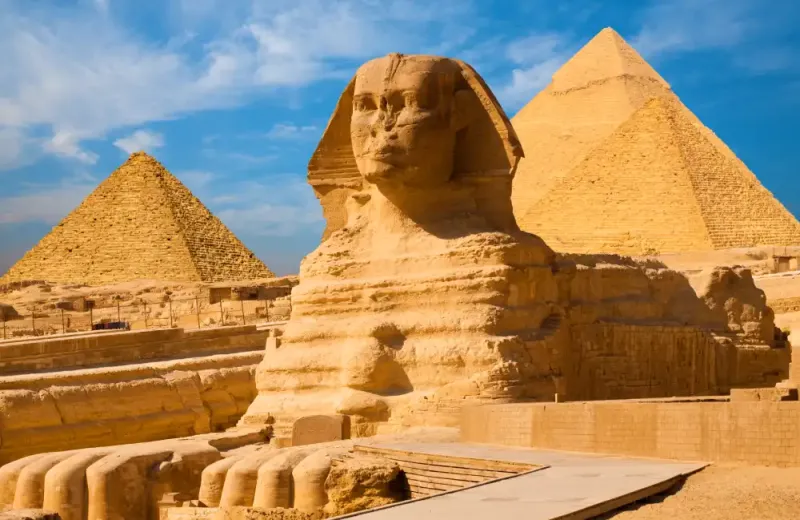
The Great Sphinx of Giza — carved from a single outcrop of natural limestone bedrock — guards the eastern face of the Pyramid of Khafre and faces the rising sun each morning. At 73 metres long and 20 metres high it is the largest monolithic statue on earth. The erosion on its body is the subject of ongoing archaeological debate, with some researchers arguing it predates the pyramids by thousands of years.