
Philae Temple — Complete Visitor Guide 2026
Philae Temple is unlike any other ancient monument in Egypt. Other temples are approached by road, through crowds, across dust. Philae is reached by motorboat — a short crossing of the blue-green waters of the Aswan reservoir, with granite boulders rising around you and the temple columns appearing above the treeline of the island as you approach. It is the most beautifully situated ancient temple in Egypt, and many visitors who have seen the Pyramids, Karnak and the Valley of the Kings rank Philae among their most memorable experiences — not for its size but for the quality of its arrival. The temple complex is dedicated to Isis, the greatest of the Egyptian goddesses — sister and wife of Osiris, mother of Horus, mistress of magic. It was the most sacred centre of Isis worship in the ancient world, and pilgrims from Egypt, Greece, Rome and Nubia came here for 600 years to seek the goddess’s blessing. It was also, historically, the last place in the ancient world where the Egyptian religion survived — a community of Isis priests continued their rituals at Philae until 537 AD, 150 years after Christianity had become the official religion of the Roman Empire. This guide is written by Ahmed Emam with 15 years of bringing international visitors to Philae.
The Approach by Motorboat
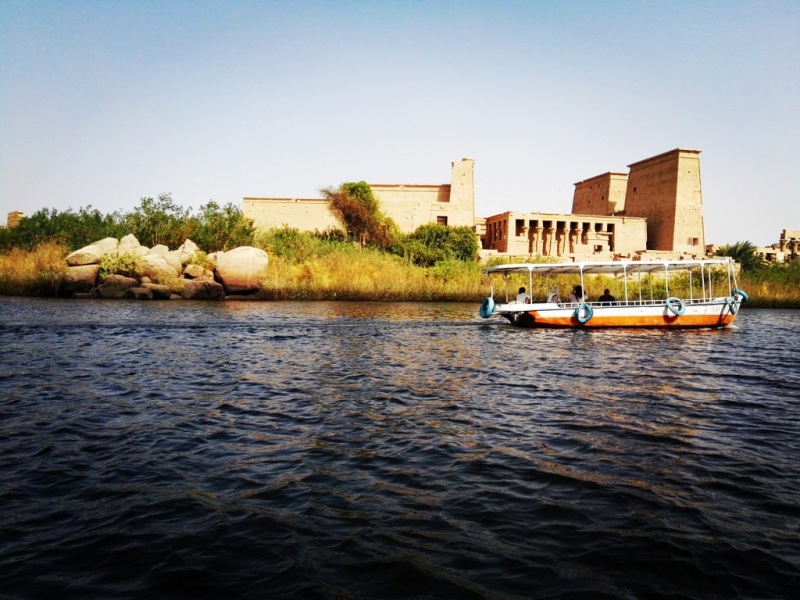
The visit to Philae begins at Shellal dock, south of Aswan, where your guide arranges a motorboat (felucca-style or covered launch) for the 10-minute crossing to Agilkia Island. The approach is part of the experience: the island appears first as a mass of palms and columns above the water, the Kiosk of Trajan visible on the western shore with its carved papyrus-capital columns rising against the sky. As the boat pulls alongside the stone landing stage and you step ashore, the scale of the First Pylon resolves in front of you. No other major temple in Egypt has an arrival like this.
What to See at Philae Temple
The Last Temple of the Ancient Egyptian Religion
One of the most remarkable facts about Philae is how long it survived. When the Roman Emperor Constantine I made Christianity the state religion of the Roman Empire in 313 AD, pagan temples across Egypt were closed, converted into churches or abandoned. At Philae, the cult of Isis continued — protected by a treaty with the Blemmyes and Nobatae tribes of Nubia, whose traditional religion centred on the Philae Isis. The Egyptian priests maintained their rituals, the sacred statue of Isis was carried periodically to Nubian temples, and pilgrims from all over the Mediterranean continued to visit. It was not until 537 AD — under the Eastern Roman Emperor Justinian I — that a military force closed the temple, arrested the last priests, confiscated the sacred statues and converted the sanctuary into a Christian chapel. The crosses carved into the temple walls and the Coptic inscriptions painted over the hieroglyphic reliefs are still visible today. Philae is the only temple in Egypt where you can see both layers of religious history in the same room.
The UNESCO Relocation of Philae
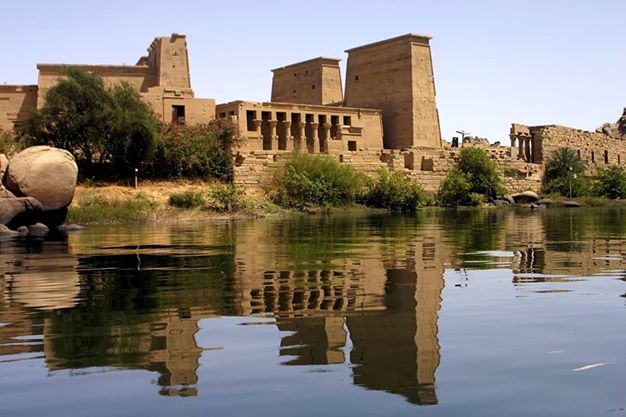
Like Abu Simbel, Philae Temple was threatened by the rising waters of Lake Nasser after the completion of the Aswan High Dam. The original Philae Island was submerged — the temples had already been partially flooded since the construction of the first Aswan Dam in 1902, spending parts of each year underwater for 70 years. Between 1972 and 1980, UNESCO and the Egyptian government dismantled all structures on Philae Island, block by block, and reassembled them on Agilkia Island — a nearby granite island whose landscape was reshaped to resemble the original Philae. The relocation preserved not just the buildings but the island setting that made Philae sacred: the water approach, the granite outcrops, the surrounding sky. What you visit today is the original stone in a faithfully reconstructed landscape.
Practical Information
Ahmed Emam’s Insider Tips
- Sit at the front of the motorboat — the approach to Philae is better from the bow than the cabin. The first view of the Kiosk of Trajan appearing over the water, with the granite rocks of the cataract around you, is the moment most visitors remember most vividly. Ask the boatman to slow down for this approach.
- Ask your guide to show you the last hieroglyphic inscription — the graffito on the Gate of Hadrian dated 394 AD is the last writing in the ancient Egyptian script ever recorded. It is not well signposted but your guide can locate it. Standing in front of it — the final word of a 3,500-year written language — is a quietly extraordinary moment.
- Look for the Christian crosses inside the sanctuary — when the temple was converted into a church in 537 AD, Coptic Christians carved crosses into the walls and painted over the hieroglyphic reliefs with whitewash. In several places both layers are visible simultaneously — a unique palimpsest of Egyptian and Christian history.
- The Sound and Light Show is especially atmospheric at Philae — because the island is reached by boat, the Sound and Light Show begins with a nocturnal motorboat crossing. The temple illuminated on its island, reflected in the dark water, is among the most visually striking evening experiences in Egypt.
- Combine Philae with the Unfinished Obelisk and High Dam on the same day — all three are within 15 minutes of Aswan and together make a complete Aswan excursion. This is the standard Aswan day on every Nile cruise itinerary.
Philae Temple on a Nile Cruise
Philae Temple is visited on the final full day of every Nile cruise from Luxor to Aswan. After disembarking or on the day before disembarkation, your private guide takes you by road to Shellal dock and by motorboat to the island. Philae is combined on the same day with the Aswan High Dam and the Unfinished Obelisk. For travelers taking a Lake Nasser cruise, Philae marks either the beginning or end of the journey depending on direction. All entrance fees and motorboat fees are included in all Best Nile Cruises packages.
Frequently Asked Questions
Why is Philae Temple on an island?
In ancient belief, the original Philae Island was considered one of the burial places of Osiris — specifically the location where his sister-wife Isis found and reassembled his body after it was scattered by the god Set. An island surrounded by the Nile’s first cataract — granite boulders, rushing water, a place between worlds — was the mythologically appropriate location for this sacred event. The island’s inaccessibility added to its sanctity: only priests and pilgrims on ritual business were permitted to land. The modern visitor’s motorboat crossing replicates something of the experience of ancient pilgrims approaching the goddess’s sanctuary.
Is Philae Temple the same as the Temple of Isis?
Yes — Philae Temple and the Temple of Isis are the same site. “Philae” refers to the island (now Agilkia Island since the relocation) and the complex as a whole. The main and largest structure within the complex is the Temple of Isis, built primarily by the Ptolemaic pharaohs between 280 and 47 BC. The complex also contains the Temple of Hathor, the Kiosk of Trajan, the Gate of Hadrian and several smaller chapels. All are commonly referred to collectively as “Philae Temple.”
When was Philae Temple moved and why?
Philae Temple was relocated by UNESCO between 1972 and 1980 to save it from permanent submersion under the waters of Lake Nasser, created by the Aswan High Dam. The original Philae Island had already been partially flooded seasonally since the construction of the first Aswan Low Dam in 1902. The relocation moved all structures to Agilkia Island, 500 metres away, which was reshaped to match the topography of the original island. The original Philae Island remains submerged. The successful relocation, completed alongside the Abu Simbel rescue, contributed to the creation of the UNESCO World Heritage Convention in 1972.
Is the Sound and Light Show at Philae worth it?
Yes — Philae’s Sound and Light Show is among the best in Egypt, for a simple reason: the island setting. The nocturnal motorboat crossing to a lit-up island temple is an experience that no land-based site can replicate. The show is a narrated walk through the illuminated complex, telling the story of Isis and Osiris and the history of the temple. If your Nile cruise schedule includes an evening in Aswan, this is the recommended use of that time. Ask your guide for the current show schedule and language options.
Who was Isis and why was Philae sacred to her?
Isis was the most powerful and widely worshipped goddess in the Egyptian pantheon — goddess of magic, healing, motherhood and resurrection. Her story, the Osiris myth, is the central narrative of ancient Egyptian religion: her husband Osiris was murdered by his brother Set, his body scattered across Egypt; Isis reassembled the pieces, resurrected him briefly through magic, and conceived their son Horus, who avenged his father and became the model for every ruling pharaoh. Philae was sacred to Isis because the island was believed to be one of the places where she found and rejoined the pieces of Osiris’s body. The temple was the most important centre of her worship from the Ptolemaic period onward, attracting pilgrims from across the Mediterranean world.
Philae is included in all our Nile cruise itineraries and Cairo and Nile cruise packages from $899 — motorboat fees, entrance fees and private Egyptologist guide all included. Contact us to plan your Aswan visit.
Written by Ahmed Emam — Egypt travel specialist since 2010, founder of Around Egypt Tours. Has guided over 400 motorboat crossings to Philae Temple with international clients.