
Valley of the Kings — Royal Necropolis of the Pharaohs
Valley of the Kings — Complete Visitor Guide 2026
The Valley of the Kings — known in Arabic as Wadi el-Muluk — is a hidden limestone valley cut deep into the Theban cliffs on the West Bank of Luxor. For over 500 years, from approximately 1550 to 1070 BC, it served as the secret burial ground of every pharaoh of ancient Egypt’s New Kingdom: from Tuthmosis I, the first pharaoh to be buried here, to Ramesses XI, the last. Sixty-five tombs have been discovered — some containing the most elaborate painted chambers in the ancient world, their colours as vivid today as the day they were sealed. This guide, written by Ahmed Emam after 15 years of taking international visitors through the valley, tells you exactly which tombs to choose, what you will see inside and how to make the most of your time there.
Why the Pharaohs Chose This Valley
For centuries, the pharaohs of the Old and Middle Kingdoms were buried inside pyramids — and those pyramids were robbed, almost without exception. By the New Kingdom, a different approach was needed. The Valley of the Kings was chosen for three reasons: its remoteness from the Nile (accessible only through a single guarded entrance), its natural pyramid — the pyramid-shaped peak of El-Qurn (“The Horn”) which towers over the valley and was sacred to the goddess Meretseger — and the quality of its limestone, which allowed deep, smooth tunnels to be cut with precision. Despite all precautions, almost every tomb was robbed in antiquity — except one. In November 1922, the English archaeologist Howard Carter discovered a step beneath the sand and uncovered the only intact royal tomb in the valley: KV62 — the Tomb of Tutankhamun. What was inside changed our understanding of ancient Egypt forever.
Which Tombs to Visit — Ahmed Emam's Recommendations
Your standard ticket includes 3 tombs. Not all 65 are open at any one time — typically 15–20 are accessible on a given day, rotating on a schedule managed by the Supreme Council of Antiquities. Here are the best choices depending on your priorities:
| Tomb | Pharaoh | Why visit | Ticket |
|---|---|---|---|
| KV9 | Ramesses V & VI | Most spectacular paintings — the ceiling of the burial chamber is entirely covered in an astronomical Book of the Heavens. The scale and colour are extraordinary. | Standard |
| KV11 | Ramesses III | Largest tomb open to visitors — 188 metres long, 12 side chambers including the famous “Butcher’s Chamber” showing kitchen scenes. Vivid colour throughout. | Standard |
| KV17 | Seti I | Most beautiful tomb in the valley — 121 metres deep, paintings in raised relief with extraordinary detail. Currently subject to conservation; check access on arrival. | Extra ticket |
| KV2 | Ramesses IV | Best for first-timers — wide, gently descending corridor, excellent lighting, vivid texts and a pink granite sarcophagus still in the burial chamber. | Standard |
| KV35 | Amenhotep II | Where 16 royal mummies were found hidden by priests in antiquity. Deep, atmospheric and less crowded than others. The sarcophagus remains in the burial chamber. | Extra ticket |
| KV62 | Tutankhamun | The most famous tomb in history — discovered intact in 1922 by Howard Carter. Smallest royal tomb in the valley but historically unmatched. The mummy of Tutankhamun remains inside. The paintings are less dramatic than KV9 but the historical significance is unique. | ~300 EGP extra |
Should You Visit Tutankhamun's Tomb?
This is the most common question visitors ask before entering the valley. The honest answer: the tomb itself is the smallest royal tomb in the valley, with four rooms and relatively simple paintings compared to KV9 or KV11. The treasure is no longer inside — it is in the Grand Egyptian Museum in Giza. What you see in KV62 is the painted burial chamber and the mummy of Tutankhamun himself, lying in a climate-controlled case in the outer coffin. If seeing the mummy of the pharaoh who was 19 when he died is meaningful to you, the extra ticket is worth every penny. If you have already seen the treasure at the GEM and want to maximise your time in the valley on more spectacular tombs, skip it and choose KV9 and KV11 instead. Your guide will advise based on your interests.
Practical Information
| Detail | Information |
|---|---|
| Opening hours | Daily 6:00 AM – 5:00 PM (summer) · 6:00 AM – 4:00 PM (winter) · Closed during national holidays |
| Standard ticket | ~750 EGP — includes access to 3 tombs from those open on the day |
| Tutankhamun | ~700 EGP extra (KV62 — separate ticket, limited daily visitors) |
| Photography inside | Strictly prohibited inside all tombs — protects the ancient pigments from flash damage |
| Location | West Bank of Luxor, 7km from the Nile ferry landing. 10–15 min by car from the East Bank hotels. |
| Best time to visit | 6:00 AM at opening — cooler temperature, no crowds inside the tombs. By 9:00 AM, tour groups arrive. |
| Time needed | 2–3 hours for 3 tombs with a guide. Allow extra time for Tutankhamun and the longer tombs (KV11). |
| What to bring | Water (essential), comfortable shoes, light clothing. The tombs are cooler inside than outside but the walk between them is exposed to the sun. |
Ahmed Emam’s Insider Tips
- Arrive at 6:00 AM exactly — the first 90 minutes are extraordinary. The tombs are empty, the temperature inside is cool and the silence makes the paintings feel alive in a way that a crowded tomb does not.
- Always choose KV9 (Ramesses V & VI) if it is open — the ceiling of the burial chamber is the most visually spectacular surface in the entire valley. Stand in the burial chamber and look up.
- Your guide chooses the 3 tombs on the morning — the open tombs rotate and your Egyptologist selects the best available combination based on which ones are open and how busy each one is.
- The electric tram is optional — it saves a 10-minute walk from the ticket office to the tombs. In summer heat, take it. In cooler months, walk and your guide explains the landscape along the way.
- Do not photograph inside the tombs — it is prohibited and the guards enforce it strictly. Focus on looking and listening to your guide. The memory of the experience will outlast any photograph.
- The valley is best combined with Hatshepsut and Colossi of Memnon on the same morning — all three are on the West Bank and make a complete half-day. This is the standard West Bank excursion on every Nile cruise itinerary.
Valley of the Kings on a Nile Cruise
The Valley of the Kings is visited on every Nile cruise between Luxor and Aswan. Your cruise ship docks on the East Bank of Luxor on Day 1, and the West Bank excursion — Valley of the Kings, Temple of Hatshepsut and Colossi of Memnon — takes place on Day 2. A private Egyptologist guide leads the entire excursion, explaining the Book of the Amduat (the “Book of What is in the Underworld”) inscribed on the tomb walls and identifying the pharaohs and gods depicted in each chamber. All entrance fees for the 3 standard tombs are included in all Best Nile Cruises packages. The Tutankhamun extra ticket can be added at the site for those who wish to visit.
Frequently Asked Questions
How many tombs can you visit in the Valley of the Kings?
A standard ticket allows entry to 3 tombs from those open on the day. Not all 65 discovered tombs are accessible — typically 15–20 are open at any time, rotating on a managed schedule. Special tickets exist for specific tombs such as Tutankhamun (KV62) and Seti I (KV17). In a 2–3 hour visit with a guide, 3 tombs is the right number — enough to see the variety and depth without rushing or fatigue.
Is the Tomb of Tutankhamun worth visiting?
It depends on what you want. Tutankhamun’s tomb (KV62) is the smallest royal tomb in the valley and its paintings are simpler than those in KV9 or KV11. However, it is the only intact royal burial ever found and the mummy of Tutankhamun remains inside in a climate-controlled case. If standing in the presence of the actual pharaoh matters to you, it is irreplaceable. The treasure is at the Grand Egyptian Museum in Giza — visiting both sites gives you the complete Tutankhamun experience.
How was Tutankhamun’s tomb discovered?
On 4 November 1922, the English archaeologist Howard Carter and his team, funded by Lord Carnarvon, uncovered a cut stone step beneath the debris of the valley floor. Over the following days they cleared the staircase and found a sealed doorway. On 26 November 1922, Carter made a small hole in the outer doorway and held a candle inside. When Lord Carnarvon asked what he could see, Carter replied: “Wonderful things.” Inside was the only unrobbed royal tomb in the entire valley — 5,000 objects packed into four small rooms, including the golden shrine, three coffins nested inside each other and the solid gold death mask of the pharaoh.
What is the Valley of the Kings “curse”?
The “Curse of the Pharaohs” refers to the series of deaths that followed the opening of Tutankhamun’s tomb in 1922 — most notably Lord Carnarvon, who died of blood poisoning 5 months after the discovery. The story was sensationalised by the press of the time. In reality, a study of 58 people present at the tomb opening found no significant difference in life expectancy compared to the general population. Howard Carter himself lived until 1939 — 17 years after entering the tomb — and died of natural causes. The “curse” is folklore. The real protection the ancient Egyptians used was secrecy — which almost worked.
Can you visit the Valley of the Kings without a guide?
Yes — tickets are sold at the entrance and no guide is required. However, the tombs are covered in hieroglyphic texts from the Book of the Amduat, the Book of Gates and the Book of Caverns — ancient religious texts guiding the pharaoh through the underworld — which are meaningless without interpretation. Visitors who go without a guide consistently report seeing impressive paintings but understanding almost nothing. A private Egyptologist guide transforms the experience from a visual spectacle into a genuine encounter with ancient Egyptian thought. All Best Nile Cruises itineraries include a private guide for the Valley of the Kings visit.
The Valley of the Kings is included in all our Nile cruise itineraries and Cairo and Nile cruise packages from $899. Private Egyptologist guide, all entrance fees for 3 standard tombs and transport from the ship included. Contact us for a free personalised itinerary — response within 4 hours.
Written by Ahmed Emam — Egypt travel specialist since 2010, founder of Around Egypt Tours. Has led over 400 guided visits to the Valley of the Kings.
Notice (8): Undefined index: position [APP/View/Elements/program_contain_wiki.ctp, line 109]Code Context<div class="program_box_data"><?php if(!empty($wiki_detail['ProgramWikiItem']['image_url'])){?><?php if($wiki_detail['ProgramWikiItem']['position'] == "Right"){?>$viewFile = '/home/bestnilecruises/public_html/app/View/Elements/program_contain_wiki.ctp' $dataForView = array( 'selectedCurrency' => '1', 'breadcrumb' => array( 'Home' => '/', 'Egypt Attractions 2026 — Complete Guide to Ancient and Modern Sites' => 'egypt-attractions', 'Luxor Attractions — Temples, Tombs and the World's Greatest Open-Air Museum' => 'luxor-attractions', 'Valley of the Kings — Royal Necropolis of the Pharaohs' => null ), 'sites' => array( (int) 0 => array( 'Site' => array( [maximum depth reached] ) ) ), 'all_menu' => array( (int) 0 => array( 'RootCategory' => array( [maximum depth reached] ), 'SubCategory' => array( [maximum depth reached] ) ), (int) 1 => array( 'RootCategory' => array( [maximum depth reached] ), 'SubCategory' => array( [maximum depth reached] ) ), (int) 2 => array( 'RootCategory' => array( [maximum depth reached] ), 'SubCategory' => array([maximum depth reached]) ), (int) 3 => array( 'RootCategory' => array( [maximum depth reached] ), 'SubCategory' => array( [maximum depth reached] ) ), (int) 4 => array( 'RootCategory' => array( [maximum depth reached] ), 'SubCategory' => array( [maximum depth reached] ) ) ), 'free_pages_menu' => array( (int) 0 => array( 'FreePage' => array( [maximum depth reached] ), 'Site' => array( [maximum depth reached] ) ), (int) 1 => array( 'FreePage' => array( [maximum depth reached] ), 'Site' => array( [maximum depth reached] ) ), (int) 2 => array( 'FreePage' => array( [maximum depth reached] ), 'Site' => array( [maximum depth reached] ) ), (int) 3 => array( 'FreePage' => array( [maximum depth reached] ), 'Site' => array( [maximum depth reached] ) ) ), 'free_pages_top' => array(), 'sitesSelect' => array( (int) 0 => array( 'Site' => array( [maximum depth reached] ) ) ), 'free_pages' => array( (int) 0 => array( 'FreePage' => array( [maximum depth reached] ) ), (int) 1 => array( 'FreePage' => array( [maximum depth reached] ) ), (int) 2 => array( 'FreePage' => array( [maximum depth reached] ) ) ), 'free_pages_main_menu' => array(), 'sitesReleated' => array(), 'roots' => array( (int) 0 => array( 'RootCategory' => array( [maximum depth reached] ) ), (int) 1 => array( 'RootCategory' => array( [maximum depth reached] ) ), (int) 2 => array( 'RootCategory' => array( [maximum depth reached] ) ), (int) 3 => array( 'RootCategory' => array( [maximum depth reached] ) ), (int) 4 => array( 'RootCategory' => array( [maximum depth reached] ) ) ), 'footer_articles' => array( (int) 0 => array( 'Category' => array( [maximum depth reached] ), 'Article' => array( [maximum depth reached] ), 'Writer' => array( [maximum depth reached] ) ), (int) 1 => array( 'Category' => array( [maximum depth reached] ), 'Article' => array( [maximum depth reached] ), 'Writer' => array( [maximum depth reached] ) ) ), 'faqs' => array(), 'hyper_links' => array(), 'footer_partners' => array(), 'toptours' => array( (int) 0 => array( 'Program' => array( [maximum depth reached] ), 'SubCategory' => array( [maximum depth reached] ), 'RootCategory' => array( [maximum depth reached] ), 'Site' => array( [maximum depth reached] ) ) ), 'home_wiki_roots' => array( 'RootCategory' => array( 'id' => '5', 'title' => 'Egypt Attractions 2026 — Complete Guide to Ancient and Modern Sites', 'short_title' => 'Egypt Attractions', 'short_description' => '<p>Egypt is home to more UNESCO World Heritage Sites and ancient monuments than almost any country on earth. From the Pyramids of Giza — the only surviving Wonder of the Ancient World — to the temple complexes of Luxor and Aswan, the Mediterranean coast of Alexandria, the untouched desert landscapes of the Western Sahara and the coral reefs of the Red Sea, Egypt offers an extraordinary range of experiences for every traveler. This guide covers every major and hidden attraction city by city, written by Ahmed Emam with 15 years of Egypt expertise.</p>', 'image_url' => '384890846-Egypt-attractions-2026-—-Pyramids-of-Giza,-Karnak-Temple,-Valley-of-the-Kings-and-the-Nile-River.webp', 'icon_url' => null, 'slug' => 'egypt-attractions' ) ), 'home_top_tours' => array( (int) 0 => array( 'Program' => array( [maximum depth reached] ), 'SubCategory' => array( [maximum depth reached] ), 'RootCategory' => array( [maximum depth reached] ), 'Site' => array( [maximum depth reached] ) ) ), 'home_roots' => array( (int) 0 => array( 'RootCategory' => array( [maximum depth reached] ) ), (int) 1 => array( 'RootCategory' => array( [maximum depth reached] ) ), (int) 2 => array( 'RootCategory' => array( [maximum depth reached] ) ), (int) 3 => array( 'RootCategory' => array( [maximum depth reached] ) ), (int) 4 => array( 'RootCategory' => array( [maximum depth reached] ) ) ), 'programs' => array( 'Program' => array( 'id' => '4', 'title' => 'Valley of the Kings — Royal Necropolis of the Pharaohs', 'short_title' => null, 'duplicate' => null, 'description' => '<div style="background: #1a1a2e; border-radius: 8px; padding: 14px 18px; margin: 0 0 1.5em; color: #fff; line-height: 1.8;"><strong style="color: #c8960c;">Quick answer:</strong> The Valley of the Kings is on the <strong>West Bank of Luxor</strong>, 10 minutes by road from the East Bank. A standard ticket (~750 EGP) includes entry to <strong>3 tombs</strong> from those open on the day. The Tomb of Tutankhamun costs an additional ~700 EGP. The valley opens at <strong>6:00 AM</strong> — arrive at opening for the best experience. All Best Nile Cruises <a style="color: #c8960c;" href="../../nile-cruises">Nile cruise itineraries</a> include the Valley of the Kings with a private Egyptologist guide.</div> <h1 style="font-size: 2em; font-weight: bold; margin: 0 0 .5em;">Valley of the Kings — Complete Visitor Guide 2026</h1> <p style="line-height: 1.8; margin: 0 0 1.2em;">The <strong>Valley of the Kings</strong> — known in Arabic as <em>Wadi el-Muluk</em> — is a hidden limestone valley cut deep into the Theban cliffs on the West Bank of Luxor. For over 500 years, from approximately 1550 to 1070 BC, it served as the secret burial ground of every pharaoh of ancient Egypt’s New Kingdom: from Tuthmosis I, the first pharaoh to be buried here, to Ramesses XI, the last. Sixty-five tombs have been discovered — some containing the most elaborate painted chambers in the ancient world, their colours as vivid today as the day they were sealed. This guide, written by Ahmed Emam after 15 years of taking international visitors through the valley, tells you exactly which tombs to choose, what you will see inside and how to make the most of your time there.</p> <h2 style="font-size: 1.3em; font-weight: 600; margin: 1.3em 0 .5em;">Why the Pharaohs Chose This Valley</h2> <p style="line-height: 1.8; margin: 0 0 1.2em;">For centuries, the pharaohs of the Old and Middle Kingdoms were buried inside pyramids — and those pyramids were robbed, almost without exception. By the New Kingdom, a different approach was needed. The Valley of the Kings was chosen for three reasons: its <strong>remoteness</strong> from the Nile (accessible only through a single guarded entrance), its <strong>natural pyramid</strong> — the pyramid-shaped peak of El-Qurn (“The Horn”) which towers over the valley and was sacred to the goddess Meretseger — and the quality of its <strong>limestone</strong>, which allowed deep, smooth tunnels to be cut with precision. Despite all precautions, almost every tomb was robbed in antiquity — except one. In November 1922, the English archaeologist <strong>Howard Carter</strong> discovered a step beneath the sand and uncovered the only intact royal tomb in the valley: <strong>KV62 — the Tomb of Tutankhamun</strong>. What was inside changed our understanding of ancient Egypt forever.</p> <h2 style="font-size: 1.3em; font-weight: 600; margin: 1.3em 0 .5em;">Which Tombs to Visit — Ahmed Emam's Recommendations</h2> <p style="line-height: 1.8; margin: 0 0 .75em;">Your standard ticket includes <strong>3 tombs</strong>. Not all 65 are open at any one time — typically 15–20 are accessible on a given day, rotating on a schedule managed by the Supreme Council of Antiquities. Here are the best choices depending on your priorities:</p> <table style="width: 100%; border-collapse: collapse; margin: 0 0 1.2em; border-radius: 8px; overflow: hidden;"> <thead> <tr style="background: #1a1a2e;"> <th style="padding: 10px 12px; text-align: left; color: #c8960c; font-weight: 500;">Tomb</th> <th style="padding: 10px 12px; text-align: left; color: #c8960c; font-weight: 500;">Pharaoh</th> <th style="padding: 10px 12px; text-align: left; color: #c8960c; font-weight: 500;">Why visit</th> <th style="padding: 10px 12px; text-align: left; color: #c8960c; font-weight: 500;">Ticket</th> </tr> </thead> <tbody> <tr> <td style="padding: 9px 12px; border-bottom: 1px solid #eee; font-weight: 600;">KV9</td> <td style="padding: 9px 12px; border-bottom: 1px solid #eee;">Ramesses V & VI</td> <td style="padding: 9px 12px; border-bottom: 1px solid #eee;"><strong>Most spectacular paintings</strong> — the ceiling of the burial chamber is entirely covered in an astronomical Book of the Heavens. The scale and colour are extraordinary.</td> <td style="padding: 9px 12px; border-bottom: 1px solid #eee;">Standard</td> </tr> <tr style="background: #f9f9f9;"> <td style="padding: 9px 12px; border-bottom: 1px solid #eee; font-weight: 600;">KV11</td> <td style="padding: 9px 12px; border-bottom: 1px solid #eee;">Ramesses III</td> <td style="padding: 9px 12px; border-bottom: 1px solid #eee;"><strong>Largest tomb open to visitors</strong> — 188 metres long, 12 side chambers including the famous “Butcher’s Chamber” showing kitchen scenes. Vivid colour throughout.</td> <td style="padding: 9px 12px; border-bottom: 1px solid #eee;">Standard</td> </tr> <tr> <td style="padding: 9px 12px; border-bottom: 1px solid #eee; font-weight: 600;">KV17</td> <td style="padding: 9px 12px; border-bottom: 1px solid #eee;">Seti I</td> <td style="padding: 9px 12px; border-bottom: 1px solid #eee;"><strong>Most beautiful tomb in the valley</strong> — 121 metres deep, paintings in raised relief with extraordinary detail. Currently subject to conservation; check access on arrival.</td> <td style="padding: 9px 12px; border-bottom: 1px solid #eee;">Extra ticket</td> </tr> <tr style="background: #f9f9f9;"> <td style="padding: 9px 12px; border-bottom: 1px solid #eee; font-weight: 600;">KV2</td> <td style="padding: 9px 12px; border-bottom: 1px solid #eee;">Ramesses IV</td> <td style="padding: 9px 12px; border-bottom: 1px solid #eee;"><strong>Best for first-timers</strong> — wide, gently descending corridor, excellent lighting, vivid texts and a pink granite sarcophagus still in the burial chamber.</td> <td style="padding: 9px 12px; border-bottom: 1px solid #eee;">Standard</td> </tr> <tr> <td style="padding: 9px 12px; border-bottom: 1px solid #eee; font-weight: 600;">KV35</td> <td style="padding: 9px 12px; border-bottom: 1px solid #eee;">Amenhotep II</td> <td style="padding: 9px 12px; border-bottom: 1px solid #eee;">Where 16 royal mummies were found hidden by priests in antiquity. Deep, atmospheric and less crowded than others. The sarcophagus remains in the burial chamber.</td> <td style="padding: 9px 12px; border-bottom: 1px solid #eee;">Extra ticket</td> </tr> <tr style="background: #f9f9f9;"> <td style="padding: 9px 12px; font-weight: 600; color: #c8960c;">KV62</td> <td style="padding: 9px 12px;"><strong>Tutankhamun</strong></td> <td style="padding: 9px 12px;">The most famous tomb in history — discovered intact in 1922 by Howard Carter. Smallest royal tomb in the valley but historically unmatched. <strong>The mummy of Tutankhamun remains inside.</strong> The paintings are less dramatic than KV9 but the historical significance is unique.</td> <td style="padding: 9px 12px; color: #c8960c; font-weight: 600;">~300 EGP extra</td> </tr> </tbody> </table> <h2 style="font-size: 1.3em; font-weight: 600; margin: 1.3em 0 .5em;">Should You Visit Tutankhamun's Tomb?</h2> <p style="line-height: 1.8; margin: 0 0 1.2em;">This is the most common question visitors ask before entering the valley. <strong>The honest answer:</strong> the tomb itself is the smallest royal tomb in the valley, with four rooms and relatively simple paintings compared to KV9 or KV11. The treasure is no longer inside — it is in the <strong>Grand Egyptian Museum</strong> in Giza. What you see in KV62 is the painted burial chamber and <strong>the mummy of Tutankhamun himself</strong>, lying in a climate-controlled case in the outer coffin. If seeing the mummy of the pharaoh who was 19 when he died is meaningful to you, the extra ticket is worth every penny. If you have already seen the treasure at the GEM and want to maximise your time in the valley on more spectacular tombs, skip it and choose KV9 and KV11 instead. Your guide will advise based on your interests.</p> <h2 style="font-size: 1.3em; font-weight: 600; margin: 1.3em 0 .5em;">Practical Information</h2> <table style="width: 100%; border-collapse: collapse; margin: 0 0 1.2em; border-radius: 8px; overflow: hidden;"> <thead> <tr style="background: #1a1a2e;"> <th style="padding: 9px 12px; text-align: left; color: #c8960c; font-weight: 500; width: 35%;">Detail</th> <th style="padding: 9px 12px; text-align: left; color: #c8960c; font-weight: 500;">Information</th> </tr> </thead> <tbody> <tr> <td style="padding: 9px 12px; border-bottom: 1px solid #eee; font-weight: 500;">Opening hours</td> <td style="padding: 9px 12px; border-bottom: 1px solid #eee;">Daily 6:00 AM – 5:00 PM (summer) · 6:00 AM – 4:00 PM (winter) · Closed during national holidays</td> </tr> <tr style="background: #f9f9f9;"> <td style="padding: 9px 12px; border-bottom: 1px solid #eee; font-weight: 500;">Standard ticket</td> <td style="padding: 9px 12px; border-bottom: 1px solid #eee;">~750 EGP — includes access to 3 tombs from those open on the day</td> </tr> <tr> <td style="padding: 9px 12px; border-bottom: 1px solid #eee; font-weight: 500;">Tutankhamun</td> <td style="padding: 9px 12px; border-bottom: 1px solid #eee;">~700 EGP extra (KV62 — separate ticket, limited daily visitors)</td> </tr> <tr style="background: #f9f9f9;"> <td style="padding: 9px 12px; border-bottom: 1px solid #eee; font-weight: 500;">Photography inside</td> <td style="padding: 9px 12px; border-bottom: 1px solid #eee;"><strong>Strictly prohibited</strong> inside all tombs — protects the ancient pigments from flash damage</td> </tr> <tr> <td style="padding: 9px 12px; border-bottom: 1px solid #eee; font-weight: 500;">Location</td> <td style="padding: 9px 12px; border-bottom: 1px solid #eee;">West Bank of Luxor, 7km from the Nile ferry landing. 10–15 min by car from the East Bank hotels.</td> </tr> <tr style="background: #f9f9f9;"> <td style="padding: 9px 12px; border-bottom: 1px solid #eee; font-weight: 500;">Best time to visit</td> <td style="padding: 9px 12px; border-bottom: 1px solid #eee;">6:00 AM at opening — cooler temperature, no crowds inside the tombs. By 9:00 AM, tour groups arrive.</td> </tr> <tr> <td style="padding: 9px 12px; border-bottom: 1px solid #eee; font-weight: 500;">Time needed</td> <td style="padding: 9px 12px; border-bottom: 1px solid #eee;">2–3 hours for 3 tombs with a guide. Allow extra time for Tutankhamun and the longer tombs (KV11).</td> </tr> <tr style="background: #f9f9f9;"> <td style="padding: 9px 12px; font-weight: 500;">What to bring</td> <td style="padding: 9px 12px;">Water (essential), comfortable shoes, light clothing. The tombs are cooler inside than outside but the walk between them is exposed to the sun.</td> </tr> </tbody> </table> <h2 style="font-size: 1.3em; font-weight: 600; margin: 1.3em 0 .5em;">Ahmed Emam’s Insider Tips</h2> <ul style="line-height: 2.2; margin: 0 0 1.2em; padding-left: 1.4em;"> <li><strong style="color: #c8960c;">Arrive at 6:00 AM exactly</strong> — the first 90 minutes are extraordinary. The tombs are empty, the temperature inside is cool and the silence makes the paintings feel alive in a way that a crowded tomb does not.</li> <li><strong style="color: #c8960c;">Always choose KV9 (Ramesses V & VI) if it is open</strong> — the ceiling of the burial chamber is the most visually spectacular surface in the entire valley. Stand in the burial chamber and look up.</li> <li><strong style="color: #c8960c;">Your guide chooses the 3 tombs on the morning</strong> — the open tombs rotate and your Egyptologist selects the best available combination based on which ones are open and how busy each one is.</li> <li><strong style="color: #c8960c;">The electric tram is optional</strong> — it saves a 10-minute walk from the ticket office to the tombs. In summer heat, take it. In cooler months, walk and your guide explains the landscape along the way.</li> <li><strong style="color: #c8960c;">Do not photograph inside the tombs</strong> — it is prohibited and the guards enforce it strictly. Focus on looking and listening to your guide. The memory of the experience will outlast any photograph.</li> <li><strong style="color: #c8960c;">The valley is best combined with Hatshepsut and Colossi of Memnon</strong> on the same morning — all three are on the West Bank and make a complete half-day. This is the standard West Bank excursion on every Nile cruise itinerary.</li> </ul> <h2 style="font-size: 1.3em; font-weight: 600; margin: 1.3em 0 .5em;">Valley of the Kings on a Nile Cruise</h2> <p style="line-height: 1.8; margin: 0 0 1.2em;">The Valley of the Kings is visited on <strong>every Nile cruise</strong> between Luxor and Aswan. Your cruise ship docks on the East Bank of Luxor on Day 1, and the West Bank excursion — Valley of the Kings, Temple of Hatshepsut and Colossi of Memnon — takes place on Day 2. A private Egyptologist guide leads the entire excursion, explaining the Book of the Amduat (the “Book of What is in the Underworld”) inscribed on the tomb walls and identifying the pharaohs and gods depicted in each chamber. All entrance fees for the 3 standard tombs are included in <a title="Cairo and Nile Cruise" href="../../egypt-packages/cairo-and-nile-cruise" target="_blank">all Best Nile Cruises packages</a>. The Tutankhamun extra ticket can be added at the site for those who wish to visit.</p> <h2 style="font-size: 1.3em; font-weight: 600; margin: 1.3em 0 .5em;">Frequently Asked Questions</h2> <h3 style="font-size: 1.05em; font-weight: 600; margin: 1em 0 .3em;">How many tombs can you visit in the Valley of the Kings?</h3> <p style="line-height: 1.8; margin: 0 0 1em;">A standard ticket allows entry to <strong>3 tombs</strong> from those open on the day. Not all 65 discovered tombs are accessible — typically 15–20 are open at any time, rotating on a managed schedule. Special tickets exist for specific tombs such as Tutankhamun (KV62) and Seti I (KV17). In a 2–3 hour visit with a guide, 3 tombs is the right number — enough to see the variety and depth without rushing or fatigue.</p> <h3 style="font-size: 1.05em; font-weight: 600; margin: 1em 0 .3em;">Is the Tomb of Tutankhamun worth visiting?</h3> <p style="line-height: 1.8; margin: 0 0 1em;">It depends on what you want. Tutankhamun’s tomb (KV62) is the smallest royal tomb in the valley and its paintings are simpler than those in KV9 or KV11. However, it is the only intact royal burial ever found and <strong>the mummy of Tutankhamun remains inside</strong> in a climate-controlled case. If standing in the presence of the actual pharaoh matters to you, it is irreplaceable. The <strong>treasure is at the Grand Egyptian Museum in Giza</strong> — visiting both sites gives you the complete Tutankhamun experience.</p> <h3 style="font-size: 1.05em; font-weight: 600; margin: 1em 0 .3em;">How was Tutankhamun’s tomb discovered?</h3> <p style="line-height: 1.8; margin: 0 0 1em;">On 4 November 1922, the English archaeologist <strong>Howard Carter</strong> and his team, funded by Lord Carnarvon, uncovered a cut stone step beneath the debris of the valley floor. Over the following days they cleared the staircase and found a sealed doorway. On 26 November 1922, Carter made a small hole in the outer doorway and held a candle inside. When Lord Carnarvon asked what he could see, Carter replied: <em>“Wonderful things.”</em> Inside was the only unrobbed royal tomb in the entire valley — 5,000 objects packed into four small rooms, including the golden shrine, three coffins nested inside each other and the solid gold death mask of the pharaoh.</p> <h3 style="font-size: 1.05em; font-weight: 600; margin: 1em 0 .3em;">What is the Valley of the Kings “curse”?</h3> <p style="line-height: 1.8; margin: 0 0 1em;">The “Curse of the Pharaohs” refers to the series of deaths that followed the opening of Tutankhamun’s tomb in 1922 — most notably Lord Carnarvon, who died of blood poisoning 5 months after the discovery. The story was sensationalised by the press of the time. In reality, a study of 58 people present at the tomb opening found no significant difference in life expectancy compared to the general population. Howard Carter himself lived until 1939 — 17 years after entering the tomb — and died of natural causes. The “curse” is folklore. The real protection the ancient Egyptians used was <strong>secrecy</strong> — which almost worked.</p> <h3 style="font-size: 1.05em; font-weight: 600; margin: 1em 0 .3em;">Can you visit the Valley of the Kings without a guide?</h3> <p style="line-height: 1.8; margin: 0 0 1em;">Yes — tickets are sold at the entrance and no guide is required. However, the tombs are covered in hieroglyphic texts from the Book of the Amduat, the Book of Gates and the Book of Caverns — ancient religious texts guiding the pharaoh through the underworld — which are meaningless without interpretation. Visitors who go without a guide consistently report seeing impressive paintings but understanding almost nothing. A private Egyptologist guide transforms the experience from a visual spectacle into a genuine encounter with ancient Egyptian thought. All <a title="Best Nile River Cruises" href="../../nile-cruises/best-nile-river-cruises" target="_blank">Best Nile Cruises itineraries</a> include a private guide for the Valley of the Kings visit.</p> <div style="background: #1a1a2e; border-radius: 8px; padding: 16px 20px; margin: 1.5em 0; color: #fff; line-height: 1.8;"><strong>Visit the Valley of the Kings with Best Nile Cruises</strong><br /> The Valley of the Kings is included in all our <a style="color: #c8960c;" href="../../nile-cruises">Nile cruise itineraries</a> and <a style="color: #c8960c;" href="../../egypt-packages/cairo-and-nile-cruise">Cairo and Nile cruise packages from $899</a>. Private Egyptologist guide, all entrance fees for 3 standard tombs and transport from the ship included. <a style="color: #c8960c;" href="../../pages/contact-us">Contact us for a free personalised itinerary</a> — response within 4 hours.</div> <p style="font-size: .85em; color: #888; margin: 1.5em 0 0;"><em>Written by Ahmed Emam — Egypt travel specialist since 2010, founder of <a href="https://www.aroundegypttours.com" rel="noopener">Around Egypt Tours</a>. Has led over 400 guided visits to the Valley of the Kings.</em></p>', 'short_description' => '<p>The Valley of the Kings is the royal necropolis of the New Kingdom pharaohs — a hidden limestone valley on the West Bank of Luxor containing 65 rock-cut tombs decorated with the most vivid ancient Egyptian paintings on earth. For over 500 years, from 1550 to 1070 BC, every pharaoh of Egypt was buried here in secret to protect their treasure from robbers. The valley is visited on every Nile cruise and is included in all Best Nile Cruises packages. This complete 2026 guide covers which tombs to visit, ticket prices, the Tutankhamun question, insider tips from Ahmed Emam and how to visit as part of a Nile cruise itinerary.</p>', 'min_price' => null, 'order' => '1', 'is_special_offer' => null, 'is_visible' => true, 'slug' => 'valley-of-the-kings', 'meta_title' => 'Valley of the Kings 2026 — Complete Visitor Guide', 'meta_keywords' => 'valley of the kings, valley of the kings egypt, visiting valley of the kings, valley of the kings guide, valley of the kings tickets, valley of the kings tombs, tutankhamun tomb valley of kings, valley of the kings luxor, best tombs valley of the kings', 'meta_description' => 'Valley of the Kings complete guide 2026: which tombs to visit, tickets, opening hours, Tutankhamun's tomb and how to combine with a Nile cruise. Expert tips.', 'inclusions' => null, 'exclusions' => null, 'duration' => null, 'sort_duration' => null, 'trip_type' => null, 'runs' => null, 'start_from' => null, 'return_to' => null, 'pickup_time' => null, 'stars_rating' => null, 'rating_type' => null, 'cruise_facilities' => null, 'cabin_facilities' => null, 'video_link' => null, 'image_url' => '1623935599-Valley-of-the-Kings-Luxor-Egypt-2026-—-royal-necropolis-in-the-limestone-cliffs-of-the-West-Bank.webp', 'cruise_description' => null, 'deck_plan_url' => null, 'deck_plan_visible' => null, 'general_info' => null, 'general_info_visible' => null, 'general_info_type' => null, 'simple_itenerary' => null, 'reviews_link' => null, 'christmas_run_day' => null, 'christmas_run_month' => null, 'trans_vehicle' => null, 'accommodation' => null, 'accommodation_visible' => null, 'top_tours' => null, 'small_group' => null, 'order_index' => null, 'root_category_id' => '5', 'program_type_id' => '7', 'site_id' => '1', 'sub_category_id' => '10', 'old_prog_id' => null, 'old_tran_id' => null, 'old_wiki_id' => null, 'schedule' => null, 'holiday_check' => null, 'long_cruise' => null, 'options' => null, 'price_note' => null, 'discount_rate' => null, 'sitemap_priority' => '0.7', 'modified' => '2026-09-17', 'sitemap_freq' => 'weekly', 'is_instant_booking' => false, 'views_count' => '264', 'detailed_views_count' => '229', 'booking_count' => '0', 'instant_booking_count' => '0', 'site_program_info_id' => null, 'sys_token' => null, 'has_flight' => false, 'image_title' => ' Valley of the Kings — Royal Necropolis of the Pharaohs, Luxor Egypt', 'image_alt' => 'Valley of the Kings Luxor Egypt 2026 — royal necropolis in the limestone cliffs of the West Bank', 'image_order' => '1', 'image_url_2' => '829263437-Valley-of-the-Kings-tomb-interior-Egypt-—-Seti-1-Tomb-2026.webp', 'image_alt_2' => 'Valley of the Kings tomb interior Egypt — Seti 1 Tomb 2026', 'image_title_2' => 'Valley of the Kings — Seti 1 Tomb | Best Nile Cruises', 'image_order_2' => '2', 'image_url_3' => '1056897102-Valley-of-the-Kings-tomb-interior-Egypt-—-Tomb-of-Ramsis-VI-2026.webp', 'image_alt_3' => 'Valley of the Kings tomb interior Egypt — Tomb of Ramsis VI 2026', 'image_title_3' => 'Valley of the Kings — Tomb of Ramsis VI | Best Nile Cruises', 'image_order_3' => '3', 'itenerary' => null, 'pr1' => null, 'pr2' => null, 'pr3' => null, 'pr4' => null, 'pr5' => null, 'pr6' => null, 'pr7' => null, 'pr8' => null, 'pr9' => null, 'pr10' => null, 'pr11' => null, 'pr12' => null, 'pr13' => null, 'pr14' => null, 'pr15' => null, 'pr16' => null, 'pr17' => null, 'pr18' => null, 'pr_type' => false, 'pr_t_1' => null, 'pr_t_2' => null, 'home_top_tours' => false, 'tags' => null, 'pr_text_1' => null, 'pr_text_2' => null, 'pr_text_3' => null, 'pr_text_4' => null, 'pr_text_5' => null, 'pr_text_6' => null, 'locations' => null, 'faq_id' => null, 'cmp_type' => null, 'cmp_price_triple' => null, 'cmp_nights' => null, 'cmp_departure' => null, 'cmp_departure_text' => null, 'cmp_pool' => false, 'cmp_balcony' => false, 'cmp_cabins' => null, 'cmp_cabin_size' => null, 'cmp_cabin_size_text' => null, 'cmp_best_for' => null, 'cmp_order' => '0' ), 'SubCategory' => array( 'root_category_id' => '5', 'id' => '10', 'slug' => 'luxor-attractions', 'title' => 'Luxor Attractions — Temples, Tombs and the World's Greatest Open-Air Museum', 'image_url' => '598133005-Luxor-attractions-2026-—-Hatshepsut-Temple-West-Bank-Egypt.webp' ), 'RootCategory' => array( 'program_type_id' => '7', 'id' => '5', 'title' => 'Egypt Attractions 2026 — Complete Guide to Ancient and Modern Sites', 'image_url' => '384890846-Egypt-attractions-2026-—-Pyramids-of-Giza,-Karnak-Temple,-Valley-of-the-Kings-and-the-Nile-River.webp', 'slug' => 'egypt-attractions' ), 'ProgramType' => array( 'view_name' => 'wiki' ), 'Facility' => array( 'id' => null, 'Internet_Wifi' => null, 'Business_center' => null, 'Air_Conditioning' => null, 'Swimming_Pools' => null, 'Spa' => null, 'Fitness_center' => null, 'Beauty_salon' => null, 'Bar' => null, 'Restaurants' => null, 'Gift_shop' => null, 'Room_service' => null, 'Laundry_Services' => null, 'Parking' => null, 'Safety_Deposit_Boxes' => null, 'Telephone' => null, 'Medical_Services' => null, 'Elevators' => null, 'Library' => null, 'Car_hire' => null, 'program_id' => null ), 'Site' => array( 'id' => '1', 'title' => 'egypt', 'menu_title' => 'Best Nile Cruises', 'meta_title' => 'English', 'meta_keywords' => 'English', 'meta_description' => 'english', 'currency_id' => '1', 'is_visible' => true, 'order' => '1', 'abbrev' => 'eng', 'subdomain' => 'www', 'description' => '<p>Discover the best Nile cruises from Luxor to Aswan. Expert-selected luxury, mid-range and budget Nile cruise packages with private guides, temples and 5-star service. Free quote in 4 hours. Book 2026.</p>', 'image_url' => null, 'image_title' => 'Best Nile Cruises — Luxury Egypt Nile River Cruise Packages 2026', 'image_alt' => 'Best Nile Cruises — Luxury Egypt Nile River Cruise Packages 2026', 'image_url2' => '239546433-Nile-Cruise-Ship-sailing-from-Luxor-to-Aswan-Egypt.webp', 'image_title2' => 'Best Nile Cruises — Expert-Selected Egypt Nile Cruise Packages 2026 | BestNileCruises.com', 'image_alt2' => 'Nile Cruise Ship sailing from Luxor to Aswan Egypt', 'flag' => 'en', 'language' => 'English' ) ), 'program_images' => array(), 'wiki_details' => array( (int) 0 => array( 'ProgramWikiItem' => array( [maximum depth reached] ) ) ), 'related_wikis' => array( (int) 0 => array( 'Program' => array( [maximum depth reached] ), 'RootCategory' => array( [maximum depth reached] ), 'SubCategory' => array( [maximum depth reached] ), 'Site' => array( [maximum depth reached] ), 'Facility' => array( [maximum depth reached] ) ), (int) 1 => array( 'Program' => array( [maximum depth reached] ), 'RootCategory' => array( [maximum depth reached] ), 'SubCategory' => array( [maximum depth reached] ), 'Site' => array( [maximum depth reached] ), 'Facility' => array( [maximum depth reached] ) ), (int) 2 => array( 'Program' => array( [maximum depth reached] ), 'RootCategory' => array( [maximum depth reached] ), 'SubCategory' => array( [maximum depth reached] ), 'Site' => array( [maximum depth reached] ), 'Facility' => array( [maximum depth reached] ) ), (int) 3 => array( 'Program' => array( [maximum depth reached] ), 'RootCategory' => array( [maximum depth reached] ), 'SubCategory' => array( [maximum depth reached] ), 'Site' => array( [maximum depth reached] ), 'Facility' => array( [maximum depth reached] ) ), (int) 4 => array( 'Program' => array( [maximum depth reached] ), 'RootCategory' => array( [maximum depth reached] ), 'SubCategory' => array( [maximum depth reached] ), 'Site' => array( [maximum depth reached] ), 'Facility' => array( [maximum depth reached] ) ), (int) 5 => array( 'Program' => array( [maximum depth reached] ), 'RootCategory' => array( [maximum depth reached] ), 'SubCategory' => array( [maximum depth reached] ), 'Site' => array( [maximum depth reached] ), 'Facility' => array( [maximum depth reached] ) ), (int) 6 => array( 'Program' => array( [maximum depth reached] ), 'RootCategory' => array( [maximum depth reached] ), 'SubCategory' => array( [maximum depth reached] ), 'Site' => array( [maximum depth reached] ), 'Facility' => array( [maximum depth reached] ) ), (int) 7 => array( 'Program' => array( [maximum depth reached] ), 'RootCategory' => array( [maximum depth reached] ), 'SubCategory' => array( [maximum depth reached] ), 'Site' => array( [maximum depth reached] ), 'Facility' => array( [maximum depth reached] ) ) ), 'related_programs' => array(), 'related_wikistopics' => array(), 'metaKeywords' => 'valley of the kings, valley of the kings egypt, visiting valley of the kings, valley of the kings guide, valley of the kings tickets, valley of the kings tombs, tutankhamun tomb valley of kings, valley of the kings luxor, best tombs valley of the kings', 'metaDescription' => 'Valley of the Kings complete guide 2026: which tombs to visit, tickets, opening hours, Tutankhamun's tomb and how to combine with a Nile cruise. Expert tips.', 'pageTitle' => 'Valley of the Kings 2026 — Complete Visitor Guide', 'tags' => array( (int) 0 => '' ), 'attached_faqs' => array(), 'rootsSubReleated' => array( (int) 0 => array( 'SubCategory' => array( [maximum depth reached] ), 'RootCategory' => array( [maximum depth reached] ) ), (int) 1 => array( 'SubCategory' => array( [maximum depth reached] ), 'RootCategory' => array( [maximum depth reached] ) ), (int) 2 => array( 'SubCategory' => array( [maximum depth reached] ), 'RootCategory' => array( [maximum depth reached] ) ), (int) 3 => array( 'SubCategory' => array( [maximum depth reached] ), 'RootCategory' => array( [maximum depth reached] ) ), (int) 4 => array( 'SubCategory' => array( [maximum depth reached] ), 'RootCategory' => array( [maximum depth reached] ) ), (int) 5 => array( 'SubCategory' => array( [maximum depth reached] ), 'RootCategory' => array( [maximum depth reached] ) ), (int) 6 => array( 'SubCategory' => array( [maximum depth reached] ), 'RootCategory' => array( [maximum depth reached] ) ) ), 'rootsReleated' => array( (int) 0 => array( 'RootCategory' => array( [maximum depth reached] ) ), (int) 1 => array( 'RootCategory' => array( [maximum depth reached] ) ), (int) 2 => array( 'RootCategory' => array( [maximum depth reached] ) ), (int) 3 => array( 'RootCategory' => array( [maximum depth reached] ) ) ), 'Auth' => array( 'User' => null ), 'site_data' => array( 'Site' => array( 'id' => '1', 'title' => 'egypt', 'menu_title' => 'Best Nile Cruises', 'meta_title' => 'English', 'meta_keywords' => 'English', 'meta_description' => 'english', 'currency_id' => '1', 'is_visible' => true, 'order' => '1', 'abbrev' => 'eng', 'subdomain' => 'www', 'description' => '<p>Discover the best Nile cruises from Luxor to Aswan. Expert-selected luxury, mid-range and budget Nile cruise packages with private guides, temples and 5-star service. Free quote in 4 hours. Book 2026.</p>', 'image_url' => null, 'image_title' => 'Best Nile Cruises — Luxury Egypt Nile River Cruise Packages 2026', 'image_alt' => 'Best Nile Cruises — Luxury Egypt Nile River Cruise Packages 2026', 'image_url2' => '239546433-Nile-Cruise-Ship-sailing-from-Luxor-to-Aswan-Egypt.webp', 'image_title2' => 'Best Nile Cruises — Expert-Selected Egypt Nile Cruise Packages 2026 | BestNileCruises.com', 'image_alt2' => 'Nile Cruise Ship sailing from Luxor to Aswan Egypt', 'flag' => 'en', 'language' => 'English' ), 'SitesConfig' => array( 'id' => '1', 'title' => 'Best Nile Cruises 2026 | Luxury & Budget Packages', 'site_id' => '1', 'facebook_url' => 'https://www.facebook.com/profile.php?id=100063472283713#', 'twitter_url' => 'https://x.com/AroundEgyp10177', 'youtube_url' => 'https://www.youtube.com/channel/UCrRxfdLp2NJnmnU3oGMCd_w?view_as=subscriber', 'google_plus_url' => '', 'instagram_plus_url' => 'https://www.instagram.com/around_egypt_tours/', 'contact_mail' => 'info@bestnilecruises.com', 'contact_phone' => '+201555552466', 'google_analytics' => '', 'twitter_code' => null, 'google_web' => '<!-- Google tag (gtag.js) --> <script async src="https://www.googletagmanager.com/gtag/js?id=G-1KK0Y5BPD9"></script> <script> window.dataLayer = window.dataLayer || []; function gtag(){dataLayer.push(arguments);} gtag('js', new Date()); gtag('config', 'G-1KK0Y5BPD9'); </script>', 'facebook_app_code' => null, 'social_code' => null, 'facebook_page_code' => null, 'banner_ads' => null, 'boxed_ads_top' => null, 'boxed_ads_end' => null, 'site_name' => null, 'site_link' => null, 'facebook_app_id' => null, 'gallery_ads' => null, 'home_ads' => null, 'meta_title' => 'Best Nile Cruises 2026 | Luxury & Budget Packages', 'meta_description' => 'Discover the best Nile cruises from Luxor to Aswan. Luxury, mid-range & budget Nile cruise packages with private guides, temples & 5-star service. Book 2026. ', 'meta_keywords' => 'best nile cruises, nile cruise packages, luxury nile cruise, nile cruise luxor to aswan, egypt nile cruise, nile river cruise egypt, best nile river cruise, nile cruise 2026, nile cruise 2027, nile cruise from luxor, budget nile cruise egypt, dahabiya nile cruise, egypt tour packages, nile cruise and egypt package, 5 star nile cruise, nile cruise aswan to luxor, egypt nile cruise holidays, nile cruise prices, egypt luxury holiday, best nile cruise company', 'trip_advisor_url' => 'https://www.tripadvisor.com/Attraction_Review-g294201-d17463448-Reviews-Around_Egypt_Tours_Egypt_Travel-Cairo_Cairo_Governorate.html', 'trip_advisor_code1' => '', 'trip_advisor_code2' => '', 'google_conversion_code' => '', 'default_mail' => 'info@bestnilecruises.com,sales@bestnilecruises.com,ahmed@bestnilecruises.com,ahmed@aroundegypttours.com', 'mail_subject' => ' _English Site Requests', 'share_code' => null, 'footer_mail' => 'info@bestnilecruises.com', 'footer_fax' => '', 'footer_phone' => '+201555552466', 'footer_address' => '39, Zohair Sabry, Madinat Nasr, Cairo, Egypt', 'flickr_url' => '', 'cruise_link' => 'https://www.bestnilecruises.com/nile-cruises/', 'why_us_link' => 'https://www.bestnilecruises.com/why-us/' ), 'Lang' => array( 'abbrev' => 'en' ), 'Currencies' => array( (int) 0 => array( [maximum depth reached] ), (int) 1 => array( [maximum depth reached] ), (int) 2 => array( [maximum depth reached] ) ) ), 'session_id_var' => '5d64772dace65b660849c295f38d06d6' ) $selectedCurrency = '1' $breadcrumb = array( 'Home' => '/', 'Egypt Attractions 2026 — Complete Guide to Ancient and Modern Sites' => 'egypt-attractions', 'Luxor Attractions — Temples, Tombs and the World's Greatest Open-Air Museum' => 'luxor-attractions', 'Valley of the Kings — Royal Necropolis of the Pharaohs' => null ) $sites = array( (int) 0 => array( 'Site' => array( 'id' => '1', 'title' => 'egypt', 'menu_title' => 'Best Nile Cruises', 'meta_title' => 'English', 'meta_keywords' => 'English', 'meta_description' => 'english', 'currency_id' => '1', 'is_visible' => true, 'order' => '1', 'abbrev' => 'eng', 'subdomain' => 'www', 'description' => '<p>Discover the best Nile cruises from Luxor to Aswan. Expert-selected luxury, mid-range and budget Nile cruise packages with private guides, temples and 5-star service. Free quote in 4 hours. Book 2026.</p>', 'image_url' => null, 'image_title' => 'Best Nile Cruises — Luxury Egypt Nile River Cruise Packages 2026', 'image_alt' => 'Best Nile Cruises — Luxury Egypt Nile River Cruise Packages 2026', 'image_url2' => '239546433-Nile-Cruise-Ship-sailing-from-Luxor-to-Aswan-Egypt.webp', 'image_title2' => 'Best Nile Cruises — Expert-Selected Egypt Nile Cruise Packages 2026 | BestNileCruises.com', 'image_alt2' => 'Nile Cruise Ship sailing from Luxor to Aswan Egypt', 'flag' => 'en', 'language' => 'English' ) ) ) $all_menu = array( (int) 0 => array( 'RootCategory' => array( 'short_title' => 'Nile Cruises', 'description' => '<section style="font-family: inherit; max-width: 100%; color: inherit;"> <h1 style="font-size: 2em; font-weight: bold; margin: 0 0 0.5em;">Nile Cruises — Compare the Best Ships & Packages 2026</h1> <p style="font-size: 1.1em; line-height: 1.8; margin: 0 0 1.2em;">A <strong>Nile cruise</strong> is one of the world's great travel experiences — sailing between <strong>Luxor and Aswan</strong> while the temples of Karnak, Edfu, Kom Ombo and Philae pass your cabin window. At BestNileCruises.com, we work with over <strong>300 expert-selected ships</strong> — from intimate Dahabiya sailing boats carrying just 8 passengers to 5-star luxury motor cruisers with onboard spas, pools and private balconies. Our team has personally inspected every ship we recommend. Every Nile cruise includes a <strong>private Egyptologist guide</strong>, all temple entrance fees, full-board meals and airport transfers.</p> <h2 style="font-size: 1.4em; font-weight: 600; margin: 1.5em 0 0.6em;">Choose Your Nile Cruise Type</h2> <p style="line-height: 1.8; margin: 0 0 1em;">Every traveler has a different style, budget and schedule. We organise our Nile cruises into clear categories so you can find the right match immediately:</p> <h3 style="font-size: 1.15em; font-weight: 600; margin: 1.2em 0 0.4em;"><a href="../../../nile-cruises/luxury-nile-cruises">Luxury Nile Cruises</a> — From $1,200 per person</h3> <p style="line-height: 1.8; margin: 0 0 1em;">Our <strong>luxury Nile cruise</strong> collection features the finest 5-star ships sailing between Luxor and Aswan. Expect marble bathrooms, French-style dining, rooftop pools with panoramic Nile views, and suites with private balconies. Ships in this category include the Sonesta St. George, the MS Salacia and Oberoi-level vessels. Your private Egyptologist guide ensures every temple visit is deeply personal, not a group lecture. Ideal for honeymoons, anniversary trips and travelers who want the best Egypt has to offer.</p> <h3 style="font-size: 1.15em; font-weight: 600; margin: 1.2em 0 0.4em;"><a href="../../../nile-cruises/dahabiya-nile-cruises">Dahabiya Nile Cruises</a> — From $900 per person</h3> <p style="line-height: 1.8; margin: 0 0 1em;">A <strong>Dahabiya cruise</strong> is the most intimate way to experience the Nile. These traditional wooden sailing boats carry just 8–12 passengers, travel by wind and current, and stop at smaller sites that large cruise ships cannot reach — including hidden Nile-bank villages and private sandbanks for swimming. The pace is slower, the atmosphere is peaceful, and the crew knows your name by the first evening. Dahabiya cruises are ideal for couples, small groups and travelers who want an exclusive alternative to larger ships.</p> <h3 style="font-size: 1.15em; font-weight: 600; margin: 1.2em 0 0.4em;"><a href="../../../nile-cruises/budget-nile-cruises">Budget Nile Cruises</a> — From $450 per person</h3> <p style="line-height: 1.8; margin: 0 0 1em;">A <strong>budget Nile cruise</strong> does not mean a poor experience — it means smart value. Our carefully selected 3-star and 4-star ships offer clean, comfortable cabins, solid buffet dining, sundeck lounging and the same iconic temple visits with a licensed guide. The main difference from luxury ships is cabin size, dining style and the number of passengers on board. Budget Nile cruises are the most popular choice for families, solo travelers and groups visiting Egypt for the first time.</p> <h2 style="font-size: 1.4em; font-weight: 600; margin: 1.5em 0 0.6em;">Nile Cruise Routes and Durations</h2> <h3 style="font-size: 1.15em; font-weight: 600; margin: 1.2em 0 0.4em;"><a href="../../../nile-cruises/nile-cruise-luxor-to-aswan">Luxor to Aswan Nile Cruise</a> — 4 to 7 Nights</h3> <p style="line-height: 1.8; margin: 0 0 1em;">The classic <strong>Luxor to Aswan</strong> route is the most popular Nile cruise journey. You board in Luxor and sail south to Aswan over 4 to 7 nights, stopping at the <strong>Temple of Edfu</strong> (dedicated to the falcon god Horus), the <strong>Temple of Kom Ombo</strong> (the unique double temple) and arriving in Aswan for the stunning <strong>Philae Temple</strong> on its island setting. Most travelers add an optional day trip to <strong>Abu Simbel</strong> — the colossal temples of Ramesses II, one of Egypt's most iconic sights. This route works best for travelers arriving from Cairo by flight or train.</p> <h3 style="font-size: 1.15em; font-weight: 600; margin: 1.2em 0 0.4em;"><a href="../../../nile-cruises/nile-cruise-aswan-to-luxor">Aswan to Luxor Nile Cruise</a> — 4 to 5 Nights</h3> <p style="line-height: 1.8; margin: 0 0 1em;">The reverse <strong>Aswan to Luxor</strong> route sails downstream with the Nile's current, which means slightly faster sailing between stops. You visit the same temples in reverse order, ending in Luxor at the Valley of the Kings and Karnak Temple. This route is ideal if you are flying into Aswan first or combining with an Abu Simbel visit at the start of your cruise rather than at the end.</p> <h3 style="font-size: 1.15em; font-weight: 600; margin: 1.2em 0 0.4em;"><a href="../../../nile-cruises/4-day-nile-cruise">4-Day Nile Cruise</a> | <a href="../../../nile-cruises/7-day-nile-cruise">7-Day Nile Cruise</a></h3> <p style="line-height: 1.8; margin: 0 0 1em;">A <strong>4-day Nile cruise</strong> covers the core highlights — Luxor temples, Edfu, Kom Ombo and Aswan — and is ideal to combine with a Cairo extension or Red Sea beach holiday. A <strong>7-day Nile cruise</strong> adds more leisure time at each site, optional visits to the West Bank tombs and Abu Simbel, evening entertainment and sunrise sailing — the full experience for travelers who want to absorb Egypt deeply.</p> <h2 style="font-size: 1.4em; font-weight: 600; margin: 1.5em 0 0.6em;">What Is Included in a Nile Cruise Package?</h2> <p style="line-height: 1.8; margin: 0 0 1em;">Every Nile cruise we offer includes:</p> <ul style="line-height: 2; margin: 0 0 1.2em; padding-left: 1.4em;"> <li><strong>Full-board accommodation</strong> — breakfast, lunch and dinner on the ship</li> <li><strong>Private Egyptologist guide</strong> — licensed guide at every temple and site</li> <li><strong>All entrance fees</strong> — Karnak, Luxor Temple, Valley of the Kings, Edfu, Kom Ombo, Philae</li> <li><strong>Airport and station transfers</strong> — private car to and from the ship</li> <li><strong>Onboard entertainment</strong> — Nubian show, Galabeya party, live music</li> <li>Optional add-ons: Abu Simbel day trip, hot air balloon over Luxor, sound and light show</li> </ul> <h2 style="font-size: 1.4em; font-weight: 600; margin: 1.5em 0 0.6em;">Nile Cruise Prices 2026</h2> <table style="width: 100%; border-collapse: collapse; margin: 0 0 1.2em;"> <thead> <tr style="background: #f5f5f5;"> <th style="padding: 10px 12px; text-align: left; border-bottom: 2px solid #ddd; font-weight: 600;">Cruise Type</th> <th style="padding: 10px 12px; text-align: left; border-bottom: 2px solid #ddd; font-weight: 600;">Duration</th> <th style="padding: 10px 12px; text-align: left; border-bottom: 2px solid #ddd; font-weight: 600;">Price From (pp)</th> <th style="padding: 10px 12px; text-align: left; border-bottom: 2px solid #ddd; font-weight: 600;">Best For</th> </tr> </thead> <tbody> <tr> <td style="padding: 10px 12px; border-bottom: 1px solid #eee;">Budget 3-Star</td> <td style="padding: 10px 12px; border-bottom: 1px solid #eee;">4 nights</td> <td style="padding: 10px 12px; border-bottom: 1px solid #eee;"><strong>$450</strong></td> <td style="padding: 10px 12px; border-bottom: 1px solid #eee;">Families, first-timers</td> </tr> <tr> <td style="padding: 10px 12px; border-bottom: 1px solid #eee;">Mid-Range 4-Star</td> <td style="padding: 10px 12px; border-bottom: 1px solid #eee;">4–5 nights</td> <td style="padding: 10px 12px; border-bottom: 1px solid #eee;"><strong>$700</strong></td> <td style="padding: 10px 12px; border-bottom: 1px solid #eee;">Couples, small groups</td> </tr> <tr> <td style="padding: 10px 12px; border-bottom: 1px solid #eee;">Luxury 5-Star</td> <td style="padding: 10px 12px; border-bottom: 1px solid #eee;">4–7 nights</td> <td style="padding: 10px 12px; border-bottom: 1px solid #eee;"><strong>$1,200</strong></td> <td style="padding: 10px 12px; border-bottom: 1px solid #eee;">Honeymoons, luxury travelers</td> </tr> <tr> <td style="padding: 10px 12px; border-bottom: 1px solid #eee;">Dahabiya Sailing</td> <td style="padding: 10px 12px; border-bottom: 1px solid #eee;">5–7 nights</td> <td style="padding: 10px 12px; border-bottom: 1px solid #eee;"><strong>$900</strong></td> <td style="padding: 10px 12px; border-bottom: 1px solid #eee;">Privacy seekers, intimate trips</td> </tr> </tbody> </table> <p style="font-size: 0.9em; line-height: 1.6; color: #666; margin: 0 0 1em;">Prices are per person in a double cabin, including full board, guided excursions and entrance fees. International flights are not included but can be added to any package. Prices vary by season — <a href="../../../pages/contact-us">request a free personalised quote</a> for exact pricing.</p> <h2 style="font-size: 1.4em; font-weight: 600; margin: 1.5em 0 0.6em;">Combine Your Nile Cruise with an Egypt Package</h2> <p style="line-height: 1.8; margin: 0 0 1em;">Most travelers combine their Nile cruise with a complete <a href="../../../egypt-packages"><strong>Egypt tour package</strong></a> that includes Cairo, the <strong>Pyramids of Giza</strong>, the <strong>Grand Egyptian Museum</strong> and domestic flights between Cairo and Luxor or Aswan. We also offer <a href="../../../combined-packages/egypt-and-jordan"><strong>Egypt and Jordan combined tours</strong></a>, <a href="../../../combined-packages/egypt-and-dubai">Egypt and Dubai packages</a> and multi-country itineraries through the Middle East — all managed by our team from start to finish.</p> <h2 style="font-size: 1.4em; font-weight: 600; margin: 1.5em 0 0.6em;">Frequently Asked Questions About Nile Cruises</h2> <h3 style="font-size: 1.1em; font-weight: 600; margin: 1em 0 0.4em;">When is the best time to take a Nile cruise?</h3> <p style="line-height: 1.8; margin: 0 0 1em;">The best season for a Nile cruise is <strong>October to April</strong>, with peak demand from November to February when temperatures range from 18–28°C. Summer (June–August) is very hot at 38–42°C but offers the lowest prices and thinner crowds.</p> <h3 style="font-size: 1.1em; font-weight: 600; margin: 1em 0 0.4em;">How do I choose between a luxury and budget Nile cruise?</h3> <p style="line-height: 1.8; margin: 0 0 1em;">Both categories visit the same temples with a licensed guide. The difference is cabin size, dining quality, ship amenities and passenger numbers. If your priority is comfort and romance, choose <a href="../../../nile-cruises/luxury-nile-cruises">luxury</a>. If your priority is seeing the sights at the best value, choose <a href="../../../nile-cruises/budget-nile-cruises">budget</a>. For total privacy, choose a <a href="../../../nile-cruises/dahabiya-nile-cruises">Dahabiya</a>.</p> <h3 style="font-size: 1.1em; font-weight: 600; margin: 1em 0 0.4em;">Can I book a Nile cruise without flights?</h3> <p style="line-height: 1.8; margin: 0 0 1em;">Yes. All our Nile cruise packages are available with or without international flights. Domestic flights between Cairo and Luxor or Aswan can be added at booking. Many travelers from the USA, UK and Europe prefer to book their own international flights and let us handle everything else on the ground.</p> <h3 style="font-size: 1.1em; font-weight: 600; margin: 1em 0 0.4em;">How far in advance should I book a Nile cruise?</h3> <p style="line-height: 1.8; margin: 0 0 1em;">For peak season (November–February), we recommend booking <strong>3 to 6 months in advance</strong> to secure your preferred ship and cabin type. For shoulder and low season, 4–6 weeks is usually sufficient. <a href="../../../pages/contact-us">Contact us for availability</a> — we respond to every inquiry within 4 hours.</p> <p style="margin: 1.5em 0 0; padding: 1em; background: #f8f8f8; border-radius: 8px; line-height: 1.8;"><strong>Ready to find your perfect Nile cruise?</strong> Browse our categories above or <a href="../../../pages/contact-us">send us your travel dates</a> and our team will prepare a free personalised quote within 4 hours — comparing the best available ships for your dates, budget and group size. No payment required until you are ready to book.</p> <p style="margin: 1.5em 0 0; font-size: 0.85em; color: #888;"><em>All Nile cruises arranged by BestNileCruises.com, operated by <a href="../../../about-us">Ahmed Emam</a> — Egypt travel specialist since 2010, founder of <a href="https://www.aroundegypttours.com" rel="noopener">Around Egypt Tours</a>. Licensed by the Egyptian Ministry of Tourism.</em></p> </section>', 'title' => 'Nile Cruises 2026 ', 'program_type_id' => '3', 'image_url' => '566918370-Nile-Cruises.webp', 'icon_url' => null, 'slug' => 'nile-cruises', 'id' => '1' ), 'SubCategory' => array( (int) 0 => array( [maximum depth reached] ), (int) 1 => array( [maximum depth reached] ), (int) 2 => array( [maximum depth reached] ), (int) 3 => array( [maximum depth reached] ), (int) 4 => array( [maximum depth reached] ) ) ), (int) 1 => array( 'RootCategory' => array( 'short_title' => 'Egypt Packages', 'description' => '<section style="font-family: inherit; max-width: 100%; color: inherit;"> <h1 style="font-size: 2em; font-weight: bold; margin: 0 0 .5em;">Egypt Packages — Private Tours with Nile Cruise 2026</h1> <p style="font-size: 1.1em; line-height: 1.8; margin: 0 0 1.2em;">Our <strong>Egypt packages</strong> combine the best of Egypt in one seamless trip — the <strong>Pyramids of Giza</strong>, the <strong>Grand Egyptian Museum</strong>, a <a href="../../../nile-cruises"><strong>Nile cruise</strong></a> from Luxor to Aswan with temple visits, and optional extensions to Abu Simbel and the Red Sea — all with <strong>private Egyptologist guides</strong>, domestic flights and entrance fees included. Every package is personally designed by <a href="../../../about-us">Ahmed Emam</a> and our team with <strong>15+ years of experience</strong> serving travelers from the USA, UK, Australia and Europe.</p> <h2 style="font-size: 1.3em; font-weight: 600; margin: 1.3em 0 .5em;">Choose Your Egypt Package</h2> <table style="width: 100%; border-collapse: collapse; margin: 0 0 1.2em; border-radius: 8px; overflow: hidden;"> <thead> <tr style="background: #1a1a2e;"> <th style="padding: 10px 12px; text-align: left; color: #c8960c; font-weight: 500;">Package</th> <th style="padding: 10px 12px; text-align: left; color: #c8960c; font-weight: 500;">Duration</th> <th style="padding: 10px 12px; text-align: left; color: #c8960c; font-weight: 500;">From (pp)</th> <th style="padding: 10px 12px; text-align: left; color: #c8960c; font-weight: 500;">Includes</th> </tr> </thead> <tbody> <tr> <td style="padding: 10px 12px; border-bottom: 1px solid #eee;"><strong>Cairo & Nile Cruise</strong></td> <td style="padding: 10px 12px; border-bottom: 1px solid #eee;">7 days</td> <td style="padding: 10px 12px; border-bottom: 1px solid #eee; color: #c8960c; font-weight: 600;">$899</td> <td style="padding: 10px 12px; border-bottom: 1px solid #eee;">Pyramids + GEM + 3-night Nile cruise + Sleeping Train</td> </tr> <tr style="background: #f9f9f9;"> <td style="padding: 10px 12px; border-bottom: 1px solid #eee;"><strong>Egypt 10-Day Grand Tour</strong></td> <td style="padding: 10px 12px; border-bottom: 1px solid #eee;">10 days</td> <td style="padding: 10px 12px; border-bottom: 1px solid #eee; color: #c8960c; font-weight: 600;">$1,599</td> <td style="padding: 10px 12px; border-bottom: 1px solid #eee;">All above + Abu Simbel + hot air balloon</td> </tr> <tr> <td style="padding: 10px 12px; border-bottom: 1px solid #eee;"><strong>Nile Cruise & Red Sea</strong></td> <td style="padding: 10px 12px; border-bottom: 1px solid #eee;">10–12 days</td> <td style="padding: 10px 12px; border-bottom: 1px solid #eee; color: #c8960c; font-weight: 600;">$1,399</td> <td style="padding: 10px 12px; border-bottom: 1px solid #eee;">Cairo + cruise + Hurghada or Sharm beach</td> </tr> <tr style="background: #f9f9f9;"> <td style="padding: 10px 12px; border-bottom: 1px solid #eee;"><strong>Luxury Egypt Tour</strong></td> <td style="padding: 10px 12px; border-bottom: 1px solid #eee;">8–12 days</td> <td style="padding: 10px 12px; border-bottom: 1px solid #eee; color: #c8960c; font-weight: 600;">$2,499</td> <td style="padding: 10px 12px; border-bottom: 1px solid #eee;">5-star hotels + luxury cruise + private everything</td> </tr> <tr> <td style="padding: 10px 12px; border-bottom: 1px solid #eee;"><strong>Egypt Honeymoon</strong></td> <td style="padding: 10px 12px; border-bottom: 1px solid #eee;">8–10 days</td> <td style="padding: 10px 12px; border-bottom: 1px solid #eee; color: #c8960c; font-weight: 600;">$1,899</td> <td style="padding: 10px 12px; border-bottom: 1px solid #eee;">Romantic Dahabiya + boutique hotels + private dinners</td> </tr> <tr style="background: #f9f9f9;"> <td style="padding: 10px 12px; border-bottom: 1px solid #eee;"><strong>Egypt Family Tour</strong></td> <td style="padding: 10px 12px; border-bottom: 1px solid #eee;">8–10 days</td> <td style="padding: 10px 12px; border-bottom: 1px solid #eee; color: #c8960c; font-weight: 600;">$999</td> <td style="padding: 10px 12px; border-bottom: 1px solid #eee;">Child-friendly ships + shorter tours + pool hotels</td> </tr> <tr> <td style="padding: 10px 12px; border-bottom: 1px solid #eee;"><strong>Christmas & New Year</strong></td> <td style="padding: 10px 12px; border-bottom: 1px solid #eee;">7–12 days</td> <td style="padding: 10px 12px; border-bottom: 1px solid #eee; color: #c8960c; font-weight: 600;">$1,299</td> <td style="padding: 10px 12px; border-bottom: 1px solid #eee;">Festive Nile cruise + Cairo + New Year's dinner</td> </tr> </tbody> </table> <h2 style="font-size: 1.3em; font-weight: 600; margin: 1.3em 0 .5em;">What Is Included in Every Package?</h2> <table style="width: 100%; border-collapse: collapse; margin: 0 0 1.2em; border-radius: 8px; overflow: hidden;"> <thead> <tr style="background: #1a1a2e;"> <th style="padding: 10px 12px; text-align: left; color: #4caf50; font-weight: 500;">✓ Included</th> <th style="padding: 10px 12px; text-align: left; color: #e24b4a; font-weight: 500;">✗ Not included</th> </tr> </thead> <tbody> <tr> <td style="padding: 8px 12px; border-bottom: 1px solid #eee;">4 or 5-star hotel in Cairo (breakfast daily)</td> <td style="padding: 8px 12px; border-bottom: 1px solid #eee;">International flights</td> </tr> <tr style="background: #f9f9f9;"> <td style="padding: 8px 12px; border-bottom: 1px solid #eee;">Nile cruise — full board (breakfast, lunch, dinner)</td> <td style="padding: 8px 12px; border-bottom: 1px solid #eee;">Travel insurance</td> </tr> <tr> <td style="padding: 8px 12px; border-bottom: 1px solid #eee;">Private Egyptologist guide at every site</td> <td style="padding: 8px 12px; border-bottom: 1px solid #eee;">Personal expenses and tips</td> </tr> <tr style="background: #f9f9f9;"> <td style="padding: 8px 12px; border-bottom: 1px solid #eee;">All entrance fees (Pyramids, GEM, Karnak, Valley of Kings, etc.)</td> <td style="padding: 8px 12px; border-bottom: 1px solid #eee;">Optional add-ons (balloon, Abu Simbel)</td> </tr> <tr> <td style="padding: 8px 12px; border-bottom: 1px solid #eee;">Domestic flights (Cairo–Luxor, Aswan–Cairo)</td> <td style="padding: 8px 12px; border-bottom: 1px solid #eee;">Drinks beyond meals</td> </tr> <tr style="background: #f9f9f9;"> <td style="padding: 8px 12px; border-bottom: 1px solid #eee;">All private transfers — air-conditioned vehicle</td> <td style="padding: 8px 12px; border-bottom: 1px solid #eee;"> </td> </tr> </tbody> </table> <h2 style="font-size: 1.3em; font-weight: 600; margin: 1.3em 0 .5em;">Why Book an Egypt Package Instead of Separate Trips?</h2> <p style="line-height: 1.8; margin: 0 0 1em;">Booking flights, hotels, Nile cruise and guides separately means coordinating with 4–5 different providers, managing your own domestic logistics, and risking gaps between connections. An <strong>Egypt travel package</strong> from BestNileCruises.com means <strong>one booking, one team, one price</strong> — we handle the domestic flights, hotel check-ins, ship boarding, guide assignments and every transfer between them. If a flight is delayed, we rearrange the schedule in real time. You focus on the experience, not the logistics.</p> <h2 style="font-size: 1.3em; font-weight: 600; margin: 1.3em 0 .5em;">Explore More Options</h2> <div style="display: grid; grid-template-columns: 1fr 1fr; gap: 10px; margin: 0 0 1.2em;"><a style="display: block; border: 1px solid #eee; border-radius: 8px; padding: 12px 14px; text-decoration: none; color: inherit;" href="../../../nile-cruises"> <strong style="color: #c8960c; display: block; margin-bottom: 4px;">Nile Cruises Only</strong> Just the cruise, no Cairo or flights · From $450 </a> <a style="display: block; border: 1px solid #eee; border-radius: 8px; padding: 12px 14px; text-decoration: none; color: inherit;" href="../../../egypt-combined-tours"> <strong style="color: #c8960c; display: block; margin-bottom: 4px;">Multi-Country Tours</strong> Egypt + Jordan, Dubai, Morocco · From $2,199 </a></div> <h2 style="font-size: 1.3em; font-weight: 600; margin: 1.3em 0 .5em;">Frequently Asked Questions</h2> <h3 style="font-size: 1.05em; font-weight: 600; margin: 1em 0 .3em;">How many days do I need in Egypt?</h3> <p style="line-height: 1.8; margin: 0 0 1em;">We recommend <strong>8 to 10 days</strong> for a complete Egypt experience covering Cairo and a Nile cruise. With 7 days you can do a shorter version. With 12+ days, add Abu Simbel, the Red Sea or a <a href="../../../egypt-combined-tours">combined trip to another country</a>.</p> <h3 style="font-size: 1.05em; font-weight: 600; margin: 1em 0 .3em;">Can I customise a package?</h3> <p style="line-height: 1.8; margin: 0 0 1em;">Every package is a starting template. We customise duration, hotel category, <a href="../../../nile-cruises">cruise ship type</a>, and add-on excursions based on your exact preferences. <a href="../../../pages/contact-us">Send us your dates</a> and we build a free custom itinerary within 4 hours.</p> <h3 style="font-size: 1.05em; font-weight: 600; margin: 1em 0 .3em;">Do I need a visa for Egypt?</h3> <p style="line-height: 1.8; margin: 0 0 1em;">Most nationalities including USA, UK, Australia and EU citizens get a <strong>visa on arrival</strong> at Cairo airport for approximately $25. E-visa is also available online. Passport must be valid for 6+ months from travel date.</p> <div style="background: #1a1a2e; border-radius: 8px; padding: 16px 20px; margin: 1.5em 0; color: #fff; line-height: 1.8;"><strong>Ready to plan your Egypt trip?</strong><br /> <a style="color: #c8960c;" href="../../../pages/contact-us">Send us your travel dates and group size</a> — we build a free custom itinerary comparing the best options for your dates, budget and travel style. Response guaranteed within 4 hours.</div> <p style="font-size: .85em; color: #888; margin: 1.5em 0 0;"><em>All packages arranged by <a href="../../../about-us">Ahmed Emam</a> — Egypt travel specialist since 2010, founder of <a href="https://www.aroundegypttours.com" rel="noopener">Around Egypt Tours</a>.</em></p> </section> <p> </p>', 'title' => 'Egypt Packages 2026 — Private Tours with Nile Cruise', 'program_type_id' => '2', 'image_url' => '1458617989-Egypt-tour-package-with-Nile-cruise-Cairo-pyramids.webp', 'icon_url' => null, 'slug' => 'egypt-packages', 'id' => '2' ), 'SubCategory' => array( (int) 0 => array( [maximum depth reached] ) ) ), (int) 2 => array( 'RootCategory' => array( 'short_title' => 'Combined Tours', 'description' => '<section style="font-family: inherit; max-width: 100%; color: inherit;"> <h1 style="font-size: 2em; font-weight: bold; margin: 0 0 .5em;">Egypt Combined Tours — See Egypt and Beyond in One Trip</h1> <p style="font-size: 1.1em; line-height: 1.8; margin: 0 0 1.2em;">Why visit just one country when you can see two or three? Our <strong>Egypt combined tours</strong> pair a complete Egypt experience — including a <a href="../../nile-cruises">Nile cruise</a>, the <strong>Pyramids of Giza</strong> and the <strong>Grand Egyptian Museum</strong> — with the best of a neighbouring country. Every combined tour is managed by our team from start to finish: one booking, one point of contact, seamless transfers between countries, and private guides in every destination.</p> <h2 style="font-size: 1.3em; font-weight: 600; margin: 1.3em 0 .5em;">Choose Your Combination</h2> <table style="width: 100%; border-collapse: collapse; margin: 0 0 1.2em; border-radius: 8px; overflow: hidden;"> <thead> <tr style="background: #1a1a2e;"> <th style="padding: 10px 12px; text-align: left; color: #c8960c; font-weight: 500;">Combined tour</th> <th style="padding: 10px 12px; text-align: left; color: #c8960c; font-weight: 500;">Duration</th> <th style="padding: 10px 12px; text-align: left; color: #c8960c; font-weight: 500;">From (pp)</th> <th style="padding: 10px 12px; text-align: left; color: #c8960c; font-weight: 500;">Highlights</th> </tr> </thead> <tbody> <tr> <td style="padding: 10px 12px; border-bottom: 1px solid #eee;"><a href="../../egypt-combined-tours/egypt-and-jordan"><strong>Egypt & Jordan</strong></a></td> <td style="padding: 10px 12px; border-bottom: 1px solid #eee;">12–15 days</td> <td style="padding: 10px 12px; border-bottom: 1px solid #eee; color: #c8960c; font-weight: 600;">$2,199</td> <td style="padding: 10px 12px; border-bottom: 1px solid #eee;">Pyramids + Nile cruise + Petra + Wadi Rum + Dead Sea</td> </tr> <tr style="background: #f9f9f9;"> <td style="padding: 10px 12px; border-bottom: 1px solid #eee;"><a href="../../egypt-combined-tours/egypt-and-dubai"><strong>Egypt & Dubai</strong></a></td> <td style="padding: 10px 12px; border-bottom: 1px solid #eee;">10–12 days</td> <td style="padding: 10px 12px; border-bottom: 1px solid #eee; color: #c8960c; font-weight: 600;">$2,499</td> <td style="padding: 10px 12px; border-bottom: 1px solid #eee;">Pyramids + Nile cruise + Dubai city + desert safari</td> </tr> <tr> <td style="padding: 10px 12px; border-bottom: 1px solid #eee;"><a href="../../egypt-combined-tours/egypt-and-morocco"><strong>Egypt & Morocco</strong></a></td> <td style="padding: 10px 12px; border-bottom: 1px solid #eee;">14–16 days</td> <td style="padding: 10px 12px; border-bottom: 1px solid #eee; color: #c8960c; font-weight: 600;">$2,799</td> <td style="padding: 10px 12px; border-bottom: 1px solid #eee;">Pyramids + Nile cruise + Marrakech + Fez + Sahara</td> </tr> <tr style="background: #f9f9f9;"> <td style="padding: 10px 12px; border-bottom: 1px solid #eee;"><a href="../../egypt-combined-tours/egypt-and-turkey"><strong>Egypt & Turkey</strong></a></td> <td style="padding: 10px 12px; border-bottom: 1px solid #eee;">12–14 days</td> <td style="padding: 10px 12px; border-bottom: 1px solid #eee; color: #c8960c; font-weight: 600;">$2,399</td> <td style="padding: 10px 12px; border-bottom: 1px solid #eee;">Pyramids + Nile cruise + Istanbul + Cappadocia</td> </tr> <tr> <td style="padding: 10px 12px; border-bottom: 1px solid #eee;"><a href="../../egypt-combined-tours/egypt-and-greece"><strong>Egypt & Greece</strong></a></td> <td style="padding: 10px 12px; border-bottom: 1px solid #eee;">12–14 days</td> <td style="padding: 10px 12px; border-bottom: 1px solid #eee; color: #c8960c; font-weight: 600;">$2,599</td> <td style="padding: 10px 12px; border-bottom: 1px solid #eee;">Pyramids + Nile cruise + Athens + Santorini</td> </tr> </tbody> </table> <h2 style="font-size: 1.3em; font-weight: 600; margin: 1.3em 0 .5em;">Why Book a Combined Tour With Us?</h2> <ul style="line-height: 2; margin: 0 0 1.2em; padding-left: 1.4em;"> <li><strong style="color: #c8960c;">One team, start to finish</strong> — we manage Egypt and the second country. No coordinating between two agencies.</li> <li><strong style="color: #c8960c;">Seamless transfers</strong> — flights between countries booked, airport pickups arranged, no gaps in the schedule.</li> <li><strong style="color: #c8960c;">Private guides everywhere</strong> — licensed local guides in Egypt, Jordan, Dubai, Morocco, Turkey, Greece and Israel.</li> <li><strong style="color: #c8960c;">Nile cruise included</strong> — every combined tour includes a Nile cruise as the Egypt centerpiece.</li> <li><strong style="color: #c8960c;">Fully customisable</strong> — change durations, swap hotels, add excursions. Every itinerary is a template.</li> </ul> <h2 style="font-size: 1.3em; font-weight: 600; margin: 1.3em 0 .5em;">Frequently Asked Questions</h2> <h3 style="font-size: 1.05em; font-weight: 600; margin: 1em 0 .3em;">Do I need separate visas for each country?</h3> <p style="line-height: 1.8; margin: 0 0 1em;">It depends on your nationality and the combination. Egypt offers visa on arrival for most Western nationalities ($25). Jordan offers visa on arrival or the Jordan Pass (which includes Petra entry). Dubai is visa-free for many nationalities. We provide full visa guidance for your specific passport when you book.</p> <h3 style="font-size: 1.05em; font-weight: 600; margin: 1em 0 .3em;">How do I travel between countries?</h3> <p style="line-height: 1.8; margin: 0 0 1em;">All inter-country travel is by direct flights, which we book as part of your package. Cairo to Amman (Jordan) is 1 hour. Cairo to Dubai is 3.5 hours. Cairo to Istanbul is 2 hours. We handle all airport transfers at both ends.</p> <h3 style="font-size: 1.05em; font-weight: 600; margin: 1em 0 .3em;">Can I customise the itinerary?</h3> <p style="line-height: 1.8; margin: 0 0 1em;">Every combined tour is fully customisable. Want 2 extra nights in Petra? Want to skip Dubai and add Oman instead? Want a luxury Nile cruise instead of mid-range? <a href="../../pages/contact-us">Tell us what you want</a> and we build it.</p> <div style="background: #1a1a2e; border-radius: 8px; padding: 16px 20px; margin: 1.5em 0; color: #fff; line-height: 1.8;"><strong>Plan your combined tour</strong><br /> <a style="color: #c8960c;" href="../../pages/contact-us">Send us your wish list</a> — which countries, how many days, your travel style. We build a free custom itinerary within 4 hours. No payment until you confirm.</div> <p style="font-size: .85em; color: #888; margin: 1.5em 0 0;"><em>All tours arranged by <a href="../../about-us">Ahmed Emam</a> — Egypt travel specialist since 2010, founder of <a href="https://www.aroundegypttours.com" rel="noopener">Around Egypt Tours</a>.</em></p> </section>', 'title' => 'Egypt Combined Tours 2026 — Multi-Country Packages', 'program_type_id' => '2', 'image_url' => '602357696-Egypt-combined-tours-—-Pyramids-of-Giza,-Petra-Jordan-and-Nile-cruise-multi-country-package.webp', 'icon_url' => null, 'slug' => 'egypt-combined-tours', 'id' => '4' ), 'SubCategory' => array() ), (int) 3 => array( 'RootCategory' => array( 'short_title' => 'Egypt Attractions', 'description' => '<section style="font-family: inherit; max-width: 100%; color: inherit;"> <h1 style="font-size: 2em; font-weight: bold; margin: 0 0 .5em;">Egypt Attractions — Complete Guide to Ancient and Modern Sites</h1> <p style="font-size: 1.05em; line-height: 1.8; margin: 0 0 1.2em;">Egypt has been drawing travelers for over two thousand years — and for good reason. No country on earth concentrates so much human history, architectural achievement and natural wonder in one place. The <strong>Pyramids of Giza</strong> are the only surviving Wonder of the Ancient World. The <strong>temples of Luxor and Karnak</strong> are the largest religious complex ever built. <strong>Abu Simbel</strong> was carved from a solid cliff by Ramesses II 3,200 years ago. These are not ruins — they are living monuments that continue to reveal new secrets. This guide, written by <a href="../../about-us">Ahmed Emam</a> with 15 years of Egypt expertise, covers every major and hidden attraction city by city.</p> <h2 style="font-size: 1.3em; font-weight: 600; margin: 1.3em 0 .5em;">Egypt Attractions by City</h2> <table style="width: 100%; border-collapse: collapse; margin: 0 0 1.2em; border-radius: 8px; overflow: hidden;"> <thead> <tr style="background: #1a1a2e;"> <th style="padding: 10px 12px; text-align: left; color: #c8960c; font-weight: 500;">City / Region</th> <th style="padding: 10px 12px; text-align: left; color: #c8960c; font-weight: 500;">Top attractions</th> <th style="padding: 10px 12px; text-align: left; color: #c8960c; font-weight: 500;">Best for</th> </tr> </thead> <tbody> <tr> <td style="padding: 9px 12px; border-bottom: 1px solid #eee; font-weight: 500;"><a href="../../giza-attractions">Giza</a></td> <td style="padding: 9px 12px; border-bottom: 1px solid #eee;">Pyramids, Sphinx, Grand Egyptian Museum</td> <td style="padding: 9px 12px; border-bottom: 1px solid #eee;">Ancient wonders, photography, history</td> </tr> <tr style="background: #f9f9f9;"> <td style="padding: 9px 12px; border-bottom: 1px solid #eee; font-weight: 500;"><a href="../../cairo-attractions">Cairo</a></td> <td style="padding: 9px 12px; border-bottom: 1px solid #eee;">Islamic Cairo, Khan El Khalili, Citadel</td> <td style="padding: 9px 12px; border-bottom: 1px solid #eee;">Culture, markets, religion, food</td> </tr> <tr> <td style="padding: 9px 12px; border-bottom: 1px solid #eee; font-weight: 500;"><a href="../../luxor-attractions">Luxor</a></td> <td style="padding: 9px 12px; border-bottom: 1px solid #eee;">Karnak, Valley of the Kings, Luxor Temple</td> <td style="padding: 9px 12px; border-bottom: 1px solid #eee;">Ancient Egypt, Nile cruise, temples</td> </tr> <tr style="background: #f9f9f9;"> <td style="padding: 9px 12px; border-bottom: 1px solid #eee; font-weight: 500;"><a href="../../aswan-attractions">Aswan</a></td> <td style="padding: 9px 12px; border-bottom: 1px solid #eee;">Philae Temple, Abu Simbel, Nile felucca</td> <td style="padding: 9px 12px; border-bottom: 1px solid #eee;">Nubia, relaxation, scenery</td> </tr> <tr> <td style="padding: 9px 12px; border-bottom: 1px solid #eee; font-weight: 500;"><a href="../../red-sea-attractions">Red Sea</a></td> <td style="padding: 9px 12px; border-bottom: 1px solid #eee;">Hurghada, Sharm el Sheikh, Ras Mohammed</td> <td style="padding: 9px 12px; border-bottom: 1px solid #eee;">Beaches, diving, snorkelling</td> </tr> <tr style="background: #f9f9f9;"> <td style="padding: 9px 12px; border-bottom: 1px solid #eee; font-weight: 500;"><a href="../../alexandria-attractions">Alexandria</a></td> <td style="padding: 9px 12px; border-bottom: 1px solid #eee;">Library, Catacombs, Qaitbay Citadel</td> <td style="padding: 9px 12px; border-bottom: 1px solid #eee;">Greco-Roman history, Mediterranean coast</td> </tr> <tr> <td style="padding: 9px 12px; border-bottom: 1px solid #eee; font-weight: 500;"><a href="../../fayoum-attractions">Fayoum</a></td> <td style="padding: 9px 12px; border-bottom: 1px solid #eee;">Wadi El Rayan, Lake Qarun, Wadi El Hitan</td> <td style="padding: 9px 12px; border-bottom: 1px solid #eee;">Nature, off-the-beaten-path, fossils</td> </tr> <tr style="background: #f9f9f9;"> <td style="padding: 9px 12px; font-weight: 500;"><a href="../../desert-attractions">Desert</a></td> <td style="padding: 9px 12px;">White Desert, Siwa Oasis, Great Sand Sea</td> <td style="padding: 9px 12px;">Adventure, camping, stargazing, silence</td> </tr> </tbody> </table> <h2 style="font-size: 1.3em; font-weight: 600; margin: 1.3em 0 .5em;">How to Combine Egypt Attractions with a Nile Cruise</h2> <p style="line-height: 1.8; margin: 0 0 1em;">The most efficient way to see Egypt’s greatest attractions is to combine a <a href="../../nile-cruises">Nile cruise</a> between Luxor and Aswan with days in Cairo and Giza. A <a href="../../egypt-packages/cairo-and-nile-cruise">7 or 8-day Egypt package</a> covers the Pyramids, the Grand Egyptian Museum, Karnak, Valley of the Kings, Edfu, Kom Ombo and Philae in a single seamless journey with a private Egyptologist guide. Best Nile Cruises arranges every element — domestic flights, hotels, cruise ship, guide and transfers — as one fully managed trip.</p> <div style="background: #1a1a2e; border-radius: 8px; padding: 16px 20px; margin: 1.5em 0; color: #fff; line-height: 1.8;"><strong>Plan your Egypt trip</strong><br /> <a style="color: #c8960c;" href="../../pages/contact-us">Contact Ahmed Emam</a> — we build a personalised Egypt itinerary covering the attractions that match your interests, time and budget. Free, within 4 hours.</div> <p style="font-size: .85em; color: #888; margin: 1.5em 0 0;"><em>Written by <a href="../../about-us">Ahmed Emam</a> — Egypt travel specialist since 2010.</em></p> </section>', 'title' => 'Egypt Attractions 2026 — Complete Guide to Ancient and Modern Sites', 'program_type_id' => '7', 'image_url' => '384890846-Egypt-attractions-2026-—-Pyramids-of-Giza,-Karnak-Temple,-Valley-of-the-Kings-and-the-Nile-River.webp', 'icon_url' => null, 'slug' => 'egypt-attractions', 'id' => '5' ), 'SubCategory' => array( (int) 0 => array( [maximum depth reached] ), (int) 1 => array( [maximum depth reached] ), (int) 2 => array( [maximum depth reached] ), (int) 3 => array( [maximum depth reached] ), (int) 4 => array( [maximum depth reached] ), (int) 5 => array( [maximum depth reached] ), (int) 6 => array( [maximum depth reached] ), (int) 7 => array( [maximum depth reached] ) ) ), (int) 4 => array( 'RootCategory' => array( 'short_title' => 'Egypt Day Tours', 'description' => '<section style="font-family: inherit; max-width: 100%; color: inherit;"> <h1 style="font-size: 2em; font-weight: bold; margin: 0 0 .5em;">Egypt Day Tours & Excursions 2026 — Private Guided Tours from Every Base</h1> <p style="font-size: 1.05em; line-height: 1.8; margin: 0 0 1.2em;">Egypt is not a destination you see from a coach window with 40 strangers. Every site — the <a href="../../egypt-attractions/cairo-attractions/pyramids-of-giza">Pyramids of Giza</a>, the <a href="../../egypt-attractions/luxor-attractions/valley-of-the-kings">Valley of the Kings</a>, the temples of <a href="../../egypt-attractions/aswan-attractions/abu-simbel">Abu Simbel</a> — deserves the full story, told by someone who knows it, at a pace that lets you absorb it. <strong>All Best Nile Cruises day tours are private, operated directly by Ahmed Emam's team, and include a licensed Egyptologist guide and a private air-conditioned vehicle.</strong> No shared coaches. No rushed schedules. No strangers in your photographs.</p> <p style="line-height: 1.8; margin: 0 0 1.5em;">Whether you are staying in a Cairo hotel for two nights before your flight, moored at Luxor on a Nile cruise, relaxing in Hurghada after a week of temples, or planning a standalone Egypt trip from scratch — we have a day tour or excursion that fits exactly where you are and what time you have.</p> <h2 style="font-size: 1.3em; font-weight: 600; margin: 1.4em 0 .6em;">Choose Your Starting Point</h2> <table style="width: 100%; border-collapse: collapse; margin: 0 0 1.8em; border-radius: 8px; overflow: hidden;"> <thead> <tr style="background: #1a1a2e;"> <th style="padding: 10px 14px; text-align: left; color: #c8960c; font-weight: 600; width: 28%;">Your Base</th> <th style="padding: 10px 14px; text-align: left; color: #c8960c; font-weight: 600; width: 40%;">Top Day Tours</th> <th style="padding: 10px 14px; text-align: left; color: #c8960c; font-weight: 600;">Duration</th> </tr> </thead> <tbody> <tr> <td style="padding: 9px 14px; border-bottom: 1px solid #eee; font-weight: 600;"><a href="../../egypt-day-tours/cairo-day-tours">Cairo</a></td> <td style="padding: 9px 14px; border-bottom: 1px solid #eee;">Pyramids & Sphinx, Grand Egyptian Museum, Saqqara, Islamic Cairo, Coptic Cairo</td> <td style="padding: 9px 14px; border-bottom: 1px solid #eee;">Half day or full day</td> </tr> <tr style="background: #fafafa;"> <td style="padding: 9px 14px; border-bottom: 1px solid #eee; font-weight: 600;"><a href="../../egypt-day-tours/luxor-day-tours">Luxor</a></td> <td style="padding: 9px 14px; border-bottom: 1px solid #eee;">Valley of the Kings, Karnak Temple, Hatshepsut, Hot Air Balloon, Medinet Habu</td> <td style="padding: 9px 14px; border-bottom: 1px solid #eee;">Half day or full day</td> </tr> <tr> <td style="padding: 9px 14px; border-bottom: 1px solid #eee; font-weight: 600;"><a href="../../egypt-day-tours/aswan-excursions">Aswan</a></td> <td style="padding: 9px 14px; border-bottom: 1px solid #eee;">Philae Temple, Abu Simbel day trip, Nubian Village, Unfinished Obelisk, Felucca</td> <td style="padding: 9px 14px; border-bottom: 1px solid #eee;">Half day or full day</td> </tr> <tr> <td style="padding: 9px 14px; border-bottom: 1px solid #eee; font-weight: 600;"><a href="../../egypt-day-tours/abu-simbel-day-trip">Abu Simbel</a></td> <td style="padding: 9px 14px; border-bottom: 1px solid #eee;">Abu Simbel temples by flight from Aswan — the most popular Egypt day trip</td> <td style="padding: 9px 14px; border-bottom: 1px solid #eee;">Full day (flight)</td> </tr> <tr style="background: #fafafa;"> <td style="padding: 9px 14px; border-bottom: 1px solid #eee; font-weight: 600;"><a href="../../egypt-day-tours/hurghada-excursions">Hurghada</a></td> <td style="padding: 9px 14px; border-bottom: 1px solid #eee;">Luxor day trip, Cairo day trip, snorkelling, desert safari, Giftun Island</td> <td style="padding: 9px 14px; border-bottom: 1px solid #eee;">Full day</td> </tr> <tr> <td style="padding: 9px 14px; border-bottom: 1px solid #eee; font-weight: 600;"><a href="../../egypt-day-tours/sharm-el-sheikh-excursions">Sharm el-Sheikh</a></td> <td style="padding: 9px 14px; border-bottom: 1px solid #eee;">Cairo day trip, St Catherine's Monastery, snorkelling, quad biking, Dahab</td> <td style="padding: 9px 14px; border-bottom: 1px solid #eee;">Full day</td> </tr> <tr style="background: #fafafa;"> <td style="padding: 9px 14px; border-bottom: 1px solid #eee; font-weight: 600;"><a href="../../egypt-day-tours/marsa-alam-tours">Marsa Alam</a></td> <td style="padding: 9px 14px; border-bottom: 1px solid #eee;">Wadi el-Gemal, snorkelling with dugongs, Luxor day trip, Abu Simbel</td> <td style="padding: 9px 14px; border-bottom: 1px solid #eee;">Half or full day</td> </tr> <tr> <td style="padding: 9px 14px; font-weight: 600;"><a href="../../egypt-day-tours/nile-cruise-shore-excursions">Nile Cruise Ship</a></td> <td style="padding: 9px 14px;">Private shore excursions at every port — Luxor, Edfu, Kom Ombo, Aswan</td> <td style="padding: 9px 14px;">Matched to your docking schedule</td> </tr> </tbody> </table> <h2 style="font-size: 1.3em; font-weight: 600; margin: 1.4em 0 .6em;">Why Private Tours — Not Group Excursions</h2> <p style="line-height: 1.8; margin: 0 0 1em;">Group excursions from hotels and cruise ships follow a fixed programme: the same tombs, the same stops, the same photo spots, the same 45 minutes at a site that deserves three hours. <strong>A private tour from Best Nile Cruises is entirely different.</strong></p> <ul style="line-height: 2.2; margin: 0 0 1.5em; padding-left: 1.4em;"> <li><strong>Your private Egyptologist guide</strong> — licensed, expert, and speaking directly to you and your group, not to 40 people at once</li> <li><strong>Your private air-conditioned vehicle</strong> — departs when you are ready, stops when you want to photograph, waits while you spend longer at a site that moves you</li> <li><strong>Your pace</strong> — some families need 20 minutes in a tomb; some archaeologists need two hours. We adapt entirely to you</li> <li><strong>Access to tombs and areas group tours skip</strong> — a private guide can take you to the lesser-visited tombs in the Valley of the Kings, the smaller chapels at Karnak, the parts of a site that group tours never reach</li> <li><strong>No strangers in your experience</strong> — your group only, from pickup to drop-off</li> </ul> <h2 style="font-size: 1.3em; font-weight: 600; margin: 1.4em 0 .6em;">What Every Best Nile Cruises Day Tour Includes</h2> <ul style="line-height: 2.2; margin: 0 0 1.5em; padding-left: 1.4em;"> <li>Private licensed Egyptologist guide (English-speaking, licensed by the Egyptian Ministry of Tourism)</li> <li>Private air-conditioned vehicle with professional driver</li> <li>Hotel or cruise ship pickup and drop-off</li> <li>All entrance fees to included sites</li> <li>Bottled water throughout</li> <li>All local taxes and service charges</li> </ul> <p style="line-height: 1.8; margin: 0 0 1.5em;"><strong>Not included:</strong> Optional camera fees inside tombs (where applicable), personal shopping, gratuities for guide and driver (appreciated but not mandatory), meals unless specified in the individual tour.</p> <h2 style="font-size: 1.3em; font-weight: 600; margin: 1.4em 0 .6em;">Frequently Asked Questions — Egypt Day Tours</h2> <h3 style="font-size: 1.1em; font-weight: 600; margin: 1.2em 0 .4em;">Can I book a day tour if I am already on a Nile cruise?</h3> <p style="line-height: 1.8; margin: 0 0 1em;">Yes — and this is one of our most popular services. Many Nile cruise passengers prefer a private shore excursion over the ship's group excursion. We coordinate with your cruise schedule, meet you at the dock, and return you before departure. See our <a href="../../egypt-day-tours/nile-cruise-shore-excursions">Nile Cruise Shore Excursions page</a> for full details.</p> <h3 style="font-size: 1.1em; font-weight: 600; margin: 1.2em 0 .4em;">How far in advance should I book a day tour?</h3> <p style="line-height: 1.8; margin: 0 0 1em;">For peak season (October to February), we recommend booking at least 2 weeks in advance to guarantee your preferred guide and vehicle. For shoulder season, 48–72 hours is usually sufficient. Same-day bookings are sometimes possible — contact us directly and we will do our best.</p> <h3 style="font-size: 1.1em; font-weight: 600; margin: 1.2em 0 .4em;">Are your day tours suitable for children?</h3> <p style="line-height: 1.8; margin: 0 0 1em;">Yes. Our guides are experienced with families and adjust the storytelling, pace and site selection to suit the ages of your children. We recommend reading our <a href="../../blog/egypt-with-kids-family-nile-cruise-2026">Egypt with Kids guide</a> before booking to understand the best sites for your children's ages.</p> <h3 style="font-size: 1.1em; font-weight: 600; margin: 1.2em 0 .4em;">What languages are your guides available in?</h3> <p style="line-height: 1.8; margin: 0 0 1em;">All guides are English-speaking as standard. French, Spanish, German, Italian and Arabic-speaking guides are available on request — please specify when booking. Japanese and other language guides can often be arranged with advance notice.</p> <div style="background: #1a1a2e; border-radius: 8px; padding: 18px 22px; margin: 2em 0; color: #fff; line-height: 1.9;"><strong style="color: #c8960c; font-size: 1.05em;">Book Your Private Egypt Day Tour</strong><br /> Tell us where you are based, what dates you have, and what you most want to see. Ahmed Emam's team will send you a personalised itinerary and quote within 24 hours — no obligation, no pressure. <a style="color: #c8960c;" href="../../pages/contact-us">Contact us here</a> or browse the day tour options below by your starting city.</div> </section>', 'title' => 'Egypt Day Tours & Excursions 2026 — Private Guided Tours from Every Base', 'program_type_id' => '1', 'image_url' => '1286600620-Egypt-day-tours-and-excursions-2026-—-private-guided-tours-to-the-Pyramids,-Luxor-temples-and-Aswan-from-every-base.webp', 'icon_url' => null, 'slug' => 'egypt-day-tours', 'id' => '6' ), 'SubCategory' => array( (int) 0 => array( [maximum depth reached] ), (int) 1 => array( [maximum depth reached] ), (int) 2 => array( [maximum depth reached] ), (int) 3 => array( [maximum depth reached] ), (int) 4 => array( [maximum depth reached] ), (int) 5 => array( [maximum depth reached] ) ) ) ) $free_pages_menu = array( (int) 0 => array( 'FreePage' => array( 'title' => '', 'icon_url' => null, 'slug' => 'compare-nile-cruise-ships' ), 'Site' => array( 'id' => '1', 'title' => 'egypt', 'menu_title' => 'Best Nile Cruises', 'meta_title' => 'English', 'meta_keywords' => 'English', 'meta_description' => 'english', 'currency_id' => '1', 'is_visible' => true, 'order' => '1', 'abbrev' => 'eng', 'subdomain' => 'www', 'description' => '<p>Discover the best Nile cruises from Luxor to Aswan. Expert-selected luxury, mid-range and budget Nile cruise packages with private guides, temples and 5-star service. Free quote in 4 hours. Book 2026.</p>', 'image_url' => null, 'image_title' => 'Best Nile Cruises — Luxury Egypt Nile River Cruise Packages 2026', 'image_alt' => 'Best Nile Cruises — Luxury Egypt Nile River Cruise Packages 2026', 'image_url2' => '239546433-Nile-Cruise-Ship-sailing-from-Luxor-to-Aswan-Egypt.webp', 'image_title2' => 'Best Nile Cruises — Expert-Selected Egypt Nile Cruise Packages 2026 | BestNileCruises.com', 'image_alt2' => 'Nile Cruise Ship sailing from Luxor to Aswan Egypt', 'flag' => 'en', 'language' => 'English' ) ), (int) 1 => array( 'FreePage' => array( 'title' => 'About Us', 'icon_url' => null, 'slug' => 'about-us' ), 'Site' => array( 'id' => '1', 'title' => 'egypt', 'menu_title' => 'Best Nile Cruises', 'meta_title' => 'English', 'meta_keywords' => 'English', 'meta_description' => 'english', 'currency_id' => '1', 'is_visible' => true, 'order' => '1', 'abbrev' => 'eng', 'subdomain' => 'www', 'description' => '<p>Discover the best Nile cruises from Luxor to Aswan. Expert-selected luxury, mid-range and budget Nile cruise packages with private guides, temples and 5-star service. Free quote in 4 hours. Book 2026.</p>', 'image_url' => null, 'image_title' => 'Best Nile Cruises — Luxury Egypt Nile River Cruise Packages 2026', 'image_alt' => 'Best Nile Cruises — Luxury Egypt Nile River Cruise Packages 2026', 'image_url2' => '239546433-Nile-Cruise-Ship-sailing-from-Luxor-to-Aswan-Egypt.webp', 'image_title2' => 'Best Nile Cruises — Expert-Selected Egypt Nile Cruise Packages 2026 | BestNileCruises.com', 'image_alt2' => 'Nile Cruise Ship sailing from Luxor to Aswan Egypt', 'flag' => 'en', 'language' => 'English' ) ), (int) 2 => array( 'FreePage' => array( 'title' => 'Why Choose Best Nile Cruises ', 'icon_url' => null, 'slug' => 'why-choose-best-nile-cruises' ), 'Site' => array( 'id' => '1', 'title' => 'egypt', 'menu_title' => 'Best Nile Cruises', 'meta_title' => 'English', 'meta_keywords' => 'English', 'meta_description' => 'english', 'currency_id' => '1', 'is_visible' => true, 'order' => '1', 'abbrev' => 'eng', 'subdomain' => 'www', 'description' => '<p>Discover the best Nile cruises from Luxor to Aswan. Expert-selected luxury, mid-range and budget Nile cruise packages with private guides, temples and 5-star service. Free quote in 4 hours. Book 2026.</p>', 'image_url' => null, 'image_title' => 'Best Nile Cruises — Luxury Egypt Nile River Cruise Packages 2026', 'image_alt' => 'Best Nile Cruises — Luxury Egypt Nile River Cruise Packages 2026', 'image_url2' => '239546433-Nile-Cruise-Ship-sailing-from-Luxor-to-Aswan-Egypt.webp', 'image_title2' => 'Best Nile Cruises — Expert-Selected Egypt Nile Cruise Packages 2026 | BestNileCruises.com', 'image_alt2' => 'Nile Cruise Ship sailing from Luxor to Aswan Egypt', 'flag' => 'en', 'language' => 'English' ) ), (int) 3 => array( 'FreePage' => array( 'title' => 'Contact Us — Plan Your Egypt Trip with Ahmed Emam', 'icon_url' => null, 'slug' => 'contact-us' ), 'Site' => array( 'id' => '1', 'title' => 'egypt', 'menu_title' => 'Best Nile Cruises', 'meta_title' => 'English', 'meta_keywords' => 'English', 'meta_description' => 'english', 'currency_id' => '1', 'is_visible' => true, 'order' => '1', 'abbrev' => 'eng', 'subdomain' => 'www', 'description' => '<p>Discover the best Nile cruises from Luxor to Aswan. Expert-selected luxury, mid-range and budget Nile cruise packages with private guides, temples and 5-star service. Free quote in 4 hours. Book 2026.</p>', 'image_url' => null, 'image_title' => 'Best Nile Cruises — Luxury Egypt Nile River Cruise Packages 2026', 'image_alt' => 'Best Nile Cruises — Luxury Egypt Nile River Cruise Packages 2026', 'image_url2' => '239546433-Nile-Cruise-Ship-sailing-from-Luxor-to-Aswan-Egypt.webp', 'image_title2' => 'Best Nile Cruises — Expert-Selected Egypt Nile Cruise Packages 2026 | BestNileCruises.com', 'image_alt2' => 'Nile Cruise Ship sailing from Luxor to Aswan Egypt', 'flag' => 'en', 'language' => 'English' ) ) ) $free_pages_top = array() $sitesSelect = array( (int) 0 => array( 'Site' => array( 'id' => '1', 'title' => 'egypt', 'menu_title' => 'Best Nile Cruises', 'meta_title' => 'English', 'meta_keywords' => 'English', 'meta_description' => 'english', 'currency_id' => '1', 'is_visible' => true, 'order' => '1', 'abbrev' => 'eng', 'subdomain' => 'www', 'description' => '<p>Discover the best Nile cruises from Luxor to Aswan. Expert-selected luxury, mid-range and budget Nile cruise packages with private guides, temples and 5-star service. Free quote in 4 hours. Book 2026.</p>', 'image_url' => null, 'image_title' => 'Best Nile Cruises — Luxury Egypt Nile River Cruise Packages 2026', 'image_alt' => 'Best Nile Cruises — Luxury Egypt Nile River Cruise Packages 2026', 'image_url2' => '239546433-Nile-Cruise-Ship-sailing-from-Luxor-to-Aswan-Egypt.webp', 'image_title2' => 'Best Nile Cruises — Expert-Selected Egypt Nile Cruise Packages 2026 | BestNileCruises.com', 'image_alt2' => 'Nile Cruise Ship sailing from Luxor to Aswan Egypt', 'flag' => 'en', 'language' => 'English' ) ) ) $free_pages = array( (int) 0 => array( 'FreePage' => array( 'title' => 'About Us', 'slug' => 'about-us' ) ), (int) 1 => array( 'FreePage' => array( 'title' => 'Why Choose Best Nile Cruises ', 'slug' => 'why-choose-best-nile-cruises' ) ), (int) 2 => array( 'FreePage' => array( 'title' => 'Contact Us — Plan Your Egypt Trip with Ahmed Emam', 'slug' => 'contact-us' ) ) ) $free_pages_main_menu = array() $sitesReleated = array() $roots = array( (int) 0 => array( 'RootCategory' => array( 'title' => 'Nile Cruises 2026 ', 'short_title' => 'Nile Cruises', 'image_url' => '566918370-Nile-Cruises.webp', 'slug' => 'nile-cruises' ) ), (int) 1 => array( 'RootCategory' => array( 'title' => 'Egypt Packages 2026 — Private Tours with Nile Cruise', 'short_title' => 'Egypt Packages', 'image_url' => '1458617989-Egypt-tour-package-with-Nile-cruise-Cairo-pyramids.webp', 'slug' => 'egypt-packages' ) ), (int) 2 => array( 'RootCategory' => array( 'title' => 'Egypt Combined Tours 2026 — Multi-Country Packages', 'short_title' => 'Combined Tours', 'image_url' => '602357696-Egypt-combined-tours-—-Pyramids-of-Giza,-Petra-Jordan-and-Nile-cruise-multi-country-package.webp', 'slug' => 'egypt-combined-tours' ) ), (int) 3 => array( 'RootCategory' => array( 'title' => 'Egypt Attractions 2026 — Complete Guide to Ancient and Modern Sites', 'short_title' => 'Egypt Attractions', 'image_url' => '384890846-Egypt-attractions-2026-—-Pyramids-of-Giza,-Karnak-Temple,-Valley-of-the-Kings-and-the-Nile-River.webp', 'slug' => 'egypt-attractions' ) ), (int) 4 => array( 'RootCategory' => array( 'title' => 'Egypt Day Tours & Excursions 2026 — Private Guided Tours from Every Base', 'short_title' => 'Egypt Day Tours', 'image_url' => '1286600620-Egypt-day-tours-and-excursions-2026-—-private-guided-tours-to-the-Pyramids,-Luxor-temples-and-Aswan-from-every-base.webp', 'slug' => 'egypt-day-tours' ) ) ) $footer_articles = array( (int) 0 => array( 'Category' => array( 'id' => '1', 'slug' => 'travel-tips', 'title' => 'Travel Tips', 'color' => '0' ), 'Article' => array( 'id' => '16', 'title' => 'How Many Days in Egypt? The Honest Answer for 2026 & 2027', 'content' => '<p>The most common question I receive from guests planning their first Egypt trip is not “which hotel?” or “which ship?” — it is “how many days do I need in Egypt?” And it is the right question to ask first, because everything else follows from the answer. I have been planning Egypt trips since 2010 and I have had this conversation thousands of times. This is my honest answer, without any commercial motivation to make you book a longer programme than you need.</p> <div style="background: #fff8e6; border-left: 4px solid #c8960c; border-radius: 0 6px 6px 0; padding: 14px 18px; margin: 0 0 1.6em;"> <p style="margin: 0; font-weight: bold; color: #1a1a2e; font-size: .95em;">The short answer, before the detail:</p> <ul style="margin: 8px 0 0; padding-left: 1.3em; line-height: 2; font-size: .92em; color: #444;"> <li><strong>7 days:</strong> Cairo + 4-night Nile Cruise. Covers all essential highlights. The most popular choice.</li> <li><strong>9 days:</strong> Cairo + Islamic Cairo + 4-night Nile Cruise. Adds depth to Cairo.</li> <li><strong>10 days:</strong> Cairo + 7-night Nile Cruise, or Cairo + Nile + Abu Simbel. Significantly more complete.</li> <li><strong>12–14 days:</strong> Cairo + Saqqara + Alexandria or Abu Simbel + 4-night Nile Cruise. Egypt at depth.</li> <li><strong>Under 5 days:</strong> Cairo only, or Nile Cruise only. Do one thing properly. Do not try to do both.</li> </ul> </div> <h2 style="font-size: 1.2em; font-weight: bold; color: #1a1a2e; margin: 0 0 10px;">The Honest Framework: What Egypt Actually Takes</h2> <p style="line-height: 1.85; margin: 0 0 1em;">Egypt has three distinct geographical and cultural regions that most visitors want to see: <strong>Cairo</strong> (ancient monuments + the Grand Egyptian Museum), the <strong>Nile Valley</strong> (Aswan, Luxor and the temples between them), and <strong>Abu Simbel</strong> (deep in Nubia, 280km south of Aswan). A fourth is <strong>Alexandria</strong> (the Mediterranean coast, 220km from Cairo). Each region needs time to do properly:</p> <div style="overflow-x: auto; -webkit-overflow-scrolling: touch;"> <table style="width: 100%; min-width: 480px; border-collapse: collapse; margin: 0 0 1.6em; border-radius: 8px; overflow: hidden; font-size: .91em;"> <thead> <tr style="background: #1a1a2e;"> <th style="padding: 9px 14px; text-align: left; color: #c8960c; font-weight: bold;">Region</th> <th style="padding: 9px 14px; text-align: left; color: #c8960c; font-weight: bold;">Minimum days</th> <th style="padding: 9px 14px; text-align: left; color: #c8960c; font-weight: bold;">What you get</th> <th style="padding: 9px 14px; text-align: left; color: #c8960c; font-weight: bold;">What you miss</th> </tr> </thead> <tbody> <tr style="background: #f9f7f2;"> <td style="padding: 9px 14px; border-bottom: 1px solid #eee; font-weight: bold;">Cairo</td> <td style="padding: 9px 14px; border-bottom: 1px solid #eee;">2 nights</td> <td style="padding: 9px 14px; border-bottom: 1px solid #eee;"><a href="../../../egypt-attractions/cairo-attractions/pyramids-of-giza">Pyramids</a>, Sphinx + <a href="../../../egypt-attractions/cairo-attractions/grand-egyptian-museum">GEM</a></td> <td style="padding: 9px 14px; border-bottom: 1px solid #eee;">Islamic Cairo, Saqqara, Coptic Cairo</td> </tr> <tr> <td style="padding: 9px 14px; border-bottom: 1px solid #eee; font-weight: bold;">Cairo (fuller)</td> <td style="padding: 9px 14px; border-bottom: 1px solid #eee;">3 nights</td> <td style="padding: 9px 14px; border-bottom: 1px solid #eee;">Above + Islamic Cairo & Citadel</td> <td style="padding: 9px 14px; border-bottom: 1px solid #eee;">Saqqara/Memphis, Old Cairo</td> </tr> <tr style="background: #f9f7f2;"> <td style="padding: 9px 14px; border-bottom: 1px solid #eee; font-weight: bold;">Nile Cruise</td> <td style="padding: 9px 14px; border-bottom: 1px solid #eee;">3 nights</td> <td style="padding: 9px 14px; border-bottom: 1px solid #eee;">Aswan temples + Karnak + Valley of the Kings</td> <td style="padding: 9px 14px; border-bottom: 1px solid #eee;">Edfu or Kom Ombo, feels rushed</td> </tr> <tr> <td style="padding: 9px 14px; border-bottom: 1px solid #eee; font-weight: bold;">Nile Cruise (right)</td> <td style="padding: 9px 14px; border-bottom: 1px solid #eee;">4 nights</td> <td style="padding: 9px 14px; border-bottom: 1px solid #eee;">All Aswan, Kom Ombo, Edfu, Luxor temples</td> <td style="padding: 9px 14px; border-bottom: 1px solid #eee;">Abu Simbel (day trip add-on possible)</td> </tr> <tr style="background: #f9f7f2;"> <td style="padding: 9px 14px; border-bottom: 1px solid #eee; font-weight: bold;">Abu Simbel</td> <td style="padding: 9px 14px; border-bottom: 1px solid #eee;">1 day</td> <td style="padding: 9px 14px; border-bottom: 1px solid #eee;">Early flight from Aswan, both temples</td> <td style="padding: 9px 14px; border-bottom: 1px solid #eee;">Overnight at Abu Simbel (fuller experience)</td> </tr> <tr> <td style="padding: 9px 14px; font-weight: bold;">Alexandria</td> <td style="padding: 9px 14px;">1 day</td> <td style="padding: 9px 14px;">Catacombs, Citadel, Bibliotheca Alexandrina</td> <td style="padding: 9px 14px;">Overnight atmosphere, Montazah Palace</td> </tr> </tbody> </table> </div> <h2 style="font-size: 1.2em; font-weight: bold; color: #1a1a2e; margin: 0 0 10px;">7 Days in Egypt — The Complete Essential Programme</h2> <p style="line-height: 1.85; margin: 0 0 1em;">Seven days is the minimum I recommend for a Cairo + Nile Cruise combination, and it works very well when the itinerary is right. The structure is: two nights Cairo (Day 1 arrival, Day 2 Pyramids + GEM), domestic flight to Aswan on Day 3, four nights on the Nile cruise visiting Aswan temples, Kom Ombo, Edfu, Karnak, Luxor Temple and the Valley of the Kings, domestic flight back to Cairo on Day 6, and international departure on Day 7.</p> <p style="line-height: 1.85; margin: 0 0 1em;"><strong>What 7 days gives you:</strong> Every major ancient Egyptian site in the country. The Pyramids and the Sphinx. Tutankhamun’s tomb and the GEM. Karnak — the largest religious complex ever built. Valley of the Kings. Philae Temple. Edfu. Kom Ombo. This is a genuinely extraordinary week of travel.</p> <p style="line-height: 1.85; margin: 0 0 1em;"><strong>What 7 days misses:</strong> Islamic Cairo (the Citadel, Khan el-Khalili, the medieval city). Old Cairo (Coptic churches, Ben Ezra Synagogue). Saqqara. Abu Simbel (unless added as an early morning flight from Aswan on Day 3 — which I strongly recommend and which is easily possible). Alexandria. If any of these matter specifically to you, add days.</p> <p style="line-height: 1.85; margin: 0 0 1.3em;"><strong>My recommendation:</strong> If you have exactly 7 days and are unsure, book the <a style="color: #c8960c;" href="../../../egypt-packages/cairo-and-nile-cruise/7-days-cairo-nile-cruise">7-day Cairo & Nile Cruise package</a> and add Abu Simbel as a morning extension on Day 3. You will not regret it and it adds only a few hours.</p> <h2 style="font-size: 1.2em; font-weight: bold; color: #1a1a2e; margin: 0 0 10px;">8 Days in Egypt — The Right Amount for Most Travellers</h2> <p style="line-height: 1.85; margin: 0 0 1em;">Eight days is the duration I recommend most often. The extra night over 7 days removes all the pressure from the itinerary and opens several meaningful options:</p> <ul style="line-height: 2; margin: 0 0 1em; padding-left: 1.3em; font-size: .92em;"> <li><strong><a style="color: #c8960c;" href="../../../egypt-packages/cairo-and-nile-cruise/8-days-cairo-nile-cruise-old-cairo">8 days with Old Cairo:</a></strong> 2 nights Cairo (Pyramids + GEM) + 1 day Old Cairo + Citadel + Khan el-Khalili + 4-night Nile Cruise + Cairo departure. Adds the Islamic and Coptic heritage of Cairo to the ancient programme.</li> <li><strong><a style="color: #c8960c;" href="../../../egypt-packages/cairo-and-nile-cruise/8-days-cairo-nile-cruise-luxor-start">8 days Luxor-start cruise:</a></strong> Cairo + fly to Luxor + embark cruise at Luxor (visiting east bank first) + sail south to Aswan. Different directional experience of the Nile Valley.</li> </ul> <p style="line-height: 1.85; margin: 0 0 1.3em;">If you have 8 days and someone offers you a 7-day programme, take the 8. The difference in experience between a rushed 7 and a comfortable 8 is significant.</p> <h2 style="font-size: 1.2em; font-weight: bold; color: #1a1a2e; margin: 0 0 10px;">9 Days in Egypt — Cairo in Full + the Complete Nile</h2> <p style="line-height: 1.85; margin: 0 0 1em;">Nine days is where Egypt starts to feel genuinely complete rather than expertly compressed. With 9 days you can see Cairo properly — Pyramids, GEM and Islamic Cairo across 3 nights — and still have 4 full nights on the Nile. Two strong 9-day options:</p> <ul style="line-height: 2; margin: 0 0 1.3em; padding-left: 1.3em; font-size: .92em;"> <li><strong><a style="color: #c8960c;" href="../../../egypt-packages/cairo-and-nile-cruise/9-days-cairo-nile-cruise-islamic-cairo">9 days with Islamic Cairo:</a></strong> Adds a dedicated Cairo day (Citadel of Saladin, Mohamed Ali Mosque, Khan el-Khalili Bazaar) to the 7-day programme.</li> <li><strong><a style="color: #c8960c;" href="../../../egypt-packages/cairo-and-nile-cruise/9-days-cairo-nile-cruise-alexandria">9 days with Alexandria:</a></strong> Replaces the Islamic Cairo day with a full-day Alexandria excursion — Catacombs of Kom el-Shoqafa, Citadel of Qaitbay, Bibliotheca Alexandrina — for those who want the Mediterranean dimension of Egypt’s history.</li> </ul> <h2 style="font-size: 1.2em; font-weight: bold; color: #1a1a2e; margin: 0 0 10px;">10 Days in Egypt — Where Egypt Becomes Transformative</h2> <p style="line-height: 1.85; margin: 0 0 1em;">Ten days is the point where the trip stops feeling like an itinerary and starts feeling like a journey. The <a style="color: #c8960c;" href="../../../egypt-packages/cairo-and-nile-cruise/10-days-cairo-7-night-nile-cruise">10-day Cairo + 7-night Nile Cruise programme</a> gives you Cairo (2 nights) and a 7-night round-trip cruise from Aswan — the same temples as a 4-night cruise but at a pace where you can sit on the sun deck and watch the desert pass, take the excursions at a leisurely morning pace, and actually feel the Nile rather than just tick the sites.</p> <p style="line-height: 1.85; margin: 0 0 1.3em;"><strong>Important fact most travellers don’t know about 7-night Nile cruises:</strong> A 7-night Nile cruise is not a longer linear journey than a 4-night cruise. It is a <strong>round trip</strong> — the ship departs Aswan, sails the full route to Luxor and back, visiting all the same temples but with more time at each, more leisure days on board, and the flexibility to skip sites you have already seen. This is fundamentally different from what most travel agents describe. It is the experience of the Nile as a way of life, not as a checklist.</p> <h2 style="font-size: 1.2em; font-weight: bold; color: #1a1a2e; margin: 0 0 10px;">12+ Days in Egypt — The Most Complete Experience</h2> <p style="line-height: 1.85; margin: 0 0 1em;">Twelve days or more allows you to add Saqqara, Memphis and Dahshur to the Cairo section (the <a href="../../../egypt-attractions/cairo-attractions/saqqara">Step Pyramid at Saqqara</a> is older than the Great Pyramid and far less visited), and to include Abu Simbel as an overnight rather than a rushed day trip. The <a style="color: #c8960c;" href="../../../egypt-packages/cairo-and-nile-cruise/12-days-cairo-nile-cruise-abu-simbel">12-day programme with Abu Simbel and Saqqara</a> is the one I recommend to guests who have time and who want to feel they have genuinely understood Egypt rather than seen the highlights.</p> <h2 style="font-size: 1.2em; font-weight: bold; color: #1a1a2e; margin: 0 0 10px;">The Honest Answer to “Is X Days Enough?”</h2> <p style="line-height: 1.85; margin: 0 0 1em;">There is no Egypt trip that is “enough.” Egypt does not resolve itself in a week or two weeks or a month. The country contains 7,000 years of documented civilisation layered on top of itself, and every serious traveller I know who has visited once comes back. The question is not “will I see everything?” — you will not — but “will I see the right things for my time, and will I have enough time at each one to actually absorb it?”</p> <p style="line-height: 1.85; margin: 0 0 1.3em;">My rule: <strong>never try to do Cairo and the Nile in under 6 nights.</strong> If you only have 5 days total, do one or the other properly. A 3-night Cairo trip covering the Pyramids and the GEM is a profoundly satisfying experience. A 4-night Nile Cruise from Aswan to Luxor is equally complete. Trying to squeeze both into 5 days leaves you with surface impressions and a lot of airport time. Choose depth over breadth whenever you have to choose.</p> <h2 style="font-size: 1.2em; font-weight: bold; color: #1a1a2e; margin: 0 0 10px;">Quick Reference — Egypt Trip Length by Traveller Type</h2> <div style="overflow-x: auto; -webkit-overflow-scrolling: touch;"> <table style="width: 100%; min-width: 480px; border-collapse: collapse; margin: 0 0 1.6em; border-radius: 8px; overflow: hidden; font-size: .91em;"> <thead> <tr style="background: #1a1a2e;"> <th style="padding: 9px 14px; text-align: left; color: #c8960c; font-weight: bold;">Traveller type</th> <th style="padding: 9px 14px; text-align: left; color: #c8960c; font-weight: bold;">Best duration</th> <th style="padding: 9px 14px; text-align: left; color: #c8960c; font-weight: bold;">Recommended programme</th> </tr> </thead> <tbody> <tr style="background: #f9f7f2;"> <td style="padding: 9px 14px; border-bottom: 1px solid #eee;">First-time visitor, tight schedule</td> <td style="padding: 9px 14px; border-bottom: 1px solid #eee;">7 days</td> <td style="padding: 9px 14px; border-bottom: 1px solid #eee;"><a style="color: #c8960c;" href="../../../egypt-packages/cairo-and-nile-cruise/7-days-cairo-nile-cruise">7-day Cairo & Nile Cruise</a></td> </tr> <tr> <td style="padding: 9px 14px; border-bottom: 1px solid #eee;">First-time, comfortable pace</td> <td style="padding: 9px 14px; border-bottom: 1px solid #eee;">8–9 days</td> <td style="padding: 9px 14px; border-bottom: 1px solid #eee;"><a style="color: #c8960c;" href="../../../egypt-packages/cairo-and-nile-cruise/8-days-cairo-nile-cruise-old-cairo">8-day with Old Cairo</a> or <a style="color: #c8960c;" href="../../../egypt-packages/cairo-and-nile-cruise/9-days-cairo-nile-cruise-islamic-cairo">9-day Islamic Cairo</a></td> </tr> <tr style="background: #f9f7f2;"> <td style="padding: 9px 14px; border-bottom: 1px solid #eee;">Slow traveller / honeymooner</td> <td style="padding: 9px 14px; border-bottom: 1px solid #eee;">10 days</td> <td style="padding: 9px 14px; border-bottom: 1px solid #eee;"><a style="color: #c8960c;" href="../../../egypt-packages/cairo-and-nile-cruise/10-days-cairo-7-night-nile-cruise">10-day Cairo + 7-night cruise</a></td> </tr> <tr> <td style="padding: 9px 14px; border-bottom: 1px solid #eee;">History & archaeology enthusiast</td> <td style="padding: 9px 14px; border-bottom: 1px solid #eee;">12 days</td> <td style="padding: 9px 14px; border-bottom: 1px solid #eee;"><a style="color: #c8960c;" href="../../../egypt-packages/cairo-and-nile-cruise/12-days-cairo-nile-cruise-abu-simbel">12-day with Abu Simbel & Saqqara</a></td> </tr> <tr style="background: #f9f7f2;"> <td style="padding: 9px 14px; border-bottom: 1px solid #eee;">Mediterranean history interest</td> <td style="padding: 9px 14px; border-bottom: 1px solid #eee;">9 days</td> <td style="padding: 9px 14px; border-bottom: 1px solid #eee;"><a style="color: #c8960c;" href="../../../egypt-packages/cairo-and-nile-cruise/9-days-cairo-nile-cruise-alexandria">9-day with Alexandria</a></td> </tr> <tr> <td style="padding: 9px 14px;">Short break, Cairo only</td> <td style="padding: 9px 14px;">3–4 days</td> <td style="padding: 9px 14px;"><a style="color: #c8960c;" href="../../../egypt-day-tours/cairo-day-tours/pyramids-and-grand-egyptian-museum-day-tour">Pyramids + GEM day tour</a> + Islamic Cairo + <a href="../../../egypt-attractions/cairo-attractions/saqqara">Saqqara</a></td> </tr> </tbody> </table> </div> <h2 style="font-size: 1.2em; font-weight: bold; color: #1a1a2e; margin: 0 0 10px;">The One Mistake I See Most Often</h2> <p style="line-height: 1.85; margin: 0 0 1.3em;">Guests who try to do Cairo, the Nile Cruise, the Red Sea and Petra all in 10 days. This is not a trip. It is a schedule. Each destination on that list deserves real time and genuine attention. Egypt alone — the Cairo + Nile combination — is complete. Adding a Red Sea beach extension at the end of a 7-day Egypt itinerary works well if that is genuinely what you want. Adding Jordan, or the Red Sea, or Petra, on a tight Egypt itinerary dilutes all of them. My advice: go deep on one country rather than shallow on three.</p> <div style="background: #1a1a2e; border-radius: 8px; padding: 20px 24px; text-align: center; margin: 1.5em 0 1em;"> <p style="margin: 0 0 6px; font-size: 1.05em; font-weight: bold; color: #c8960c;">Tell Me Your Available Days — I’ll Build the Right Itinerary</p> <p style="margin: 0 0 14px; font-size: .88em; color: #ddd; line-height: 1.75;">Every Egypt trip I build is customised to the guest’s actual available time, interests and budget. There is no template. Tell me your dates and I will tell you honestly what makes sense.</p> <a style="display: inline-block; background: #c8960c; color: #1a1a2e; font-weight: bold; padding: 12px 30px; border-radius: 6px; text-decoration: none; font-size: .95em;" href="../../../pages/contact-us">Plan My Egypt Trip →</a> <p style="margin: 14px 0 0; font-size: .82em; color: #aaa;">Or WhatsApp Ahmed: <a style="color: #c8960c;" href="https://wa.me/201555552466?text=I%20would%20like%20help%20planning%20my%20Egypt%20trip">+20 155 555 2466</a></p> </div> <p style="font-size: .82em; color: #888; border-top: 1px solid #eee; padding-top: 10px; margin: 13px 0 0; line-height: 1.7;"><em>Written by <strong>Ahmed Emam</strong> — Egypt travel specialist since 2010, founder of Best Nile Cruises, <a style="color: #c8960c;" href="https://www.aroundegypttours.com" target="_blank" rel="noopener">Around Egypt Tours</a> and <a style="color: #c8960c;" href="https://www.egyptfortravel.com" target="_blank" rel="noopener">Egypt For Travel</a>. Has designed and operated thousands of Egypt itineraries across all durations and budgets. <strong>Last updated: July 2026.</strong></em></p>', 'tags' => '', 'image_url' => '378e22178af75dbfa8efa136797ef279.jpg', 'short_desc' => '<p>Best Nile Cruises answers the most common Egypt travel question: how many days do you actually need? Honest breakdown of 7, 8, 9, 10 and 12-day itineraries, what each covers, what each misses, and which programme is right for your time and travel style.</p>', 'is_visible' => true, 'category_id' => '1', 'parent_id' => null, 'featured' => true, 'lft' => '31', 'rght' => '32', 'created' => '2026-07-07 13:22:19', 'modified' => '2026-09-16 12:51:51', 'site_id' => '1', 'user_id' => '2', 'meta_title' => 'How Many Days in Egypt? The Honest Answer for 2026 & 2027', 'meta_keywords' => 'how many days in egypt, egypt trip duration, how long to visit egypt, days needed for egypt, egypt itinerary days, how long in egypt cairo nile cruise, egypt travel days 2026, minimum days egypt, ideal egypt trip length', 'meta_description' => '7, 10 or 14 days in Egypt? Ahmed Emam answers honestly — what you can see, what you'll miss, and how to build the right Egypt itinerary for your time.', 'sitemap_priority' => '0.7', 'sitemap_freq' => 'weekly', 'slug' => 'how-many-days-in-egypt', 'writer' => '', 'order' => null, 'count' => '119', 'writer_id' => '1', 'image_title' => 'How Many Days in Egypt? Complete Travel Guide 2026 | Best Nile Cruises', 'image_alt' => 'Egypt travel collage — Pyramids of Giza, Nile Cruise ship and Karnak Temple, illustrating how many days you need in Egypt for a Cairo and Nile Cruise trip 2026' ), 'Writer' => array( 'id' => '1', 'meta_title' => 'Ahmed Emam | Expert in Egypt Travel and Tour Writing', 'meta_description' => ' Discover insightful travel content with Ahmed Emam, a seasoned owener and Egyptologist and tour operator with over 15 years of experience in curating unforgettable journeys across Egypt.', 'meta_keywords' => 'Writer', 'title' => 'Ahmed Emam', 'short_title' => null, 'description' => '<p>Ahmed Emam is an Egypt travel specialist with over 15 years of experience arranging Nile cruises and Egypt tours for international travelers from the USA, UK, Australia, Italy, Spain and Europe. Founder of BestNileCruises.com, AroundEgyptTours.com, EgyptForTravel.com and EgyptTopTours.com. Based in Cairo, Ahmed has personally inspected over 300 Nile cruise ships and built itineraries for more than 50,000 satisfied travelers.</p> ', 'is_visible' => true, 'order' => null, 'slug' => 'emam', 'fb_page' => null, 'tw_page' => null, 'user_id' => '2', 'site_id' => '1', 'image_url' => '3d96d3574b0f611411532816d4baa7ef.jpg', 'job' => 'Founder' ) ), (int) 1 => array( 'Category' => array( 'id' => '8', 'slug' => 'festivals-celebrations', 'title' => 'Festivals & Celebrations', 'color' => '0' ), 'Article' => array( 'id' => '15', 'title' => 'Abu Simbel Sun Festival— The Solar Alignment of Ramesses II: Dates, What Happens, and How to Be There', 'content' => '<div style="background: #1a1a2e; border-radius: 8px; padding: 14px 18px; margin: 0 0 1.5em; color: #fff; line-height: 1.9;"><strong style="color: #c8960c;">The Abu Simbel Sun Festival 2027 dates:</strong> <strong>February 22, 2027</strong> (Ramesses II's coronation/birthday) and <strong>October 22, 2027</strong> (Battle of Kadesh victory). On these two mornings each year, the rising sun penetrates 65 metres into the Great Temple of Abu Simbel and illuminates the faces of three of the four inner sanctuary statues — Ramesses II, Ra-Horakhty, and Amun — leaving only Ptah, god of darkness, in shadow. This phenomenon was engineered by ancient Egyptian architects 3,300 years ago and continues to occur with extraordinary precision. This guide tells you exactly what happens, how to witness it, and how to plan your trip.</div> <h1>Abu Simbel Sun Festival 2027 — The Solar Alignment of Ramesses II</h1> <p>Twice a year, at the <a href="../../../egypt-attractions/aswan-attractions/abu-simbel">Great Temple of Abu Simbel</a>, something happens that stops even the most well-travelled visitors in complete silence. At sunrise, a single shaft of light enters the temple entrance, travels 65 metres through the darkness of the hypostyle hall and the vestibule, and illuminates the faces of the gods seated in the inner sanctuary. For approximately 20 minutes, the stone faces of Ramesses II, Ra-Horakhty, and Amun glow in the early light while Ptah — the god of darkness and the underworld — remains in shadow beside them.</p> <p>This alignment was not accidental. It was engineered by ancient Egyptian architects 3,300 years ago, specifically to mark two dates in the pharaonic calendar corresponding to Ramesses II's birthday (or coronation day) on February 22 and his victory at the Battle of Kadesh on October 22. The precision required to achieve this inside a rock-cut temple is a feat that modern engineers study with genuine admiration.</p> <h2>Abu Simbel Sun Festival 2027 — Exact Dates</h2> <table style="width: 100%; border-collapse: collapse; margin: 0 0 1.5em; border-radius: 8px; overflow: hidden;"> <thead> <tr style="background: #1a1a2e;"> <th style="padding: 10px 14px; text-align: left; color: #c8960c; font-weight: 600; width: 28%;">Festival</th> <th style="padding: 10px 14px; text-align: left; color: #c8960c; font-weight: 600; width: 28%;">2027 Date</th> <th style="padding: 10px 14px; text-align: left; color: #c8960c; font-weight: 600;">What it marks</th> </tr> </thead> <tbody> <tr> <td style="padding: 9px 14px; border-bottom: 1px solid #eee; font-weight: 600;">February Sun Festival</td> <td style="padding: 9px 14px; border-bottom: 1px solid #eee; color: #c8960c; font-weight: 600;">February 22, 2027</td> <td style="padding: 9px 14px; border-bottom: 1px solid #eee;">The birthday (or coronation day) of Ramesses II — the pharaoh for whom Abu Simbel was built</td> </tr> <tr style="background: #fafafa;"> <td style="padding: 9px 14px; font-weight: 600;">October Sun Festival</td> <td style="padding: 9px 14px; color: #c8960c; font-weight: 600;">October 22, 2027</td> <td style="padding: 9px 14px;">Ramesses II's victory at the Battle of Kadesh — the ancient world's most documented military battle</td> </tr> </tbody> </table> <p><strong>Note on timing:</strong> The alignment begins at approximately 06:00–06:15 local time (Egypt time, UTC+2) and the illumination lasts approximately 20 minutes. The temple opens early on festival days specifically for the event. Visitors must be inside the sanctuary or as deep into the hypostyle hall as possible before sunrise to witness the full alignment. Arriving at 05:30 is strongly recommended.</p> <p><strong>Important note on the original vs current dates:</strong> When the temples of Abu Simbel were relocated 65 metres uphill in 1968 to save them from the rising waters of Lake Nasser, the alignment shifted by approximately one day. The original ancient dates were February 21 and October 21. The current observed festival dates are February 22 and October 22. The Egyptian Ministry of Antiquities recognises the 22nd as the official festival date for both months.</p> <figure style="margin: 24px 0; text-align: center;"> <figcaption style="font-size: 13px; color: #666; margin-top: 8px;"><img src="../../../files/images_upload/solar%20abu%20simbel.jpg" alt="" width="500" height="225" /></figcaption> </figure> <h2>The Engineering Behind the Solar Alignment</h2> <p>The Great Temple of Abu Simbel was carved entirely from a sandstone cliff during the reign of Ramesses II (1279–1213 BCE). The temple is oriented precisely so that on two specific mornings, the axis of the temple aligns perfectly with the rising sun on the horizon. The entrance faces east-northeast at a precise angle that allows the sunrise beam to travel the full length of the temple — through the entrance, through the hypostyle hall with its eight Osiride pillars, through the vestibule, and into the innermost sanctuary 65 metres from the entrance.</p> <p>In the sanctuary, four statues are carved from the living rock: Ptah (god of darkness, left), Ramesses II himself (as a deified pharaoh), Amun (king of the gods), and Ra-Horakhty (the sun god, right). The alignment was designed so the sun illuminates everything <em>except</em> Ptah — the god of darkness who, by sacred logic, must remain in shadow even as the sun illuminates his companions.</p> <p>The precision of this engineering is made more remarkable by the fact that the ancient Egyptians achieved it without any of the astronomical instruments used today. The entire temple orientation was calculated from the movement of stars and sun positions alone, executed at the scale of a cliff face, and it has worked without interruption for over three millennia.</p> <h2>What to Expect on Festival Day</h2> <p>The Abu Simbel Sun Festival is Egypt's most atmospheric ancient event. Here is what actually happens:</p> <ul> <li><strong>Crowds arrive before dawn.</strong> The February festival in particular draws thousands of visitors — Egyptians, Arab tourists, and international travellers. Many people camp overnight at Abu Simbel to secure a good position. If you are flying from Aswan, the early morning flight (approx. 06:00 departure) arrives as the event begins. For the full experience, staying in Abu Simbel the night before is strongly recommended.</li> <li><strong>The atmosphere outside the temple before sunrise is extraordinary. Music, traditional Nubian performance, and a gathered crowd watching the desert horizon together creates an energy unlike any other Egypt site visit.</strong></li> <li><strong>The illumination lasts approximately 20 minutes. The light enters slowly, the faces brighten gradually, and then the sun rises above the alignment angle and the sanctuary returns to its normal indirect lighting. Those 20 minutes feel entirely different from ordinary time.</strong></li> <li><strong>Photography restrictions apply inside the sanctuary. Flash photography is prohibited. Long-exposure photography without flash is usually permitted but rules can change — confirm with your guide on the day.</strong></li> <li><strong>After the alignment, the temple is open for normal visiting. This is actually the best time to visit the rest of the temple — the crowd thins, the morning light is perfect, and the temple reliefs are extraordinary in the warm early sun.</strong></li> </ul> <figure style="margin: 24px 0; text-align: center;"> <figcaption style="font-size: 13px; color: #666; margin-top: 8px;"><img src="../../../files/images_upload/egypt-photos-0069-800.jpg" alt="" width="500" height="349" /></figcaption> </figure> <h2>How to Get to Abu Simbel for the Sun Festival 2027</h2> <p>Abu Simbel is 280km south of Aswan and 40km from the Sudan border. There are two ways to reach it:</p> <h3>Option 1: Stay in Abu Simbel the Night Before (Strongly Recommended for the Festival)</h3> <p>The best way to experience the Sun Festival is to arrive in Abu Simbel the afternoon before, check into a local guesthouse or the Seti Abu Simbel Lake Resort, visit the temples in the late afternoon when they are quieter, have dinner, and be at the temple entrance before 05:30 the following morning. This gives you the full experience — the pre-dawn atmosphere, the alignment itself, and the post-alignment temple visit — without the rush of an early morning flight.</p> <h3>Option 2: Early Morning Flight from Aswan</h3> <p>EgyptAir operates early morning flights from Aswan to Abu Simbel (approximately 45 minutes). On festival days, the earliest flight typically departs around 06:00, arriving as the alignment begins. You risk missing the opening minutes of the illumination but typically arrive in time for the peak illumination period. Return flights in late morning. This is the right choice for travellers whose Egypt itinerary does not allow an Abu Simbel overnight.</p> <h3>Option 3: Road Convoy from Aswan</h3> <p>The road convoy departs Aswan at approximately 03:00–04:00 (timing varies by festival and by year). The drive is 3.5 hours one-way on a good desert road. For festival day, Ahmed does not recommend the road convoy — the timing means arriving exhausted at the alignment and then facing another 3.5-hour drive back. The flight is significantly better.</p> <h2>Abu Simbel Sun Festival — What to Know Before You Book</h2> <ul> <li><strong>Book flights and accommodation 3–6 months in advance. The February festival in particular sells out accommodation in Abu Simbel many months ahead. Aswan flights on February 21–22 also fill quickly with festival visitors.</strong></li> <li><strong>The February festival is larger and more atmospheric than October. February draws significantly more visitors and has a stronger festival atmosphere with cultural performances. October is quieter and more intimate — better for photography, harder to get the full festival energy.</strong></li> <li><strong>Combine with a Nile cruise or Aswan extension. The Sun Festival works best as part of a wider Egypt itinerary. Most travellers combine it with a <a href="../../../nile-cruises">Nile cruise ending in Aswan</a> plus an Abu Simbel overnight, or as a standalone 4–5 day Aswan extension including <a href="../../../egypt-attractions/aswan-attractions/philae-temple">Philae Temple</a>, the <a href="../../../egypt-attractions/aswan-attractions/unfinished-obelisk">Unfinished Obelisk</a>, and <a href="../../../egypt-attractions/aswan-attractions/lake-nasser">Lake Nasser</a>.</strong></li> <li><strong>Dress in layers for the pre-dawn desert. The desert at 05:00 in February is cold — often 10–12°C at Abu Simbel even in winter. Bring a warm layer. By 08:00 it will be 25°C and the layer will come off.</strong></li> <li><strong>Bring a torch and good camera settings. The sanctuary is very dark during the alignment itself. A small torch and phone camera in night/low-light mode captures the atmosphere. Do not use flash.</strong></li> </ul> <h2>The History of Abu Simbel — Why Ramesses II Built It Here</h2> <p>Abu Simbel was not built at this location by accident. Ramesses II chose this specific cliff face on the west bank of the Nile, deep in Nubia, for two reasons: political and religious. Politically, it was a statement of Egyptian power to the Nubian peoples to the south — two massive temples cut into the cliff with four 20-metre colossi of the pharaoh visible from the river, impossible to ignore. Religiously, it was a temple of self-deification — Ramesses II was worshipped as a living god at Abu Simbel during his own lifetime, alongside the major deities Amun, Ra-Horakhty, and Ptah.</p> <p>The smaller temple beside the Great Temple was dedicated to Ramesses II's favourite wife, Queen Nefertari, and to the goddess Hathor. It is the only temple in ancient Egypt dedicated to a queen by a pharaoh during her own lifetime — a measure of how uniquely Nefertari was regarded. The facade features alternating colossi of Ramesses II and Nefertari at identical scale — also unique in ancient Egyptian art, where queens were always depicted smaller than pharaohs.</p> <p>When the Aswan High Dam was completed in 1970, the rising waters of <a href="../../../egypt-attractions/aswan-attractions/lake-nasser">Lake Nasser</a> threatened to submerge both temples entirely. In one of the most ambitious engineering projects of the 20th century, UNESCO coordinated the cutting of both temples into 1,036 blocks weighing up to 30 tonnes each, and their reassembly 65 metres higher and 200 metres back from the original position — preserving the solar alignment with only a one-day shift.</p> <h2>Frequently Asked Questions — Abu Simbel Sun Festival 2027</h2> <h3>What are the exact Abu Simbel Sun Festival 2027 dates?</h3> <p>February 22, 2027 and October 22, 2027. The solar alignment occurs at sunrise on each date, beginning at approximately 06:00–06:15 Egypt local time (UTC+2) and lasting approximately 20 minutes. These dates are recognised by the Egyptian Ministry of Antiquities and Tourism as the official festival dates.</p> <h3>Why does the sun illuminate three statues and not all four?</h3> <p>The four sanctuary statues are Ptah (god of darkness and the underworld), Ramesses II, Amun (king of the gods), and Ra-Horakhty (the sun god). The ancient architects deliberately designed the alignment so that Ptah — the god associated with darkness — remains in shadow even when the sun illuminates his companions. This is intentional theology, not an engineering limitation. The fact that this deliberate exception still works after 3,300 years and a relocation is one of the most extraordinary aspects of the Abu Simbel phenomenon.</p> <h3>Is the February or October festival better to attend?</h3> <p>February is larger, more atmospheric, and draws greater crowds — there is genuine festival energy with cultural performances and a shared sense of occasion. October is quieter, cooler, and better for photography. For a first visit, February is the stronger experience. For photographers and those who prefer intimate experiences, October is excellent.</p> <h3>Can I see Abu Simbel without attending the Sun Festival?</h3> <p>Absolutely — and the vast majority of Abu Simbel visitors do exactly this. The temples are open year-round and are extraordinary at any time. A dawn visit (arriving at 07:00 by early morning flight from Aswan before the day-trip crowds arrive) delivers the temples almost to yourself. The solar alignment on festival days is a special addition to an already exceptional site. See our complete <a href="../../../egypt-attractions/aswan-attractions/abu-simbel">Abu Simbel guide here.</a></p> <h3>How far in advance should I book for the February 2027 Sun Festival?</h3> <p>By September 2026 at the very latest. Abu Simbel has very limited accommodation (fewer than 10 hotels and guesthouses in the village). Aswan flights on February 21–22 sell out months ahead. Ahmed recommends booking the complete programme — Abu Simbel overnight, flights, and Nile cruise or Aswan hotel — by July 2026 for guaranteed availability.</p> <div style="background: #1a1a2e; border-radius: 8px; padding: 16px 20px; margin: 1.5em 0; color: #fff; line-height: 1.9;"><strong style="color: #c8960c;">Want to be at Abu Simbel for the 2027 Sun Festival? Plan now.</strong><br /> The February 22, 2027 festival will sell out accommodation many months ahead. Ahmed Emam can build a complete programme around the festival — Abu Simbel overnight, the alignment at dawn, and a full Egypt itinerary before or after. <a style="color: #c8960c;" href="../../../pages/contact-us">Contact us here</a> to start planning, or browse our <a style="color: #c8960c;" href="../../../nile-cruises">Nile cruise programmes</a> and <a style="color: #c8960c;" href="../../../egypt-packages">Egypt packages</a> for the ideal combination.</div> <p style="font-size: .85em; color: #888; margin: 1.5em 0 0;"><em>Written by <a title="about us" href="../../../pages/about-us" target="_blank">Ahmed Emam</a> — Egypt travel specialist since 2010, founder of <a href="https://www.aroundegypttours.com" rel="noopener">Around Egypt Tours</a> and <a title="Egypt For Travel" href="https://www.egyptfortravel.com/" target="_blank">Egypt For Travel</a> Has attended the Abu Simbel Sun Festival multiple times and accompanied international clients to both the February and October alignments. Last reviewed and updated: June 2026.</em></p>', 'tags' => '', 'image_url' => 'fa6667143a39ba643b1a9640d4c40f3d.jpg', 'short_desc' => '<p>Abu Simbel Sun Festival 2027 — exact dates (February 22 and October 22), what happens during the solar alignment, the engineering story behind it, how to get there, when to book, and which festival is better to attend. The complete guide by Ahmed Emam, Egypt travel specialist since 2010.</p>', 'is_visible' => true, 'category_id' => '8', 'parent_id' => null, 'featured' => true, 'lft' => '29', 'rght' => '30', 'created' => '2026-06-22 22:48:15', 'modified' => '2026-09-17 12:40:10', 'site_id' => '1', 'user_id' => '2', 'meta_title' => 'Abu Simbel Sun Festival 2027 — February & October Dates', 'meta_keywords' => 'abu simbel sun festival, abu simbel solar alignment, abu simbel february 2027, abu simbel october 2026, sun festival egypt, abu simbel festival dates, abu simbel sun alignment, ramesses ii sun festival, abu simbel egypt 2027, abu simbel birthday ramesses', 'meta_description' => 'Abu Simbel Sun Festival 2027 — exact dates, what happens during the solar alignment, how to get there, and how to book. The complete guide by Best Nile Cruises Egypt.', 'sitemap_priority' => '0.8', 'sitemap_freq' => 'weekly', 'slug' => 'abu-simbel-sun-festival', 'writer' => '', 'order' => null, 'count' => '281', 'writer_id' => '1', 'image_title' => 'Abu Simbel Sun Festival 2027 — February & October Solar Alignment | Best Nile Cruises', 'image_alt' => 'Abu Simbel Sun Festival 2027 — Great Temple of Ramesses II at dawn, solar alignment February 22 and October 22 Egypt' ), 'Writer' => array( 'id' => '1', 'meta_title' => 'Ahmed Emam | Expert in Egypt Travel and Tour Writing', 'meta_description' => ' Discover insightful travel content with Ahmed Emam, a seasoned owener and Egyptologist and tour operator with over 15 years of experience in curating unforgettable journeys across Egypt.', 'meta_keywords' => 'Writer', 'title' => 'Ahmed Emam', 'short_title' => null, 'description' => '<p>Ahmed Emam is an Egypt travel specialist with over 15 years of experience arranging Nile cruises and Egypt tours for international travelers from the USA, UK, Australia, Italy, Spain and Europe. Founder of BestNileCruises.com, AroundEgyptTours.com, EgyptForTravel.com and EgyptTopTours.com. Based in Cairo, Ahmed has personally inspected over 300 Nile cruise ships and built itineraries for more than 50,000 satisfied travelers.</p> ', 'is_visible' => true, 'order' => null, 'slug' => 'emam', 'fb_page' => null, 'tw_page' => null, 'user_id' => '2', 'site_id' => '1', 'image_url' => '3d96d3574b0f611411532816d4baa7ef.jpg', 'job' => 'Founder' ) ) ) $faqs = array() $hyper_links = array() $footer_partners = array() $toptours = array( (int) 0 => array( 'Program' => array( 'id' => '27', 'title' => '8 Days Cairo & Nile Cruise with Old Cairo — Pyramids, GEM, Citadel & 3-Night Cruise 2026', 'short_title' => '8 Days Cairo & Nile Cruise with Old Cairo', 'slug' => '8-days-cairo-nile-cruise-old-cairo', 'min_price' => '1399', 'image_url' => '538614112-8-day-Cairo-and-Nile-cruise-deluxe-tour-Egypt-5-star-ship.webp', 'image_alt' => '8-day Cairo and Nile cruise deluxe tour Egypt 5-star ship', 'description' => '<div style="background: #1a1a2e; border-radius: 8px; padding: 16px 20px; margin: 0 0 1.5em; color: #fff; line-height: 1.9; font-size: .95em;"><strong style="color: #c8960c; font-size: 1.05em;">8 Days Cairo & Nile Cruise with Old Cairo:</strong> 3 nights Cairo · <a style="color: #c8960c;" href="../../../egypt-attractions/cairo-attractions/pyramids-of-giza">Pyramids</a> + <a style="color: #c8960c;" href="../../../egypt-attractions/cairo-attractions/grand-egyptian-museum">GEM</a> · Coptic Cairo + Citadel + Khan el-Khalili · Domestic flight Cairo → Luxor (Day 4) · <strong>4 nights cruise Luxor → Aswan</strong> · <a style="color: #c8960c;" href="../../../egypt-attractions/luxor-attractions/karnak-temple">Karnak</a> · West Bank · <a style="color: #c8960c;" href="../../../egypt-attractions/luxor-attractions/temple-of-edfu">Edfu</a> · <a style="color: #c8960c;" href="../../../egypt-attractions/aswan-attractions/kom-ombo-temple">Kom Ombo</a> · <a style="color: #c8960c;" href="../../../egypt-attractions/aswan-attractions/philae-temple">Philae</a> · Disembark Aswan · <strong style="color: #c8960c;">Standard 4**** from $1,399 · Standard 5**** from $1,669</strong> · <a style="color: #c8960c; font-weight: 600;" href="../../../pages/contact-us">Book now →</a></div> <h1 style="font-size: 1.85em; font-weight: bold; color: #1a1a2e; margin: 0 0 .4em;">8 Days Cairo & Nile Cruise with Old Cairo — The Complete Egypt Experience 2026</h1> <p style="line-height: 1.85; margin: 0 0 1.3em;"><strong>Ahmed’s honest take:</strong> When guests ask me the difference between the 7-day and 8-day programme, the answer is one day of Cairo — but that one day is not a minor addition. It is the difference between seeing ancient Egypt and seeing Cairo as a complete, living city. The 7-day gives you the Pyramids, the Sphinx and the Grand Egyptian Museum: the pharaonic world in full. The 8-day adds Old Cairo — the Coptic churches that predate Islam in Egypt by six centuries, the Citadel of Saladin, the Mohamed Ali Mosque and the medieval Khan el-Khalili Bazaar. Cairo is at least three civilisations layered on top of each other, separated by a thousand years each. This programme shows you all three. The cruise is four nights, sailing south from Luxor to Aswan — covering Karnak, the Valley of the Kings, Edfu, Kom Ombo and Philae Temple before disembarking in Aswan on Day 8. If you want more time on the Nile, see our <a style="color: #c8960c;" href="../../../egypt-packages/cairo-and-nile-cruise/9-days-cairo-nile-cruise-islamic-cairo">9-day programme</a>. But if eight days is your window, this is a genuinely complete Egypt trip.</p> <h2 style="font-size: 1.1em; font-weight: bold; color: #1a1a2e; margin: 0 0 10px;">What This Package Covers</h2> <div style="overflow-x: auto; -webkit-overflow-scrolling: touch;"> <table style="width: 100%; min-width: 480px; border-collapse: collapse; margin: 0 0 1.5em; font-size: .91em; border-radius: 8px; overflow: hidden;"> <tbody> <tr style="background: #1a1a2e;"> <td style="padding: 9px 14px; color: #c8960c; font-weight: bold; width: 32%;">Duration</td> <td style="padding: 9px 14px; color: #fff;">8 days / 7 nights — 3 nights Cairo + 4 nights Nile Cruise · Disembark Aswan Day 8</td> </tr> <tr> <td style="padding: 9px 14px; font-weight: bold; color: #1a1a2e; border-bottom: 1px solid #eee;">Ancient Cairo (Day 2)</td> <td style="padding: 9px 14px; border-bottom: 1px solid #eee;"><a style="color: #c8960c;" href="../../../egypt-attractions/cairo-attractions/pyramids-of-giza">Pyramids of Giza</a> · Great Sphinx · Valley Temple · <a style="color: #c8960c;" href="../../../egypt-attractions/cairo-attractions/grand-egyptian-museum">Grand Egyptian Museum</a></td> </tr> <tr style="background: #f9f7f2;"> <td style="padding: 9px 14px; font-weight: bold; color: #1a1a2e; border-bottom: 1px solid #eee;">Old Cairo (Day 3)</td> <td style="padding: 9px 14px; border-bottom: 1px solid #eee;">Coptic Cairo (Hanging Church · St Sergius · Ben Ezra Synagogue) · <a style="color: #c8960c;" href="../../../egypt-attractions/cairo-attractions/citadel-of-saladin">Citadel of Saladin</a> · Mohamed Ali Mosque · <a style="color: #c8960c;" href="../../../egypt-attractions/cairo-attractions/khan-el-khalili">Khan el-Khalili</a></td> </tr> <tr> <td style="padding: 9px 14px; font-weight: bold; color: #1a1a2e; border-bottom: 1px solid #eee;">Nile Cruise</td> <td style="padding: 9px 14px; border-bottom: 1px solid #eee;"><strong>4 nights — Luxor → Aswan (southbound)</strong> · All meals on board</td> </tr> <tr style="background: #f9f7f2;"> <td style="padding: 9px 14px; font-weight: bold; color: #1a1a2e; border-bottom: 1px solid #eee;">Luxor (Days 4–5)</td> <td style="padding: 9px 14px; border-bottom: 1px solid #eee;"><a style="color: #c8960c;" href="../../../egypt-attractions/luxor-attractions/karnak-temple">Karnak Temple</a> · <a style="color: #c8960c;" href="../../../egypt-attractions/luxor-attractions/luxor-temple">Luxor Temple</a> · <a style="color: #c8960c;" href="../../../egypt-attractions/luxor-attractions/valley-of-the-kings">Valley of the Kings</a> · <a style="color: #c8960c;" href="../../../egypt-attractions/luxor-attractions/temple-of-hatshepsut">Hatshepsut Temple</a> · <a style="color: #c8960c;" href="../../../egypt-attractions/luxor-attractions/colossi-of-memnon">Colossi of Memnon</a></td> </tr> <tr> <td style="padding: 9px 14px; font-weight: bold; color: #1a1a2e; border-bottom: 1px solid #eee;">Sailing (Days 6–7)</td> <td style="padding: 9px 14px; border-bottom: 1px solid #eee;"><a style="color: #c8960c;" href="../../../egypt-attractions/luxor-attractions/temple-of-edfu">Edfu Temple</a> · <a style="color: #c8960c;" href="../../../egypt-attractions/aswan-attractions/kom-ombo-temple">Kom Ombo Temple</a> · Aswan High Dam · <a style="color: #c8960c;" href="../../../egypt-attractions/aswan-attractions/philae-temple">Philae Temple</a></td> </tr> <tr style="background: #f9f7f2;"> <td style="padding: 9px 14px; font-weight: bold; color: #1a1a2e; border-bottom: 1px solid #eee;">Flight</td> <td style="padding: 9px 14px; border-bottom: 1px solid #eee;">Domestic flight <strong>Cairo → Luxor</strong> (Day 4) — included · End of tour: Aswan Airport Day 8</td> </tr> <tr> <td style="padding: 9px 14px; font-weight: bold; color: #1a1a2e; border-bottom: 1px solid #eee;">Guide</td> <td style="padding: 9px 14px; border-bottom: 1px solid #eee;">Private licensed Egyptologist guide throughout · Private air-conditioned vehicle all transfers</td> </tr> <tr style="background: #f9f7f2;"> <td style="padding: 9px 14px; font-weight: bold; color: #1a1a2e;">Price from</td> <td style="padding: 9px 14px;"><strong>Standard 4**** from $1,399 · Standard 5**** from $1,669</strong> · per person triple occupancy low season</td> </tr> </tbody> </table> </div> <h2 style="font-size: 1.1em; font-weight: bold; color: #1a1a2e; margin: 0 0 8px;">Choose Your Cruise & Hotel Tier</h2> <div style="overflow-x: auto; -webkit-overflow-scrolling: touch;"> <table style="width: 100%; min-width: 480px; border-collapse: collapse; margin: 0 0 1.5em; font-size: .91em; border-radius: 8px; overflow: hidden;"> <thead> <tr style="background: #1a1a2e;"> <th style="padding: 9px 14px; text-align: left; color: #c8960c; font-weight: bold;">Tier</th> <th style="padding: 9px 14px; text-align: left; color: #c8960c; font-weight: bold;">What you get</th> <th style="padding: 9px 14px; text-align: left; color: #c8960c; font-weight: bold;">From (per person)</th> </tr> </thead> <tbody> <tr style="background: #f9f7f2;"> <td style="padding: 9px 14px; font-weight: bold; border-bottom: 1px solid #eee;"><a style="color: #c8960c;" href="../../../nile-cruises/budget-nile-cruises">Standard 4****</a></td> <td style="padding: 9px 14px; border-bottom: 1px solid #eee;">4-star Cairo hotel · Comfortable cruise cabin · All meals on board · Shared pool deck</td> <td style="padding: 9px 14px; border-bottom: 1px solid #eee;"><strong>$1,399 pp</strong> (triple, low season)</td> </tr> <tr> <td style="padding: 9px 14px; font-weight: bold;"><a style="color: #c8960c;" href="../../../nile-cruises/best-nile-river-cruises">Standard 5****</a></td> <td style="padding: 9px 14px;">5-star Cairo hotel · Larger cruise cabin · Upgraded dining & service · Renovated ships</td> <td style="padding: 9px 14px;"><strong>$1,669 pp</strong> (triple, low season)</td> </tr> </tbody> </table> </div> <h2 style="font-size: 1.1em; font-weight: bold; color: #1a1a2e; margin: 0 0 8px;">Why Old Cairo Makes This Trip Different</h2> <p style="line-height: 1.85; margin: 0 0 1.3em;">Cairo is at least three civilisations layered on top of each other, separated by a thousand years each. The 7-day programme shows you the oldest layer: 4,500-year-old Egypt at the Giza Plateau and the GEM. This 8-day programme adds the Christian and Islamic layers built on top of everything that came before. <strong>Coptic Cairo</strong> — the Hanging Church standing above Roman towers since the 3rd century AD — is one of the oldest Christian communities in the world, tracing its faith to St Mark’s arrival in Alexandria in 55 AD. <strong>The Citadel of Saladin</strong> (1176 AD) dominates the eastern skyline as the pyramids dominate the western one. Inside it, the <strong>Mohamed Ali Mosque</strong> (1848) has alabaster walls and an interior so striking it stops conversation, with a panoramic view over Cairo that places the pyramid silhouette on the western horizon. <strong>Khan el-Khalili</strong>, operating since the 14th century through the Fatimid streets of Al-Muizz, is where modern Cairo lives alongside ancient trade. If you do one thing in Cairo that is not a pharaonic monument, it is this evening.</p> <h2 style="font-size: 1.1em; font-weight: bold; color: #1a1a2e; margin: 0 0 12px;">Frequently Asked Questions</h2> <div style="border: 1px solid #e3ddd0; border-radius: 8px; padding: 13px 17px; margin-bottom: 8px; background: #fff;"> <h3 style="margin: 0 0 5px; font-size: .92em; font-weight: bold; color: #1a1a2e;">What is the price of this 8-day package?</h3> <p style="margin: 0; font-size: .87em; line-height: 1.8; color: #444;">Standard 4**** from <strong>$1,399 per person</strong> (triple, low season) to $2,199 (single, high season). Standard 5**** from <strong>$1,669 per person</strong> (triple, low season) to $2,499 (single, high season). Both tiers include the domestic flight Cairo → Luxor, private guide throughout, all cruise meals and all entrance fees listed in the itinerary. See full price table below. <a style="color: #c8960c;" href="../../../pages/contact-us">Contact us</a> for exact pricing on your dates.</p> </div> <div style="border: 1px solid #e3ddd0; border-radius: 8px; padding: 13px 17px; margin-bottom: 8px; background: #fff;"> <h3 style="margin: 0 0 5px; font-size: .92em; font-weight: bold; color: #1a1a2e;">How many nights is the Nile cruise?</h3> <p style="margin: 0; font-size: .87em; line-height: 1.8; color: #444;">Four nights — Days 4 through 7. The cruise boards in Luxor on Day 4 and visits Karnak, Luxor Temple, the West Bank (Valley of Kings, Hatshepsut, Colossi of Memnon), Edfu Temple, Kom Ombo Temple, and Aswan (High Dam, Philae Temple). The cruise disembarks in Aswan on Day 8 morning. If you want a longer cruise or a different direction, see the <a style="color: #c8960c;" href="../../../egypt-packages/cairo-and-nile-cruise/9-days-cairo-nile-cruise-islamic-cairo">9-day programme</a>.</p> </div> <div style="border: 1px solid #e3ddd0; border-radius: 8px; padding: 13px 17px; margin-bottom: 8px; background: #fff;"> <h3 style="margin: 0 0 5px; font-size: .92em; font-weight: bold; color: #1a1a2e;">Does the tour end in Cairo or Aswan?</h3> <p style="margin: 0; font-size: .87em; line-height: 1.8; color: #444;">The tour ends in <strong>Aswan</strong>. You disembark the cruise on Day 8 morning and transfer to <strong>Aswan Airport (ASW)</strong> for your onward flight. If you wish to fly back to Cairo before your international departure, we can arrange a domestic connection from Aswan to Cairo (EgyptAir, approximately 1 hour — ask us to include this when enquiring).</p> </div> <div style="border: 1px solid #e3ddd0; border-radius: 8px; padding: 13px 17px; margin-bottom: 8px; background: #fff;"> <h3 style="margin: 0 0 5px; font-size: .92em; font-weight: bold; color: #1a1a2e;">Can I add Abu Simbel?</h3> <p style="margin: 0; font-size: .87em; line-height: 1.8; color: #444;">Yes — <a style="color: #c8960c;" href="../../../egypt-day-tours/abu-simbel-day-trip">Abu Simbel</a> can be added as an early morning EgyptAir flight from Aswan on Day 7 (depart ~06:00, return ~11:00) before the High Dam and Philae sightseeing. Approximately $180–$220 per person. Strongly recommended. Mention when enquiring and we arrange everything.</p> </div> <div style="border: 1px solid #e3ddd0; border-radius: 8px; padding: 13px 17px; margin-bottom: 1.5em; background: #fff;"> <h3 style="margin: 0 0 5px; font-size: .92em; font-weight: bold; color: #1a1a2e;">What does the Old Cairo day include exactly?</h3> <p style="margin: 0; font-size: .87em; line-height: 1.8; color: #444;">Day 3: Morning in <strong>Coptic Cairo</strong> — the Hanging Church, Church of St Sergius (where the Holy Family sheltered during the Flight into Egypt) and Ben Ezra Synagogue (where the Cairo Geniza, 300,000 medieval manuscripts, was discovered in 1896). Afternoon: <strong>Citadel of Saladin</strong> and the <strong>Mohamed Ali Mosque</strong> with panoramic Cairo views. Evening: guided walk through <strong>Khan el-Khalili Bazaar</strong> including El Fishawy coffeehouse (open 250+ years). All with your private Egyptologist guide. All entrance fees included.</p> </div> <div style="background: #1a1a2e; border-radius: 8px; padding: 20px 24px; text-align: center; margin: 0 0 1.5em;"> <p style="margin: 0 0 6px; font-size: 1.05em; font-weight: bold; color: #c8960c;">Book This Package — Response Within 24 Hours</p> <p style="margin: 0 0 14px; font-size: .88em; color: #ddd; line-height: 1.75;">Tell us your dates, group size and preferred tier (4* or 5*). We confirm ship, hotels, the domestic flight and all logistics. Price fixed from confirmation.</p> <a style="display: inline-block; background: #c8960c; color: #1a1a2e; font-weight: bold; padding: 12px 30px; border-radius: 6px; text-decoration: none; font-size: .95em;" href="../../../pages/contact-us">Book Now →</a> <p style="margin: 12px 0 0; font-size: .82em; color: #aaa;">WhatsApp Ahmed: <a style="color: #c8960c;" href="https://wa.me/201555552466?text=I%20would%20like%20to%20book%20the%208-day%20Cairo%20Nile%20Cruise%20with%20Old%20Cairo">+20 155 555 2466</a></p> </div>', 'short_description' => '<p>Three nights Cairo covering the <a style="color: #c8960c;" href="../../../egypt-attractions/cairo-attractions/pyramids-of-giza">Pyramids of Giza</a>, the <a style="color: #c8960c;" href="../../../egypt-attractions/cairo-attractions/grand-egyptian-museum">Grand Egyptian Museum</a>, Coptic Cairo, the <a style="color: #c8960c;" href="../../../egypt-attractions/cairo-attractions/citadel-of-saladin">Citadel of Saladin</a>, the Mohamed Ali Mosque and the medieval Khan el-Khalili Bazaar. A domestic flight to Luxor on Day 4 begins a <strong>4-night Nile Cruise</strong> sailing south through Edfu and Kom Ombo to Aswan. Disembark Aswan on Day 8. One domestic flight included. <strong>From $1,399 per person.</strong> <a style="color: #c8960c;" href="../../../pages/contact-us">Book now →</a></p>', 'discount_rate' => '' ), 'SubCategory' => array( 'short_title' => 'Cairo & Nile Cruise', 'title' => 'Cairo and Nile Cruise Packages 2026', 'short_description' => '<p>Combine Cairo and a Nile cruise in one complete Egypt tour. Explore the Pyramids of Giza, the Grand Egyptian Museum and Old Cairo — then fly to Luxor for a Nile cruise to Aswan visiting Karnak, Valley of the Kings, Edfu, Kom Ombo and Philae. Available in budget, deluxe and luxury ship categories. Private Egyptologist guide, domestic flights and all entrance fees included. From $899 per person.</p>', 'image_url' => '8721046-Cairo-and-Nile-cruise-packages-—-Pyramids-of-Giza-and-Nile-cruise-ship-Egypt-2026.webp', 'image_alt' => 'Cairo and Nile cruise packages — Pyramids of Giza and Nile cruise ship Egypt 2026', 'slug' => 'cairo-and-nile-cruise' ), 'RootCategory' => array( 'slug' => 'egypt-packages' ), 'Site' => array( 'title' => 'egypt' ) ) ) $home_wiki_roots = array( 'RootCategory' => array( 'id' => '5', 'title' => 'Egypt Attractions 2026 — Complete Guide to Ancient and Modern Sites', 'short_title' => 'Egypt Attractions', 'short_description' => '<p>Egypt is home to more UNESCO World Heritage Sites and ancient monuments than almost any country on earth. From the Pyramids of Giza — the only surviving Wonder of the Ancient World — to the temple complexes of Luxor and Aswan, the Mediterranean coast of Alexandria, the untouched desert landscapes of the Western Sahara and the coral reefs of the Red Sea, Egypt offers an extraordinary range of experiences for every traveler. This guide covers every major and hidden attraction city by city, written by Ahmed Emam with 15 years of Egypt expertise.</p>', 'image_url' => '384890846-Egypt-attractions-2026-—-Pyramids-of-Giza,-Karnak-Temple,-Valley-of-the-Kings-and-the-Nile-River.webp', 'icon_url' => null, 'slug' => 'egypt-attractions' ) ) $home_top_tours = array( (int) 0 => array( 'Program' => array( 'id' => '27', 'title' => '8 Days Cairo & Nile Cruise with Old Cairo — Pyramids, GEM, Citadel & 3-Night Cruise 2026', 'short_title' => '8 Days Cairo & Nile Cruise with Old Cairo', 'slug' => '8-days-cairo-nile-cruise-old-cairo', 'min_price' => '1399', 'image_url' => '538614112-8-day-Cairo-and-Nile-cruise-deluxe-tour-Egypt-5-star-ship.webp', 'image_alt' => '8-day Cairo and Nile cruise deluxe tour Egypt 5-star ship', 'description' => '<div style="background: #1a1a2e; border-radius: 8px; padding: 16px 20px; margin: 0 0 1.5em; color: #fff; line-height: 1.9; font-size: .95em;"><strong style="color: #c8960c; font-size: 1.05em;">8 Days Cairo & Nile Cruise with Old Cairo:</strong> 3 nights Cairo · <a style="color: #c8960c;" href="../../../egypt-attractions/cairo-attractions/pyramids-of-giza">Pyramids</a> + <a style="color: #c8960c;" href="../../../egypt-attractions/cairo-attractions/grand-egyptian-museum">GEM</a> · Coptic Cairo + Citadel + Khan el-Khalili · Domestic flight Cairo → Luxor (Day 4) · <strong>4 nights cruise Luxor → Aswan</strong> · <a style="color: #c8960c;" href="../../../egypt-attractions/luxor-attractions/karnak-temple">Karnak</a> · West Bank · <a style="color: #c8960c;" href="../../../egypt-attractions/luxor-attractions/temple-of-edfu">Edfu</a> · <a style="color: #c8960c;" href="../../../egypt-attractions/aswan-attractions/kom-ombo-temple">Kom Ombo</a> · <a style="color: #c8960c;" href="../../../egypt-attractions/aswan-attractions/philae-temple">Philae</a> · Disembark Aswan · <strong style="color: #c8960c;">Standard 4**** from $1,399 · Standard 5**** from $1,669</strong> · <a style="color: #c8960c; font-weight: 600;" href="../../../pages/contact-us">Book now →</a></div> <h1 style="font-size: 1.85em; font-weight: bold; color: #1a1a2e; margin: 0 0 .4em;">8 Days Cairo & Nile Cruise with Old Cairo — The Complete Egypt Experience 2026</h1> <p style="line-height: 1.85; margin: 0 0 1.3em;"><strong>Ahmed’s honest take:</strong> When guests ask me the difference between the 7-day and 8-day programme, the answer is one day of Cairo — but that one day is not a minor addition. It is the difference between seeing ancient Egypt and seeing Cairo as a complete, living city. The 7-day gives you the Pyramids, the Sphinx and the Grand Egyptian Museum: the pharaonic world in full. The 8-day adds Old Cairo — the Coptic churches that predate Islam in Egypt by six centuries, the Citadel of Saladin, the Mohamed Ali Mosque and the medieval Khan el-Khalili Bazaar. Cairo is at least three civilisations layered on top of each other, separated by a thousand years each. This programme shows you all three. The cruise is four nights, sailing south from Luxor to Aswan — covering Karnak, the Valley of the Kings, Edfu, Kom Ombo and Philae Temple before disembarking in Aswan on Day 8. If you want more time on the Nile, see our <a style="color: #c8960c;" href="../../../egypt-packages/cairo-and-nile-cruise/9-days-cairo-nile-cruise-islamic-cairo">9-day programme</a>. But if eight days is your window, this is a genuinely complete Egypt trip.</p> <h2 style="font-size: 1.1em; font-weight: bold; color: #1a1a2e; margin: 0 0 10px;">What This Package Covers</h2> <div style="overflow-x: auto; -webkit-overflow-scrolling: touch;"> <table style="width: 100%; min-width: 480px; border-collapse: collapse; margin: 0 0 1.5em; font-size: .91em; border-radius: 8px; overflow: hidden;"> <tbody> <tr style="background: #1a1a2e;"> <td style="padding: 9px 14px; color: #c8960c; font-weight: bold; width: 32%;">Duration</td> <td style="padding: 9px 14px; color: #fff;">8 days / 7 nights — 3 nights Cairo + 4 nights Nile Cruise · Disembark Aswan Day 8</td> </tr> <tr> <td style="padding: 9px 14px; font-weight: bold; color: #1a1a2e; border-bottom: 1px solid #eee;">Ancient Cairo (Day 2)</td> <td style="padding: 9px 14px; border-bottom: 1px solid #eee;"><a style="color: #c8960c;" href="../../../egypt-attractions/cairo-attractions/pyramids-of-giza">Pyramids of Giza</a> · Great Sphinx · Valley Temple · <a style="color: #c8960c;" href="../../../egypt-attractions/cairo-attractions/grand-egyptian-museum">Grand Egyptian Museum</a></td> </tr> <tr style="background: #f9f7f2;"> <td style="padding: 9px 14px; font-weight: bold; color: #1a1a2e; border-bottom: 1px solid #eee;">Old Cairo (Day 3)</td> <td style="padding: 9px 14px; border-bottom: 1px solid #eee;">Coptic Cairo (Hanging Church · St Sergius · Ben Ezra Synagogue) · <a style="color: #c8960c;" href="../../../egypt-attractions/cairo-attractions/citadel-of-saladin">Citadel of Saladin</a> · Mohamed Ali Mosque · <a style="color: #c8960c;" href="../../../egypt-attractions/cairo-attractions/khan-el-khalili">Khan el-Khalili</a></td> </tr> <tr> <td style="padding: 9px 14px; font-weight: bold; color: #1a1a2e; border-bottom: 1px solid #eee;">Nile Cruise</td> <td style="padding: 9px 14px; border-bottom: 1px solid #eee;"><strong>4 nights — Luxor → Aswan (southbound)</strong> · All meals on board</td> </tr> <tr style="background: #f9f7f2;"> <td style="padding: 9px 14px; font-weight: bold; color: #1a1a2e; border-bottom: 1px solid #eee;">Luxor (Days 4–5)</td> <td style="padding: 9px 14px; border-bottom: 1px solid #eee;"><a style="color: #c8960c;" href="../../../egypt-attractions/luxor-attractions/karnak-temple">Karnak Temple</a> · <a style="color: #c8960c;" href="../../../egypt-attractions/luxor-attractions/luxor-temple">Luxor Temple</a> · <a style="color: #c8960c;" href="../../../egypt-attractions/luxor-attractions/valley-of-the-kings">Valley of the Kings</a> · <a style="color: #c8960c;" href="../../../egypt-attractions/luxor-attractions/temple-of-hatshepsut">Hatshepsut Temple</a> · <a style="color: #c8960c;" href="../../../egypt-attractions/luxor-attractions/colossi-of-memnon">Colossi of Memnon</a></td> </tr> <tr> <td style="padding: 9px 14px; font-weight: bold; color: #1a1a2e; border-bottom: 1px solid #eee;">Sailing (Days 6–7)</td> <td style="padding: 9px 14px; border-bottom: 1px solid #eee;"><a style="color: #c8960c;" href="../../../egypt-attractions/luxor-attractions/temple-of-edfu">Edfu Temple</a> · <a style="color: #c8960c;" href="../../../egypt-attractions/aswan-attractions/kom-ombo-temple">Kom Ombo Temple</a> · Aswan High Dam · <a style="color: #c8960c;" href="../../../egypt-attractions/aswan-attractions/philae-temple">Philae Temple</a></td> </tr> <tr style="background: #f9f7f2;"> <td style="padding: 9px 14px; font-weight: bold; color: #1a1a2e; border-bottom: 1px solid #eee;">Flight</td> <td style="padding: 9px 14px; border-bottom: 1px solid #eee;">Domestic flight <strong>Cairo → Luxor</strong> (Day 4) — included · End of tour: Aswan Airport Day 8</td> </tr> <tr> <td style="padding: 9px 14px; font-weight: bold; color: #1a1a2e; border-bottom: 1px solid #eee;">Guide</td> <td style="padding: 9px 14px; border-bottom: 1px solid #eee;">Private licensed Egyptologist guide throughout · Private air-conditioned vehicle all transfers</td> </tr> <tr style="background: #f9f7f2;"> <td style="padding: 9px 14px; font-weight: bold; color: #1a1a2e;">Price from</td> <td style="padding: 9px 14px;"><strong>Standard 4**** from $1,399 · Standard 5**** from $1,669</strong> · per person triple occupancy low season</td> </tr> </tbody> </table> </div> <h2 style="font-size: 1.1em; font-weight: bold; color: #1a1a2e; margin: 0 0 8px;">Choose Your Cruise & Hotel Tier</h2> <div style="overflow-x: auto; -webkit-overflow-scrolling: touch;"> <table style="width: 100%; min-width: 480px; border-collapse: collapse; margin: 0 0 1.5em; font-size: .91em; border-radius: 8px; overflow: hidden;"> <thead> <tr style="background: #1a1a2e;"> <th style="padding: 9px 14px; text-align: left; color: #c8960c; font-weight: bold;">Tier</th> <th style="padding: 9px 14px; text-align: left; color: #c8960c; font-weight: bold;">What you get</th> <th style="padding: 9px 14px; text-align: left; color: #c8960c; font-weight: bold;">From (per person)</th> </tr> </thead> <tbody> <tr style="background: #f9f7f2;"> <td style="padding: 9px 14px; font-weight: bold; border-bottom: 1px solid #eee;"><a style="color: #c8960c;" href="../../../nile-cruises/budget-nile-cruises">Standard 4****</a></td> <td style="padding: 9px 14px; border-bottom: 1px solid #eee;">4-star Cairo hotel · Comfortable cruise cabin · All meals on board · Shared pool deck</td> <td style="padding: 9px 14px; border-bottom: 1px solid #eee;"><strong>$1,399 pp</strong> (triple, low season)</td> </tr> <tr> <td style="padding: 9px 14px; font-weight: bold;"><a style="color: #c8960c;" href="../../../nile-cruises/best-nile-river-cruises">Standard 5****</a></td> <td style="padding: 9px 14px;">5-star Cairo hotel · Larger cruise cabin · Upgraded dining & service · Renovated ships</td> <td style="padding: 9px 14px;"><strong>$1,669 pp</strong> (triple, low season)</td> </tr> </tbody> </table> </div> <h2 style="font-size: 1.1em; font-weight: bold; color: #1a1a2e; margin: 0 0 8px;">Why Old Cairo Makes This Trip Different</h2> <p style="line-height: 1.85; margin: 0 0 1.3em;">Cairo is at least three civilisations layered on top of each other, separated by a thousand years each. The 7-day programme shows you the oldest layer: 4,500-year-old Egypt at the Giza Plateau and the GEM. This 8-day programme adds the Christian and Islamic layers built on top of everything that came before. <strong>Coptic Cairo</strong> — the Hanging Church standing above Roman towers since the 3rd century AD — is one of the oldest Christian communities in the world, tracing its faith to St Mark’s arrival in Alexandria in 55 AD. <strong>The Citadel of Saladin</strong> (1176 AD) dominates the eastern skyline as the pyramids dominate the western one. Inside it, the <strong>Mohamed Ali Mosque</strong> (1848) has alabaster walls and an interior so striking it stops conversation, with a panoramic view over Cairo that places the pyramid silhouette on the western horizon. <strong>Khan el-Khalili</strong>, operating since the 14th century through the Fatimid streets of Al-Muizz, is where modern Cairo lives alongside ancient trade. If you do one thing in Cairo that is not a pharaonic monument, it is this evening.</p> <h2 style="font-size: 1.1em; font-weight: bold; color: #1a1a2e; margin: 0 0 12px;">Frequently Asked Questions</h2> <div style="border: 1px solid #e3ddd0; border-radius: 8px; padding: 13px 17px; margin-bottom: 8px; background: #fff;"> <h3 style="margin: 0 0 5px; font-size: .92em; font-weight: bold; color: #1a1a2e;">What is the price of this 8-day package?</h3> <p style="margin: 0; font-size: .87em; line-height: 1.8; color: #444;">Standard 4**** from <strong>$1,399 per person</strong> (triple, low season) to $2,199 (single, high season). Standard 5**** from <strong>$1,669 per person</strong> (triple, low season) to $2,499 (single, high season). Both tiers include the domestic flight Cairo → Luxor, private guide throughout, all cruise meals and all entrance fees listed in the itinerary. See full price table below. <a style="color: #c8960c;" href="../../../pages/contact-us">Contact us</a> for exact pricing on your dates.</p> </div> <div style="border: 1px solid #e3ddd0; border-radius: 8px; padding: 13px 17px; margin-bottom: 8px; background: #fff;"> <h3 style="margin: 0 0 5px; font-size: .92em; font-weight: bold; color: #1a1a2e;">How many nights is the Nile cruise?</h3> <p style="margin: 0; font-size: .87em; line-height: 1.8; color: #444;">Four nights — Days 4 through 7. The cruise boards in Luxor on Day 4 and visits Karnak, Luxor Temple, the West Bank (Valley of Kings, Hatshepsut, Colossi of Memnon), Edfu Temple, Kom Ombo Temple, and Aswan (High Dam, Philae Temple). The cruise disembarks in Aswan on Day 8 morning. If you want a longer cruise or a different direction, see the <a style="color: #c8960c;" href="../../../egypt-packages/cairo-and-nile-cruise/9-days-cairo-nile-cruise-islamic-cairo">9-day programme</a>.</p> </div> <div style="border: 1px solid #e3ddd0; border-radius: 8px; padding: 13px 17px; margin-bottom: 8px; background: #fff;"> <h3 style="margin: 0 0 5px; font-size: .92em; font-weight: bold; color: #1a1a2e;">Does the tour end in Cairo or Aswan?</h3> <p style="margin: 0; font-size: .87em; line-height: 1.8; color: #444;">The tour ends in <strong>Aswan</strong>. You disembark the cruise on Day 8 morning and transfer to <strong>Aswan Airport (ASW)</strong> for your onward flight. If you wish to fly back to Cairo before your international departure, we can arrange a domestic connection from Aswan to Cairo (EgyptAir, approximately 1 hour — ask us to include this when enquiring).</p> </div> <div style="border: 1px solid #e3ddd0; border-radius: 8px; padding: 13px 17px; margin-bottom: 8px; background: #fff;"> <h3 style="margin: 0 0 5px; font-size: .92em; font-weight: bold; color: #1a1a2e;">Can I add Abu Simbel?</h3> <p style="margin: 0; font-size: .87em; line-height: 1.8; color: #444;">Yes — <a style="color: #c8960c;" href="../../../egypt-day-tours/abu-simbel-day-trip">Abu Simbel</a> can be added as an early morning EgyptAir flight from Aswan on Day 7 (depart ~06:00, return ~11:00) before the High Dam and Philae sightseeing. Approximately $180–$220 per person. Strongly recommended. Mention when enquiring and we arrange everything.</p> </div> <div style="border: 1px solid #e3ddd0; border-radius: 8px; padding: 13px 17px; margin-bottom: 1.5em; background: #fff;"> <h3 style="margin: 0 0 5px; font-size: .92em; font-weight: bold; color: #1a1a2e;">What does the Old Cairo day include exactly?</h3> <p style="margin: 0; font-size: .87em; line-height: 1.8; color: #444;">Day 3: Morning in <strong>Coptic Cairo</strong> — the Hanging Church, Church of St Sergius (where the Holy Family sheltered during the Flight into Egypt) and Ben Ezra Synagogue (where the Cairo Geniza, 300,000 medieval manuscripts, was discovered in 1896). Afternoon: <strong>Citadel of Saladin</strong> and the <strong>Mohamed Ali Mosque</strong> with panoramic Cairo views. Evening: guided walk through <strong>Khan el-Khalili Bazaar</strong> including El Fishawy coffeehouse (open 250+ years). All with your private Egyptologist guide. All entrance fees included.</p> </div> <div style="background: #1a1a2e; border-radius: 8px; padding: 20px 24px; text-align: center; margin: 0 0 1.5em;"> <p style="margin: 0 0 6px; font-size: 1.05em; font-weight: bold; color: #c8960c;">Book This Package — Response Within 24 Hours</p> <p style="margin: 0 0 14px; font-size: .88em; color: #ddd; line-height: 1.75;">Tell us your dates, group size and preferred tier (4* or 5*). We confirm ship, hotels, the domestic flight and all logistics. Price fixed from confirmation.</p> <a style="display: inline-block; background: #c8960c; color: #1a1a2e; font-weight: bold; padding: 12px 30px; border-radius: 6px; text-decoration: none; font-size: .95em;" href="../../../pages/contact-us">Book Now →</a> <p style="margin: 12px 0 0; font-size: .82em; color: #aaa;">WhatsApp Ahmed: <a style="color: #c8960c;" href="https://wa.me/201555552466?text=I%20would%20like%20to%20book%20the%208-day%20Cairo%20Nile%20Cruise%20with%20Old%20Cairo">+20 155 555 2466</a></p> </div>', 'locations' => null, 'short_description' => '<p>Three nights Cairo covering the <a style="color: #c8960c;" href="../../../egypt-attractions/cairo-attractions/pyramids-of-giza">Pyramids of Giza</a>, the <a style="color: #c8960c;" href="../../../egypt-attractions/cairo-attractions/grand-egyptian-museum">Grand Egyptian Museum</a>, Coptic Cairo, the <a style="color: #c8960c;" href="../../../egypt-attractions/cairo-attractions/citadel-of-saladin">Citadel of Saladin</a>, the Mohamed Ali Mosque and the medieval Khan el-Khalili Bazaar. A domestic flight to Luxor on Day 4 begins a <strong>4-night Nile Cruise</strong> sailing south through Edfu and Kom Ombo to Aswan. Disembark Aswan on Day 8. One domestic flight included. <strong>From $1,399 per person.</strong> <a style="color: #c8960c;" href="../../../pages/contact-us">Book now →</a></p>', 'discount_rate' => '', 'duration' => '8 Days / 7 Nights', 'runs' => 'Every Day', 'schedule' => null ), 'SubCategory' => array( 'short_title' => 'Cairo & Nile Cruise', 'title' => 'Cairo and Nile Cruise Packages 2026', 'short_description' => '<p>Combine Cairo and a Nile cruise in one complete Egypt tour. Explore the Pyramids of Giza, the Grand Egyptian Museum and Old Cairo — then fly to Luxor for a Nile cruise to Aswan visiting Karnak, Valley of the Kings, Edfu, Kom Ombo and Philae. Available in budget, deluxe and luxury ship categories. Private Egyptologist guide, domestic flights and all entrance fees included. From $899 per person.</p>', 'image_url' => '8721046-Cairo-and-Nile-cruise-packages-—-Pyramids-of-Giza-and-Nile-cruise-ship-Egypt-2026.webp', 'image_alt' => 'Cairo and Nile cruise packages — Pyramids of Giza and Nile cruise ship Egypt 2026', 'slug' => 'cairo-and-nile-cruise' ), 'RootCategory' => array( 'slug' => 'egypt-packages' ), 'Site' => array( 'title' => 'egypt', 'menu_title' => 'Best Nile Cruises' ) ) ) $home_roots = array( (int) 0 => array( 'RootCategory' => array( 'id' => '1', 'title' => 'Nile Cruises 2026 ', 'short_title' => 'Nile Cruises', 'short_description' => '<p>Explore the best Nile cruises from Luxor to Aswan — luxury 5-star ships, traditional Dahabiya sailboats and budget-friendly options. Expert-selected by Ahmed Emam with 15+ years of Egypt travel experience. Compare ships, routes and prices. Free personalized quote in 4 hours.</p>', 'description' => '<section style="font-family: inherit; max-width: 100%; color: inherit;"> <h1 style="font-size: 2em; font-weight: bold; margin: 0 0 0.5em;">Nile Cruises — Compare the Best Ships & Packages 2026</h1> <p style="font-size: 1.1em; line-height: 1.8; margin: 0 0 1.2em;">A <strong>Nile cruise</strong> is one of the world's great travel experiences — sailing between <strong>Luxor and Aswan</strong> while the temples of Karnak, Edfu, Kom Ombo and Philae pass your cabin window. At BestNileCruises.com, we work with over <strong>300 expert-selected ships</strong> — from intimate Dahabiya sailing boats carrying just 8 passengers to 5-star luxury motor cruisers with onboard spas, pools and private balconies. Our team has personally inspected every ship we recommend. Every Nile cruise includes a <strong>private Egyptologist guide</strong>, all temple entrance fees, full-board meals and airport transfers.</p> <h2 style="font-size: 1.4em; font-weight: 600; margin: 1.5em 0 0.6em;">Choose Your Nile Cruise Type</h2> <p style="line-height: 1.8; margin: 0 0 1em;">Every traveler has a different style, budget and schedule. We organise our Nile cruises into clear categories so you can find the right match immediately:</p> <h3 style="font-size: 1.15em; font-weight: 600; margin: 1.2em 0 0.4em;"><a href="../../../nile-cruises/luxury-nile-cruises">Luxury Nile Cruises</a> — From $1,200 per person</h3> <p style="line-height: 1.8; margin: 0 0 1em;">Our <strong>luxury Nile cruise</strong> collection features the finest 5-star ships sailing between Luxor and Aswan. Expect marble bathrooms, French-style dining, rooftop pools with panoramic Nile views, and suites with private balconies. Ships in this category include the Sonesta St. George, the MS Salacia and Oberoi-level vessels. Your private Egyptologist guide ensures every temple visit is deeply personal, not a group lecture. Ideal for honeymoons, anniversary trips and travelers who want the best Egypt has to offer.</p> <h3 style="font-size: 1.15em; font-weight: 600; margin: 1.2em 0 0.4em;"><a href="../../../nile-cruises/dahabiya-nile-cruises">Dahabiya Nile Cruises</a> — From $900 per person</h3> <p style="line-height: 1.8; margin: 0 0 1em;">A <strong>Dahabiya cruise</strong> is the most intimate way to experience the Nile. These traditional wooden sailing boats carry just 8–12 passengers, travel by wind and current, and stop at smaller sites that large cruise ships cannot reach — including hidden Nile-bank villages and private sandbanks for swimming. The pace is slower, the atmosphere is peaceful, and the crew knows your name by the first evening. Dahabiya cruises are ideal for couples, small groups and travelers who want an exclusive alternative to larger ships.</p> <h3 style="font-size: 1.15em; font-weight: 600; margin: 1.2em 0 0.4em;"><a href="../../../nile-cruises/budget-nile-cruises">Budget Nile Cruises</a> — From $450 per person</h3> <p style="line-height: 1.8; margin: 0 0 1em;">A <strong>budget Nile cruise</strong> does not mean a poor experience — it means smart value. Our carefully selected 3-star and 4-star ships offer clean, comfortable cabins, solid buffet dining, sundeck lounging and the same iconic temple visits with a licensed guide. The main difference from luxury ships is cabin size, dining style and the number of passengers on board. Budget Nile cruises are the most popular choice for families, solo travelers and groups visiting Egypt for the first time.</p> <h2 style="font-size: 1.4em; font-weight: 600; margin: 1.5em 0 0.6em;">Nile Cruise Routes and Durations</h2> <h3 style="font-size: 1.15em; font-weight: 600; margin: 1.2em 0 0.4em;"><a href="../../../nile-cruises/nile-cruise-luxor-to-aswan">Luxor to Aswan Nile Cruise</a> — 4 to 7 Nights</h3> <p style="line-height: 1.8; margin: 0 0 1em;">The classic <strong>Luxor to Aswan</strong> route is the most popular Nile cruise journey. You board in Luxor and sail south to Aswan over 4 to 7 nights, stopping at the <strong>Temple of Edfu</strong> (dedicated to the falcon god Horus), the <strong>Temple of Kom Ombo</strong> (the unique double temple) and arriving in Aswan for the stunning <strong>Philae Temple</strong> on its island setting. Most travelers add an optional day trip to <strong>Abu Simbel</strong> — the colossal temples of Ramesses II, one of Egypt's most iconic sights. This route works best for travelers arriving from Cairo by flight or train.</p> <h3 style="font-size: 1.15em; font-weight: 600; margin: 1.2em 0 0.4em;"><a href="../../../nile-cruises/nile-cruise-aswan-to-luxor">Aswan to Luxor Nile Cruise</a> — 4 to 5 Nights</h3> <p style="line-height: 1.8; margin: 0 0 1em;">The reverse <strong>Aswan to Luxor</strong> route sails downstream with the Nile's current, which means slightly faster sailing between stops. You visit the same temples in reverse order, ending in Luxor at the Valley of the Kings and Karnak Temple. This route is ideal if you are flying into Aswan first or combining with an Abu Simbel visit at the start of your cruise rather than at the end.</p> <h3 style="font-size: 1.15em; font-weight: 600; margin: 1.2em 0 0.4em;"><a href="../../../nile-cruises/4-day-nile-cruise">4-Day Nile Cruise</a> | <a href="../../../nile-cruises/7-day-nile-cruise">7-Day Nile Cruise</a></h3> <p style="line-height: 1.8; margin: 0 0 1em;">A <strong>4-day Nile cruise</strong> covers the core highlights — Luxor temples, Edfu, Kom Ombo and Aswan — and is ideal to combine with a Cairo extension or Red Sea beach holiday. A <strong>7-day Nile cruise</strong> adds more leisure time at each site, optional visits to the West Bank tombs and Abu Simbel, evening entertainment and sunrise sailing — the full experience for travelers who want to absorb Egypt deeply.</p> <h2 style="font-size: 1.4em; font-weight: 600; margin: 1.5em 0 0.6em;">What Is Included in a Nile Cruise Package?</h2> <p style="line-height: 1.8; margin: 0 0 1em;">Every Nile cruise we offer includes:</p> <ul style="line-height: 2; margin: 0 0 1.2em; padding-left: 1.4em;"> <li><strong>Full-board accommodation</strong> — breakfast, lunch and dinner on the ship</li> <li><strong>Private Egyptologist guide</strong> — licensed guide at every temple and site</li> <li><strong>All entrance fees</strong> — Karnak, Luxor Temple, Valley of the Kings, Edfu, Kom Ombo, Philae</li> <li><strong>Airport and station transfers</strong> — private car to and from the ship</li> <li><strong>Onboard entertainment</strong> — Nubian show, Galabeya party, live music</li> <li>Optional add-ons: Abu Simbel day trip, hot air balloon over Luxor, sound and light show</li> </ul> <h2 style="font-size: 1.4em; font-weight: 600; margin: 1.5em 0 0.6em;">Nile Cruise Prices 2026</h2> <table style="width: 100%; border-collapse: collapse; margin: 0 0 1.2em;"> <thead> <tr style="background: #f5f5f5;"> <th style="padding: 10px 12px; text-align: left; border-bottom: 2px solid #ddd; font-weight: 600;">Cruise Type</th> <th style="padding: 10px 12px; text-align: left; border-bottom: 2px solid #ddd; font-weight: 600;">Duration</th> <th style="padding: 10px 12px; text-align: left; border-bottom: 2px solid #ddd; font-weight: 600;">Price From (pp)</th> <th style="padding: 10px 12px; text-align: left; border-bottom: 2px solid #ddd; font-weight: 600;">Best For</th> </tr> </thead> <tbody> <tr> <td style="padding: 10px 12px; border-bottom: 1px solid #eee;">Budget 3-Star</td> <td style="padding: 10px 12px; border-bottom: 1px solid #eee;">4 nights</td> <td style="padding: 10px 12px; border-bottom: 1px solid #eee;"><strong>$450</strong></td> <td style="padding: 10px 12px; border-bottom: 1px solid #eee;">Families, first-timers</td> </tr> <tr> <td style="padding: 10px 12px; border-bottom: 1px solid #eee;">Mid-Range 4-Star</td> <td style="padding: 10px 12px; border-bottom: 1px solid #eee;">4–5 nights</td> <td style="padding: 10px 12px; border-bottom: 1px solid #eee;"><strong>$700</strong></td> <td style="padding: 10px 12px; border-bottom: 1px solid #eee;">Couples, small groups</td> </tr> <tr> <td style="padding: 10px 12px; border-bottom: 1px solid #eee;">Luxury 5-Star</td> <td style="padding: 10px 12px; border-bottom: 1px solid #eee;">4–7 nights</td> <td style="padding: 10px 12px; border-bottom: 1px solid #eee;"><strong>$1,200</strong></td> <td style="padding: 10px 12px; border-bottom: 1px solid #eee;">Honeymoons, luxury travelers</td> </tr> <tr> <td style="padding: 10px 12px; border-bottom: 1px solid #eee;">Dahabiya Sailing</td> <td style="padding: 10px 12px; border-bottom: 1px solid #eee;">5–7 nights</td> <td style="padding: 10px 12px; border-bottom: 1px solid #eee;"><strong>$900</strong></td> <td style="padding: 10px 12px; border-bottom: 1px solid #eee;">Privacy seekers, intimate trips</td> </tr> </tbody> </table> <p style="font-size: 0.9em; line-height: 1.6; color: #666; margin: 0 0 1em;">Prices are per person in a double cabin, including full board, guided excursions and entrance fees. International flights are not included but can be added to any package. Prices vary by season — <a href="../../../pages/contact-us">request a free personalised quote</a> for exact pricing.</p> <h2 style="font-size: 1.4em; font-weight: 600; margin: 1.5em 0 0.6em;">Combine Your Nile Cruise with an Egypt Package</h2> <p style="line-height: 1.8; margin: 0 0 1em;">Most travelers combine their Nile cruise with a complete <a href="../../../egypt-packages"><strong>Egypt tour package</strong></a> that includes Cairo, the <strong>Pyramids of Giza</strong>, the <strong>Grand Egyptian Museum</strong> and domestic flights between Cairo and Luxor or Aswan. We also offer <a href="../../../combined-packages/egypt-and-jordan"><strong>Egypt and Jordan combined tours</strong></a>, <a href="../../../combined-packages/egypt-and-dubai">Egypt and Dubai packages</a> and multi-country itineraries through the Middle East — all managed by our team from start to finish.</p> <h2 style="font-size: 1.4em; font-weight: 600; margin: 1.5em 0 0.6em;">Frequently Asked Questions About Nile Cruises</h2> <h3 style="font-size: 1.1em; font-weight: 600; margin: 1em 0 0.4em;">When is the best time to take a Nile cruise?</h3> <p style="line-height: 1.8; margin: 0 0 1em;">The best season for a Nile cruise is <strong>October to April</strong>, with peak demand from November to February when temperatures range from 18–28°C. Summer (June–August) is very hot at 38–42°C but offers the lowest prices and thinner crowds.</p> <h3 style="font-size: 1.1em; font-weight: 600; margin: 1em 0 0.4em;">How do I choose between a luxury and budget Nile cruise?</h3> <p style="line-height: 1.8; margin: 0 0 1em;">Both categories visit the same temples with a licensed guide. The difference is cabin size, dining quality, ship amenities and passenger numbers. If your priority is comfort and romance, choose <a href="../../../nile-cruises/luxury-nile-cruises">luxury</a>. If your priority is seeing the sights at the best value, choose <a href="../../../nile-cruises/budget-nile-cruises">budget</a>. For total privacy, choose a <a href="../../../nile-cruises/dahabiya-nile-cruises">Dahabiya</a>.</p> <h3 style="font-size: 1.1em; font-weight: 600; margin: 1em 0 0.4em;">Can I book a Nile cruise without flights?</h3> <p style="line-height: 1.8; margin: 0 0 1em;">Yes. All our Nile cruise packages are available with or without international flights. Domestic flights between Cairo and Luxor or Aswan can be added at booking. Many travelers from the USA, UK and Europe prefer to book their own international flights and let us handle everything else on the ground.</p> <h3 style="font-size: 1.1em; font-weight: 600; margin: 1em 0 0.4em;">How far in advance should I book a Nile cruise?</h3> <p style="line-height: 1.8; margin: 0 0 1em;">For peak season (November–February), we recommend booking <strong>3 to 6 months in advance</strong> to secure your preferred ship and cabin type. For shoulder and low season, 4–6 weeks is usually sufficient. <a href="../../../pages/contact-us">Contact us for availability</a> — we respond to every inquiry within 4 hours.</p> <p style="margin: 1.5em 0 0; padding: 1em; background: #f8f8f8; border-radius: 8px; line-height: 1.8;"><strong>Ready to find your perfect Nile cruise?</strong> Browse our categories above or <a href="../../../pages/contact-us">send us your travel dates</a> and our team will prepare a free personalised quote within 4 hours — comparing the best available ships for your dates, budget and group size. No payment required until you are ready to book.</p> <p style="margin: 1.5em 0 0; font-size: 0.85em; color: #888;"><em>All Nile cruises arranged by BestNileCruises.com, operated by <a href="../../../about-us">Ahmed Emam</a> — Egypt travel specialist since 2010, founder of <a href="https://www.aroundegypttours.com" rel="noopener">Around Egypt Tours</a>. Licensed by the Egyptian Ministry of Tourism.</em></p> </section>', 'image_url' => '566918370-Nile-Cruises.webp', 'image_url2' => '325991298-Nile-Cruises.webp', 'icon_url' => null, 'slug' => 'nile-cruises' ) ), (int) 1 => array( 'RootCategory' => array( 'id' => '2', 'title' => 'Egypt Packages 2026 — Private Tours with Nile Cruise', 'short_title' => 'Egypt Packages', 'short_description' => '<p>Complete Egypt packages with Nile cruise included. Multi-day private tours covering Cairo, Pyramids, the Grand Egyptian Museum, Luxor, Aswan and Abu Simbel. Expert-built Egypt travel packages from 7 to 15 days for families, couples, honeymooners and luxury travelers. Private Egyptologist guides, domestic flights and all entrance fees included. From $899 per person.</p>', 'description' => '<section style="font-family: inherit; max-width: 100%; color: inherit;"> <h1 style="font-size: 2em; font-weight: bold; margin: 0 0 .5em;">Egypt Packages — Private Tours with Nile Cruise 2026</h1> <p style="font-size: 1.1em; line-height: 1.8; margin: 0 0 1.2em;">Our <strong>Egypt packages</strong> combine the best of Egypt in one seamless trip — the <strong>Pyramids of Giza</strong>, the <strong>Grand Egyptian Museum</strong>, a <a href="../../../nile-cruises"><strong>Nile cruise</strong></a> from Luxor to Aswan with temple visits, and optional extensions to Abu Simbel and the Red Sea — all with <strong>private Egyptologist guides</strong>, domestic flights and entrance fees included. Every package is personally designed by <a href="../../../about-us">Ahmed Emam</a> and our team with <strong>15+ years of experience</strong> serving travelers from the USA, UK, Australia and Europe.</p> <h2 style="font-size: 1.3em; font-weight: 600; margin: 1.3em 0 .5em;">Choose Your Egypt Package</h2> <table style="width: 100%; border-collapse: collapse; margin: 0 0 1.2em; border-radius: 8px; overflow: hidden;"> <thead> <tr style="background: #1a1a2e;"> <th style="padding: 10px 12px; text-align: left; color: #c8960c; font-weight: 500;">Package</th> <th style="padding: 10px 12px; text-align: left; color: #c8960c; font-weight: 500;">Duration</th> <th style="padding: 10px 12px; text-align: left; color: #c8960c; font-weight: 500;">From (pp)</th> <th style="padding: 10px 12px; text-align: left; color: #c8960c; font-weight: 500;">Includes</th> </tr> </thead> <tbody> <tr> <td style="padding: 10px 12px; border-bottom: 1px solid #eee;"><strong>Cairo & Nile Cruise</strong></td> <td style="padding: 10px 12px; border-bottom: 1px solid #eee;">7 days</td> <td style="padding: 10px 12px; border-bottom: 1px solid #eee; color: #c8960c; font-weight: 600;">$899</td> <td style="padding: 10px 12px; border-bottom: 1px solid #eee;">Pyramids + GEM + 3-night Nile cruise + Sleeping Train</td> </tr> <tr style="background: #f9f9f9;"> <td style="padding: 10px 12px; border-bottom: 1px solid #eee;"><strong>Egypt 10-Day Grand Tour</strong></td> <td style="padding: 10px 12px; border-bottom: 1px solid #eee;">10 days</td> <td style="padding: 10px 12px; border-bottom: 1px solid #eee; color: #c8960c; font-weight: 600;">$1,599</td> <td style="padding: 10px 12px; border-bottom: 1px solid #eee;">All above + Abu Simbel + hot air balloon</td> </tr> <tr> <td style="padding: 10px 12px; border-bottom: 1px solid #eee;"><strong>Nile Cruise & Red Sea</strong></td> <td style="padding: 10px 12px; border-bottom: 1px solid #eee;">10–12 days</td> <td style="padding: 10px 12px; border-bottom: 1px solid #eee; color: #c8960c; font-weight: 600;">$1,399</td> <td style="padding: 10px 12px; border-bottom: 1px solid #eee;">Cairo + cruise + Hurghada or Sharm beach</td> </tr> <tr style="background: #f9f9f9;"> <td style="padding: 10px 12px; border-bottom: 1px solid #eee;"><strong>Luxury Egypt Tour</strong></td> <td style="padding: 10px 12px; border-bottom: 1px solid #eee;">8–12 days</td> <td style="padding: 10px 12px; border-bottom: 1px solid #eee; color: #c8960c; font-weight: 600;">$2,499</td> <td style="padding: 10px 12px; border-bottom: 1px solid #eee;">5-star hotels + luxury cruise + private everything</td> </tr> <tr> <td style="padding: 10px 12px; border-bottom: 1px solid #eee;"><strong>Egypt Honeymoon</strong></td> <td style="padding: 10px 12px; border-bottom: 1px solid #eee;">8–10 days</td> <td style="padding: 10px 12px; border-bottom: 1px solid #eee; color: #c8960c; font-weight: 600;">$1,899</td> <td style="padding: 10px 12px; border-bottom: 1px solid #eee;">Romantic Dahabiya + boutique hotels + private dinners</td> </tr> <tr style="background: #f9f9f9;"> <td style="padding: 10px 12px; border-bottom: 1px solid #eee;"><strong>Egypt Family Tour</strong></td> <td style="padding: 10px 12px; border-bottom: 1px solid #eee;">8–10 days</td> <td style="padding: 10px 12px; border-bottom: 1px solid #eee; color: #c8960c; font-weight: 600;">$999</td> <td style="padding: 10px 12px; border-bottom: 1px solid #eee;">Child-friendly ships + shorter tours + pool hotels</td> </tr> <tr> <td style="padding: 10px 12px; border-bottom: 1px solid #eee;"><strong>Christmas & New Year</strong></td> <td style="padding: 10px 12px; border-bottom: 1px solid #eee;">7–12 days</td> <td style="padding: 10px 12px; border-bottom: 1px solid #eee; color: #c8960c; font-weight: 600;">$1,299</td> <td style="padding: 10px 12px; border-bottom: 1px solid #eee;">Festive Nile cruise + Cairo + New Year's dinner</td> </tr> </tbody> </table> <h2 style="font-size: 1.3em; font-weight: 600; margin: 1.3em 0 .5em;">What Is Included in Every Package?</h2> <table style="width: 100%; border-collapse: collapse; margin: 0 0 1.2em; border-radius: 8px; overflow: hidden;"> <thead> <tr style="background: #1a1a2e;"> <th style="padding: 10px 12px; text-align: left; color: #4caf50; font-weight: 500;">✓ Included</th> <th style="padding: 10px 12px; text-align: left; color: #e24b4a; font-weight: 500;">✗ Not included</th> </tr> </thead> <tbody> <tr> <td style="padding: 8px 12px; border-bottom: 1px solid #eee;">4 or 5-star hotel in Cairo (breakfast daily)</td> <td style="padding: 8px 12px; border-bottom: 1px solid #eee;">International flights</td> </tr> <tr style="background: #f9f9f9;"> <td style="padding: 8px 12px; border-bottom: 1px solid #eee;">Nile cruise — full board (breakfast, lunch, dinner)</td> <td style="padding: 8px 12px; border-bottom: 1px solid #eee;">Travel insurance</td> </tr> <tr> <td style="padding: 8px 12px; border-bottom: 1px solid #eee;">Private Egyptologist guide at every site</td> <td style="padding: 8px 12px; border-bottom: 1px solid #eee;">Personal expenses and tips</td> </tr> <tr style="background: #f9f9f9;"> <td style="padding: 8px 12px; border-bottom: 1px solid #eee;">All entrance fees (Pyramids, GEM, Karnak, Valley of Kings, etc.)</td> <td style="padding: 8px 12px; border-bottom: 1px solid #eee;">Optional add-ons (balloon, Abu Simbel)</td> </tr> <tr> <td style="padding: 8px 12px; border-bottom: 1px solid #eee;">Domestic flights (Cairo–Luxor, Aswan–Cairo)</td> <td style="padding: 8px 12px; border-bottom: 1px solid #eee;">Drinks beyond meals</td> </tr> <tr style="background: #f9f9f9;"> <td style="padding: 8px 12px; border-bottom: 1px solid #eee;">All private transfers — air-conditioned vehicle</td> <td style="padding: 8px 12px; border-bottom: 1px solid #eee;"> </td> </tr> </tbody> </table> <h2 style="font-size: 1.3em; font-weight: 600; margin: 1.3em 0 .5em;">Why Book an Egypt Package Instead of Separate Trips?</h2> <p style="line-height: 1.8; margin: 0 0 1em;">Booking flights, hotels, Nile cruise and guides separately means coordinating with 4–5 different providers, managing your own domestic logistics, and risking gaps between connections. An <strong>Egypt travel package</strong> from BestNileCruises.com means <strong>one booking, one team, one price</strong> — we handle the domestic flights, hotel check-ins, ship boarding, guide assignments and every transfer between them. If a flight is delayed, we rearrange the schedule in real time. You focus on the experience, not the logistics.</p> <h2 style="font-size: 1.3em; font-weight: 600; margin: 1.3em 0 .5em;">Explore More Options</h2> <div style="display: grid; grid-template-columns: 1fr 1fr; gap: 10px; margin: 0 0 1.2em;"><a style="display: block; border: 1px solid #eee; border-radius: 8px; padding: 12px 14px; text-decoration: none; color: inherit;" href="../../../nile-cruises"> <strong style="color: #c8960c; display: block; margin-bottom: 4px;">Nile Cruises Only</strong> Just the cruise, no Cairo or flights · From $450 </a> <a style="display: block; border: 1px solid #eee; border-radius: 8px; padding: 12px 14px; text-decoration: none; color: inherit;" href="../../../egypt-combined-tours"> <strong style="color: #c8960c; display: block; margin-bottom: 4px;">Multi-Country Tours</strong> Egypt + Jordan, Dubai, Morocco · From $2,199 </a></div> <h2 style="font-size: 1.3em; font-weight: 600; margin: 1.3em 0 .5em;">Frequently Asked Questions</h2> <h3 style="font-size: 1.05em; font-weight: 600; margin: 1em 0 .3em;">How many days do I need in Egypt?</h3> <p style="line-height: 1.8; margin: 0 0 1em;">We recommend <strong>8 to 10 days</strong> for a complete Egypt experience covering Cairo and a Nile cruise. With 7 days you can do a shorter version. With 12+ days, add Abu Simbel, the Red Sea or a <a href="../../../egypt-combined-tours">combined trip to another country</a>.</p> <h3 style="font-size: 1.05em; font-weight: 600; margin: 1em 0 .3em;">Can I customise a package?</h3> <p style="line-height: 1.8; margin: 0 0 1em;">Every package is a starting template. We customise duration, hotel category, <a href="../../../nile-cruises">cruise ship type</a>, and add-on excursions based on your exact preferences. <a href="../../../pages/contact-us">Send us your dates</a> and we build a free custom itinerary within 4 hours.</p> <h3 style="font-size: 1.05em; font-weight: 600; margin: 1em 0 .3em;">Do I need a visa for Egypt?</h3> <p style="line-height: 1.8; margin: 0 0 1em;">Most nationalities including USA, UK, Australia and EU citizens get a <strong>visa on arrival</strong> at Cairo airport for approximately $25. E-visa is also available online. Passport must be valid for 6+ months from travel date.</p> <div style="background: #1a1a2e; border-radius: 8px; padding: 16px 20px; margin: 1.5em 0; color: #fff; line-height: 1.8;"><strong>Ready to plan your Egypt trip?</strong><br /> <a style="color: #c8960c;" href="../../../pages/contact-us">Send us your travel dates and group size</a> — we build a free custom itinerary comparing the best options for your dates, budget and travel style. Response guaranteed within 4 hours.</div> <p style="font-size: .85em; color: #888; margin: 1.5em 0 0;"><em>All packages arranged by <a href="../../../about-us">Ahmed Emam</a> — Egypt travel specialist since 2010, founder of <a href="https://www.aroundegypttours.com" rel="noopener">Around Egypt Tours</a>.</em></p> </section> <p> </p>', 'image_url' => '1458617989-Egypt-tour-package-with-Nile-cruise-Cairo-pyramids.webp', 'image_url2' => '1381176206-Egypt-tour-package-with-Nile-cruise-Cairo-pyramids.webp', 'icon_url' => null, 'slug' => 'egypt-packages' ) ), (int) 2 => array( 'RootCategory' => array( 'id' => '4', 'title' => 'Egypt Combined Tours 2026 — Multi-Country Packages', 'short_title' => 'Combined Tours', 'short_description' => '<p>Combine your Egypt tour and Nile cruise with Jordan, Dubai, Morocco, Turkey, Greece or Israel in one seamless trip. Multi-country packages designed by Egypt travel experts with 15+ years experience. Private guides, all logistics handled, one team from start to finish. From $2,199 per person.</p>', 'description' => '<section style="font-family: inherit; max-width: 100%; color: inherit;"> <h1 style="font-size: 2em; font-weight: bold; margin: 0 0 .5em;">Egypt Combined Tours — See Egypt and Beyond in One Trip</h1> <p style="font-size: 1.1em; line-height: 1.8; margin: 0 0 1.2em;">Why visit just one country when you can see two or three? Our <strong>Egypt combined tours</strong> pair a complete Egypt experience — including a <a href="../../nile-cruises">Nile cruise</a>, the <strong>Pyramids of Giza</strong> and the <strong>Grand Egyptian Museum</strong> — with the best of a neighbouring country. Every combined tour is managed by our team from start to finish: one booking, one point of contact, seamless transfers between countries, and private guides in every destination.</p> <h2 style="font-size: 1.3em; font-weight: 600; margin: 1.3em 0 .5em;">Choose Your Combination</h2> <table style="width: 100%; border-collapse: collapse; margin: 0 0 1.2em; border-radius: 8px; overflow: hidden;"> <thead> <tr style="background: #1a1a2e;"> <th style="padding: 10px 12px; text-align: left; color: #c8960c; font-weight: 500;">Combined tour</th> <th style="padding: 10px 12px; text-align: left; color: #c8960c; font-weight: 500;">Duration</th> <th style="padding: 10px 12px; text-align: left; color: #c8960c; font-weight: 500;">From (pp)</th> <th style="padding: 10px 12px; text-align: left; color: #c8960c; font-weight: 500;">Highlights</th> </tr> </thead> <tbody> <tr> <td style="padding: 10px 12px; border-bottom: 1px solid #eee;"><a href="../../egypt-combined-tours/egypt-and-jordan"><strong>Egypt & Jordan</strong></a></td> <td style="padding: 10px 12px; border-bottom: 1px solid #eee;">12–15 days</td> <td style="padding: 10px 12px; border-bottom: 1px solid #eee; color: #c8960c; font-weight: 600;">$2,199</td> <td style="padding: 10px 12px; border-bottom: 1px solid #eee;">Pyramids + Nile cruise + Petra + Wadi Rum + Dead Sea</td> </tr> <tr style="background: #f9f9f9;"> <td style="padding: 10px 12px; border-bottom: 1px solid #eee;"><a href="../../egypt-combined-tours/egypt-and-dubai"><strong>Egypt & Dubai</strong></a></td> <td style="padding: 10px 12px; border-bottom: 1px solid #eee;">10–12 days</td> <td style="padding: 10px 12px; border-bottom: 1px solid #eee; color: #c8960c; font-weight: 600;">$2,499</td> <td style="padding: 10px 12px; border-bottom: 1px solid #eee;">Pyramids + Nile cruise + Dubai city + desert safari</td> </tr> <tr> <td style="padding: 10px 12px; border-bottom: 1px solid #eee;"><a href="../../egypt-combined-tours/egypt-and-morocco"><strong>Egypt & Morocco</strong></a></td> <td style="padding: 10px 12px; border-bottom: 1px solid #eee;">14–16 days</td> <td style="padding: 10px 12px; border-bottom: 1px solid #eee; color: #c8960c; font-weight: 600;">$2,799</td> <td style="padding: 10px 12px; border-bottom: 1px solid #eee;">Pyramids + Nile cruise + Marrakech + Fez + Sahara</td> </tr> <tr style="background: #f9f9f9;"> <td style="padding: 10px 12px; border-bottom: 1px solid #eee;"><a href="../../egypt-combined-tours/egypt-and-turkey"><strong>Egypt & Turkey</strong></a></td> <td style="padding: 10px 12px; border-bottom: 1px solid #eee;">12–14 days</td> <td style="padding: 10px 12px; border-bottom: 1px solid #eee; color: #c8960c; font-weight: 600;">$2,399</td> <td style="padding: 10px 12px; border-bottom: 1px solid #eee;">Pyramids + Nile cruise + Istanbul + Cappadocia</td> </tr> <tr> <td style="padding: 10px 12px; border-bottom: 1px solid #eee;"><a href="../../egypt-combined-tours/egypt-and-greece"><strong>Egypt & Greece</strong></a></td> <td style="padding: 10px 12px; border-bottom: 1px solid #eee;">12–14 days</td> <td style="padding: 10px 12px; border-bottom: 1px solid #eee; color: #c8960c; font-weight: 600;">$2,599</td> <td style="padding: 10px 12px; border-bottom: 1px solid #eee;">Pyramids + Nile cruise + Athens + Santorini</td> </tr> </tbody> </table> <h2 style="font-size: 1.3em; font-weight: 600; margin: 1.3em 0 .5em;">Why Book a Combined Tour With Us?</h2> <ul style="line-height: 2; margin: 0 0 1.2em; padding-left: 1.4em;"> <li><strong style="color: #c8960c;">One team, start to finish</strong> — we manage Egypt and the second country. No coordinating between two agencies.</li> <li><strong style="color: #c8960c;">Seamless transfers</strong> — flights between countries booked, airport pickups arranged, no gaps in the schedule.</li> <li><strong style="color: #c8960c;">Private guides everywhere</strong> — licensed local guides in Egypt, Jordan, Dubai, Morocco, Turkey, Greece and Israel.</li> <li><strong style="color: #c8960c;">Nile cruise included</strong> — every combined tour includes a Nile cruise as the Egypt centerpiece.</li> <li><strong style="color: #c8960c;">Fully customisable</strong> — change durations, swap hotels, add excursions. Every itinerary is a template.</li> </ul> <h2 style="font-size: 1.3em; font-weight: 600; margin: 1.3em 0 .5em;">Frequently Asked Questions</h2> <h3 style="font-size: 1.05em; font-weight: 600; margin: 1em 0 .3em;">Do I need separate visas for each country?</h3> <p style="line-height: 1.8; margin: 0 0 1em;">It depends on your nationality and the combination. Egypt offers visa on arrival for most Western nationalities ($25). Jordan offers visa on arrival or the Jordan Pass (which includes Petra entry). Dubai is visa-free for many nationalities. We provide full visa guidance for your specific passport when you book.</p> <h3 style="font-size: 1.05em; font-weight: 600; margin: 1em 0 .3em;">How do I travel between countries?</h3> <p style="line-height: 1.8; margin: 0 0 1em;">All inter-country travel is by direct flights, which we book as part of your package. Cairo to Amman (Jordan) is 1 hour. Cairo to Dubai is 3.5 hours. Cairo to Istanbul is 2 hours. We handle all airport transfers at both ends.</p> <h3 style="font-size: 1.05em; font-weight: 600; margin: 1em 0 .3em;">Can I customise the itinerary?</h3> <p style="line-height: 1.8; margin: 0 0 1em;">Every combined tour is fully customisable. Want 2 extra nights in Petra? Want to skip Dubai and add Oman instead? Want a luxury Nile cruise instead of mid-range? <a href="../../pages/contact-us">Tell us what you want</a> and we build it.</p> <div style="background: #1a1a2e; border-radius: 8px; padding: 16px 20px; margin: 1.5em 0; color: #fff; line-height: 1.8;"><strong>Plan your combined tour</strong><br /> <a style="color: #c8960c;" href="../../pages/contact-us">Send us your wish list</a> — which countries, how many days, your travel style. We build a free custom itinerary within 4 hours. No payment until you confirm.</div> <p style="font-size: .85em; color: #888; margin: 1.5em 0 0;"><em>All tours arranged by <a href="../../about-us">Ahmed Emam</a> — Egypt travel specialist since 2010, founder of <a href="https://www.aroundegypttours.com" rel="noopener">Around Egypt Tours</a>.</em></p> </section>', 'image_url' => '602357696-Egypt-combined-tours-—-Pyramids-of-Giza,-Petra-Jordan-and-Nile-cruise-multi-country-package.webp', 'image_url2' => '1140481793-Egypt-and-Jordan-combined-tour-package-—-Pyramids-and-Petra.webp', 'icon_url' => null, 'slug' => 'egypt-combined-tours' ) ), (int) 3 => array( 'RootCategory' => array( 'id' => '5', 'title' => 'Egypt Attractions 2026 — Complete Guide to Ancient and Modern Sites', 'short_title' => 'Egypt Attractions', 'short_description' => '<p>Egypt is home to more UNESCO World Heritage Sites and ancient monuments than almost any country on earth. From the Pyramids of Giza — the only surviving Wonder of the Ancient World — to the temple complexes of Luxor and Aswan, the Mediterranean coast of Alexandria, the untouched desert landscapes of the Western Sahara and the coral reefs of the Red Sea, Egypt offers an extraordinary range of experiences for every traveler. This guide covers every major and hidden attraction city by city, written by Ahmed Emam with 15 years of Egypt expertise.</p>', 'description' => '<section style="font-family: inherit; max-width: 100%; color: inherit;"> <h1 style="font-size: 2em; font-weight: bold; margin: 0 0 .5em;">Egypt Attractions — Complete Guide to Ancient and Modern Sites</h1> <p style="font-size: 1.05em; line-height: 1.8; margin: 0 0 1.2em;">Egypt has been drawing travelers for over two thousand years — and for good reason. No country on earth concentrates so much human history, architectural achievement and natural wonder in one place. The <strong>Pyramids of Giza</strong> are the only surviving Wonder of the Ancient World. The <strong>temples of Luxor and Karnak</strong> are the largest religious complex ever built. <strong>Abu Simbel</strong> was carved from a solid cliff by Ramesses II 3,200 years ago. These are not ruins — they are living monuments that continue to reveal new secrets. This guide, written by <a href="../../about-us">Ahmed Emam</a> with 15 years of Egypt expertise, covers every major and hidden attraction city by city.</p> <h2 style="font-size: 1.3em; font-weight: 600; margin: 1.3em 0 .5em;">Egypt Attractions by City</h2> <table style="width: 100%; border-collapse: collapse; margin: 0 0 1.2em; border-radius: 8px; overflow: hidden;"> <thead> <tr style="background: #1a1a2e;"> <th style="padding: 10px 12px; text-align: left; color: #c8960c; font-weight: 500;">City / Region</th> <th style="padding: 10px 12px; text-align: left; color: #c8960c; font-weight: 500;">Top attractions</th> <th style="padding: 10px 12px; text-align: left; color: #c8960c; font-weight: 500;">Best for</th> </tr> </thead> <tbody> <tr> <td style="padding: 9px 12px; border-bottom: 1px solid #eee; font-weight: 500;"><a href="../../giza-attractions">Giza</a></td> <td style="padding: 9px 12px; border-bottom: 1px solid #eee;">Pyramids, Sphinx, Grand Egyptian Museum</td> <td style="padding: 9px 12px; border-bottom: 1px solid #eee;">Ancient wonders, photography, history</td> </tr> <tr style="background: #f9f9f9;"> <td style="padding: 9px 12px; border-bottom: 1px solid #eee; font-weight: 500;"><a href="../../cairo-attractions">Cairo</a></td> <td style="padding: 9px 12px; border-bottom: 1px solid #eee;">Islamic Cairo, Khan El Khalili, Citadel</td> <td style="padding: 9px 12px; border-bottom: 1px solid #eee;">Culture, markets, religion, food</td> </tr> <tr> <td style="padding: 9px 12px; border-bottom: 1px solid #eee; font-weight: 500;"><a href="../../luxor-attractions">Luxor</a></td> <td style="padding: 9px 12px; border-bottom: 1px solid #eee;">Karnak, Valley of the Kings, Luxor Temple</td> <td style="padding: 9px 12px; border-bottom: 1px solid #eee;">Ancient Egypt, Nile cruise, temples</td> </tr> <tr style="background: #f9f9f9;"> <td style="padding: 9px 12px; border-bottom: 1px solid #eee; font-weight: 500;"><a href="../../aswan-attractions">Aswan</a></td> <td style="padding: 9px 12px; border-bottom: 1px solid #eee;">Philae Temple, Abu Simbel, Nile felucca</td> <td style="padding: 9px 12px; border-bottom: 1px solid #eee;">Nubia, relaxation, scenery</td> </tr> <tr> <td style="padding: 9px 12px; border-bottom: 1px solid #eee; font-weight: 500;"><a href="../../red-sea-attractions">Red Sea</a></td> <td style="padding: 9px 12px; border-bottom: 1px solid #eee;">Hurghada, Sharm el Sheikh, Ras Mohammed</td> <td style="padding: 9px 12px; border-bottom: 1px solid #eee;">Beaches, diving, snorkelling</td> </tr> <tr style="background: #f9f9f9;"> <td style="padding: 9px 12px; border-bottom: 1px solid #eee; font-weight: 500;"><a href="../../alexandria-attractions">Alexandria</a></td> <td style="padding: 9px 12px; border-bottom: 1px solid #eee;">Library, Catacombs, Qaitbay Citadel</td> <td style="padding: 9px 12px; border-bottom: 1px solid #eee;">Greco-Roman history, Mediterranean coast</td> </tr> <tr> <td style="padding: 9px 12px; border-bottom: 1px solid #eee; font-weight: 500;"><a href="../../fayoum-attractions">Fayoum</a></td> <td style="padding: 9px 12px; border-bottom: 1px solid #eee;">Wadi El Rayan, Lake Qarun, Wadi El Hitan</td> <td style="padding: 9px 12px; border-bottom: 1px solid #eee;">Nature, off-the-beaten-path, fossils</td> </tr> <tr style="background: #f9f9f9;"> <td style="padding: 9px 12px; font-weight: 500;"><a href="../../desert-attractions">Desert</a></td> <td style="padding: 9px 12px;">White Desert, Siwa Oasis, Great Sand Sea</td> <td style="padding: 9px 12px;">Adventure, camping, stargazing, silence</td> </tr> </tbody> </table> <h2 style="font-size: 1.3em; font-weight: 600; margin: 1.3em 0 .5em;">How to Combine Egypt Attractions with a Nile Cruise</h2> <p style="line-height: 1.8; margin: 0 0 1em;">The most efficient way to see Egypt’s greatest attractions is to combine a <a href="../../nile-cruises">Nile cruise</a> between Luxor and Aswan with days in Cairo and Giza. A <a href="../../egypt-packages/cairo-and-nile-cruise">7 or 8-day Egypt package</a> covers the Pyramids, the Grand Egyptian Museum, Karnak, Valley of the Kings, Edfu, Kom Ombo and Philae in a single seamless journey with a private Egyptologist guide. Best Nile Cruises arranges every element — domestic flights, hotels, cruise ship, guide and transfers — as one fully managed trip.</p> <div style="background: #1a1a2e; border-radius: 8px; padding: 16px 20px; margin: 1.5em 0; color: #fff; line-height: 1.8;"><strong>Plan your Egypt trip</strong><br /> <a style="color: #c8960c;" href="../../pages/contact-us">Contact Ahmed Emam</a> — we build a personalised Egypt itinerary covering the attractions that match your interests, time and budget. Free, within 4 hours.</div> <p style="font-size: .85em; color: #888; margin: 1.5em 0 0;"><em>Written by <a href="../../about-us">Ahmed Emam</a> — Egypt travel specialist since 2010.</em></p> </section>', 'image_url' => '384890846-Egypt-attractions-2026-—-Pyramids-of-Giza,-Karnak-Temple,-Valley-of-the-Kings-and-the-Nile-River.webp', 'image_url2' => '894933366-Egypt-tourist-attractions-—-Karnak-Temple-colonnade-and-Pyramids-of-Giza.webp', 'icon_url' => null, 'slug' => 'egypt-attractions' ) ), (int) 4 => array( 'RootCategory' => array( 'id' => '6', 'title' => 'Egypt Day Tours & Excursions 2026 — Private Guided Tours from Every Base', 'short_title' => 'Egypt Day Tours', 'short_description' => '<p>Egypt day tours and excursions operated directly by Ahmed Emam and his team since 2010. Private guided tours from Cairo, Luxor, Aswan, Hurghada, Sharm el-Sheikh and Marsa Alam — and shore excursions from your Nile cruise ship. Every tour is private: your guide, your vehicle, your pace. No shared coaches, no fixed group schedules, no compromises. Whether you have one day in Cairo or a full week to explore Upper Egypt, we build the right tour around your time and interests.</p>', 'description' => '<section style="font-family: inherit; max-width: 100%; color: inherit;"> <h1 style="font-size: 2em; font-weight: bold; margin: 0 0 .5em;">Egypt Day Tours & Excursions 2026 — Private Guided Tours from Every Base</h1> <p style="font-size: 1.05em; line-height: 1.8; margin: 0 0 1.2em;">Egypt is not a destination you see from a coach window with 40 strangers. Every site — the <a href="../../egypt-attractions/cairo-attractions/pyramids-of-giza">Pyramids of Giza</a>, the <a href="../../egypt-attractions/luxor-attractions/valley-of-the-kings">Valley of the Kings</a>, the temples of <a href="../../egypt-attractions/aswan-attractions/abu-simbel">Abu Simbel</a> — deserves the full story, told by someone who knows it, at a pace that lets you absorb it. <strong>All Best Nile Cruises day tours are private, operated directly by Ahmed Emam's team, and include a licensed Egyptologist guide and a private air-conditioned vehicle.</strong> No shared coaches. No rushed schedules. No strangers in your photographs.</p> <p style="line-height: 1.8; margin: 0 0 1.5em;">Whether you are staying in a Cairo hotel for two nights before your flight, moored at Luxor on a Nile cruise, relaxing in Hurghada after a week of temples, or planning a standalone Egypt trip from scratch — we have a day tour or excursion that fits exactly where you are and what time you have.</p> <h2 style="font-size: 1.3em; font-weight: 600; margin: 1.4em 0 .6em;">Choose Your Starting Point</h2> <table style="width: 100%; border-collapse: collapse; margin: 0 0 1.8em; border-radius: 8px; overflow: hidden;"> <thead> <tr style="background: #1a1a2e;"> <th style="padding: 10px 14px; text-align: left; color: #c8960c; font-weight: 600; width: 28%;">Your Base</th> <th style="padding: 10px 14px; text-align: left; color: #c8960c; font-weight: 600; width: 40%;">Top Day Tours</th> <th style="padding: 10px 14px; text-align: left; color: #c8960c; font-weight: 600;">Duration</th> </tr> </thead> <tbody> <tr> <td style="padding: 9px 14px; border-bottom: 1px solid #eee; font-weight: 600;"><a href="../../egypt-day-tours/cairo-day-tours">Cairo</a></td> <td style="padding: 9px 14px; border-bottom: 1px solid #eee;">Pyramids & Sphinx, Grand Egyptian Museum, Saqqara, Islamic Cairo, Coptic Cairo</td> <td style="padding: 9px 14px; border-bottom: 1px solid #eee;">Half day or full day</td> </tr> <tr style="background: #fafafa;"> <td style="padding: 9px 14px; border-bottom: 1px solid #eee; font-weight: 600;"><a href="../../egypt-day-tours/luxor-day-tours">Luxor</a></td> <td style="padding: 9px 14px; border-bottom: 1px solid #eee;">Valley of the Kings, Karnak Temple, Hatshepsut, Hot Air Balloon, Medinet Habu</td> <td style="padding: 9px 14px; border-bottom: 1px solid #eee;">Half day or full day</td> </tr> <tr> <td style="padding: 9px 14px; border-bottom: 1px solid #eee; font-weight: 600;"><a href="../../egypt-day-tours/aswan-excursions">Aswan</a></td> <td style="padding: 9px 14px; border-bottom: 1px solid #eee;">Philae Temple, Abu Simbel day trip, Nubian Village, Unfinished Obelisk, Felucca</td> <td style="padding: 9px 14px; border-bottom: 1px solid #eee;">Half day or full day</td> </tr> <tr> <td style="padding: 9px 14px; border-bottom: 1px solid #eee; font-weight: 600;"><a href="../../egypt-day-tours/abu-simbel-day-trip">Abu Simbel</a></td> <td style="padding: 9px 14px; border-bottom: 1px solid #eee;">Abu Simbel temples by flight from Aswan — the most popular Egypt day trip</td> <td style="padding: 9px 14px; border-bottom: 1px solid #eee;">Full day (flight)</td> </tr> <tr style="background: #fafafa;"> <td style="padding: 9px 14px; border-bottom: 1px solid #eee; font-weight: 600;"><a href="../../egypt-day-tours/hurghada-excursions">Hurghada</a></td> <td style="padding: 9px 14px; border-bottom: 1px solid #eee;">Luxor day trip, Cairo day trip, snorkelling, desert safari, Giftun Island</td> <td style="padding: 9px 14px; border-bottom: 1px solid #eee;">Full day</td> </tr> <tr> <td style="padding: 9px 14px; border-bottom: 1px solid #eee; font-weight: 600;"><a href="../../egypt-day-tours/sharm-el-sheikh-excursions">Sharm el-Sheikh</a></td> <td style="padding: 9px 14px; border-bottom: 1px solid #eee;">Cairo day trip, St Catherine's Monastery, snorkelling, quad biking, Dahab</td> <td style="padding: 9px 14px; border-bottom: 1px solid #eee;">Full day</td> </tr> <tr style="background: #fafafa;"> <td style="padding: 9px 14px; border-bottom: 1px solid #eee; font-weight: 600;"><a href="../../egypt-day-tours/marsa-alam-tours">Marsa Alam</a></td> <td style="padding: 9px 14px; border-bottom: 1px solid #eee;">Wadi el-Gemal, snorkelling with dugongs, Luxor day trip, Abu Simbel</td> <td style="padding: 9px 14px; border-bottom: 1px solid #eee;">Half or full day</td> </tr> <tr> <td style="padding: 9px 14px; font-weight: 600;"><a href="../../egypt-day-tours/nile-cruise-shore-excursions">Nile Cruise Ship</a></td> <td style="padding: 9px 14px;">Private shore excursions at every port — Luxor, Edfu, Kom Ombo, Aswan</td> <td style="padding: 9px 14px;">Matched to your docking schedule</td> </tr> </tbody> </table> <h2 style="font-size: 1.3em; font-weight: 600; margin: 1.4em 0 .6em;">Why Private Tours — Not Group Excursions</h2> <p style="line-height: 1.8; margin: 0 0 1em;">Group excursions from hotels and cruise ships follow a fixed programme: the same tombs, the same stops, the same photo spots, the same 45 minutes at a site that deserves three hours. <strong>A private tour from Best Nile Cruises is entirely different.</strong></p> <ul style="line-height: 2.2; margin: 0 0 1.5em; padding-left: 1.4em;"> <li><strong>Your private Egyptologist guide</strong> — licensed, expert, and speaking directly to you and your group, not to 40 people at once</li> <li><strong>Your private air-conditioned vehicle</strong> — departs when you are ready, stops when you want to photograph, waits while you spend longer at a site that moves you</li> <li><strong>Your pace</strong> — some families need 20 minutes in a tomb; some archaeologists need two hours. We adapt entirely to you</li> <li><strong>Access to tombs and areas group tours skip</strong> — a private guide can take you to the lesser-visited tombs in the Valley of the Kings, the smaller chapels at Karnak, the parts of a site that group tours never reach</li> <li><strong>No strangers in your experience</strong> — your group only, from pickup to drop-off</li> </ul> <h2 style="font-size: 1.3em; font-weight: 600; margin: 1.4em 0 .6em;">What Every Best Nile Cruises Day Tour Includes</h2> <ul style="line-height: 2.2; margin: 0 0 1.5em; padding-left: 1.4em;"> <li>Private licensed Egyptologist guide (English-speaking, licensed by the Egyptian Ministry of Tourism)</li> <li>Private air-conditioned vehicle with professional driver</li> <li>Hotel or cruise ship pickup and drop-off</li> <li>All entrance fees to included sites</li> <li>Bottled water throughout</li> <li>All local taxes and service charges</li> </ul> <p style="line-height: 1.8; margin: 0 0 1.5em;"><strong>Not included:</strong> Optional camera fees inside tombs (where applicable), personal shopping, gratuities for guide and driver (appreciated but not mandatory), meals unless specified in the individual tour.</p> <h2 style="font-size: 1.3em; font-weight: 600; margin: 1.4em 0 .6em;">Frequently Asked Questions — Egypt Day Tours</h2> <h3 style="font-size: 1.1em; font-weight: 600; margin: 1.2em 0 .4em;">Can I book a day tour if I am already on a Nile cruise?</h3> <p style="line-height: 1.8; margin: 0 0 1em;">Yes — and this is one of our most popular services. Many Nile cruise passengers prefer a private shore excursion over the ship's group excursion. We coordinate with your cruise schedule, meet you at the dock, and return you before departure. See our <a href="../../egypt-day-tours/nile-cruise-shore-excursions">Nile Cruise Shore Excursions page</a> for full details.</p> <h3 style="font-size: 1.1em; font-weight: 600; margin: 1.2em 0 .4em;">How far in advance should I book a day tour?</h3> <p style="line-height: 1.8; margin: 0 0 1em;">For peak season (October to February), we recommend booking at least 2 weeks in advance to guarantee your preferred guide and vehicle. For shoulder season, 48–72 hours is usually sufficient. Same-day bookings are sometimes possible — contact us directly and we will do our best.</p> <h3 style="font-size: 1.1em; font-weight: 600; margin: 1.2em 0 .4em;">Are your day tours suitable for children?</h3> <p style="line-height: 1.8; margin: 0 0 1em;">Yes. Our guides are experienced with families and adjust the storytelling, pace and site selection to suit the ages of your children. We recommend reading our <a href="../../blog/egypt-with-kids-family-nile-cruise-2026">Egypt with Kids guide</a> before booking to understand the best sites for your children's ages.</p> <h3 style="font-size: 1.1em; font-weight: 600; margin: 1.2em 0 .4em;">What languages are your guides available in?</h3> <p style="line-height: 1.8; margin: 0 0 1em;">All guides are English-speaking as standard. French, Spanish, German, Italian and Arabic-speaking guides are available on request — please specify when booking. Japanese and other language guides can often be arranged with advance notice.</p> <div style="background: #1a1a2e; border-radius: 8px; padding: 18px 22px; margin: 2em 0; color: #fff; line-height: 1.9;"><strong style="color: #c8960c; font-size: 1.05em;">Book Your Private Egypt Day Tour</strong><br /> Tell us where you are based, what dates you have, and what you most want to see. Ahmed Emam's team will send you a personalised itinerary and quote within 24 hours — no obligation, no pressure. <a style="color: #c8960c;" href="../../pages/contact-us">Contact us here</a> or browse the day tour options below by your starting city.</div> </section>', 'image_url' => '1286600620-Egypt-day-tours-and-excursions-2026-—-private-guided-tours-to-the-Pyramids,-Luxor-temples-and-Aswan-from-every-base.webp', 'image_url2' => '200651855-Private-guided-day-tour-at-the-Pyramids-of-Giza-Egypt-—-Best-Nile-Cruises-day-tours-operated-by-Ahmed-Emam.webp', 'icon_url' => null, 'slug' => 'egypt-day-tours' ) ) ) $programs = array( 'Program' => array( 'id' => '4', 'title' => 'Valley of the Kings — Royal Necropolis of the Pharaohs', 'short_title' => null, 'duplicate' => null, 'description' => '<div style="background: #1a1a2e; border-radius: 8px; padding: 14px 18px; margin: 0 0 1.5em; color: #fff; line-height: 1.8;"><strong style="color: #c8960c;">Quick answer:</strong> The Valley of the Kings is on the <strong>West Bank of Luxor</strong>, 10 minutes by road from the East Bank. A standard ticket (~750 EGP) includes entry to <strong>3 tombs</strong> from those open on the day. The Tomb of Tutankhamun costs an additional ~700 EGP. The valley opens at <strong>6:00 AM</strong> — arrive at opening for the best experience. All Best Nile Cruises <a style="color: #c8960c;" href="../../nile-cruises">Nile cruise itineraries</a> include the Valley of the Kings with a private Egyptologist guide.</div> <h1 style="font-size: 2em; font-weight: bold; margin: 0 0 .5em;">Valley of the Kings — Complete Visitor Guide 2026</h1> <p style="line-height: 1.8; margin: 0 0 1.2em;">The <strong>Valley of the Kings</strong> — known in Arabic as <em>Wadi el-Muluk</em> — is a hidden limestone valley cut deep into the Theban cliffs on the West Bank of Luxor. For over 500 years, from approximately 1550 to 1070 BC, it served as the secret burial ground of every pharaoh of ancient Egypt’s New Kingdom: from Tuthmosis I, the first pharaoh to be buried here, to Ramesses XI, the last. Sixty-five tombs have been discovered — some containing the most elaborate painted chambers in the ancient world, their colours as vivid today as the day they were sealed. This guide, written by Ahmed Emam after 15 years of taking international visitors through the valley, tells you exactly which tombs to choose, what you will see inside and how to make the most of your time there.</p> <h2 style="font-size: 1.3em; font-weight: 600; margin: 1.3em 0 .5em;">Why the Pharaohs Chose This Valley</h2> <p style="line-height: 1.8; margin: 0 0 1.2em;">For centuries, the pharaohs of the Old and Middle Kingdoms were buried inside pyramids — and those pyramids were robbed, almost without exception. By the New Kingdom, a different approach was needed. The Valley of the Kings was chosen for three reasons: its <strong>remoteness</strong> from the Nile (accessible only through a single guarded entrance), its <strong>natural pyramid</strong> — the pyramid-shaped peak of El-Qurn (“The Horn”) which towers over the valley and was sacred to the goddess Meretseger — and the quality of its <strong>limestone</strong>, which allowed deep, smooth tunnels to be cut with precision. Despite all precautions, almost every tomb was robbed in antiquity — except one. In November 1922, the English archaeologist <strong>Howard Carter</strong> discovered a step beneath the sand and uncovered the only intact royal tomb in the valley: <strong>KV62 — the Tomb of Tutankhamun</strong>. What was inside changed our understanding of ancient Egypt forever.</p> <h2 style="font-size: 1.3em; font-weight: 600; margin: 1.3em 0 .5em;">Which Tombs to Visit — Ahmed Emam's Recommendations</h2> <p style="line-height: 1.8; margin: 0 0 .75em;">Your standard ticket includes <strong>3 tombs</strong>. Not all 65 are open at any one time — typically 15–20 are accessible on a given day, rotating on a schedule managed by the Supreme Council of Antiquities. Here are the best choices depending on your priorities:</p> <table style="width: 100%; border-collapse: collapse; margin: 0 0 1.2em; border-radius: 8px; overflow: hidden;"> <thead> <tr style="background: #1a1a2e;"> <th style="padding: 10px 12px; text-align: left; color: #c8960c; font-weight: 500;">Tomb</th> <th style="padding: 10px 12px; text-align: left; color: #c8960c; font-weight: 500;">Pharaoh</th> <th style="padding: 10px 12px; text-align: left; color: #c8960c; font-weight: 500;">Why visit</th> <th style="padding: 10px 12px; text-align: left; color: #c8960c; font-weight: 500;">Ticket</th> </tr> </thead> <tbody> <tr> <td style="padding: 9px 12px; border-bottom: 1px solid #eee; font-weight: 600;">KV9</td> <td style="padding: 9px 12px; border-bottom: 1px solid #eee;">Ramesses V & VI</td> <td style="padding: 9px 12px; border-bottom: 1px solid #eee;"><strong>Most spectacular paintings</strong> — the ceiling of the burial chamber is entirely covered in an astronomical Book of the Heavens. The scale and colour are extraordinary.</td> <td style="padding: 9px 12px; border-bottom: 1px solid #eee;">Standard</td> </tr> <tr style="background: #f9f9f9;"> <td style="padding: 9px 12px; border-bottom: 1px solid #eee; font-weight: 600;">KV11</td> <td style="padding: 9px 12px; border-bottom: 1px solid #eee;">Ramesses III</td> <td style="padding: 9px 12px; border-bottom: 1px solid #eee;"><strong>Largest tomb open to visitors</strong> — 188 metres long, 12 side chambers including the famous “Butcher’s Chamber” showing kitchen scenes. Vivid colour throughout.</td> <td style="padding: 9px 12px; border-bottom: 1px solid #eee;">Standard</td> </tr> <tr> <td style="padding: 9px 12px; border-bottom: 1px solid #eee; font-weight: 600;">KV17</td> <td style="padding: 9px 12px; border-bottom: 1px solid #eee;">Seti I</td> <td style="padding: 9px 12px; border-bottom: 1px solid #eee;"><strong>Most beautiful tomb in the valley</strong> — 121 metres deep, paintings in raised relief with extraordinary detail. Currently subject to conservation; check access on arrival.</td> <td style="padding: 9px 12px; border-bottom: 1px solid #eee;">Extra ticket</td> </tr> <tr style="background: #f9f9f9;"> <td style="padding: 9px 12px; border-bottom: 1px solid #eee; font-weight: 600;">KV2</td> <td style="padding: 9px 12px; border-bottom: 1px solid #eee;">Ramesses IV</td> <td style="padding: 9px 12px; border-bottom: 1px solid #eee;"><strong>Best for first-timers</strong> — wide, gently descending corridor, excellent lighting, vivid texts and a pink granite sarcophagus still in the burial chamber.</td> <td style="padding: 9px 12px; border-bottom: 1px solid #eee;">Standard</td> </tr> <tr> <td style="padding: 9px 12px; border-bottom: 1px solid #eee; font-weight: 600;">KV35</td> <td style="padding: 9px 12px; border-bottom: 1px solid #eee;">Amenhotep II</td> <td style="padding: 9px 12px; border-bottom: 1px solid #eee;">Where 16 royal mummies were found hidden by priests in antiquity. Deep, atmospheric and less crowded than others. The sarcophagus remains in the burial chamber.</td> <td style="padding: 9px 12px; border-bottom: 1px solid #eee;">Extra ticket</td> </tr> <tr style="background: #f9f9f9;"> <td style="padding: 9px 12px; font-weight: 600; color: #c8960c;">KV62</td> <td style="padding: 9px 12px;"><strong>Tutankhamun</strong></td> <td style="padding: 9px 12px;">The most famous tomb in history — discovered intact in 1922 by Howard Carter. Smallest royal tomb in the valley but historically unmatched. <strong>The mummy of Tutankhamun remains inside.</strong> The paintings are less dramatic than KV9 but the historical significance is unique.</td> <td style="padding: 9px 12px; color: #c8960c; font-weight: 600;">~300 EGP extra</td> </tr> </tbody> </table> <h2 style="font-size: 1.3em; font-weight: 600; margin: 1.3em 0 .5em;">Should You Visit Tutankhamun's Tomb?</h2> <p style="line-height: 1.8; margin: 0 0 1.2em;">This is the most common question visitors ask before entering the valley. <strong>The honest answer:</strong> the tomb itself is the smallest royal tomb in the valley, with four rooms and relatively simple paintings compared to KV9 or KV11. The treasure is no longer inside — it is in the <strong>Grand Egyptian Museum</strong> in Giza. What you see in KV62 is the painted burial chamber and <strong>the mummy of Tutankhamun himself</strong>, lying in a climate-controlled case in the outer coffin. If seeing the mummy of the pharaoh who was 19 when he died is meaningful to you, the extra ticket is worth every penny. If you have already seen the treasure at the GEM and want to maximise your time in the valley on more spectacular tombs, skip it and choose KV9 and KV11 instead. Your guide will advise based on your interests.</p> <h2 style="font-size: 1.3em; font-weight: 600; margin: 1.3em 0 .5em;">Practical Information</h2> <table style="width: 100%; border-collapse: collapse; margin: 0 0 1.2em; border-radius: 8px; overflow: hidden;"> <thead> <tr style="background: #1a1a2e;"> <th style="padding: 9px 12px; text-align: left; color: #c8960c; font-weight: 500; width: 35%;">Detail</th> <th style="padding: 9px 12px; text-align: left; color: #c8960c; font-weight: 500;">Information</th> </tr> </thead> <tbody> <tr> <td style="padding: 9px 12px; border-bottom: 1px solid #eee; font-weight: 500;">Opening hours</td> <td style="padding: 9px 12px; border-bottom: 1px solid #eee;">Daily 6:00 AM – 5:00 PM (summer) · 6:00 AM – 4:00 PM (winter) · Closed during national holidays</td> </tr> <tr style="background: #f9f9f9;"> <td style="padding: 9px 12px; border-bottom: 1px solid #eee; font-weight: 500;">Standard ticket</td> <td style="padding: 9px 12px; border-bottom: 1px solid #eee;">~750 EGP — includes access to 3 tombs from those open on the day</td> </tr> <tr> <td style="padding: 9px 12px; border-bottom: 1px solid #eee; font-weight: 500;">Tutankhamun</td> <td style="padding: 9px 12px; border-bottom: 1px solid #eee;">~700 EGP extra (KV62 — separate ticket, limited daily visitors)</td> </tr> <tr style="background: #f9f9f9;"> <td style="padding: 9px 12px; border-bottom: 1px solid #eee; font-weight: 500;">Photography inside</td> <td style="padding: 9px 12px; border-bottom: 1px solid #eee;"><strong>Strictly prohibited</strong> inside all tombs — protects the ancient pigments from flash damage</td> </tr> <tr> <td style="padding: 9px 12px; border-bottom: 1px solid #eee; font-weight: 500;">Location</td> <td style="padding: 9px 12px; border-bottom: 1px solid #eee;">West Bank of Luxor, 7km from the Nile ferry landing. 10–15 min by car from the East Bank hotels.</td> </tr> <tr style="background: #f9f9f9;"> <td style="padding: 9px 12px; border-bottom: 1px solid #eee; font-weight: 500;">Best time to visit</td> <td style="padding: 9px 12px; border-bottom: 1px solid #eee;">6:00 AM at opening — cooler temperature, no crowds inside the tombs. By 9:00 AM, tour groups arrive.</td> </tr> <tr> <td style="padding: 9px 12px; border-bottom: 1px solid #eee; font-weight: 500;">Time needed</td> <td style="padding: 9px 12px; border-bottom: 1px solid #eee;">2–3 hours for 3 tombs with a guide. Allow extra time for Tutankhamun and the longer tombs (KV11).</td> </tr> <tr style="background: #f9f9f9;"> <td style="padding: 9px 12px; font-weight: 500;">What to bring</td> <td style="padding: 9px 12px;">Water (essential), comfortable shoes, light clothing. The tombs are cooler inside than outside but the walk between them is exposed to the sun.</td> </tr> </tbody> </table> <h2 style="font-size: 1.3em; font-weight: 600; margin: 1.3em 0 .5em;">Ahmed Emam’s Insider Tips</h2> <ul style="line-height: 2.2; margin: 0 0 1.2em; padding-left: 1.4em;"> <li><strong style="color: #c8960c;">Arrive at 6:00 AM exactly</strong> — the first 90 minutes are extraordinary. The tombs are empty, the temperature inside is cool and the silence makes the paintings feel alive in a way that a crowded tomb does not.</li> <li><strong style="color: #c8960c;">Always choose KV9 (Ramesses V & VI) if it is open</strong> — the ceiling of the burial chamber is the most visually spectacular surface in the entire valley. Stand in the burial chamber and look up.</li> <li><strong style="color: #c8960c;">Your guide chooses the 3 tombs on the morning</strong> — the open tombs rotate and your Egyptologist selects the best available combination based on which ones are open and how busy each one is.</li> <li><strong style="color: #c8960c;">The electric tram is optional</strong> — it saves a 10-minute walk from the ticket office to the tombs. In summer heat, take it. In cooler months, walk and your guide explains the landscape along the way.</li> <li><strong style="color: #c8960c;">Do not photograph inside the tombs</strong> — it is prohibited and the guards enforce it strictly. Focus on looking and listening to your guide. The memory of the experience will outlast any photograph.</li> <li><strong style="color: #c8960c;">The valley is best combined with Hatshepsut and Colossi of Memnon</strong> on the same morning — all three are on the West Bank and make a complete half-day. This is the standard West Bank excursion on every Nile cruise itinerary.</li> </ul> <h2 style="font-size: 1.3em; font-weight: 600; margin: 1.3em 0 .5em;">Valley of the Kings on a Nile Cruise</h2> <p style="line-height: 1.8; margin: 0 0 1.2em;">The Valley of the Kings is visited on <strong>every Nile cruise</strong> between Luxor and Aswan. Your cruise ship docks on the East Bank of Luxor on Day 1, and the West Bank excursion — Valley of the Kings, Temple of Hatshepsut and Colossi of Memnon — takes place on Day 2. A private Egyptologist guide leads the entire excursion, explaining the Book of the Amduat (the “Book of What is in the Underworld”) inscribed on the tomb walls and identifying the pharaohs and gods depicted in each chamber. All entrance fees for the 3 standard tombs are included in <a title="Cairo and Nile Cruise" href="../../egypt-packages/cairo-and-nile-cruise" target="_blank">all Best Nile Cruises packages</a>. The Tutankhamun extra ticket can be added at the site for those who wish to visit.</p> <h2 style="font-size: 1.3em; font-weight: 600; margin: 1.3em 0 .5em;">Frequently Asked Questions</h2> <h3 style="font-size: 1.05em; font-weight: 600; margin: 1em 0 .3em;">How many tombs can you visit in the Valley of the Kings?</h3> <p style="line-height: 1.8; margin: 0 0 1em;">A standard ticket allows entry to <strong>3 tombs</strong> from those open on the day. Not all 65 discovered tombs are accessible — typically 15–20 are open at any time, rotating on a managed schedule. Special tickets exist for specific tombs such as Tutankhamun (KV62) and Seti I (KV17). In a 2–3 hour visit with a guide, 3 tombs is the right number — enough to see the variety and depth without rushing or fatigue.</p> <h3 style="font-size: 1.05em; font-weight: 600; margin: 1em 0 .3em;">Is the Tomb of Tutankhamun worth visiting?</h3> <p style="line-height: 1.8; margin: 0 0 1em;">It depends on what you want. Tutankhamun’s tomb (KV62) is the smallest royal tomb in the valley and its paintings are simpler than those in KV9 or KV11. However, it is the only intact royal burial ever found and <strong>the mummy of Tutankhamun remains inside</strong> in a climate-controlled case. If standing in the presence of the actual pharaoh matters to you, it is irreplaceable. The <strong>treasure is at the Grand Egyptian Museum in Giza</strong> — visiting both sites gives you the complete Tutankhamun experience.</p> <h3 style="font-size: 1.05em; font-weight: 600; margin: 1em 0 .3em;">How was Tutankhamun’s tomb discovered?</h3> <p style="line-height: 1.8; margin: 0 0 1em;">On 4 November 1922, the English archaeologist <strong>Howard Carter</strong> and his team, funded by Lord Carnarvon, uncovered a cut stone step beneath the debris of the valley floor. Over the following days they cleared the staircase and found a sealed doorway. On 26 November 1922, Carter made a small hole in the outer doorway and held a candle inside. When Lord Carnarvon asked what he could see, Carter replied: <em>“Wonderful things.”</em> Inside was the only unrobbed royal tomb in the entire valley — 5,000 objects packed into four small rooms, including the golden shrine, three coffins nested inside each other and the solid gold death mask of the pharaoh.</p> <h3 style="font-size: 1.05em; font-weight: 600; margin: 1em 0 .3em;">What is the Valley of the Kings “curse”?</h3> <p style="line-height: 1.8; margin: 0 0 1em;">The “Curse of the Pharaohs” refers to the series of deaths that followed the opening of Tutankhamun’s tomb in 1922 — most notably Lord Carnarvon, who died of blood poisoning 5 months after the discovery. The story was sensationalised by the press of the time. In reality, a study of 58 people present at the tomb opening found no significant difference in life expectancy compared to the general population. Howard Carter himself lived until 1939 — 17 years after entering the tomb — and died of natural causes. The “curse” is folklore. The real protection the ancient Egyptians used was <strong>secrecy</strong> — which almost worked.</p> <h3 style="font-size: 1.05em; font-weight: 600; margin: 1em 0 .3em;">Can you visit the Valley of the Kings without a guide?</h3> <p style="line-height: 1.8; margin: 0 0 1em;">Yes — tickets are sold at the entrance and no guide is required. However, the tombs are covered in hieroglyphic texts from the Book of the Amduat, the Book of Gates and the Book of Caverns — ancient religious texts guiding the pharaoh through the underworld — which are meaningless without interpretation. Visitors who go without a guide consistently report seeing impressive paintings but understanding almost nothing. A private Egyptologist guide transforms the experience from a visual spectacle into a genuine encounter with ancient Egyptian thought. All <a title="Best Nile River Cruises" href="../../nile-cruises/best-nile-river-cruises" target="_blank">Best Nile Cruises itineraries</a> include a private guide for the Valley of the Kings visit.</p> <div style="background: #1a1a2e; border-radius: 8px; padding: 16px 20px; margin: 1.5em 0; color: #fff; line-height: 1.8;"><strong>Visit the Valley of the Kings with Best Nile Cruises</strong><br /> The Valley of the Kings is included in all our <a style="color: #c8960c;" href="../../nile-cruises">Nile cruise itineraries</a> and <a style="color: #c8960c;" href="../../egypt-packages/cairo-and-nile-cruise">Cairo and Nile cruise packages from $899</a>. Private Egyptologist guide, all entrance fees for 3 standard tombs and transport from the ship included. <a style="color: #c8960c;" href="../../pages/contact-us">Contact us for a free personalised itinerary</a> — response within 4 hours.</div> <p style="font-size: .85em; color: #888; margin: 1.5em 0 0;"><em>Written by Ahmed Emam — Egypt travel specialist since 2010, founder of <a href="https://www.aroundegypttours.com" rel="noopener">Around Egypt Tours</a>. Has led over 400 guided visits to the Valley of the Kings.</em></p>', 'short_description' => '<p>The Valley of the Kings is the royal necropolis of the New Kingdom pharaohs — a hidden limestone valley on the West Bank of Luxor containing 65 rock-cut tombs decorated with the most vivid ancient Egyptian paintings on earth. For over 500 years, from 1550 to 1070 BC, every pharaoh of Egypt was buried here in secret to protect their treasure from robbers. The valley is visited on every Nile cruise and is included in all Best Nile Cruises packages. This complete 2026 guide covers which tombs to visit, ticket prices, the Tutankhamun question, insider tips from Ahmed Emam and how to visit as part of a Nile cruise itinerary.</p>', 'min_price' => null, 'order' => '1', 'is_special_offer' => null, 'is_visible' => true, 'slug' => 'valley-of-the-kings', 'meta_title' => 'Valley of the Kings 2026 — Complete Visitor Guide', 'meta_keywords' => 'valley of the kings, valley of the kings egypt, visiting valley of the kings, valley of the kings guide, valley of the kings tickets, valley of the kings tombs, tutankhamun tomb valley of kings, valley of the kings luxor, best tombs valley of the kings', 'meta_description' => 'Valley of the Kings complete guide 2026: which tombs to visit, tickets, opening hours, Tutankhamun's tomb and how to combine with a Nile cruise. Expert tips.', 'inclusions' => null, 'exclusions' => null, 'duration' => null, 'sort_duration' => null, 'trip_type' => null, 'runs' => null, 'start_from' => null, 'return_to' => null, 'pickup_time' => null, 'stars_rating' => null, 'rating_type' => null, 'cruise_facilities' => null, 'cabin_facilities' => null, 'video_link' => null, 'image_url' => '1623935599-Valley-of-the-Kings-Luxor-Egypt-2026-—-royal-necropolis-in-the-limestone-cliffs-of-the-West-Bank.webp', 'cruise_description' => null, 'deck_plan_url' => null, 'deck_plan_visible' => null, 'general_info' => null, 'general_info_visible' => null, 'general_info_type' => null, 'simple_itenerary' => null, 'reviews_link' => null, 'christmas_run_day' => null, 'christmas_run_month' => null, 'trans_vehicle' => null, 'accommodation' => null, 'accommodation_visible' => null, 'top_tours' => null, 'small_group' => null, 'order_index' => null, 'root_category_id' => '5', 'program_type_id' => '7', 'site_id' => '1', 'sub_category_id' => '10', 'old_prog_id' => null, 'old_tran_id' => null, 'old_wiki_id' => null, 'schedule' => null, 'holiday_check' => null, 'long_cruise' => null, 'options' => null, 'price_note' => null, 'discount_rate' => null, 'sitemap_priority' => '0.7', 'modified' => '2026-09-17', 'sitemap_freq' => 'weekly', 'is_instant_booking' => false, 'views_count' => '264', 'detailed_views_count' => '229', 'booking_count' => '0', 'instant_booking_count' => '0', 'site_program_info_id' => null, 'sys_token' => null, 'has_flight' => false, 'image_title' => ' Valley of the Kings — Royal Necropolis of the Pharaohs, Luxor Egypt', 'image_alt' => 'Valley of the Kings Luxor Egypt 2026 — royal necropolis in the limestone cliffs of the West Bank', 'image_order' => '1', 'image_url_2' => '829263437-Valley-of-the-Kings-tomb-interior-Egypt-—-Seti-1-Tomb-2026.webp', 'image_alt_2' => 'Valley of the Kings tomb interior Egypt — Seti 1 Tomb 2026', 'image_title_2' => 'Valley of the Kings — Seti 1 Tomb | Best Nile Cruises', 'image_order_2' => '2', 'image_url_3' => '1056897102-Valley-of-the-Kings-tomb-interior-Egypt-—-Tomb-of-Ramsis-VI-2026.webp', 'image_alt_3' => 'Valley of the Kings tomb interior Egypt — Tomb of Ramsis VI 2026', 'image_title_3' => 'Valley of the Kings — Tomb of Ramsis VI | Best Nile Cruises', 'image_order_3' => '3', 'itenerary' => null, 'pr1' => null, 'pr2' => null, 'pr3' => null, 'pr4' => null, 'pr5' => null, 'pr6' => null, 'pr7' => null, 'pr8' => null, 'pr9' => null, 'pr10' => null, 'pr11' => null, 'pr12' => null, 'pr13' => null, 'pr14' => null, 'pr15' => null, 'pr16' => null, 'pr17' => null, 'pr18' => null, 'pr_type' => false, 'pr_t_1' => null, 'pr_t_2' => null, 'home_top_tours' => false, 'tags' => null, 'pr_text_1' => null, 'pr_text_2' => null, 'pr_text_3' => null, 'pr_text_4' => null, 'pr_text_5' => null, 'pr_text_6' => null, 'locations' => null, 'faq_id' => null, 'cmp_type' => null, 'cmp_price_triple' => null, 'cmp_nights' => null, 'cmp_departure' => null, 'cmp_departure_text' => null, 'cmp_pool' => false, 'cmp_balcony' => false, 'cmp_cabins' => null, 'cmp_cabin_size' => null, 'cmp_cabin_size_text' => null, 'cmp_best_for' => null, 'cmp_order' => '0' ), 'SubCategory' => array( 'root_category_id' => '5', 'id' => '10', 'slug' => 'luxor-attractions', 'title' => 'Luxor Attractions — Temples, Tombs and the World's Greatest Open-Air Museum', 'image_url' => '598133005-Luxor-attractions-2026-—-Hatshepsut-Temple-West-Bank-Egypt.webp' ), 'RootCategory' => array( 'program_type_id' => '7', 'id' => '5', 'title' => 'Egypt Attractions 2026 — Complete Guide to Ancient and Modern Sites', 'image_url' => '384890846-Egypt-attractions-2026-—-Pyramids-of-Giza,-Karnak-Temple,-Valley-of-the-Kings-and-the-Nile-River.webp', 'slug' => 'egypt-attractions' ), 'ProgramType' => array( 'view_name' => 'wiki' ), 'Facility' => array( 'id' => null, 'Internet_Wifi' => null, 'Business_center' => null, 'Air_Conditioning' => null, 'Swimming_Pools' => null, 'Spa' => null, 'Fitness_center' => null, 'Beauty_salon' => null, 'Bar' => null, 'Restaurants' => null, 'Gift_shop' => null, 'Room_service' => null, 'Laundry_Services' => null, 'Parking' => null, 'Safety_Deposit_Boxes' => null, 'Telephone' => null, 'Medical_Services' => null, 'Elevators' => null, 'Library' => null, 'Car_hire' => null, 'program_id' => null ), 'Site' => array( 'id' => '1', 'title' => 'egypt', 'menu_title' => 'Best Nile Cruises', 'meta_title' => 'English', 'meta_keywords' => 'English', 'meta_description' => 'english', 'currency_id' => '1', 'is_visible' => true, 'order' => '1', 'abbrev' => 'eng', 'subdomain' => 'www', 'description' => '<p>Discover the best Nile cruises from Luxor to Aswan. Expert-selected luxury, mid-range and budget Nile cruise packages with private guides, temples and 5-star service. Free quote in 4 hours. Book 2026.</p>', 'image_url' => null, 'image_title' => 'Best Nile Cruises — Luxury Egypt Nile River Cruise Packages 2026', 'image_alt' => 'Best Nile Cruises — Luxury Egypt Nile River Cruise Packages 2026', 'image_url2' => '239546433-Nile-Cruise-Ship-sailing-from-Luxor-to-Aswan-Egypt.webp', 'image_title2' => 'Best Nile Cruises — Expert-Selected Egypt Nile Cruise Packages 2026 | BestNileCruises.com', 'image_alt2' => 'Nile Cruise Ship sailing from Luxor to Aswan Egypt', 'flag' => 'en', 'language' => 'English' ) ) $program_images = array() $wiki_details = array( (int) 0 => array( 'ProgramWikiItem' => array( 'program_id' => '4', 'image_url' => '475491872-.webp', 'description' => '<p>The burial chamber ceiling of KV9 (Ramesses V and VI) — covered entirely in the astronomical Book of the Heavens, showing the sun god Ra on his night journey through the underworld. The deep blue background and precise yellow astronomical figures have survived 3,100 years. Standing directly below this ceiling, which spans the full width of the chamber, is one of the most extraordinary visual experiences in Egypt.</p>' ) ) ) $related_wikis = array( (int) 0 => array( 'Program' => array( 'id' => '22', 'title' => 'El Kab — Ancient Capital of Upper Egypt, Exclusively Reached by Dahabiya', 'short_title' => null, 'min_price' => null, 'duration' => null, 'image_url' => '1345986947-El-Kab-ancient-Nekheb-rock-cut-tombs-cliff-face-east-bank-Nile-Egypt-2026-—-Dahabiya-exclusive-site.webp', 'stars_rating' => null, 'rating_type' => null, 'discount_rate' => null, 'slug' => 'el-kab' ), 'RootCategory' => array( 'slug' => 'egypt-attractions' ), 'SubCategory' => array( 'slug' => 'luxor-attractions' ), 'Site' => array( 'title' => 'egypt', 'menu_title' => 'Best Nile Cruises', 'id' => '1' ), 'Facility' => array( 'id' => null, 'Internet_Wifi' => null, 'Business_center' => null, 'Air_Conditioning' => null, 'Swimming_Pools' => null, 'Spa' => null, 'Fitness_center' => null, 'Beauty_salon' => null, 'Bar' => null, 'Restaurants' => null, 'Gift_shop' => null, 'Room_service' => null, 'Laundry_Services' => null, 'Parking' => null, 'Safety_Deposit_Boxes' => null, 'Telephone' => null, 'Medical_Services' => null, 'Elevators' => null, 'Library' => null, 'Car_hire' => null, 'program_id' => null ) ), (int) 1 => array( 'Program' => array( 'id' => '4', 'title' => 'Valley of the Kings — Royal Necropolis of the Pharaohs', 'short_title' => null, 'min_price' => null, 'duration' => null, 'image_url' => '1623935599-Valley-of-the-Kings-Luxor-Egypt-2026-—-royal-necropolis-in-the-limestone-cliffs-of-the-West-Bank.webp', 'stars_rating' => null, 'rating_type' => null, 'discount_rate' => null, 'slug' => 'valley-of-the-kings' ), 'RootCategory' => array( 'slug' => 'egypt-attractions' ), 'SubCategory' => array( 'slug' => 'luxor-attractions' ), 'Site' => array( 'title' => 'egypt', 'menu_title' => 'Best Nile Cruises', 'id' => '1' ), 'Facility' => array( 'id' => null, 'Internet_Wifi' => null, 'Business_center' => null, 'Air_Conditioning' => null, 'Swimming_Pools' => null, 'Spa' => null, 'Fitness_center' => null, 'Beauty_salon' => null, 'Bar' => null, 'Restaurants' => null, 'Gift_shop' => null, 'Room_service' => null, 'Laundry_Services' => null, 'Parking' => null, 'Safety_Deposit_Boxes' => null, 'Telephone' => null, 'Medical_Services' => null, 'Elevators' => null, 'Library' => null, 'Car_hire' => null, 'program_id' => null ) ), (int) 2 => array( 'Program' => array( 'id' => '7', 'title' => 'Karnak Temple — The Largest Ancient Religious Complex Ever Built', 'short_title' => null, 'min_price' => null, 'duration' => null, 'image_url' => '1591843656-Karnak-Temple-Sound-and-Light-Show-Luxor-Egypt-night-—-illuminated-pylons-and-columns-reflected-in-Sacred-Lake.webp', 'stars_rating' => null, 'rating_type' => null, 'discount_rate' => null, 'slug' => 'karnak-temple' ), 'RootCategory' => array( 'slug' => 'egypt-attractions' ), 'SubCategory' => array( 'slug' => 'luxor-attractions' ), 'Site' => array( 'title' => 'egypt', 'menu_title' => 'Best Nile Cruises', 'id' => '1' ), 'Facility' => array( 'id' => null, 'Internet_Wifi' => null, 'Business_center' => null, 'Air_Conditioning' => null, 'Swimming_Pools' => null, 'Spa' => null, 'Fitness_center' => null, 'Beauty_salon' => null, 'Bar' => null, 'Restaurants' => null, 'Gift_shop' => null, 'Room_service' => null, 'Laundry_Services' => null, 'Parking' => null, 'Safety_Deposit_Boxes' => null, 'Telephone' => null, 'Medical_Services' => null, 'Elevators' => null, 'Library' => null, 'Car_hire' => null, 'program_id' => null ) ), (int) 3 => array( 'Program' => array( 'id' => '9', 'title' => 'Luxor Temple — Three Thousand Years at the Heart of the City', 'short_title' => null, 'min_price' => null, 'duration' => null, 'image_url' => '1065577416-Luxor-Temple-illuminated-at-night-Egypt-2026-—-obelisk-and-First-Pylon-of-Ramesses-II-lit-in-gold-against-the-night-sky.webp', 'stars_rating' => null, 'rating_type' => null, 'discount_rate' => null, 'slug' => 'luxor-temple' ), 'RootCategory' => array( 'slug' => 'egypt-attractions' ), 'SubCategory' => array( 'slug' => 'luxor-attractions' ), 'Site' => array( 'title' => 'egypt', 'menu_title' => 'Best Nile Cruises', 'id' => '1' ), 'Facility' => array( 'id' => null, 'Internet_Wifi' => null, 'Business_center' => null, 'Air_Conditioning' => null, 'Swimming_Pools' => null, 'Spa' => null, 'Fitness_center' => null, 'Beauty_salon' => null, 'Bar' => null, 'Restaurants' => null, 'Gift_shop' => null, 'Room_service' => null, 'Laundry_Services' => null, 'Parking' => null, 'Safety_Deposit_Boxes' => null, 'Telephone' => null, 'Medical_Services' => null, 'Elevators' => null, 'Library' => null, 'Car_hire' => null, 'program_id' => null ) ), (int) 4 => array( 'Program' => array( 'id' => '10', 'title' => 'Temple of Hatshepsut — Egypt's Greatest Female Pharaoh and Her Extraordinary Monument', 'short_title' => null, 'min_price' => null, 'duration' => null, 'image_url' => '827868191-Temple-of-Hatshepsut-Deir-el-Bahri-Luxor-Egypt-2026-—-three-colonnaded-terraces-rising-against-the-Theban-limestone.webp', 'stars_rating' => null, 'rating_type' => null, 'discount_rate' => null, 'slug' => 'temple-of-hatshepsut' ), 'RootCategory' => array( 'slug' => 'egypt-attractions' ), 'SubCategory' => array( 'slug' => 'luxor-attractions' ), 'Site' => array( 'title' => 'egypt', 'menu_title' => 'Best Nile Cruises', 'id' => '1' ), 'Facility' => array( 'id' => null, 'Internet_Wifi' => null, 'Business_center' => null, 'Air_Conditioning' => null, 'Swimming_Pools' => null, 'Spa' => null, 'Fitness_center' => null, 'Beauty_salon' => null, 'Bar' => null, 'Restaurants' => null, 'Gift_shop' => null, 'Room_service' => null, 'Laundry_Services' => null, 'Parking' => null, 'Safety_Deposit_Boxes' => null, 'Telephone' => null, 'Medical_Services' => null, 'Elevators' => null, 'Library' => null, 'Car_hire' => null, 'program_id' => null ) ), (int) 5 => array( 'Program' => array( 'id' => '18', 'title' => 'Temple of Edfu — The Best-Preserved Ancient Temple in Egypt', 'short_title' => null, 'min_price' => null, 'duration' => null, 'image_url' => '526069135-Temple-of-Edfu-First-Pylon-36-metres-Egypt-2026-—-tallest-pylon-in-Egypt-with-two-black-granite-Horus-falcon-statues-at-entrance.webp', 'stars_rating' => null, 'rating_type' => null, 'discount_rate' => null, 'slug' => 'temple-of-edfu' ), 'RootCategory' => array( 'slug' => 'egypt-attractions' ), 'SubCategory' => array( 'slug' => 'luxor-attractions' ), 'Site' => array( 'title' => 'egypt', 'menu_title' => 'Best Nile Cruises', 'id' => '1' ), 'Facility' => array( 'id' => null, 'Internet_Wifi' => null, 'Business_center' => null, 'Air_Conditioning' => null, 'Swimming_Pools' => null, 'Spa' => null, 'Fitness_center' => null, 'Beauty_salon' => null, 'Bar' => null, 'Restaurants' => null, 'Gift_shop' => null, 'Room_service' => null, 'Laundry_Services' => null, 'Parking' => null, 'Safety_Deposit_Boxes' => null, 'Telephone' => null, 'Medical_Services' => null, 'Elevators' => null, 'Library' => null, 'Car_hire' => null, 'program_id' => null ) ), (int) 6 => array( 'Program' => array( 'id' => '21', 'title' => 'Esna Temple — The Temple 9 Metres Below the Modern Town', 'short_title' => null, 'min_price' => null, 'duration' => null, 'image_url' => '1738122178-Esna-Temple-hypostyle-hall-Egypt-2026-—-18-columns-with-composite-capitals-and-astronomical-ceiling-9-metres-below-modern-Esna-street.webp', 'stars_rating' => null, 'rating_type' => null, 'discount_rate' => null, 'slug' => 'esna-temple' ), 'RootCategory' => array( 'slug' => 'egypt-attractions' ), 'SubCategory' => array( 'slug' => 'luxor-attractions' ), 'Site' => array( 'title' => 'egypt', 'menu_title' => 'Best Nile Cruises', 'id' => '1' ), 'Facility' => array( 'id' => null, 'Internet_Wifi' => null, 'Business_center' => null, 'Air_Conditioning' => null, 'Swimming_Pools' => null, 'Spa' => null, 'Fitness_center' => null, 'Beauty_salon' => null, 'Bar' => null, 'Restaurants' => null, 'Gift_shop' => null, 'Room_service' => null, 'Laundry_Services' => null, 'Parking' => null, 'Safety_Deposit_Boxes' => null, 'Telephone' => null, 'Medical_Services' => null, 'Elevators' => null, 'Library' => null, 'Car_hire' => null, 'program_id' => null ) ), (int) 7 => array( 'Program' => array( 'id' => '19', 'title' => 'Colossi of Memnon — Guardians of Egypt's Greatest Lost Temple', 'short_title' => null, 'min_price' => null, 'duration' => null, 'image_url' => '1227306013-Colossi-of-Memnon-West-Bank-Luxor-Egypt-2026-—-two-18-metre-seated-statues-of-Amenhotep-III-in-the-agricultural-plain.webp', 'stars_rating' => null, 'rating_type' => null, 'discount_rate' => null, 'slug' => 'colossi-of-memnon' ), 'RootCategory' => array( 'slug' => 'egypt-attractions' ), 'SubCategory' => array( 'slug' => 'luxor-attractions' ), 'Site' => array( 'title' => 'egypt', 'menu_title' => 'Best Nile Cruises', 'id' => '1' ), 'Facility' => array( 'id' => null, 'Internet_Wifi' => null, 'Business_center' => null, 'Air_Conditioning' => null, 'Swimming_Pools' => null, 'Spa' => null, 'Fitness_center' => null, 'Beauty_salon' => null, 'Bar' => null, 'Restaurants' => null, 'Gift_shop' => null, 'Room_service' => null, 'Laundry_Services' => null, 'Parking' => null, 'Safety_Deposit_Boxes' => null, 'Telephone' => null, 'Medical_Services' => null, 'Elevators' => null, 'Library' => null, 'Car_hire' => null, 'program_id' => null ) ) ) $related_programs = array() $related_wikistopics = array() $metaKeywords = 'valley of the kings, valley of the kings egypt, visiting valley of the kings, valley of the kings guide, valley of the kings tickets, valley of the kings tombs, tutankhamun tomb valley of kings, valley of the kings luxor, best tombs valley of the kings' $metaDescription = 'Valley of the Kings complete guide 2026: which tombs to visit, tickets, opening hours, Tutankhamun's tomb and how to combine with a Nile cruise. Expert tips.' $pageTitle = 'Valley of the Kings 2026 — Complete Visitor Guide' $tags = array( (int) 0 => '' ) $attached_faqs = array() $rootsSubReleated = array( (int) 0 => array( 'SubCategory' => array( 'title' => 'Giza Attractions — Pyramids, Sphinx and Grand Egyptian Museum', 'short_title' => 'Giza Attractions', 'image_url' => '462991824-Giza-attractions-—-Pyramids-of-Giza-and-Great-Sphinx-Egypt-2026.webp', 'slug' => 'giza-attractions' ), 'RootCategory' => array( 'slug' => 'egypt-attractions', 'id' => '5' ) ), (int) 1 => array( 'SubCategory' => array( 'title' => 'Cairo Attractions — Islamic Cairo, Coptic Sites and Historic Markets', 'short_title' => 'Cairo Attractions', 'image_url' => '879214294-Cairo-attractions-2026-—-Egyptian-Museum-Egypt.webp', 'slug' => 'cairo-attractions' ), 'RootCategory' => array( 'slug' => 'egypt-attractions', 'id' => '5' ) ), (int) 2 => array( 'SubCategory' => array( 'title' => 'Aswan Attractions — Philae Temple, Abu Simbel and Nubian Heritage', 'short_title' => 'Aswan Attractions', 'image_url' => '1577733782-Aswan-attractions-2026-—-Kom-Ombo-Temple-on-island-in-Nile-River-Egypt-with-felucca.webp', 'slug' => 'aswan-attractions' ), 'RootCategory' => array( 'slug' => 'egypt-attractions', 'id' => '5' ) ), (int) 3 => array( 'SubCategory' => array( 'title' => 'Red Sea Attractions — Beaches, Diving and Coral Reefs in Egypt', 'short_title' => 'Red Sea Attractions', 'image_url' => '504883588-Red-Sea-attractions-Egypt-2026-—-Hurghada-coral-reef-snorkelling-and-beach.webp', 'slug' => 'red-sea-attractions' ), 'RootCategory' => array( 'slug' => 'egypt-attractions', 'id' => '5' ) ), (int) 4 => array( 'SubCategory' => array( 'title' => 'Alexandria Attractions — The Pearl of the Mediterranean', 'short_title' => 'Alexandria Attractions', 'image_url' => '329159814-Alexandria-Egypt-attractions-2026-—-Qaitbay-Citadel-on-the-Mediterranean-Sea.webp', 'slug' => 'alexandria-attractions' ), 'RootCategory' => array( 'slug' => 'egypt-attractions', 'id' => '5' ) ), (int) 5 => array( 'SubCategory' => array( 'title' => 'Fayoum Attractions — Oasis, Lakes and the Valley of Whales', 'short_title' => 'Fayoum Attractions', 'image_url' => '1081237400-Fayoum-attractions-Egypt-2026-—-Wadi-El-Rayan-waterfalls-and-lake-oasis.webp', 'slug' => 'fayoum-attractions' ), 'RootCategory' => array( 'slug' => 'egypt-attractions', 'id' => '5' ) ), (int) 6 => array( 'SubCategory' => array( 'title' => 'Egypt Desert Attractions — White Desert, Siwa Oasis and the Sahara', 'short_title' => 'Desert Attractions', 'image_url' => '232245755-Egypt-desert-attractions-2026-—-Siwa-National-Park-chalk-rock-formations-at-sunset.webp', 'slug' => 'desert-attractions' ), 'RootCategory' => array( 'slug' => 'egypt-attractions', 'id' => '5' ) ) ) $rootsReleated = array( (int) 0 => array( 'RootCategory' => array( 'title' => 'Nile Cruises 2026 ', 'short_title' => 'Nile Cruises', 'image_url' => '566918370-Nile-Cruises.webp', 'slug' => 'nile-cruises' ) ), (int) 1 => array( 'RootCategory' => array( 'title' => 'Egypt Packages 2026 — Private Tours with Nile Cruise', 'short_title' => 'Egypt Packages', 'image_url' => '1458617989-Egypt-tour-package-with-Nile-cruise-Cairo-pyramids.webp', 'slug' => 'egypt-packages' ) ), (int) 2 => array( 'RootCategory' => array( 'title' => 'Egypt Combined Tours 2026 — Multi-Country Packages', 'short_title' => 'Combined Tours', 'image_url' => '602357696-Egypt-combined-tours-—-Pyramids-of-Giza,-Petra-Jordan-and-Nile-cruise-multi-country-package.webp', 'slug' => 'egypt-combined-tours' ) ), (int) 3 => array( 'RootCategory' => array( 'title' => 'Egypt Day Tours & Excursions 2026 — Private Guided Tours from Every Base', 'short_title' => 'Egypt Day Tours', 'image_url' => '1286600620-Egypt-day-tours-and-excursions-2026-—-private-guided-tours-to-the-Pyramids,-Luxor-temples-and-Aswan-from-every-base.webp', 'slug' => 'egypt-day-tours' ) ) ) $Auth = array( 'User' => null ) $site_data = array( 'Site' => array( 'id' => '1', 'title' => 'egypt', 'menu_title' => 'Best Nile Cruises', 'meta_title' => 'English', 'meta_keywords' => 'English', 'meta_description' => 'english', 'currency_id' => '1', 'is_visible' => true, 'order' => '1', 'abbrev' => 'eng', 'subdomain' => 'www', 'description' => '<p>Discover the best Nile cruises from Luxor to Aswan. Expert-selected luxury, mid-range and budget Nile cruise packages with private guides, temples and 5-star service. Free quote in 4 hours. Book 2026.</p>', 'image_url' => null, 'image_title' => 'Best Nile Cruises — Luxury Egypt Nile River Cruise Packages 2026', 'image_alt' => 'Best Nile Cruises — Luxury Egypt Nile River Cruise Packages 2026', 'image_url2' => '239546433-Nile-Cruise-Ship-sailing-from-Luxor-to-Aswan-Egypt.webp', 'image_title2' => 'Best Nile Cruises — Expert-Selected Egypt Nile Cruise Packages 2026 | BestNileCruises.com', 'image_alt2' => 'Nile Cruise Ship sailing from Luxor to Aswan Egypt', 'flag' => 'en', 'language' => 'English' ), 'SitesConfig' => array( 'id' => '1', 'title' => 'Best Nile Cruises 2026 | Luxury & Budget Packages', 'site_id' => '1', 'facebook_url' => 'https://www.facebook.com/profile.php?id=100063472283713#', 'twitter_url' => 'https://x.com/AroundEgyp10177', 'youtube_url' => 'https://www.youtube.com/channel/UCrRxfdLp2NJnmnU3oGMCd_w?view_as=subscriber', 'google_plus_url' => '', 'instagram_plus_url' => 'https://www.instagram.com/around_egypt_tours/', 'contact_mail' => 'info@bestnilecruises.com', 'contact_phone' => '+201555552466', 'google_analytics' => '', 'twitter_code' => null, 'google_web' => '<!-- Google tag (gtag.js) --> <script async src="https://www.googletagmanager.com/gtag/js?id=G-1KK0Y5BPD9"></script> <script> window.dataLayer = window.dataLayer || []; function gtag(){dataLayer.push(arguments);} gtag('js', new Date()); gtag('config', 'G-1KK0Y5BPD9'); </script>', 'facebook_app_code' => null, 'social_code' => null, 'facebook_page_code' => null, 'banner_ads' => null, 'boxed_ads_top' => null, 'boxed_ads_end' => null, 'site_name' => null, 'site_link' => null, 'facebook_app_id' => null, 'gallery_ads' => null, 'home_ads' => null, 'meta_title' => 'Best Nile Cruises 2026 | Luxury & Budget Packages', 'meta_description' => 'Discover the best Nile cruises from Luxor to Aswan. Luxury, mid-range & budget Nile cruise packages with private guides, temples & 5-star service. Book 2026. ', 'meta_keywords' => 'best nile cruises, nile cruise packages, luxury nile cruise, nile cruise luxor to aswan, egypt nile cruise, nile river cruise egypt, best nile river cruise, nile cruise 2026, nile cruise 2027, nile cruise from luxor, budget nile cruise egypt, dahabiya nile cruise, egypt tour packages, nile cruise and egypt package, 5 star nile cruise, nile cruise aswan to luxor, egypt nile cruise holidays, nile cruise prices, egypt luxury holiday, best nile cruise company', 'trip_advisor_url' => 'https://www.tripadvisor.com/Attraction_Review-g294201-d17463448-Reviews-Around_Egypt_Tours_Egypt_Travel-Cairo_Cairo_Governorate.html', 'trip_advisor_code1' => '', 'trip_advisor_code2' => '', 'google_conversion_code' => '', 'default_mail' => 'info@bestnilecruises.com,sales@bestnilecruises.com,ahmed@bestnilecruises.com,ahmed@aroundegypttours.com', 'mail_subject' => ' _English Site Requests', 'share_code' => null, 'footer_mail' => 'info@bestnilecruises.com', 'footer_fax' => '', 'footer_phone' => '+201555552466', 'footer_address' => '39, Zohair Sabry, Madinat Nasr, Cairo, Egypt', 'flickr_url' => '', 'cruise_link' => 'https://www.bestnilecruises.com/nile-cruises/', 'why_us_link' => 'https://www.bestnilecruises.com/why-us/' ), 'Lang' => array( 'abbrev' => 'en' ), 'Currencies' => array( (int) 0 => array( 'Currency' => array( [maximum depth reached] ) ), (int) 1 => array( 'Currency' => array( [maximum depth reached] ) ), (int) 2 => array( 'Currency' => array( [maximum depth reached] ) ) ) ) $session_id_var = '5d64772dace65b660849c295f38d06d6' $large_image = 'https://www.bestnilecruises.com/files/large/1623935599-Valley-of-the-Kings-Luxor-Egypt-2026-—-royal-necropolis-in-the-limestone-cliffs-of-the-West-Bank.webp' $xlarge_image = 'https://www.bestnilecruises.com/files/xlarge/1623935599-Valley-of-the-Kings-Luxor-Egypt-2026-—-royal-necropolis-in-the-limestone-cliffs-of-the-West-Bank.webp' $image = 'https://www.bestnilecruises.com/files/xlarge/1623935599-Valley-of-the-Kings-Luxor-Egypt-2026-—-royal-necropolis-in-the-limestone-cliffs-of-the-West-Bank.webp' $wiki_detail = array( 'ProgramWikiItem' => array( 'program_id' => '4', 'image_url' => '475491872-.webp', 'description' => '<p>The burial chamber ceiling of KV9 (Ramesses V and VI) — covered entirely in the astronomical Book of the Heavens, showing the sun god Ra on his night journey through the underworld. The deep blue background and precise yellow astronomical figures have survived 3,100 years. Standing directly below this ceiling, which spans the full width of the chamber, is one of the most extraordinary visual experiences in Egypt.</p>' ) ) $http_response_header = array( (int) 0 => 'HTTP/1.0 200 OK', (int) 1 => 'Connection: close', (int) 2 => 'Cache-Control: public, max-age=604800', (int) 3 => 'Expires: Thu, 24 Sep 2026 10:42:34 GMT', (int) 4 => 'Content-Type: image/webp', (int) 5 => 'Last-Modified: Sun, 14 Jun 2026 08:03:21 GMT', (int) 6 => 'Accept-Ranges: bytes', (int) 7 => 'Content-Length: 124776', (int) 8 => 'Date: Thu, 17 Sep 2026 10:42:34 GMT', (int) 9 => 'Server: LiteSpeed', (int) 10 => 'Vary: User-Agent' )include - APP/View/Elements/program_contain_wiki.ctp, line 109 View::_evaluate() - CORE/Cake/View/View.php, line 971 View::_render() - CORE/Cake/View/View.php, line 933 View::_renderElement() - CORE/Cake/View/View.php, line 1224 View::element() - CORE/Cake/View/View.php, line 418 include - APP/View/Programs/view_wiki.ctp, line 1 View::_evaluate() - CORE/Cake/View/View.php, line 971 View::_render() - CORE/Cake/View/View.php, line 933 View::render() - CORE/Cake/View/View.php, line 473 Controller::render() - CORE/Cake/Controller/Controller.php, line 968 ProgramsController::view_slug() - APP/Controller/ProgramsController.php, line 227 ReflectionMethod::invokeArgs() - [internal], line ?? Controller::invokeAction() - CORE/Cake/Controller/Controller.php, line 499 Dispatcher::_invoke() - CORE/Cake/Routing/Dispatcher.php, line 193 Dispatcher::dispatch() - CORE/Cake/Routing/Dispatcher.php, line 167 [main] - APP/webroot/index.php, line 92
Notice (8): Undefined index: position [APP/View/Elements/program_contain_wiki.ctp, line 112]Code Context<img src="<?php echo Configure::read('ImagePath.large').$wiki_detail['ProgramWikiItem']['image_url']; ?>" border="0" style="float: right;margin: 0px 0px 10px 10px;"><?php echo $this->Cfunctions->replaceStr($wiki_detail['ProgramWikiItem']['description'],$hyper_links); ?><?php }elseif($wiki_detail['ProgramWikiItem']['position'] == "Left"){?>$viewFile = '/home/bestnilecruises/public_html/app/View/Elements/program_contain_wiki.ctp' $dataForView = array( 'selectedCurrency' => '1', 'breadcrumb' => array( 'Home' => '/', 'Egypt Attractions 2026 — Complete Guide to Ancient and Modern Sites' => 'egypt-attractions', 'Luxor Attractions — Temples, Tombs and the World's Greatest Open-Air Museum' => 'luxor-attractions', 'Valley of the Kings — Royal Necropolis of the Pharaohs' => null ), 'sites' => array( (int) 0 => array( 'Site' => array( [maximum depth reached] ) ) ), 'all_menu' => array( (int) 0 => array( 'RootCategory' => array( [maximum depth reached] ), 'SubCategory' => array( [maximum depth reached] ) ), (int) 1 => array( 'RootCategory' => array( [maximum depth reached] ), 'SubCategory' => array( [maximum depth reached] ) ), (int) 2 => array( 'RootCategory' => array( [maximum depth reached] ), 'SubCategory' => array([maximum depth reached]) ), (int) 3 => array( 'RootCategory' => array( [maximum depth reached] ), 'SubCategory' => array( [maximum depth reached] ) ), (int) 4 => array( 'RootCategory' => array( [maximum depth reached] ), 'SubCategory' => array( [maximum depth reached] ) ) ), 'free_pages_menu' => array( (int) 0 => array( 'FreePage' => array( [maximum depth reached] ), 'Site' => array( [maximum depth reached] ) ), (int) 1 => array( 'FreePage' => array( [maximum depth reached] ), 'Site' => array( [maximum depth reached] ) ), (int) 2 => array( 'FreePage' => array( [maximum depth reached] ), 'Site' => array( [maximum depth reached] ) ), (int) 3 => array( 'FreePage' => array( [maximum depth reached] ), 'Site' => array( [maximum depth reached] ) ) ), 'free_pages_top' => array(), 'sitesSelect' => array( (int) 0 => array( 'Site' => array( [maximum depth reached] ) ) ), 'free_pages' => array( (int) 0 => array( 'FreePage' => array( [maximum depth reached] ) ), (int) 1 => array( 'FreePage' => array( [maximum depth reached] ) ), (int) 2 => array( 'FreePage' => array( [maximum depth reached] ) ) ), 'free_pages_main_menu' => array(), 'sitesReleated' => array(), 'roots' => array( (int) 0 => array( 'RootCategory' => array( [maximum depth reached] ) ), (int) 1 => array( 'RootCategory' => array( [maximum depth reached] ) ), (int) 2 => array( 'RootCategory' => array( [maximum depth reached] ) ), (int) 3 => array( 'RootCategory' => array( [maximum depth reached] ) ), (int) 4 => array( 'RootCategory' => array( [maximum depth reached] ) ) ), 'footer_articles' => array( (int) 0 => array( 'Category' => array( [maximum depth reached] ), 'Article' => array( [maximum depth reached] ), 'Writer' => array( [maximum depth reached] ) ), (int) 1 => array( 'Category' => array( [maximum depth reached] ), 'Article' => array( [maximum depth reached] ), 'Writer' => array( [maximum depth reached] ) ) ), 'faqs' => array(), 'hyper_links' => array(), 'footer_partners' => array(), 'toptours' => array( (int) 0 => array( 'Program' => array( [maximum depth reached] ), 'SubCategory' => array( [maximum depth reached] ), 'RootCategory' => array( [maximum depth reached] ), 'Site' => array( [maximum depth reached] ) ) ), 'home_wiki_roots' => array( 'RootCategory' => array( 'id' => '5', 'title' => 'Egypt Attractions 2026 — Complete Guide to Ancient and Modern Sites', 'short_title' => 'Egypt Attractions', 'short_description' => '<p>Egypt is home to more UNESCO World Heritage Sites and ancient monuments than almost any country on earth. From the Pyramids of Giza — the only surviving Wonder of the Ancient World — to the temple complexes of Luxor and Aswan, the Mediterranean coast of Alexandria, the untouched desert landscapes of the Western Sahara and the coral reefs of the Red Sea, Egypt offers an extraordinary range of experiences for every traveler. This guide covers every major and hidden attraction city by city, written by Ahmed Emam with 15 years of Egypt expertise.</p>', 'image_url' => '384890846-Egypt-attractions-2026-—-Pyramids-of-Giza,-Karnak-Temple,-Valley-of-the-Kings-and-the-Nile-River.webp', 'icon_url' => null, 'slug' => 'egypt-attractions' ) ), 'home_top_tours' => array( (int) 0 => array( 'Program' => array( [maximum depth reached] ), 'SubCategory' => array( [maximum depth reached] ), 'RootCategory' => array( [maximum depth reached] ), 'Site' => array( [maximum depth reached] ) ) ), 'home_roots' => array( (int) 0 => array( 'RootCategory' => array( [maximum depth reached] ) ), (int) 1 => array( 'RootCategory' => array( [maximum depth reached] ) ), (int) 2 => array( 'RootCategory' => array( [maximum depth reached] ) ), (int) 3 => array( 'RootCategory' => array( [maximum depth reached] ) ), (int) 4 => array( 'RootCategory' => array( [maximum depth reached] ) ) ), 'programs' => array( 'Program' => array( 'id' => '4', 'title' => 'Valley of the Kings — Royal Necropolis of the Pharaohs', 'short_title' => null, 'duplicate' => null, 'description' => '<div style="background: #1a1a2e; border-radius: 8px; padding: 14px 18px; margin: 0 0 1.5em; color: #fff; line-height: 1.8;"><strong style="color: #c8960c;">Quick answer:</strong> The Valley of the Kings is on the <strong>West Bank of Luxor</strong>, 10 minutes by road from the East Bank. A standard ticket (~750 EGP) includes entry to <strong>3 tombs</strong> from those open on the day. The Tomb of Tutankhamun costs an additional ~700 EGP. The valley opens at <strong>6:00 AM</strong> — arrive at opening for the best experience. All Best Nile Cruises <a style="color: #c8960c;" href="../../nile-cruises">Nile cruise itineraries</a> include the Valley of the Kings with a private Egyptologist guide.</div> <h1 style="font-size: 2em; font-weight: bold; margin: 0 0 .5em;">Valley of the Kings — Complete Visitor Guide 2026</h1> <p style="line-height: 1.8; margin: 0 0 1.2em;">The <strong>Valley of the Kings</strong> — known in Arabic as <em>Wadi el-Muluk</em> — is a hidden limestone valley cut deep into the Theban cliffs on the West Bank of Luxor. For over 500 years, from approximately 1550 to 1070 BC, it served as the secret burial ground of every pharaoh of ancient Egypt’s New Kingdom: from Tuthmosis I, the first pharaoh to be buried here, to Ramesses XI, the last. Sixty-five tombs have been discovered — some containing the most elaborate painted chambers in the ancient world, their colours as vivid today as the day they were sealed. This guide, written by Ahmed Emam after 15 years of taking international visitors through the valley, tells you exactly which tombs to choose, what you will see inside and how to make the most of your time there.</p> <h2 style="font-size: 1.3em; font-weight: 600; margin: 1.3em 0 .5em;">Why the Pharaohs Chose This Valley</h2> <p style="line-height: 1.8; margin: 0 0 1.2em;">For centuries, the pharaohs of the Old and Middle Kingdoms were buried inside pyramids — and those pyramids were robbed, almost without exception. By the New Kingdom, a different approach was needed. The Valley of the Kings was chosen for three reasons: its <strong>remoteness</strong> from the Nile (accessible only through a single guarded entrance), its <strong>natural pyramid</strong> — the pyramid-shaped peak of El-Qurn (“The Horn”) which towers over the valley and was sacred to the goddess Meretseger — and the quality of its <strong>limestone</strong>, which allowed deep, smooth tunnels to be cut with precision. Despite all precautions, almost every tomb was robbed in antiquity — except one. In November 1922, the English archaeologist <strong>Howard Carter</strong> discovered a step beneath the sand and uncovered the only intact royal tomb in the valley: <strong>KV62 — the Tomb of Tutankhamun</strong>. What was inside changed our understanding of ancient Egypt forever.</p> <h2 style="font-size: 1.3em; font-weight: 600; margin: 1.3em 0 .5em;">Which Tombs to Visit — Ahmed Emam's Recommendations</h2> <p style="line-height: 1.8; margin: 0 0 .75em;">Your standard ticket includes <strong>3 tombs</strong>. Not all 65 are open at any one time — typically 15–20 are accessible on a given day, rotating on a schedule managed by the Supreme Council of Antiquities. Here are the best choices depending on your priorities:</p> <table style="width: 100%; border-collapse: collapse; margin: 0 0 1.2em; border-radius: 8px; overflow: hidden;"> <thead> <tr style="background: #1a1a2e;"> <th style="padding: 10px 12px; text-align: left; color: #c8960c; font-weight: 500;">Tomb</th> <th style="padding: 10px 12px; text-align: left; color: #c8960c; font-weight: 500;">Pharaoh</th> <th style="padding: 10px 12px; text-align: left; color: #c8960c; font-weight: 500;">Why visit</th> <th style="padding: 10px 12px; text-align: left; color: #c8960c; font-weight: 500;">Ticket</th> </tr> </thead> <tbody> <tr> <td style="padding: 9px 12px; border-bottom: 1px solid #eee; font-weight: 600;">KV9</td> <td style="padding: 9px 12px; border-bottom: 1px solid #eee;">Ramesses V & VI</td> <td style="padding: 9px 12px; border-bottom: 1px solid #eee;"><strong>Most spectacular paintings</strong> — the ceiling of the burial chamber is entirely covered in an astronomical Book of the Heavens. The scale and colour are extraordinary.</td> <td style="padding: 9px 12px; border-bottom: 1px solid #eee;">Standard</td> </tr> <tr style="background: #f9f9f9;"> <td style="padding: 9px 12px; border-bottom: 1px solid #eee; font-weight: 600;">KV11</td> <td style="padding: 9px 12px; border-bottom: 1px solid #eee;">Ramesses III</td> <td style="padding: 9px 12px; border-bottom: 1px solid #eee;"><strong>Largest tomb open to visitors</strong> — 188 metres long, 12 side chambers including the famous “Butcher’s Chamber” showing kitchen scenes. Vivid colour throughout.</td> <td style="padding: 9px 12px; border-bottom: 1px solid #eee;">Standard</td> </tr> <tr> <td style="padding: 9px 12px; border-bottom: 1px solid #eee; font-weight: 600;">KV17</td> <td style="padding: 9px 12px; border-bottom: 1px solid #eee;">Seti I</td> <td style="padding: 9px 12px; border-bottom: 1px solid #eee;"><strong>Most beautiful tomb in the valley</strong> — 121 metres deep, paintings in raised relief with extraordinary detail. Currently subject to conservation; check access on arrival.</td> <td style="padding: 9px 12px; border-bottom: 1px solid #eee;">Extra ticket</td> </tr> <tr style="background: #f9f9f9;"> <td style="padding: 9px 12px; border-bottom: 1px solid #eee; font-weight: 600;">KV2</td> <td style="padding: 9px 12px; border-bottom: 1px solid #eee;">Ramesses IV</td> <td style="padding: 9px 12px; border-bottom: 1px solid #eee;"><strong>Best for first-timers</strong> — wide, gently descending corridor, excellent lighting, vivid texts and a pink granite sarcophagus still in the burial chamber.</td> <td style="padding: 9px 12px; border-bottom: 1px solid #eee;">Standard</td> </tr> <tr> <td style="padding: 9px 12px; border-bottom: 1px solid #eee; font-weight: 600;">KV35</td> <td style="padding: 9px 12px; border-bottom: 1px solid #eee;">Amenhotep II</td> <td style="padding: 9px 12px; border-bottom: 1px solid #eee;">Where 16 royal mummies were found hidden by priests in antiquity. Deep, atmospheric and less crowded than others. The sarcophagus remains in the burial chamber.</td> <td style="padding: 9px 12px; border-bottom: 1px solid #eee;">Extra ticket</td> </tr> <tr style="background: #f9f9f9;"> <td style="padding: 9px 12px; font-weight: 600; color: #c8960c;">KV62</td> <td style="padding: 9px 12px;"><strong>Tutankhamun</strong></td> <td style="padding: 9px 12px;">The most famous tomb in history — discovered intact in 1922 by Howard Carter. Smallest royal tomb in the valley but historically unmatched. <strong>The mummy of Tutankhamun remains inside.</strong> The paintings are less dramatic than KV9 but the historical significance is unique.</td> <td style="padding: 9px 12px; color: #c8960c; font-weight: 600;">~300 EGP extra</td> </tr> </tbody> </table> <h2 style="font-size: 1.3em; font-weight: 600; margin: 1.3em 0 .5em;">Should You Visit Tutankhamun's Tomb?</h2> <p style="line-height: 1.8; margin: 0 0 1.2em;">This is the most common question visitors ask before entering the valley. <strong>The honest answer:</strong> the tomb itself is the smallest royal tomb in the valley, with four rooms and relatively simple paintings compared to KV9 or KV11. The treasure is no longer inside — it is in the <strong>Grand Egyptian Museum</strong> in Giza. What you see in KV62 is the painted burial chamber and <strong>the mummy of Tutankhamun himself</strong>, lying in a climate-controlled case in the outer coffin. If seeing the mummy of the pharaoh who was 19 when he died is meaningful to you, the extra ticket is worth every penny. If you have already seen the treasure at the GEM and want to maximise your time in the valley on more spectacular tombs, skip it and choose KV9 and KV11 instead. Your guide will advise based on your interests.</p> <h2 style="font-size: 1.3em; font-weight: 600; margin: 1.3em 0 .5em;">Practical Information</h2> <table style="width: 100%; border-collapse: collapse; margin: 0 0 1.2em; border-radius: 8px; overflow: hidden;"> <thead> <tr style="background: #1a1a2e;"> <th style="padding: 9px 12px; text-align: left; color: #c8960c; font-weight: 500; width: 35%;">Detail</th> <th style="padding: 9px 12px; text-align: left; color: #c8960c; font-weight: 500;">Information</th> </tr> </thead> <tbody> <tr> <td style="padding: 9px 12px; border-bottom: 1px solid #eee; font-weight: 500;">Opening hours</td> <td style="padding: 9px 12px; border-bottom: 1px solid #eee;">Daily 6:00 AM – 5:00 PM (summer) · 6:00 AM – 4:00 PM (winter) · Closed during national holidays</td> </tr> <tr style="background: #f9f9f9;"> <td style="padding: 9px 12px; border-bottom: 1px solid #eee; font-weight: 500;">Standard ticket</td> <td style="padding: 9px 12px; border-bottom: 1px solid #eee;">~750 EGP — includes access to 3 tombs from those open on the day</td> </tr> <tr> <td style="padding: 9px 12px; border-bottom: 1px solid #eee; font-weight: 500;">Tutankhamun</td> <td style="padding: 9px 12px; border-bottom: 1px solid #eee;">~700 EGP extra (KV62 — separate ticket, limited daily visitors)</td> </tr> <tr style="background: #f9f9f9;"> <td style="padding: 9px 12px; border-bottom: 1px solid #eee; font-weight: 500;">Photography inside</td> <td style="padding: 9px 12px; border-bottom: 1px solid #eee;"><strong>Strictly prohibited</strong> inside all tombs — protects the ancient pigments from flash damage</td> </tr> <tr> <td style="padding: 9px 12px; border-bottom: 1px solid #eee; font-weight: 500;">Location</td> <td style="padding: 9px 12px; border-bottom: 1px solid #eee;">West Bank of Luxor, 7km from the Nile ferry landing. 10–15 min by car from the East Bank hotels.</td> </tr> <tr style="background: #f9f9f9;"> <td style="padding: 9px 12px; border-bottom: 1px solid #eee; font-weight: 500;">Best time to visit</td> <td style="padding: 9px 12px; border-bottom: 1px solid #eee;">6:00 AM at opening — cooler temperature, no crowds inside the tombs. By 9:00 AM, tour groups arrive.</td> </tr> <tr> <td style="padding: 9px 12px; border-bottom: 1px solid #eee; font-weight: 500;">Time needed</td> <td style="padding: 9px 12px; border-bottom: 1px solid #eee;">2–3 hours for 3 tombs with a guide. Allow extra time for Tutankhamun and the longer tombs (KV11).</td> </tr> <tr style="background: #f9f9f9;"> <td style="padding: 9px 12px; font-weight: 500;">What to bring</td> <td style="padding: 9px 12px;">Water (essential), comfortable shoes, light clothing. The tombs are cooler inside than outside but the walk between them is exposed to the sun.</td> </tr> </tbody> </table> <h2 style="font-size: 1.3em; font-weight: 600; margin: 1.3em 0 .5em;">Ahmed Emam’s Insider Tips</h2> <ul style="line-height: 2.2; margin: 0 0 1.2em; padding-left: 1.4em;"> <li><strong style="color: #c8960c;">Arrive at 6:00 AM exactly</strong> — the first 90 minutes are extraordinary. The tombs are empty, the temperature inside is cool and the silence makes the paintings feel alive in a way that a crowded tomb does not.</li> <li><strong style="color: #c8960c;">Always choose KV9 (Ramesses V & VI) if it is open</strong> — the ceiling of the burial chamber is the most visually spectacular surface in the entire valley. Stand in the burial chamber and look up.</li> <li><strong style="color: #c8960c;">Your guide chooses the 3 tombs on the morning</strong> — the open tombs rotate and your Egyptologist selects the best available combination based on which ones are open and how busy each one is.</li> <li><strong style="color: #c8960c;">The electric tram is optional</strong> — it saves a 10-minute walk from the ticket office to the tombs. In summer heat, take it. In cooler months, walk and your guide explains the landscape along the way.</li> <li><strong style="color: #c8960c;">Do not photograph inside the tombs</strong> — it is prohibited and the guards enforce it strictly. Focus on looking and listening to your guide. The memory of the experience will outlast any photograph.</li> <li><strong style="color: #c8960c;">The valley is best combined with Hatshepsut and Colossi of Memnon</strong> on the same morning — all three are on the West Bank and make a complete half-day. This is the standard West Bank excursion on every Nile cruise itinerary.</li> </ul> <h2 style="font-size: 1.3em; font-weight: 600; margin: 1.3em 0 .5em;">Valley of the Kings on a Nile Cruise</h2> <p style="line-height: 1.8; margin: 0 0 1.2em;">The Valley of the Kings is visited on <strong>every Nile cruise</strong> between Luxor and Aswan. Your cruise ship docks on the East Bank of Luxor on Day 1, and the West Bank excursion — Valley of the Kings, Temple of Hatshepsut and Colossi of Memnon — takes place on Day 2. A private Egyptologist guide leads the entire excursion, explaining the Book of the Amduat (the “Book of What is in the Underworld”) inscribed on the tomb walls and identifying the pharaohs and gods depicted in each chamber. All entrance fees for the 3 standard tombs are included in <a title="Cairo and Nile Cruise" href="../../egypt-packages/cairo-and-nile-cruise" target="_blank">all Best Nile Cruises packages</a>. The Tutankhamun extra ticket can be added at the site for those who wish to visit.</p> <h2 style="font-size: 1.3em; font-weight: 600; margin: 1.3em 0 .5em;">Frequently Asked Questions</h2> <h3 style="font-size: 1.05em; font-weight: 600; margin: 1em 0 .3em;">How many tombs can you visit in the Valley of the Kings?</h3> <p style="line-height: 1.8; margin: 0 0 1em;">A standard ticket allows entry to <strong>3 tombs</strong> from those open on the day. Not all 65 discovered tombs are accessible — typically 15–20 are open at any time, rotating on a managed schedule. Special tickets exist for specific tombs such as Tutankhamun (KV62) and Seti I (KV17). In a 2–3 hour visit with a guide, 3 tombs is the right number — enough to see the variety and depth without rushing or fatigue.</p> <h3 style="font-size: 1.05em; font-weight: 600; margin: 1em 0 .3em;">Is the Tomb of Tutankhamun worth visiting?</h3> <p style="line-height: 1.8; margin: 0 0 1em;">It depends on what you want. Tutankhamun’s tomb (KV62) is the smallest royal tomb in the valley and its paintings are simpler than those in KV9 or KV11. However, it is the only intact royal burial ever found and <strong>the mummy of Tutankhamun remains inside</strong> in a climate-controlled case. If standing in the presence of the actual pharaoh matters to you, it is irreplaceable. The <strong>treasure is at the Grand Egyptian Museum in Giza</strong> — visiting both sites gives you the complete Tutankhamun experience.</p> <h3 style="font-size: 1.05em; font-weight: 600; margin: 1em 0 .3em;">How was Tutankhamun’s tomb discovered?</h3> <p style="line-height: 1.8; margin: 0 0 1em;">On 4 November 1922, the English archaeologist <strong>Howard Carter</strong> and his team, funded by Lord Carnarvon, uncovered a cut stone step beneath the debris of the valley floor. Over the following days they cleared the staircase and found a sealed doorway. On 26 November 1922, Carter made a small hole in the outer doorway and held a candle inside. When Lord Carnarvon asked what he could see, Carter replied: <em>“Wonderful things.”</em> Inside was the only unrobbed royal tomb in the entire valley — 5,000 objects packed into four small rooms, including the golden shrine, three coffins nested inside each other and the solid gold death mask of the pharaoh.</p> <h3 style="font-size: 1.05em; font-weight: 600; margin: 1em 0 .3em;">What is the Valley of the Kings “curse”?</h3> <p style="line-height: 1.8; margin: 0 0 1em;">The “Curse of the Pharaohs” refers to the series of deaths that followed the opening of Tutankhamun’s tomb in 1922 — most notably Lord Carnarvon, who died of blood poisoning 5 months after the discovery. The story was sensationalised by the press of the time. In reality, a study of 58 people present at the tomb opening found no significant difference in life expectancy compared to the general population. Howard Carter himself lived until 1939 — 17 years after entering the tomb — and died of natural causes. The “curse” is folklore. The real protection the ancient Egyptians used was <strong>secrecy</strong> — which almost worked.</p> <h3 style="font-size: 1.05em; font-weight: 600; margin: 1em 0 .3em;">Can you visit the Valley of the Kings without a guide?</h3> <p style="line-height: 1.8; margin: 0 0 1em;">Yes — tickets are sold at the entrance and no guide is required. However, the tombs are covered in hieroglyphic texts from the Book of the Amduat, the Book of Gates and the Book of Caverns — ancient religious texts guiding the pharaoh through the underworld — which are meaningless without interpretation. Visitors who go without a guide consistently report seeing impressive paintings but understanding almost nothing. A private Egyptologist guide transforms the experience from a visual spectacle into a genuine encounter with ancient Egyptian thought. All <a title="Best Nile River Cruises" href="../../nile-cruises/best-nile-river-cruises" target="_blank">Best Nile Cruises itineraries</a> include a private guide for the Valley of the Kings visit.</p> <div style="background: #1a1a2e; border-radius: 8px; padding: 16px 20px; margin: 1.5em 0; color: #fff; line-height: 1.8;"><strong>Visit the Valley of the Kings with Best Nile Cruises</strong><br /> The Valley of the Kings is included in all our <a style="color: #c8960c;" href="../../nile-cruises">Nile cruise itineraries</a> and <a style="color: #c8960c;" href="../../egypt-packages/cairo-and-nile-cruise">Cairo and Nile cruise packages from $899</a>. Private Egyptologist guide, all entrance fees for 3 standard tombs and transport from the ship included. <a style="color: #c8960c;" href="../../pages/contact-us">Contact us for a free personalised itinerary</a> — response within 4 hours.</div> <p style="font-size: .85em; color: #888; margin: 1.5em 0 0;"><em>Written by Ahmed Emam — Egypt travel specialist since 2010, founder of <a href="https://www.aroundegypttours.com" rel="noopener">Around Egypt Tours</a>. Has led over 400 guided visits to the Valley of the Kings.</em></p>', 'short_description' => '<p>The Valley of the Kings is the royal necropolis of the New Kingdom pharaohs — a hidden limestone valley on the West Bank of Luxor containing 65 rock-cut tombs decorated with the most vivid ancient Egyptian paintings on earth. For over 500 years, from 1550 to 1070 BC, every pharaoh of Egypt was buried here in secret to protect their treasure from robbers. The valley is visited on every Nile cruise and is included in all Best Nile Cruises packages. This complete 2026 guide covers which tombs to visit, ticket prices, the Tutankhamun question, insider tips from Ahmed Emam and how to visit as part of a Nile cruise itinerary.</p>', 'min_price' => null, 'order' => '1', 'is_special_offer' => null, 'is_visible' => true, 'slug' => 'valley-of-the-kings', 'meta_title' => 'Valley of the Kings 2026 — Complete Visitor Guide', 'meta_keywords' => 'valley of the kings, valley of the kings egypt, visiting valley of the kings, valley of the kings guide, valley of the kings tickets, valley of the kings tombs, tutankhamun tomb valley of kings, valley of the kings luxor, best tombs valley of the kings', 'meta_description' => 'Valley of the Kings complete guide 2026: which tombs to visit, tickets, opening hours, Tutankhamun's tomb and how to combine with a Nile cruise. Expert tips.', 'inclusions' => null, 'exclusions' => null, 'duration' => null, 'sort_duration' => null, 'trip_type' => null, 'runs' => null, 'start_from' => null, 'return_to' => null, 'pickup_time' => null, 'stars_rating' => null, 'rating_type' => null, 'cruise_facilities' => null, 'cabin_facilities' => null, 'video_link' => null, 'image_url' => '1623935599-Valley-of-the-Kings-Luxor-Egypt-2026-—-royal-necropolis-in-the-limestone-cliffs-of-the-West-Bank.webp', 'cruise_description' => null, 'deck_plan_url' => null, 'deck_plan_visible' => null, 'general_info' => null, 'general_info_visible' => null, 'general_info_type' => null, 'simple_itenerary' => null, 'reviews_link' => null, 'christmas_run_day' => null, 'christmas_run_month' => null, 'trans_vehicle' => null, 'accommodation' => null, 'accommodation_visible' => null, 'top_tours' => null, 'small_group' => null, 'order_index' => null, 'root_category_id' => '5', 'program_type_id' => '7', 'site_id' => '1', 'sub_category_id' => '10', 'old_prog_id' => null, 'old_tran_id' => null, 'old_wiki_id' => null, 'schedule' => null, 'holiday_check' => null, 'long_cruise' => null, 'options' => null, 'price_note' => null, 'discount_rate' => null, 'sitemap_priority' => '0.7', 'modified' => '2026-09-17', 'sitemap_freq' => 'weekly', 'is_instant_booking' => false, 'views_count' => '264', 'detailed_views_count' => '229', 'booking_count' => '0', 'instant_booking_count' => '0', 'site_program_info_id' => null, 'sys_token' => null, 'has_flight' => false, 'image_title' => ' Valley of the Kings — Royal Necropolis of the Pharaohs, Luxor Egypt', 'image_alt' => 'Valley of the Kings Luxor Egypt 2026 — royal necropolis in the limestone cliffs of the West Bank', 'image_order' => '1', 'image_url_2' => '829263437-Valley-of-the-Kings-tomb-interior-Egypt-—-Seti-1-Tomb-2026.webp', 'image_alt_2' => 'Valley of the Kings tomb interior Egypt — Seti 1 Tomb 2026', 'image_title_2' => 'Valley of the Kings — Seti 1 Tomb | Best Nile Cruises', 'image_order_2' => '2', 'image_url_3' => '1056897102-Valley-of-the-Kings-tomb-interior-Egypt-—-Tomb-of-Ramsis-VI-2026.webp', 'image_alt_3' => 'Valley of the Kings tomb interior Egypt — Tomb of Ramsis VI 2026', 'image_title_3' => 'Valley of the Kings — Tomb of Ramsis VI | Best Nile Cruises', 'image_order_3' => '3', 'itenerary' => null, 'pr1' => null, 'pr2' => null, 'pr3' => null, 'pr4' => null, 'pr5' => null, 'pr6' => null, 'pr7' => null, 'pr8' => null, 'pr9' => null, 'pr10' => null, 'pr11' => null, 'pr12' => null, 'pr13' => null, 'pr14' => null, 'pr15' => null, 'pr16' => null, 'pr17' => null, 'pr18' => null, 'pr_type' => false, 'pr_t_1' => null, 'pr_t_2' => null, 'home_top_tours' => false, 'tags' => null, 'pr_text_1' => null, 'pr_text_2' => null, 'pr_text_3' => null, 'pr_text_4' => null, 'pr_text_5' => null, 'pr_text_6' => null, 'locations' => null, 'faq_id' => null, 'cmp_type' => null, 'cmp_price_triple' => null, 'cmp_nights' => null, 'cmp_departure' => null, 'cmp_departure_text' => null, 'cmp_pool' => false, 'cmp_balcony' => false, 'cmp_cabins' => null, 'cmp_cabin_size' => null, 'cmp_cabin_size_text' => null, 'cmp_best_for' => null, 'cmp_order' => '0' ), 'SubCategory' => array( 'root_category_id' => '5', 'id' => '10', 'slug' => 'luxor-attractions', 'title' => 'Luxor Attractions — Temples, Tombs and the World's Greatest Open-Air Museum', 'image_url' => '598133005-Luxor-attractions-2026-—-Hatshepsut-Temple-West-Bank-Egypt.webp' ), 'RootCategory' => array( 'program_type_id' => '7', 'id' => '5', 'title' => 'Egypt Attractions 2026 — Complete Guide to Ancient and Modern Sites', 'image_url' => '384890846-Egypt-attractions-2026-—-Pyramids-of-Giza,-Karnak-Temple,-Valley-of-the-Kings-and-the-Nile-River.webp', 'slug' => 'egypt-attractions' ), 'ProgramType' => array( 'view_name' => 'wiki' ), 'Facility' => array( 'id' => null, 'Internet_Wifi' => null, 'Business_center' => null, 'Air_Conditioning' => null, 'Swimming_Pools' => null, 'Spa' => null, 'Fitness_center' => null, 'Beauty_salon' => null, 'Bar' => null, 'Restaurants' => null, 'Gift_shop' => null, 'Room_service' => null, 'Laundry_Services' => null, 'Parking' => null, 'Safety_Deposit_Boxes' => null, 'Telephone' => null, 'Medical_Services' => null, 'Elevators' => null, 'Library' => null, 'Car_hire' => null, 'program_id' => null ), 'Site' => array( 'id' => '1', 'title' => 'egypt', 'menu_title' => 'Best Nile Cruises', 'meta_title' => 'English', 'meta_keywords' => 'English', 'meta_description' => 'english', 'currency_id' => '1', 'is_visible' => true, 'order' => '1', 'abbrev' => 'eng', 'subdomain' => 'www', 'description' => '<p>Discover the best Nile cruises from Luxor to Aswan. Expert-selected luxury, mid-range and budget Nile cruise packages with private guides, temples and 5-star service. Free quote in 4 hours. Book 2026.</p>', 'image_url' => null, 'image_title' => 'Best Nile Cruises — Luxury Egypt Nile River Cruise Packages 2026', 'image_alt' => 'Best Nile Cruises — Luxury Egypt Nile River Cruise Packages 2026', 'image_url2' => '239546433-Nile-Cruise-Ship-sailing-from-Luxor-to-Aswan-Egypt.webp', 'image_title2' => 'Best Nile Cruises — Expert-Selected Egypt Nile Cruise Packages 2026 | BestNileCruises.com', 'image_alt2' => 'Nile Cruise Ship sailing from Luxor to Aswan Egypt', 'flag' => 'en', 'language' => 'English' ) ), 'program_images' => array(), 'wiki_details' => array( (int) 0 => array( 'ProgramWikiItem' => array( [maximum depth reached] ) ) ), 'related_wikis' => array( (int) 0 => array( 'Program' => array( [maximum depth reached] ), 'RootCategory' => array( [maximum depth reached] ), 'SubCategory' => array( [maximum depth reached] ), 'Site' => array( [maximum depth reached] ), 'Facility' => array( [maximum depth reached] ) ), (int) 1 => array( 'Program' => array( [maximum depth reached] ), 'RootCategory' => array( [maximum depth reached] ), 'SubCategory' => array( [maximum depth reached] ), 'Site' => array( [maximum depth reached] ), 'Facility' => array( [maximum depth reached] ) ), (int) 2 => array( 'Program' => array( [maximum depth reached] ), 'RootCategory' => array( [maximum depth reached] ), 'SubCategory' => array( [maximum depth reached] ), 'Site' => array( [maximum depth reached] ), 'Facility' => array( [maximum depth reached] ) ), (int) 3 => array( 'Program' => array( [maximum depth reached] ), 'RootCategory' => array( [maximum depth reached] ), 'SubCategory' => array( [maximum depth reached] ), 'Site' => array( [maximum depth reached] ), 'Facility' => array( [maximum depth reached] ) ), (int) 4 => array( 'Program' => array( [maximum depth reached] ), 'RootCategory' => array( [maximum depth reached] ), 'SubCategory' => array( [maximum depth reached] ), 'Site' => array( [maximum depth reached] ), 'Facility' => array( [maximum depth reached] ) ), (int) 5 => array( 'Program' => array( [maximum depth reached] ), 'RootCategory' => array( [maximum depth reached] ), 'SubCategory' => array( [maximum depth reached] ), 'Site' => array( [maximum depth reached] ), 'Facility' => array( [maximum depth reached] ) ), (int) 6 => array( 'Program' => array( [maximum depth reached] ), 'RootCategory' => array( [maximum depth reached] ), 'SubCategory' => array( [maximum depth reached] ), 'Site' => array( [maximum depth reached] ), 'Facility' => array( [maximum depth reached] ) ), (int) 7 => array( 'Program' => array( [maximum depth reached] ), 'RootCategory' => array( [maximum depth reached] ), 'SubCategory' => array( [maximum depth reached] ), 'Site' => array( [maximum depth reached] ), 'Facility' => array( [maximum depth reached] ) ) ), 'related_programs' => array(), 'related_wikistopics' => array(), 'metaKeywords' => 'valley of the kings, valley of the kings egypt, visiting valley of the kings, valley of the kings guide, valley of the kings tickets, valley of the kings tombs, tutankhamun tomb valley of kings, valley of the kings luxor, best tombs valley of the kings', 'metaDescription' => 'Valley of the Kings complete guide 2026: which tombs to visit, tickets, opening hours, Tutankhamun's tomb and how to combine with a Nile cruise. Expert tips.', 'pageTitle' => 'Valley of the Kings 2026 — Complete Visitor Guide', 'tags' => array( (int) 0 => '' ), 'attached_faqs' => array(), 'rootsSubReleated' => array( (int) 0 => array( 'SubCategory' => array( [maximum depth reached] ), 'RootCategory' => array( [maximum depth reached] ) ), (int) 1 => array( 'SubCategory' => array( [maximum depth reached] ), 'RootCategory' => array( [maximum depth reached] ) ), (int) 2 => array( 'SubCategory' => array( [maximum depth reached] ), 'RootCategory' => array( [maximum depth reached] ) ), (int) 3 => array( 'SubCategory' => array( [maximum depth reached] ), 'RootCategory' => array( [maximum depth reached] ) ), (int) 4 => array( 'SubCategory' => array( [maximum depth reached] ), 'RootCategory' => array( [maximum depth reached] ) ), (int) 5 => array( 'SubCategory' => array( [maximum depth reached] ), 'RootCategory' => array( [maximum depth reached] ) ), (int) 6 => array( 'SubCategory' => array( [maximum depth reached] ), 'RootCategory' => array( [maximum depth reached] ) ) ), 'rootsReleated' => array( (int) 0 => array( 'RootCategory' => array( [maximum depth reached] ) ), (int) 1 => array( 'RootCategory' => array( [maximum depth reached] ) ), (int) 2 => array( 'RootCategory' => array( [maximum depth reached] ) ), (int) 3 => array( 'RootCategory' => array( [maximum depth reached] ) ) ), 'Auth' => array( 'User' => null ), 'site_data' => array( 'Site' => array( 'id' => '1', 'title' => 'egypt', 'menu_title' => 'Best Nile Cruises', 'meta_title' => 'English', 'meta_keywords' => 'English', 'meta_description' => 'english', 'currency_id' => '1', 'is_visible' => true, 'order' => '1', 'abbrev' => 'eng', 'subdomain' => 'www', 'description' => '<p>Discover the best Nile cruises from Luxor to Aswan. Expert-selected luxury, mid-range and budget Nile cruise packages with private guides, temples and 5-star service. Free quote in 4 hours. Book 2026.</p>', 'image_url' => null, 'image_title' => 'Best Nile Cruises — Luxury Egypt Nile River Cruise Packages 2026', 'image_alt' => 'Best Nile Cruises — Luxury Egypt Nile River Cruise Packages 2026', 'image_url2' => '239546433-Nile-Cruise-Ship-sailing-from-Luxor-to-Aswan-Egypt.webp', 'image_title2' => 'Best Nile Cruises — Expert-Selected Egypt Nile Cruise Packages 2026 | BestNileCruises.com', 'image_alt2' => 'Nile Cruise Ship sailing from Luxor to Aswan Egypt', 'flag' => 'en', 'language' => 'English' ), 'SitesConfig' => array( 'id' => '1', 'title' => 'Best Nile Cruises 2026 | Luxury & Budget Packages', 'site_id' => '1', 'facebook_url' => 'https://www.facebook.com/profile.php?id=100063472283713#', 'twitter_url' => 'https://x.com/AroundEgyp10177', 'youtube_url' => 'https://www.youtube.com/channel/UCrRxfdLp2NJnmnU3oGMCd_w?view_as=subscriber', 'google_plus_url' => '', 'instagram_plus_url' => 'https://www.instagram.com/around_egypt_tours/', 'contact_mail' => 'info@bestnilecruises.com', 'contact_phone' => '+201555552466', 'google_analytics' => '', 'twitter_code' => null, 'google_web' => '<!-- Google tag (gtag.js) --> <script async src="https://www.googletagmanager.com/gtag/js?id=G-1KK0Y5BPD9"></script> <script> window.dataLayer = window.dataLayer || []; function gtag(){dataLayer.push(arguments);} gtag('js', new Date()); gtag('config', 'G-1KK0Y5BPD9'); </script>', 'facebook_app_code' => null, 'social_code' => null, 'facebook_page_code' => null, 'banner_ads' => null, 'boxed_ads_top' => null, 'boxed_ads_end' => null, 'site_name' => null, 'site_link' => null, 'facebook_app_id' => null, 'gallery_ads' => null, 'home_ads' => null, 'meta_title' => 'Best Nile Cruises 2026 | Luxury & Budget Packages', 'meta_description' => 'Discover the best Nile cruises from Luxor to Aswan. Luxury, mid-range & budget Nile cruise packages with private guides, temples & 5-star service. Book 2026. ', 'meta_keywords' => 'best nile cruises, nile cruise packages, luxury nile cruise, nile cruise luxor to aswan, egypt nile cruise, nile river cruise egypt, best nile river cruise, nile cruise 2026, nile cruise 2027, nile cruise from luxor, budget nile cruise egypt, dahabiya nile cruise, egypt tour packages, nile cruise and egypt package, 5 star nile cruise, nile cruise aswan to luxor, egypt nile cruise holidays, nile cruise prices, egypt luxury holiday, best nile cruise company', 'trip_advisor_url' => 'https://www.tripadvisor.com/Attraction_Review-g294201-d17463448-Reviews-Around_Egypt_Tours_Egypt_Travel-Cairo_Cairo_Governorate.html', 'trip_advisor_code1' => '', 'trip_advisor_code2' => '', 'google_conversion_code' => '', 'default_mail' => 'info@bestnilecruises.com,sales@bestnilecruises.com,ahmed@bestnilecruises.com,ahmed@aroundegypttours.com', 'mail_subject' => ' _English Site Requests', 'share_code' => null, 'footer_mail' => 'info@bestnilecruises.com', 'footer_fax' => '', 'footer_phone' => '+201555552466', 'footer_address' => '39, Zohair Sabry, Madinat Nasr, Cairo, Egypt', 'flickr_url' => '', 'cruise_link' => 'https://www.bestnilecruises.com/nile-cruises/', 'why_us_link' => 'https://www.bestnilecruises.com/why-us/' ), 'Lang' => array( 'abbrev' => 'en' ), 'Currencies' => array( (int) 0 => array( [maximum depth reached] ), (int) 1 => array( [maximum depth reached] ), (int) 2 => array( [maximum depth reached] ) ) ), 'session_id_var' => '5d64772dace65b660849c295f38d06d6' ) $selectedCurrency = '1' $breadcrumb = array( 'Home' => '/', 'Egypt Attractions 2026 — Complete Guide to Ancient and Modern Sites' => 'egypt-attractions', 'Luxor Attractions — Temples, Tombs and the World's Greatest Open-Air Museum' => 'luxor-attractions', 'Valley of the Kings — Royal Necropolis of the Pharaohs' => null ) $sites = array( (int) 0 => array( 'Site' => array( 'id' => '1', 'title' => 'egypt', 'menu_title' => 'Best Nile Cruises', 'meta_title' => 'English', 'meta_keywords' => 'English', 'meta_description' => 'english', 'currency_id' => '1', 'is_visible' => true, 'order' => '1', 'abbrev' => 'eng', 'subdomain' => 'www', 'description' => '<p>Discover the best Nile cruises from Luxor to Aswan. Expert-selected luxury, mid-range and budget Nile cruise packages with private guides, temples and 5-star service. Free quote in 4 hours. Book 2026.</p>', 'image_url' => null, 'image_title' => 'Best Nile Cruises — Luxury Egypt Nile River Cruise Packages 2026', 'image_alt' => 'Best Nile Cruises — Luxury Egypt Nile River Cruise Packages 2026', 'image_url2' => '239546433-Nile-Cruise-Ship-sailing-from-Luxor-to-Aswan-Egypt.webp', 'image_title2' => 'Best Nile Cruises — Expert-Selected Egypt Nile Cruise Packages 2026 | BestNileCruises.com', 'image_alt2' => 'Nile Cruise Ship sailing from Luxor to Aswan Egypt', 'flag' => 'en', 'language' => 'English' ) ) ) $all_menu = array( (int) 0 => array( 'RootCategory' => array( 'short_title' => 'Nile Cruises', 'description' => '<section style="font-family: inherit; max-width: 100%; color: inherit;"> <h1 style="font-size: 2em; font-weight: bold; margin: 0 0 0.5em;">Nile Cruises — Compare the Best Ships & Packages 2026</h1> <p style="font-size: 1.1em; line-height: 1.8; margin: 0 0 1.2em;">A <strong>Nile cruise</strong> is one of the world's great travel experiences — sailing between <strong>Luxor and Aswan</strong> while the temples of Karnak, Edfu, Kom Ombo and Philae pass your cabin window. At BestNileCruises.com, we work with over <strong>300 expert-selected ships</strong> — from intimate Dahabiya sailing boats carrying just 8 passengers to 5-star luxury motor cruisers with onboard spas, pools and private balconies. Our team has personally inspected every ship we recommend. Every Nile cruise includes a <strong>private Egyptologist guide</strong>, all temple entrance fees, full-board meals and airport transfers.</p> <h2 style="font-size: 1.4em; font-weight: 600; margin: 1.5em 0 0.6em;">Choose Your Nile Cruise Type</h2> <p style="line-height: 1.8; margin: 0 0 1em;">Every traveler has a different style, budget and schedule. We organise our Nile cruises into clear categories so you can find the right match immediately:</p> <h3 style="font-size: 1.15em; font-weight: 600; margin: 1.2em 0 0.4em;"><a href="../../../nile-cruises/luxury-nile-cruises">Luxury Nile Cruises</a> — From $1,200 per person</h3> <p style="line-height: 1.8; margin: 0 0 1em;">Our <strong>luxury Nile cruise</strong> collection features the finest 5-star ships sailing between Luxor and Aswan. Expect marble bathrooms, French-style dining, rooftop pools with panoramic Nile views, and suites with private balconies. Ships in this category include the Sonesta St. George, the MS Salacia and Oberoi-level vessels. Your private Egyptologist guide ensures every temple visit is deeply personal, not a group lecture. Ideal for honeymoons, anniversary trips and travelers who want the best Egypt has to offer.</p> <h3 style="font-size: 1.15em; font-weight: 600; margin: 1.2em 0 0.4em;"><a href="../../../nile-cruises/dahabiya-nile-cruises">Dahabiya Nile Cruises</a> — From $900 per person</h3> <p style="line-height: 1.8; margin: 0 0 1em;">A <strong>Dahabiya cruise</strong> is the most intimate way to experience the Nile. These traditional wooden sailing boats carry just 8–12 passengers, travel by wind and current, and stop at smaller sites that large cruise ships cannot reach — including hidden Nile-bank villages and private sandbanks for swimming. The pace is slower, the atmosphere is peaceful, and the crew knows your name by the first evening. Dahabiya cruises are ideal for couples, small groups and travelers who want an exclusive alternative to larger ships.</p> <h3 style="font-size: 1.15em; font-weight: 600; margin: 1.2em 0 0.4em;"><a href="../../../nile-cruises/budget-nile-cruises">Budget Nile Cruises</a> — From $450 per person</h3> <p style="line-height: 1.8; margin: 0 0 1em;">A <strong>budget Nile cruise</strong> does not mean a poor experience — it means smart value. Our carefully selected 3-star and 4-star ships offer clean, comfortable cabins, solid buffet dining, sundeck lounging and the same iconic temple visits with a licensed guide. The main difference from luxury ships is cabin size, dining style and the number of passengers on board. Budget Nile cruises are the most popular choice for families, solo travelers and groups visiting Egypt for the first time.</p> <h2 style="font-size: 1.4em; font-weight: 600; margin: 1.5em 0 0.6em;">Nile Cruise Routes and Durations</h2> <h3 style="font-size: 1.15em; font-weight: 600; margin: 1.2em 0 0.4em;"><a href="../../../nile-cruises/nile-cruise-luxor-to-aswan">Luxor to Aswan Nile Cruise</a> — 4 to 7 Nights</h3> <p style="line-height: 1.8; margin: 0 0 1em;">The classic <strong>Luxor to Aswan</strong> route is the most popular Nile cruise journey. You board in Luxor and sail south to Aswan over 4 to 7 nights, stopping at the <strong>Temple of Edfu</strong> (dedicated to the falcon god Horus), the <strong>Temple of Kom Ombo</strong> (the unique double temple) and arriving in Aswan for the stunning <strong>Philae Temple</strong> on its island setting. Most travelers add an optional day trip to <strong>Abu Simbel</strong> — the colossal temples of Ramesses II, one of Egypt's most iconic sights. This route works best for travelers arriving from Cairo by flight or train.</p> <h3 style="font-size: 1.15em; font-weight: 600; margin: 1.2em 0 0.4em;"><a href="../../../nile-cruises/nile-cruise-aswan-to-luxor">Aswan to Luxor Nile Cruise</a> — 4 to 5 Nights</h3> <p style="line-height: 1.8; margin: 0 0 1em;">The reverse <strong>Aswan to Luxor</strong> route sails downstream with the Nile's current, which means slightly faster sailing between stops. You visit the same temples in reverse order, ending in Luxor at the Valley of the Kings and Karnak Temple. This route is ideal if you are flying into Aswan first or combining with an Abu Simbel visit at the start of your cruise rather than at the end.</p> <h3 style="font-size: 1.15em; font-weight: 600; margin: 1.2em 0 0.4em;"><a href="../../../nile-cruises/4-day-nile-cruise">4-Day Nile Cruise</a> | <a href="../../../nile-cruises/7-day-nile-cruise">7-Day Nile Cruise</a></h3> <p style="line-height: 1.8; margin: 0 0 1em;">A <strong>4-day Nile cruise</strong> covers the core highlights — Luxor temples, Edfu, Kom Ombo and Aswan — and is ideal to combine with a Cairo extension or Red Sea beach holiday. A <strong>7-day Nile cruise</strong> adds more leisure time at each site, optional visits to the West Bank tombs and Abu Simbel, evening entertainment and sunrise sailing — the full experience for travelers who want to absorb Egypt deeply.</p> <h2 style="font-size: 1.4em; font-weight: 600; margin: 1.5em 0 0.6em;">What Is Included in a Nile Cruise Package?</h2> <p style="line-height: 1.8; margin: 0 0 1em;">Every Nile cruise we offer includes:</p> <ul style="line-height: 2; margin: 0 0 1.2em; padding-left: 1.4em;"> <li><strong>Full-board accommodation</strong> — breakfast, lunch and dinner on the ship</li> <li><strong>Private Egyptologist guide</strong> — licensed guide at every temple and site</li> <li><strong>All entrance fees</strong> — Karnak, Luxor Temple, Valley of the Kings, Edfu, Kom Ombo, Philae</li> <li><strong>Airport and station transfers</strong> — private car to and from the ship</li> <li><strong>Onboard entertainment</strong> — Nubian show, Galabeya party, live music</li> <li>Optional add-ons: Abu Simbel day trip, hot air balloon over Luxor, sound and light show</li> </ul> <h2 style="font-size: 1.4em; font-weight: 600; margin: 1.5em 0 0.6em;">Nile Cruise Prices 2026</h2> <table style="width: 100%; border-collapse: collapse; margin: 0 0 1.2em;"> <thead> <tr style="background: #f5f5f5;"> <th style="padding: 10px 12px; text-align: left; border-bottom: 2px solid #ddd; font-weight: 600;">Cruise Type</th> <th style="padding: 10px 12px; text-align: left; border-bottom: 2px solid #ddd; font-weight: 600;">Duration</th> <th style="padding: 10px 12px; text-align: left; border-bottom: 2px solid #ddd; font-weight: 600;">Price From (pp)</th> <th style="padding: 10px 12px; text-align: left; border-bottom: 2px solid #ddd; font-weight: 600;">Best For</th> </tr> </thead> <tbody> <tr> <td style="padding: 10px 12px; border-bottom: 1px solid #eee;">Budget 3-Star</td> <td style="padding: 10px 12px; border-bottom: 1px solid #eee;">4 nights</td> <td style="padding: 10px 12px; border-bottom: 1px solid #eee;"><strong>$450</strong></td> <td style="padding: 10px 12px; border-bottom: 1px solid #eee;">Families, first-timers</td> </tr> <tr> <td style="padding: 10px 12px; border-bottom: 1px solid #eee;">Mid-Range 4-Star</td> <td style="padding: 10px 12px; border-bottom: 1px solid #eee;">4–5 nights</td> <td style="padding: 10px 12px; border-bottom: 1px solid #eee;"><strong>$700</strong></td> <td style="padding: 10px 12px; border-bottom: 1px solid #eee;">Couples, small groups</td> </tr> <tr> <td style="padding: 10px 12px; border-bottom: 1px solid #eee;">Luxury 5-Star</td> <td style="padding: 10px 12px; border-bottom: 1px solid #eee;">4–7 nights</td> <td style="padding: 10px 12px; border-bottom: 1px solid #eee;"><strong>$1,200</strong></td> <td style="padding: 10px 12px; border-bottom: 1px solid #eee;">Honeymoons, luxury travelers</td> </tr> <tr> <td style="padding: 10px 12px; border-bottom: 1px solid #eee;">Dahabiya Sailing</td> <td style="padding: 10px 12px; border-bottom: 1px solid #eee;">5–7 nights</td> <td style="padding: 10px 12px; border-bottom: 1px solid #eee;"><strong>$900</strong></td> <td style="padding: 10px 12px; border-bottom: 1px solid #eee;">Privacy seekers, intimate trips</td> </tr> </tbody> </table> <p style="font-size: 0.9em; line-height: 1.6; color: #666; margin: 0 0 1em;">Prices are per person in a double cabin, including full board, guided excursions and entrance fees. International flights are not included but can be added to any package. Prices vary by season — <a href="../../../pages/contact-us">request a free personalised quote</a> for exact pricing.</p> <h2 style="font-size: 1.4em; font-weight: 600; margin: 1.5em 0 0.6em;">Combine Your Nile Cruise with an Egypt Package</h2> <p style="line-height: 1.8; margin: 0 0 1em;">Most travelers combine their Nile cruise with a complete <a href="../../../egypt-packages"><strong>Egypt tour package</strong></a> that includes Cairo, the <strong>Pyramids of Giza</strong>, the <strong>Grand Egyptian Museum</strong> and domestic flights between Cairo and Luxor or Aswan. We also offer <a href="../../../combined-packages/egypt-and-jordan"><strong>Egypt and Jordan combined tours</strong></a>, <a href="../../../combined-packages/egypt-and-dubai">Egypt and Dubai packages</a> and multi-country itineraries through the Middle East — all managed by our team from start to finish.</p> <h2 style="font-size: 1.4em; font-weight: 600; margin: 1.5em 0 0.6em;">Frequently Asked Questions About Nile Cruises</h2> <h3 style="font-size: 1.1em; font-weight: 600; margin: 1em 0 0.4em;">When is the best time to take a Nile cruise?</h3> <p style="line-height: 1.8; margin: 0 0 1em;">The best season for a Nile cruise is <strong>October to April</strong>, with peak demand from November to February when temperatures range from 18–28°C. Summer (June–August) is very hot at 38–42°C but offers the lowest prices and thinner crowds.</p> <h3 style="font-size: 1.1em; font-weight: 600; margin: 1em 0 0.4em;">How do I choose between a luxury and budget Nile cruise?</h3> <p style="line-height: 1.8; margin: 0 0 1em;">Both categories visit the same temples with a licensed guide. The difference is cabin size, dining quality, ship amenities and passenger numbers. If your priority is comfort and romance, choose <a href="../../../nile-cruises/luxury-nile-cruises">luxury</a>. If your priority is seeing the sights at the best value, choose <a href="../../../nile-cruises/budget-nile-cruises">budget</a>. For total privacy, choose a <a href="../../../nile-cruises/dahabiya-nile-cruises">Dahabiya</a>.</p> <h3 style="font-size: 1.1em; font-weight: 600; margin: 1em 0 0.4em;">Can I book a Nile cruise without flights?</h3> <p style="line-height: 1.8; margin: 0 0 1em;">Yes. All our Nile cruise packages are available with or without international flights. Domestic flights between Cairo and Luxor or Aswan can be added at booking. Many travelers from the USA, UK and Europe prefer to book their own international flights and let us handle everything else on the ground.</p> <h3 style="font-size: 1.1em; font-weight: 600; margin: 1em 0 0.4em;">How far in advance should I book a Nile cruise?</h3> <p style="line-height: 1.8; margin: 0 0 1em;">For peak season (November–February), we recommend booking <strong>3 to 6 months in advance</strong> to secure your preferred ship and cabin type. For shoulder and low season, 4–6 weeks is usually sufficient. <a href="../../../pages/contact-us">Contact us for availability</a> — we respond to every inquiry within 4 hours.</p> <p style="margin: 1.5em 0 0; padding: 1em; background: #f8f8f8; border-radius: 8px; line-height: 1.8;"><strong>Ready to find your perfect Nile cruise?</strong> Browse our categories above or <a href="../../../pages/contact-us">send us your travel dates</a> and our team will prepare a free personalised quote within 4 hours — comparing the best available ships for your dates, budget and group size. No payment required until you are ready to book.</p> <p style="margin: 1.5em 0 0; font-size: 0.85em; color: #888;"><em>All Nile cruises arranged by BestNileCruises.com, operated by <a href="../../../about-us">Ahmed Emam</a> — Egypt travel specialist since 2010, founder of <a href="https://www.aroundegypttours.com" rel="noopener">Around Egypt Tours</a>. Licensed by the Egyptian Ministry of Tourism.</em></p> </section>', 'title' => 'Nile Cruises 2026 ', 'program_type_id' => '3', 'image_url' => '566918370-Nile-Cruises.webp', 'icon_url' => null, 'slug' => 'nile-cruises', 'id' => '1' ), 'SubCategory' => array( (int) 0 => array( [maximum depth reached] ), (int) 1 => array( [maximum depth reached] ), (int) 2 => array( [maximum depth reached] ), (int) 3 => array( [maximum depth reached] ), (int) 4 => array( [maximum depth reached] ) ) ), (int) 1 => array( 'RootCategory' => array( 'short_title' => 'Egypt Packages', 'description' => '<section style="font-family: inherit; max-width: 100%; color: inherit;"> <h1 style="font-size: 2em; font-weight: bold; margin: 0 0 .5em;">Egypt Packages — Private Tours with Nile Cruise 2026</h1> <p style="font-size: 1.1em; line-height: 1.8; margin: 0 0 1.2em;">Our <strong>Egypt packages</strong> combine the best of Egypt in one seamless trip — the <strong>Pyramids of Giza</strong>, the <strong>Grand Egyptian Museum</strong>, a <a href="../../../nile-cruises"><strong>Nile cruise</strong></a> from Luxor to Aswan with temple visits, and optional extensions to Abu Simbel and the Red Sea — all with <strong>private Egyptologist guides</strong>, domestic flights and entrance fees included. Every package is personally designed by <a href="../../../about-us">Ahmed Emam</a> and our team with <strong>15+ years of experience</strong> serving travelers from the USA, UK, Australia and Europe.</p> <h2 style="font-size: 1.3em; font-weight: 600; margin: 1.3em 0 .5em;">Choose Your Egypt Package</h2> <table style="width: 100%; border-collapse: collapse; margin: 0 0 1.2em; border-radius: 8px; overflow: hidden;"> <thead> <tr style="background: #1a1a2e;"> <th style="padding: 10px 12px; text-align: left; color: #c8960c; font-weight: 500;">Package</th> <th style="padding: 10px 12px; text-align: left; color: #c8960c; font-weight: 500;">Duration</th> <th style="padding: 10px 12px; text-align: left; color: #c8960c; font-weight: 500;">From (pp)</th> <th style="padding: 10px 12px; text-align: left; color: #c8960c; font-weight: 500;">Includes</th> </tr> </thead> <tbody> <tr> <td style="padding: 10px 12px; border-bottom: 1px solid #eee;"><strong>Cairo & Nile Cruise</strong></td> <td style="padding: 10px 12px; border-bottom: 1px solid #eee;">7 days</td> <td style="padding: 10px 12px; border-bottom: 1px solid #eee; color: #c8960c; font-weight: 600;">$899</td> <td style="padding: 10px 12px; border-bottom: 1px solid #eee;">Pyramids + GEM + 3-night Nile cruise + Sleeping Train</td> </tr> <tr style="background: #f9f9f9;"> <td style="padding: 10px 12px; border-bottom: 1px solid #eee;"><strong>Egypt 10-Day Grand Tour</strong></td> <td style="padding: 10px 12px; border-bottom: 1px solid #eee;">10 days</td> <td style="padding: 10px 12px; border-bottom: 1px solid #eee; color: #c8960c; font-weight: 600;">$1,599</td> <td style="padding: 10px 12px; border-bottom: 1px solid #eee;">All above + Abu Simbel + hot air balloon</td> </tr> <tr> <td style="padding: 10px 12px; border-bottom: 1px solid #eee;"><strong>Nile Cruise & Red Sea</strong></td> <td style="padding: 10px 12px; border-bottom: 1px solid #eee;">10–12 days</td> <td style="padding: 10px 12px; border-bottom: 1px solid #eee; color: #c8960c; font-weight: 600;">$1,399</td> <td style="padding: 10px 12px; border-bottom: 1px solid #eee;">Cairo + cruise + Hurghada or Sharm beach</td> </tr> <tr style="background: #f9f9f9;"> <td style="padding: 10px 12px; border-bottom: 1px solid #eee;"><strong>Luxury Egypt Tour</strong></td> <td style="padding: 10px 12px; border-bottom: 1px solid #eee;">8–12 days</td> <td style="padding: 10px 12px; border-bottom: 1px solid #eee; color: #c8960c; font-weight: 600;">$2,499</td> <td style="padding: 10px 12px; border-bottom: 1px solid #eee;">5-star hotels + luxury cruise + private everything</td> </tr> <tr> <td style="padding: 10px 12px; border-bottom: 1px solid #eee;"><strong>Egypt Honeymoon</strong></td> <td style="padding: 10px 12px; border-bottom: 1px solid #eee;">8–10 days</td> <td style="padding: 10px 12px; border-bottom: 1px solid #eee; color: #c8960c; font-weight: 600;">$1,899</td> <td style="padding: 10px 12px; border-bottom: 1px solid #eee;">Romantic Dahabiya + boutique hotels + private dinners</td> </tr> <tr style="background: #f9f9f9;"> <td style="padding: 10px 12px; border-bottom: 1px solid #eee;"><strong>Egypt Family Tour</strong></td> <td style="padding: 10px 12px; border-bottom: 1px solid #eee;">8–10 days</td> <td style="padding: 10px 12px; border-bottom: 1px solid #eee; color: #c8960c; font-weight: 600;">$999</td> <td style="padding: 10px 12px; border-bottom: 1px solid #eee;">Child-friendly ships + shorter tours + pool hotels</td> </tr> <tr> <td style="padding: 10px 12px; border-bottom: 1px solid #eee;"><strong>Christmas & New Year</strong></td> <td style="padding: 10px 12px; border-bottom: 1px solid #eee;">7–12 days</td> <td style="padding: 10px 12px; border-bottom: 1px solid #eee; color: #c8960c; font-weight: 600;">$1,299</td> <td style="padding: 10px 12px; border-bottom: 1px solid #eee;">Festive Nile cruise + Cairo + New Year's dinner</td> </tr> </tbody> </table> <h2 style="font-size: 1.3em; font-weight: 600; margin: 1.3em 0 .5em;">What Is Included in Every Package?</h2> <table style="width: 100%; border-collapse: collapse; margin: 0 0 1.2em; border-radius: 8px; overflow: hidden;"> <thead> <tr style="background: #1a1a2e;"> <th style="padding: 10px 12px; text-align: left; color: #4caf50; font-weight: 500;">✓ Included</th> <th style="padding: 10px 12px; text-align: left; color: #e24b4a; font-weight: 500;">✗ Not included</th> </tr> </thead> <tbody> <tr> <td style="padding: 8px 12px; border-bottom: 1px solid #eee;">4 or 5-star hotel in Cairo (breakfast daily)</td> <td style="padding: 8px 12px; border-bottom: 1px solid #eee;">International flights</td> </tr> <tr style="background: #f9f9f9;"> <td style="padding: 8px 12px; border-bottom: 1px solid #eee;">Nile cruise — full board (breakfast, lunch, dinner)</td> <td style="padding: 8px 12px; border-bottom: 1px solid #eee;">Travel insurance</td> </tr> <tr> <td style="padding: 8px 12px; border-bottom: 1px solid #eee;">Private Egyptologist guide at every site</td> <td style="padding: 8px 12px; border-bottom: 1px solid #eee;">Personal expenses and tips</td> </tr> <tr style="background: #f9f9f9;"> <td style="padding: 8px 12px; border-bottom: 1px solid #eee;">All entrance fees (Pyramids, GEM, Karnak, Valley of Kings, etc.)</td> <td style="padding: 8px 12px; border-bottom: 1px solid #eee;">Optional add-ons (balloon, Abu Simbel)</td> </tr> <tr> <td style="padding: 8px 12px; border-bottom: 1px solid #eee;">Domestic flights (Cairo–Luxor, Aswan–Cairo)</td> <td style="padding: 8px 12px; border-bottom: 1px solid #eee;">Drinks beyond meals</td> </tr> <tr style="background: #f9f9f9;"> <td style="padding: 8px 12px; border-bottom: 1px solid #eee;">All private transfers — air-conditioned vehicle</td> <td style="padding: 8px 12px; border-bottom: 1px solid #eee;"> </td> </tr> </tbody> </table> <h2 style="font-size: 1.3em; font-weight: 600; margin: 1.3em 0 .5em;">Why Book an Egypt Package Instead of Separate Trips?</h2> <p style="line-height: 1.8; margin: 0 0 1em;">Booking flights, hotels, Nile cruise and guides separately means coordinating with 4–5 different providers, managing your own domestic logistics, and risking gaps between connections. An <strong>Egypt travel package</strong> from BestNileCruises.com means <strong>one booking, one team, one price</strong> — we handle the domestic flights, hotel check-ins, ship boarding, guide assignments and every transfer between them. If a flight is delayed, we rearrange the schedule in real time. You focus on the experience, not the logistics.</p> <h2 style="font-size: 1.3em; font-weight: 600; margin: 1.3em 0 .5em;">Explore More Options</h2> <div style="display: grid; grid-template-columns: 1fr 1fr; gap: 10px; margin: 0 0 1.2em;"><a style="display: block; border: 1px solid #eee; border-radius: 8px; padding: 12px 14px; text-decoration: none; color: inherit;" href="../../../nile-cruises"> <strong style="color: #c8960c; display: block; margin-bottom: 4px;">Nile Cruises Only</strong> Just the cruise, no Cairo or flights · From $450 </a> <a style="display: block; border: 1px solid #eee; border-radius: 8px; padding: 12px 14px; text-decoration: none; color: inherit;" href="../../../egypt-combined-tours"> <strong style="color: #c8960c; display: block; margin-bottom: 4px;">Multi-Country Tours</strong> Egypt + Jordan, Dubai, Morocco · From $2,199 </a></div> <h2 style="font-size: 1.3em; font-weight: 600; margin: 1.3em 0 .5em;">Frequently Asked Questions</h2> <h3 style="font-size: 1.05em; font-weight: 600; margin: 1em 0 .3em;">How many days do I need in Egypt?</h3> <p style="line-height: 1.8; margin: 0 0 1em;">We recommend <strong>8 to 10 days</strong> for a complete Egypt experience covering Cairo and a Nile cruise. With 7 days you can do a shorter version. With 12+ days, add Abu Simbel, the Red Sea or a <a href="../../../egypt-combined-tours">combined trip to another country</a>.</p> <h3 style="font-size: 1.05em; font-weight: 600; margin: 1em 0 .3em;">Can I customise a package?</h3> <p style="line-height: 1.8; margin: 0 0 1em;">Every package is a starting template. We customise duration, hotel category, <a href="../../../nile-cruises">cruise ship type</a>, and add-on excursions based on your exact preferences. <a href="../../../pages/contact-us">Send us your dates</a> and we build a free custom itinerary within 4 hours.</p> <h3 style="font-size: 1.05em; font-weight: 600; margin: 1em 0 .3em;">Do I need a visa for Egypt?</h3> <p style="line-height: 1.8; margin: 0 0 1em;">Most nationalities including USA, UK, Australia and EU citizens get a <strong>visa on arrival</strong> at Cairo airport for approximately $25. E-visa is also available online. Passport must be valid for 6+ months from travel date.</p> <div style="background: #1a1a2e; border-radius: 8px; padding: 16px 20px; margin: 1.5em 0; color: #fff; line-height: 1.8;"><strong>Ready to plan your Egypt trip?</strong><br /> <a style="color: #c8960c;" href="../../../pages/contact-us">Send us your travel dates and group size</a> — we build a free custom itinerary comparing the best options for your dates, budget and travel style. Response guaranteed within 4 hours.</div> <p style="font-size: .85em; color: #888; margin: 1.5em 0 0;"><em>All packages arranged by <a href="../../../about-us">Ahmed Emam</a> — Egypt travel specialist since 2010, founder of <a href="https://www.aroundegypttours.com" rel="noopener">Around Egypt Tours</a>.</em></p> </section> <p> </p>', 'title' => 'Egypt Packages 2026 — Private Tours with Nile Cruise', 'program_type_id' => '2', 'image_url' => '1458617989-Egypt-tour-package-with-Nile-cruise-Cairo-pyramids.webp', 'icon_url' => null, 'slug' => 'egypt-packages', 'id' => '2' ), 'SubCategory' => array( (int) 0 => array( [maximum depth reached] ) ) ), (int) 2 => array( 'RootCategory' => array( 'short_title' => 'Combined Tours', 'description' => '<section style="font-family: inherit; max-width: 100%; color: inherit;"> <h1 style="font-size: 2em; font-weight: bold; margin: 0 0 .5em;">Egypt Combined Tours — See Egypt and Beyond in One Trip</h1> <p style="font-size: 1.1em; line-height: 1.8; margin: 0 0 1.2em;">Why visit just one country when you can see two or three? Our <strong>Egypt combined tours</strong> pair a complete Egypt experience — including a <a href="../../nile-cruises">Nile cruise</a>, the <strong>Pyramids of Giza</strong> and the <strong>Grand Egyptian Museum</strong> — with the best of a neighbouring country. Every combined tour is managed by our team from start to finish: one booking, one point of contact, seamless transfers between countries, and private guides in every destination.</p> <h2 style="font-size: 1.3em; font-weight: 600; margin: 1.3em 0 .5em;">Choose Your Combination</h2> <table style="width: 100%; border-collapse: collapse; margin: 0 0 1.2em; border-radius: 8px; overflow: hidden;"> <thead> <tr style="background: #1a1a2e;"> <th style="padding: 10px 12px; text-align: left; color: #c8960c; font-weight: 500;">Combined tour</th> <th style="padding: 10px 12px; text-align: left; color: #c8960c; font-weight: 500;">Duration</th> <th style="padding: 10px 12px; text-align: left; color: #c8960c; font-weight: 500;">From (pp)</th> <th style="padding: 10px 12px; text-align: left; color: #c8960c; font-weight: 500;">Highlights</th> </tr> </thead> <tbody> <tr> <td style="padding: 10px 12px; border-bottom: 1px solid #eee;"><a href="../../egypt-combined-tours/egypt-and-jordan"><strong>Egypt & Jordan</strong></a></td> <td style="padding: 10px 12px; border-bottom: 1px solid #eee;">12–15 days</td> <td style="padding: 10px 12px; border-bottom: 1px solid #eee; color: #c8960c; font-weight: 600;">$2,199</td> <td style="padding: 10px 12px; border-bottom: 1px solid #eee;">Pyramids + Nile cruise + Petra + Wadi Rum + Dead Sea</td> </tr> <tr style="background: #f9f9f9;"> <td style="padding: 10px 12px; border-bottom: 1px solid #eee;"><a href="../../egypt-combined-tours/egypt-and-dubai"><strong>Egypt & Dubai</strong></a></td> <td style="padding: 10px 12px; border-bottom: 1px solid #eee;">10–12 days</td> <td style="padding: 10px 12px; border-bottom: 1px solid #eee; color: #c8960c; font-weight: 600;">$2,499</td> <td style="padding: 10px 12px; border-bottom: 1px solid #eee;">Pyramids + Nile cruise + Dubai city + desert safari</td> </tr> <tr> <td style="padding: 10px 12px; border-bottom: 1px solid #eee;"><a href="../../egypt-combined-tours/egypt-and-morocco"><strong>Egypt & Morocco</strong></a></td> <td style="padding: 10px 12px; border-bottom: 1px solid #eee;">14–16 days</td> <td style="padding: 10px 12px; border-bottom: 1px solid #eee; color: #c8960c; font-weight: 600;">$2,799</td> <td style="padding: 10px 12px; border-bottom: 1px solid #eee;">Pyramids + Nile cruise + Marrakech + Fez + Sahara</td> </tr> <tr style="background: #f9f9f9;"> <td style="padding: 10px 12px; border-bottom: 1px solid #eee;"><a href="../../egypt-combined-tours/egypt-and-turkey"><strong>Egypt & Turkey</strong></a></td> <td style="padding: 10px 12px; border-bottom: 1px solid #eee;">12–14 days</td> <td style="padding: 10px 12px; border-bottom: 1px solid #eee; color: #c8960c; font-weight: 600;">$2,399</td> <td style="padding: 10px 12px; border-bottom: 1px solid #eee;">Pyramids + Nile cruise + Istanbul + Cappadocia</td> </tr> <tr> <td style="padding: 10px 12px; border-bottom: 1px solid #eee;"><a href="../../egypt-combined-tours/egypt-and-greece"><strong>Egypt & Greece</strong></a></td> <td style="padding: 10px 12px; border-bottom: 1px solid #eee;">12–14 days</td> <td style="padding: 10px 12px; border-bottom: 1px solid #eee; color: #c8960c; font-weight: 600;">$2,599</td> <td style="padding: 10px 12px; border-bottom: 1px solid #eee;">Pyramids + Nile cruise + Athens + Santorini</td> </tr> </tbody> </table> <h2 style="font-size: 1.3em; font-weight: 600; margin: 1.3em 0 .5em;">Why Book a Combined Tour With Us?</h2> <ul style="line-height: 2; margin: 0 0 1.2em; padding-left: 1.4em;"> <li><strong style="color: #c8960c;">One team, start to finish</strong> — we manage Egypt and the second country. No coordinating between two agencies.</li> <li><strong style="color: #c8960c;">Seamless transfers</strong> — flights between countries booked, airport pickups arranged, no gaps in the schedule.</li> <li><strong style="color: #c8960c;">Private guides everywhere</strong> — licensed local guides in Egypt, Jordan, Dubai, Morocco, Turkey, Greece and Israel.</li> <li><strong style="color: #c8960c;">Nile cruise included</strong> — every combined tour includes a Nile cruise as the Egypt centerpiece.</li> <li><strong style="color: #c8960c;">Fully customisable</strong> — change durations, swap hotels, add excursions. Every itinerary is a template.</li> </ul> <h2 style="font-size: 1.3em; font-weight: 600; margin: 1.3em 0 .5em;">Frequently Asked Questions</h2> <h3 style="font-size: 1.05em; font-weight: 600; margin: 1em 0 .3em;">Do I need separate visas for each country?</h3> <p style="line-height: 1.8; margin: 0 0 1em;">It depends on your nationality and the combination. Egypt offers visa on arrival for most Western nationalities ($25). Jordan offers visa on arrival or the Jordan Pass (which includes Petra entry). Dubai is visa-free for many nationalities. We provide full visa guidance for your specific passport when you book.</p> <h3 style="font-size: 1.05em; font-weight: 600; margin: 1em 0 .3em;">How do I travel between countries?</h3> <p style="line-height: 1.8; margin: 0 0 1em;">All inter-country travel is by direct flights, which we book as part of your package. Cairo to Amman (Jordan) is 1 hour. Cairo to Dubai is 3.5 hours. Cairo to Istanbul is 2 hours. We handle all airport transfers at both ends.</p> <h3 style="font-size: 1.05em; font-weight: 600; margin: 1em 0 .3em;">Can I customise the itinerary?</h3> <p style="line-height: 1.8; margin: 0 0 1em;">Every combined tour is fully customisable. Want 2 extra nights in Petra? Want to skip Dubai and add Oman instead? Want a luxury Nile cruise instead of mid-range? <a href="../../pages/contact-us">Tell us what you want</a> and we build it.</p> <div style="background: #1a1a2e; border-radius: 8px; padding: 16px 20px; margin: 1.5em 0; color: #fff; line-height: 1.8;"><strong>Plan your combined tour</strong><br /> <a style="color: #c8960c;" href="../../pages/contact-us">Send us your wish list</a> — which countries, how many days, your travel style. We build a free custom itinerary within 4 hours. No payment until you confirm.</div> <p style="font-size: .85em; color: #888; margin: 1.5em 0 0;"><em>All tours arranged by <a href="../../about-us">Ahmed Emam</a> — Egypt travel specialist since 2010, founder of <a href="https://www.aroundegypttours.com" rel="noopener">Around Egypt Tours</a>.</em></p> </section>', 'title' => 'Egypt Combined Tours 2026 — Multi-Country Packages', 'program_type_id' => '2', 'image_url' => '602357696-Egypt-combined-tours-—-Pyramids-of-Giza,-Petra-Jordan-and-Nile-cruise-multi-country-package.webp', 'icon_url' => null, 'slug' => 'egypt-combined-tours', 'id' => '4' ), 'SubCategory' => array() ), (int) 3 => array( 'RootCategory' => array( 'short_title' => 'Egypt Attractions', 'description' => '<section style="font-family: inherit; max-width: 100%; color: inherit;"> <h1 style="font-size: 2em; font-weight: bold; margin: 0 0 .5em;">Egypt Attractions — Complete Guide to Ancient and Modern Sites</h1> <p style="font-size: 1.05em; line-height: 1.8; margin: 0 0 1.2em;">Egypt has been drawing travelers for over two thousand years — and for good reason. No country on earth concentrates so much human history, architectural achievement and natural wonder in one place. The <strong>Pyramids of Giza</strong> are the only surviving Wonder of the Ancient World. The <strong>temples of Luxor and Karnak</strong> are the largest religious complex ever built. <strong>Abu Simbel</strong> was carved from a solid cliff by Ramesses II 3,200 years ago. These are not ruins — they are living monuments that continue to reveal new secrets. This guide, written by <a href="../../about-us">Ahmed Emam</a> with 15 years of Egypt expertise, covers every major and hidden attraction city by city.</p> <h2 style="font-size: 1.3em; font-weight: 600; margin: 1.3em 0 .5em;">Egypt Attractions by City</h2> <table style="width: 100%; border-collapse: collapse; margin: 0 0 1.2em; border-radius: 8px; overflow: hidden;"> <thead> <tr style="background: #1a1a2e;"> <th style="padding: 10px 12px; text-align: left; color: #c8960c; font-weight: 500;">City / Region</th> <th style="padding: 10px 12px; text-align: left; color: #c8960c; font-weight: 500;">Top attractions</th> <th style="padding: 10px 12px; text-align: left; color: #c8960c; font-weight: 500;">Best for</th> </tr> </thead> <tbody> <tr> <td style="padding: 9px 12px; border-bottom: 1px solid #eee; font-weight: 500;"><a href="../../giza-attractions">Giza</a></td> <td style="padding: 9px 12px; border-bottom: 1px solid #eee;">Pyramids, Sphinx, Grand Egyptian Museum</td> <td style="padding: 9px 12px; border-bottom: 1px solid #eee;">Ancient wonders, photography, history</td> </tr> <tr style="background: #f9f9f9;"> <td style="padding: 9px 12px; border-bottom: 1px solid #eee; font-weight: 500;"><a href="../../cairo-attractions">Cairo</a></td> <td style="padding: 9px 12px; border-bottom: 1px solid #eee;">Islamic Cairo, Khan El Khalili, Citadel</td> <td style="padding: 9px 12px; border-bottom: 1px solid #eee;">Culture, markets, religion, food</td> </tr> <tr> <td style="padding: 9px 12px; border-bottom: 1px solid #eee; font-weight: 500;"><a href="../../luxor-attractions">Luxor</a></td> <td style="padding: 9px 12px; border-bottom: 1px solid #eee;">Karnak, Valley of the Kings, Luxor Temple</td> <td style="padding: 9px 12px; border-bottom: 1px solid #eee;">Ancient Egypt, Nile cruise, temples</td> </tr> <tr style="background: #f9f9f9;"> <td style="padding: 9px 12px; border-bottom: 1px solid #eee; font-weight: 500;"><a href="../../aswan-attractions">Aswan</a></td> <td style="padding: 9px 12px; border-bottom: 1px solid #eee;">Philae Temple, Abu Simbel, Nile felucca</td> <td style="padding: 9px 12px; border-bottom: 1px solid #eee;">Nubia, relaxation, scenery</td> </tr> <tr> <td style="padding: 9px 12px; border-bottom: 1px solid #eee; font-weight: 500;"><a href="../../red-sea-attractions">Red Sea</a></td> <td style="padding: 9px 12px; border-bottom: 1px solid #eee;">Hurghada, Sharm el Sheikh, Ras Mohammed</td> <td style="padding: 9px 12px; border-bottom: 1px solid #eee;">Beaches, diving, snorkelling</td> </tr> <tr style="background: #f9f9f9;"> <td style="padding: 9px 12px; border-bottom: 1px solid #eee; font-weight: 500;"><a href="../../alexandria-attractions">Alexandria</a></td> <td style="padding: 9px 12px; border-bottom: 1px solid #eee;">Library, Catacombs, Qaitbay Citadel</td> <td style="padding: 9px 12px; border-bottom: 1px solid #eee;">Greco-Roman history, Mediterranean coast</td> </tr> <tr> <td style="padding: 9px 12px; border-bottom: 1px solid #eee; font-weight: 500;"><a href="../../fayoum-attractions">Fayoum</a></td> <td style="padding: 9px 12px; border-bottom: 1px solid #eee;">Wadi El Rayan, Lake Qarun, Wadi El Hitan</td> <td style="padding: 9px 12px; border-bottom: 1px solid #eee;">Nature, off-the-beaten-path, fossils</td> </tr> <tr style="background: #f9f9f9;"> <td style="padding: 9px 12px; font-weight: 500;"><a href="../../desert-attractions">Desert</a></td> <td style="padding: 9px 12px;">White Desert, Siwa Oasis, Great Sand Sea</td> <td style="padding: 9px 12px;">Adventure, camping, stargazing, silence</td> </tr> </tbody> </table> <h2 style="font-size: 1.3em; font-weight: 600; margin: 1.3em 0 .5em;">How to Combine Egypt Attractions with a Nile Cruise</h2> <p style="line-height: 1.8; margin: 0 0 1em;">The most efficient way to see Egypt’s greatest attractions is to combine a <a href="../../nile-cruises">Nile cruise</a> between Luxor and Aswan with days in Cairo and Giza. A <a href="../../egypt-packages/cairo-and-nile-cruise">7 or 8-day Egypt package</a> covers the Pyramids, the Grand Egyptian Museum, Karnak, Valley of the Kings, Edfu, Kom Ombo and Philae in a single seamless journey with a private Egyptologist guide. Best Nile Cruises arranges every element — domestic flights, hotels, cruise ship, guide and transfers — as one fully managed trip.</p> <div style="background: #1a1a2e; border-radius: 8px; padding: 16px 20px; margin: 1.5em 0; color: #fff; line-height: 1.8;"><strong>Plan your Egypt trip</strong><br /> <a style="color: #c8960c;" href="../../pages/contact-us">Contact Ahmed Emam</a> — we build a personalised Egypt itinerary covering the attractions that match your interests, time and budget. Free, within 4 hours.</div> <p style="font-size: .85em; color: #888; margin: 1.5em 0 0;"><em>Written by <a href="../../about-us">Ahmed Emam</a> — Egypt travel specialist since 2010.</em></p> </section>', 'title' => 'Egypt Attractions 2026 — Complete Guide to Ancient and Modern Sites', 'program_type_id' => '7', 'image_url' => '384890846-Egypt-attractions-2026-—-Pyramids-of-Giza,-Karnak-Temple,-Valley-of-the-Kings-and-the-Nile-River.webp', 'icon_url' => null, 'slug' => 'egypt-attractions', 'id' => '5' ), 'SubCategory' => array( (int) 0 => array( [maximum depth reached] ), (int) 1 => array( [maximum depth reached] ), (int) 2 => array( [maximum depth reached] ), (int) 3 => array( [maximum depth reached] ), (int) 4 => array( [maximum depth reached] ), (int) 5 => array( [maximum depth reached] ), (int) 6 => array( [maximum depth reached] ), (int) 7 => array( [maximum depth reached] ) ) ), (int) 4 => array( 'RootCategory' => array( 'short_title' => 'Egypt Day Tours', 'description' => '<section style="font-family: inherit; max-width: 100%; color: inherit;"> <h1 style="font-size: 2em; font-weight: bold; margin: 0 0 .5em;">Egypt Day Tours & Excursions 2026 — Private Guided Tours from Every Base</h1> <p style="font-size: 1.05em; line-height: 1.8; margin: 0 0 1.2em;">Egypt is not a destination you see from a coach window with 40 strangers. Every site — the <a href="../../egypt-attractions/cairo-attractions/pyramids-of-giza">Pyramids of Giza</a>, the <a href="../../egypt-attractions/luxor-attractions/valley-of-the-kings">Valley of the Kings</a>, the temples of <a href="../../egypt-attractions/aswan-attractions/abu-simbel">Abu Simbel</a> — deserves the full story, told by someone who knows it, at a pace that lets you absorb it. <strong>All Best Nile Cruises day tours are private, operated directly by Ahmed Emam's team, and include a licensed Egyptologist guide and a private air-conditioned vehicle.</strong> No shared coaches. No rushed schedules. No strangers in your photographs.</p> <p style="line-height: 1.8; margin: 0 0 1.5em;">Whether you are staying in a Cairo hotel for two nights before your flight, moored at Luxor on a Nile cruise, relaxing in Hurghada after a week of temples, or planning a standalone Egypt trip from scratch — we have a day tour or excursion that fits exactly where you are and what time you have.</p> <h2 style="font-size: 1.3em; font-weight: 600; margin: 1.4em 0 .6em;">Choose Your Starting Point</h2> <table style="width: 100%; border-collapse: collapse; margin: 0 0 1.8em; border-radius: 8px; overflow: hidden;"> <thead> <tr style="background: #1a1a2e;"> <th style="padding: 10px 14px; text-align: left; color: #c8960c; font-weight: 600; width: 28%;">Your Base</th> <th style="padding: 10px 14px; text-align: left; color: #c8960c; font-weight: 600; width: 40%;">Top Day Tours</th> <th style="padding: 10px 14px; text-align: left; color: #c8960c; font-weight: 600;">Duration</th> </tr> </thead> <tbody> <tr> <td style="padding: 9px 14px; border-bottom: 1px solid #eee; font-weight: 600;"><a href="../../egypt-day-tours/cairo-day-tours">Cairo</a></td> <td style="padding: 9px 14px; border-bottom: 1px solid #eee;">Pyramids & Sphinx, Grand Egyptian Museum, Saqqara, Islamic Cairo, Coptic Cairo</td> <td style="padding: 9px 14px; border-bottom: 1px solid #eee;">Half day or full day</td> </tr> <tr style="background: #fafafa;"> <td style="padding: 9px 14px; border-bottom: 1px solid #eee; font-weight: 600;"><a href="../../egypt-day-tours/luxor-day-tours">Luxor</a></td> <td style="padding: 9px 14px; border-bottom: 1px solid #eee;">Valley of the Kings, Karnak Temple, Hatshepsut, Hot Air Balloon, Medinet Habu</td> <td style="padding: 9px 14px; border-bottom: 1px solid #eee;">Half day or full day</td> </tr> <tr> <td style="padding: 9px 14px; border-bottom: 1px solid #eee; font-weight: 600;"><a href="../../egypt-day-tours/aswan-excursions">Aswan</a></td> <td style="padding: 9px 14px; border-bottom: 1px solid #eee;">Philae Temple, Abu Simbel day trip, Nubian Village, Unfinished Obelisk, Felucca</td> <td style="padding: 9px 14px; border-bottom: 1px solid #eee;">Half day or full day</td> </tr> <tr> <td style="padding: 9px 14px; border-bottom: 1px solid #eee; font-weight: 600;"><a href="../../egypt-day-tours/abu-simbel-day-trip">Abu Simbel</a></td> <td style="padding: 9px 14px; border-bottom: 1px solid #eee;">Abu Simbel temples by flight from Aswan — the most popular Egypt day trip</td> <td style="padding: 9px 14px; border-bottom: 1px solid #eee;">Full day (flight)</td> </tr> <tr style="background: #fafafa;"> <td style="padding: 9px 14px; border-bottom: 1px solid #eee; font-weight: 600;"><a href="../../egypt-day-tours/hurghada-excursions">Hurghada</a></td> <td style="padding: 9px 14px; border-bottom: 1px solid #eee;">Luxor day trip, Cairo day trip, snorkelling, desert safari, Giftun Island</td> <td style="padding: 9px 14px; border-bottom: 1px solid #eee;">Full day</td> </tr> <tr> <td style="padding: 9px 14px; border-bottom: 1px solid #eee; font-weight: 600;"><a href="../../egypt-day-tours/sharm-el-sheikh-excursions">Sharm el-Sheikh</a></td> <td style="padding: 9px 14px; border-bottom: 1px solid #eee;">Cairo day trip, St Catherine's Monastery, snorkelling, quad biking, Dahab</td> <td style="padding: 9px 14px; border-bottom: 1px solid #eee;">Full day</td> </tr> <tr style="background: #fafafa;"> <td style="padding: 9px 14px; border-bottom: 1px solid #eee; font-weight: 600;"><a href="../../egypt-day-tours/marsa-alam-tours">Marsa Alam</a></td> <td style="padding: 9px 14px; border-bottom: 1px solid #eee;">Wadi el-Gemal, snorkelling with dugongs, Luxor day trip, Abu Simbel</td> <td style="padding: 9px 14px; border-bottom: 1px solid #eee;">Half or full day</td> </tr> <tr> <td style="padding: 9px 14px; font-weight: 600;"><a href="../../egypt-day-tours/nile-cruise-shore-excursions">Nile Cruise Ship</a></td> <td style="padding: 9px 14px;">Private shore excursions at every port — Luxor, Edfu, Kom Ombo, Aswan</td> <td style="padding: 9px 14px;">Matched to your docking schedule</td> </tr> </tbody> </table> <h2 style="font-size: 1.3em; font-weight: 600; margin: 1.4em 0 .6em;">Why Private Tours — Not Group Excursions</h2> <p style="line-height: 1.8; margin: 0 0 1em;">Group excursions from hotels and cruise ships follow a fixed programme: the same tombs, the same stops, the same photo spots, the same 45 minutes at a site that deserves three hours. <strong>A private tour from Best Nile Cruises is entirely different.</strong></p> <ul style="line-height: 2.2; margin: 0 0 1.5em; padding-left: 1.4em;"> <li><strong>Your private Egyptologist guide</strong> — licensed, expert, and speaking directly to you and your group, not to 40 people at once</li> <li><strong>Your private air-conditioned vehicle</strong> — departs when you are ready, stops when you want to photograph, waits while you spend longer at a site that moves you</li> <li><strong>Your pace</strong> — some families need 20 minutes in a tomb; some archaeologists need two hours. We adapt entirely to you</li> <li><strong>Access to tombs and areas group tours skip</strong> — a private guide can take you to the lesser-visited tombs in the Valley of the Kings, the smaller chapels at Karnak, the parts of a site that group tours never reach</li> <li><strong>No strangers in your experience</strong> — your group only, from pickup to drop-off</li> </ul> <h2 style="font-size: 1.3em; font-weight: 600; margin: 1.4em 0 .6em;">What Every Best Nile Cruises Day Tour Includes</h2> <ul style="line-height: 2.2; margin: 0 0 1.5em; padding-left: 1.4em;"> <li>Private licensed Egyptologist guide (English-speaking, licensed by the Egyptian Ministry of Tourism)</li> <li>Private air-conditioned vehicle with professional driver</li> <li>Hotel or cruise ship pickup and drop-off</li> <li>All entrance fees to included sites</li> <li>Bottled water throughout</li> <li>All local taxes and service charges</li> </ul> <p style="line-height: 1.8; margin: 0 0 1.5em;"><strong>Not included:</strong> Optional camera fees inside tombs (where applicable), personal shopping, gratuities for guide and driver (appreciated but not mandatory), meals unless specified in the individual tour.</p> <h2 style="font-size: 1.3em; font-weight: 600; margin: 1.4em 0 .6em;">Frequently Asked Questions — Egypt Day Tours</h2> <h3 style="font-size: 1.1em; font-weight: 600; margin: 1.2em 0 .4em;">Can I book a day tour if I am already on a Nile cruise?</h3> <p style="line-height: 1.8; margin: 0 0 1em;">Yes — and this is one of our most popular services. Many Nile cruise passengers prefer a private shore excursion over the ship's group excursion. We coordinate with your cruise schedule, meet you at the dock, and return you before departure. See our <a href="../../egypt-day-tours/nile-cruise-shore-excursions">Nile Cruise Shore Excursions page</a> for full details.</p> <h3 style="font-size: 1.1em; font-weight: 600; margin: 1.2em 0 .4em;">How far in advance should I book a day tour?</h3> <p style="line-height: 1.8; margin: 0 0 1em;">For peak season (October to February), we recommend booking at least 2 weeks in advance to guarantee your preferred guide and vehicle. For shoulder season, 48–72 hours is usually sufficient. Same-day bookings are sometimes possible — contact us directly and we will do our best.</p> <h3 style="font-size: 1.1em; font-weight: 600; margin: 1.2em 0 .4em;">Are your day tours suitable for children?</h3> <p style="line-height: 1.8; margin: 0 0 1em;">Yes. Our guides are experienced with families and adjust the storytelling, pace and site selection to suit the ages of your children. We recommend reading our <a href="../../blog/egypt-with-kids-family-nile-cruise-2026">Egypt with Kids guide</a> before booking to understand the best sites for your children's ages.</p> <h3 style="font-size: 1.1em; font-weight: 600; margin: 1.2em 0 .4em;">What languages are your guides available in?</h3> <p style="line-height: 1.8; margin: 0 0 1em;">All guides are English-speaking as standard. French, Spanish, German, Italian and Arabic-speaking guides are available on request — please specify when booking. Japanese and other language guides can often be arranged with advance notice.</p> <div style="background: #1a1a2e; border-radius: 8px; padding: 18px 22px; margin: 2em 0; color: #fff; line-height: 1.9;"><strong style="color: #c8960c; font-size: 1.05em;">Book Your Private Egypt Day Tour</strong><br /> Tell us where you are based, what dates you have, and what you most want to see. Ahmed Emam's team will send you a personalised itinerary and quote within 24 hours — no obligation, no pressure. <a style="color: #c8960c;" href="../../pages/contact-us">Contact us here</a> or browse the day tour options below by your starting city.</div> </section>', 'title' => 'Egypt Day Tours & Excursions 2026 — Private Guided Tours from Every Base', 'program_type_id' => '1', 'image_url' => '1286600620-Egypt-day-tours-and-excursions-2026-—-private-guided-tours-to-the-Pyramids,-Luxor-temples-and-Aswan-from-every-base.webp', 'icon_url' => null, 'slug' => 'egypt-day-tours', 'id' => '6' ), 'SubCategory' => array( (int) 0 => array( [maximum depth reached] ), (int) 1 => array( [maximum depth reached] ), (int) 2 => array( [maximum depth reached] ), (int) 3 => array( [maximum depth reached] ), (int) 4 => array( [maximum depth reached] ), (int) 5 => array( [maximum depth reached] ) ) ) ) $free_pages_menu = array( (int) 0 => array( 'FreePage' => array( 'title' => '', 'icon_url' => null, 'slug' => 'compare-nile-cruise-ships' ), 'Site' => array( 'id' => '1', 'title' => 'egypt', 'menu_title' => 'Best Nile Cruises', 'meta_title' => 'English', 'meta_keywords' => 'English', 'meta_description' => 'english', 'currency_id' => '1', 'is_visible' => true, 'order' => '1', 'abbrev' => 'eng', 'subdomain' => 'www', 'description' => '<p>Discover the best Nile cruises from Luxor to Aswan. Expert-selected luxury, mid-range and budget Nile cruise packages with private guides, temples and 5-star service. Free quote in 4 hours. Book 2026.</p>', 'image_url' => null, 'image_title' => 'Best Nile Cruises — Luxury Egypt Nile River Cruise Packages 2026', 'image_alt' => 'Best Nile Cruises — Luxury Egypt Nile River Cruise Packages 2026', 'image_url2' => '239546433-Nile-Cruise-Ship-sailing-from-Luxor-to-Aswan-Egypt.webp', 'image_title2' => 'Best Nile Cruises — Expert-Selected Egypt Nile Cruise Packages 2026 | BestNileCruises.com', 'image_alt2' => 'Nile Cruise Ship sailing from Luxor to Aswan Egypt', 'flag' => 'en', 'language' => 'English' ) ), (int) 1 => array( 'FreePage' => array( 'title' => 'About Us', 'icon_url' => null, 'slug' => 'about-us' ), 'Site' => array( 'id' => '1', 'title' => 'egypt', 'menu_title' => 'Best Nile Cruises', 'meta_title' => 'English', 'meta_keywords' => 'English', 'meta_description' => 'english', 'currency_id' => '1', 'is_visible' => true, 'order' => '1', 'abbrev' => 'eng', 'subdomain' => 'www', 'description' => '<p>Discover the best Nile cruises from Luxor to Aswan. Expert-selected luxury, mid-range and budget Nile cruise packages with private guides, temples and 5-star service. Free quote in 4 hours. Book 2026.</p>', 'image_url' => null, 'image_title' => 'Best Nile Cruises — Luxury Egypt Nile River Cruise Packages 2026', 'image_alt' => 'Best Nile Cruises — Luxury Egypt Nile River Cruise Packages 2026', 'image_url2' => '239546433-Nile-Cruise-Ship-sailing-from-Luxor-to-Aswan-Egypt.webp', 'image_title2' => 'Best Nile Cruises — Expert-Selected Egypt Nile Cruise Packages 2026 | BestNileCruises.com', 'image_alt2' => 'Nile Cruise Ship sailing from Luxor to Aswan Egypt', 'flag' => 'en', 'language' => 'English' ) ), (int) 2 => array( 'FreePage' => array( 'title' => 'Why Choose Best Nile Cruises ', 'icon_url' => null, 'slug' => 'why-choose-best-nile-cruises' ), 'Site' => array( 'id' => '1', 'title' => 'egypt', 'menu_title' => 'Best Nile Cruises', 'meta_title' => 'English', 'meta_keywords' => 'English', 'meta_description' => 'english', 'currency_id' => '1', 'is_visible' => true, 'order' => '1', 'abbrev' => 'eng', 'subdomain' => 'www', 'description' => '<p>Discover the best Nile cruises from Luxor to Aswan. Expert-selected luxury, mid-range and budget Nile cruise packages with private guides, temples and 5-star service. Free quote in 4 hours. Book 2026.</p>', 'image_url' => null, 'image_title' => 'Best Nile Cruises — Luxury Egypt Nile River Cruise Packages 2026', 'image_alt' => 'Best Nile Cruises — Luxury Egypt Nile River Cruise Packages 2026', 'image_url2' => '239546433-Nile-Cruise-Ship-sailing-from-Luxor-to-Aswan-Egypt.webp', 'image_title2' => 'Best Nile Cruises — Expert-Selected Egypt Nile Cruise Packages 2026 | BestNileCruises.com', 'image_alt2' => 'Nile Cruise Ship sailing from Luxor to Aswan Egypt', 'flag' => 'en', 'language' => 'English' ) ), (int) 3 => array( 'FreePage' => array( 'title' => 'Contact Us — Plan Your Egypt Trip with Ahmed Emam', 'icon_url' => null, 'slug' => 'contact-us' ), 'Site' => array( 'id' => '1', 'title' => 'egypt', 'menu_title' => 'Best Nile Cruises', 'meta_title' => 'English', 'meta_keywords' => 'English', 'meta_description' => 'english', 'currency_id' => '1', 'is_visible' => true, 'order' => '1', 'abbrev' => 'eng', 'subdomain' => 'www', 'description' => '<p>Discover the best Nile cruises from Luxor to Aswan. Expert-selected luxury, mid-range and budget Nile cruise packages with private guides, temples and 5-star service. Free quote in 4 hours. Book 2026.</p>', 'image_url' => null, 'image_title' => 'Best Nile Cruises — Luxury Egypt Nile River Cruise Packages 2026', 'image_alt' => 'Best Nile Cruises — Luxury Egypt Nile River Cruise Packages 2026', 'image_url2' => '239546433-Nile-Cruise-Ship-sailing-from-Luxor-to-Aswan-Egypt.webp', 'image_title2' => 'Best Nile Cruises — Expert-Selected Egypt Nile Cruise Packages 2026 | BestNileCruises.com', 'image_alt2' => 'Nile Cruise Ship sailing from Luxor to Aswan Egypt', 'flag' => 'en', 'language' => 'English' ) ) ) $free_pages_top = array() $sitesSelect = array( (int) 0 => array( 'Site' => array( 'id' => '1', 'title' => 'egypt', 'menu_title' => 'Best Nile Cruises', 'meta_title' => 'English', 'meta_keywords' => 'English', 'meta_description' => 'english', 'currency_id' => '1', 'is_visible' => true, 'order' => '1', 'abbrev' => 'eng', 'subdomain' => 'www', 'description' => '<p>Discover the best Nile cruises from Luxor to Aswan. Expert-selected luxury, mid-range and budget Nile cruise packages with private guides, temples and 5-star service. Free quote in 4 hours. Book 2026.</p>', 'image_url' => null, 'image_title' => 'Best Nile Cruises — Luxury Egypt Nile River Cruise Packages 2026', 'image_alt' => 'Best Nile Cruises — Luxury Egypt Nile River Cruise Packages 2026', 'image_url2' => '239546433-Nile-Cruise-Ship-sailing-from-Luxor-to-Aswan-Egypt.webp', 'image_title2' => 'Best Nile Cruises — Expert-Selected Egypt Nile Cruise Packages 2026 | BestNileCruises.com', 'image_alt2' => 'Nile Cruise Ship sailing from Luxor to Aswan Egypt', 'flag' => 'en', 'language' => 'English' ) ) ) $free_pages = array( (int) 0 => array( 'FreePage' => array( 'title' => 'About Us', 'slug' => 'about-us' ) ), (int) 1 => array( 'FreePage' => array( 'title' => 'Why Choose Best Nile Cruises ', 'slug' => 'why-choose-best-nile-cruises' ) ), (int) 2 => array( 'FreePage' => array( 'title' => 'Contact Us — Plan Your Egypt Trip with Ahmed Emam', 'slug' => 'contact-us' ) ) ) $free_pages_main_menu = array() $sitesReleated = array() $roots = array( (int) 0 => array( 'RootCategory' => array( 'title' => 'Nile Cruises 2026 ', 'short_title' => 'Nile Cruises', 'image_url' => '566918370-Nile-Cruises.webp', 'slug' => 'nile-cruises' ) ), (int) 1 => array( 'RootCategory' => array( 'title' => 'Egypt Packages 2026 — Private Tours with Nile Cruise', 'short_title' => 'Egypt Packages', 'image_url' => '1458617989-Egypt-tour-package-with-Nile-cruise-Cairo-pyramids.webp', 'slug' => 'egypt-packages' ) ), (int) 2 => array( 'RootCategory' => array( 'title' => 'Egypt Combined Tours 2026 — Multi-Country Packages', 'short_title' => 'Combined Tours', 'image_url' => '602357696-Egypt-combined-tours-—-Pyramids-of-Giza,-Petra-Jordan-and-Nile-cruise-multi-country-package.webp', 'slug' => 'egypt-combined-tours' ) ), (int) 3 => array( 'RootCategory' => array( 'title' => 'Egypt Attractions 2026 — Complete Guide to Ancient and Modern Sites', 'short_title' => 'Egypt Attractions', 'image_url' => '384890846-Egypt-attractions-2026-—-Pyramids-of-Giza,-Karnak-Temple,-Valley-of-the-Kings-and-the-Nile-River.webp', 'slug' => 'egypt-attractions' ) ), (int) 4 => array( 'RootCategory' => array( 'title' => 'Egypt Day Tours & Excursions 2026 — Private Guided Tours from Every Base', 'short_title' => 'Egypt Day Tours', 'image_url' => '1286600620-Egypt-day-tours-and-excursions-2026-—-private-guided-tours-to-the-Pyramids,-Luxor-temples-and-Aswan-from-every-base.webp', 'slug' => 'egypt-day-tours' ) ) ) $footer_articles = array( (int) 0 => array( 'Category' => array( 'id' => '1', 'slug' => 'travel-tips', 'title' => 'Travel Tips', 'color' => '0' ), 'Article' => array( 'id' => '16', 'title' => 'How Many Days in Egypt? The Honest Answer for 2026 & 2027', 'content' => '<p>The most common question I receive from guests planning their first Egypt trip is not “which hotel?” or “which ship?” — it is “how many days do I need in Egypt?” And it is the right question to ask first, because everything else follows from the answer. I have been planning Egypt trips since 2010 and I have had this conversation thousands of times. This is my honest answer, without any commercial motivation to make you book a longer programme than you need.</p> <div style="background: #fff8e6; border-left: 4px solid #c8960c; border-radius: 0 6px 6px 0; padding: 14px 18px; margin: 0 0 1.6em;"> <p style="margin: 0; font-weight: bold; color: #1a1a2e; font-size: .95em;">The short answer, before the detail:</p> <ul style="margin: 8px 0 0; padding-left: 1.3em; line-height: 2; font-size: .92em; color: #444;"> <li><strong>7 days:</strong> Cairo + 4-night Nile Cruise. Covers all essential highlights. The most popular choice.</li> <li><strong>9 days:</strong> Cairo + Islamic Cairo + 4-night Nile Cruise. Adds depth to Cairo.</li> <li><strong>10 days:</strong> Cairo + 7-night Nile Cruise, or Cairo + Nile + Abu Simbel. Significantly more complete.</li> <li><strong>12–14 days:</strong> Cairo + Saqqara + Alexandria or Abu Simbel + 4-night Nile Cruise. Egypt at depth.</li> <li><strong>Under 5 days:</strong> Cairo only, or Nile Cruise only. Do one thing properly. Do not try to do both.</li> </ul> </div> <h2 style="font-size: 1.2em; font-weight: bold; color: #1a1a2e; margin: 0 0 10px;">The Honest Framework: What Egypt Actually Takes</h2> <p style="line-height: 1.85; margin: 0 0 1em;">Egypt has three distinct geographical and cultural regions that most visitors want to see: <strong>Cairo</strong> (ancient monuments + the Grand Egyptian Museum), the <strong>Nile Valley</strong> (Aswan, Luxor and the temples between them), and <strong>Abu Simbel</strong> (deep in Nubia, 280km south of Aswan). A fourth is <strong>Alexandria</strong> (the Mediterranean coast, 220km from Cairo). Each region needs time to do properly:</p> <div style="overflow-x: auto; -webkit-overflow-scrolling: touch;"> <table style="width: 100%; min-width: 480px; border-collapse: collapse; margin: 0 0 1.6em; border-radius: 8px; overflow: hidden; font-size: .91em;"> <thead> <tr style="background: #1a1a2e;"> <th style="padding: 9px 14px; text-align: left; color: #c8960c; font-weight: bold;">Region</th> <th style="padding: 9px 14px; text-align: left; color: #c8960c; font-weight: bold;">Minimum days</th> <th style="padding: 9px 14px; text-align: left; color: #c8960c; font-weight: bold;">What you get</th> <th style="padding: 9px 14px; text-align: left; color: #c8960c; font-weight: bold;">What you miss</th> </tr> </thead> <tbody> <tr style="background: #f9f7f2;"> <td style="padding: 9px 14px; border-bottom: 1px solid #eee; font-weight: bold;">Cairo</td> <td style="padding: 9px 14px; border-bottom: 1px solid #eee;">2 nights</td> <td style="padding: 9px 14px; border-bottom: 1px solid #eee;"><a href="../../../egypt-attractions/cairo-attractions/pyramids-of-giza">Pyramids</a>, Sphinx + <a href="../../../egypt-attractions/cairo-attractions/grand-egyptian-museum">GEM</a></td> <td style="padding: 9px 14px; border-bottom: 1px solid #eee;">Islamic Cairo, Saqqara, Coptic Cairo</td> </tr> <tr> <td style="padding: 9px 14px; border-bottom: 1px solid #eee; font-weight: bold;">Cairo (fuller)</td> <td style="padding: 9px 14px; border-bottom: 1px solid #eee;">3 nights</td> <td style="padding: 9px 14px; border-bottom: 1px solid #eee;">Above + Islamic Cairo & Citadel</td> <td style="padding: 9px 14px; border-bottom: 1px solid #eee;">Saqqara/Memphis, Old Cairo</td> </tr> <tr style="background: #f9f7f2;"> <td style="padding: 9px 14px; border-bottom: 1px solid #eee; font-weight: bold;">Nile Cruise</td> <td style="padding: 9px 14px; border-bottom: 1px solid #eee;">3 nights</td> <td style="padding: 9px 14px; border-bottom: 1px solid #eee;">Aswan temples + Karnak + Valley of the Kings</td> <td style="padding: 9px 14px; border-bottom: 1px solid #eee;">Edfu or Kom Ombo, feels rushed</td> </tr> <tr> <td style="padding: 9px 14px; border-bottom: 1px solid #eee; font-weight: bold;">Nile Cruise (right)</td> <td style="padding: 9px 14px; border-bottom: 1px solid #eee;">4 nights</td> <td style="padding: 9px 14px; border-bottom: 1px solid #eee;">All Aswan, Kom Ombo, Edfu, Luxor temples</td> <td style="padding: 9px 14px; border-bottom: 1px solid #eee;">Abu Simbel (day trip add-on possible)</td> </tr> <tr style="background: #f9f7f2;"> <td style="padding: 9px 14px; border-bottom: 1px solid #eee; font-weight: bold;">Abu Simbel</td> <td style="padding: 9px 14px; border-bottom: 1px solid #eee;">1 day</td> <td style="padding: 9px 14px; border-bottom: 1px solid #eee;">Early flight from Aswan, both temples</td> <td style="padding: 9px 14px; border-bottom: 1px solid #eee;">Overnight at Abu Simbel (fuller experience)</td> </tr> <tr> <td style="padding: 9px 14px; font-weight: bold;">Alexandria</td> <td style="padding: 9px 14px;">1 day</td> <td style="padding: 9px 14px;">Catacombs, Citadel, Bibliotheca Alexandrina</td> <td style="padding: 9px 14px;">Overnight atmosphere, Montazah Palace</td> </tr> </tbody> </table> </div> <h2 style="font-size: 1.2em; font-weight: bold; color: #1a1a2e; margin: 0 0 10px;">7 Days in Egypt — The Complete Essential Programme</h2> <p style="line-height: 1.85; margin: 0 0 1em;">Seven days is the minimum I recommend for a Cairo + Nile Cruise combination, and it works very well when the itinerary is right. The structure is: two nights Cairo (Day 1 arrival, Day 2 Pyramids + GEM), domestic flight to Aswan on Day 3, four nights on the Nile cruise visiting Aswan temples, Kom Ombo, Edfu, Karnak, Luxor Temple and the Valley of the Kings, domestic flight back to Cairo on Day 6, and international departure on Day 7.</p> <p style="line-height: 1.85; margin: 0 0 1em;"><strong>What 7 days gives you:</strong> Every major ancient Egyptian site in the country. The Pyramids and the Sphinx. Tutankhamun’s tomb and the GEM. Karnak — the largest religious complex ever built. Valley of the Kings. Philae Temple. Edfu. Kom Ombo. This is a genuinely extraordinary week of travel.</p> <p style="line-height: 1.85; margin: 0 0 1em;"><strong>What 7 days misses:</strong> Islamic Cairo (the Citadel, Khan el-Khalili, the medieval city). Old Cairo (Coptic churches, Ben Ezra Synagogue). Saqqara. Abu Simbel (unless added as an early morning flight from Aswan on Day 3 — which I strongly recommend and which is easily possible). Alexandria. If any of these matter specifically to you, add days.</p> <p style="line-height: 1.85; margin: 0 0 1.3em;"><strong>My recommendation:</strong> If you have exactly 7 days and are unsure, book the <a style="color: #c8960c;" href="../../../egypt-packages/cairo-and-nile-cruise/7-days-cairo-nile-cruise">7-day Cairo & Nile Cruise package</a> and add Abu Simbel as a morning extension on Day 3. You will not regret it and it adds only a few hours.</p> <h2 style="font-size: 1.2em; font-weight: bold; color: #1a1a2e; margin: 0 0 10px;">8 Days in Egypt — The Right Amount for Most Travellers</h2> <p style="line-height: 1.85; margin: 0 0 1em;">Eight days is the duration I recommend most often. The extra night over 7 days removes all the pressure from the itinerary and opens several meaningful options:</p> <ul style="line-height: 2; margin: 0 0 1em; padding-left: 1.3em; font-size: .92em;"> <li><strong><a style="color: #c8960c;" href="../../../egypt-packages/cairo-and-nile-cruise/8-days-cairo-nile-cruise-old-cairo">8 days with Old Cairo:</a></strong> 2 nights Cairo (Pyramids + GEM) + 1 day Old Cairo + Citadel + Khan el-Khalili + 4-night Nile Cruise + Cairo departure. Adds the Islamic and Coptic heritage of Cairo to the ancient programme.</li> <li><strong><a style="color: #c8960c;" href="../../../egypt-packages/cairo-and-nile-cruise/8-days-cairo-nile-cruise-luxor-start">8 days Luxor-start cruise:</a></strong> Cairo + fly to Luxor + embark cruise at Luxor (visiting east bank first) + sail south to Aswan. Different directional experience of the Nile Valley.</li> </ul> <p style="line-height: 1.85; margin: 0 0 1.3em;">If you have 8 days and someone offers you a 7-day programme, take the 8. The difference in experience between a rushed 7 and a comfortable 8 is significant.</p> <h2 style="font-size: 1.2em; font-weight: bold; color: #1a1a2e; margin: 0 0 10px;">9 Days in Egypt — Cairo in Full + the Complete Nile</h2> <p style="line-height: 1.85; margin: 0 0 1em;">Nine days is where Egypt starts to feel genuinely complete rather than expertly compressed. With 9 days you can see Cairo properly — Pyramids, GEM and Islamic Cairo across 3 nights — and still have 4 full nights on the Nile. Two strong 9-day options:</p> <ul style="line-height: 2; margin: 0 0 1.3em; padding-left: 1.3em; font-size: .92em;"> <li><strong><a style="color: #c8960c;" href="../../../egypt-packages/cairo-and-nile-cruise/9-days-cairo-nile-cruise-islamic-cairo">9 days with Islamic Cairo:</a></strong> Adds a dedicated Cairo day (Citadel of Saladin, Mohamed Ali Mosque, Khan el-Khalili Bazaar) to the 7-day programme.</li> <li><strong><a style="color: #c8960c;" href="../../../egypt-packages/cairo-and-nile-cruise/9-days-cairo-nile-cruise-alexandria">9 days with Alexandria:</a></strong> Replaces the Islamic Cairo day with a full-day Alexandria excursion — Catacombs of Kom el-Shoqafa, Citadel of Qaitbay, Bibliotheca Alexandrina — for those who want the Mediterranean dimension of Egypt’s history.</li> </ul> <h2 style="font-size: 1.2em; font-weight: bold; color: #1a1a2e; margin: 0 0 10px;">10 Days in Egypt — Where Egypt Becomes Transformative</h2> <p style="line-height: 1.85; margin: 0 0 1em;">Ten days is the point where the trip stops feeling like an itinerary and starts feeling like a journey. The <a style="color: #c8960c;" href="../../../egypt-packages/cairo-and-nile-cruise/10-days-cairo-7-night-nile-cruise">10-day Cairo + 7-night Nile Cruise programme</a> gives you Cairo (2 nights) and a 7-night round-trip cruise from Aswan — the same temples as a 4-night cruise but at a pace where you can sit on the sun deck and watch the desert pass, take the excursions at a leisurely morning pace, and actually feel the Nile rather than just tick the sites.</p> <p style="line-height: 1.85; margin: 0 0 1.3em;"><strong>Important fact most travellers don’t know about 7-night Nile cruises:</strong> A 7-night Nile cruise is not a longer linear journey than a 4-night cruise. It is a <strong>round trip</strong> — the ship departs Aswan, sails the full route to Luxor and back, visiting all the same temples but with more time at each, more leisure days on board, and the flexibility to skip sites you have already seen. This is fundamentally different from what most travel agents describe. It is the experience of the Nile as a way of life, not as a checklist.</p> <h2 style="font-size: 1.2em; font-weight: bold; color: #1a1a2e; margin: 0 0 10px;">12+ Days in Egypt — The Most Complete Experience</h2> <p style="line-height: 1.85; margin: 0 0 1em;">Twelve days or more allows you to add Saqqara, Memphis and Dahshur to the Cairo section (the <a href="../../../egypt-attractions/cairo-attractions/saqqara">Step Pyramid at Saqqara</a> is older than the Great Pyramid and far less visited), and to include Abu Simbel as an overnight rather than a rushed day trip. The <a style="color: #c8960c;" href="../../../egypt-packages/cairo-and-nile-cruise/12-days-cairo-nile-cruise-abu-simbel">12-day programme with Abu Simbel and Saqqara</a> is the one I recommend to guests who have time and who want to feel they have genuinely understood Egypt rather than seen the highlights.</p> <h2 style="font-size: 1.2em; font-weight: bold; color: #1a1a2e; margin: 0 0 10px;">The Honest Answer to “Is X Days Enough?”</h2> <p style="line-height: 1.85; margin: 0 0 1em;">There is no Egypt trip that is “enough.” Egypt does not resolve itself in a week or two weeks or a month. The country contains 7,000 years of documented civilisation layered on top of itself, and every serious traveller I know who has visited once comes back. The question is not “will I see everything?” — you will not — but “will I see the right things for my time, and will I have enough time at each one to actually absorb it?”</p> <p style="line-height: 1.85; margin: 0 0 1.3em;">My rule: <strong>never try to do Cairo and the Nile in under 6 nights.</strong> If you only have 5 days total, do one or the other properly. A 3-night Cairo trip covering the Pyramids and the GEM is a profoundly satisfying experience. A 4-night Nile Cruise from Aswan to Luxor is equally complete. Trying to squeeze both into 5 days leaves you with surface impressions and a lot of airport time. Choose depth over breadth whenever you have to choose.</p> <h2 style="font-size: 1.2em; font-weight: bold; color: #1a1a2e; margin: 0 0 10px;">Quick Reference — Egypt Trip Length by Traveller Type</h2> <div style="overflow-x: auto; -webkit-overflow-scrolling: touch;"> <table style="width: 100%; min-width: 480px; border-collapse: collapse; margin: 0 0 1.6em; border-radius: 8px; overflow: hidden; font-size: .91em;"> <thead> <tr style="background: #1a1a2e;"> <th style="padding: 9px 14px; text-align: left; color: #c8960c; font-weight: bold;">Traveller type</th> <th style="padding: 9px 14px; text-align: left; color: #c8960c; font-weight: bold;">Best duration</th> <th style="padding: 9px 14px; text-align: left; color: #c8960c; font-weight: bold;">Recommended programme</th> </tr> </thead> <tbody> <tr style="background: #f9f7f2;"> <td style="padding: 9px 14px; border-bottom: 1px solid #eee;">First-time visitor, tight schedule</td> <td style="padding: 9px 14px; border-bottom: 1px solid #eee;">7 days</td> <td style="padding: 9px 14px; border-bottom: 1px solid #eee;"><a style="color: #c8960c;" href="../../../egypt-packages/cairo-and-nile-cruise/7-days-cairo-nile-cruise">7-day Cairo & Nile Cruise</a></td> </tr> <tr> <td style="padding: 9px 14px; border-bottom: 1px solid #eee;">First-time, comfortable pace</td> <td style="padding: 9px 14px; border-bottom: 1px solid #eee;">8–9 days</td> <td style="padding: 9px 14px; border-bottom: 1px solid #eee;"><a style="color: #c8960c;" href="../../../egypt-packages/cairo-and-nile-cruise/8-days-cairo-nile-cruise-old-cairo">8-day with Old Cairo</a> or <a style="color: #c8960c;" href="../../../egypt-packages/cairo-and-nile-cruise/9-days-cairo-nile-cruise-islamic-cairo">9-day Islamic Cairo</a></td> </tr> <tr style="background: #f9f7f2;"> <td style="padding: 9px 14px; border-bottom: 1px solid #eee;">Slow traveller / honeymooner</td> <td style="padding: 9px 14px; border-bottom: 1px solid #eee;">10 days</td> <td style="padding: 9px 14px; border-bottom: 1px solid #eee;"><a style="color: #c8960c;" href="../../../egypt-packages/cairo-and-nile-cruise/10-days-cairo-7-night-nile-cruise">10-day Cairo + 7-night cruise</a></td> </tr> <tr> <td style="padding: 9px 14px; border-bottom: 1px solid #eee;">History & archaeology enthusiast</td> <td style="padding: 9px 14px; border-bottom: 1px solid #eee;">12 days</td> <td style="padding: 9px 14px; border-bottom: 1px solid #eee;"><a style="color: #c8960c;" href="../../../egypt-packages/cairo-and-nile-cruise/12-days-cairo-nile-cruise-abu-simbel">12-day with Abu Simbel & Saqqara</a></td> </tr> <tr style="background: #f9f7f2;"> <td style="padding: 9px 14px; border-bottom: 1px solid #eee;">Mediterranean history interest</td> <td style="padding: 9px 14px; border-bottom: 1px solid #eee;">9 days</td> <td style="padding: 9px 14px; border-bottom: 1px solid #eee;"><a style="color: #c8960c;" href="../../../egypt-packages/cairo-and-nile-cruise/9-days-cairo-nile-cruise-alexandria">9-day with Alexandria</a></td> </tr> <tr> <td style="padding: 9px 14px;">Short break, Cairo only</td> <td style="padding: 9px 14px;">3–4 days</td> <td style="padding: 9px 14px;"><a style="color: #c8960c;" href="../../../egypt-day-tours/cairo-day-tours/pyramids-and-grand-egyptian-museum-day-tour">Pyramids + GEM day tour</a> + Islamic Cairo + <a href="../../../egypt-attractions/cairo-attractions/saqqara">Saqqara</a></td> </tr> </tbody> </table> </div> <h2 style="font-size: 1.2em; font-weight: bold; color: #1a1a2e; margin: 0 0 10px;">The One Mistake I See Most Often</h2> <p style="line-height: 1.85; margin: 0 0 1.3em;">Guests who try to do Cairo, the Nile Cruise, the Red Sea and Petra all in 10 days. This is not a trip. It is a schedule. Each destination on that list deserves real time and genuine attention. Egypt alone — the Cairo + Nile combination — is complete. Adding a Red Sea beach extension at the end of a 7-day Egypt itinerary works well if that is genuinely what you want. Adding Jordan, or the Red Sea, or Petra, on a tight Egypt itinerary dilutes all of them. My advice: go deep on one country rather than shallow on three.</p> <div style="background: #1a1a2e; border-radius: 8px; padding: 20px 24px; text-align: center; margin: 1.5em 0 1em;"> <p style="margin: 0 0 6px; font-size: 1.05em; font-weight: bold; color: #c8960c;">Tell Me Your Available Days — I’ll Build the Right Itinerary</p> <p style="margin: 0 0 14px; font-size: .88em; color: #ddd; line-height: 1.75;">Every Egypt trip I build is customised to the guest’s actual available time, interests and budget. There is no template. Tell me your dates and I will tell you honestly what makes sense.</p> <a style="display: inline-block; background: #c8960c; color: #1a1a2e; font-weight: bold; padding: 12px 30px; border-radius: 6px; text-decoration: none; font-size: .95em;" href="../../../pages/contact-us">Plan My Egypt Trip →</a> <p style="margin: 14px 0 0; font-size: .82em; color: #aaa;">Or WhatsApp Ahmed: <a style="color: #c8960c;" href="https://wa.me/201555552466?text=I%20would%20like%20help%20planning%20my%20Egypt%20trip">+20 155 555 2466</a></p> </div> <p style="font-size: .82em; color: #888; border-top: 1px solid #eee; padding-top: 10px; margin: 13px 0 0; line-height: 1.7;"><em>Written by <strong>Ahmed Emam</strong> — Egypt travel specialist since 2010, founder of Best Nile Cruises, <a style="color: #c8960c;" href="https://www.aroundegypttours.com" target="_blank" rel="noopener">Around Egypt Tours</a> and <a style="color: #c8960c;" href="https://www.egyptfortravel.com" target="_blank" rel="noopener">Egypt For Travel</a>. Has designed and operated thousands of Egypt itineraries across all durations and budgets. <strong>Last updated: July 2026.</strong></em></p>', 'tags' => '', 'image_url' => '378e22178af75dbfa8efa136797ef279.jpg', 'short_desc' => '<p>Best Nile Cruises answers the most common Egypt travel question: how many days do you actually need? Honest breakdown of 7, 8, 9, 10 and 12-day itineraries, what each covers, what each misses, and which programme is right for your time and travel style.</p>', 'is_visible' => true, 'category_id' => '1', 'parent_id' => null, 'featured' => true, 'lft' => '31', 'rght' => '32', 'created' => '2026-07-07 13:22:19', 'modified' => '2026-09-16 12:51:51', 'site_id' => '1', 'user_id' => '2', 'meta_title' => 'How Many Days in Egypt? The Honest Answer for 2026 & 2027', 'meta_keywords' => 'how many days in egypt, egypt trip duration, how long to visit egypt, days needed for egypt, egypt itinerary days, how long in egypt cairo nile cruise, egypt travel days 2026, minimum days egypt, ideal egypt trip length', 'meta_description' => '7, 10 or 14 days in Egypt? Ahmed Emam answers honestly — what you can see, what you'll miss, and how to build the right Egypt itinerary for your time.', 'sitemap_priority' => '0.7', 'sitemap_freq' => 'weekly', 'slug' => 'how-many-days-in-egypt', 'writer' => '', 'order' => null, 'count' => '119', 'writer_id' => '1', 'image_title' => 'How Many Days in Egypt? Complete Travel Guide 2026 | Best Nile Cruises', 'image_alt' => 'Egypt travel collage — Pyramids of Giza, Nile Cruise ship and Karnak Temple, illustrating how many days you need in Egypt for a Cairo and Nile Cruise trip 2026' ), 'Writer' => array( 'id' => '1', 'meta_title' => 'Ahmed Emam | Expert in Egypt Travel and Tour Writing', 'meta_description' => ' Discover insightful travel content with Ahmed Emam, a seasoned owener and Egyptologist and tour operator with over 15 years of experience in curating unforgettable journeys across Egypt.', 'meta_keywords' => 'Writer', 'title' => 'Ahmed Emam', 'short_title' => null, 'description' => '<p>Ahmed Emam is an Egypt travel specialist with over 15 years of experience arranging Nile cruises and Egypt tours for international travelers from the USA, UK, Australia, Italy, Spain and Europe. Founder of BestNileCruises.com, AroundEgyptTours.com, EgyptForTravel.com and EgyptTopTours.com. Based in Cairo, Ahmed has personally inspected over 300 Nile cruise ships and built itineraries for more than 50,000 satisfied travelers.</p> ', 'is_visible' => true, 'order' => null, 'slug' => 'emam', 'fb_page' => null, 'tw_page' => null, 'user_id' => '2', 'site_id' => '1', 'image_url' => '3d96d3574b0f611411532816d4baa7ef.jpg', 'job' => 'Founder' ) ), (int) 1 => array( 'Category' => array( 'id' => '8', 'slug' => 'festivals-celebrations', 'title' => 'Festivals & Celebrations', 'color' => '0' ), 'Article' => array( 'id' => '15', 'title' => 'Abu Simbel Sun Festival— The Solar Alignment of Ramesses II: Dates, What Happens, and How to Be There', 'content' => '<div style="background: #1a1a2e; border-radius: 8px; padding: 14px 18px; margin: 0 0 1.5em; color: #fff; line-height: 1.9;"><strong style="color: #c8960c;">The Abu Simbel Sun Festival 2027 dates:</strong> <strong>February 22, 2027</strong> (Ramesses II's coronation/birthday) and <strong>October 22, 2027</strong> (Battle of Kadesh victory). On these two mornings each year, the rising sun penetrates 65 metres into the Great Temple of Abu Simbel and illuminates the faces of three of the four inner sanctuary statues — Ramesses II, Ra-Horakhty, and Amun — leaving only Ptah, god of darkness, in shadow. This phenomenon was engineered by ancient Egyptian architects 3,300 years ago and continues to occur with extraordinary precision. This guide tells you exactly what happens, how to witness it, and how to plan your trip.</div> <h1>Abu Simbel Sun Festival 2027 — The Solar Alignment of Ramesses II</h1> <p>Twice a year, at the <a href="../../../egypt-attractions/aswan-attractions/abu-simbel">Great Temple of Abu Simbel</a>, something happens that stops even the most well-travelled visitors in complete silence. At sunrise, a single shaft of light enters the temple entrance, travels 65 metres through the darkness of the hypostyle hall and the vestibule, and illuminates the faces of the gods seated in the inner sanctuary. For approximately 20 minutes, the stone faces of Ramesses II, Ra-Horakhty, and Amun glow in the early light while Ptah — the god of darkness and the underworld — remains in shadow beside them.</p> <p>This alignment was not accidental. It was engineered by ancient Egyptian architects 3,300 years ago, specifically to mark two dates in the pharaonic calendar corresponding to Ramesses II's birthday (or coronation day) on February 22 and his victory at the Battle of Kadesh on October 22. The precision required to achieve this inside a rock-cut temple is a feat that modern engineers study with genuine admiration.</p> <h2>Abu Simbel Sun Festival 2027 — Exact Dates</h2> <table style="width: 100%; border-collapse: collapse; margin: 0 0 1.5em; border-radius: 8px; overflow: hidden;"> <thead> <tr style="background: #1a1a2e;"> <th style="padding: 10px 14px; text-align: left; color: #c8960c; font-weight: 600; width: 28%;">Festival</th> <th style="padding: 10px 14px; text-align: left; color: #c8960c; font-weight: 600; width: 28%;">2027 Date</th> <th style="padding: 10px 14px; text-align: left; color: #c8960c; font-weight: 600;">What it marks</th> </tr> </thead> <tbody> <tr> <td style="padding: 9px 14px; border-bottom: 1px solid #eee; font-weight: 600;">February Sun Festival</td> <td style="padding: 9px 14px; border-bottom: 1px solid #eee; color: #c8960c; font-weight: 600;">February 22, 2027</td> <td style="padding: 9px 14px; border-bottom: 1px solid #eee;">The birthday (or coronation day) of Ramesses II — the pharaoh for whom Abu Simbel was built</td> </tr> <tr style="background: #fafafa;"> <td style="padding: 9px 14px; font-weight: 600;">October Sun Festival</td> <td style="padding: 9px 14px; color: #c8960c; font-weight: 600;">October 22, 2027</td> <td style="padding: 9px 14px;">Ramesses II's victory at the Battle of Kadesh — the ancient world's most documented military battle</td> </tr> </tbody> </table> <p><strong>Note on timing:</strong> The alignment begins at approximately 06:00–06:15 local time (Egypt time, UTC+2) and the illumination lasts approximately 20 minutes. The temple opens early on festival days specifically for the event. Visitors must be inside the sanctuary or as deep into the hypostyle hall as possible before sunrise to witness the full alignment. Arriving at 05:30 is strongly recommended.</p> <p><strong>Important note on the original vs current dates:</strong> When the temples of Abu Simbel were relocated 65 metres uphill in 1968 to save them from the rising waters of Lake Nasser, the alignment shifted by approximately one day. The original ancient dates were February 21 and October 21. The current observed festival dates are February 22 and October 22. The Egyptian Ministry of Antiquities recognises the 22nd as the official festival date for both months.</p> <figure style="margin: 24px 0; text-align: center;"> <figcaption style="font-size: 13px; color: #666; margin-top: 8px;"><img src="../../../files/images_upload/solar%20abu%20simbel.jpg" alt="" width="500" height="225" /></figcaption> </figure> <h2>The Engineering Behind the Solar Alignment</h2> <p>The Great Temple of Abu Simbel was carved entirely from a sandstone cliff during the reign of Ramesses II (1279–1213 BCE). The temple is oriented precisely so that on two specific mornings, the axis of the temple aligns perfectly with the rising sun on the horizon. The entrance faces east-northeast at a precise angle that allows the sunrise beam to travel the full length of the temple — through the entrance, through the hypostyle hall with its eight Osiride pillars, through the vestibule, and into the innermost sanctuary 65 metres from the entrance.</p> <p>In the sanctuary, four statues are carved from the living rock: Ptah (god of darkness, left), Ramesses II himself (as a deified pharaoh), Amun (king of the gods), and Ra-Horakhty (the sun god, right). The alignment was designed so the sun illuminates everything <em>except</em> Ptah — the god of darkness who, by sacred logic, must remain in shadow even as the sun illuminates his companions.</p> <p>The precision of this engineering is made more remarkable by the fact that the ancient Egyptians achieved it without any of the astronomical instruments used today. The entire temple orientation was calculated from the movement of stars and sun positions alone, executed at the scale of a cliff face, and it has worked without interruption for over three millennia.</p> <h2>What to Expect on Festival Day</h2> <p>The Abu Simbel Sun Festival is Egypt's most atmospheric ancient event. Here is what actually happens:</p> <ul> <li><strong>Crowds arrive before dawn.</strong> The February festival in particular draws thousands of visitors — Egyptians, Arab tourists, and international travellers. Many people camp overnight at Abu Simbel to secure a good position. If you are flying from Aswan, the early morning flight (approx. 06:00 departure) arrives as the event begins. For the full experience, staying in Abu Simbel the night before is strongly recommended.</li> <li><strong>The atmosphere outside the temple before sunrise is extraordinary. Music, traditional Nubian performance, and a gathered crowd watching the desert horizon together creates an energy unlike any other Egypt site visit.</strong></li> <li><strong>The illumination lasts approximately 20 minutes. The light enters slowly, the faces brighten gradually, and then the sun rises above the alignment angle and the sanctuary returns to its normal indirect lighting. Those 20 minutes feel entirely different from ordinary time.</strong></li> <li><strong>Photography restrictions apply inside the sanctuary. Flash photography is prohibited. Long-exposure photography without flash is usually permitted but rules can change — confirm with your guide on the day.</strong></li> <li><strong>After the alignment, the temple is open for normal visiting. This is actually the best time to visit the rest of the temple — the crowd thins, the morning light is perfect, and the temple reliefs are extraordinary in the warm early sun.</strong></li> </ul> <figure style="margin: 24px 0; text-align: center;"> <figcaption style="font-size: 13px; color: #666; margin-top: 8px;"><img src="../../../files/images_upload/egypt-photos-0069-800.jpg" alt="" width="500" height="349" /></figcaption> </figure> <h2>How to Get to Abu Simbel for the Sun Festival 2027</h2> <p>Abu Simbel is 280km south of Aswan and 40km from the Sudan border. There are two ways to reach it:</p> <h3>Option 1: Stay in Abu Simbel the Night Before (Strongly Recommended for the Festival)</h3> <p>The best way to experience the Sun Festival is to arrive in Abu Simbel the afternoon before, check into a local guesthouse or the Seti Abu Simbel Lake Resort, visit the temples in the late afternoon when they are quieter, have dinner, and be at the temple entrance before 05:30 the following morning. This gives you the full experience — the pre-dawn atmosphere, the alignment itself, and the post-alignment temple visit — without the rush of an early morning flight.</p> <h3>Option 2: Early Morning Flight from Aswan</h3> <p>EgyptAir operates early morning flights from Aswan to Abu Simbel (approximately 45 minutes). On festival days, the earliest flight typically departs around 06:00, arriving as the alignment begins. You risk missing the opening minutes of the illumination but typically arrive in time for the peak illumination period. Return flights in late morning. This is the right choice for travellers whose Egypt itinerary does not allow an Abu Simbel overnight.</p> <h3>Option 3: Road Convoy from Aswan</h3> <p>The road convoy departs Aswan at approximately 03:00–04:00 (timing varies by festival and by year). The drive is 3.5 hours one-way on a good desert road. For festival day, Ahmed does not recommend the road convoy — the timing means arriving exhausted at the alignment and then facing another 3.5-hour drive back. The flight is significantly better.</p> <h2>Abu Simbel Sun Festival — What to Know Before You Book</h2> <ul> <li><strong>Book flights and accommodation 3–6 months in advance. The February festival in particular sells out accommodation in Abu Simbel many months ahead. Aswan flights on February 21–22 also fill quickly with festival visitors.</strong></li> <li><strong>The February festival is larger and more atmospheric than October. February draws significantly more visitors and has a stronger festival atmosphere with cultural performances. October is quieter and more intimate — better for photography, harder to get the full festival energy.</strong></li> <li><strong>Combine with a Nile cruise or Aswan extension. The Sun Festival works best as part of a wider Egypt itinerary. Most travellers combine it with a <a href="../../../nile-cruises">Nile cruise ending in Aswan</a> plus an Abu Simbel overnight, or as a standalone 4–5 day Aswan extension including <a href="../../../egypt-attractions/aswan-attractions/philae-temple">Philae Temple</a>, the <a href="../../../egypt-attractions/aswan-attractions/unfinished-obelisk">Unfinished Obelisk</a>, and <a href="../../../egypt-attractions/aswan-attractions/lake-nasser">Lake Nasser</a>.</strong></li> <li><strong>Dress in layers for the pre-dawn desert. The desert at 05:00 in February is cold — often 10–12°C at Abu Simbel even in winter. Bring a warm layer. By 08:00 it will be 25°C and the layer will come off.</strong></li> <li><strong>Bring a torch and good camera settings. The sanctuary is very dark during the alignment itself. A small torch and phone camera in night/low-light mode captures the atmosphere. Do not use flash.</strong></li> </ul> <h2>The History of Abu Simbel — Why Ramesses II Built It Here</h2> <p>Abu Simbel was not built at this location by accident. Ramesses II chose this specific cliff face on the west bank of the Nile, deep in Nubia, for two reasons: political and religious. Politically, it was a statement of Egyptian power to the Nubian peoples to the south — two massive temples cut into the cliff with four 20-metre colossi of the pharaoh visible from the river, impossible to ignore. Religiously, it was a temple of self-deification — Ramesses II was worshipped as a living god at Abu Simbel during his own lifetime, alongside the major deities Amun, Ra-Horakhty, and Ptah.</p> <p>The smaller temple beside the Great Temple was dedicated to Ramesses II's favourite wife, Queen Nefertari, and to the goddess Hathor. It is the only temple in ancient Egypt dedicated to a queen by a pharaoh during her own lifetime — a measure of how uniquely Nefertari was regarded. The facade features alternating colossi of Ramesses II and Nefertari at identical scale — also unique in ancient Egyptian art, where queens were always depicted smaller than pharaohs.</p> <p>When the Aswan High Dam was completed in 1970, the rising waters of <a href="../../../egypt-attractions/aswan-attractions/lake-nasser">Lake Nasser</a> threatened to submerge both temples entirely. In one of the most ambitious engineering projects of the 20th century, UNESCO coordinated the cutting of both temples into 1,036 blocks weighing up to 30 tonnes each, and their reassembly 65 metres higher and 200 metres back from the original position — preserving the solar alignment with only a one-day shift.</p> <h2>Frequently Asked Questions — Abu Simbel Sun Festival 2027</h2> <h3>What are the exact Abu Simbel Sun Festival 2027 dates?</h3> <p>February 22, 2027 and October 22, 2027. The solar alignment occurs at sunrise on each date, beginning at approximately 06:00–06:15 Egypt local time (UTC+2) and lasting approximately 20 minutes. These dates are recognised by the Egyptian Ministry of Antiquities and Tourism as the official festival dates.</p> <h3>Why does the sun illuminate three statues and not all four?</h3> <p>The four sanctuary statues are Ptah (god of darkness and the underworld), Ramesses II, Amun (king of the gods), and Ra-Horakhty (the sun god). The ancient architects deliberately designed the alignment so that Ptah — the god associated with darkness — remains in shadow even when the sun illuminates his companions. This is intentional theology, not an engineering limitation. The fact that this deliberate exception still works after 3,300 years and a relocation is one of the most extraordinary aspects of the Abu Simbel phenomenon.</p> <h3>Is the February or October festival better to attend?</h3> <p>February is larger, more atmospheric, and draws greater crowds — there is genuine festival energy with cultural performances and a shared sense of occasion. October is quieter, cooler, and better for photography. For a first visit, February is the stronger experience. For photographers and those who prefer intimate experiences, October is excellent.</p> <h3>Can I see Abu Simbel without attending the Sun Festival?</h3> <p>Absolutely — and the vast majority of Abu Simbel visitors do exactly this. The temples are open year-round and are extraordinary at any time. A dawn visit (arriving at 07:00 by early morning flight from Aswan before the day-trip crowds arrive) delivers the temples almost to yourself. The solar alignment on festival days is a special addition to an already exceptional site. See our complete <a href="../../../egypt-attractions/aswan-attractions/abu-simbel">Abu Simbel guide here.</a></p> <h3>How far in advance should I book for the February 2027 Sun Festival?</h3> <p>By September 2026 at the very latest. Abu Simbel has very limited accommodation (fewer than 10 hotels and guesthouses in the village). Aswan flights on February 21–22 sell out months ahead. Ahmed recommends booking the complete programme — Abu Simbel overnight, flights, and Nile cruise or Aswan hotel — by July 2026 for guaranteed availability.</p> <div style="background: #1a1a2e; border-radius: 8px; padding: 16px 20px; margin: 1.5em 0; color: #fff; line-height: 1.9;"><strong style="color: #c8960c;">Want to be at Abu Simbel for the 2027 Sun Festival? Plan now.</strong><br /> The February 22, 2027 festival will sell out accommodation many months ahead. Ahmed Emam can build a complete programme around the festival — Abu Simbel overnight, the alignment at dawn, and a full Egypt itinerary before or after. <a style="color: #c8960c;" href="../../../pages/contact-us">Contact us here</a> to start planning, or browse our <a style="color: #c8960c;" href="../../../nile-cruises">Nile cruise programmes</a> and <a style="color: #c8960c;" href="../../../egypt-packages">Egypt packages</a> for the ideal combination.</div> <p style="font-size: .85em; color: #888; margin: 1.5em 0 0;"><em>Written by <a title="about us" href="../../../pages/about-us" target="_blank">Ahmed Emam</a> — Egypt travel specialist since 2010, founder of <a href="https://www.aroundegypttours.com" rel="noopener">Around Egypt Tours</a> and <a title="Egypt For Travel" href="https://www.egyptfortravel.com/" target="_blank">Egypt For Travel</a> Has attended the Abu Simbel Sun Festival multiple times and accompanied international clients to both the February and October alignments. Last reviewed and updated: June 2026.</em></p>', 'tags' => '', 'image_url' => 'fa6667143a39ba643b1a9640d4c40f3d.jpg', 'short_desc' => '<p>Abu Simbel Sun Festival 2027 — exact dates (February 22 and October 22), what happens during the solar alignment, the engineering story behind it, how to get there, when to book, and which festival is better to attend. The complete guide by Ahmed Emam, Egypt travel specialist since 2010.</p>', 'is_visible' => true, 'category_id' => '8', 'parent_id' => null, 'featured' => true, 'lft' => '29', 'rght' => '30', 'created' => '2026-06-22 22:48:15', 'modified' => '2026-09-17 12:40:10', 'site_id' => '1', 'user_id' => '2', 'meta_title' => 'Abu Simbel Sun Festival 2027 — February & October Dates', 'meta_keywords' => 'abu simbel sun festival, abu simbel solar alignment, abu simbel february 2027, abu simbel october 2026, sun festival egypt, abu simbel festival dates, abu simbel sun alignment, ramesses ii sun festival, abu simbel egypt 2027, abu simbel birthday ramesses', 'meta_description' => 'Abu Simbel Sun Festival 2027 — exact dates, what happens during the solar alignment, how to get there, and how to book. The complete guide by Best Nile Cruises Egypt.', 'sitemap_priority' => '0.8', 'sitemap_freq' => 'weekly', 'slug' => 'abu-simbel-sun-festival', 'writer' => '', 'order' => null, 'count' => '281', 'writer_id' => '1', 'image_title' => 'Abu Simbel Sun Festival 2027 — February & October Solar Alignment | Best Nile Cruises', 'image_alt' => 'Abu Simbel Sun Festival 2027 — Great Temple of Ramesses II at dawn, solar alignment February 22 and October 22 Egypt' ), 'Writer' => array( 'id' => '1', 'meta_title' => 'Ahmed Emam | Expert in Egypt Travel and Tour Writing', 'meta_description' => ' Discover insightful travel content with Ahmed Emam, a seasoned owener and Egyptologist and tour operator with over 15 years of experience in curating unforgettable journeys across Egypt.', 'meta_keywords' => 'Writer', 'title' => 'Ahmed Emam', 'short_title' => null, 'description' => '<p>Ahmed Emam is an Egypt travel specialist with over 15 years of experience arranging Nile cruises and Egypt tours for international travelers from the USA, UK, Australia, Italy, Spain and Europe. Founder of BestNileCruises.com, AroundEgyptTours.com, EgyptForTravel.com and EgyptTopTours.com. Based in Cairo, Ahmed has personally inspected over 300 Nile cruise ships and built itineraries for more than 50,000 satisfied travelers.</p> ', 'is_visible' => true, 'order' => null, 'slug' => 'emam', 'fb_page' => null, 'tw_page' => null, 'user_id' => '2', 'site_id' => '1', 'image_url' => '3d96d3574b0f611411532816d4baa7ef.jpg', 'job' => 'Founder' ) ) ) $faqs = array() $hyper_links = array() $footer_partners = array() $toptours = array( (int) 0 => array( 'Program' => array( 'id' => '27', 'title' => '8 Days Cairo & Nile Cruise with Old Cairo — Pyramids, GEM, Citadel & 3-Night Cruise 2026', 'short_title' => '8 Days Cairo & Nile Cruise with Old Cairo', 'slug' => '8-days-cairo-nile-cruise-old-cairo', 'min_price' => '1399', 'image_url' => '538614112-8-day-Cairo-and-Nile-cruise-deluxe-tour-Egypt-5-star-ship.webp', 'image_alt' => '8-day Cairo and Nile cruise deluxe tour Egypt 5-star ship', 'description' => '<div style="background: #1a1a2e; border-radius: 8px; padding: 16px 20px; margin: 0 0 1.5em; color: #fff; line-height: 1.9; font-size: .95em;"><strong style="color: #c8960c; font-size: 1.05em;">8 Days Cairo & Nile Cruise with Old Cairo:</strong> 3 nights Cairo · <a style="color: #c8960c;" href="../../../egypt-attractions/cairo-attractions/pyramids-of-giza">Pyramids</a> + <a style="color: #c8960c;" href="../../../egypt-attractions/cairo-attractions/grand-egyptian-museum">GEM</a> · Coptic Cairo + Citadel + Khan el-Khalili · Domestic flight Cairo → Luxor (Day 4) · <strong>4 nights cruise Luxor → Aswan</strong> · <a style="color: #c8960c;" href="../../../egypt-attractions/luxor-attractions/karnak-temple">Karnak</a> · West Bank · <a style="color: #c8960c;" href="../../../egypt-attractions/luxor-attractions/temple-of-edfu">Edfu</a> · <a style="color: #c8960c;" href="../../../egypt-attractions/aswan-attractions/kom-ombo-temple">Kom Ombo</a> · <a style="color: #c8960c;" href="../../../egypt-attractions/aswan-attractions/philae-temple">Philae</a> · Disembark Aswan · <strong style="color: #c8960c;">Standard 4**** from $1,399 · Standard 5**** from $1,669</strong> · <a style="color: #c8960c; font-weight: 600;" href="../../../pages/contact-us">Book now →</a></div> <h1 style="font-size: 1.85em; font-weight: bold; color: #1a1a2e; margin: 0 0 .4em;">8 Days Cairo & Nile Cruise with Old Cairo — The Complete Egypt Experience 2026</h1> <p style="line-height: 1.85; margin: 0 0 1.3em;"><strong>Ahmed’s honest take:</strong> When guests ask me the difference between the 7-day and 8-day programme, the answer is one day of Cairo — but that one day is not a minor addition. It is the difference between seeing ancient Egypt and seeing Cairo as a complete, living city. The 7-day gives you the Pyramids, the Sphinx and the Grand Egyptian Museum: the pharaonic world in full. The 8-day adds Old Cairo — the Coptic churches that predate Islam in Egypt by six centuries, the Citadel of Saladin, the Mohamed Ali Mosque and the medieval Khan el-Khalili Bazaar. Cairo is at least three civilisations layered on top of each other, separated by a thousand years each. This programme shows you all three. The cruise is four nights, sailing south from Luxor to Aswan — covering Karnak, the Valley of the Kings, Edfu, Kom Ombo and Philae Temple before disembarking in Aswan on Day 8. If you want more time on the Nile, see our <a style="color: #c8960c;" href="../../../egypt-packages/cairo-and-nile-cruise/9-days-cairo-nile-cruise-islamic-cairo">9-day programme</a>. But if eight days is your window, this is a genuinely complete Egypt trip.</p> <h2 style="font-size: 1.1em; font-weight: bold; color: #1a1a2e; margin: 0 0 10px;">What This Package Covers</h2> <div style="overflow-x: auto; -webkit-overflow-scrolling: touch;"> <table style="width: 100%; min-width: 480px; border-collapse: collapse; margin: 0 0 1.5em; font-size: .91em; border-radius: 8px; overflow: hidden;"> <tbody> <tr style="background: #1a1a2e;"> <td style="padding: 9px 14px; color: #c8960c; font-weight: bold; width: 32%;">Duration</td> <td style="padding: 9px 14px; color: #fff;">8 days / 7 nights — 3 nights Cairo + 4 nights Nile Cruise · Disembark Aswan Day 8</td> </tr> <tr> <td style="padding: 9px 14px; font-weight: bold; color: #1a1a2e; border-bottom: 1px solid #eee;">Ancient Cairo (Day 2)</td> <td style="padding: 9px 14px; border-bottom: 1px solid #eee;"><a style="color: #c8960c;" href="../../../egypt-attractions/cairo-attractions/pyramids-of-giza">Pyramids of Giza</a> · Great Sphinx · Valley Temple · <a style="color: #c8960c;" href="../../../egypt-attractions/cairo-attractions/grand-egyptian-museum">Grand Egyptian Museum</a></td> </tr> <tr style="background: #f9f7f2;"> <td style="padding: 9px 14px; font-weight: bold; color: #1a1a2e; border-bottom: 1px solid #eee;">Old Cairo (Day 3)</td> <td style="padding: 9px 14px; border-bottom: 1px solid #eee;">Coptic Cairo (Hanging Church · St Sergius · Ben Ezra Synagogue) · <a style="color: #c8960c;" href="../../../egypt-attractions/cairo-attractions/citadel-of-saladin">Citadel of Saladin</a> · Mohamed Ali Mosque · <a style="color: #c8960c;" href="../../../egypt-attractions/cairo-attractions/khan-el-khalili">Khan el-Khalili</a></td> </tr> <tr> <td style="padding: 9px 14px; font-weight: bold; color: #1a1a2e; border-bottom: 1px solid #eee;">Nile Cruise</td> <td style="padding: 9px 14px; border-bottom: 1px solid #eee;"><strong>4 nights — Luxor → Aswan (southbound)</strong> · All meals on board</td> </tr> <tr style="background: #f9f7f2;"> <td style="padding: 9px 14px; font-weight: bold; color: #1a1a2e; border-bottom: 1px solid #eee;">Luxor (Days 4–5)</td> <td style="padding: 9px 14px; border-bottom: 1px solid #eee;"><a style="color: #c8960c;" href="../../../egypt-attractions/luxor-attractions/karnak-temple">Karnak Temple</a> · <a style="color: #c8960c;" href="../../../egypt-attractions/luxor-attractions/luxor-temple">Luxor Temple</a> · <a style="color: #c8960c;" href="../../../egypt-attractions/luxor-attractions/valley-of-the-kings">Valley of the Kings</a> · <a style="color: #c8960c;" href="../../../egypt-attractions/luxor-attractions/temple-of-hatshepsut">Hatshepsut Temple</a> · <a style="color: #c8960c;" href="../../../egypt-attractions/luxor-attractions/colossi-of-memnon">Colossi of Memnon</a></td> </tr> <tr> <td style="padding: 9px 14px; font-weight: bold; color: #1a1a2e; border-bottom: 1px solid #eee;">Sailing (Days 6–7)</td> <td style="padding: 9px 14px; border-bottom: 1px solid #eee;"><a style="color: #c8960c;" href="../../../egypt-attractions/luxor-attractions/temple-of-edfu">Edfu Temple</a> · <a style="color: #c8960c;" href="../../../egypt-attractions/aswan-attractions/kom-ombo-temple">Kom Ombo Temple</a> · Aswan High Dam · <a style="color: #c8960c;" href="../../../egypt-attractions/aswan-attractions/philae-temple">Philae Temple</a></td> </tr> <tr style="background: #f9f7f2;"> <td style="padding: 9px 14px; font-weight: bold; color: #1a1a2e; border-bottom: 1px solid #eee;">Flight</td> <td style="padding: 9px 14px; border-bottom: 1px solid #eee;">Domestic flight <strong>Cairo → Luxor</strong> (Day 4) — included · End of tour: Aswan Airport Day 8</td> </tr> <tr> <td style="padding: 9px 14px; font-weight: bold; color: #1a1a2e; border-bottom: 1px solid #eee;">Guide</td> <td style="padding: 9px 14px; border-bottom: 1px solid #eee;">Private licensed Egyptologist guide throughout · Private air-conditioned vehicle all transfers</td> </tr> <tr style="background: #f9f7f2;"> <td style="padding: 9px 14px; font-weight: bold; color: #1a1a2e;">Price from</td> <td style="padding: 9px 14px;"><strong>Standard 4**** from $1,399 · Standard 5**** from $1,669</strong> · per person triple occupancy low season</td> </tr> </tbody> </table> </div> <h2 style="font-size: 1.1em; font-weight: bold; color: #1a1a2e; margin: 0 0 8px;">Choose Your Cruise & Hotel Tier</h2> <div style="overflow-x: auto; -webkit-overflow-scrolling: touch;"> <table style="width: 100%; min-width: 480px; border-collapse: collapse; margin: 0 0 1.5em; font-size: .91em; border-radius: 8px; overflow: hidden;"> <thead> <tr style="background: #1a1a2e;"> <th style="padding: 9px 14px; text-align: left; color: #c8960c; font-weight: bold;">Tier</th> <th style="padding: 9px 14px; text-align: left; color: #c8960c; font-weight: bold;">What you get</th> <th style="padding: 9px 14px; text-align: left; color: #c8960c; font-weight: bold;">From (per person)</th> </tr> </thead> <tbody> <tr style="background: #f9f7f2;"> <td style="padding: 9px 14px; font-weight: bold; border-bottom: 1px solid #eee;"><a style="color: #c8960c;" href="../../../nile-cruises/budget-nile-cruises">Standard 4****</a></td> <td style="padding: 9px 14px; border-bottom: 1px solid #eee;">4-star Cairo hotel · Comfortable cruise cabin · All meals on board · Shared pool deck</td> <td style="padding: 9px 14px; border-bottom: 1px solid #eee;"><strong>$1,399 pp</strong> (triple, low season)</td> </tr> <tr> <td style="padding: 9px 14px; font-weight: bold;"><a style="color: #c8960c;" href="../../../nile-cruises/best-nile-river-cruises">Standard 5****</a></td> <td style="padding: 9px 14px;">5-star Cairo hotel · Larger cruise cabin · Upgraded dining & service · Renovated ships</td> <td style="padding: 9px 14px;"><strong>$1,669 pp</strong> (triple, low season)</td> </tr> </tbody> </table> </div> <h2 style="font-size: 1.1em; font-weight: bold; color: #1a1a2e; margin: 0 0 8px;">Why Old Cairo Makes This Trip Different</h2> <p style="line-height: 1.85; margin: 0 0 1.3em;">Cairo is at least three civilisations layered on top of each other, separated by a thousand years each. The 7-day programme shows you the oldest layer: 4,500-year-old Egypt at the Giza Plateau and the GEM. This 8-day programme adds the Christian and Islamic layers built on top of everything that came before. <strong>Coptic Cairo</strong> — the Hanging Church standing above Roman towers since the 3rd century AD — is one of the oldest Christian communities in the world, tracing its faith to St Mark’s arrival in Alexandria in 55 AD. <strong>The Citadel of Saladin</strong> (1176 AD) dominates the eastern skyline as the pyramids dominate the western one. Inside it, the <strong>Mohamed Ali Mosque</strong> (1848) has alabaster walls and an interior so striking it stops conversation, with a panoramic view over Cairo that places the pyramid silhouette on the western horizon. <strong>Khan el-Khalili</strong>, operating since the 14th century through the Fatimid streets of Al-Muizz, is where modern Cairo lives alongside ancient trade. If you do one thing in Cairo that is not a pharaonic monument, it is this evening.</p> <h2 style="font-size: 1.1em; font-weight: bold; color: #1a1a2e; margin: 0 0 12px;">Frequently Asked Questions</h2> <div style="border: 1px solid #e3ddd0; border-radius: 8px; padding: 13px 17px; margin-bottom: 8px; background: #fff;"> <h3 style="margin: 0 0 5px; font-size: .92em; font-weight: bold; color: #1a1a2e;">What is the price of this 8-day package?</h3> <p style="margin: 0; font-size: .87em; line-height: 1.8; color: #444;">Standard 4**** from <strong>$1,399 per person</strong> (triple, low season) to $2,199 (single, high season). Standard 5**** from <strong>$1,669 per person</strong> (triple, low season) to $2,499 (single, high season). Both tiers include the domestic flight Cairo → Luxor, private guide throughout, all cruise meals and all entrance fees listed in the itinerary. See full price table below. <a style="color: #c8960c;" href="../../../pages/contact-us">Contact us</a> for exact pricing on your dates.</p> </div> <div style="border: 1px solid #e3ddd0; border-radius: 8px; padding: 13px 17px; margin-bottom: 8px; background: #fff;"> <h3 style="margin: 0 0 5px; font-size: .92em; font-weight: bold; color: #1a1a2e;">How many nights is the Nile cruise?</h3> <p style="margin: 0; font-size: .87em; line-height: 1.8; color: #444;">Four nights — Days 4 through 7. The cruise boards in Luxor on Day 4 and visits Karnak, Luxor Temple, the West Bank (Valley of Kings, Hatshepsut, Colossi of Memnon), Edfu Temple, Kom Ombo Temple, and Aswan (High Dam, Philae Temple). The cruise disembarks in Aswan on Day 8 morning. If you want a longer cruise or a different direction, see the <a style="color: #c8960c;" href="../../../egypt-packages/cairo-and-nile-cruise/9-days-cairo-nile-cruise-islamic-cairo">9-day programme</a>.</p> </div> <div style="border: 1px solid #e3ddd0; border-radius: 8px; padding: 13px 17px; margin-bottom: 8px; background: #fff;"> <h3 style="margin: 0 0 5px; font-size: .92em; font-weight: bold; color: #1a1a2e;">Does the tour end in Cairo or Aswan?</h3> <p style="margin: 0; font-size: .87em; line-height: 1.8; color: #444;">The tour ends in <strong>Aswan</strong>. You disembark the cruise on Day 8 morning and transfer to <strong>Aswan Airport (ASW)</strong> for your onward flight. If you wish to fly back to Cairo before your international departure, we can arrange a domestic connection from Aswan to Cairo (EgyptAir, approximately 1 hour — ask us to include this when enquiring).</p> </div> <div style="border: 1px solid #e3ddd0; border-radius: 8px; padding: 13px 17px; margin-bottom: 8px; background: #fff;"> <h3 style="margin: 0 0 5px; font-size: .92em; font-weight: bold; color: #1a1a2e;">Can I add Abu Simbel?</h3> <p style="margin: 0; font-size: .87em; line-height: 1.8; color: #444;">Yes — <a style="color: #c8960c;" href="../../../egypt-day-tours/abu-simbel-day-trip">Abu Simbel</a> can be added as an early morning EgyptAir flight from Aswan on Day 7 (depart ~06:00, return ~11:00) before the High Dam and Philae sightseeing. Approximately $180–$220 per person. Strongly recommended. Mention when enquiring and we arrange everything.</p> </div> <div style="border: 1px solid #e3ddd0; border-radius: 8px; padding: 13px 17px; margin-bottom: 1.5em; background: #fff;"> <h3 style="margin: 0 0 5px; font-size: .92em; font-weight: bold; color: #1a1a2e;">What does the Old Cairo day include exactly?</h3> <p style="margin: 0; font-size: .87em; line-height: 1.8; color: #444;">Day 3: Morning in <strong>Coptic Cairo</strong> — the Hanging Church, Church of St Sergius (where the Holy Family sheltered during the Flight into Egypt) and Ben Ezra Synagogue (where the Cairo Geniza, 300,000 medieval manuscripts, was discovered in 1896). Afternoon: <strong>Citadel of Saladin</strong> and the <strong>Mohamed Ali Mosque</strong> with panoramic Cairo views. Evening: guided walk through <strong>Khan el-Khalili Bazaar</strong> including El Fishawy coffeehouse (open 250+ years). All with your private Egyptologist guide. All entrance fees included.</p> </div> <div style="background: #1a1a2e; border-radius: 8px; padding: 20px 24px; text-align: center; margin: 0 0 1.5em;"> <p style="margin: 0 0 6px; font-size: 1.05em; font-weight: bold; color: #c8960c;">Book This Package — Response Within 24 Hours</p> <p style="margin: 0 0 14px; font-size: .88em; color: #ddd; line-height: 1.75;">Tell us your dates, group size and preferred tier (4* or 5*). We confirm ship, hotels, the domestic flight and all logistics. Price fixed from confirmation.</p> <a style="display: inline-block; background: #c8960c; color: #1a1a2e; font-weight: bold; padding: 12px 30px; border-radius: 6px; text-decoration: none; font-size: .95em;" href="../../../pages/contact-us">Book Now →</a> <p style="margin: 12px 0 0; font-size: .82em; color: #aaa;">WhatsApp Ahmed: <a style="color: #c8960c;" href="https://wa.me/201555552466?text=I%20would%20like%20to%20book%20the%208-day%20Cairo%20Nile%20Cruise%20with%20Old%20Cairo">+20 155 555 2466</a></p> </div>', 'short_description' => '<p>Three nights Cairo covering the <a style="color: #c8960c;" href="../../../egypt-attractions/cairo-attractions/pyramids-of-giza">Pyramids of Giza</a>, the <a style="color: #c8960c;" href="../../../egypt-attractions/cairo-attractions/grand-egyptian-museum">Grand Egyptian Museum</a>, Coptic Cairo, the <a style="color: #c8960c;" href="../../../egypt-attractions/cairo-attractions/citadel-of-saladin">Citadel of Saladin</a>, the Mohamed Ali Mosque and the medieval Khan el-Khalili Bazaar. A domestic flight to Luxor on Day 4 begins a <strong>4-night Nile Cruise</strong> sailing south through Edfu and Kom Ombo to Aswan. Disembark Aswan on Day 8. One domestic flight included. <strong>From $1,399 per person.</strong> <a style="color: #c8960c;" href="../../../pages/contact-us">Book now →</a></p>', 'discount_rate' => '' ), 'SubCategory' => array( 'short_title' => 'Cairo & Nile Cruise', 'title' => 'Cairo and Nile Cruise Packages 2026', 'short_description' => '<p>Combine Cairo and a Nile cruise in one complete Egypt tour. Explore the Pyramids of Giza, the Grand Egyptian Museum and Old Cairo — then fly to Luxor for a Nile cruise to Aswan visiting Karnak, Valley of the Kings, Edfu, Kom Ombo and Philae. Available in budget, deluxe and luxury ship categories. Private Egyptologist guide, domestic flights and all entrance fees included. From $899 per person.</p>', 'image_url' => '8721046-Cairo-and-Nile-cruise-packages-—-Pyramids-of-Giza-and-Nile-cruise-ship-Egypt-2026.webp', 'image_alt' => 'Cairo and Nile cruise packages — Pyramids of Giza and Nile cruise ship Egypt 2026', 'slug' => 'cairo-and-nile-cruise' ), 'RootCategory' => array( 'slug' => 'egypt-packages' ), 'Site' => array( 'title' => 'egypt' ) ) ) $home_wiki_roots = array( 'RootCategory' => array( 'id' => '5', 'title' => 'Egypt Attractions 2026 — Complete Guide to Ancient and Modern Sites', 'short_title' => 'Egypt Attractions', 'short_description' => '<p>Egypt is home to more UNESCO World Heritage Sites and ancient monuments than almost any country on earth. From the Pyramids of Giza — the only surviving Wonder of the Ancient World — to the temple complexes of Luxor and Aswan, the Mediterranean coast of Alexandria, the untouched desert landscapes of the Western Sahara and the coral reefs of the Red Sea, Egypt offers an extraordinary range of experiences for every traveler. This guide covers every major and hidden attraction city by city, written by Ahmed Emam with 15 years of Egypt expertise.</p>', 'image_url' => '384890846-Egypt-attractions-2026-—-Pyramids-of-Giza,-Karnak-Temple,-Valley-of-the-Kings-and-the-Nile-River.webp', 'icon_url' => null, 'slug' => 'egypt-attractions' ) ) $home_top_tours = array( (int) 0 => array( 'Program' => array( 'id' => '27', 'title' => '8 Days Cairo & Nile Cruise with Old Cairo — Pyramids, GEM, Citadel & 3-Night Cruise 2026', 'short_title' => '8 Days Cairo & Nile Cruise with Old Cairo', 'slug' => '8-days-cairo-nile-cruise-old-cairo', 'min_price' => '1399', 'image_url' => '538614112-8-day-Cairo-and-Nile-cruise-deluxe-tour-Egypt-5-star-ship.webp', 'image_alt' => '8-day Cairo and Nile cruise deluxe tour Egypt 5-star ship', 'description' => '<div style="background: #1a1a2e; border-radius: 8px; padding: 16px 20px; margin: 0 0 1.5em; color: #fff; line-height: 1.9; font-size: .95em;"><strong style="color: #c8960c; font-size: 1.05em;">8 Days Cairo & Nile Cruise with Old Cairo:</strong> 3 nights Cairo · <a style="color: #c8960c;" href="../../../egypt-attractions/cairo-attractions/pyramids-of-giza">Pyramids</a> + <a style="color: #c8960c;" href="../../../egypt-attractions/cairo-attractions/grand-egyptian-museum">GEM</a> · Coptic Cairo + Citadel + Khan el-Khalili · Domestic flight Cairo → Luxor (Day 4) · <strong>4 nights cruise Luxor → Aswan</strong> · <a style="color: #c8960c;" href="../../../egypt-attractions/luxor-attractions/karnak-temple">Karnak</a> · West Bank · <a style="color: #c8960c;" href="../../../egypt-attractions/luxor-attractions/temple-of-edfu">Edfu</a> · <a style="color: #c8960c;" href="../../../egypt-attractions/aswan-attractions/kom-ombo-temple">Kom Ombo</a> · <a style="color: #c8960c;" href="../../../egypt-attractions/aswan-attractions/philae-temple">Philae</a> · Disembark Aswan · <strong style="color: #c8960c;">Standard 4**** from $1,399 · Standard 5**** from $1,669</strong> · <a style="color: #c8960c; font-weight: 600;" href="../../../pages/contact-us">Book now →</a></div> <h1 style="font-size: 1.85em; font-weight: bold; color: #1a1a2e; margin: 0 0 .4em;">8 Days Cairo & Nile Cruise with Old Cairo — The Complete Egypt Experience 2026</h1> <p style="line-height: 1.85; margin: 0 0 1.3em;"><strong>Ahmed’s honest take:</strong> When guests ask me the difference between the 7-day and 8-day programme, the answer is one day of Cairo — but that one day is not a minor addition. It is the difference between seeing ancient Egypt and seeing Cairo as a complete, living city. The 7-day gives you the Pyramids, the Sphinx and the Grand Egyptian Museum: the pharaonic world in full. The 8-day adds Old Cairo — the Coptic churches that predate Islam in Egypt by six centuries, the Citadel of Saladin, the Mohamed Ali Mosque and the medieval Khan el-Khalili Bazaar. Cairo is at least three civilisations layered on top of each other, separated by a thousand years each. This programme shows you all three. The cruise is four nights, sailing south from Luxor to Aswan — covering Karnak, the Valley of the Kings, Edfu, Kom Ombo and Philae Temple before disembarking in Aswan on Day 8. If you want more time on the Nile, see our <a style="color: #c8960c;" href="../../../egypt-packages/cairo-and-nile-cruise/9-days-cairo-nile-cruise-islamic-cairo">9-day programme</a>. But if eight days is your window, this is a genuinely complete Egypt trip.</p> <h2 style="font-size: 1.1em; font-weight: bold; color: #1a1a2e; margin: 0 0 10px;">What This Package Covers</h2> <div style="overflow-x: auto; -webkit-overflow-scrolling: touch;"> <table style="width: 100%; min-width: 480px; border-collapse: collapse; margin: 0 0 1.5em; font-size: .91em; border-radius: 8px; overflow: hidden;"> <tbody> <tr style="background: #1a1a2e;"> <td style="padding: 9px 14px; color: #c8960c; font-weight: bold; width: 32%;">Duration</td> <td style="padding: 9px 14px; color: #fff;">8 days / 7 nights — 3 nights Cairo + 4 nights Nile Cruise · Disembark Aswan Day 8</td> </tr> <tr> <td style="padding: 9px 14px; font-weight: bold; color: #1a1a2e; border-bottom: 1px solid #eee;">Ancient Cairo (Day 2)</td> <td style="padding: 9px 14px; border-bottom: 1px solid #eee;"><a style="color: #c8960c;" href="../../../egypt-attractions/cairo-attractions/pyramids-of-giza">Pyramids of Giza</a> · Great Sphinx · Valley Temple · <a style="color: #c8960c;" href="../../../egypt-attractions/cairo-attractions/grand-egyptian-museum">Grand Egyptian Museum</a></td> </tr> <tr style="background: #f9f7f2;"> <td style="padding: 9px 14px; font-weight: bold; color: #1a1a2e; border-bottom: 1px solid #eee;">Old Cairo (Day 3)</td> <td style="padding: 9px 14px; border-bottom: 1px solid #eee;">Coptic Cairo (Hanging Church · St Sergius · Ben Ezra Synagogue) · <a style="color: #c8960c;" href="../../../egypt-attractions/cairo-attractions/citadel-of-saladin">Citadel of Saladin</a> · Mohamed Ali Mosque · <a style="color: #c8960c;" href="../../../egypt-attractions/cairo-attractions/khan-el-khalili">Khan el-Khalili</a></td> </tr> <tr> <td style="padding: 9px 14px; font-weight: bold; color: #1a1a2e; border-bottom: 1px solid #eee;">Nile Cruise</td> <td style="padding: 9px 14px; border-bottom: 1px solid #eee;"><strong>4 nights — Luxor → Aswan (southbound)</strong> · All meals on board</td> </tr> <tr style="background: #f9f7f2;"> <td style="padding: 9px 14px; font-weight: bold; color: #1a1a2e; border-bottom: 1px solid #eee;">Luxor (Days 4–5)</td> <td style="padding: 9px 14px; border-bottom: 1px solid #eee;"><a style="color: #c8960c;" href="../../../egypt-attractions/luxor-attractions/karnak-temple">Karnak Temple</a> · <a style="color: #c8960c;" href="../../../egypt-attractions/luxor-attractions/luxor-temple">Luxor Temple</a> · <a style="color: #c8960c;" href="../../../egypt-attractions/luxor-attractions/valley-of-the-kings">Valley of the Kings</a> · <a style="color: #c8960c;" href="../../../egypt-attractions/luxor-attractions/temple-of-hatshepsut">Hatshepsut Temple</a> · <a style="color: #c8960c;" href="../../../egypt-attractions/luxor-attractions/colossi-of-memnon">Colossi of Memnon</a></td> </tr> <tr> <td style="padding: 9px 14px; font-weight: bold; color: #1a1a2e; border-bottom: 1px solid #eee;">Sailing (Days 6–7)</td> <td style="padding: 9px 14px; border-bottom: 1px solid #eee;"><a style="color: #c8960c;" href="../../../egypt-attractions/luxor-attractions/temple-of-edfu">Edfu Temple</a> · <a style="color: #c8960c;" href="../../../egypt-attractions/aswan-attractions/kom-ombo-temple">Kom Ombo Temple</a> · Aswan High Dam · <a style="color: #c8960c;" href="../../../egypt-attractions/aswan-attractions/philae-temple">Philae Temple</a></td> </tr> <tr style="background: #f9f7f2;"> <td style="padding: 9px 14px; font-weight: bold; color: #1a1a2e; border-bottom: 1px solid #eee;">Flight</td> <td style="padding: 9px 14px; border-bottom: 1px solid #eee;">Domestic flight <strong>Cairo → Luxor</strong> (Day 4) — included · End of tour: Aswan Airport Day 8</td> </tr> <tr> <td style="padding: 9px 14px; font-weight: bold; color: #1a1a2e; border-bottom: 1px solid #eee;">Guide</td> <td style="padding: 9px 14px; border-bottom: 1px solid #eee;">Private licensed Egyptologist guide throughout · Private air-conditioned vehicle all transfers</td> </tr> <tr style="background: #f9f7f2;"> <td style="padding: 9px 14px; font-weight: bold; color: #1a1a2e;">Price from</td> <td style="padding: 9px 14px;"><strong>Standard 4**** from $1,399 · Standard 5**** from $1,669</strong> · per person triple occupancy low season</td> </tr> </tbody> </table> </div> <h2 style="font-size: 1.1em; font-weight: bold; color: #1a1a2e; margin: 0 0 8px;">Choose Your Cruise & Hotel Tier</h2> <div style="overflow-x: auto; -webkit-overflow-scrolling: touch;"> <table style="width: 100%; min-width: 480px; border-collapse: collapse; margin: 0 0 1.5em; font-size: .91em; border-radius: 8px; overflow: hidden;"> <thead> <tr style="background: #1a1a2e;"> <th style="padding: 9px 14px; text-align: left; color: #c8960c; font-weight: bold;">Tier</th> <th style="padding: 9px 14px; text-align: left; color: #c8960c; font-weight: bold;">What you get</th> <th style="padding: 9px 14px; text-align: left; color: #c8960c; font-weight: bold;">From (per person)</th> </tr> </thead> <tbody> <tr style="background: #f9f7f2;"> <td style="padding: 9px 14px; font-weight: bold; border-bottom: 1px solid #eee;"><a style="color: #c8960c;" href="../../../nile-cruises/budget-nile-cruises">Standard 4****</a></td> <td style="padding: 9px 14px; border-bottom: 1px solid #eee;">4-star Cairo hotel · Comfortable cruise cabin · All meals on board · Shared pool deck</td> <td style="padding: 9px 14px; border-bottom: 1px solid #eee;"><strong>$1,399 pp</strong> (triple, low season)</td> </tr> <tr> <td style="padding: 9px 14px; font-weight: bold;"><a style="color: #c8960c;" href="../../../nile-cruises/best-nile-river-cruises">Standard 5****</a></td> <td style="padding: 9px 14px;">5-star Cairo hotel · Larger cruise cabin · Upgraded dining & service · Renovated ships</td> <td style="padding: 9px 14px;"><strong>$1,669 pp</strong> (triple, low season)</td> </tr> </tbody> </table> </div> <h2 style="font-size: 1.1em; font-weight: bold; color: #1a1a2e; margin: 0 0 8px;">Why Old Cairo Makes This Trip Different</h2> <p style="line-height: 1.85; margin: 0 0 1.3em;">Cairo is at least three civilisations layered on top of each other, separated by a thousand years each. The 7-day programme shows you the oldest layer: 4,500-year-old Egypt at the Giza Plateau and the GEM. This 8-day programme adds the Christian and Islamic layers built on top of everything that came before. <strong>Coptic Cairo</strong> — the Hanging Church standing above Roman towers since the 3rd century AD — is one of the oldest Christian communities in the world, tracing its faith to St Mark’s arrival in Alexandria in 55 AD. <strong>The Citadel of Saladin</strong> (1176 AD) dominates the eastern skyline as the pyramids dominate the western one. Inside it, the <strong>Mohamed Ali Mosque</strong> (1848) has alabaster walls and an interior so striking it stops conversation, with a panoramic view over Cairo that places the pyramid silhouette on the western horizon. <strong>Khan el-Khalili</strong>, operating since the 14th century through the Fatimid streets of Al-Muizz, is where modern Cairo lives alongside ancient trade. If you do one thing in Cairo that is not a pharaonic monument, it is this evening.</p> <h2 style="font-size: 1.1em; font-weight: bold; color: #1a1a2e; margin: 0 0 12px;">Frequently Asked Questions</h2> <div style="border: 1px solid #e3ddd0; border-radius: 8px; padding: 13px 17px; margin-bottom: 8px; background: #fff;"> <h3 style="margin: 0 0 5px; font-size: .92em; font-weight: bold; color: #1a1a2e;">What is the price of this 8-day package?</h3> <p style="margin: 0; font-size: .87em; line-height: 1.8; color: #444;">Standard 4**** from <strong>$1,399 per person</strong> (triple, low season) to $2,199 (single, high season). Standard 5**** from <strong>$1,669 per person</strong> (triple, low season) to $2,499 (single, high season). Both tiers include the domestic flight Cairo → Luxor, private guide throughout, all cruise meals and all entrance fees listed in the itinerary. See full price table below. <a style="color: #c8960c;" href="../../../pages/contact-us">Contact us</a> for exact pricing on your dates.</p> </div> <div style="border: 1px solid #e3ddd0; border-radius: 8px; padding: 13px 17px; margin-bottom: 8px; background: #fff;"> <h3 style="margin: 0 0 5px; font-size: .92em; font-weight: bold; color: #1a1a2e;">How many nights is the Nile cruise?</h3> <p style="margin: 0; font-size: .87em; line-height: 1.8; color: #444;">Four nights — Days 4 through 7. The cruise boards in Luxor on Day 4 and visits Karnak, Luxor Temple, the West Bank (Valley of Kings, Hatshepsut, Colossi of Memnon), Edfu Temple, Kom Ombo Temple, and Aswan (High Dam, Philae Temple). The cruise disembarks in Aswan on Day 8 morning. If you want a longer cruise or a different direction, see the <a style="color: #c8960c;" href="../../../egypt-packages/cairo-and-nile-cruise/9-days-cairo-nile-cruise-islamic-cairo">9-day programme</a>.</p> </div> <div style="border: 1px solid #e3ddd0; border-radius: 8px; padding: 13px 17px; margin-bottom: 8px; background: #fff;"> <h3 style="margin: 0 0 5px; font-size: .92em; font-weight: bold; color: #1a1a2e;">Does the tour end in Cairo or Aswan?</h3> <p style="margin: 0; font-size: .87em; line-height: 1.8; color: #444;">The tour ends in <strong>Aswan</strong>. You disembark the cruise on Day 8 morning and transfer to <strong>Aswan Airport (ASW)</strong> for your onward flight. If you wish to fly back to Cairo before your international departure, we can arrange a domestic connection from Aswan to Cairo (EgyptAir, approximately 1 hour — ask us to include this when enquiring).</p> </div> <div style="border: 1px solid #e3ddd0; border-radius: 8px; padding: 13px 17px; margin-bottom: 8px; background: #fff;"> <h3 style="margin: 0 0 5px; font-size: .92em; font-weight: bold; color: #1a1a2e;">Can I add Abu Simbel?</h3> <p style="margin: 0; font-size: .87em; line-height: 1.8; color: #444;">Yes — <a style="color: #c8960c;" href="../../../egypt-day-tours/abu-simbel-day-trip">Abu Simbel</a> can be added as an early morning EgyptAir flight from Aswan on Day 7 (depart ~06:00, return ~11:00) before the High Dam and Philae sightseeing. Approximately $180–$220 per person. Strongly recommended. Mention when enquiring and we arrange everything.</p> </div> <div style="border: 1px solid #e3ddd0; border-radius: 8px; padding: 13px 17px; margin-bottom: 1.5em; background: #fff;"> <h3 style="margin: 0 0 5px; font-size: .92em; font-weight: bold; color: #1a1a2e;">What does the Old Cairo day include exactly?</h3> <p style="margin: 0; font-size: .87em; line-height: 1.8; color: #444;">Day 3: Morning in <strong>Coptic Cairo</strong> — the Hanging Church, Church of St Sergius (where the Holy Family sheltered during the Flight into Egypt) and Ben Ezra Synagogue (where the Cairo Geniza, 300,000 medieval manuscripts, was discovered in 1896). Afternoon: <strong>Citadel of Saladin</strong> and the <strong>Mohamed Ali Mosque</strong> with panoramic Cairo views. Evening: guided walk through <strong>Khan el-Khalili Bazaar</strong> including El Fishawy coffeehouse (open 250+ years). All with your private Egyptologist guide. All entrance fees included.</p> </div> <div style="background: #1a1a2e; border-radius: 8px; padding: 20px 24px; text-align: center; margin: 0 0 1.5em;"> <p style="margin: 0 0 6px; font-size: 1.05em; font-weight: bold; color: #c8960c;">Book This Package — Response Within 24 Hours</p> <p style="margin: 0 0 14px; font-size: .88em; color: #ddd; line-height: 1.75;">Tell us your dates, group size and preferred tier (4* or 5*). We confirm ship, hotels, the domestic flight and all logistics. Price fixed from confirmation.</p> <a style="display: inline-block; background: #c8960c; color: #1a1a2e; font-weight: bold; padding: 12px 30px; border-radius: 6px; text-decoration: none; font-size: .95em;" href="../../../pages/contact-us">Book Now →</a> <p style="margin: 12px 0 0; font-size: .82em; color: #aaa;">WhatsApp Ahmed: <a style="color: #c8960c;" href="https://wa.me/201555552466?text=I%20would%20like%20to%20book%20the%208-day%20Cairo%20Nile%20Cruise%20with%20Old%20Cairo">+20 155 555 2466</a></p> </div>', 'locations' => null, 'short_description' => '<p>Three nights Cairo covering the <a style="color: #c8960c;" href="../../../egypt-attractions/cairo-attractions/pyramids-of-giza">Pyramids of Giza</a>, the <a style="color: #c8960c;" href="../../../egypt-attractions/cairo-attractions/grand-egyptian-museum">Grand Egyptian Museum</a>, Coptic Cairo, the <a style="color: #c8960c;" href="../../../egypt-attractions/cairo-attractions/citadel-of-saladin">Citadel of Saladin</a>, the Mohamed Ali Mosque and the medieval Khan el-Khalili Bazaar. A domestic flight to Luxor on Day 4 begins a <strong>4-night Nile Cruise</strong> sailing south through Edfu and Kom Ombo to Aswan. Disembark Aswan on Day 8. One domestic flight included. <strong>From $1,399 per person.</strong> <a style="color: #c8960c;" href="../../../pages/contact-us">Book now →</a></p>', 'discount_rate' => '', 'duration' => '8 Days / 7 Nights', 'runs' => 'Every Day', 'schedule' => null ), 'SubCategory' => array( 'short_title' => 'Cairo & Nile Cruise', 'title' => 'Cairo and Nile Cruise Packages 2026', 'short_description' => '<p>Combine Cairo and a Nile cruise in one complete Egypt tour. Explore the Pyramids of Giza, the Grand Egyptian Museum and Old Cairo — then fly to Luxor for a Nile cruise to Aswan visiting Karnak, Valley of the Kings, Edfu, Kom Ombo and Philae. Available in budget, deluxe and luxury ship categories. Private Egyptologist guide, domestic flights and all entrance fees included. From $899 per person.</p>', 'image_url' => '8721046-Cairo-and-Nile-cruise-packages-—-Pyramids-of-Giza-and-Nile-cruise-ship-Egypt-2026.webp', 'image_alt' => 'Cairo and Nile cruise packages — Pyramids of Giza and Nile cruise ship Egypt 2026', 'slug' => 'cairo-and-nile-cruise' ), 'RootCategory' => array( 'slug' => 'egypt-packages' ), 'Site' => array( 'title' => 'egypt', 'menu_title' => 'Best Nile Cruises' ) ) ) $home_roots = array( (int) 0 => array( 'RootCategory' => array( 'id' => '1', 'title' => 'Nile Cruises 2026 ', 'short_title' => 'Nile Cruises', 'short_description' => '<p>Explore the best Nile cruises from Luxor to Aswan — luxury 5-star ships, traditional Dahabiya sailboats and budget-friendly options. Expert-selected by Ahmed Emam with 15+ years of Egypt travel experience. Compare ships, routes and prices. Free personalized quote in 4 hours.</p>', 'description' => '<section style="font-family: inherit; max-width: 100%; color: inherit;"> <h1 style="font-size: 2em; font-weight: bold; margin: 0 0 0.5em;">Nile Cruises — Compare the Best Ships & Packages 2026</h1> <p style="font-size: 1.1em; line-height: 1.8; margin: 0 0 1.2em;">A <strong>Nile cruise</strong> is one of the world's great travel experiences — sailing between <strong>Luxor and Aswan</strong> while the temples of Karnak, Edfu, Kom Ombo and Philae pass your cabin window. At BestNileCruises.com, we work with over <strong>300 expert-selected ships</strong> — from intimate Dahabiya sailing boats carrying just 8 passengers to 5-star luxury motor cruisers with onboard spas, pools and private balconies. Our team has personally inspected every ship we recommend. Every Nile cruise includes a <strong>private Egyptologist guide</strong>, all temple entrance fees, full-board meals and airport transfers.</p> <h2 style="font-size: 1.4em; font-weight: 600; margin: 1.5em 0 0.6em;">Choose Your Nile Cruise Type</h2> <p style="line-height: 1.8; margin: 0 0 1em;">Every traveler has a different style, budget and schedule. We organise our Nile cruises into clear categories so you can find the right match immediately:</p> <h3 style="font-size: 1.15em; font-weight: 600; margin: 1.2em 0 0.4em;"><a href="../../../nile-cruises/luxury-nile-cruises">Luxury Nile Cruises</a> — From $1,200 per person</h3> <p style="line-height: 1.8; margin: 0 0 1em;">Our <strong>luxury Nile cruise</strong> collection features the finest 5-star ships sailing between Luxor and Aswan. Expect marble bathrooms, French-style dining, rooftop pools with panoramic Nile views, and suites with private balconies. Ships in this category include the Sonesta St. George, the MS Salacia and Oberoi-level vessels. Your private Egyptologist guide ensures every temple visit is deeply personal, not a group lecture. Ideal for honeymoons, anniversary trips and travelers who want the best Egypt has to offer.</p> <h3 style="font-size: 1.15em; font-weight: 600; margin: 1.2em 0 0.4em;"><a href="../../../nile-cruises/dahabiya-nile-cruises">Dahabiya Nile Cruises</a> — From $900 per person</h3> <p style="line-height: 1.8; margin: 0 0 1em;">A <strong>Dahabiya cruise</strong> is the most intimate way to experience the Nile. These traditional wooden sailing boats carry just 8–12 passengers, travel by wind and current, and stop at smaller sites that large cruise ships cannot reach — including hidden Nile-bank villages and private sandbanks for swimming. The pace is slower, the atmosphere is peaceful, and the crew knows your name by the first evening. Dahabiya cruises are ideal for couples, small groups and travelers who want an exclusive alternative to larger ships.</p> <h3 style="font-size: 1.15em; font-weight: 600; margin: 1.2em 0 0.4em;"><a href="../../../nile-cruises/budget-nile-cruises">Budget Nile Cruises</a> — From $450 per person</h3> <p style="line-height: 1.8; margin: 0 0 1em;">A <strong>budget Nile cruise</strong> does not mean a poor experience — it means smart value. Our carefully selected 3-star and 4-star ships offer clean, comfortable cabins, solid buffet dining, sundeck lounging and the same iconic temple visits with a licensed guide. The main difference from luxury ships is cabin size, dining style and the number of passengers on board. Budget Nile cruises are the most popular choice for families, solo travelers and groups visiting Egypt for the first time.</p> <h2 style="font-size: 1.4em; font-weight: 600; margin: 1.5em 0 0.6em;">Nile Cruise Routes and Durations</h2> <h3 style="font-size: 1.15em; font-weight: 600; margin: 1.2em 0 0.4em;"><a href="../../../nile-cruises/nile-cruise-luxor-to-aswan">Luxor to Aswan Nile Cruise</a> — 4 to 7 Nights</h3> <p style="line-height: 1.8; margin: 0 0 1em;">The classic <strong>Luxor to Aswan</strong> route is the most popular Nile cruise journey. You board in Luxor and sail south to Aswan over 4 to 7 nights, stopping at the <strong>Temple of Edfu</strong> (dedicated to the falcon god Horus), the <strong>Temple of Kom Ombo</strong> (the unique double temple) and arriving in Aswan for the stunning <strong>Philae Temple</strong> on its island setting. Most travelers add an optional day trip to <strong>Abu Simbel</strong> — the colossal temples of Ramesses II, one of Egypt's most iconic sights. This route works best for travelers arriving from Cairo by flight or train.</p> <h3 style="font-size: 1.15em; font-weight: 600; margin: 1.2em 0 0.4em;"><a href="../../../nile-cruises/nile-cruise-aswan-to-luxor">Aswan to Luxor Nile Cruise</a> — 4 to 5 Nights</h3> <p style="line-height: 1.8; margin: 0 0 1em;">The reverse <strong>Aswan to Luxor</strong> route sails downstream with the Nile's current, which means slightly faster sailing between stops. You visit the same temples in reverse order, ending in Luxor at the Valley of the Kings and Karnak Temple. This route is ideal if you are flying into Aswan first or combining with an Abu Simbel visit at the start of your cruise rather than at the end.</p> <h3 style="font-size: 1.15em; font-weight: 600; margin: 1.2em 0 0.4em;"><a href="../../../nile-cruises/4-day-nile-cruise">4-Day Nile Cruise</a> | <a href="../../../nile-cruises/7-day-nile-cruise">7-Day Nile Cruise</a></h3> <p style="line-height: 1.8; margin: 0 0 1em;">A <strong>4-day Nile cruise</strong> covers the core highlights — Luxor temples, Edfu, Kom Ombo and Aswan — and is ideal to combine with a Cairo extension or Red Sea beach holiday. A <strong>7-day Nile cruise</strong> adds more leisure time at each site, optional visits to the West Bank tombs and Abu Simbel, evening entertainment and sunrise sailing — the full experience for travelers who want to absorb Egypt deeply.</p> <h2 style="font-size: 1.4em; font-weight: 600; margin: 1.5em 0 0.6em;">What Is Included in a Nile Cruise Package?</h2> <p style="line-height: 1.8; margin: 0 0 1em;">Every Nile cruise we offer includes:</p> <ul style="line-height: 2; margin: 0 0 1.2em; padding-left: 1.4em;"> <li><strong>Full-board accommodation</strong> — breakfast, lunch and dinner on the ship</li> <li><strong>Private Egyptologist guide</strong> — licensed guide at every temple and site</li> <li><strong>All entrance fees</strong> — Karnak, Luxor Temple, Valley of the Kings, Edfu, Kom Ombo, Philae</li> <li><strong>Airport and station transfers</strong> — private car to and from the ship</li> <li><strong>Onboard entertainment</strong> — Nubian show, Galabeya party, live music</li> <li>Optional add-ons: Abu Simbel day trip, hot air balloon over Luxor, sound and light show</li> </ul> <h2 style="font-size: 1.4em; font-weight: 600; margin: 1.5em 0 0.6em;">Nile Cruise Prices 2026</h2> <table style="width: 100%; border-collapse: collapse; margin: 0 0 1.2em;"> <thead> <tr style="background: #f5f5f5;"> <th style="padding: 10px 12px; text-align: left; border-bottom: 2px solid #ddd; font-weight: 600;">Cruise Type</th> <th style="padding: 10px 12px; text-align: left; border-bottom: 2px solid #ddd; font-weight: 600;">Duration</th> <th style="padding: 10px 12px; text-align: left; border-bottom: 2px solid #ddd; font-weight: 600;">Price From (pp)</th> <th style="padding: 10px 12px; text-align: left; border-bottom: 2px solid #ddd; font-weight: 600;">Best For</th> </tr> </thead> <tbody> <tr> <td style="padding: 10px 12px; border-bottom: 1px solid #eee;">Budget 3-Star</td> <td style="padding: 10px 12px; border-bottom: 1px solid #eee;">4 nights</td> <td style="padding: 10px 12px; border-bottom: 1px solid #eee;"><strong>$450</strong></td> <td style="padding: 10px 12px; border-bottom: 1px solid #eee;">Families, first-timers</td> </tr> <tr> <td style="padding: 10px 12px; border-bottom: 1px solid #eee;">Mid-Range 4-Star</td> <td style="padding: 10px 12px; border-bottom: 1px solid #eee;">4–5 nights</td> <td style="padding: 10px 12px; border-bottom: 1px solid #eee;"><strong>$700</strong></td> <td style="padding: 10px 12px; border-bottom: 1px solid #eee;">Couples, small groups</td> </tr> <tr> <td style="padding: 10px 12px; border-bottom: 1px solid #eee;">Luxury 5-Star</td> <td style="padding: 10px 12px; border-bottom: 1px solid #eee;">4–7 nights</td> <td style="padding: 10px 12px; border-bottom: 1px solid #eee;"><strong>$1,200</strong></td> <td style="padding: 10px 12px; border-bottom: 1px solid #eee;">Honeymoons, luxury travelers</td> </tr> <tr> <td style="padding: 10px 12px; border-bottom: 1px solid #eee;">Dahabiya Sailing</td> <td style="padding: 10px 12px; border-bottom: 1px solid #eee;">5–7 nights</td> <td style="padding: 10px 12px; border-bottom: 1px solid #eee;"><strong>$900</strong></td> <td style="padding: 10px 12px; border-bottom: 1px solid #eee;">Privacy seekers, intimate trips</td> </tr> </tbody> </table> <p style="font-size: 0.9em; line-height: 1.6; color: #666; margin: 0 0 1em;">Prices are per person in a double cabin, including full board, guided excursions and entrance fees. International flights are not included but can be added to any package. Prices vary by season — <a href="../../../pages/contact-us">request a free personalised quote</a> for exact pricing.</p> <h2 style="font-size: 1.4em; font-weight: 600; margin: 1.5em 0 0.6em;">Combine Your Nile Cruise with an Egypt Package</h2> <p style="line-height: 1.8; margin: 0 0 1em;">Most travelers combine their Nile cruise with a complete <a href="../../../egypt-packages"><strong>Egypt tour package</strong></a> that includes Cairo, the <strong>Pyramids of Giza</strong>, the <strong>Grand Egyptian Museum</strong> and domestic flights between Cairo and Luxor or Aswan. We also offer <a href="../../../combined-packages/egypt-and-jordan"><strong>Egypt and Jordan combined tours</strong></a>, <a href="../../../combined-packages/egypt-and-dubai">Egypt and Dubai packages</a> and multi-country itineraries through the Middle East — all managed by our team from start to finish.</p> <h2 style="font-size: 1.4em; font-weight: 600; margin: 1.5em 0 0.6em;">Frequently Asked Questions About Nile Cruises</h2> <h3 style="font-size: 1.1em; font-weight: 600; margin: 1em 0 0.4em;">When is the best time to take a Nile cruise?</h3> <p style="line-height: 1.8; margin: 0 0 1em;">The best season for a Nile cruise is <strong>October to April</strong>, with peak demand from November to February when temperatures range from 18–28°C. Summer (June–August) is very hot at 38–42°C but offers the lowest prices and thinner crowds.</p> <h3 style="font-size: 1.1em; font-weight: 600; margin: 1em 0 0.4em;">How do I choose between a luxury and budget Nile cruise?</h3> <p style="line-height: 1.8; margin: 0 0 1em;">Both categories visit the same temples with a licensed guide. The difference is cabin size, dining quality, ship amenities and passenger numbers. If your priority is comfort and romance, choose <a href="../../../nile-cruises/luxury-nile-cruises">luxury</a>. If your priority is seeing the sights at the best value, choose <a href="../../../nile-cruises/budget-nile-cruises">budget</a>. For total privacy, choose a <a href="../../../nile-cruises/dahabiya-nile-cruises">Dahabiya</a>.</p> <h3 style="font-size: 1.1em; font-weight: 600; margin: 1em 0 0.4em;">Can I book a Nile cruise without flights?</h3> <p style="line-height: 1.8; margin: 0 0 1em;">Yes. All our Nile cruise packages are available with or without international flights. Domestic flights between Cairo and Luxor or Aswan can be added at booking. Many travelers from the USA, UK and Europe prefer to book their own international flights and let us handle everything else on the ground.</p> <h3 style="font-size: 1.1em; font-weight: 600; margin: 1em 0 0.4em;">How far in advance should I book a Nile cruise?</h3> <p style="line-height: 1.8; margin: 0 0 1em;">For peak season (November–February), we recommend booking <strong>3 to 6 months in advance</strong> to secure your preferred ship and cabin type. For shoulder and low season, 4–6 weeks is usually sufficient. <a href="../../../pages/contact-us">Contact us for availability</a> — we respond to every inquiry within 4 hours.</p> <p style="margin: 1.5em 0 0; padding: 1em; background: #f8f8f8; border-radius: 8px; line-height: 1.8;"><strong>Ready to find your perfect Nile cruise?</strong> Browse our categories above or <a href="../../../pages/contact-us">send us your travel dates</a> and our team will prepare a free personalised quote within 4 hours — comparing the best available ships for your dates, budget and group size. No payment required until you are ready to book.</p> <p style="margin: 1.5em 0 0; font-size: 0.85em; color: #888;"><em>All Nile cruises arranged by BestNileCruises.com, operated by <a href="../../../about-us">Ahmed Emam</a> — Egypt travel specialist since 2010, founder of <a href="https://www.aroundegypttours.com" rel="noopener">Around Egypt Tours</a>. Licensed by the Egyptian Ministry of Tourism.</em></p> </section>', 'image_url' => '566918370-Nile-Cruises.webp', 'image_url2' => '325991298-Nile-Cruises.webp', 'icon_url' => null, 'slug' => 'nile-cruises' ) ), (int) 1 => array( 'RootCategory' => array( 'id' => '2', 'title' => 'Egypt Packages 2026 — Private Tours with Nile Cruise', 'short_title' => 'Egypt Packages', 'short_description' => '<p>Complete Egypt packages with Nile cruise included. Multi-day private tours covering Cairo, Pyramids, the Grand Egyptian Museum, Luxor, Aswan and Abu Simbel. Expert-built Egypt travel packages from 7 to 15 days for families, couples, honeymooners and luxury travelers. Private Egyptologist guides, domestic flights and all entrance fees included. From $899 per person.</p>', 'description' => '<section style="font-family: inherit; max-width: 100%; color: inherit;"> <h1 style="font-size: 2em; font-weight: bold; margin: 0 0 .5em;">Egypt Packages — Private Tours with Nile Cruise 2026</h1> <p style="font-size: 1.1em; line-height: 1.8; margin: 0 0 1.2em;">Our <strong>Egypt packages</strong> combine the best of Egypt in one seamless trip — the <strong>Pyramids of Giza</strong>, the <strong>Grand Egyptian Museum</strong>, a <a href="../../../nile-cruises"><strong>Nile cruise</strong></a> from Luxor to Aswan with temple visits, and optional extensions to Abu Simbel and the Red Sea — all with <strong>private Egyptologist guides</strong>, domestic flights and entrance fees included. Every package is personally designed by <a href="../../../about-us">Ahmed Emam</a> and our team with <strong>15+ years of experience</strong> serving travelers from the USA, UK, Australia and Europe.</p> <h2 style="font-size: 1.3em; font-weight: 600; margin: 1.3em 0 .5em;">Choose Your Egypt Package</h2> <table style="width: 100%; border-collapse: collapse; margin: 0 0 1.2em; border-radius: 8px; overflow: hidden;"> <thead> <tr style="background: #1a1a2e;"> <th style="padding: 10px 12px; text-align: left; color: #c8960c; font-weight: 500;">Package</th> <th style="padding: 10px 12px; text-align: left; color: #c8960c; font-weight: 500;">Duration</th> <th style="padding: 10px 12px; text-align: left; color: #c8960c; font-weight: 500;">From (pp)</th> <th style="padding: 10px 12px; text-align: left; color: #c8960c; font-weight: 500;">Includes</th> </tr> </thead> <tbody> <tr> <td style="padding: 10px 12px; border-bottom: 1px solid #eee;"><strong>Cairo & Nile Cruise</strong></td> <td style="padding: 10px 12px; border-bottom: 1px solid #eee;">7 days</td> <td style="padding: 10px 12px; border-bottom: 1px solid #eee; color: #c8960c; font-weight: 600;">$899</td> <td style="padding: 10px 12px; border-bottom: 1px solid #eee;">Pyramids + GEM + 3-night Nile cruise + Sleeping Train</td> </tr> <tr style="background: #f9f9f9;"> <td style="padding: 10px 12px; border-bottom: 1px solid #eee;"><strong>Egypt 10-Day Grand Tour</strong></td> <td style="padding: 10px 12px; border-bottom: 1px solid #eee;">10 days</td> <td style="padding: 10px 12px; border-bottom: 1px solid #eee; color: #c8960c; font-weight: 600;">$1,599</td> <td style="padding: 10px 12px; border-bottom: 1px solid #eee;">All above + Abu Simbel + hot air balloon</td> </tr> <tr> <td style="padding: 10px 12px; border-bottom: 1px solid #eee;"><strong>Nile Cruise & Red Sea</strong></td> <td style="padding: 10px 12px; border-bottom: 1px solid #eee;">10–12 days</td> <td style="padding: 10px 12px; border-bottom: 1px solid #eee; color: #c8960c; font-weight: 600;">$1,399</td> <td style="padding: 10px 12px; border-bottom: 1px solid #eee;">Cairo + cruise + Hurghada or Sharm beach</td> </tr> <tr style="background: #f9f9f9;"> <td style="padding: 10px 12px; border-bottom: 1px solid #eee;"><strong>Luxury Egypt Tour</strong></td> <td style="padding: 10px 12px; border-bottom: 1px solid #eee;">8–12 days</td> <td style="padding: 10px 12px; border-bottom: 1px solid #eee; color: #c8960c; font-weight: 600;">$2,499</td> <td style="padding: 10px 12px; border-bottom: 1px solid #eee;">5-star hotels + luxury cruise + private everything</td> </tr> <tr> <td style="padding: 10px 12px; border-bottom: 1px solid #eee;"><strong>Egypt Honeymoon</strong></td> <td style="padding: 10px 12px; border-bottom: 1px solid #eee;">8–10 days</td> <td style="padding: 10px 12px; border-bottom: 1px solid #eee; color: #c8960c; font-weight: 600;">$1,899</td> <td style="padding: 10px 12px; border-bottom: 1px solid #eee;">Romantic Dahabiya + boutique hotels + private dinners</td> </tr> <tr style="background: #f9f9f9;"> <td style="padding: 10px 12px; border-bottom: 1px solid #eee;"><strong>Egypt Family Tour</strong></td> <td style="padding: 10px 12px; border-bottom: 1px solid #eee;">8–10 days</td> <td style="padding: 10px 12px; border-bottom: 1px solid #eee; color: #c8960c; font-weight: 600;">$999</td> <td style="padding: 10px 12px; border-bottom: 1px solid #eee;">Child-friendly ships + shorter tours + pool hotels</td> </tr> <tr> <td style="padding: 10px 12px; border-bottom: 1px solid #eee;"><strong>Christmas & New Year</strong></td> <td style="padding: 10px 12px; border-bottom: 1px solid #eee;">7–12 days</td> <td style="padding: 10px 12px; border-bottom: 1px solid #eee; color: #c8960c; font-weight: 600;">$1,299</td> <td style="padding: 10px 12px; border-bottom: 1px solid #eee;">Festive Nile cruise + Cairo + New Year's dinner</td> </tr> </tbody> </table> <h2 style="font-size: 1.3em; font-weight: 600; margin: 1.3em 0 .5em;">What Is Included in Every Package?</h2> <table style="width: 100%; border-collapse: collapse; margin: 0 0 1.2em; border-radius: 8px; overflow: hidden;"> <thead> <tr style="background: #1a1a2e;"> <th style="padding: 10px 12px; text-align: left; color: #4caf50; font-weight: 500;">✓ Included</th> <th style="padding: 10px 12px; text-align: left; color: #e24b4a; font-weight: 500;">✗ Not included</th> </tr> </thead> <tbody> <tr> <td style="padding: 8px 12px; border-bottom: 1px solid #eee;">4 or 5-star hotel in Cairo (breakfast daily)</td> <td style="padding: 8px 12px; border-bottom: 1px solid #eee;">International flights</td> </tr> <tr style="background: #f9f9f9;"> <td style="padding: 8px 12px; border-bottom: 1px solid #eee;">Nile cruise — full board (breakfast, lunch, dinner)</td> <td style="padding: 8px 12px; border-bottom: 1px solid #eee;">Travel insurance</td> </tr> <tr> <td style="padding: 8px 12px; border-bottom: 1px solid #eee;">Private Egyptologist guide at every site</td> <td style="padding: 8px 12px; border-bottom: 1px solid #eee;">Personal expenses and tips</td> </tr> <tr style="background: #f9f9f9;"> <td style="padding: 8px 12px; border-bottom: 1px solid #eee;">All entrance fees (Pyramids, GEM, Karnak, Valley of Kings, etc.)</td> <td style="padding: 8px 12px; border-bottom: 1px solid #eee;">Optional add-ons (balloon, Abu Simbel)</td> </tr> <tr> <td style="padding: 8px 12px; border-bottom: 1px solid #eee;">Domestic flights (Cairo–Luxor, Aswan–Cairo)</td> <td style="padding: 8px 12px; border-bottom: 1px solid #eee;">Drinks beyond meals</td> </tr> <tr style="background: #f9f9f9;"> <td style="padding: 8px 12px; border-bottom: 1px solid #eee;">All private transfers — air-conditioned vehicle</td> <td style="padding: 8px 12px; border-bottom: 1px solid #eee;"> </td> </tr> </tbody> </table> <h2 style="font-size: 1.3em; font-weight: 600; margin: 1.3em 0 .5em;">Why Book an Egypt Package Instead of Separate Trips?</h2> <p style="line-height: 1.8; margin: 0 0 1em;">Booking flights, hotels, Nile cruise and guides separately means coordinating with 4–5 different providers, managing your own domestic logistics, and risking gaps between connections. An <strong>Egypt travel package</strong> from BestNileCruises.com means <strong>one booking, one team, one price</strong> — we handle the domestic flights, hotel check-ins, ship boarding, guide assignments and every transfer between them. If a flight is delayed, we rearrange the schedule in real time. You focus on the experience, not the logistics.</p> <h2 style="font-size: 1.3em; font-weight: 600; margin: 1.3em 0 .5em;">Explore More Options</h2> <div style="display: grid; grid-template-columns: 1fr 1fr; gap: 10px; margin: 0 0 1.2em;"><a style="display: block; border: 1px solid #eee; border-radius: 8px; padding: 12px 14px; text-decoration: none; color: inherit;" href="../../../nile-cruises"> <strong style="color: #c8960c; display: block; margin-bottom: 4px;">Nile Cruises Only</strong> Just the cruise, no Cairo or flights · From $450 </a> <a style="display: block; border: 1px solid #eee; border-radius: 8px; padding: 12px 14px; text-decoration: none; color: inherit;" href="../../../egypt-combined-tours"> <strong style="color: #c8960c; display: block; margin-bottom: 4px;">Multi-Country Tours</strong> Egypt + Jordan, Dubai, Morocco · From $2,199 </a></div> <h2 style="font-size: 1.3em; font-weight: 600; margin: 1.3em 0 .5em;">Frequently Asked Questions</h2> <h3 style="font-size: 1.05em; font-weight: 600; margin: 1em 0 .3em;">How many days do I need in Egypt?</h3> <p style="line-height: 1.8; margin: 0 0 1em;">We recommend <strong>8 to 10 days</strong> for a complete Egypt experience covering Cairo and a Nile cruise. With 7 days you can do a shorter version. With 12+ days, add Abu Simbel, the Red Sea or a <a href="../../../egypt-combined-tours">combined trip to another country</a>.</p> <h3 style="font-size: 1.05em; font-weight: 600; margin: 1em 0 .3em;">Can I customise a package?</h3> <p style="line-height: 1.8; margin: 0 0 1em;">Every package is a starting template. We customise duration, hotel category, <a href="../../../nile-cruises">cruise ship type</a>, and add-on excursions based on your exact preferences. <a href="../../../pages/contact-us">Send us your dates</a> and we build a free custom itinerary within 4 hours.</p> <h3 style="font-size: 1.05em; font-weight: 600; margin: 1em 0 .3em;">Do I need a visa for Egypt?</h3> <p style="line-height: 1.8; margin: 0 0 1em;">Most nationalities including USA, UK, Australia and EU citizens get a <strong>visa on arrival</strong> at Cairo airport for approximately $25. E-visa is also available online. Passport must be valid for 6+ months from travel date.</p> <div style="background: #1a1a2e; border-radius: 8px; padding: 16px 20px; margin: 1.5em 0; color: #fff; line-height: 1.8;"><strong>Ready to plan your Egypt trip?</strong><br /> <a style="color: #c8960c;" href="../../../pages/contact-us">Send us your travel dates and group size</a> — we build a free custom itinerary comparing the best options for your dates, budget and travel style. Response guaranteed within 4 hours.</div> <p style="font-size: .85em; color: #888; margin: 1.5em 0 0;"><em>All packages arranged by <a href="../../../about-us">Ahmed Emam</a> — Egypt travel specialist since 2010, founder of <a href="https://www.aroundegypttours.com" rel="noopener">Around Egypt Tours</a>.</em></p> </section> <p> </p>', 'image_url' => '1458617989-Egypt-tour-package-with-Nile-cruise-Cairo-pyramids.webp', 'image_url2' => '1381176206-Egypt-tour-package-with-Nile-cruise-Cairo-pyramids.webp', 'icon_url' => null, 'slug' => 'egypt-packages' ) ), (int) 2 => array( 'RootCategory' => array( 'id' => '4', 'title' => 'Egypt Combined Tours 2026 — Multi-Country Packages', 'short_title' => 'Combined Tours', 'short_description' => '<p>Combine your Egypt tour and Nile cruise with Jordan, Dubai, Morocco, Turkey, Greece or Israel in one seamless trip. Multi-country packages designed by Egypt travel experts with 15+ years experience. Private guides, all logistics handled, one team from start to finish. From $2,199 per person.</p>', 'description' => '<section style="font-family: inherit; max-width: 100%; color: inherit;"> <h1 style="font-size: 2em; font-weight: bold; margin: 0 0 .5em;">Egypt Combined Tours — See Egypt and Beyond in One Trip</h1> <p style="font-size: 1.1em; line-height: 1.8; margin: 0 0 1.2em;">Why visit just one country when you can see two or three? Our <strong>Egypt combined tours</strong> pair a complete Egypt experience — including a <a href="../../nile-cruises">Nile cruise</a>, the <strong>Pyramids of Giza</strong> and the <strong>Grand Egyptian Museum</strong> — with the best of a neighbouring country. Every combined tour is managed by our team from start to finish: one booking, one point of contact, seamless transfers between countries, and private guides in every destination.</p> <h2 style="font-size: 1.3em; font-weight: 600; margin: 1.3em 0 .5em;">Choose Your Combination</h2> <table style="width: 100%; border-collapse: collapse; margin: 0 0 1.2em; border-radius: 8px; overflow: hidden;"> <thead> <tr style="background: #1a1a2e;"> <th style="padding: 10px 12px; text-align: left; color: #c8960c; font-weight: 500;">Combined tour</th> <th style="padding: 10px 12px; text-align: left; color: #c8960c; font-weight: 500;">Duration</th> <th style="padding: 10px 12px; text-align: left; color: #c8960c; font-weight: 500;">From (pp)</th> <th style="padding: 10px 12px; text-align: left; color: #c8960c; font-weight: 500;">Highlights</th> </tr> </thead> <tbody> <tr> <td style="padding: 10px 12px; border-bottom: 1px solid #eee;"><a href="../../egypt-combined-tours/egypt-and-jordan"><strong>Egypt & Jordan</strong></a></td> <td style="padding: 10px 12px; border-bottom: 1px solid #eee;">12–15 days</td> <td style="padding: 10px 12px; border-bottom: 1px solid #eee; color: #c8960c; font-weight: 600;">$2,199</td> <td style="padding: 10px 12px; border-bottom: 1px solid #eee;">Pyramids + Nile cruise + Petra + Wadi Rum + Dead Sea</td> </tr> <tr style="background: #f9f9f9;"> <td style="padding: 10px 12px; border-bottom: 1px solid #eee;"><a href="../../egypt-combined-tours/egypt-and-dubai"><strong>Egypt & Dubai</strong></a></td> <td style="padding: 10px 12px; border-bottom: 1px solid #eee;">10–12 days</td> <td style="padding: 10px 12px; border-bottom: 1px solid #eee; color: #c8960c; font-weight: 600;">$2,499</td> <td style="padding: 10px 12px; border-bottom: 1px solid #eee;">Pyramids + Nile cruise + Dubai city + desert safari</td> </tr> <tr> <td style="padding: 10px 12px; border-bottom: 1px solid #eee;"><a href="../../egypt-combined-tours/egypt-and-morocco"><strong>Egypt & Morocco</strong></a></td> <td style="padding: 10px 12px; border-bottom: 1px solid #eee;">14–16 days</td> <td style="padding: 10px 12px; border-bottom: 1px solid #eee; color: #c8960c; font-weight: 600;">$2,799</td> <td style="padding: 10px 12px; border-bottom: 1px solid #eee;">Pyramids + Nile cruise + Marrakech + Fez + Sahara</td> </tr> <tr style="background: #f9f9f9;"> <td style="padding: 10px 12px; border-bottom: 1px solid #eee;"><a href="../../egypt-combined-tours/egypt-and-turkey"><strong>Egypt & Turkey</strong></a></td> <td style="padding: 10px 12px; border-bottom: 1px solid #eee;">12–14 days</td> <td style="padding: 10px 12px; border-bottom: 1px solid #eee; color: #c8960c; font-weight: 600;">$2,399</td> <td style="padding: 10px 12px; border-bottom: 1px solid #eee;">Pyramids + Nile cruise + Istanbul + Cappadocia</td> </tr> <tr> <td style="padding: 10px 12px; border-bottom: 1px solid #eee;"><a href="../../egypt-combined-tours/egypt-and-greece"><strong>Egypt & Greece</strong></a></td> <td style="padding: 10px 12px; border-bottom: 1px solid #eee;">12–14 days</td> <td style="padding: 10px 12px; border-bottom: 1px solid #eee; color: #c8960c; font-weight: 600;">$2,599</td> <td style="padding: 10px 12px; border-bottom: 1px solid #eee;">Pyramids + Nile cruise + Athens + Santorini</td> </tr> </tbody> </table> <h2 style="font-size: 1.3em; font-weight: 600; margin: 1.3em 0 .5em;">Why Book a Combined Tour With Us?</h2> <ul style="line-height: 2; margin: 0 0 1.2em; padding-left: 1.4em;"> <li><strong style="color: #c8960c;">One team, start to finish</strong> — we manage Egypt and the second country. No coordinating between two agencies.</li> <li><strong style="color: #c8960c;">Seamless transfers</strong> — flights between countries booked, airport pickups arranged, no gaps in the schedule.</li> <li><strong style="color: #c8960c;">Private guides everywhere</strong> — licensed local guides in Egypt, Jordan, Dubai, Morocco, Turkey, Greece and Israel.</li> <li><strong style="color: #c8960c;">Nile cruise included</strong> — every combined tour includes a Nile cruise as the Egypt centerpiece.</li> <li><strong style="color: #c8960c;">Fully customisable</strong> — change durations, swap hotels, add excursions. Every itinerary is a template.</li> </ul> <h2 style="font-size: 1.3em; font-weight: 600; margin: 1.3em 0 .5em;">Frequently Asked Questions</h2> <h3 style="font-size: 1.05em; font-weight: 600; margin: 1em 0 .3em;">Do I need separate visas for each country?</h3> <p style="line-height: 1.8; margin: 0 0 1em;">It depends on your nationality and the combination. Egypt offers visa on arrival for most Western nationalities ($25). Jordan offers visa on arrival or the Jordan Pass (which includes Petra entry). Dubai is visa-free for many nationalities. We provide full visa guidance for your specific passport when you book.</p> <h3 style="font-size: 1.05em; font-weight: 600; margin: 1em 0 .3em;">How do I travel between countries?</h3> <p style="line-height: 1.8; margin: 0 0 1em;">All inter-country travel is by direct flights, which we book as part of your package. Cairo to Amman (Jordan) is 1 hour. Cairo to Dubai is 3.5 hours. Cairo to Istanbul is 2 hours. We handle all airport transfers at both ends.</p> <h3 style="font-size: 1.05em; font-weight: 600; margin: 1em 0 .3em;">Can I customise the itinerary?</h3> <p style="line-height: 1.8; margin: 0 0 1em;">Every combined tour is fully customisable. Want 2 extra nights in Petra? Want to skip Dubai and add Oman instead? Want a luxury Nile cruise instead of mid-range? <a href="../../pages/contact-us">Tell us what you want</a> and we build it.</p> <div style="background: #1a1a2e; border-radius: 8px; padding: 16px 20px; margin: 1.5em 0; color: #fff; line-height: 1.8;"><strong>Plan your combined tour</strong><br /> <a style="color: #c8960c;" href="../../pages/contact-us">Send us your wish list</a> — which countries, how many days, your travel style. We build a free custom itinerary within 4 hours. No payment until you confirm.</div> <p style="font-size: .85em; color: #888; margin: 1.5em 0 0;"><em>All tours arranged by <a href="../../about-us">Ahmed Emam</a> — Egypt travel specialist since 2010, founder of <a href="https://www.aroundegypttours.com" rel="noopener">Around Egypt Tours</a>.</em></p> </section>', 'image_url' => '602357696-Egypt-combined-tours-—-Pyramids-of-Giza,-Petra-Jordan-and-Nile-cruise-multi-country-package.webp', 'image_url2' => '1140481793-Egypt-and-Jordan-combined-tour-package-—-Pyramids-and-Petra.webp', 'icon_url' => null, 'slug' => 'egypt-combined-tours' ) ), (int) 3 => array( 'RootCategory' => array( 'id' => '5', 'title' => 'Egypt Attractions 2026 — Complete Guide to Ancient and Modern Sites', 'short_title' => 'Egypt Attractions', 'short_description' => '<p>Egypt is home to more UNESCO World Heritage Sites and ancient monuments than almost any country on earth. From the Pyramids of Giza — the only surviving Wonder of the Ancient World — to the temple complexes of Luxor and Aswan, the Mediterranean coast of Alexandria, the untouched desert landscapes of the Western Sahara and the coral reefs of the Red Sea, Egypt offers an extraordinary range of experiences for every traveler. This guide covers every major and hidden attraction city by city, written by Ahmed Emam with 15 years of Egypt expertise.</p>', 'description' => '<section style="font-family: inherit; max-width: 100%; color: inherit;"> <h1 style="font-size: 2em; font-weight: bold; margin: 0 0 .5em;">Egypt Attractions — Complete Guide to Ancient and Modern Sites</h1> <p style="font-size: 1.05em; line-height: 1.8; margin: 0 0 1.2em;">Egypt has been drawing travelers for over two thousand years — and for good reason. No country on earth concentrates so much human history, architectural achievement and natural wonder in one place. The <strong>Pyramids of Giza</strong> are the only surviving Wonder of the Ancient World. The <strong>temples of Luxor and Karnak</strong> are the largest religious complex ever built. <strong>Abu Simbel</strong> was carved from a solid cliff by Ramesses II 3,200 years ago. These are not ruins — they are living monuments that continue to reveal new secrets. This guide, written by <a href="../../about-us">Ahmed Emam</a> with 15 years of Egypt expertise, covers every major and hidden attraction city by city.</p> <h2 style="font-size: 1.3em; font-weight: 600; margin: 1.3em 0 .5em;">Egypt Attractions by City</h2> <table style="width: 100%; border-collapse: collapse; margin: 0 0 1.2em; border-radius: 8px; overflow: hidden;"> <thead> <tr style="background: #1a1a2e;"> <th style="padding: 10px 12px; text-align: left; color: #c8960c; font-weight: 500;">City / Region</th> <th style="padding: 10px 12px; text-align: left; color: #c8960c; font-weight: 500;">Top attractions</th> <th style="padding: 10px 12px; text-align: left; color: #c8960c; font-weight: 500;">Best for</th> </tr> </thead> <tbody> <tr> <td style="padding: 9px 12px; border-bottom: 1px solid #eee; font-weight: 500;"><a href="../../giza-attractions">Giza</a></td> <td style="padding: 9px 12px; border-bottom: 1px solid #eee;">Pyramids, Sphinx, Grand Egyptian Museum</td> <td style="padding: 9px 12px; border-bottom: 1px solid #eee;">Ancient wonders, photography, history</td> </tr> <tr style="background: #f9f9f9;"> <td style="padding: 9px 12px; border-bottom: 1px solid #eee; font-weight: 500;"><a href="../../cairo-attractions">Cairo</a></td> <td style="padding: 9px 12px; border-bottom: 1px solid #eee;">Islamic Cairo, Khan El Khalili, Citadel</td> <td style="padding: 9px 12px; border-bottom: 1px solid #eee;">Culture, markets, religion, food</td> </tr> <tr> <td style="padding: 9px 12px; border-bottom: 1px solid #eee; font-weight: 500;"><a href="../../luxor-attractions">Luxor</a></td> <td style="padding: 9px 12px; border-bottom: 1px solid #eee;">Karnak, Valley of the Kings, Luxor Temple</td> <td style="padding: 9px 12px; border-bottom: 1px solid #eee;">Ancient Egypt, Nile cruise, temples</td> </tr> <tr style="background: #f9f9f9;"> <td style="padding: 9px 12px; border-bottom: 1px solid #eee; font-weight: 500;"><a href="../../aswan-attractions">Aswan</a></td> <td style="padding: 9px 12px; border-bottom: 1px solid #eee;">Philae Temple, Abu Simbel, Nile felucca</td> <td style="padding: 9px 12px; border-bottom: 1px solid #eee;">Nubia, relaxation, scenery</td> </tr> <tr> <td style="padding: 9px 12px; border-bottom: 1px solid #eee; font-weight: 500;"><a href="../../red-sea-attractions">Red Sea</a></td> <td style="padding: 9px 12px; border-bottom: 1px solid #eee;">Hurghada, Sharm el Sheikh, Ras Mohammed</td> <td style="padding: 9px 12px; border-bottom: 1px solid #eee;">Beaches, diving, snorkelling</td> </tr> <tr style="background: #f9f9f9;"> <td style="padding: 9px 12px; border-bottom: 1px solid #eee; font-weight: 500;"><a href="../../alexandria-attractions">Alexandria</a></td> <td style="padding: 9px 12px; border-bottom: 1px solid #eee;">Library, Catacombs, Qaitbay Citadel</td> <td style="padding: 9px 12px; border-bottom: 1px solid #eee;">Greco-Roman history, Mediterranean coast</td> </tr> <tr> <td style="padding: 9px 12px; border-bottom: 1px solid #eee; font-weight: 500;"><a href="../../fayoum-attractions">Fayoum</a></td> <td style="padding: 9px 12px; border-bottom: 1px solid #eee;">Wadi El Rayan, Lake Qarun, Wadi El Hitan</td> <td style="padding: 9px 12px; border-bottom: 1px solid #eee;">Nature, off-the-beaten-path, fossils</td> </tr> <tr style="background: #f9f9f9;"> <td style="padding: 9px 12px; font-weight: 500;"><a href="../../desert-attractions">Desert</a></td> <td style="padding: 9px 12px;">White Desert, Siwa Oasis, Great Sand Sea</td> <td style="padding: 9px 12px;">Adventure, camping, stargazing, silence</td> </tr> </tbody> </table> <h2 style="font-size: 1.3em; font-weight: 600; margin: 1.3em 0 .5em;">How to Combine Egypt Attractions with a Nile Cruise</h2> <p style="line-height: 1.8; margin: 0 0 1em;">The most efficient way to see Egypt’s greatest attractions is to combine a <a href="../../nile-cruises">Nile cruise</a> between Luxor and Aswan with days in Cairo and Giza. A <a href="../../egypt-packages/cairo-and-nile-cruise">7 or 8-day Egypt package</a> covers the Pyramids, the Grand Egyptian Museum, Karnak, Valley of the Kings, Edfu, Kom Ombo and Philae in a single seamless journey with a private Egyptologist guide. Best Nile Cruises arranges every element — domestic flights, hotels, cruise ship, guide and transfers — as one fully managed trip.</p> <div style="background: #1a1a2e; border-radius: 8px; padding: 16px 20px; margin: 1.5em 0; color: #fff; line-height: 1.8;"><strong>Plan your Egypt trip</strong><br /> <a style="color: #c8960c;" href="../../pages/contact-us">Contact Ahmed Emam</a> — we build a personalised Egypt itinerary covering the attractions that match your interests, time and budget. Free, within 4 hours.</div> <p style="font-size: .85em; color: #888; margin: 1.5em 0 0;"><em>Written by <a href="../../about-us">Ahmed Emam</a> — Egypt travel specialist since 2010.</em></p> </section>', 'image_url' => '384890846-Egypt-attractions-2026-—-Pyramids-of-Giza,-Karnak-Temple,-Valley-of-the-Kings-and-the-Nile-River.webp', 'image_url2' => '894933366-Egypt-tourist-attractions-—-Karnak-Temple-colonnade-and-Pyramids-of-Giza.webp', 'icon_url' => null, 'slug' => 'egypt-attractions' ) ), (int) 4 => array( 'RootCategory' => array( 'id' => '6', 'title' => 'Egypt Day Tours & Excursions 2026 — Private Guided Tours from Every Base', 'short_title' => 'Egypt Day Tours', 'short_description' => '<p>Egypt day tours and excursions operated directly by Ahmed Emam and his team since 2010. Private guided tours from Cairo, Luxor, Aswan, Hurghada, Sharm el-Sheikh and Marsa Alam — and shore excursions from your Nile cruise ship. Every tour is private: your guide, your vehicle, your pace. No shared coaches, no fixed group schedules, no compromises. Whether you have one day in Cairo or a full week to explore Upper Egypt, we build the right tour around your time and interests.</p>', 'description' => '<section style="font-family: inherit; max-width: 100%; color: inherit;"> <h1 style="font-size: 2em; font-weight: bold; margin: 0 0 .5em;">Egypt Day Tours & Excursions 2026 — Private Guided Tours from Every Base</h1> <p style="font-size: 1.05em; line-height: 1.8; margin: 0 0 1.2em;">Egypt is not a destination you see from a coach window with 40 strangers. Every site — the <a href="../../egypt-attractions/cairo-attractions/pyramids-of-giza">Pyramids of Giza</a>, the <a href="../../egypt-attractions/luxor-attractions/valley-of-the-kings">Valley of the Kings</a>, the temples of <a href="../../egypt-attractions/aswan-attractions/abu-simbel">Abu Simbel</a> — deserves the full story, told by someone who knows it, at a pace that lets you absorb it. <strong>All Best Nile Cruises day tours are private, operated directly by Ahmed Emam's team, and include a licensed Egyptologist guide and a private air-conditioned vehicle.</strong> No shared coaches. No rushed schedules. No strangers in your photographs.</p> <p style="line-height: 1.8; margin: 0 0 1.5em;">Whether you are staying in a Cairo hotel for two nights before your flight, moored at Luxor on a Nile cruise, relaxing in Hurghada after a week of temples, or planning a standalone Egypt trip from scratch — we have a day tour or excursion that fits exactly where you are and what time you have.</p> <h2 style="font-size: 1.3em; font-weight: 600; margin: 1.4em 0 .6em;">Choose Your Starting Point</h2> <table style="width: 100%; border-collapse: collapse; margin: 0 0 1.8em; border-radius: 8px; overflow: hidden;"> <thead> <tr style="background: #1a1a2e;"> <th style="padding: 10px 14px; text-align: left; color: #c8960c; font-weight: 600; width: 28%;">Your Base</th> <th style="padding: 10px 14px; text-align: left; color: #c8960c; font-weight: 600; width: 40%;">Top Day Tours</th> <th style="padding: 10px 14px; text-align: left; color: #c8960c; font-weight: 600;">Duration</th> </tr> </thead> <tbody> <tr> <td style="padding: 9px 14px; border-bottom: 1px solid #eee; font-weight: 600;"><a href="../../egypt-day-tours/cairo-day-tours">Cairo</a></td> <td style="padding: 9px 14px; border-bottom: 1px solid #eee;">Pyramids & Sphinx, Grand Egyptian Museum, Saqqara, Islamic Cairo, Coptic Cairo</td> <td style="padding: 9px 14px; border-bottom: 1px solid #eee;">Half day or full day</td> </tr> <tr style="background: #fafafa;"> <td style="padding: 9px 14px; border-bottom: 1px solid #eee; font-weight: 600;"><a href="../../egypt-day-tours/luxor-day-tours">Luxor</a></td> <td style="padding: 9px 14px; border-bottom: 1px solid #eee;">Valley of the Kings, Karnak Temple, Hatshepsut, Hot Air Balloon, Medinet Habu</td> <td style="padding: 9px 14px; border-bottom: 1px solid #eee;">Half day or full day</td> </tr> <tr> <td style="padding: 9px 14px; border-bottom: 1px solid #eee; font-weight: 600;"><a href="../../egypt-day-tours/aswan-excursions">Aswan</a></td> <td style="padding: 9px 14px; border-bottom: 1px solid #eee;">Philae Temple, Abu Simbel day trip, Nubian Village, Unfinished Obelisk, Felucca</td> <td style="padding: 9px 14px; border-bottom: 1px solid #eee;">Half day or full day</td> </tr> <tr> <td style="padding: 9px 14px; border-bottom: 1px solid #eee; font-weight: 600;"><a href="../../egypt-day-tours/abu-simbel-day-trip">Abu Simbel</a></td> <td style="padding: 9px 14px; border-bottom: 1px solid #eee;">Abu Simbel temples by flight from Aswan — the most popular Egypt day trip</td> <td style="padding: 9px 14px; border-bottom: 1px solid #eee;">Full day (flight)</td> </tr> <tr style="background: #fafafa;"> <td style="padding: 9px 14px; border-bottom: 1px solid #eee; font-weight: 600;"><a href="../../egypt-day-tours/hurghada-excursions">Hurghada</a></td> <td style="padding: 9px 14px; border-bottom: 1px solid #eee;">Luxor day trip, Cairo day trip, snorkelling, desert safari, Giftun Island</td> <td style="padding: 9px 14px; border-bottom: 1px solid #eee;">Full day</td> </tr> <tr> <td style="padding: 9px 14px; border-bottom: 1px solid #eee; font-weight: 600;"><a href="../../egypt-day-tours/sharm-el-sheikh-excursions">Sharm el-Sheikh</a></td> <td style="padding: 9px 14px; border-bottom: 1px solid #eee;">Cairo day trip, St Catherine's Monastery, snorkelling, quad biking, Dahab</td> <td style="padding: 9px 14px; border-bottom: 1px solid #eee;">Full day</td> </tr> <tr style="background: #fafafa;"> <td style="padding: 9px 14px; border-bottom: 1px solid #eee; font-weight: 600;"><a href="../../egypt-day-tours/marsa-alam-tours">Marsa Alam</a></td> <td style="padding: 9px 14px; border-bottom: 1px solid #eee;">Wadi el-Gemal, snorkelling with dugongs, Luxor day trip, Abu Simbel</td> <td style="padding: 9px 14px; border-bottom: 1px solid #eee;">Half or full day</td> </tr> <tr> <td style="padding: 9px 14px; font-weight: 600;"><a href="../../egypt-day-tours/nile-cruise-shore-excursions">Nile Cruise Ship</a></td> <td style="padding: 9px 14px;">Private shore excursions at every port — Luxor, Edfu, Kom Ombo, Aswan</td> <td style="padding: 9px 14px;">Matched to your docking schedule</td> </tr> </tbody> </table> <h2 style="font-size: 1.3em; font-weight: 600; margin: 1.4em 0 .6em;">Why Private Tours — Not Group Excursions</h2> <p style="line-height: 1.8; margin: 0 0 1em;">Group excursions from hotels and cruise ships follow a fixed programme: the same tombs, the same stops, the same photo spots, the same 45 minutes at a site that deserves three hours. <strong>A private tour from Best Nile Cruises is entirely different.</strong></p> <ul style="line-height: 2.2; margin: 0 0 1.5em; padding-left: 1.4em;"> <li><strong>Your private Egyptologist guide</strong> — licensed, expert, and speaking directly to you and your group, not to 40 people at once</li> <li><strong>Your private air-conditioned vehicle</strong> — departs when you are ready, stops when you want to photograph, waits while you spend longer at a site that moves you</li> <li><strong>Your pace</strong> — some families need 20 minutes in a tomb; some archaeologists need two hours. We adapt entirely to you</li> <li><strong>Access to tombs and areas group tours skip</strong> — a private guide can take you to the lesser-visited tombs in the Valley of the Kings, the smaller chapels at Karnak, the parts of a site that group tours never reach</li> <li><strong>No strangers in your experience</strong> — your group only, from pickup to drop-off</li> </ul> <h2 style="font-size: 1.3em; font-weight: 600; margin: 1.4em 0 .6em;">What Every Best Nile Cruises Day Tour Includes</h2> <ul style="line-height: 2.2; margin: 0 0 1.5em; padding-left: 1.4em;"> <li>Private licensed Egyptologist guide (English-speaking, licensed by the Egyptian Ministry of Tourism)</li> <li>Private air-conditioned vehicle with professional driver</li> <li>Hotel or cruise ship pickup and drop-off</li> <li>All entrance fees to included sites</li> <li>Bottled water throughout</li> <li>All local taxes and service charges</li> </ul> <p style="line-height: 1.8; margin: 0 0 1.5em;"><strong>Not included:</strong> Optional camera fees inside tombs (where applicable), personal shopping, gratuities for guide and driver (appreciated but not mandatory), meals unless specified in the individual tour.</p> <h2 style="font-size: 1.3em; font-weight: 600; margin: 1.4em 0 .6em;">Frequently Asked Questions — Egypt Day Tours</h2> <h3 style="font-size: 1.1em; font-weight: 600; margin: 1.2em 0 .4em;">Can I book a day tour if I am already on a Nile cruise?</h3> <p style="line-height: 1.8; margin: 0 0 1em;">Yes — and this is one of our most popular services. Many Nile cruise passengers prefer a private shore excursion over the ship's group excursion. We coordinate with your cruise schedule, meet you at the dock, and return you before departure. See our <a href="../../egypt-day-tours/nile-cruise-shore-excursions">Nile Cruise Shore Excursions page</a> for full details.</p> <h3 style="font-size: 1.1em; font-weight: 600; margin: 1.2em 0 .4em;">How far in advance should I book a day tour?</h3> <p style="line-height: 1.8; margin: 0 0 1em;">For peak season (October to February), we recommend booking at least 2 weeks in advance to guarantee your preferred guide and vehicle. For shoulder season, 48–72 hours is usually sufficient. Same-day bookings are sometimes possible — contact us directly and we will do our best.</p> <h3 style="font-size: 1.1em; font-weight: 600; margin: 1.2em 0 .4em;">Are your day tours suitable for children?</h3> <p style="line-height: 1.8; margin: 0 0 1em;">Yes. Our guides are experienced with families and adjust the storytelling, pace and site selection to suit the ages of your children. We recommend reading our <a href="../../blog/egypt-with-kids-family-nile-cruise-2026">Egypt with Kids guide</a> before booking to understand the best sites for your children's ages.</p> <h3 style="font-size: 1.1em; font-weight: 600; margin: 1.2em 0 .4em;">What languages are your guides available in?</h3> <p style="line-height: 1.8; margin: 0 0 1em;">All guides are English-speaking as standard. French, Spanish, German, Italian and Arabic-speaking guides are available on request — please specify when booking. Japanese and other language guides can often be arranged with advance notice.</p> <div style="background: #1a1a2e; border-radius: 8px; padding: 18px 22px; margin: 2em 0; color: #fff; line-height: 1.9;"><strong style="color: #c8960c; font-size: 1.05em;">Book Your Private Egypt Day Tour</strong><br /> Tell us where you are based, what dates you have, and what you most want to see. Ahmed Emam's team will send you a personalised itinerary and quote within 24 hours — no obligation, no pressure. <a style="color: #c8960c;" href="../../pages/contact-us">Contact us here</a> or browse the day tour options below by your starting city.</div> </section>', 'image_url' => '1286600620-Egypt-day-tours-and-excursions-2026-—-private-guided-tours-to-the-Pyramids,-Luxor-temples-and-Aswan-from-every-base.webp', 'image_url2' => '200651855-Private-guided-day-tour-at-the-Pyramids-of-Giza-Egypt-—-Best-Nile-Cruises-day-tours-operated-by-Ahmed-Emam.webp', 'icon_url' => null, 'slug' => 'egypt-day-tours' ) ) ) $programs = array( 'Program' => array( 'id' => '4', 'title' => 'Valley of the Kings — Royal Necropolis of the Pharaohs', 'short_title' => null, 'duplicate' => null, 'description' => '<div style="background: #1a1a2e; border-radius: 8px; padding: 14px 18px; margin: 0 0 1.5em; color: #fff; line-height: 1.8;"><strong style="color: #c8960c;">Quick answer:</strong> The Valley of the Kings is on the <strong>West Bank of Luxor</strong>, 10 minutes by road from the East Bank. A standard ticket (~750 EGP) includes entry to <strong>3 tombs</strong> from those open on the day. The Tomb of Tutankhamun costs an additional ~700 EGP. The valley opens at <strong>6:00 AM</strong> — arrive at opening for the best experience. All Best Nile Cruises <a style="color: #c8960c;" href="../../nile-cruises">Nile cruise itineraries</a> include the Valley of the Kings with a private Egyptologist guide.</div> <h1 style="font-size: 2em; font-weight: bold; margin: 0 0 .5em;">Valley of the Kings — Complete Visitor Guide 2026</h1> <p style="line-height: 1.8; margin: 0 0 1.2em;">The <strong>Valley of the Kings</strong> — known in Arabic as <em>Wadi el-Muluk</em> — is a hidden limestone valley cut deep into the Theban cliffs on the West Bank of Luxor. For over 500 years, from approximately 1550 to 1070 BC, it served as the secret burial ground of every pharaoh of ancient Egypt’s New Kingdom: from Tuthmosis I, the first pharaoh to be buried here, to Ramesses XI, the last. Sixty-five tombs have been discovered — some containing the most elaborate painted chambers in the ancient world, their colours as vivid today as the day they were sealed. This guide, written by Ahmed Emam after 15 years of taking international visitors through the valley, tells you exactly which tombs to choose, what you will see inside and how to make the most of your time there.</p> <h2 style="font-size: 1.3em; font-weight: 600; margin: 1.3em 0 .5em;">Why the Pharaohs Chose This Valley</h2> <p style="line-height: 1.8; margin: 0 0 1.2em;">For centuries, the pharaohs of the Old and Middle Kingdoms were buried inside pyramids — and those pyramids were robbed, almost without exception. By the New Kingdom, a different approach was needed. The Valley of the Kings was chosen for three reasons: its <strong>remoteness</strong> from the Nile (accessible only through a single guarded entrance), its <strong>natural pyramid</strong> — the pyramid-shaped peak of El-Qurn (“The Horn”) which towers over the valley and was sacred to the goddess Meretseger — and the quality of its <strong>limestone</strong>, which allowed deep, smooth tunnels to be cut with precision. Despite all precautions, almost every tomb was robbed in antiquity — except one. In November 1922, the English archaeologist <strong>Howard Carter</strong> discovered a step beneath the sand and uncovered the only intact royal tomb in the valley: <strong>KV62 — the Tomb of Tutankhamun</strong>. What was inside changed our understanding of ancient Egypt forever.</p> <h2 style="font-size: 1.3em; font-weight: 600; margin: 1.3em 0 .5em;">Which Tombs to Visit — Ahmed Emam's Recommendations</h2> <p style="line-height: 1.8; margin: 0 0 .75em;">Your standard ticket includes <strong>3 tombs</strong>. Not all 65 are open at any one time — typically 15–20 are accessible on a given day, rotating on a schedule managed by the Supreme Council of Antiquities. Here are the best choices depending on your priorities:</p> <table style="width: 100%; border-collapse: collapse; margin: 0 0 1.2em; border-radius: 8px; overflow: hidden;"> <thead> <tr style="background: #1a1a2e;"> <th style="padding: 10px 12px; text-align: left; color: #c8960c; font-weight: 500;">Tomb</th> <th style="padding: 10px 12px; text-align: left; color: #c8960c; font-weight: 500;">Pharaoh</th> <th style="padding: 10px 12px; text-align: left; color: #c8960c; font-weight: 500;">Why visit</th> <th style="padding: 10px 12px; text-align: left; color: #c8960c; font-weight: 500;">Ticket</th> </tr> </thead> <tbody> <tr> <td style="padding: 9px 12px; border-bottom: 1px solid #eee; font-weight: 600;">KV9</td> <td style="padding: 9px 12px; border-bottom: 1px solid #eee;">Ramesses V & VI</td> <td style="padding: 9px 12px; border-bottom: 1px solid #eee;"><strong>Most spectacular paintings</strong> — the ceiling of the burial chamber is entirely covered in an astronomical Book of the Heavens. The scale and colour are extraordinary.</td> <td style="padding: 9px 12px; border-bottom: 1px solid #eee;">Standard</td> </tr> <tr style="background: #f9f9f9;"> <td style="padding: 9px 12px; border-bottom: 1px solid #eee; font-weight: 600;">KV11</td> <td style="padding: 9px 12px; border-bottom: 1px solid #eee;">Ramesses III</td> <td style="padding: 9px 12px; border-bottom: 1px solid #eee;"><strong>Largest tomb open to visitors</strong> — 188 metres long, 12 side chambers including the famous “Butcher’s Chamber” showing kitchen scenes. Vivid colour throughout.</td> <td style="padding: 9px 12px; border-bottom: 1px solid #eee;">Standard</td> </tr> <tr> <td style="padding: 9px 12px; border-bottom: 1px solid #eee; font-weight: 600;">KV17</td> <td style="padding: 9px 12px; border-bottom: 1px solid #eee;">Seti I</td> <td style="padding: 9px 12px; border-bottom: 1px solid #eee;"><strong>Most beautiful tomb in the valley</strong> — 121 metres deep, paintings in raised relief with extraordinary detail. Currently subject to conservation; check access on arrival.</td> <td style="padding: 9px 12px; border-bottom: 1px solid #eee;">Extra ticket</td> </tr> <tr style="background: #f9f9f9;"> <td style="padding: 9px 12px; border-bottom: 1px solid #eee; font-weight: 600;">KV2</td> <td style="padding: 9px 12px; border-bottom: 1px solid #eee;">Ramesses IV</td> <td style="padding: 9px 12px; border-bottom: 1px solid #eee;"><strong>Best for first-timers</strong> — wide, gently descending corridor, excellent lighting, vivid texts and a pink granite sarcophagus still in the burial chamber.</td> <td style="padding: 9px 12px; border-bottom: 1px solid #eee;">Standard</td> </tr> <tr> <td style="padding: 9px 12px; border-bottom: 1px solid #eee; font-weight: 600;">KV35</td> <td style="padding: 9px 12px; border-bottom: 1px solid #eee;">Amenhotep II</td> <td style="padding: 9px 12px; border-bottom: 1px solid #eee;">Where 16 royal mummies were found hidden by priests in antiquity. Deep, atmospheric and less crowded than others. The sarcophagus remains in the burial chamber.</td> <td style="padding: 9px 12px; border-bottom: 1px solid #eee;">Extra ticket</td> </tr> <tr style="background: #f9f9f9;"> <td style="padding: 9px 12px; font-weight: 600; color: #c8960c;">KV62</td> <td style="padding: 9px 12px;"><strong>Tutankhamun</strong></td> <td style="padding: 9px 12px;">The most famous tomb in history — discovered intact in 1922 by Howard Carter. Smallest royal tomb in the valley but historically unmatched. <strong>The mummy of Tutankhamun remains inside.</strong> The paintings are less dramatic than KV9 but the historical significance is unique.</td> <td style="padding: 9px 12px; color: #c8960c; font-weight: 600;">~300 EGP extra</td> </tr> </tbody> </table> <h2 style="font-size: 1.3em; font-weight: 600; margin: 1.3em 0 .5em;">Should You Visit Tutankhamun's Tomb?</h2> <p style="line-height: 1.8; margin: 0 0 1.2em;">This is the most common question visitors ask before entering the valley. <strong>The honest answer:</strong> the tomb itself is the smallest royal tomb in the valley, with four rooms and relatively simple paintings compared to KV9 or KV11. The treasure is no longer inside — it is in the <strong>Grand Egyptian Museum</strong> in Giza. What you see in KV62 is the painted burial chamber and <strong>the mummy of Tutankhamun himself</strong>, lying in a climate-controlled case in the outer coffin. If seeing the mummy of the pharaoh who was 19 when he died is meaningful to you, the extra ticket is worth every penny. If you have already seen the treasure at the GEM and want to maximise your time in the valley on more spectacular tombs, skip it and choose KV9 and KV11 instead. Your guide will advise based on your interests.</p> <h2 style="font-size: 1.3em; font-weight: 600; margin: 1.3em 0 .5em;">Practical Information</h2> <table style="width: 100%; border-collapse: collapse; margin: 0 0 1.2em; border-radius: 8px; overflow: hidden;"> <thead> <tr style="background: #1a1a2e;"> <th style="padding: 9px 12px; text-align: left; color: #c8960c; font-weight: 500; width: 35%;">Detail</th> <th style="padding: 9px 12px; text-align: left; color: #c8960c; font-weight: 500;">Information</th> </tr> </thead> <tbody> <tr> <td style="padding: 9px 12px; border-bottom: 1px solid #eee; font-weight: 500;">Opening hours</td> <td style="padding: 9px 12px; border-bottom: 1px solid #eee;">Daily 6:00 AM – 5:00 PM (summer) · 6:00 AM – 4:00 PM (winter) · Closed during national holidays</td> </tr> <tr style="background: #f9f9f9;"> <td style="padding: 9px 12px; border-bottom: 1px solid #eee; font-weight: 500;">Standard ticket</td> <td style="padding: 9px 12px; border-bottom: 1px solid #eee;">~750 EGP — includes access to 3 tombs from those open on the day</td> </tr> <tr> <td style="padding: 9px 12px; border-bottom: 1px solid #eee; font-weight: 500;">Tutankhamun</td> <td style="padding: 9px 12px; border-bottom: 1px solid #eee;">~700 EGP extra (KV62 — separate ticket, limited daily visitors)</td> </tr> <tr style="background: #f9f9f9;"> <td style="padding: 9px 12px; border-bottom: 1px solid #eee; font-weight: 500;">Photography inside</td> <td style="padding: 9px 12px; border-bottom: 1px solid #eee;"><strong>Strictly prohibited</strong> inside all tombs — protects the ancient pigments from flash damage</td> </tr> <tr> <td style="padding: 9px 12px; border-bottom: 1px solid #eee; font-weight: 500;">Location</td> <td style="padding: 9px 12px; border-bottom: 1px solid #eee;">West Bank of Luxor, 7km from the Nile ferry landing. 10–15 min by car from the East Bank hotels.</td> </tr> <tr style="background: #f9f9f9;"> <td style="padding: 9px 12px; border-bottom: 1px solid #eee; font-weight: 500;">Best time to visit</td> <td style="padding: 9px 12px; border-bottom: 1px solid #eee;">6:00 AM at opening — cooler temperature, no crowds inside the tombs. By 9:00 AM, tour groups arrive.</td> </tr> <tr> <td style="padding: 9px 12px; border-bottom: 1px solid #eee; font-weight: 500;">Time needed</td> <td style="padding: 9px 12px; border-bottom: 1px solid #eee;">2–3 hours for 3 tombs with a guide. Allow extra time for Tutankhamun and the longer tombs (KV11).</td> </tr> <tr style="background: #f9f9f9;"> <td style="padding: 9px 12px; font-weight: 500;">What to bring</td> <td style="padding: 9px 12px;">Water (essential), comfortable shoes, light clothing. The tombs are cooler inside than outside but the walk between them is exposed to the sun.</td> </tr> </tbody> </table> <h2 style="font-size: 1.3em; font-weight: 600; margin: 1.3em 0 .5em;">Ahmed Emam’s Insider Tips</h2> <ul style="line-height: 2.2; margin: 0 0 1.2em; padding-left: 1.4em;"> <li><strong style="color: #c8960c;">Arrive at 6:00 AM exactly</strong> — the first 90 minutes are extraordinary. The tombs are empty, the temperature inside is cool and the silence makes the paintings feel alive in a way that a crowded tomb does not.</li> <li><strong style="color: #c8960c;">Always choose KV9 (Ramesses V & VI) if it is open</strong> — the ceiling of the burial chamber is the most visually spectacular surface in the entire valley. Stand in the burial chamber and look up.</li> <li><strong style="color: #c8960c;">Your guide chooses the 3 tombs on the morning</strong> — the open tombs rotate and your Egyptologist selects the best available combination based on which ones are open and how busy each one is.</li> <li><strong style="color: #c8960c;">The electric tram is optional</strong> — it saves a 10-minute walk from the ticket office to the tombs. In summer heat, take it. In cooler months, walk and your guide explains the landscape along the way.</li> <li><strong style="color: #c8960c;">Do not photograph inside the tombs</strong> — it is prohibited and the guards enforce it strictly. Focus on looking and listening to your guide. The memory of the experience will outlast any photograph.</li> <li><strong style="color: #c8960c;">The valley is best combined with Hatshepsut and Colossi of Memnon</strong> on the same morning — all three are on the West Bank and make a complete half-day. This is the standard West Bank excursion on every Nile cruise itinerary.</li> </ul> <h2 style="font-size: 1.3em; font-weight: 600; margin: 1.3em 0 .5em;">Valley of the Kings on a Nile Cruise</h2> <p style="line-height: 1.8; margin: 0 0 1.2em;">The Valley of the Kings is visited on <strong>every Nile cruise</strong> between Luxor and Aswan. Your cruise ship docks on the East Bank of Luxor on Day 1, and the West Bank excursion — Valley of the Kings, Temple of Hatshepsut and Colossi of Memnon — takes place on Day 2. A private Egyptologist guide leads the entire excursion, explaining the Book of the Amduat (the “Book of What is in the Underworld”) inscribed on the tomb walls and identifying the pharaohs and gods depicted in each chamber. All entrance fees for the 3 standard tombs are included in <a title="Cairo and Nile Cruise" href="../../egypt-packages/cairo-and-nile-cruise" target="_blank">all Best Nile Cruises packages</a>. The Tutankhamun extra ticket can be added at the site for those who wish to visit.</p> <h2 style="font-size: 1.3em; font-weight: 600; margin: 1.3em 0 .5em;">Frequently Asked Questions</h2> <h3 style="font-size: 1.05em; font-weight: 600; margin: 1em 0 .3em;">How many tombs can you visit in the Valley of the Kings?</h3> <p style="line-height: 1.8; margin: 0 0 1em;">A standard ticket allows entry to <strong>3 tombs</strong> from those open on the day. Not all 65 discovered tombs are accessible — typically 15–20 are open at any time, rotating on a managed schedule. Special tickets exist for specific tombs such as Tutankhamun (KV62) and Seti I (KV17). In a 2–3 hour visit with a guide, 3 tombs is the right number — enough to see the variety and depth without rushing or fatigue.</p> <h3 style="font-size: 1.05em; font-weight: 600; margin: 1em 0 .3em;">Is the Tomb of Tutankhamun worth visiting?</h3> <p style="line-height: 1.8; margin: 0 0 1em;">It depends on what you want. Tutankhamun’s tomb (KV62) is the smallest royal tomb in the valley and its paintings are simpler than those in KV9 or KV11. However, it is the only intact royal burial ever found and <strong>the mummy of Tutankhamun remains inside</strong> in a climate-controlled case. If standing in the presence of the actual pharaoh matters to you, it is irreplaceable. The <strong>treasure is at the Grand Egyptian Museum in Giza</strong> — visiting both sites gives you the complete Tutankhamun experience.</p> <h3 style="font-size: 1.05em; font-weight: 600; margin: 1em 0 .3em;">How was Tutankhamun’s tomb discovered?</h3> <p style="line-height: 1.8; margin: 0 0 1em;">On 4 November 1922, the English archaeologist <strong>Howard Carter</strong> and his team, funded by Lord Carnarvon, uncovered a cut stone step beneath the debris of the valley floor. Over the following days they cleared the staircase and found a sealed doorway. On 26 November 1922, Carter made a small hole in the outer doorway and held a candle inside. When Lord Carnarvon asked what he could see, Carter replied: <em>“Wonderful things.”</em> Inside was the only unrobbed royal tomb in the entire valley — 5,000 objects packed into four small rooms, including the golden shrine, three coffins nested inside each other and the solid gold death mask of the pharaoh.</p> <h3 style="font-size: 1.05em; font-weight: 600; margin: 1em 0 .3em;">What is the Valley of the Kings “curse”?</h3> <p style="line-height: 1.8; margin: 0 0 1em;">The “Curse of the Pharaohs” refers to the series of deaths that followed the opening of Tutankhamun’s tomb in 1922 — most notably Lord Carnarvon, who died of blood poisoning 5 months after the discovery. The story was sensationalised by the press of the time. In reality, a study of 58 people present at the tomb opening found no significant difference in life expectancy compared to the general population. Howard Carter himself lived until 1939 — 17 years after entering the tomb — and died of natural causes. The “curse” is folklore. The real protection the ancient Egyptians used was <strong>secrecy</strong> — which almost worked.</p> <h3 style="font-size: 1.05em; font-weight: 600; margin: 1em 0 .3em;">Can you visit the Valley of the Kings without a guide?</h3> <p style="line-height: 1.8; margin: 0 0 1em;">Yes — tickets are sold at the entrance and no guide is required. However, the tombs are covered in hieroglyphic texts from the Book of the Amduat, the Book of Gates and the Book of Caverns — ancient religious texts guiding the pharaoh through the underworld — which are meaningless without interpretation. Visitors who go without a guide consistently report seeing impressive paintings but understanding almost nothing. A private Egyptologist guide transforms the experience from a visual spectacle into a genuine encounter with ancient Egyptian thought. All <a title="Best Nile River Cruises" href="../../nile-cruises/best-nile-river-cruises" target="_blank">Best Nile Cruises itineraries</a> include a private guide for the Valley of the Kings visit.</p> <div style="background: #1a1a2e; border-radius: 8px; padding: 16px 20px; margin: 1.5em 0; color: #fff; line-height: 1.8;"><strong>Visit the Valley of the Kings with Best Nile Cruises</strong><br /> The Valley of the Kings is included in all our <a style="color: #c8960c;" href="../../nile-cruises">Nile cruise itineraries</a> and <a style="color: #c8960c;" href="../../egypt-packages/cairo-and-nile-cruise">Cairo and Nile cruise packages from $899</a>. Private Egyptologist guide, all entrance fees for 3 standard tombs and transport from the ship included. <a style="color: #c8960c;" href="../../pages/contact-us">Contact us for a free personalised itinerary</a> — response within 4 hours.</div> <p style="font-size: .85em; color: #888; margin: 1.5em 0 0;"><em>Written by Ahmed Emam — Egypt travel specialist since 2010, founder of <a href="https://www.aroundegypttours.com" rel="noopener">Around Egypt Tours</a>. Has led over 400 guided visits to the Valley of the Kings.</em></p>', 'short_description' => '<p>The Valley of the Kings is the royal necropolis of the New Kingdom pharaohs — a hidden limestone valley on the West Bank of Luxor containing 65 rock-cut tombs decorated with the most vivid ancient Egyptian paintings on earth. For over 500 years, from 1550 to 1070 BC, every pharaoh of Egypt was buried here in secret to protect their treasure from robbers. The valley is visited on every Nile cruise and is included in all Best Nile Cruises packages. This complete 2026 guide covers which tombs to visit, ticket prices, the Tutankhamun question, insider tips from Ahmed Emam and how to visit as part of a Nile cruise itinerary.</p>', 'min_price' => null, 'order' => '1', 'is_special_offer' => null, 'is_visible' => true, 'slug' => 'valley-of-the-kings', 'meta_title' => 'Valley of the Kings 2026 — Complete Visitor Guide', 'meta_keywords' => 'valley of the kings, valley of the kings egypt, visiting valley of the kings, valley of the kings guide, valley of the kings tickets, valley of the kings tombs, tutankhamun tomb valley of kings, valley of the kings luxor, best tombs valley of the kings', 'meta_description' => 'Valley of the Kings complete guide 2026: which tombs to visit, tickets, opening hours, Tutankhamun's tomb and how to combine with a Nile cruise. Expert tips.', 'inclusions' => null, 'exclusions' => null, 'duration' => null, 'sort_duration' => null, 'trip_type' => null, 'runs' => null, 'start_from' => null, 'return_to' => null, 'pickup_time' => null, 'stars_rating' => null, 'rating_type' => null, 'cruise_facilities' => null, 'cabin_facilities' => null, 'video_link' => null, 'image_url' => '1623935599-Valley-of-the-Kings-Luxor-Egypt-2026-—-royal-necropolis-in-the-limestone-cliffs-of-the-West-Bank.webp', 'cruise_description' => null, 'deck_plan_url' => null, 'deck_plan_visible' => null, 'general_info' => null, 'general_info_visible' => null, 'general_info_type' => null, 'simple_itenerary' => null, 'reviews_link' => null, 'christmas_run_day' => null, 'christmas_run_month' => null, 'trans_vehicle' => null, 'accommodation' => null, 'accommodation_visible' => null, 'top_tours' => null, 'small_group' => null, 'order_index' => null, 'root_category_id' => '5', 'program_type_id' => '7', 'site_id' => '1', 'sub_category_id' => '10', 'old_prog_id' => null, 'old_tran_id' => null, 'old_wiki_id' => null, 'schedule' => null, 'holiday_check' => null, 'long_cruise' => null, 'options' => null, 'price_note' => null, 'discount_rate' => null, 'sitemap_priority' => '0.7', 'modified' => '2026-09-17', 'sitemap_freq' => 'weekly', 'is_instant_booking' => false, 'views_count' => '264', 'detailed_views_count' => '229', 'booking_count' => '0', 'instant_booking_count' => '0', 'site_program_info_id' => null, 'sys_token' => null, 'has_flight' => false, 'image_title' => ' Valley of the Kings — Royal Necropolis of the Pharaohs, Luxor Egypt', 'image_alt' => 'Valley of the Kings Luxor Egypt 2026 — royal necropolis in the limestone cliffs of the West Bank', 'image_order' => '1', 'image_url_2' => '829263437-Valley-of-the-Kings-tomb-interior-Egypt-—-Seti-1-Tomb-2026.webp', 'image_alt_2' => 'Valley of the Kings tomb interior Egypt — Seti 1 Tomb 2026', 'image_title_2' => 'Valley of the Kings — Seti 1 Tomb | Best Nile Cruises', 'image_order_2' => '2', 'image_url_3' => '1056897102-Valley-of-the-Kings-tomb-interior-Egypt-—-Tomb-of-Ramsis-VI-2026.webp', 'image_alt_3' => 'Valley of the Kings tomb interior Egypt — Tomb of Ramsis VI 2026', 'image_title_3' => 'Valley of the Kings — Tomb of Ramsis VI | Best Nile Cruises', 'image_order_3' => '3', 'itenerary' => null, 'pr1' => null, 'pr2' => null, 'pr3' => null, 'pr4' => null, 'pr5' => null, 'pr6' => null, 'pr7' => null, 'pr8' => null, 'pr9' => null, 'pr10' => null, 'pr11' => null, 'pr12' => null, 'pr13' => null, 'pr14' => null, 'pr15' => null, 'pr16' => null, 'pr17' => null, 'pr18' => null, 'pr_type' => false, 'pr_t_1' => null, 'pr_t_2' => null, 'home_top_tours' => false, 'tags' => null, 'pr_text_1' => null, 'pr_text_2' => null, 'pr_text_3' => null, 'pr_text_4' => null, 'pr_text_5' => null, 'pr_text_6' => null, 'locations' => null, 'faq_id' => null, 'cmp_type' => null, 'cmp_price_triple' => null, 'cmp_nights' => null, 'cmp_departure' => null, 'cmp_departure_text' => null, 'cmp_pool' => false, 'cmp_balcony' => false, 'cmp_cabins' => null, 'cmp_cabin_size' => null, 'cmp_cabin_size_text' => null, 'cmp_best_for' => null, 'cmp_order' => '0' ), 'SubCategory' => array( 'root_category_id' => '5', 'id' => '10', 'slug' => 'luxor-attractions', 'title' => 'Luxor Attractions — Temples, Tombs and the World's Greatest Open-Air Museum', 'image_url' => '598133005-Luxor-attractions-2026-—-Hatshepsut-Temple-West-Bank-Egypt.webp' ), 'RootCategory' => array( 'program_type_id' => '7', 'id' => '5', 'title' => 'Egypt Attractions 2026 — Complete Guide to Ancient and Modern Sites', 'image_url' => '384890846-Egypt-attractions-2026-—-Pyramids-of-Giza,-Karnak-Temple,-Valley-of-the-Kings-and-the-Nile-River.webp', 'slug' => 'egypt-attractions' ), 'ProgramType' => array( 'view_name' => 'wiki' ), 'Facility' => array( 'id' => null, 'Internet_Wifi' => null, 'Business_center' => null, 'Air_Conditioning' => null, 'Swimming_Pools' => null, 'Spa' => null, 'Fitness_center' => null, 'Beauty_salon' => null, 'Bar' => null, 'Restaurants' => null, 'Gift_shop' => null, 'Room_service' => null, 'Laundry_Services' => null, 'Parking' => null, 'Safety_Deposit_Boxes' => null, 'Telephone' => null, 'Medical_Services' => null, 'Elevators' => null, 'Library' => null, 'Car_hire' => null, 'program_id' => null ), 'Site' => array( 'id' => '1', 'title' => 'egypt', 'menu_title' => 'Best Nile Cruises', 'meta_title' => 'English', 'meta_keywords' => 'English', 'meta_description' => 'english', 'currency_id' => '1', 'is_visible' => true, 'order' => '1', 'abbrev' => 'eng', 'subdomain' => 'www', 'description' => '<p>Discover the best Nile cruises from Luxor to Aswan. Expert-selected luxury, mid-range and budget Nile cruise packages with private guides, temples and 5-star service. Free quote in 4 hours. Book 2026.</p>', 'image_url' => null, 'image_title' => 'Best Nile Cruises — Luxury Egypt Nile River Cruise Packages 2026', 'image_alt' => 'Best Nile Cruises — Luxury Egypt Nile River Cruise Packages 2026', 'image_url2' => '239546433-Nile-Cruise-Ship-sailing-from-Luxor-to-Aswan-Egypt.webp', 'image_title2' => 'Best Nile Cruises — Expert-Selected Egypt Nile Cruise Packages 2026 | BestNileCruises.com', 'image_alt2' => 'Nile Cruise Ship sailing from Luxor to Aswan Egypt', 'flag' => 'en', 'language' => 'English' ) ) $program_images = array() $wiki_details = array( (int) 0 => array( 'ProgramWikiItem' => array( 'program_id' => '4', 'image_url' => '475491872-.webp', 'description' => '<p>The burial chamber ceiling of KV9 (Ramesses V and VI) — covered entirely in the astronomical Book of the Heavens, showing the sun god Ra on his night journey through the underworld. The deep blue background and precise yellow astronomical figures have survived 3,100 years. Standing directly below this ceiling, which spans the full width of the chamber, is one of the most extraordinary visual experiences in Egypt.</p>' ) ) ) $related_wikis = array( (int) 0 => array( 'Program' => array( 'id' => '22', 'title' => 'El Kab — Ancient Capital of Upper Egypt, Exclusively Reached by Dahabiya', 'short_title' => null, 'min_price' => null, 'duration' => null, 'image_url' => '1345986947-El-Kab-ancient-Nekheb-rock-cut-tombs-cliff-face-east-bank-Nile-Egypt-2026-—-Dahabiya-exclusive-site.webp', 'stars_rating' => null, 'rating_type' => null, 'discount_rate' => null, 'slug' => 'el-kab' ), 'RootCategory' => array( 'slug' => 'egypt-attractions' ), 'SubCategory' => array( 'slug' => 'luxor-attractions' ), 'Site' => array( 'title' => 'egypt', 'menu_title' => 'Best Nile Cruises', 'id' => '1' ), 'Facility' => array( 'id' => null, 'Internet_Wifi' => null, 'Business_center' => null, 'Air_Conditioning' => null, 'Swimming_Pools' => null, 'Spa' => null, 'Fitness_center' => null, 'Beauty_salon' => null, 'Bar' => null, 'Restaurants' => null, 'Gift_shop' => null, 'Room_service' => null, 'Laundry_Services' => null, 'Parking' => null, 'Safety_Deposit_Boxes' => null, 'Telephone' => null, 'Medical_Services' => null, 'Elevators' => null, 'Library' => null, 'Car_hire' => null, 'program_id' => null ) ), (int) 1 => array( 'Program' => array( 'id' => '4', 'title' => 'Valley of the Kings — Royal Necropolis of the Pharaohs', 'short_title' => null, 'min_price' => null, 'duration' => null, 'image_url' => '1623935599-Valley-of-the-Kings-Luxor-Egypt-2026-—-royal-necropolis-in-the-limestone-cliffs-of-the-West-Bank.webp', 'stars_rating' => null, 'rating_type' => null, 'discount_rate' => null, 'slug' => 'valley-of-the-kings' ), 'RootCategory' => array( 'slug' => 'egypt-attractions' ), 'SubCategory' => array( 'slug' => 'luxor-attractions' ), 'Site' => array( 'title' => 'egypt', 'menu_title' => 'Best Nile Cruises', 'id' => '1' ), 'Facility' => array( 'id' => null, 'Internet_Wifi' => null, 'Business_center' => null, 'Air_Conditioning' => null, 'Swimming_Pools' => null, 'Spa' => null, 'Fitness_center' => null, 'Beauty_salon' => null, 'Bar' => null, 'Restaurants' => null, 'Gift_shop' => null, 'Room_service' => null, 'Laundry_Services' => null, 'Parking' => null, 'Safety_Deposit_Boxes' => null, 'Telephone' => null, 'Medical_Services' => null, 'Elevators' => null, 'Library' => null, 'Car_hire' => null, 'program_id' => null ) ), (int) 2 => array( 'Program' => array( 'id' => '7', 'title' => 'Karnak Temple — The Largest Ancient Religious Complex Ever Built', 'short_title' => null, 'min_price' => null, 'duration' => null, 'image_url' => '1591843656-Karnak-Temple-Sound-and-Light-Show-Luxor-Egypt-night-—-illuminated-pylons-and-columns-reflected-in-Sacred-Lake.webp', 'stars_rating' => null, 'rating_type' => null, 'discount_rate' => null, 'slug' => 'karnak-temple' ), 'RootCategory' => array( 'slug' => 'egypt-attractions' ), 'SubCategory' => array( 'slug' => 'luxor-attractions' ), 'Site' => array( 'title' => 'egypt', 'menu_title' => 'Best Nile Cruises', 'id' => '1' ), 'Facility' => array( 'id' => null, 'Internet_Wifi' => null, 'Business_center' => null, 'Air_Conditioning' => null, 'Swimming_Pools' => null, 'Spa' => null, 'Fitness_center' => null, 'Beauty_salon' => null, 'Bar' => null, 'Restaurants' => null, 'Gift_shop' => null, 'Room_service' => null, 'Laundry_Services' => null, 'Parking' => null, 'Safety_Deposit_Boxes' => null, 'Telephone' => null, 'Medical_Services' => null, 'Elevators' => null, 'Library' => null, 'Car_hire' => null, 'program_id' => null ) ), (int) 3 => array( 'Program' => array( 'id' => '9', 'title' => 'Luxor Temple — Three Thousand Years at the Heart of the City', 'short_title' => null, 'min_price' => null, 'duration' => null, 'image_url' => '1065577416-Luxor-Temple-illuminated-at-night-Egypt-2026-—-obelisk-and-First-Pylon-of-Ramesses-II-lit-in-gold-against-the-night-sky.webp', 'stars_rating' => null, 'rating_type' => null, 'discount_rate' => null, 'slug' => 'luxor-temple' ), 'RootCategory' => array( 'slug' => 'egypt-attractions' ), 'SubCategory' => array( 'slug' => 'luxor-attractions' ), 'Site' => array( 'title' => 'egypt', 'menu_title' => 'Best Nile Cruises', 'id' => '1' ), 'Facility' => array( 'id' => null, 'Internet_Wifi' => null, 'Business_center' => null, 'Air_Conditioning' => null, 'Swimming_Pools' => null, 'Spa' => null, 'Fitness_center' => null, 'Beauty_salon' => null, 'Bar' => null, 'Restaurants' => null, 'Gift_shop' => null, 'Room_service' => null, 'Laundry_Services' => null, 'Parking' => null, 'Safety_Deposit_Boxes' => null, 'Telephone' => null, 'Medical_Services' => null, 'Elevators' => null, 'Library' => null, 'Car_hire' => null, 'program_id' => null ) ), (int) 4 => array( 'Program' => array( 'id' => '10', 'title' => 'Temple of Hatshepsut — Egypt's Greatest Female Pharaoh and Her Extraordinary Monument', 'short_title' => null, 'min_price' => null, 'duration' => null, 'image_url' => '827868191-Temple-of-Hatshepsut-Deir-el-Bahri-Luxor-Egypt-2026-—-three-colonnaded-terraces-rising-against-the-Theban-limestone.webp', 'stars_rating' => null, 'rating_type' => null, 'discount_rate' => null, 'slug' => 'temple-of-hatshepsut' ), 'RootCategory' => array( 'slug' => 'egypt-attractions' ), 'SubCategory' => array( 'slug' => 'luxor-attractions' ), 'Site' => array( 'title' => 'egypt', 'menu_title' => 'Best Nile Cruises', 'id' => '1' ), 'Facility' => array( 'id' => null, 'Internet_Wifi' => null, 'Business_center' => null, 'Air_Conditioning' => null, 'Swimming_Pools' => null, 'Spa' => null, 'Fitness_center' => null, 'Beauty_salon' => null, 'Bar' => null, 'Restaurants' => null, 'Gift_shop' => null, 'Room_service' => null, 'Laundry_Services' => null, 'Parking' => null, 'Safety_Deposit_Boxes' => null, 'Telephone' => null, 'Medical_Services' => null, 'Elevators' => null, 'Library' => null, 'Car_hire' => null, 'program_id' => null ) ), (int) 5 => array( 'Program' => array( 'id' => '18', 'title' => 'Temple of Edfu — The Best-Preserved Ancient Temple in Egypt', 'short_title' => null, 'min_price' => null, 'duration' => null, 'image_url' => '526069135-Temple-of-Edfu-First-Pylon-36-metres-Egypt-2026-—-tallest-pylon-in-Egypt-with-two-black-granite-Horus-falcon-statues-at-entrance.webp', 'stars_rating' => null, 'rating_type' => null, 'discount_rate' => null, 'slug' => 'temple-of-edfu' ), 'RootCategory' => array( 'slug' => 'egypt-attractions' ), 'SubCategory' => array( 'slug' => 'luxor-attractions' ), 'Site' => array( 'title' => 'egypt', 'menu_title' => 'Best Nile Cruises', 'id' => '1' ), 'Facility' => array( 'id' => null, 'Internet_Wifi' => null, 'Business_center' => null, 'Air_Conditioning' => null, 'Swimming_Pools' => null, 'Spa' => null, 'Fitness_center' => null, 'Beauty_salon' => null, 'Bar' => null, 'Restaurants' => null, 'Gift_shop' => null, 'Room_service' => null, 'Laundry_Services' => null, 'Parking' => null, 'Safety_Deposit_Boxes' => null, 'Telephone' => null, 'Medical_Services' => null, 'Elevators' => null, 'Library' => null, 'Car_hire' => null, 'program_id' => null ) ), (int) 6 => array( 'Program' => array( 'id' => '21', 'title' => 'Esna Temple — The Temple 9 Metres Below the Modern Town', 'short_title' => null, 'min_price' => null, 'duration' => null, 'image_url' => '1738122178-Esna-Temple-hypostyle-hall-Egypt-2026-—-18-columns-with-composite-capitals-and-astronomical-ceiling-9-metres-below-modern-Esna-street.webp', 'stars_rating' => null, 'rating_type' => null, 'discount_rate' => null, 'slug' => 'esna-temple' ), 'RootCategory' => array( 'slug' => 'egypt-attractions' ), 'SubCategory' => array( 'slug' => 'luxor-attractions' ), 'Site' => array( 'title' => 'egypt', 'menu_title' => 'Best Nile Cruises', 'id' => '1' ), 'Facility' => array( 'id' => null, 'Internet_Wifi' => null, 'Business_center' => null, 'Air_Conditioning' => null, 'Swimming_Pools' => null, 'Spa' => null, 'Fitness_center' => null, 'Beauty_salon' => null, 'Bar' => null, 'Restaurants' => null, 'Gift_shop' => null, 'Room_service' => null, 'Laundry_Services' => null, 'Parking' => null, 'Safety_Deposit_Boxes' => null, 'Telephone' => null, 'Medical_Services' => null, 'Elevators' => null, 'Library' => null, 'Car_hire' => null, 'program_id' => null ) ), (int) 7 => array( 'Program' => array( 'id' => '19', 'title' => 'Colossi of Memnon — Guardians of Egypt's Greatest Lost Temple', 'short_title' => null, 'min_price' => null, 'duration' => null, 'image_url' => '1227306013-Colossi-of-Memnon-West-Bank-Luxor-Egypt-2026-—-two-18-metre-seated-statues-of-Amenhotep-III-in-the-agricultural-plain.webp', 'stars_rating' => null, 'rating_type' => null, 'discount_rate' => null, 'slug' => 'colossi-of-memnon' ), 'RootCategory' => array( 'slug' => 'egypt-attractions' ), 'SubCategory' => array( 'slug' => 'luxor-attractions' ), 'Site' => array( 'title' => 'egypt', 'menu_title' => 'Best Nile Cruises', 'id' => '1' ), 'Facility' => array( 'id' => null, 'Internet_Wifi' => null, 'Business_center' => null, 'Air_Conditioning' => null, 'Swimming_Pools' => null, 'Spa' => null, 'Fitness_center' => null, 'Beauty_salon' => null, 'Bar' => null, 'Restaurants' => null, 'Gift_shop' => null, 'Room_service' => null, 'Laundry_Services' => null, 'Parking' => null, 'Safety_Deposit_Boxes' => null, 'Telephone' => null, 'Medical_Services' => null, 'Elevators' => null, 'Library' => null, 'Car_hire' => null, 'program_id' => null ) ) ) $related_programs = array() $related_wikistopics = array() $metaKeywords = 'valley of the kings, valley of the kings egypt, visiting valley of the kings, valley of the kings guide, valley of the kings tickets, valley of the kings tombs, tutankhamun tomb valley of kings, valley of the kings luxor, best tombs valley of the kings' $metaDescription = 'Valley of the Kings complete guide 2026: which tombs to visit, tickets, opening hours, Tutankhamun's tomb and how to combine with a Nile cruise. Expert tips.' $pageTitle = 'Valley of the Kings 2026 — Complete Visitor Guide' $tags = array( (int) 0 => '' ) $attached_faqs = array() $rootsSubReleated = array( (int) 0 => array( 'SubCategory' => array( 'title' => 'Giza Attractions — Pyramids, Sphinx and Grand Egyptian Museum', 'short_title' => 'Giza Attractions', 'image_url' => '462991824-Giza-attractions-—-Pyramids-of-Giza-and-Great-Sphinx-Egypt-2026.webp', 'slug' => 'giza-attractions' ), 'RootCategory' => array( 'slug' => 'egypt-attractions', 'id' => '5' ) ), (int) 1 => array( 'SubCategory' => array( 'title' => 'Cairo Attractions — Islamic Cairo, Coptic Sites and Historic Markets', 'short_title' => 'Cairo Attractions', 'image_url' => '879214294-Cairo-attractions-2026-—-Egyptian-Museum-Egypt.webp', 'slug' => 'cairo-attractions' ), 'RootCategory' => array( 'slug' => 'egypt-attractions', 'id' => '5' ) ), (int) 2 => array( 'SubCategory' => array( 'title' => 'Aswan Attractions — Philae Temple, Abu Simbel and Nubian Heritage', 'short_title' => 'Aswan Attractions', 'image_url' => '1577733782-Aswan-attractions-2026-—-Kom-Ombo-Temple-on-island-in-Nile-River-Egypt-with-felucca.webp', 'slug' => 'aswan-attractions' ), 'RootCategory' => array( 'slug' => 'egypt-attractions', 'id' => '5' ) ), (int) 3 => array( 'SubCategory' => array( 'title' => 'Red Sea Attractions — Beaches, Diving and Coral Reefs in Egypt', 'short_title' => 'Red Sea Attractions', 'image_url' => '504883588-Red-Sea-attractions-Egypt-2026-—-Hurghada-coral-reef-snorkelling-and-beach.webp', 'slug' => 'red-sea-attractions' ), 'RootCategory' => array( 'slug' => 'egypt-attractions', 'id' => '5' ) ), (int) 4 => array( 'SubCategory' => array( 'title' => 'Alexandria Attractions — The Pearl of the Mediterranean', 'short_title' => 'Alexandria Attractions', 'image_url' => '329159814-Alexandria-Egypt-attractions-2026-—-Qaitbay-Citadel-on-the-Mediterranean-Sea.webp', 'slug' => 'alexandria-attractions' ), 'RootCategory' => array( 'slug' => 'egypt-attractions', 'id' => '5' ) ), (int) 5 => array( 'SubCategory' => array( 'title' => 'Fayoum Attractions — Oasis, Lakes and the Valley of Whales', 'short_title' => 'Fayoum Attractions', 'image_url' => '1081237400-Fayoum-attractions-Egypt-2026-—-Wadi-El-Rayan-waterfalls-and-lake-oasis.webp', 'slug' => 'fayoum-attractions' ), 'RootCategory' => array( 'slug' => 'egypt-attractions', 'id' => '5' ) ), (int) 6 => array( 'SubCategory' => array( 'title' => 'Egypt Desert Attractions — White Desert, Siwa Oasis and the Sahara', 'short_title' => 'Desert Attractions', 'image_url' => '232245755-Egypt-desert-attractions-2026-—-Siwa-National-Park-chalk-rock-formations-at-sunset.webp', 'slug' => 'desert-attractions' ), 'RootCategory' => array( 'slug' => 'egypt-attractions', 'id' => '5' ) ) ) $rootsReleated = array( (int) 0 => array( 'RootCategory' => array( 'title' => 'Nile Cruises 2026 ', 'short_title' => 'Nile Cruises', 'image_url' => '566918370-Nile-Cruises.webp', 'slug' => 'nile-cruises' ) ), (int) 1 => array( 'RootCategory' => array( 'title' => 'Egypt Packages 2026 — Private Tours with Nile Cruise', 'short_title' => 'Egypt Packages', 'image_url' => '1458617989-Egypt-tour-package-with-Nile-cruise-Cairo-pyramids.webp', 'slug' => 'egypt-packages' ) ), (int) 2 => array( 'RootCategory' => array( 'title' => 'Egypt Combined Tours 2026 — Multi-Country Packages', 'short_title' => 'Combined Tours', 'image_url' => '602357696-Egypt-combined-tours-—-Pyramids-of-Giza,-Petra-Jordan-and-Nile-cruise-multi-country-package.webp', 'slug' => 'egypt-combined-tours' ) ), (int) 3 => array( 'RootCategory' => array( 'title' => 'Egypt Day Tours & Excursions 2026 — Private Guided Tours from Every Base', 'short_title' => 'Egypt Day Tours', 'image_url' => '1286600620-Egypt-day-tours-and-excursions-2026-—-private-guided-tours-to-the-Pyramids,-Luxor-temples-and-Aswan-from-every-base.webp', 'slug' => 'egypt-day-tours' ) ) ) $Auth = array( 'User' => null ) $site_data = array( 'Site' => array( 'id' => '1', 'title' => 'egypt', 'menu_title' => 'Best Nile Cruises', 'meta_title' => 'English', 'meta_keywords' => 'English', 'meta_description' => 'english', 'currency_id' => '1', 'is_visible' => true, 'order' => '1', 'abbrev' => 'eng', 'subdomain' => 'www', 'description' => '<p>Discover the best Nile cruises from Luxor to Aswan. Expert-selected luxury, mid-range and budget Nile cruise packages with private guides, temples and 5-star service. Free quote in 4 hours. Book 2026.</p>', 'image_url' => null, 'image_title' => 'Best Nile Cruises — Luxury Egypt Nile River Cruise Packages 2026', 'image_alt' => 'Best Nile Cruises — Luxury Egypt Nile River Cruise Packages 2026', 'image_url2' => '239546433-Nile-Cruise-Ship-sailing-from-Luxor-to-Aswan-Egypt.webp', 'image_title2' => 'Best Nile Cruises — Expert-Selected Egypt Nile Cruise Packages 2026 | BestNileCruises.com', 'image_alt2' => 'Nile Cruise Ship sailing from Luxor to Aswan Egypt', 'flag' => 'en', 'language' => 'English' ), 'SitesConfig' => array( 'id' => '1', 'title' => 'Best Nile Cruises 2026 | Luxury & Budget Packages', 'site_id' => '1', 'facebook_url' => 'https://www.facebook.com/profile.php?id=100063472283713#', 'twitter_url' => 'https://x.com/AroundEgyp10177', 'youtube_url' => 'https://www.youtube.com/channel/UCrRxfdLp2NJnmnU3oGMCd_w?view_as=subscriber', 'google_plus_url' => '', 'instagram_plus_url' => 'https://www.instagram.com/around_egypt_tours/', 'contact_mail' => 'info@bestnilecruises.com', 'contact_phone' => '+201555552466', 'google_analytics' => '', 'twitter_code' => null, 'google_web' => '<!-- Google tag (gtag.js) --> <script async src="https://www.googletagmanager.com/gtag/js?id=G-1KK0Y5BPD9"></script> <script> window.dataLayer = window.dataLayer || []; function gtag(){dataLayer.push(arguments);} gtag('js', new Date()); gtag('config', 'G-1KK0Y5BPD9'); </script>', 'facebook_app_code' => null, 'social_code' => null, 'facebook_page_code' => null, 'banner_ads' => null, 'boxed_ads_top' => null, 'boxed_ads_end' => null, 'site_name' => null, 'site_link' => null, 'facebook_app_id' => null, 'gallery_ads' => null, 'home_ads' => null, 'meta_title' => 'Best Nile Cruises 2026 | Luxury & Budget Packages', 'meta_description' => 'Discover the best Nile cruises from Luxor to Aswan. Luxury, mid-range & budget Nile cruise packages with private guides, temples & 5-star service. Book 2026. ', 'meta_keywords' => 'best nile cruises, nile cruise packages, luxury nile cruise, nile cruise luxor to aswan, egypt nile cruise, nile river cruise egypt, best nile river cruise, nile cruise 2026, nile cruise 2027, nile cruise from luxor, budget nile cruise egypt, dahabiya nile cruise, egypt tour packages, nile cruise and egypt package, 5 star nile cruise, nile cruise aswan to luxor, egypt nile cruise holidays, nile cruise prices, egypt luxury holiday, best nile cruise company', 'trip_advisor_url' => 'https://www.tripadvisor.com/Attraction_Review-g294201-d17463448-Reviews-Around_Egypt_Tours_Egypt_Travel-Cairo_Cairo_Governorate.html', 'trip_advisor_code1' => '', 'trip_advisor_code2' => '', 'google_conversion_code' => '', 'default_mail' => 'info@bestnilecruises.com,sales@bestnilecruises.com,ahmed@bestnilecruises.com,ahmed@aroundegypttours.com', 'mail_subject' => ' _English Site Requests', 'share_code' => null, 'footer_mail' => 'info@bestnilecruises.com', 'footer_fax' => '', 'footer_phone' => '+201555552466', 'footer_address' => '39, Zohair Sabry, Madinat Nasr, Cairo, Egypt', 'flickr_url' => '', 'cruise_link' => 'https://www.bestnilecruises.com/nile-cruises/', 'why_us_link' => 'https://www.bestnilecruises.com/why-us/' ), 'Lang' => array( 'abbrev' => 'en' ), 'Currencies' => array( (int) 0 => array( 'Currency' => array( [maximum depth reached] ) ), (int) 1 => array( 'Currency' => array( [maximum depth reached] ) ), (int) 2 => array( 'Currency' => array( [maximum depth reached] ) ) ) ) $session_id_var = '5d64772dace65b660849c295f38d06d6' $large_image = 'https://www.bestnilecruises.com/files/large/1623935599-Valley-of-the-Kings-Luxor-Egypt-2026-—-royal-necropolis-in-the-limestone-cliffs-of-the-West-Bank.webp' $xlarge_image = 'https://www.bestnilecruises.com/files/xlarge/1623935599-Valley-of-the-Kings-Luxor-Egypt-2026-—-royal-necropolis-in-the-limestone-cliffs-of-the-West-Bank.webp' $image = 'https://www.bestnilecruises.com/files/xlarge/1623935599-Valley-of-the-Kings-Luxor-Egypt-2026-—-royal-necropolis-in-the-limestone-cliffs-of-the-West-Bank.webp' $wiki_detail = array( 'ProgramWikiItem' => array( 'program_id' => '4', 'image_url' => '475491872-.webp', 'description' => '<p>The burial chamber ceiling of KV9 (Ramesses V and VI) — covered entirely in the astronomical Book of the Heavens, showing the sun god Ra on his night journey through the underworld. The deep blue background and precise yellow astronomical figures have survived 3,100 years. Standing directly below this ceiling, which spans the full width of the chamber, is one of the most extraordinary visual experiences in Egypt.</p>' ) ) $http_response_header = array( (int) 0 => 'HTTP/1.0 200 OK', (int) 1 => 'Connection: close', (int) 2 => 'Cache-Control: public, max-age=604800', (int) 3 => 'Expires: Thu, 24 Sep 2026 10:42:34 GMT', (int) 4 => 'Content-Type: image/webp', (int) 5 => 'Last-Modified: Sun, 14 Jun 2026 08:03:21 GMT', (int) 6 => 'Accept-Ranges: bytes', (int) 7 => 'Content-Length: 124776', (int) 8 => 'Date: Thu, 17 Sep 2026 10:42:34 GMT', (int) 9 => 'Server: LiteSpeed', (int) 10 => 'Vary: User-Agent' )include - APP/View/Elements/program_contain_wiki.ctp, line 112 View::_evaluate() - CORE/Cake/View/View.php, line 971 View::_render() - CORE/Cake/View/View.php, line 933 View::_renderElement() - CORE/Cake/View/View.php, line 1224 View::element() - CORE/Cake/View/View.php, line 418 include - APP/View/Programs/view_wiki.ctp, line 1 View::_evaluate() - CORE/Cake/View/View.php, line 971 View::_render() - CORE/Cake/View/View.php, line 933 View::render() - CORE/Cake/View/View.php, line 473 Controller::render() - CORE/Cake/Controller/Controller.php, line 968 ProgramsController::view_slug() - APP/Controller/ProgramsController.php, line 227 ReflectionMethod::invokeArgs() - [internal], line ?? Controller::invokeAction() - CORE/Cake/Controller/Controller.php, line 499 Dispatcher::_invoke() - CORE/Cake/Routing/Dispatcher.php, line 193 Dispatcher::dispatch() - CORE/Cake/Routing/Dispatcher.php, line 167 [main] - APP/webroot/index.php, line 92
Notice (8): Undefined index: position [APP/View/Elements/program_contain_wiki.ctp, line 115]Code Context<img src="<?php echo Configure::read('ImagePath.large').$wiki_detail['ProgramWikiItem']['image_url']; ?>" border="0" style="float: left;margin: 0px 10px 10px 0px;"><?php echo $this->Cfunctions->replaceStr($wiki_detail['ProgramWikiItem']['description'],$hyper_links); ?><?php }elseif($wiki_detail['ProgramWikiItem']['position'] == "Up"){?>$viewFile = '/home/bestnilecruises/public_html/app/View/Elements/program_contain_wiki.ctp' $dataForView = array( 'selectedCurrency' => '1', 'breadcrumb' => array( 'Home' => '/', 'Egypt Attractions 2026 — Complete Guide to Ancient and Modern Sites' => 'egypt-attractions', 'Luxor Attractions — Temples, Tombs and the World's Greatest Open-Air Museum' => 'luxor-attractions', 'Valley of the Kings — Royal Necropolis of the Pharaohs' => null ), 'sites' => array( (int) 0 => array( 'Site' => array( [maximum depth reached] ) ) ), 'all_menu' => array( (int) 0 => array( 'RootCategory' => array( [maximum depth reached] ), 'SubCategory' => array( [maximum depth reached] ) ), (int) 1 => array( 'RootCategory' => array( [maximum depth reached] ), 'SubCategory' => array( [maximum depth reached] ) ), (int) 2 => array( 'RootCategory' => array( [maximum depth reached] ), 'SubCategory' => array([maximum depth reached]) ), (int) 3 => array( 'RootCategory' => array( [maximum depth reached] ), 'SubCategory' => array( [maximum depth reached] ) ), (int) 4 => array( 'RootCategory' => array( [maximum depth reached] ), 'SubCategory' => array( [maximum depth reached] ) ) ), 'free_pages_menu' => array( (int) 0 => array( 'FreePage' => array( [maximum depth reached] ), 'Site' => array( [maximum depth reached] ) ), (int) 1 => array( 'FreePage' => array( [maximum depth reached] ), 'Site' => array( [maximum depth reached] ) ), (int) 2 => array( 'FreePage' => array( [maximum depth reached] ), 'Site' => array( [maximum depth reached] ) ), (int) 3 => array( 'FreePage' => array( [maximum depth reached] ), 'Site' => array( [maximum depth reached] ) ) ), 'free_pages_top' => array(), 'sitesSelect' => array( (int) 0 => array( 'Site' => array( [maximum depth reached] ) ) ), 'free_pages' => array( (int) 0 => array( 'FreePage' => array( [maximum depth reached] ) ), (int) 1 => array( 'FreePage' => array( [maximum depth reached] ) ), (int) 2 => array( 'FreePage' => array( [maximum depth reached] ) ) ), 'free_pages_main_menu' => array(), 'sitesReleated' => array(), 'roots' => array( (int) 0 => array( 'RootCategory' => array( [maximum depth reached] ) ), (int) 1 => array( 'RootCategory' => array( [maximum depth reached] ) ), (int) 2 => array( 'RootCategory' => array( [maximum depth reached] ) ), (int) 3 => array( 'RootCategory' => array( [maximum depth reached] ) ), (int) 4 => array( 'RootCategory' => array( [maximum depth reached] ) ) ), 'footer_articles' => array( (int) 0 => array( 'Category' => array( [maximum depth reached] ), 'Article' => array( [maximum depth reached] ), 'Writer' => array( [maximum depth reached] ) ), (int) 1 => array( 'Category' => array( [maximum depth reached] ), 'Article' => array( [maximum depth reached] ), 'Writer' => array( [maximum depth reached] ) ) ), 'faqs' => array(), 'hyper_links' => array(), 'footer_partners' => array(), 'toptours' => array( (int) 0 => array( 'Program' => array( [maximum depth reached] ), 'SubCategory' => array( [maximum depth reached] ), 'RootCategory' => array( [maximum depth reached] ), 'Site' => array( [maximum depth reached] ) ) ), 'home_wiki_roots' => array( 'RootCategory' => array( 'id' => '5', 'title' => 'Egypt Attractions 2026 — Complete Guide to Ancient and Modern Sites', 'short_title' => 'Egypt Attractions', 'short_description' => '<p>Egypt is home to more UNESCO World Heritage Sites and ancient monuments than almost any country on earth. From the Pyramids of Giza — the only surviving Wonder of the Ancient World — to the temple complexes of Luxor and Aswan, the Mediterranean coast of Alexandria, the untouched desert landscapes of the Western Sahara and the coral reefs of the Red Sea, Egypt offers an extraordinary range of experiences for every traveler. This guide covers every major and hidden attraction city by city, written by Ahmed Emam with 15 years of Egypt expertise.</p>', 'image_url' => '384890846-Egypt-attractions-2026-—-Pyramids-of-Giza,-Karnak-Temple,-Valley-of-the-Kings-and-the-Nile-River.webp', 'icon_url' => null, 'slug' => 'egypt-attractions' ) ), 'home_top_tours' => array( (int) 0 => array( 'Program' => array( [maximum depth reached] ), 'SubCategory' => array( [maximum depth reached] ), 'RootCategory' => array( [maximum depth reached] ), 'Site' => array( [maximum depth reached] ) ) ), 'home_roots' => array( (int) 0 => array( 'RootCategory' => array( [maximum depth reached] ) ), (int) 1 => array( 'RootCategory' => array( [maximum depth reached] ) ), (int) 2 => array( 'RootCategory' => array( [maximum depth reached] ) ), (int) 3 => array( 'RootCategory' => array( [maximum depth reached] ) ), (int) 4 => array( 'RootCategory' => array( [maximum depth reached] ) ) ), 'programs' => array( 'Program' => array( 'id' => '4', 'title' => 'Valley of the Kings — Royal Necropolis of the Pharaohs', 'short_title' => null, 'duplicate' => null, 'description' => '<div style="background: #1a1a2e; border-radius: 8px; padding: 14px 18px; margin: 0 0 1.5em; color: #fff; line-height: 1.8;"><strong style="color: #c8960c;">Quick answer:</strong> The Valley of the Kings is on the <strong>West Bank of Luxor</strong>, 10 minutes by road from the East Bank. A standard ticket (~750 EGP) includes entry to <strong>3 tombs</strong> from those open on the day. The Tomb of Tutankhamun costs an additional ~700 EGP. The valley opens at <strong>6:00 AM</strong> — arrive at opening for the best experience. All Best Nile Cruises <a style="color: #c8960c;" href="../../nile-cruises">Nile cruise itineraries</a> include the Valley of the Kings with a private Egyptologist guide.</div> <h1 style="font-size: 2em; font-weight: bold; margin: 0 0 .5em;">Valley of the Kings — Complete Visitor Guide 2026</h1> <p style="line-height: 1.8; margin: 0 0 1.2em;">The <strong>Valley of the Kings</strong> — known in Arabic as <em>Wadi el-Muluk</em> — is a hidden limestone valley cut deep into the Theban cliffs on the West Bank of Luxor. For over 500 years, from approximately 1550 to 1070 BC, it served as the secret burial ground of every pharaoh of ancient Egypt’s New Kingdom: from Tuthmosis I, the first pharaoh to be buried here, to Ramesses XI, the last. Sixty-five tombs have been discovered — some containing the most elaborate painted chambers in the ancient world, their colours as vivid today as the day they were sealed. This guide, written by Ahmed Emam after 15 years of taking international visitors through the valley, tells you exactly which tombs to choose, what you will see inside and how to make the most of your time there.</p> <h2 style="font-size: 1.3em; font-weight: 600; margin: 1.3em 0 .5em;">Why the Pharaohs Chose This Valley</h2> <p style="line-height: 1.8; margin: 0 0 1.2em;">For centuries, the pharaohs of the Old and Middle Kingdoms were buried inside pyramids — and those pyramids were robbed, almost without exception. By the New Kingdom, a different approach was needed. The Valley of the Kings was chosen for three reasons: its <strong>remoteness</strong> from the Nile (accessible only through a single guarded entrance), its <strong>natural pyramid</strong> — the pyramid-shaped peak of El-Qurn (“The Horn”) which towers over the valley and was sacred to the goddess Meretseger — and the quality of its <strong>limestone</strong>, which allowed deep, smooth tunnels to be cut with precision. Despite all precautions, almost every tomb was robbed in antiquity — except one. In November 1922, the English archaeologist <strong>Howard Carter</strong> discovered a step beneath the sand and uncovered the only intact royal tomb in the valley: <strong>KV62 — the Tomb of Tutankhamun</strong>. What was inside changed our understanding of ancient Egypt forever.</p> <h2 style="font-size: 1.3em; font-weight: 600; margin: 1.3em 0 .5em;">Which Tombs to Visit — Ahmed Emam's Recommendations</h2> <p style="line-height: 1.8; margin: 0 0 .75em;">Your standard ticket includes <strong>3 tombs</strong>. Not all 65 are open at any one time — typically 15–20 are accessible on a given day, rotating on a schedule managed by the Supreme Council of Antiquities. Here are the best choices depending on your priorities:</p> <table style="width: 100%; border-collapse: collapse; margin: 0 0 1.2em; border-radius: 8px; overflow: hidden;"> <thead> <tr style="background: #1a1a2e;"> <th style="padding: 10px 12px; text-align: left; color: #c8960c; font-weight: 500;">Tomb</th> <th style="padding: 10px 12px; text-align: left; color: #c8960c; font-weight: 500;">Pharaoh</th> <th style="padding: 10px 12px; text-align: left; color: #c8960c; font-weight: 500;">Why visit</th> <th style="padding: 10px 12px; text-align: left; color: #c8960c; font-weight: 500;">Ticket</th> </tr> </thead> <tbody> <tr> <td style="padding: 9px 12px; border-bottom: 1px solid #eee; font-weight: 600;">KV9</td> <td style="padding: 9px 12px; border-bottom: 1px solid #eee;">Ramesses V & VI</td> <td style="padding: 9px 12px; border-bottom: 1px solid #eee;"><strong>Most spectacular paintings</strong> — the ceiling of the burial chamber is entirely covered in an astronomical Book of the Heavens. The scale and colour are extraordinary.</td> <td style="padding: 9px 12px; border-bottom: 1px solid #eee;">Standard</td> </tr> <tr style="background: #f9f9f9;"> <td style="padding: 9px 12px; border-bottom: 1px solid #eee; font-weight: 600;">KV11</td> <td style="padding: 9px 12px; border-bottom: 1px solid #eee;">Ramesses III</td> <td style="padding: 9px 12px; border-bottom: 1px solid #eee;"><strong>Largest tomb open to visitors</strong> — 188 metres long, 12 side chambers including the famous “Butcher’s Chamber” showing kitchen scenes. Vivid colour throughout.</td> <td style="padding: 9px 12px; border-bottom: 1px solid #eee;">Standard</td> </tr> <tr> <td style="padding: 9px 12px; border-bottom: 1px solid #eee; font-weight: 600;">KV17</td> <td style="padding: 9px 12px; border-bottom: 1px solid #eee;">Seti I</td> <td style="padding: 9px 12px; border-bottom: 1px solid #eee;"><strong>Most beautiful tomb in the valley</strong> — 121 metres deep, paintings in raised relief with extraordinary detail. Currently subject to conservation; check access on arrival.</td> <td style="padding: 9px 12px; border-bottom: 1px solid #eee;">Extra ticket</td> </tr> <tr style="background: #f9f9f9;"> <td style="padding: 9px 12px; border-bottom: 1px solid #eee; font-weight: 600;">KV2</td> <td style="padding: 9px 12px; border-bottom: 1px solid #eee;">Ramesses IV</td> <td style="padding: 9px 12px; border-bottom: 1px solid #eee;"><strong>Best for first-timers</strong> — wide, gently descending corridor, excellent lighting, vivid texts and a pink granite sarcophagus still in the burial chamber.</td> <td style="padding: 9px 12px; border-bottom: 1px solid #eee;">Standard</td> </tr> <tr> <td style="padding: 9px 12px; border-bottom: 1px solid #eee; font-weight: 600;">KV35</td> <td style="padding: 9px 12px; border-bottom: 1px solid #eee;">Amenhotep II</td> <td style="padding: 9px 12px; border-bottom: 1px solid #eee;">Where 16 royal mummies were found hidden by priests in antiquity. Deep, atmospheric and less crowded than others. The sarcophagus remains in the burial chamber.</td> <td style="padding: 9px 12px; border-bottom: 1px solid #eee;">Extra ticket</td> </tr> <tr style="background: #f9f9f9;"> <td style="padding: 9px 12px; font-weight: 600; color: #c8960c;">KV62</td> <td style="padding: 9px 12px;"><strong>Tutankhamun</strong></td> <td style="padding: 9px 12px;">The most famous tomb in history — discovered intact in 1922 by Howard Carter. Smallest royal tomb in the valley but historically unmatched. <strong>The mummy of Tutankhamun remains inside.</strong> The paintings are less dramatic than KV9 but the historical significance is unique.</td> <td style="padding: 9px 12px; color: #c8960c; font-weight: 600;">~300 EGP extra</td> </tr> </tbody> </table> <h2 style="font-size: 1.3em; font-weight: 600; margin: 1.3em 0 .5em;">Should You Visit Tutankhamun's Tomb?</h2> <p style="line-height: 1.8; margin: 0 0 1.2em;">This is the most common question visitors ask before entering the valley. <strong>The honest answer:</strong> the tomb itself is the smallest royal tomb in the valley, with four rooms and relatively simple paintings compared to KV9 or KV11. The treasure is no longer inside — it is in the <strong>Grand Egyptian Museum</strong> in Giza. What you see in KV62 is the painted burial chamber and <strong>the mummy of Tutankhamun himself</strong>, lying in a climate-controlled case in the outer coffin. If seeing the mummy of the pharaoh who was 19 when he died is meaningful to you, the extra ticket is worth every penny. If you have already seen the treasure at the GEM and want to maximise your time in the valley on more spectacular tombs, skip it and choose KV9 and KV11 instead. Your guide will advise based on your interests.</p> <h2 style="font-size: 1.3em; font-weight: 600; margin: 1.3em 0 .5em;">Practical Information</h2> <table style="width: 100%; border-collapse: collapse; margin: 0 0 1.2em; border-radius: 8px; overflow: hidden;"> <thead> <tr style="background: #1a1a2e;"> <th style="padding: 9px 12px; text-align: left; color: #c8960c; font-weight: 500; width: 35%;">Detail</th> <th style="padding: 9px 12px; text-align: left; color: #c8960c; font-weight: 500;">Information</th> </tr> </thead> <tbody> <tr> <td style="padding: 9px 12px; border-bottom: 1px solid #eee; font-weight: 500;">Opening hours</td> <td style="padding: 9px 12px; border-bottom: 1px solid #eee;">Daily 6:00 AM – 5:00 PM (summer) · 6:00 AM – 4:00 PM (winter) · Closed during national holidays</td> </tr> <tr style="background: #f9f9f9;"> <td style="padding: 9px 12px; border-bottom: 1px solid #eee; font-weight: 500;">Standard ticket</td> <td style="padding: 9px 12px; border-bottom: 1px solid #eee;">~750 EGP — includes access to 3 tombs from those open on the day</td> </tr> <tr> <td style="padding: 9px 12px; border-bottom: 1px solid #eee; font-weight: 500;">Tutankhamun</td> <td style="padding: 9px 12px; border-bottom: 1px solid #eee;">~700 EGP extra (KV62 — separate ticket, limited daily visitors)</td> </tr> <tr style="background: #f9f9f9;"> <td style="padding: 9px 12px; border-bottom: 1px solid #eee; font-weight: 500;">Photography inside</td> <td style="padding: 9px 12px; border-bottom: 1px solid #eee;"><strong>Strictly prohibited</strong> inside all tombs — protects the ancient pigments from flash damage</td> </tr> <tr> <td style="padding: 9px 12px; border-bottom: 1px solid #eee; font-weight: 500;">Location</td> <td style="padding: 9px 12px; border-bottom: 1px solid #eee;">West Bank of Luxor, 7km from the Nile ferry landing. 10–15 min by car from the East Bank hotels.</td> </tr> <tr style="background: #f9f9f9;"> <td style="padding: 9px 12px; border-bottom: 1px solid #eee; font-weight: 500;">Best time to visit</td> <td style="padding: 9px 12px; border-bottom: 1px solid #eee;">6:00 AM at opening — cooler temperature, no crowds inside the tombs. By 9:00 AM, tour groups arrive.</td> </tr> <tr> <td style="padding: 9px 12px; border-bottom: 1px solid #eee; font-weight: 500;">Time needed</td> <td style="padding: 9px 12px; border-bottom: 1px solid #eee;">2–3 hours for 3 tombs with a guide. Allow extra time for Tutankhamun and the longer tombs (KV11).</td> </tr> <tr style="background: #f9f9f9;"> <td style="padding: 9px 12px; font-weight: 500;">What to bring</td> <td style="padding: 9px 12px;">Water (essential), comfortable shoes, light clothing. The tombs are cooler inside than outside but the walk between them is exposed to the sun.</td> </tr> </tbody> </table> <h2 style="font-size: 1.3em; font-weight: 600; margin: 1.3em 0 .5em;">Ahmed Emam’s Insider Tips</h2> <ul style="line-height: 2.2; margin: 0 0 1.2em; padding-left: 1.4em;"> <li><strong style="color: #c8960c;">Arrive at 6:00 AM exactly</strong> — the first 90 minutes are extraordinary. The tombs are empty, the temperature inside is cool and the silence makes the paintings feel alive in a way that a crowded tomb does not.</li> <li><strong style="color: #c8960c;">Always choose KV9 (Ramesses V & VI) if it is open</strong> — the ceiling of the burial chamber is the most visually spectacular surface in the entire valley. Stand in the burial chamber and look up.</li> <li><strong style="color: #c8960c;">Your guide chooses the 3 tombs on the morning</strong> — the open tombs rotate and your Egyptologist selects the best available combination based on which ones are open and how busy each one is.</li> <li><strong style="color: #c8960c;">The electric tram is optional</strong> — it saves a 10-minute walk from the ticket office to the tombs. In summer heat, take it. In cooler months, walk and your guide explains the landscape along the way.</li> <li><strong style="color: #c8960c;">Do not photograph inside the tombs</strong> — it is prohibited and the guards enforce it strictly. Focus on looking and listening to your guide. The memory of the experience will outlast any photograph.</li> <li><strong style="color: #c8960c;">The valley is best combined with Hatshepsut and Colossi of Memnon</strong> on the same morning — all three are on the West Bank and make a complete half-day. This is the standard West Bank excursion on every Nile cruise itinerary.</li> </ul> <h2 style="font-size: 1.3em; font-weight: 600; margin: 1.3em 0 .5em;">Valley of the Kings on a Nile Cruise</h2> <p style="line-height: 1.8; margin: 0 0 1.2em;">The Valley of the Kings is visited on <strong>every Nile cruise</strong> between Luxor and Aswan. Your cruise ship docks on the East Bank of Luxor on Day 1, and the West Bank excursion — Valley of the Kings, Temple of Hatshepsut and Colossi of Memnon — takes place on Day 2. A private Egyptologist guide leads the entire excursion, explaining the Book of the Amduat (the “Book of What is in the Underworld”) inscribed on the tomb walls and identifying the pharaohs and gods depicted in each chamber. All entrance fees for the 3 standard tombs are included in <a title="Cairo and Nile Cruise" href="../../egypt-packages/cairo-and-nile-cruise" target="_blank">all Best Nile Cruises packages</a>. The Tutankhamun extra ticket can be added at the site for those who wish to visit.</p> <h2 style="font-size: 1.3em; font-weight: 600; margin: 1.3em 0 .5em;">Frequently Asked Questions</h2> <h3 style="font-size: 1.05em; font-weight: 600; margin: 1em 0 .3em;">How many tombs can you visit in the Valley of the Kings?</h3> <p style="line-height: 1.8; margin: 0 0 1em;">A standard ticket allows entry to <strong>3 tombs</strong> from those open on the day. Not all 65 discovered tombs are accessible — typically 15–20 are open at any time, rotating on a managed schedule. Special tickets exist for specific tombs such as Tutankhamun (KV62) and Seti I (KV17). In a 2–3 hour visit with a guide, 3 tombs is the right number — enough to see the variety and depth without rushing or fatigue.</p> <h3 style="font-size: 1.05em; font-weight: 600; margin: 1em 0 .3em;">Is the Tomb of Tutankhamun worth visiting?</h3> <p style="line-height: 1.8; margin: 0 0 1em;">It depends on what you want. Tutankhamun’s tomb (KV62) is the smallest royal tomb in the valley and its paintings are simpler than those in KV9 or KV11. However, it is the only intact royal burial ever found and <strong>the mummy of Tutankhamun remains inside</strong> in a climate-controlled case. If standing in the presence of the actual pharaoh matters to you, it is irreplaceable. The <strong>treasure is at the Grand Egyptian Museum in Giza</strong> — visiting both sites gives you the complete Tutankhamun experience.</p> <h3 style="font-size: 1.05em; font-weight: 600; margin: 1em 0 .3em;">How was Tutankhamun’s tomb discovered?</h3> <p style="line-height: 1.8; margin: 0 0 1em;">On 4 November 1922, the English archaeologist <strong>Howard Carter</strong> and his team, funded by Lord Carnarvon, uncovered a cut stone step beneath the debris of the valley floor. Over the following days they cleared the staircase and found a sealed doorway. On 26 November 1922, Carter made a small hole in the outer doorway and held a candle inside. When Lord Carnarvon asked what he could see, Carter replied: <em>“Wonderful things.”</em> Inside was the only unrobbed royal tomb in the entire valley — 5,000 objects packed into four small rooms, including the golden shrine, three coffins nested inside each other and the solid gold death mask of the pharaoh.</p> <h3 style="font-size: 1.05em; font-weight: 600; margin: 1em 0 .3em;">What is the Valley of the Kings “curse”?</h3> <p style="line-height: 1.8; margin: 0 0 1em;">The “Curse of the Pharaohs” refers to the series of deaths that followed the opening of Tutankhamun’s tomb in 1922 — most notably Lord Carnarvon, who died of blood poisoning 5 months after the discovery. The story was sensationalised by the press of the time. In reality, a study of 58 people present at the tomb opening found no significant difference in life expectancy compared to the general population. Howard Carter himself lived until 1939 — 17 years after entering the tomb — and died of natural causes. The “curse” is folklore. The real protection the ancient Egyptians used was <strong>secrecy</strong> — which almost worked.</p> <h3 style="font-size: 1.05em; font-weight: 600; margin: 1em 0 .3em;">Can you visit the Valley of the Kings without a guide?</h3> <p style="line-height: 1.8; margin: 0 0 1em;">Yes — tickets are sold at the entrance and no guide is required. However, the tombs are covered in hieroglyphic texts from the Book of the Amduat, the Book of Gates and the Book of Caverns — ancient religious texts guiding the pharaoh through the underworld — which are meaningless without interpretation. Visitors who go without a guide consistently report seeing impressive paintings but understanding almost nothing. A private Egyptologist guide transforms the experience from a visual spectacle into a genuine encounter with ancient Egyptian thought. All <a title="Best Nile River Cruises" href="../../nile-cruises/best-nile-river-cruises" target="_blank">Best Nile Cruises itineraries</a> include a private guide for the Valley of the Kings visit.</p> <div style="background: #1a1a2e; border-radius: 8px; padding: 16px 20px; margin: 1.5em 0; color: #fff; line-height: 1.8;"><strong>Visit the Valley of the Kings with Best Nile Cruises</strong><br /> The Valley of the Kings is included in all our <a style="color: #c8960c;" href="../../nile-cruises">Nile cruise itineraries</a> and <a style="color: #c8960c;" href="../../egypt-packages/cairo-and-nile-cruise">Cairo and Nile cruise packages from $899</a>. Private Egyptologist guide, all entrance fees for 3 standard tombs and transport from the ship included. <a style="color: #c8960c;" href="../../pages/contact-us">Contact us for a free personalised itinerary</a> — response within 4 hours.</div> <p style="font-size: .85em; color: #888; margin: 1.5em 0 0;"><em>Written by Ahmed Emam — Egypt travel specialist since 2010, founder of <a href="https://www.aroundegypttours.com" rel="noopener">Around Egypt Tours</a>. Has led over 400 guided visits to the Valley of the Kings.</em></p>', 'short_description' => '<p>The Valley of the Kings is the royal necropolis of the New Kingdom pharaohs — a hidden limestone valley on the West Bank of Luxor containing 65 rock-cut tombs decorated with the most vivid ancient Egyptian paintings on earth. For over 500 years, from 1550 to 1070 BC, every pharaoh of Egypt was buried here in secret to protect their treasure from robbers. The valley is visited on every Nile cruise and is included in all Best Nile Cruises packages. This complete 2026 guide covers which tombs to visit, ticket prices, the Tutankhamun question, insider tips from Ahmed Emam and how to visit as part of a Nile cruise itinerary.</p>', 'min_price' => null, 'order' => '1', 'is_special_offer' => null, 'is_visible' => true, 'slug' => 'valley-of-the-kings', 'meta_title' => 'Valley of the Kings 2026 — Complete Visitor Guide', 'meta_keywords' => 'valley of the kings, valley of the kings egypt, visiting valley of the kings, valley of the kings guide, valley of the kings tickets, valley of the kings tombs, tutankhamun tomb valley of kings, valley of the kings luxor, best tombs valley of the kings', 'meta_description' => 'Valley of the Kings complete guide 2026: which tombs to visit, tickets, opening hours, Tutankhamun's tomb and how to combine with a Nile cruise. Expert tips.', 'inclusions' => null, 'exclusions' => null, 'duration' => null, 'sort_duration' => null, 'trip_type' => null, 'runs' => null, 'start_from' => null, 'return_to' => null, 'pickup_time' => null, 'stars_rating' => null, 'rating_type' => null, 'cruise_facilities' => null, 'cabin_facilities' => null, 'video_link' => null, 'image_url' => '1623935599-Valley-of-the-Kings-Luxor-Egypt-2026-—-royal-necropolis-in-the-limestone-cliffs-of-the-West-Bank.webp', 'cruise_description' => null, 'deck_plan_url' => null, 'deck_plan_visible' => null, 'general_info' => null, 'general_info_visible' => null, 'general_info_type' => null, 'simple_itenerary' => null, 'reviews_link' => null, 'christmas_run_day' => null, 'christmas_run_month' => null, 'trans_vehicle' => null, 'accommodation' => null, 'accommodation_visible' => null, 'top_tours' => null, 'small_group' => null, 'order_index' => null, 'root_category_id' => '5', 'program_type_id' => '7', 'site_id' => '1', 'sub_category_id' => '10', 'old_prog_id' => null, 'old_tran_id' => null, 'old_wiki_id' => null, 'schedule' => null, 'holiday_check' => null, 'long_cruise' => null, 'options' => null, 'price_note' => null, 'discount_rate' => null, 'sitemap_priority' => '0.7', 'modified' => '2026-09-17', 'sitemap_freq' => 'weekly', 'is_instant_booking' => false, 'views_count' => '264', 'detailed_views_count' => '229', 'booking_count' => '0', 'instant_booking_count' => '0', 'site_program_info_id' => null, 'sys_token' => null, 'has_flight' => false, 'image_title' => ' Valley of the Kings — Royal Necropolis of the Pharaohs, Luxor Egypt', 'image_alt' => 'Valley of the Kings Luxor Egypt 2026 — royal necropolis in the limestone cliffs of the West Bank', 'image_order' => '1', 'image_url_2' => '829263437-Valley-of-the-Kings-tomb-interior-Egypt-—-Seti-1-Tomb-2026.webp', 'image_alt_2' => 'Valley of the Kings tomb interior Egypt — Seti 1 Tomb 2026', 'image_title_2' => 'Valley of the Kings — Seti 1 Tomb | Best Nile Cruises', 'image_order_2' => '2', 'image_url_3' => '1056897102-Valley-of-the-Kings-tomb-interior-Egypt-—-Tomb-of-Ramsis-VI-2026.webp', 'image_alt_3' => 'Valley of the Kings tomb interior Egypt — Tomb of Ramsis VI 2026', 'image_title_3' => 'Valley of the Kings — Tomb of Ramsis VI | Best Nile Cruises', 'image_order_3' => '3', 'itenerary' => null, 'pr1' => null, 'pr2' => null, 'pr3' => null, 'pr4' => null, 'pr5' => null, 'pr6' => null, 'pr7' => null, 'pr8' => null, 'pr9' => null, 'pr10' => null, 'pr11' => null, 'pr12' => null, 'pr13' => null, 'pr14' => null, 'pr15' => null, 'pr16' => null, 'pr17' => null, 'pr18' => null, 'pr_type' => false, 'pr_t_1' => null, 'pr_t_2' => null, 'home_top_tours' => false, 'tags' => null, 'pr_text_1' => null, 'pr_text_2' => null, 'pr_text_3' => null, 'pr_text_4' => null, 'pr_text_5' => null, 'pr_text_6' => null, 'locations' => null, 'faq_id' => null, 'cmp_type' => null, 'cmp_price_triple' => null, 'cmp_nights' => null, 'cmp_departure' => null, 'cmp_departure_text' => null, 'cmp_pool' => false, 'cmp_balcony' => false, 'cmp_cabins' => null, 'cmp_cabin_size' => null, 'cmp_cabin_size_text' => null, 'cmp_best_for' => null, 'cmp_order' => '0' ), 'SubCategory' => array( 'root_category_id' => '5', 'id' => '10', 'slug' => 'luxor-attractions', 'title' => 'Luxor Attractions — Temples, Tombs and the World's Greatest Open-Air Museum', 'image_url' => '598133005-Luxor-attractions-2026-—-Hatshepsut-Temple-West-Bank-Egypt.webp' ), 'RootCategory' => array( 'program_type_id' => '7', 'id' => '5', 'title' => 'Egypt Attractions 2026 — Complete Guide to Ancient and Modern Sites', 'image_url' => '384890846-Egypt-attractions-2026-—-Pyramids-of-Giza,-Karnak-Temple,-Valley-of-the-Kings-and-the-Nile-River.webp', 'slug' => 'egypt-attractions' ), 'ProgramType' => array( 'view_name' => 'wiki' ), 'Facility' => array( 'id' => null, 'Internet_Wifi' => null, 'Business_center' => null, 'Air_Conditioning' => null, 'Swimming_Pools' => null, 'Spa' => null, 'Fitness_center' => null, 'Beauty_salon' => null, 'Bar' => null, 'Restaurants' => null, 'Gift_shop' => null, 'Room_service' => null, 'Laundry_Services' => null, 'Parking' => null, 'Safety_Deposit_Boxes' => null, 'Telephone' => null, 'Medical_Services' => null, 'Elevators' => null, 'Library' => null, 'Car_hire' => null, 'program_id' => null ), 'Site' => array( 'id' => '1', 'title' => 'egypt', 'menu_title' => 'Best Nile Cruises', 'meta_title' => 'English', 'meta_keywords' => 'English', 'meta_description' => 'english', 'currency_id' => '1', 'is_visible' => true, 'order' => '1', 'abbrev' => 'eng', 'subdomain' => 'www', 'description' => '<p>Discover the best Nile cruises from Luxor to Aswan. Expert-selected luxury, mid-range and budget Nile cruise packages with private guides, temples and 5-star service. Free quote in 4 hours. Book 2026.</p>', 'image_url' => null, 'image_title' => 'Best Nile Cruises — Luxury Egypt Nile River Cruise Packages 2026', 'image_alt' => 'Best Nile Cruises — Luxury Egypt Nile River Cruise Packages 2026', 'image_url2' => '239546433-Nile-Cruise-Ship-sailing-from-Luxor-to-Aswan-Egypt.webp', 'image_title2' => 'Best Nile Cruises — Expert-Selected Egypt Nile Cruise Packages 2026 | BestNileCruises.com', 'image_alt2' => 'Nile Cruise Ship sailing from Luxor to Aswan Egypt', 'flag' => 'en', 'language' => 'English' ) ), 'program_images' => array(), 'wiki_details' => array( (int) 0 => array( 'ProgramWikiItem' => array( [maximum depth reached] ) ) ), 'related_wikis' => array( (int) 0 => array( 'Program' => array( [maximum depth reached] ), 'RootCategory' => array( [maximum depth reached] ), 'SubCategory' => array( [maximum depth reached] ), 'Site' => array( [maximum depth reached] ), 'Facility' => array( [maximum depth reached] ) ), (int) 1 => array( 'Program' => array( [maximum depth reached] ), 'RootCategory' => array( [maximum depth reached] ), 'SubCategory' => array( [maximum depth reached] ), 'Site' => array( [maximum depth reached] ), 'Facility' => array( [maximum depth reached] ) ), (int) 2 => array( 'Program' => array( [maximum depth reached] ), 'RootCategory' => array( [maximum depth reached] ), 'SubCategory' => array( [maximum depth reached] ), 'Site' => array( [maximum depth reached] ), 'Facility' => array( [maximum depth reached] ) ), (int) 3 => array( 'Program' => array( [maximum depth reached] ), 'RootCategory' => array( [maximum depth reached] ), 'SubCategory' => array( [maximum depth reached] ), 'Site' => array( [maximum depth reached] ), 'Facility' => array( [maximum depth reached] ) ), (int) 4 => array( 'Program' => array( [maximum depth reached] ), 'RootCategory' => array( [maximum depth reached] ), 'SubCategory' => array( [maximum depth reached] ), 'Site' => array( [maximum depth reached] ), 'Facility' => array( [maximum depth reached] ) ), (int) 5 => array( 'Program' => array( [maximum depth reached] ), 'RootCategory' => array( [maximum depth reached] ), 'SubCategory' => array( [maximum depth reached] ), 'Site' => array( [maximum depth reached] ), 'Facility' => array( [maximum depth reached] ) ), (int) 6 => array( 'Program' => array( [maximum depth reached] ), 'RootCategory' => array( [maximum depth reached] ), 'SubCategory' => array( [maximum depth reached] ), 'Site' => array( [maximum depth reached] ), 'Facility' => array( [maximum depth reached] ) ), (int) 7 => array( 'Program' => array( [maximum depth reached] ), 'RootCategory' => array( [maximum depth reached] ), 'SubCategory' => array( [maximum depth reached] ), 'Site' => array( [maximum depth reached] ), 'Facility' => array( [maximum depth reached] ) ) ), 'related_programs' => array(), 'related_wikistopics' => array(), 'metaKeywords' => 'valley of the kings, valley of the kings egypt, visiting valley of the kings, valley of the kings guide, valley of the kings tickets, valley of the kings tombs, tutankhamun tomb valley of kings, valley of the kings luxor, best tombs valley of the kings', 'metaDescription' => 'Valley of the Kings complete guide 2026: which tombs to visit, tickets, opening hours, Tutankhamun's tomb and how to combine with a Nile cruise. Expert tips.', 'pageTitle' => 'Valley of the Kings 2026 — Complete Visitor Guide', 'tags' => array( (int) 0 => '' ), 'attached_faqs' => array(), 'rootsSubReleated' => array( (int) 0 => array( 'SubCategory' => array( [maximum depth reached] ), 'RootCategory' => array( [maximum depth reached] ) ), (int) 1 => array( 'SubCategory' => array( [maximum depth reached] ), 'RootCategory' => array( [maximum depth reached] ) ), (int) 2 => array( 'SubCategory' => array( [maximum depth reached] ), 'RootCategory' => array( [maximum depth reached] ) ), (int) 3 => array( 'SubCategory' => array( [maximum depth reached] ), 'RootCategory' => array( [maximum depth reached] ) ), (int) 4 => array( 'SubCategory' => array( [maximum depth reached] ), 'RootCategory' => array( [maximum depth reached] ) ), (int) 5 => array( 'SubCategory' => array( [maximum depth reached] ), 'RootCategory' => array( [maximum depth reached] ) ), (int) 6 => array( 'SubCategory' => array( [maximum depth reached] ), 'RootCategory' => array( [maximum depth reached] ) ) ), 'rootsReleated' => array( (int) 0 => array( 'RootCategory' => array( [maximum depth reached] ) ), (int) 1 => array( 'RootCategory' => array( [maximum depth reached] ) ), (int) 2 => array( 'RootCategory' => array( [maximum depth reached] ) ), (int) 3 => array( 'RootCategory' => array( [maximum depth reached] ) ) ), 'Auth' => array( 'User' => null ), 'site_data' => array( 'Site' => array( 'id' => '1', 'title' => 'egypt', 'menu_title' => 'Best Nile Cruises', 'meta_title' => 'English', 'meta_keywords' => 'English', 'meta_description' => 'english', 'currency_id' => '1', 'is_visible' => true, 'order' => '1', 'abbrev' => 'eng', 'subdomain' => 'www', 'description' => '<p>Discover the best Nile cruises from Luxor to Aswan. Expert-selected luxury, mid-range and budget Nile cruise packages with private guides, temples and 5-star service. Free quote in 4 hours. Book 2026.</p>', 'image_url' => null, 'image_title' => 'Best Nile Cruises — Luxury Egypt Nile River Cruise Packages 2026', 'image_alt' => 'Best Nile Cruises — Luxury Egypt Nile River Cruise Packages 2026', 'image_url2' => '239546433-Nile-Cruise-Ship-sailing-from-Luxor-to-Aswan-Egypt.webp', 'image_title2' => 'Best Nile Cruises — Expert-Selected Egypt Nile Cruise Packages 2026 | BestNileCruises.com', 'image_alt2' => 'Nile Cruise Ship sailing from Luxor to Aswan Egypt', 'flag' => 'en', 'language' => 'English' ), 'SitesConfig' => array( 'id' => '1', 'title' => 'Best Nile Cruises 2026 | Luxury & Budget Packages', 'site_id' => '1', 'facebook_url' => 'https://www.facebook.com/profile.php?id=100063472283713#', 'twitter_url' => 'https://x.com/AroundEgyp10177', 'youtube_url' => 'https://www.youtube.com/channel/UCrRxfdLp2NJnmnU3oGMCd_w?view_as=subscriber', 'google_plus_url' => '', 'instagram_plus_url' => 'https://www.instagram.com/around_egypt_tours/', 'contact_mail' => 'info@bestnilecruises.com', 'contact_phone' => '+201555552466', 'google_analytics' => '', 'twitter_code' => null, 'google_web' => '<!-- Google tag (gtag.js) --> <script async src="https://www.googletagmanager.com/gtag/js?id=G-1KK0Y5BPD9"></script> <script> window.dataLayer = window.dataLayer || []; function gtag(){dataLayer.push(arguments);} gtag('js', new Date()); gtag('config', 'G-1KK0Y5BPD9'); </script>', 'facebook_app_code' => null, 'social_code' => null, 'facebook_page_code' => null, 'banner_ads' => null, 'boxed_ads_top' => null, 'boxed_ads_end' => null, 'site_name' => null, 'site_link' => null, 'facebook_app_id' => null, 'gallery_ads' => null, 'home_ads' => null, 'meta_title' => 'Best Nile Cruises 2026 | Luxury & Budget Packages', 'meta_description' => 'Discover the best Nile cruises from Luxor to Aswan. Luxury, mid-range & budget Nile cruise packages with private guides, temples & 5-star service. Book 2026. ', 'meta_keywords' => 'best nile cruises, nile cruise packages, luxury nile cruise, nile cruise luxor to aswan, egypt nile cruise, nile river cruise egypt, best nile river cruise, nile cruise 2026, nile cruise 2027, nile cruise from luxor, budget nile cruise egypt, dahabiya nile cruise, egypt tour packages, nile cruise and egypt package, 5 star nile cruise, nile cruise aswan to luxor, egypt nile cruise holidays, nile cruise prices, egypt luxury holiday, best nile cruise company', 'trip_advisor_url' => 'https://www.tripadvisor.com/Attraction_Review-g294201-d17463448-Reviews-Around_Egypt_Tours_Egypt_Travel-Cairo_Cairo_Governorate.html', 'trip_advisor_code1' => '', 'trip_advisor_code2' => '', 'google_conversion_code' => '', 'default_mail' => 'info@bestnilecruises.com,sales@bestnilecruises.com,ahmed@bestnilecruises.com,ahmed@aroundegypttours.com', 'mail_subject' => ' _English Site Requests', 'share_code' => null, 'footer_mail' => 'info@bestnilecruises.com', 'footer_fax' => '', 'footer_phone' => '+201555552466', 'footer_address' => '39, Zohair Sabry, Madinat Nasr, Cairo, Egypt', 'flickr_url' => '', 'cruise_link' => 'https://www.bestnilecruises.com/nile-cruises/', 'why_us_link' => 'https://www.bestnilecruises.com/why-us/' ), 'Lang' => array( 'abbrev' => 'en' ), 'Currencies' => array( (int) 0 => array( [maximum depth reached] ), (int) 1 => array( [maximum depth reached] ), (int) 2 => array( [maximum depth reached] ) ) ), 'session_id_var' => '5d64772dace65b660849c295f38d06d6' ) $selectedCurrency = '1' $breadcrumb = array( 'Home' => '/', 'Egypt Attractions 2026 — Complete Guide to Ancient and Modern Sites' => 'egypt-attractions', 'Luxor Attractions — Temples, Tombs and the World's Greatest Open-Air Museum' => 'luxor-attractions', 'Valley of the Kings — Royal Necropolis of the Pharaohs' => null ) $sites = array( (int) 0 => array( 'Site' => array( 'id' => '1', 'title' => 'egypt', 'menu_title' => 'Best Nile Cruises', 'meta_title' => 'English', 'meta_keywords' => 'English', 'meta_description' => 'english', 'currency_id' => '1', 'is_visible' => true, 'order' => '1', 'abbrev' => 'eng', 'subdomain' => 'www', 'description' => '<p>Discover the best Nile cruises from Luxor to Aswan. Expert-selected luxury, mid-range and budget Nile cruise packages with private guides, temples and 5-star service. Free quote in 4 hours. Book 2026.</p>', 'image_url' => null, 'image_title' => 'Best Nile Cruises — Luxury Egypt Nile River Cruise Packages 2026', 'image_alt' => 'Best Nile Cruises — Luxury Egypt Nile River Cruise Packages 2026', 'image_url2' => '239546433-Nile-Cruise-Ship-sailing-from-Luxor-to-Aswan-Egypt.webp', 'image_title2' => 'Best Nile Cruises — Expert-Selected Egypt Nile Cruise Packages 2026 | BestNileCruises.com', 'image_alt2' => 'Nile Cruise Ship sailing from Luxor to Aswan Egypt', 'flag' => 'en', 'language' => 'English' ) ) ) $all_menu = array( (int) 0 => array( 'RootCategory' => array( 'short_title' => 'Nile Cruises', 'description' => '<section style="font-family: inherit; max-width: 100%; color: inherit;"> <h1 style="font-size: 2em; font-weight: bold; margin: 0 0 0.5em;">Nile Cruises — Compare the Best Ships & Packages 2026</h1> <p style="font-size: 1.1em; line-height: 1.8; margin: 0 0 1.2em;">A <strong>Nile cruise</strong> is one of the world's great travel experiences — sailing between <strong>Luxor and Aswan</strong> while the temples of Karnak, Edfu, Kom Ombo and Philae pass your cabin window. At BestNileCruises.com, we work with over <strong>300 expert-selected ships</strong> — from intimate Dahabiya sailing boats carrying just 8 passengers to 5-star luxury motor cruisers with onboard spas, pools and private balconies. Our team has personally inspected every ship we recommend. Every Nile cruise includes a <strong>private Egyptologist guide</strong>, all temple entrance fees, full-board meals and airport transfers.</p> <h2 style="font-size: 1.4em; font-weight: 600; margin: 1.5em 0 0.6em;">Choose Your Nile Cruise Type</h2> <p style="line-height: 1.8; margin: 0 0 1em;">Every traveler has a different style, budget and schedule. We organise our Nile cruises into clear categories so you can find the right match immediately:</p> <h3 style="font-size: 1.15em; font-weight: 600; margin: 1.2em 0 0.4em;"><a href="../../../nile-cruises/luxury-nile-cruises">Luxury Nile Cruises</a> — From $1,200 per person</h3> <p style="line-height: 1.8; margin: 0 0 1em;">Our <strong>luxury Nile cruise</strong> collection features the finest 5-star ships sailing between Luxor and Aswan. Expect marble bathrooms, French-style dining, rooftop pools with panoramic Nile views, and suites with private balconies. Ships in this category include the Sonesta St. George, the MS Salacia and Oberoi-level vessels. Your private Egyptologist guide ensures every temple visit is deeply personal, not a group lecture. Ideal for honeymoons, anniversary trips and travelers who want the best Egypt has to offer.</p> <h3 style="font-size: 1.15em; font-weight: 600; margin: 1.2em 0 0.4em;"><a href="../../../nile-cruises/dahabiya-nile-cruises">Dahabiya Nile Cruises</a> — From $900 per person</h3> <p style="line-height: 1.8; margin: 0 0 1em;">A <strong>Dahabiya cruise</strong> is the most intimate way to experience the Nile. These traditional wooden sailing boats carry just 8–12 passengers, travel by wind and current, and stop at smaller sites that large cruise ships cannot reach — including hidden Nile-bank villages and private sandbanks for swimming. The pace is slower, the atmosphere is peaceful, and the crew knows your name by the first evening. Dahabiya cruises are ideal for couples, small groups and travelers who want an exclusive alternative to larger ships.</p> <h3 style="font-size: 1.15em; font-weight: 600; margin: 1.2em 0 0.4em;"><a href="../../../nile-cruises/budget-nile-cruises">Budget Nile Cruises</a> — From $450 per person</h3> <p style="line-height: 1.8; margin: 0 0 1em;">A <strong>budget Nile cruise</strong> does not mean a poor experience — it means smart value. Our carefully selected 3-star and 4-star ships offer clean, comfortable cabins, solid buffet dining, sundeck lounging and the same iconic temple visits with a licensed guide. The main difference from luxury ships is cabin size, dining style and the number of passengers on board. Budget Nile cruises are the most popular choice for families, solo travelers and groups visiting Egypt for the first time.</p> <h2 style="font-size: 1.4em; font-weight: 600; margin: 1.5em 0 0.6em;">Nile Cruise Routes and Durations</h2> <h3 style="font-size: 1.15em; font-weight: 600; margin: 1.2em 0 0.4em;"><a href="../../../nile-cruises/nile-cruise-luxor-to-aswan">Luxor to Aswan Nile Cruise</a> — 4 to 7 Nights</h3> <p style="line-height: 1.8; margin: 0 0 1em;">The classic <strong>Luxor to Aswan</strong> route is the most popular Nile cruise journey. You board in Luxor and sail south to Aswan over 4 to 7 nights, stopping at the <strong>Temple of Edfu</strong> (dedicated to the falcon god Horus), the <strong>Temple of Kom Ombo</strong> (the unique double temple) and arriving in Aswan for the stunning <strong>Philae Temple</strong> on its island setting. Most travelers add an optional day trip to <strong>Abu Simbel</strong> — the colossal temples of Ramesses II, one of Egypt's most iconic sights. This route works best for travelers arriving from Cairo by flight or train.</p> <h3 style="font-size: 1.15em; font-weight: 600; margin: 1.2em 0 0.4em;"><a href="../../../nile-cruises/nile-cruise-aswan-to-luxor">Aswan to Luxor Nile Cruise</a> — 4 to 5 Nights</h3> <p style="line-height: 1.8; margin: 0 0 1em;">The reverse <strong>Aswan to Luxor</strong> route sails downstream with the Nile's current, which means slightly faster sailing between stops. You visit the same temples in reverse order, ending in Luxor at the Valley of the Kings and Karnak Temple. This route is ideal if you are flying into Aswan first or combining with an Abu Simbel visit at the start of your cruise rather than at the end.</p> <h3 style="font-size: 1.15em; font-weight: 600; margin: 1.2em 0 0.4em;"><a href="../../../nile-cruises/4-day-nile-cruise">4-Day Nile Cruise</a> | <a href="../../../nile-cruises/7-day-nile-cruise">7-Day Nile Cruise</a></h3> <p style="line-height: 1.8; margin: 0 0 1em;">A <strong>4-day Nile cruise</strong> covers the core highlights — Luxor temples, Edfu, Kom Ombo and Aswan — and is ideal to combine with a Cairo extension or Red Sea beach holiday. A <strong>7-day Nile cruise</strong> adds more leisure time at each site, optional visits to the West Bank tombs and Abu Simbel, evening entertainment and sunrise sailing — the full experience for travelers who want to absorb Egypt deeply.</p> <h2 style="font-size: 1.4em; font-weight: 600; margin: 1.5em 0 0.6em;">What Is Included in a Nile Cruise Package?</h2> <p style="line-height: 1.8; margin: 0 0 1em;">Every Nile cruise we offer includes:</p> <ul style="line-height: 2; margin: 0 0 1.2em; padding-left: 1.4em;"> <li><strong>Full-board accommodation</strong> — breakfast, lunch and dinner on the ship</li> <li><strong>Private Egyptologist guide</strong> — licensed guide at every temple and site</li> <li><strong>All entrance fees</strong> — Karnak, Luxor Temple, Valley of the Kings, Edfu, Kom Ombo, Philae</li> <li><strong>Airport and station transfers</strong> — private car to and from the ship</li> <li><strong>Onboard entertainment</strong> — Nubian show, Galabeya party, live music</li> <li>Optional add-ons: Abu Simbel day trip, hot air balloon over Luxor, sound and light show</li> </ul> <h2 style="font-size: 1.4em; font-weight: 600; margin: 1.5em 0 0.6em;">Nile Cruise Prices 2026</h2> <table style="width: 100%; border-collapse: collapse; margin: 0 0 1.2em;"> <thead> <tr style="background: #f5f5f5;"> <th style="padding: 10px 12px; text-align: left; border-bottom: 2px solid #ddd; font-weight: 600;">Cruise Type</th> <th style="padding: 10px 12px; text-align: left; border-bottom: 2px solid #ddd; font-weight: 600;">Duration</th> <th style="padding: 10px 12px; text-align: left; border-bottom: 2px solid #ddd; font-weight: 600;">Price From (pp)</th> <th style="padding: 10px 12px; text-align: left; border-bottom: 2px solid #ddd; font-weight: 600;">Best For</th> </tr> </thead> <tbody> <tr> <td style="padding: 10px 12px; border-bottom: 1px solid #eee;">Budget 3-Star</td> <td style="padding: 10px 12px; border-bottom: 1px solid #eee;">4 nights</td> <td style="padding: 10px 12px; border-bottom: 1px solid #eee;"><strong>$450</strong></td> <td style="padding: 10px 12px; border-bottom: 1px solid #eee;">Families, first-timers</td> </tr> <tr> <td style="padding: 10px 12px; border-bottom: 1px solid #eee;">Mid-Range 4-Star</td> <td style="padding: 10px 12px; border-bottom: 1px solid #eee;">4–5 nights</td> <td style="padding: 10px 12px; border-bottom: 1px solid #eee;"><strong>$700</strong></td> <td style="padding: 10px 12px; border-bottom: 1px solid #eee;">Couples, small groups</td> </tr> <tr> <td style="padding: 10px 12px; border-bottom: 1px solid #eee;">Luxury 5-Star</td> <td style="padding: 10px 12px; border-bottom: 1px solid #eee;">4–7 nights</td> <td style="padding: 10px 12px; border-bottom: 1px solid #eee;"><strong>$1,200</strong></td> <td style="padding: 10px 12px; border-bottom: 1px solid #eee;">Honeymoons, luxury travelers</td> </tr> <tr> <td style="padding: 10px 12px; border-bottom: 1px solid #eee;">Dahabiya Sailing</td> <td style="padding: 10px 12px; border-bottom: 1px solid #eee;">5–7 nights</td> <td style="padding: 10px 12px; border-bottom: 1px solid #eee;"><strong>$900</strong></td> <td style="padding: 10px 12px; border-bottom: 1px solid #eee;">Privacy seekers, intimate trips</td> </tr> </tbody> </table> <p style="font-size: 0.9em; line-height: 1.6; color: #666; margin: 0 0 1em;">Prices are per person in a double cabin, including full board, guided excursions and entrance fees. International flights are not included but can be added to any package. Prices vary by season — <a href="../../../pages/contact-us">request a free personalised quote</a> for exact pricing.</p> <h2 style="font-size: 1.4em; font-weight: 600; margin: 1.5em 0 0.6em;">Combine Your Nile Cruise with an Egypt Package</h2> <p style="line-height: 1.8; margin: 0 0 1em;">Most travelers combine their Nile cruise with a complete <a href="../../../egypt-packages"><strong>Egypt tour package</strong></a> that includes Cairo, the <strong>Pyramids of Giza</strong>, the <strong>Grand Egyptian Museum</strong> and domestic flights between Cairo and Luxor or Aswan. We also offer <a href="../../../combined-packages/egypt-and-jordan"><strong>Egypt and Jordan combined tours</strong></a>, <a href="../../../combined-packages/egypt-and-dubai">Egypt and Dubai packages</a> and multi-country itineraries through the Middle East — all managed by our team from start to finish.</p> <h2 style="font-size: 1.4em; font-weight: 600; margin: 1.5em 0 0.6em;">Frequently Asked Questions About Nile Cruises</h2> <h3 style="font-size: 1.1em; font-weight: 600; margin: 1em 0 0.4em;">When is the best time to take a Nile cruise?</h3> <p style="line-height: 1.8; margin: 0 0 1em;">The best season for a Nile cruise is <strong>October to April</strong>, with peak demand from November to February when temperatures range from 18–28°C. Summer (June–August) is very hot at 38–42°C but offers the lowest prices and thinner crowds.</p> <h3 style="font-size: 1.1em; font-weight: 600; margin: 1em 0 0.4em;">How do I choose between a luxury and budget Nile cruise?</h3> <p style="line-height: 1.8; margin: 0 0 1em;">Both categories visit the same temples with a licensed guide. The difference is cabin size, dining quality, ship amenities and passenger numbers. If your priority is comfort and romance, choose <a href="../../../nile-cruises/luxury-nile-cruises">luxury</a>. If your priority is seeing the sights at the best value, choose <a href="../../../nile-cruises/budget-nile-cruises">budget</a>. For total privacy, choose a <a href="../../../nile-cruises/dahabiya-nile-cruises">Dahabiya</a>.</p> <h3 style="font-size: 1.1em; font-weight: 600; margin: 1em 0 0.4em;">Can I book a Nile cruise without flights?</h3> <p style="line-height: 1.8; margin: 0 0 1em;">Yes. All our Nile cruise packages are available with or without international flights. Domestic flights between Cairo and Luxor or Aswan can be added at booking. Many travelers from the USA, UK and Europe prefer to book their own international flights and let us handle everything else on the ground.</p> <h3 style="font-size: 1.1em; font-weight: 600; margin: 1em 0 0.4em;">How far in advance should I book a Nile cruise?</h3> <p style="line-height: 1.8; margin: 0 0 1em;">For peak season (November–February), we recommend booking <strong>3 to 6 months in advance</strong> to secure your preferred ship and cabin type. For shoulder and low season, 4–6 weeks is usually sufficient. <a href="../../../pages/contact-us">Contact us for availability</a> — we respond to every inquiry within 4 hours.</p> <p style="margin: 1.5em 0 0; padding: 1em; background: #f8f8f8; border-radius: 8px; line-height: 1.8;"><strong>Ready to find your perfect Nile cruise?</strong> Browse our categories above or <a href="../../../pages/contact-us">send us your travel dates</a> and our team will prepare a free personalised quote within 4 hours — comparing the best available ships for your dates, budget and group size. No payment required until you are ready to book.</p> <p style="margin: 1.5em 0 0; font-size: 0.85em; color: #888;"><em>All Nile cruises arranged by BestNileCruises.com, operated by <a href="../../../about-us">Ahmed Emam</a> — Egypt travel specialist since 2010, founder of <a href="https://www.aroundegypttours.com" rel="noopener">Around Egypt Tours</a>. Licensed by the Egyptian Ministry of Tourism.</em></p> </section>', 'title' => 'Nile Cruises 2026 ', 'program_type_id' => '3', 'image_url' => '566918370-Nile-Cruises.webp', 'icon_url' => null, 'slug' => 'nile-cruises', 'id' => '1' ), 'SubCategory' => array( (int) 0 => array( [maximum depth reached] ), (int) 1 => array( [maximum depth reached] ), (int) 2 => array( [maximum depth reached] ), (int) 3 => array( [maximum depth reached] ), (int) 4 => array( [maximum depth reached] ) ) ), (int) 1 => array( 'RootCategory' => array( 'short_title' => 'Egypt Packages', 'description' => '<section style="font-family: inherit; max-width: 100%; color: inherit;"> <h1 style="font-size: 2em; font-weight: bold; margin: 0 0 .5em;">Egypt Packages — Private Tours with Nile Cruise 2026</h1> <p style="font-size: 1.1em; line-height: 1.8; margin: 0 0 1.2em;">Our <strong>Egypt packages</strong> combine the best of Egypt in one seamless trip — the <strong>Pyramids of Giza</strong>, the <strong>Grand Egyptian Museum</strong>, a <a href="../../../nile-cruises"><strong>Nile cruise</strong></a> from Luxor to Aswan with temple visits, and optional extensions to Abu Simbel and the Red Sea — all with <strong>private Egyptologist guides</strong>, domestic flights and entrance fees included. Every package is personally designed by <a href="../../../about-us">Ahmed Emam</a> and our team with <strong>15+ years of experience</strong> serving travelers from the USA, UK, Australia and Europe.</p> <h2 style="font-size: 1.3em; font-weight: 600; margin: 1.3em 0 .5em;">Choose Your Egypt Package</h2> <table style="width: 100%; border-collapse: collapse; margin: 0 0 1.2em; border-radius: 8px; overflow: hidden;"> <thead> <tr style="background: #1a1a2e;"> <th style="padding: 10px 12px; text-align: left; color: #c8960c; font-weight: 500;">Package</th> <th style="padding: 10px 12px; text-align: left; color: #c8960c; font-weight: 500;">Duration</th> <th style="padding: 10px 12px; text-align: left; color: #c8960c; font-weight: 500;">From (pp)</th> <th style="padding: 10px 12px; text-align: left; color: #c8960c; font-weight: 500;">Includes</th> </tr> </thead> <tbody> <tr> <td style="padding: 10px 12px; border-bottom: 1px solid #eee;"><strong>Cairo & Nile Cruise</strong></td> <td style="padding: 10px 12px; border-bottom: 1px solid #eee;">7 days</td> <td style="padding: 10px 12px; border-bottom: 1px solid #eee; color: #c8960c; font-weight: 600;">$899</td> <td style="padding: 10px 12px; border-bottom: 1px solid #eee;">Pyramids + GEM + 3-night Nile cruise + Sleeping Train</td> </tr> <tr style="background: #f9f9f9;"> <td style="padding: 10px 12px; border-bottom: 1px solid #eee;"><strong>Egypt 10-Day Grand Tour</strong></td> <td style="padding: 10px 12px; border-bottom: 1px solid #eee;">10 days</td> <td style="padding: 10px 12px; border-bottom: 1px solid #eee; color: #c8960c; font-weight: 600;">$1,599</td> <td style="padding: 10px 12px; border-bottom: 1px solid #eee;">All above + Abu Simbel + hot air balloon</td> </tr> <tr> <td style="padding: 10px 12px; border-bottom: 1px solid #eee;"><strong>Nile Cruise & Red Sea</strong></td> <td style="padding: 10px 12px; border-bottom: 1px solid #eee;">10–12 days</td> <td style="padding: 10px 12px; border-bottom: 1px solid #eee; color: #c8960c; font-weight: 600;">$1,399</td> <td style="padding: 10px 12px; border-bottom: 1px solid #eee;">Cairo + cruise + Hurghada or Sharm beach</td> </tr> <tr style="background: #f9f9f9;"> <td style="padding: 10px 12px; border-bottom: 1px solid #eee;"><strong>Luxury Egypt Tour</strong></td> <td style="padding: 10px 12px; border-bottom: 1px solid #eee;">8–12 days</td> <td style="padding: 10px 12px; border-bottom: 1px solid #eee; color: #c8960c; font-weight: 600;">$2,499</td> <td style="padding: 10px 12px; border-bottom: 1px solid #eee;">5-star hotels + luxury cruise + private everything</td> </tr> <tr> <td style="padding: 10px 12px; border-bottom: 1px solid #eee;"><strong>Egypt Honeymoon</strong></td> <td style="padding: 10px 12px; border-bottom: 1px solid #eee;">8–10 days</td> <td style="padding: 10px 12px; border-bottom: 1px solid #eee; color: #c8960c; font-weight: 600;">$1,899</td> <td style="padding: 10px 12px; border-bottom: 1px solid #eee;">Romantic Dahabiya + boutique hotels + private dinners</td> </tr> <tr style="background: #f9f9f9;"> <td style="padding: 10px 12px; border-bottom: 1px solid #eee;"><strong>Egypt Family Tour</strong></td> <td style="padding: 10px 12px; border-bottom: 1px solid #eee;">8–10 days</td> <td style="padding: 10px 12px; border-bottom: 1px solid #eee; color: #c8960c; font-weight: 600;">$999</td> <td style="padding: 10px 12px; border-bottom: 1px solid #eee;">Child-friendly ships + shorter tours + pool hotels</td> </tr> <tr> <td style="padding: 10px 12px; border-bottom: 1px solid #eee;"><strong>Christmas & New Year</strong></td> <td style="padding: 10px 12px; border-bottom: 1px solid #eee;">7–12 days</td> <td style="padding: 10px 12px; border-bottom: 1px solid #eee; color: #c8960c; font-weight: 600;">$1,299</td> <td style="padding: 10px 12px; border-bottom: 1px solid #eee;">Festive Nile cruise + Cairo + New Year's dinner</td> </tr> </tbody> </table> <h2 style="font-size: 1.3em; font-weight: 600; margin: 1.3em 0 .5em;">What Is Included in Every Package?</h2> <table style="width: 100%; border-collapse: collapse; margin: 0 0 1.2em; border-radius: 8px; overflow: hidden;"> <thead> <tr style="background: #1a1a2e;"> <th style="padding: 10px 12px; text-align: left; color: #4caf50; font-weight: 500;">✓ Included</th> <th style="padding: 10px 12px; text-align: left; color: #e24b4a; font-weight: 500;">✗ Not included</th> </tr> </thead> <tbody> <tr> <td style="padding: 8px 12px; border-bottom: 1px solid #eee;">4 or 5-star hotel in Cairo (breakfast daily)</td> <td style="padding: 8px 12px; border-bottom: 1px solid #eee;">International flights</td> </tr> <tr style="background: #f9f9f9;"> <td style="padding: 8px 12px; border-bottom: 1px solid #eee;">Nile cruise — full board (breakfast, lunch, dinner)</td> <td style="padding: 8px 12px; border-bottom: 1px solid #eee;">Travel insurance</td> </tr> <tr> <td style="padding: 8px 12px; border-bottom: 1px solid #eee;">Private Egyptologist guide at every site</td> <td style="padding: 8px 12px; border-bottom: 1px solid #eee;">Personal expenses and tips</td> </tr> <tr style="background: #f9f9f9;"> <td style="padding: 8px 12px; border-bottom: 1px solid #eee;">All entrance fees (Pyramids, GEM, Karnak, Valley of Kings, etc.)</td> <td style="padding: 8px 12px; border-bottom: 1px solid #eee;">Optional add-ons (balloon, Abu Simbel)</td> </tr> <tr> <td style="padding: 8px 12px; border-bottom: 1px solid #eee;">Domestic flights (Cairo–Luxor, Aswan–Cairo)</td> <td style="padding: 8px 12px; border-bottom: 1px solid #eee;">Drinks beyond meals</td> </tr> <tr style="background: #f9f9f9;"> <td style="padding: 8px 12px; border-bottom: 1px solid #eee;">All private transfers — air-conditioned vehicle</td> <td style="padding: 8px 12px; border-bottom: 1px solid #eee;"> </td> </tr> </tbody> </table> <h2 style="font-size: 1.3em; font-weight: 600; margin: 1.3em 0 .5em;">Why Book an Egypt Package Instead of Separate Trips?</h2> <p style="line-height: 1.8; margin: 0 0 1em;">Booking flights, hotels, Nile cruise and guides separately means coordinating with 4–5 different providers, managing your own domestic logistics, and risking gaps between connections. An <strong>Egypt travel package</strong> from BestNileCruises.com means <strong>one booking, one team, one price</strong> — we handle the domestic flights, hotel check-ins, ship boarding, guide assignments and every transfer between them. If a flight is delayed, we rearrange the schedule in real time. You focus on the experience, not the logistics.</p> <h2 style="font-size: 1.3em; font-weight: 600; margin: 1.3em 0 .5em;">Explore More Options</h2> <div style="display: grid; grid-template-columns: 1fr 1fr; gap: 10px; margin: 0 0 1.2em;"><a style="display: block; border: 1px solid #eee; border-radius: 8px; padding: 12px 14px; text-decoration: none; color: inherit;" href="../../../nile-cruises"> <strong style="color: #c8960c; display: block; margin-bottom: 4px;">Nile Cruises Only</strong> Just the cruise, no Cairo or flights · From $450 </a> <a style="display: block; border: 1px solid #eee; border-radius: 8px; padding: 12px 14px; text-decoration: none; color: inherit;" href="../../../egypt-combined-tours"> <strong style="color: #c8960c; display: block; margin-bottom: 4px;">Multi-Country Tours</strong> Egypt + Jordan, Dubai, Morocco · From $2,199 </a></div> <h2 style="font-size: 1.3em; font-weight: 600; margin: 1.3em 0 .5em;">Frequently Asked Questions</h2> <h3 style="font-size: 1.05em; font-weight: 600; margin: 1em 0 .3em;">How many days do I need in Egypt?</h3> <p style="line-height: 1.8; margin: 0 0 1em;">We recommend <strong>8 to 10 days</strong> for a complete Egypt experience covering Cairo and a Nile cruise. With 7 days you can do a shorter version. With 12+ days, add Abu Simbel, the Red Sea or a <a href="../../../egypt-combined-tours">combined trip to another country</a>.</p> <h3 style="font-size: 1.05em; font-weight: 600; margin: 1em 0 .3em;">Can I customise a package?</h3> <p style="line-height: 1.8; margin: 0 0 1em;">Every package is a starting template. We customise duration, hotel category, <a href="../../../nile-cruises">cruise ship type</a>, and add-on excursions based on your exact preferences. <a href="../../../pages/contact-us">Send us your dates</a> and we build a free custom itinerary within 4 hours.</p> <h3 style="font-size: 1.05em; font-weight: 600; margin: 1em 0 .3em;">Do I need a visa for Egypt?</h3> <p style="line-height: 1.8; margin: 0 0 1em;">Most nationalities including USA, UK, Australia and EU citizens get a <strong>visa on arrival</strong> at Cairo airport for approximately $25. E-visa is also available online. Passport must be valid for 6+ months from travel date.</p> <div style="background: #1a1a2e; border-radius: 8px; padding: 16px 20px; margin: 1.5em 0; color: #fff; line-height: 1.8;"><strong>Ready to plan your Egypt trip?</strong><br /> <a style="color: #c8960c;" href="../../../pages/contact-us">Send us your travel dates and group size</a> — we build a free custom itinerary comparing the best options for your dates, budget and travel style. Response guaranteed within 4 hours.</div> <p style="font-size: .85em; color: #888; margin: 1.5em 0 0;"><em>All packages arranged by <a href="../../../about-us">Ahmed Emam</a> — Egypt travel specialist since 2010, founder of <a href="https://www.aroundegypttours.com" rel="noopener">Around Egypt Tours</a>.</em></p> </section> <p> </p>', 'title' => 'Egypt Packages 2026 — Private Tours with Nile Cruise', 'program_type_id' => '2', 'image_url' => '1458617989-Egypt-tour-package-with-Nile-cruise-Cairo-pyramids.webp', 'icon_url' => null, 'slug' => 'egypt-packages', 'id' => '2' ), 'SubCategory' => array( (int) 0 => array( [maximum depth reached] ) ) ), (int) 2 => array( 'RootCategory' => array( 'short_title' => 'Combined Tours', 'description' => '<section style="font-family: inherit; max-width: 100%; color: inherit;"> <h1 style="font-size: 2em; font-weight: bold; margin: 0 0 .5em;">Egypt Combined Tours — See Egypt and Beyond in One Trip</h1> <p style="font-size: 1.1em; line-height: 1.8; margin: 0 0 1.2em;">Why visit just one country when you can see two or three? Our <strong>Egypt combined tours</strong> pair a complete Egypt experience — including a <a href="../../nile-cruises">Nile cruise</a>, the <strong>Pyramids of Giza</strong> and the <strong>Grand Egyptian Museum</strong> — with the best of a neighbouring country. Every combined tour is managed by our team from start to finish: one booking, one point of contact, seamless transfers between countries, and private guides in every destination.</p> <h2 style="font-size: 1.3em; font-weight: 600; margin: 1.3em 0 .5em;">Choose Your Combination</h2> <table style="width: 100%; border-collapse: collapse; margin: 0 0 1.2em; border-radius: 8px; overflow: hidden;"> <thead> <tr style="background: #1a1a2e;"> <th style="padding: 10px 12px; text-align: left; color: #c8960c; font-weight: 500;">Combined tour</th> <th style="padding: 10px 12px; text-align: left; color: #c8960c; font-weight: 500;">Duration</th> <th style="padding: 10px 12px; text-align: left; color: #c8960c; font-weight: 500;">From (pp)</th> <th style="padding: 10px 12px; text-align: left; color: #c8960c; font-weight: 500;">Highlights</th> </tr> </thead> <tbody> <tr> <td style="padding: 10px 12px; border-bottom: 1px solid #eee;"><a href="../../egypt-combined-tours/egypt-and-jordan"><strong>Egypt & Jordan</strong></a></td> <td style="padding: 10px 12px; border-bottom: 1px solid #eee;">12–15 days</td> <td style="padding: 10px 12px; border-bottom: 1px solid #eee; color: #c8960c; font-weight: 600;">$2,199</td> <td style="padding: 10px 12px; border-bottom: 1px solid #eee;">Pyramids + Nile cruise + Petra + Wadi Rum + Dead Sea</td> </tr> <tr style="background: #f9f9f9;"> <td style="padding: 10px 12px; border-bottom: 1px solid #eee;"><a href="../../egypt-combined-tours/egypt-and-dubai"><strong>Egypt & Dubai</strong></a></td> <td style="padding: 10px 12px; border-bottom: 1px solid #eee;">10–12 days</td> <td style="padding: 10px 12px; border-bottom: 1px solid #eee; color: #c8960c; font-weight: 600;">$2,499</td> <td style="padding: 10px 12px; border-bottom: 1px solid #eee;">Pyramids + Nile cruise + Dubai city + desert safari</td> </tr> <tr> <td style="padding: 10px 12px; border-bottom: 1px solid #eee;"><a href="../../egypt-combined-tours/egypt-and-morocco"><strong>Egypt & Morocco</strong></a></td> <td style="padding: 10px 12px; border-bottom: 1px solid #eee;">14–16 days</td> <td style="padding: 10px 12px; border-bottom: 1px solid #eee; color: #c8960c; font-weight: 600;">$2,799</td> <td style="padding: 10px 12px; border-bottom: 1px solid #eee;">Pyramids + Nile cruise + Marrakech + Fez + Sahara</td> </tr> <tr style="background: #f9f9f9;"> <td style="padding: 10px 12px; border-bottom: 1px solid #eee;"><a href="../../egypt-combined-tours/egypt-and-turkey"><strong>Egypt & Turkey</strong></a></td> <td style="padding: 10px 12px; border-bottom: 1px solid #eee;">12–14 days</td> <td style="padding: 10px 12px; border-bottom: 1px solid #eee; color: #c8960c; font-weight: 600;">$2,399</td> <td style="padding: 10px 12px; border-bottom: 1px solid #eee;">Pyramids + Nile cruise + Istanbul + Cappadocia</td> </tr> <tr> <td style="padding: 10px 12px; border-bottom: 1px solid #eee;"><a href="../../egypt-combined-tours/egypt-and-greece"><strong>Egypt & Greece</strong></a></td> <td style="padding: 10px 12px; border-bottom: 1px solid #eee;">12–14 days</td> <td style="padding: 10px 12px; border-bottom: 1px solid #eee; color: #c8960c; font-weight: 600;">$2,599</td> <td style="padding: 10px 12px; border-bottom: 1px solid #eee;">Pyramids + Nile cruise + Athens + Santorini</td> </tr> </tbody> </table> <h2 style="font-size: 1.3em; font-weight: 600; margin: 1.3em 0 .5em;">Why Book a Combined Tour With Us?</h2> <ul style="line-height: 2; margin: 0 0 1.2em; padding-left: 1.4em;"> <li><strong style="color: #c8960c;">One team, start to finish</strong> — we manage Egypt and the second country. No coordinating between two agencies.</li> <li><strong style="color: #c8960c;">Seamless transfers</strong> — flights between countries booked, airport pickups arranged, no gaps in the schedule.</li> <li><strong style="color: #c8960c;">Private guides everywhere</strong> — licensed local guides in Egypt, Jordan, Dubai, Morocco, Turkey, Greece and Israel.</li> <li><strong style="color: #c8960c;">Nile cruise included</strong> — every combined tour includes a Nile cruise as the Egypt centerpiece.</li> <li><strong style="color: #c8960c;">Fully customisable</strong> — change durations, swap hotels, add excursions. Every itinerary is a template.</li> </ul> <h2 style="font-size: 1.3em; font-weight: 600; margin: 1.3em 0 .5em;">Frequently Asked Questions</h2> <h3 style="font-size: 1.05em; font-weight: 600; margin: 1em 0 .3em;">Do I need separate visas for each country?</h3> <p style="line-height: 1.8; margin: 0 0 1em;">It depends on your nationality and the combination. Egypt offers visa on arrival for most Western nationalities ($25). Jordan offers visa on arrival or the Jordan Pass (which includes Petra entry). Dubai is visa-free for many nationalities. We provide full visa guidance for your specific passport when you book.</p> <h3 style="font-size: 1.05em; font-weight: 600; margin: 1em 0 .3em;">How do I travel between countries?</h3> <p style="line-height: 1.8; margin: 0 0 1em;">All inter-country travel is by direct flights, which we book as part of your package. Cairo to Amman (Jordan) is 1 hour. Cairo to Dubai is 3.5 hours. Cairo to Istanbul is 2 hours. We handle all airport transfers at both ends.</p> <h3 style="font-size: 1.05em; font-weight: 600; margin: 1em 0 .3em;">Can I customise the itinerary?</h3> <p style="line-height: 1.8; margin: 0 0 1em;">Every combined tour is fully customisable. Want 2 extra nights in Petra? Want to skip Dubai and add Oman instead? Want a luxury Nile cruise instead of mid-range? <a href="../../pages/contact-us">Tell us what you want</a> and we build it.</p> <div style="background: #1a1a2e; border-radius: 8px; padding: 16px 20px; margin: 1.5em 0; color: #fff; line-height: 1.8;"><strong>Plan your combined tour</strong><br /> <a style="color: #c8960c;" href="../../pages/contact-us">Send us your wish list</a> — which countries, how many days, your travel style. We build a free custom itinerary within 4 hours. No payment until you confirm.</div> <p style="font-size: .85em; color: #888; margin: 1.5em 0 0;"><em>All tours arranged by <a href="../../about-us">Ahmed Emam</a> — Egypt travel specialist since 2010, founder of <a href="https://www.aroundegypttours.com" rel="noopener">Around Egypt Tours</a>.</em></p> </section>', 'title' => 'Egypt Combined Tours 2026 — Multi-Country Packages', 'program_type_id' => '2', 'image_url' => '602357696-Egypt-combined-tours-—-Pyramids-of-Giza,-Petra-Jordan-and-Nile-cruise-multi-country-package.webp', 'icon_url' => null, 'slug' => 'egypt-combined-tours', 'id' => '4' ), 'SubCategory' => array() ), (int) 3 => array( 'RootCategory' => array( 'short_title' => 'Egypt Attractions', 'description' => '<section style="font-family: inherit; max-width: 100%; color: inherit;"> <h1 style="font-size: 2em; font-weight: bold; margin: 0 0 .5em;">Egypt Attractions — Complete Guide to Ancient and Modern Sites</h1> <p style="font-size: 1.05em; line-height: 1.8; margin: 0 0 1.2em;">Egypt has been drawing travelers for over two thousand years — and for good reason. No country on earth concentrates so much human history, architectural achievement and natural wonder in one place. The <strong>Pyramids of Giza</strong> are the only surviving Wonder of the Ancient World. The <strong>temples of Luxor and Karnak</strong> are the largest religious complex ever built. <strong>Abu Simbel</strong> was carved from a solid cliff by Ramesses II 3,200 years ago. These are not ruins — they are living monuments that continue to reveal new secrets. This guide, written by <a href="../../about-us">Ahmed Emam</a> with 15 years of Egypt expertise, covers every major and hidden attraction city by city.</p> <h2 style="font-size: 1.3em; font-weight: 600; margin: 1.3em 0 .5em;">Egypt Attractions by City</h2> <table style="width: 100%; border-collapse: collapse; margin: 0 0 1.2em; border-radius: 8px; overflow: hidden;"> <thead> <tr style="background: #1a1a2e;"> <th style="padding: 10px 12px; text-align: left; color: #c8960c; font-weight: 500;">City / Region</th> <th style="padding: 10px 12px; text-align: left; color: #c8960c; font-weight: 500;">Top attractions</th> <th style="padding: 10px 12px; text-align: left; color: #c8960c; font-weight: 500;">Best for</th> </tr> </thead> <tbody> <tr> <td style="padding: 9px 12px; border-bottom: 1px solid #eee; font-weight: 500;"><a href="../../giza-attractions">Giza</a></td> <td style="padding: 9px 12px; border-bottom: 1px solid #eee;">Pyramids, Sphinx, Grand Egyptian Museum</td> <td style="padding: 9px 12px; border-bottom: 1px solid #eee;">Ancient wonders, photography, history</td> </tr> <tr style="background: #f9f9f9;"> <td style="padding: 9px 12px; border-bottom: 1px solid #eee; font-weight: 500;"><a href="../../cairo-attractions">Cairo</a></td> <td style="padding: 9px 12px; border-bottom: 1px solid #eee;">Islamic Cairo, Khan El Khalili, Citadel</td> <td style="padding: 9px 12px; border-bottom: 1px solid #eee;">Culture, markets, religion, food</td> </tr> <tr> <td style="padding: 9px 12px; border-bottom: 1px solid #eee; font-weight: 500;"><a href="../../luxor-attractions">Luxor</a></td> <td style="padding: 9px 12px; border-bottom: 1px solid #eee;">Karnak, Valley of the Kings, Luxor Temple</td> <td style="padding: 9px 12px; border-bottom: 1px solid #eee;">Ancient Egypt, Nile cruise, temples</td> </tr> <tr style="background: #f9f9f9;"> <td style="padding: 9px 12px; border-bottom: 1px solid #eee; font-weight: 500;"><a href="../../aswan-attractions">Aswan</a></td> <td style="padding: 9px 12px; border-bottom: 1px solid #eee;">Philae Temple, Abu Simbel, Nile felucca</td> <td style="padding: 9px 12px; border-bottom: 1px solid #eee;">Nubia, relaxation, scenery</td> </tr> <tr> <td style="padding: 9px 12px; border-bottom: 1px solid #eee; font-weight: 500;"><a href="../../red-sea-attractions">Red Sea</a></td> <td style="padding: 9px 12px; border-bottom: 1px solid #eee;">Hurghada, Sharm el Sheikh, Ras Mohammed</td> <td style="padding: 9px 12px; border-bottom: 1px solid #eee;">Beaches, diving, snorkelling</td> </tr> <tr style="background: #f9f9f9;"> <td style="padding: 9px 12px; border-bottom: 1px solid #eee; font-weight: 500;"><a href="../../alexandria-attractions">Alexandria</a></td> <td style="padding: 9px 12px; border-bottom: 1px solid #eee;">Library, Catacombs, Qaitbay Citadel</td> <td style="padding: 9px 12px; border-bottom: 1px solid #eee;">Greco-Roman history, Mediterranean coast</td> </tr> <tr> <td style="padding: 9px 12px; border-bottom: 1px solid #eee; font-weight: 500;"><a href="../../fayoum-attractions">Fayoum</a></td> <td style="padding: 9px 12px; border-bottom: 1px solid #eee;">Wadi El Rayan, Lake Qarun, Wadi El Hitan</td> <td style="padding: 9px 12px; border-bottom: 1px solid #eee;">Nature, off-the-beaten-path, fossils</td> </tr> <tr style="background: #f9f9f9;"> <td style="padding: 9px 12px; font-weight: 500;"><a href="../../desert-attractions">Desert</a></td> <td style="padding: 9px 12px;">White Desert, Siwa Oasis, Great Sand Sea</td> <td style="padding: 9px 12px;">Adventure, camping, stargazing, silence</td> </tr> </tbody> </table> <h2 style="font-size: 1.3em; font-weight: 600; margin: 1.3em 0 .5em;">How to Combine Egypt Attractions with a Nile Cruise</h2> <p style="line-height: 1.8; margin: 0 0 1em;">The most efficient way to see Egypt’s greatest attractions is to combine a <a href="../../nile-cruises">Nile cruise</a> between Luxor and Aswan with days in Cairo and Giza. A <a href="../../egypt-packages/cairo-and-nile-cruise">7 or 8-day Egypt package</a> covers the Pyramids, the Grand Egyptian Museum, Karnak, Valley of the Kings, Edfu, Kom Ombo and Philae in a single seamless journey with a private Egyptologist guide. Best Nile Cruises arranges every element — domestic flights, hotels, cruise ship, guide and transfers — as one fully managed trip.</p> <div style="background: #1a1a2e; border-radius: 8px; padding: 16px 20px; margin: 1.5em 0; color: #fff; line-height: 1.8;"><strong>Plan your Egypt trip</strong><br /> <a style="color: #c8960c;" href="../../pages/contact-us">Contact Ahmed Emam</a> — we build a personalised Egypt itinerary covering the attractions that match your interests, time and budget. Free, within 4 hours.</div> <p style="font-size: .85em; color: #888; margin: 1.5em 0 0;"><em>Written by <a href="../../about-us">Ahmed Emam</a> — Egypt travel specialist since 2010.</em></p> </section>', 'title' => 'Egypt Attractions 2026 — Complete Guide to Ancient and Modern Sites', 'program_type_id' => '7', 'image_url' => '384890846-Egypt-attractions-2026-—-Pyramids-of-Giza,-Karnak-Temple,-Valley-of-the-Kings-and-the-Nile-River.webp', 'icon_url' => null, 'slug' => 'egypt-attractions', 'id' => '5' ), 'SubCategory' => array( (int) 0 => array( [maximum depth reached] ), (int) 1 => array( [maximum depth reached] ), (int) 2 => array( [maximum depth reached] ), (int) 3 => array( [maximum depth reached] ), (int) 4 => array( [maximum depth reached] ), (int) 5 => array( [maximum depth reached] ), (int) 6 => array( [maximum depth reached] ), (int) 7 => array( [maximum depth reached] ) ) ), (int) 4 => array( 'RootCategory' => array( 'short_title' => 'Egypt Day Tours', 'description' => '<section style="font-family: inherit; max-width: 100%; color: inherit;"> <h1 style="font-size: 2em; font-weight: bold; margin: 0 0 .5em;">Egypt Day Tours & Excursions 2026 — Private Guided Tours from Every Base</h1> <p style="font-size: 1.05em; line-height: 1.8; margin: 0 0 1.2em;">Egypt is not a destination you see from a coach window with 40 strangers. Every site — the <a href="../../egypt-attractions/cairo-attractions/pyramids-of-giza">Pyramids of Giza</a>, the <a href="../../egypt-attractions/luxor-attractions/valley-of-the-kings">Valley of the Kings</a>, the temples of <a href="../../egypt-attractions/aswan-attractions/abu-simbel">Abu Simbel</a> — deserves the full story, told by someone who knows it, at a pace that lets you absorb it. <strong>All Best Nile Cruises day tours are private, operated directly by Ahmed Emam's team, and include a licensed Egyptologist guide and a private air-conditioned vehicle.</strong> No shared coaches. No rushed schedules. No strangers in your photographs.</p> <p style="line-height: 1.8; margin: 0 0 1.5em;">Whether you are staying in a Cairo hotel for two nights before your flight, moored at Luxor on a Nile cruise, relaxing in Hurghada after a week of temples, or planning a standalone Egypt trip from scratch — we have a day tour or excursion that fits exactly where you are and what time you have.</p> <h2 style="font-size: 1.3em; font-weight: 600; margin: 1.4em 0 .6em;">Choose Your Starting Point</h2> <table style="width: 100%; border-collapse: collapse; margin: 0 0 1.8em; border-radius: 8px; overflow: hidden;"> <thead> <tr style="background: #1a1a2e;"> <th style="padding: 10px 14px; text-align: left; color: #c8960c; font-weight: 600; width: 28%;">Your Base</th> <th style="padding: 10px 14px; text-align: left; color: #c8960c; font-weight: 600; width: 40%;">Top Day Tours</th> <th style="padding: 10px 14px; text-align: left; color: #c8960c; font-weight: 600;">Duration</th> </tr> </thead> <tbody> <tr> <td style="padding: 9px 14px; border-bottom: 1px solid #eee; font-weight: 600;"><a href="../../egypt-day-tours/cairo-day-tours">Cairo</a></td> <td style="padding: 9px 14px; border-bottom: 1px solid #eee;">Pyramids & Sphinx, Grand Egyptian Museum, Saqqara, Islamic Cairo, Coptic Cairo</td> <td style="padding: 9px 14px; border-bottom: 1px solid #eee;">Half day or full day</td> </tr> <tr style="background: #fafafa;"> <td style="padding: 9px 14px; border-bottom: 1px solid #eee; font-weight: 600;"><a href="../../egypt-day-tours/luxor-day-tours">Luxor</a></td> <td style="padding: 9px 14px; border-bottom: 1px solid #eee;">Valley of the Kings, Karnak Temple, Hatshepsut, Hot Air Balloon, Medinet Habu</td> <td style="padding: 9px 14px; border-bottom: 1px solid #eee;">Half day or full day</td> </tr> <tr> <td style="padding: 9px 14px; border-bottom: 1px solid #eee; font-weight: 600;"><a href="../../egypt-day-tours/aswan-excursions">Aswan</a></td> <td style="padding: 9px 14px; border-bottom: 1px solid #eee;">Philae Temple, Abu Simbel day trip, Nubian Village, Unfinished Obelisk, Felucca</td> <td style="padding: 9px 14px; border-bottom: 1px solid #eee;">Half day or full day</td> </tr> <tr> <td style="padding: 9px 14px; border-bottom: 1px solid #eee; font-weight: 600;"><a href="../../egypt-day-tours/abu-simbel-day-trip">Abu Simbel</a></td> <td style="padding: 9px 14px; border-bottom: 1px solid #eee;">Abu Simbel temples by flight from Aswan — the most popular Egypt day trip</td> <td style="padding: 9px 14px; border-bottom: 1px solid #eee;">Full day (flight)</td> </tr> <tr style="background: #fafafa;"> <td style="padding: 9px 14px; border-bottom: 1px solid #eee; font-weight: 600;"><a href="../../egypt-day-tours/hurghada-excursions">Hurghada</a></td> <td style="padding: 9px 14px; border-bottom: 1px solid #eee;">Luxor day trip, Cairo day trip, snorkelling, desert safari, Giftun Island</td> <td style="padding: 9px 14px; border-bottom: 1px solid #eee;">Full day</td> </tr> <tr> <td style="padding: 9px 14px; border-bottom: 1px solid #eee; font-weight: 600;"><a href="../../egypt-day-tours/sharm-el-sheikh-excursions">Sharm el-Sheikh</a></td> <td style="padding: 9px 14px; border-bottom: 1px solid #eee;">Cairo day trip, St Catherine's Monastery, snorkelling, quad biking, Dahab</td> <td style="padding: 9px 14px; border-bottom: 1px solid #eee;">Full day</td> </tr> <tr style="background: #fafafa;"> <td style="padding: 9px 14px; border-bottom: 1px solid #eee; font-weight: 600;"><a href="../../egypt-day-tours/marsa-alam-tours">Marsa Alam</a></td> <td style="padding: 9px 14px; border-bottom: 1px solid #eee;">Wadi el-Gemal, snorkelling with dugongs, Luxor day trip, Abu Simbel</td> <td style="padding: 9px 14px; border-bottom: 1px solid #eee;">Half or full day</td> </tr> <tr> <td style="padding: 9px 14px; font-weight: 600;"><a href="../../egypt-day-tours/nile-cruise-shore-excursions">Nile Cruise Ship</a></td> <td style="padding: 9px 14px;">Private shore excursions at every port — Luxor, Edfu, Kom Ombo, Aswan</td> <td style="padding: 9px 14px;">Matched to your docking schedule</td> </tr> </tbody> </table> <h2 style="font-size: 1.3em; font-weight: 600; margin: 1.4em 0 .6em;">Why Private Tours — Not Group Excursions</h2> <p style="line-height: 1.8; margin: 0 0 1em;">Group excursions from hotels and cruise ships follow a fixed programme: the same tombs, the same stops, the same photo spots, the same 45 minutes at a site that deserves three hours. <strong>A private tour from Best Nile Cruises is entirely different.</strong></p> <ul style="line-height: 2.2; margin: 0 0 1.5em; padding-left: 1.4em;"> <li><strong>Your private Egyptologist guide</strong> — licensed, expert, and speaking directly to you and your group, not to 40 people at once</li> <li><strong>Your private air-conditioned vehicle</strong> — departs when you are ready, stops when you want to photograph, waits while you spend longer at a site that moves you</li> <li><strong>Your pace</strong> — some families need 20 minutes in a tomb; some archaeologists need two hours. We adapt entirely to you</li> <li><strong>Access to tombs and areas group tours skip</strong> — a private guide can take you to the lesser-visited tombs in the Valley of the Kings, the smaller chapels at Karnak, the parts of a site that group tours never reach</li> <li><strong>No strangers in your experience</strong> — your group only, from pickup to drop-off</li> </ul> <h2 style="font-size: 1.3em; font-weight: 600; margin: 1.4em 0 .6em;">What Every Best Nile Cruises Day Tour Includes</h2> <ul style="line-height: 2.2; margin: 0 0 1.5em; padding-left: 1.4em;"> <li>Private licensed Egyptologist guide (English-speaking, licensed by the Egyptian Ministry of Tourism)</li> <li>Private air-conditioned vehicle with professional driver</li> <li>Hotel or cruise ship pickup and drop-off</li> <li>All entrance fees to included sites</li> <li>Bottled water throughout</li> <li>All local taxes and service charges</li> </ul> <p style="line-height: 1.8; margin: 0 0 1.5em;"><strong>Not included:</strong> Optional camera fees inside tombs (where applicable), personal shopping, gratuities for guide and driver (appreciated but not mandatory), meals unless specified in the individual tour.</p> <h2 style="font-size: 1.3em; font-weight: 600; margin: 1.4em 0 .6em;">Frequently Asked Questions — Egypt Day Tours</h2> <h3 style="font-size: 1.1em; font-weight: 600; margin: 1.2em 0 .4em;">Can I book a day tour if I am already on a Nile cruise?</h3> <p style="line-height: 1.8; margin: 0 0 1em;">Yes — and this is one of our most popular services. Many Nile cruise passengers prefer a private shore excursion over the ship's group excursion. We coordinate with your cruise schedule, meet you at the dock, and return you before departure. See our <a href="../../egypt-day-tours/nile-cruise-shore-excursions">Nile Cruise Shore Excursions page</a> for full details.</p> <h3 style="font-size: 1.1em; font-weight: 600; margin: 1.2em 0 .4em;">How far in advance should I book a day tour?</h3> <p style="line-height: 1.8; margin: 0 0 1em;">For peak season (October to February), we recommend booking at least 2 weeks in advance to guarantee your preferred guide and vehicle. For shoulder season, 48–72 hours is usually sufficient. Same-day bookings are sometimes possible — contact us directly and we will do our best.</p> <h3 style="font-size: 1.1em; font-weight: 600; margin: 1.2em 0 .4em;">Are your day tours suitable for children?</h3> <p style="line-height: 1.8; margin: 0 0 1em;">Yes. Our guides are experienced with families and adjust the storytelling, pace and site selection to suit the ages of your children. We recommend reading our <a href="../../blog/egypt-with-kids-family-nile-cruise-2026">Egypt with Kids guide</a> before booking to understand the best sites for your children's ages.</p> <h3 style="font-size: 1.1em; font-weight: 600; margin: 1.2em 0 .4em;">What languages are your guides available in?</h3> <p style="line-height: 1.8; margin: 0 0 1em;">All guides are English-speaking as standard. French, Spanish, German, Italian and Arabic-speaking guides are available on request — please specify when booking. Japanese and other language guides can often be arranged with advance notice.</p> <div style="background: #1a1a2e; border-radius: 8px; padding: 18px 22px; margin: 2em 0; color: #fff; line-height: 1.9;"><strong style="color: #c8960c; font-size: 1.05em;">Book Your Private Egypt Day Tour</strong><br /> Tell us where you are based, what dates you have, and what you most want to see. Ahmed Emam's team will send you a personalised itinerary and quote within 24 hours — no obligation, no pressure. <a style="color: #c8960c;" href="../../pages/contact-us">Contact us here</a> or browse the day tour options below by your starting city.</div> </section>', 'title' => 'Egypt Day Tours & Excursions 2026 — Private Guided Tours from Every Base', 'program_type_id' => '1', 'image_url' => '1286600620-Egypt-day-tours-and-excursions-2026-—-private-guided-tours-to-the-Pyramids,-Luxor-temples-and-Aswan-from-every-base.webp', 'icon_url' => null, 'slug' => 'egypt-day-tours', 'id' => '6' ), 'SubCategory' => array( (int) 0 => array( [maximum depth reached] ), (int) 1 => array( [maximum depth reached] ), (int) 2 => array( [maximum depth reached] ), (int) 3 => array( [maximum depth reached] ), (int) 4 => array( [maximum depth reached] ), (int) 5 => array( [maximum depth reached] ) ) ) ) $free_pages_menu = array( (int) 0 => array( 'FreePage' => array( 'title' => '', 'icon_url' => null, 'slug' => 'compare-nile-cruise-ships' ), 'Site' => array( 'id' => '1', 'title' => 'egypt', 'menu_title' => 'Best Nile Cruises', 'meta_title' => 'English', 'meta_keywords' => 'English', 'meta_description' => 'english', 'currency_id' => '1', 'is_visible' => true, 'order' => '1', 'abbrev' => 'eng', 'subdomain' => 'www', 'description' => '<p>Discover the best Nile cruises from Luxor to Aswan. Expert-selected luxury, mid-range and budget Nile cruise packages with private guides, temples and 5-star service. Free quote in 4 hours. Book 2026.</p>', 'image_url' => null, 'image_title' => 'Best Nile Cruises — Luxury Egypt Nile River Cruise Packages 2026', 'image_alt' => 'Best Nile Cruises — Luxury Egypt Nile River Cruise Packages 2026', 'image_url2' => '239546433-Nile-Cruise-Ship-sailing-from-Luxor-to-Aswan-Egypt.webp', 'image_title2' => 'Best Nile Cruises — Expert-Selected Egypt Nile Cruise Packages 2026 | BestNileCruises.com', 'image_alt2' => 'Nile Cruise Ship sailing from Luxor to Aswan Egypt', 'flag' => 'en', 'language' => 'English' ) ), (int) 1 => array( 'FreePage' => array( 'title' => 'About Us', 'icon_url' => null, 'slug' => 'about-us' ), 'Site' => array( 'id' => '1', 'title' => 'egypt', 'menu_title' => 'Best Nile Cruises', 'meta_title' => 'English', 'meta_keywords' => 'English', 'meta_description' => 'english', 'currency_id' => '1', 'is_visible' => true, 'order' => '1', 'abbrev' => 'eng', 'subdomain' => 'www', 'description' => '<p>Discover the best Nile cruises from Luxor to Aswan. Expert-selected luxury, mid-range and budget Nile cruise packages with private guides, temples and 5-star service. Free quote in 4 hours. Book 2026.</p>', 'image_url' => null, 'image_title' => 'Best Nile Cruises — Luxury Egypt Nile River Cruise Packages 2026', 'image_alt' => 'Best Nile Cruises — Luxury Egypt Nile River Cruise Packages 2026', 'image_url2' => '239546433-Nile-Cruise-Ship-sailing-from-Luxor-to-Aswan-Egypt.webp', 'image_title2' => 'Best Nile Cruises — Expert-Selected Egypt Nile Cruise Packages 2026 | BestNileCruises.com', 'image_alt2' => 'Nile Cruise Ship sailing from Luxor to Aswan Egypt', 'flag' => 'en', 'language' => 'English' ) ), (int) 2 => array( 'FreePage' => array( 'title' => 'Why Choose Best Nile Cruises ', 'icon_url' => null, 'slug' => 'why-choose-best-nile-cruises' ), 'Site' => array( 'id' => '1', 'title' => 'egypt', 'menu_title' => 'Best Nile Cruises', 'meta_title' => 'English', 'meta_keywords' => 'English', 'meta_description' => 'english', 'currency_id' => '1', 'is_visible' => true, 'order' => '1', 'abbrev' => 'eng', 'subdomain' => 'www', 'description' => '<p>Discover the best Nile cruises from Luxor to Aswan. Expert-selected luxury, mid-range and budget Nile cruise packages with private guides, temples and 5-star service. Free quote in 4 hours. Book 2026.</p>', 'image_url' => null, 'image_title' => 'Best Nile Cruises — Luxury Egypt Nile River Cruise Packages 2026', 'image_alt' => 'Best Nile Cruises — Luxury Egypt Nile River Cruise Packages 2026', 'image_url2' => '239546433-Nile-Cruise-Ship-sailing-from-Luxor-to-Aswan-Egypt.webp', 'image_title2' => 'Best Nile Cruises — Expert-Selected Egypt Nile Cruise Packages 2026 | BestNileCruises.com', 'image_alt2' => 'Nile Cruise Ship sailing from Luxor to Aswan Egypt', 'flag' => 'en', 'language' => 'English' ) ), (int) 3 => array( 'FreePage' => array( 'title' => 'Contact Us — Plan Your Egypt Trip with Ahmed Emam', 'icon_url' => null, 'slug' => 'contact-us' ), 'Site' => array( 'id' => '1', 'title' => 'egypt', 'menu_title' => 'Best Nile Cruises', 'meta_title' => 'English', 'meta_keywords' => 'English', 'meta_description' => 'english', 'currency_id' => '1', 'is_visible' => true, 'order' => '1', 'abbrev' => 'eng', 'subdomain' => 'www', 'description' => '<p>Discover the best Nile cruises from Luxor to Aswan. Expert-selected luxury, mid-range and budget Nile cruise packages with private guides, temples and 5-star service. Free quote in 4 hours. Book 2026.</p>', 'image_url' => null, 'image_title' => 'Best Nile Cruises — Luxury Egypt Nile River Cruise Packages 2026', 'image_alt' => 'Best Nile Cruises — Luxury Egypt Nile River Cruise Packages 2026', 'image_url2' => '239546433-Nile-Cruise-Ship-sailing-from-Luxor-to-Aswan-Egypt.webp', 'image_title2' => 'Best Nile Cruises — Expert-Selected Egypt Nile Cruise Packages 2026 | BestNileCruises.com', 'image_alt2' => 'Nile Cruise Ship sailing from Luxor to Aswan Egypt', 'flag' => 'en', 'language' => 'English' ) ) ) $free_pages_top = array() $sitesSelect = array( (int) 0 => array( 'Site' => array( 'id' => '1', 'title' => 'egypt', 'menu_title' => 'Best Nile Cruises', 'meta_title' => 'English', 'meta_keywords' => 'English', 'meta_description' => 'english', 'currency_id' => '1', 'is_visible' => true, 'order' => '1', 'abbrev' => 'eng', 'subdomain' => 'www', 'description' => '<p>Discover the best Nile cruises from Luxor to Aswan. Expert-selected luxury, mid-range and budget Nile cruise packages with private guides, temples and 5-star service. Free quote in 4 hours. Book 2026.</p>', 'image_url' => null, 'image_title' => 'Best Nile Cruises — Luxury Egypt Nile River Cruise Packages 2026', 'image_alt' => 'Best Nile Cruises — Luxury Egypt Nile River Cruise Packages 2026', 'image_url2' => '239546433-Nile-Cruise-Ship-sailing-from-Luxor-to-Aswan-Egypt.webp', 'image_title2' => 'Best Nile Cruises — Expert-Selected Egypt Nile Cruise Packages 2026 | BestNileCruises.com', 'image_alt2' => 'Nile Cruise Ship sailing from Luxor to Aswan Egypt', 'flag' => 'en', 'language' => 'English' ) ) ) $free_pages = array( (int) 0 => array( 'FreePage' => array( 'title' => 'About Us', 'slug' => 'about-us' ) ), (int) 1 => array( 'FreePage' => array( 'title' => 'Why Choose Best Nile Cruises ', 'slug' => 'why-choose-best-nile-cruises' ) ), (int) 2 => array( 'FreePage' => array( 'title' => 'Contact Us — Plan Your Egypt Trip with Ahmed Emam', 'slug' => 'contact-us' ) ) ) $free_pages_main_menu = array() $sitesReleated = array() $roots = array( (int) 0 => array( 'RootCategory' => array( 'title' => 'Nile Cruises 2026 ', 'short_title' => 'Nile Cruises', 'image_url' => '566918370-Nile-Cruises.webp', 'slug' => 'nile-cruises' ) ), (int) 1 => array( 'RootCategory' => array( 'title' => 'Egypt Packages 2026 — Private Tours with Nile Cruise', 'short_title' => 'Egypt Packages', 'image_url' => '1458617989-Egypt-tour-package-with-Nile-cruise-Cairo-pyramids.webp', 'slug' => 'egypt-packages' ) ), (int) 2 => array( 'RootCategory' => array( 'title' => 'Egypt Combined Tours 2026 — Multi-Country Packages', 'short_title' => 'Combined Tours', 'image_url' => '602357696-Egypt-combined-tours-—-Pyramids-of-Giza,-Petra-Jordan-and-Nile-cruise-multi-country-package.webp', 'slug' => 'egypt-combined-tours' ) ), (int) 3 => array( 'RootCategory' => array( 'title' => 'Egypt Attractions 2026 — Complete Guide to Ancient and Modern Sites', 'short_title' => 'Egypt Attractions', 'image_url' => '384890846-Egypt-attractions-2026-—-Pyramids-of-Giza,-Karnak-Temple,-Valley-of-the-Kings-and-the-Nile-River.webp', 'slug' => 'egypt-attractions' ) ), (int) 4 => array( 'RootCategory' => array( 'title' => 'Egypt Day Tours & Excursions 2026 — Private Guided Tours from Every Base', 'short_title' => 'Egypt Day Tours', 'image_url' => '1286600620-Egypt-day-tours-and-excursions-2026-—-private-guided-tours-to-the-Pyramids,-Luxor-temples-and-Aswan-from-every-base.webp', 'slug' => 'egypt-day-tours' ) ) ) $footer_articles = array( (int) 0 => array( 'Category' => array( 'id' => '1', 'slug' => 'travel-tips', 'title' => 'Travel Tips', 'color' => '0' ), 'Article' => array( 'id' => '16', 'title' => 'How Many Days in Egypt? The Honest Answer for 2026 & 2027', 'content' => '<p>The most common question I receive from guests planning their first Egypt trip is not “which hotel?” or “which ship?” — it is “how many days do I need in Egypt?” And it is the right question to ask first, because everything else follows from the answer. I have been planning Egypt trips since 2010 and I have had this conversation thousands of times. This is my honest answer, without any commercial motivation to make you book a longer programme than you need.</p> <div style="background: #fff8e6; border-left: 4px solid #c8960c; border-radius: 0 6px 6px 0; padding: 14px 18px; margin: 0 0 1.6em;"> <p style="margin: 0; font-weight: bold; color: #1a1a2e; font-size: .95em;">The short answer, before the detail:</p> <ul style="margin: 8px 0 0; padding-left: 1.3em; line-height: 2; font-size: .92em; color: #444;"> <li><strong>7 days:</strong> Cairo + 4-night Nile Cruise. Covers all essential highlights. The most popular choice.</li> <li><strong>9 days:</strong> Cairo + Islamic Cairo + 4-night Nile Cruise. Adds depth to Cairo.</li> <li><strong>10 days:</strong> Cairo + 7-night Nile Cruise, or Cairo + Nile + Abu Simbel. Significantly more complete.</li> <li><strong>12–14 days:</strong> Cairo + Saqqara + Alexandria or Abu Simbel + 4-night Nile Cruise. Egypt at depth.</li> <li><strong>Under 5 days:</strong> Cairo only, or Nile Cruise only. Do one thing properly. Do not try to do both.</li> </ul> </div> <h2 style="font-size: 1.2em; font-weight: bold; color: #1a1a2e; margin: 0 0 10px;">The Honest Framework: What Egypt Actually Takes</h2> <p style="line-height: 1.85; margin: 0 0 1em;">Egypt has three distinct geographical and cultural regions that most visitors want to see: <strong>Cairo</strong> (ancient monuments + the Grand Egyptian Museum), the <strong>Nile Valley</strong> (Aswan, Luxor and the temples between them), and <strong>Abu Simbel</strong> (deep in Nubia, 280km south of Aswan). A fourth is <strong>Alexandria</strong> (the Mediterranean coast, 220km from Cairo). Each region needs time to do properly:</p> <div style="overflow-x: auto; -webkit-overflow-scrolling: touch;"> <table style="width: 100%; min-width: 480px; border-collapse: collapse; margin: 0 0 1.6em; border-radius: 8px; overflow: hidden; font-size: .91em;"> <thead> <tr style="background: #1a1a2e;"> <th style="padding: 9px 14px; text-align: left; color: #c8960c; font-weight: bold;">Region</th> <th style="padding: 9px 14px; text-align: left; color: #c8960c; font-weight: bold;">Minimum days</th> <th style="padding: 9px 14px; text-align: left; color: #c8960c; font-weight: bold;">What you get</th> <th style="padding: 9px 14px; text-align: left; color: #c8960c; font-weight: bold;">What you miss</th> </tr> </thead> <tbody> <tr style="background: #f9f7f2;"> <td style="padding: 9px 14px; border-bottom: 1px solid #eee; font-weight: bold;">Cairo</td> <td style="padding: 9px 14px; border-bottom: 1px solid #eee;">2 nights</td> <td style="padding: 9px 14px; border-bottom: 1px solid #eee;"><a href="../../../egypt-attractions/cairo-attractions/pyramids-of-giza">Pyramids</a>, Sphinx + <a href="../../../egypt-attractions/cairo-attractions/grand-egyptian-museum">GEM</a></td> <td style="padding: 9px 14px; border-bottom: 1px solid #eee;">Islamic Cairo, Saqqara, Coptic Cairo</td> </tr> <tr> <td style="padding: 9px 14px; border-bottom: 1px solid #eee; font-weight: bold;">Cairo (fuller)</td> <td style="padding: 9px 14px; border-bottom: 1px solid #eee;">3 nights</td> <td style="padding: 9px 14px; border-bottom: 1px solid #eee;">Above + Islamic Cairo & Citadel</td> <td style="padding: 9px 14px; border-bottom: 1px solid #eee;">Saqqara/Memphis, Old Cairo</td> </tr> <tr style="background: #f9f7f2;"> <td style="padding: 9px 14px; border-bottom: 1px solid #eee; font-weight: bold;">Nile Cruise</td> <td style="padding: 9px 14px; border-bottom: 1px solid #eee;">3 nights</td> <td style="padding: 9px 14px; border-bottom: 1px solid #eee;">Aswan temples + Karnak + Valley of the Kings</td> <td style="padding: 9px 14px; border-bottom: 1px solid #eee;">Edfu or Kom Ombo, feels rushed</td> </tr> <tr> <td style="padding: 9px 14px; border-bottom: 1px solid #eee; font-weight: bold;">Nile Cruise (right)</td> <td style="padding: 9px 14px; border-bottom: 1px solid #eee;">4 nights</td> <td style="padding: 9px 14px; border-bottom: 1px solid #eee;">All Aswan, Kom Ombo, Edfu, Luxor temples</td> <td style="padding: 9px 14px; border-bottom: 1px solid #eee;">Abu Simbel (day trip add-on possible)</td> </tr> <tr style="background: #f9f7f2;"> <td style="padding: 9px 14px; border-bottom: 1px solid #eee; font-weight: bold;">Abu Simbel</td> <td style="padding: 9px 14px; border-bottom: 1px solid #eee;">1 day</td> <td style="padding: 9px 14px; border-bottom: 1px solid #eee;">Early flight from Aswan, both temples</td> <td style="padding: 9px 14px; border-bottom: 1px solid #eee;">Overnight at Abu Simbel (fuller experience)</td> </tr> <tr> <td style="padding: 9px 14px; font-weight: bold;">Alexandria</td> <td style="padding: 9px 14px;">1 day</td> <td style="padding: 9px 14px;">Catacombs, Citadel, Bibliotheca Alexandrina</td> <td style="padding: 9px 14px;">Overnight atmosphere, Montazah Palace</td> </tr> </tbody> </table> </div> <h2 style="font-size: 1.2em; font-weight: bold; color: #1a1a2e; margin: 0 0 10px;">7 Days in Egypt — The Complete Essential Programme</h2> <p style="line-height: 1.85; margin: 0 0 1em;">Seven days is the minimum I recommend for a Cairo + Nile Cruise combination, and it works very well when the itinerary is right. The structure is: two nights Cairo (Day 1 arrival, Day 2 Pyramids + GEM), domestic flight to Aswan on Day 3, four nights on the Nile cruise visiting Aswan temples, Kom Ombo, Edfu, Karnak, Luxor Temple and the Valley of the Kings, domestic flight back to Cairo on Day 6, and international departure on Day 7.</p> <p style="line-height: 1.85; margin: 0 0 1em;"><strong>What 7 days gives you:</strong> Every major ancient Egyptian site in the country. The Pyramids and the Sphinx. Tutankhamun’s tomb and the GEM. Karnak — the largest religious complex ever built. Valley of the Kings. Philae Temple. Edfu. Kom Ombo. This is a genuinely extraordinary week of travel.</p> <p style="line-height: 1.85; margin: 0 0 1em;"><strong>What 7 days misses:</strong> Islamic Cairo (the Citadel, Khan el-Khalili, the medieval city). Old Cairo (Coptic churches, Ben Ezra Synagogue). Saqqara. Abu Simbel (unless added as an early morning flight from Aswan on Day 3 — which I strongly recommend and which is easily possible). Alexandria. If any of these matter specifically to you, add days.</p> <p style="line-height: 1.85; margin: 0 0 1.3em;"><strong>My recommendation:</strong> If you have exactly 7 days and are unsure, book the <a style="color: #c8960c;" href="../../../egypt-packages/cairo-and-nile-cruise/7-days-cairo-nile-cruise">7-day Cairo & Nile Cruise package</a> and add Abu Simbel as a morning extension on Day 3. You will not regret it and it adds only a few hours.</p> <h2 style="font-size: 1.2em; font-weight: bold; color: #1a1a2e; margin: 0 0 10px;">8 Days in Egypt — The Right Amount for Most Travellers</h2> <p style="line-height: 1.85; margin: 0 0 1em;">Eight days is the duration I recommend most often. The extra night over 7 days removes all the pressure from the itinerary and opens several meaningful options:</p> <ul style="line-height: 2; margin: 0 0 1em; padding-left: 1.3em; font-size: .92em;"> <li><strong><a style="color: #c8960c;" href="../../../egypt-packages/cairo-and-nile-cruise/8-days-cairo-nile-cruise-old-cairo">8 days with Old Cairo:</a></strong> 2 nights Cairo (Pyramids + GEM) + 1 day Old Cairo + Citadel + Khan el-Khalili + 4-night Nile Cruise + Cairo departure. Adds the Islamic and Coptic heritage of Cairo to the ancient programme.</li> <li><strong><a style="color: #c8960c;" href="../../../egypt-packages/cairo-and-nile-cruise/8-days-cairo-nile-cruise-luxor-start">8 days Luxor-start cruise:</a></strong> Cairo + fly to Luxor + embark cruise at Luxor (visiting east bank first) + sail south to Aswan. Different directional experience of the Nile Valley.</li> </ul> <p style="line-height: 1.85; margin: 0 0 1.3em;">If you have 8 days and someone offers you a 7-day programme, take the 8. The difference in experience between a rushed 7 and a comfortable 8 is significant.</p> <h2 style="font-size: 1.2em; font-weight: bold; color: #1a1a2e; margin: 0 0 10px;">9 Days in Egypt — Cairo in Full + the Complete Nile</h2> <p style="line-height: 1.85; margin: 0 0 1em;">Nine days is where Egypt starts to feel genuinely complete rather than expertly compressed. With 9 days you can see Cairo properly — Pyramids, GEM and Islamic Cairo across 3 nights — and still have 4 full nights on the Nile. Two strong 9-day options:</p> <ul style="line-height: 2; margin: 0 0 1.3em; padding-left: 1.3em; font-size: .92em;"> <li><strong><a style="color: #c8960c;" href="../../../egypt-packages/cairo-and-nile-cruise/9-days-cairo-nile-cruise-islamic-cairo">9 days with Islamic Cairo:</a></strong> Adds a dedicated Cairo day (Citadel of Saladin, Mohamed Ali Mosque, Khan el-Khalili Bazaar) to the 7-day programme.</li> <li><strong><a style="color: #c8960c;" href="../../../egypt-packages/cairo-and-nile-cruise/9-days-cairo-nile-cruise-alexandria">9 days with Alexandria:</a></strong> Replaces the Islamic Cairo day with a full-day Alexandria excursion — Catacombs of Kom el-Shoqafa, Citadel of Qaitbay, Bibliotheca Alexandrina — for those who want the Mediterranean dimension of Egypt’s history.</li> </ul> <h2 style="font-size: 1.2em; font-weight: bold; color: #1a1a2e; margin: 0 0 10px;">10 Days in Egypt — Where Egypt Becomes Transformative</h2> <p style="line-height: 1.85; margin: 0 0 1em;">Ten days is the point where the trip stops feeling like an itinerary and starts feeling like a journey. The <a style="color: #c8960c;" href="../../../egypt-packages/cairo-and-nile-cruise/10-days-cairo-7-night-nile-cruise">10-day Cairo + 7-night Nile Cruise programme</a> gives you Cairo (2 nights) and a 7-night round-trip cruise from Aswan — the same temples as a 4-night cruise but at a pace where you can sit on the sun deck and watch the desert pass, take the excursions at a leisurely morning pace, and actually feel the Nile rather than just tick the sites.</p> <p style="line-height: 1.85; margin: 0 0 1.3em;"><strong>Important fact most travellers don’t know about 7-night Nile cruises:</strong> A 7-night Nile cruise is not a longer linear journey than a 4-night cruise. It is a <strong>round trip</strong> — the ship departs Aswan, sails the full route to Luxor and back, visiting all the same temples but with more time at each, more leisure days on board, and the flexibility to skip sites you have already seen. This is fundamentally different from what most travel agents describe. It is the experience of the Nile as a way of life, not as a checklist.</p> <h2 style="font-size: 1.2em; font-weight: bold; color: #1a1a2e; margin: 0 0 10px;">12+ Days in Egypt — The Most Complete Experience</h2> <p style="line-height: 1.85; margin: 0 0 1em;">Twelve days or more allows you to add Saqqara, Memphis and Dahshur to the Cairo section (the <a href="../../../egypt-attractions/cairo-attractions/saqqara">Step Pyramid at Saqqara</a> is older than the Great Pyramid and far less visited), and to include Abu Simbel as an overnight rather than a rushed day trip. The <a style="color: #c8960c;" href="../../../egypt-packages/cairo-and-nile-cruise/12-days-cairo-nile-cruise-abu-simbel">12-day programme with Abu Simbel and Saqqara</a> is the one I recommend to guests who have time and who want to feel they have genuinely understood Egypt rather than seen the highlights.</p> <h2 style="font-size: 1.2em; font-weight: bold; color: #1a1a2e; margin: 0 0 10px;">The Honest Answer to “Is X Days Enough?”</h2> <p style="line-height: 1.85; margin: 0 0 1em;">There is no Egypt trip that is “enough.” Egypt does not resolve itself in a week or two weeks or a month. The country contains 7,000 years of documented civilisation layered on top of itself, and every serious traveller I know who has visited once comes back. The question is not “will I see everything?” — you will not — but “will I see the right things for my time, and will I have enough time at each one to actually absorb it?”</p> <p style="line-height: 1.85; margin: 0 0 1.3em;">My rule: <strong>never try to do Cairo and the Nile in under 6 nights.</strong> If you only have 5 days total, do one or the other properly. A 3-night Cairo trip covering the Pyramids and the GEM is a profoundly satisfying experience. A 4-night Nile Cruise from Aswan to Luxor is equally complete. Trying to squeeze both into 5 days leaves you with surface impressions and a lot of airport time. Choose depth over breadth whenever you have to choose.</p> <h2 style="font-size: 1.2em; font-weight: bold; color: #1a1a2e; margin: 0 0 10px;">Quick Reference — Egypt Trip Length by Traveller Type</h2> <div style="overflow-x: auto; -webkit-overflow-scrolling: touch;"> <table style="width: 100%; min-width: 480px; border-collapse: collapse; margin: 0 0 1.6em; border-radius: 8px; overflow: hidden; font-size: .91em;"> <thead> <tr style="background: #1a1a2e;"> <th style="padding: 9px 14px; text-align: left; color: #c8960c; font-weight: bold;">Traveller type</th> <th style="padding: 9px 14px; text-align: left; color: #c8960c; font-weight: bold;">Best duration</th> <th style="padding: 9px 14px; text-align: left; color: #c8960c; font-weight: bold;">Recommended programme</th> </tr> </thead> <tbody> <tr style="background: #f9f7f2;"> <td style="padding: 9px 14px; border-bottom: 1px solid #eee;">First-time visitor, tight schedule</td> <td style="padding: 9px 14px; border-bottom: 1px solid #eee;">7 days</td> <td style="padding: 9px 14px; border-bottom: 1px solid #eee;"><a style="color: #c8960c;" href="../../../egypt-packages/cairo-and-nile-cruise/7-days-cairo-nile-cruise">7-day Cairo & Nile Cruise</a></td> </tr> <tr> <td style="padding: 9px 14px; border-bottom: 1px solid #eee;">First-time, comfortable pace</td> <td style="padding: 9px 14px; border-bottom: 1px solid #eee;">8–9 days</td> <td style="padding: 9px 14px; border-bottom: 1px solid #eee;"><a style="color: #c8960c;" href="../../../egypt-packages/cairo-and-nile-cruise/8-days-cairo-nile-cruise-old-cairo">8-day with Old Cairo</a> or <a style="color: #c8960c;" href="../../../egypt-packages/cairo-and-nile-cruise/9-days-cairo-nile-cruise-islamic-cairo">9-day Islamic Cairo</a></td> </tr> <tr style="background: #f9f7f2;"> <td style="padding: 9px 14px; border-bottom: 1px solid #eee;">Slow traveller / honeymooner</td> <td style="padding: 9px 14px; border-bottom: 1px solid #eee;">10 days</td> <td style="padding: 9px 14px; border-bottom: 1px solid #eee;"><a style="color: #c8960c;" href="../../../egypt-packages/cairo-and-nile-cruise/10-days-cairo-7-night-nile-cruise">10-day Cairo + 7-night cruise</a></td> </tr> <tr> <td style="padding: 9px 14px; border-bottom: 1px solid #eee;">History & archaeology enthusiast</td> <td style="padding: 9px 14px; border-bottom: 1px solid #eee;">12 days</td> <td style="padding: 9px 14px; border-bottom: 1px solid #eee;"><a style="color: #c8960c;" href="../../../egypt-packages/cairo-and-nile-cruise/12-days-cairo-nile-cruise-abu-simbel">12-day with Abu Simbel & Saqqara</a></td> </tr> <tr style="background: #f9f7f2;"> <td style="padding: 9px 14px; border-bottom: 1px solid #eee;">Mediterranean history interest</td> <td style="padding: 9px 14px; border-bottom: 1px solid #eee;">9 days</td> <td style="padding: 9px 14px; border-bottom: 1px solid #eee;"><a style="color: #c8960c;" href="../../../egypt-packages/cairo-and-nile-cruise/9-days-cairo-nile-cruise-alexandria">9-day with Alexandria</a></td> </tr> <tr> <td style="padding: 9px 14px;">Short break, Cairo only</td> <td style="padding: 9px 14px;">3–4 days</td> <td style="padding: 9px 14px;"><a style="color: #c8960c;" href="../../../egypt-day-tours/cairo-day-tours/pyramids-and-grand-egyptian-museum-day-tour">Pyramids + GEM day tour</a> + Islamic Cairo + <a href="../../../egypt-attractions/cairo-attractions/saqqara">Saqqara</a></td> </tr> </tbody> </table> </div> <h2 style="font-size: 1.2em; font-weight: bold; color: #1a1a2e; margin: 0 0 10px;">The One Mistake I See Most Often</h2> <p style="line-height: 1.85; margin: 0 0 1.3em;">Guests who try to do Cairo, the Nile Cruise, the Red Sea and Petra all in 10 days. This is not a trip. It is a schedule. Each destination on that list deserves real time and genuine attention. Egypt alone — the Cairo + Nile combination — is complete. Adding a Red Sea beach extension at the end of a 7-day Egypt itinerary works well if that is genuinely what you want. Adding Jordan, or the Red Sea, or Petra, on a tight Egypt itinerary dilutes all of them. My advice: go deep on one country rather than shallow on three.</p> <div style="background: #1a1a2e; border-radius: 8px; padding: 20px 24px; text-align: center; margin: 1.5em 0 1em;"> <p style="margin: 0 0 6px; font-size: 1.05em; font-weight: bold; color: #c8960c;">Tell Me Your Available Days — I’ll Build the Right Itinerary</p> <p style="margin: 0 0 14px; font-size: .88em; color: #ddd; line-height: 1.75;">Every Egypt trip I build is customised to the guest’s actual available time, interests and budget. There is no template. Tell me your dates and I will tell you honestly what makes sense.</p> <a style="display: inline-block; background: #c8960c; color: #1a1a2e; font-weight: bold; padding: 12px 30px; border-radius: 6px; text-decoration: none; font-size: .95em;" href="../../../pages/contact-us">Plan My Egypt Trip →</a> <p style="margin: 14px 0 0; font-size: .82em; color: #aaa;">Or WhatsApp Ahmed: <a style="color: #c8960c;" href="https://wa.me/201555552466?text=I%20would%20like%20help%20planning%20my%20Egypt%20trip">+20 155 555 2466</a></p> </div> <p style="font-size: .82em; color: #888; border-top: 1px solid #eee; padding-top: 10px; margin: 13px 0 0; line-height: 1.7;"><em>Written by <strong>Ahmed Emam</strong> — Egypt travel specialist since 2010, founder of Best Nile Cruises, <a style="color: #c8960c;" href="https://www.aroundegypttours.com" target="_blank" rel="noopener">Around Egypt Tours</a> and <a style="color: #c8960c;" href="https://www.egyptfortravel.com" target="_blank" rel="noopener">Egypt For Travel</a>. Has designed and operated thousands of Egypt itineraries across all durations and budgets. <strong>Last updated: July 2026.</strong></em></p>', 'tags' => '', 'image_url' => '378e22178af75dbfa8efa136797ef279.jpg', 'short_desc' => '<p>Best Nile Cruises answers the most common Egypt travel question: how many days do you actually need? Honest breakdown of 7, 8, 9, 10 and 12-day itineraries, what each covers, what each misses, and which programme is right for your time and travel style.</p>', 'is_visible' => true, 'category_id' => '1', 'parent_id' => null, 'featured' => true, 'lft' => '31', 'rght' => '32', 'created' => '2026-07-07 13:22:19', 'modified' => '2026-09-16 12:51:51', 'site_id' => '1', 'user_id' => '2', 'meta_title' => 'How Many Days in Egypt? The Honest Answer for 2026 & 2027', 'meta_keywords' => 'how many days in egypt, egypt trip duration, how long to visit egypt, days needed for egypt, egypt itinerary days, how long in egypt cairo nile cruise, egypt travel days 2026, minimum days egypt, ideal egypt trip length', 'meta_description' => '7, 10 or 14 days in Egypt? Ahmed Emam answers honestly — what you can see, what you'll miss, and how to build the right Egypt itinerary for your time.', 'sitemap_priority' => '0.7', 'sitemap_freq' => 'weekly', 'slug' => 'how-many-days-in-egypt', 'writer' => '', 'order' => null, 'count' => '119', 'writer_id' => '1', 'image_title' => 'How Many Days in Egypt? Complete Travel Guide 2026 | Best Nile Cruises', 'image_alt' => 'Egypt travel collage — Pyramids of Giza, Nile Cruise ship and Karnak Temple, illustrating how many days you need in Egypt for a Cairo and Nile Cruise trip 2026' ), 'Writer' => array( 'id' => '1', 'meta_title' => 'Ahmed Emam | Expert in Egypt Travel and Tour Writing', 'meta_description' => ' Discover insightful travel content with Ahmed Emam, a seasoned owener and Egyptologist and tour operator with over 15 years of experience in curating unforgettable journeys across Egypt.', 'meta_keywords' => 'Writer', 'title' => 'Ahmed Emam', 'short_title' => null, 'description' => '<p>Ahmed Emam is an Egypt travel specialist with over 15 years of experience arranging Nile cruises and Egypt tours for international travelers from the USA, UK, Australia, Italy, Spain and Europe. Founder of BestNileCruises.com, AroundEgyptTours.com, EgyptForTravel.com and EgyptTopTours.com. Based in Cairo, Ahmed has personally inspected over 300 Nile cruise ships and built itineraries for more than 50,000 satisfied travelers.</p> ', 'is_visible' => true, 'order' => null, 'slug' => 'emam', 'fb_page' => null, 'tw_page' => null, 'user_id' => '2', 'site_id' => '1', 'image_url' => '3d96d3574b0f611411532816d4baa7ef.jpg', 'job' => 'Founder' ) ), (int) 1 => array( 'Category' => array( 'id' => '8', 'slug' => 'festivals-celebrations', 'title' => 'Festivals & Celebrations', 'color' => '0' ), 'Article' => array( 'id' => '15', 'title' => 'Abu Simbel Sun Festival— The Solar Alignment of Ramesses II: Dates, What Happens, and How to Be There', 'content' => '<div style="background: #1a1a2e; border-radius: 8px; padding: 14px 18px; margin: 0 0 1.5em; color: #fff; line-height: 1.9;"><strong style="color: #c8960c;">The Abu Simbel Sun Festival 2027 dates:</strong> <strong>February 22, 2027</strong> (Ramesses II's coronation/birthday) and <strong>October 22, 2027</strong> (Battle of Kadesh victory). On these two mornings each year, the rising sun penetrates 65 metres into the Great Temple of Abu Simbel and illuminates the faces of three of the four inner sanctuary statues — Ramesses II, Ra-Horakhty, and Amun — leaving only Ptah, god of darkness, in shadow. This phenomenon was engineered by ancient Egyptian architects 3,300 years ago and continues to occur with extraordinary precision. This guide tells you exactly what happens, how to witness it, and how to plan your trip.</div> <h1>Abu Simbel Sun Festival 2027 — The Solar Alignment of Ramesses II</h1> <p>Twice a year, at the <a href="../../../egypt-attractions/aswan-attractions/abu-simbel">Great Temple of Abu Simbel</a>, something happens that stops even the most well-travelled visitors in complete silence. At sunrise, a single shaft of light enters the temple entrance, travels 65 metres through the darkness of the hypostyle hall and the vestibule, and illuminates the faces of the gods seated in the inner sanctuary. For approximately 20 minutes, the stone faces of Ramesses II, Ra-Horakhty, and Amun glow in the early light while Ptah — the god of darkness and the underworld — remains in shadow beside them.</p> <p>This alignment was not accidental. It was engineered by ancient Egyptian architects 3,300 years ago, specifically to mark two dates in the pharaonic calendar corresponding to Ramesses II's birthday (or coronation day) on February 22 and his victory at the Battle of Kadesh on October 22. The precision required to achieve this inside a rock-cut temple is a feat that modern engineers study with genuine admiration.</p> <h2>Abu Simbel Sun Festival 2027 — Exact Dates</h2> <table style="width: 100%; border-collapse: collapse; margin: 0 0 1.5em; border-radius: 8px; overflow: hidden;"> <thead> <tr style="background: #1a1a2e;"> <th style="padding: 10px 14px; text-align: left; color: #c8960c; font-weight: 600; width: 28%;">Festival</th> <th style="padding: 10px 14px; text-align: left; color: #c8960c; font-weight: 600; width: 28%;">2027 Date</th> <th style="padding: 10px 14px; text-align: left; color: #c8960c; font-weight: 600;">What it marks</th> </tr> </thead> <tbody> <tr> <td style="padding: 9px 14px; border-bottom: 1px solid #eee; font-weight: 600;">February Sun Festival</td> <td style="padding: 9px 14px; border-bottom: 1px solid #eee; color: #c8960c; font-weight: 600;">February 22, 2027</td> <td style="padding: 9px 14px; border-bottom: 1px solid #eee;">The birthday (or coronation day) of Ramesses II — the pharaoh for whom Abu Simbel was built</td> </tr> <tr style="background: #fafafa;"> <td style="padding: 9px 14px; font-weight: 600;">October Sun Festival</td> <td style="padding: 9px 14px; color: #c8960c; font-weight: 600;">October 22, 2027</td> <td style="padding: 9px 14px;">Ramesses II's victory at the Battle of Kadesh — the ancient world's most documented military battle</td> </tr> </tbody> </table> <p><strong>Note on timing:</strong> The alignment begins at approximately 06:00–06:15 local time (Egypt time, UTC+2) and the illumination lasts approximately 20 minutes. The temple opens early on festival days specifically for the event. Visitors must be inside the sanctuary or as deep into the hypostyle hall as possible before sunrise to witness the full alignment. Arriving at 05:30 is strongly recommended.</p> <p><strong>Important note on the original vs current dates:</strong> When the temples of Abu Simbel were relocated 65 metres uphill in 1968 to save them from the rising waters of Lake Nasser, the alignment shifted by approximately one day. The original ancient dates were February 21 and October 21. The current observed festival dates are February 22 and October 22. The Egyptian Ministry of Antiquities recognises the 22nd as the official festival date for both months.</p> <figure style="margin: 24px 0; text-align: center;"> <figcaption style="font-size: 13px; color: #666; margin-top: 8px;"><img src="../../../files/images_upload/solar%20abu%20simbel.jpg" alt="" width="500" height="225" /></figcaption> </figure> <h2>The Engineering Behind the Solar Alignment</h2> <p>The Great Temple of Abu Simbel was carved entirely from a sandstone cliff during the reign of Ramesses II (1279–1213 BCE). The temple is oriented precisely so that on two specific mornings, the axis of the temple aligns perfectly with the rising sun on the horizon. The entrance faces east-northeast at a precise angle that allows the sunrise beam to travel the full length of the temple — through the entrance, through the hypostyle hall with its eight Osiride pillars, through the vestibule, and into the innermost sanctuary 65 metres from the entrance.</p> <p>In the sanctuary, four statues are carved from the living rock: Ptah (god of darkness, left), Ramesses II himself (as a deified pharaoh), Amun (king of the gods), and Ra-Horakhty (the sun god, right). The alignment was designed so the sun illuminates everything <em>except</em> Ptah — the god of darkness who, by sacred logic, must remain in shadow even as the sun illuminates his companions.</p> <p>The precision of this engineering is made more remarkable by the fact that the ancient Egyptians achieved it without any of the astronomical instruments used today. The entire temple orientation was calculated from the movement of stars and sun positions alone, executed at the scale of a cliff face, and it has worked without interruption for over three millennia.</p> <h2>What to Expect on Festival Day</h2> <p>The Abu Simbel Sun Festival is Egypt's most atmospheric ancient event. Here is what actually happens:</p> <ul> <li><strong>Crowds arrive before dawn.</strong> The February festival in particular draws thousands of visitors — Egyptians, Arab tourists, and international travellers. Many people camp overnight at Abu Simbel to secure a good position. If you are flying from Aswan, the early morning flight (approx. 06:00 departure) arrives as the event begins. For the full experience, staying in Abu Simbel the night before is strongly recommended.</li> <li><strong>The atmosphere outside the temple before sunrise is extraordinary. Music, traditional Nubian performance, and a gathered crowd watching the desert horizon together creates an energy unlike any other Egypt site visit.</strong></li> <li><strong>The illumination lasts approximately 20 minutes. The light enters slowly, the faces brighten gradually, and then the sun rises above the alignment angle and the sanctuary returns to its normal indirect lighting. Those 20 minutes feel entirely different from ordinary time.</strong></li> <li><strong>Photography restrictions apply inside the sanctuary. Flash photography is prohibited. Long-exposure photography without flash is usually permitted but rules can change — confirm with your guide on the day.</strong></li> <li><strong>After the alignment, the temple is open for normal visiting. This is actually the best time to visit the rest of the temple — the crowd thins, the morning light is perfect, and the temple reliefs are extraordinary in the warm early sun.</strong></li> </ul> <figure style="margin: 24px 0; text-align: center;"> <figcaption style="font-size: 13px; color: #666; margin-top: 8px;"><img src="../../../files/images_upload/egypt-photos-0069-800.jpg" alt="" width="500" height="349" /></figcaption> </figure> <h2>How to Get to Abu Simbel for the Sun Festival 2027</h2> <p>Abu Simbel is 280km south of Aswan and 40km from the Sudan border. There are two ways to reach it:</p> <h3>Option 1: Stay in Abu Simbel the Night Before (Strongly Recommended for the Festival)</h3> <p>The best way to experience the Sun Festival is to arrive in Abu Simbel the afternoon before, check into a local guesthouse or the Seti Abu Simbel Lake Resort, visit the temples in the late afternoon when they are quieter, have dinner, and be at the temple entrance before 05:30 the following morning. This gives you the full experience — the pre-dawn atmosphere, the alignment itself, and the post-alignment temple visit — without the rush of an early morning flight.</p> <h3>Option 2: Early Morning Flight from Aswan</h3> <p>EgyptAir operates early morning flights from Aswan to Abu Simbel (approximately 45 minutes). On festival days, the earliest flight typically departs around 06:00, arriving as the alignment begins. You risk missing the opening minutes of the illumination but typically arrive in time for the peak illumination period. Return flights in late morning. This is the right choice for travellers whose Egypt itinerary does not allow an Abu Simbel overnight.</p> <h3>Option 3: Road Convoy from Aswan</h3> <p>The road convoy departs Aswan at approximately 03:00–04:00 (timing varies by festival and by year). The drive is 3.5 hours one-way on a good desert road. For festival day, Ahmed does not recommend the road convoy — the timing means arriving exhausted at the alignment and then facing another 3.5-hour drive back. The flight is significantly better.</p> <h2>Abu Simbel Sun Festival — What to Know Before You Book</h2> <ul> <li><strong>Book flights and accommodation 3–6 months in advance. The February festival in particular sells out accommodation in Abu Simbel many months ahead. Aswan flights on February 21–22 also fill quickly with festival visitors.</strong></li> <li><strong>The February festival is larger and more atmospheric than October. February draws significantly more visitors and has a stronger festival atmosphere with cultural performances. October is quieter and more intimate — better for photography, harder to get the full festival energy.</strong></li> <li><strong>Combine with a Nile cruise or Aswan extension. The Sun Festival works best as part of a wider Egypt itinerary. Most travellers combine it with a <a href="../../../nile-cruises">Nile cruise ending in Aswan</a> plus an Abu Simbel overnight, or as a standalone 4–5 day Aswan extension including <a href="../../../egypt-attractions/aswan-attractions/philae-temple">Philae Temple</a>, the <a href="../../../egypt-attractions/aswan-attractions/unfinished-obelisk">Unfinished Obelisk</a>, and <a href="../../../egypt-attractions/aswan-attractions/lake-nasser">Lake Nasser</a>.</strong></li> <li><strong>Dress in layers for the pre-dawn desert. The desert at 05:00 in February is cold — often 10–12°C at Abu Simbel even in winter. Bring a warm layer. By 08:00 it will be 25°C and the layer will come off.</strong></li> <li><strong>Bring a torch and good camera settings. The sanctuary is very dark during the alignment itself. A small torch and phone camera in night/low-light mode captures the atmosphere. Do not use flash.</strong></li> </ul> <h2>The History of Abu Simbel — Why Ramesses II Built It Here</h2> <p>Abu Simbel was not built at this location by accident. Ramesses II chose this specific cliff face on the west bank of the Nile, deep in Nubia, for two reasons: political and religious. Politically, it was a statement of Egyptian power to the Nubian peoples to the south — two massive temples cut into the cliff with four 20-metre colossi of the pharaoh visible from the river, impossible to ignore. Religiously, it was a temple of self-deification — Ramesses II was worshipped as a living god at Abu Simbel during his own lifetime, alongside the major deities Amun, Ra-Horakhty, and Ptah.</p> <p>The smaller temple beside the Great Temple was dedicated to Ramesses II's favourite wife, Queen Nefertari, and to the goddess Hathor. It is the only temple in ancient Egypt dedicated to a queen by a pharaoh during her own lifetime — a measure of how uniquely Nefertari was regarded. The facade features alternating colossi of Ramesses II and Nefertari at identical scale — also unique in ancient Egyptian art, where queens were always depicted smaller than pharaohs.</p> <p>When the Aswan High Dam was completed in 1970, the rising waters of <a href="../../../egypt-attractions/aswan-attractions/lake-nasser">Lake Nasser</a> threatened to submerge both temples entirely. In one of the most ambitious engineering projects of the 20th century, UNESCO coordinated the cutting of both temples into 1,036 blocks weighing up to 30 tonnes each, and their reassembly 65 metres higher and 200 metres back from the original position — preserving the solar alignment with only a one-day shift.</p> <h2>Frequently Asked Questions — Abu Simbel Sun Festival 2027</h2> <h3>What are the exact Abu Simbel Sun Festival 2027 dates?</h3> <p>February 22, 2027 and October 22, 2027. The solar alignment occurs at sunrise on each date, beginning at approximately 06:00–06:15 Egypt local time (UTC+2) and lasting approximately 20 minutes. These dates are recognised by the Egyptian Ministry of Antiquities and Tourism as the official festival dates.</p> <h3>Why does the sun illuminate three statues and not all four?</h3> <p>The four sanctuary statues are Ptah (god of darkness and the underworld), Ramesses II, Amun (king of the gods), and Ra-Horakhty (the sun god). The ancient architects deliberately designed the alignment so that Ptah — the god associated with darkness — remains in shadow even when the sun illuminates his companions. This is intentional theology, not an engineering limitation. The fact that this deliberate exception still works after 3,300 years and a relocation is one of the most extraordinary aspects of the Abu Simbel phenomenon.</p> <h3>Is the February or October festival better to attend?</h3> <p>February is larger, more atmospheric, and draws greater crowds — there is genuine festival energy with cultural performances and a shared sense of occasion. October is quieter, cooler, and better for photography. For a first visit, February is the stronger experience. For photographers and those who prefer intimate experiences, October is excellent.</p> <h3>Can I see Abu Simbel without attending the Sun Festival?</h3> <p>Absolutely — and the vast majority of Abu Simbel visitors do exactly this. The temples are open year-round and are extraordinary at any time. A dawn visit (arriving at 07:00 by early morning flight from Aswan before the day-trip crowds arrive) delivers the temples almost to yourself. The solar alignment on festival days is a special addition to an already exceptional site. See our complete <a href="../../../egypt-attractions/aswan-attractions/abu-simbel">Abu Simbel guide here.</a></p> <h3>How far in advance should I book for the February 2027 Sun Festival?</h3> <p>By September 2026 at the very latest. Abu Simbel has very limited accommodation (fewer than 10 hotels and guesthouses in the village). Aswan flights on February 21–22 sell out months ahead. Ahmed recommends booking the complete programme — Abu Simbel overnight, flights, and Nile cruise or Aswan hotel — by July 2026 for guaranteed availability.</p> <div style="background: #1a1a2e; border-radius: 8px; padding: 16px 20px; margin: 1.5em 0; color: #fff; line-height: 1.9;"><strong style="color: #c8960c;">Want to be at Abu Simbel for the 2027 Sun Festival? Plan now.</strong><br /> The February 22, 2027 festival will sell out accommodation many months ahead. Ahmed Emam can build a complete programme around the festival — Abu Simbel overnight, the alignment at dawn, and a full Egypt itinerary before or after. <a style="color: #c8960c;" href="../../../pages/contact-us">Contact us here</a> to start planning, or browse our <a style="color: #c8960c;" href="../../../nile-cruises">Nile cruise programmes</a> and <a style="color: #c8960c;" href="../../../egypt-packages">Egypt packages</a> for the ideal combination.</div> <p style="font-size: .85em; color: #888; margin: 1.5em 0 0;"><em>Written by <a title="about us" href="../../../pages/about-us" target="_blank">Ahmed Emam</a> — Egypt travel specialist since 2010, founder of <a href="https://www.aroundegypttours.com" rel="noopener">Around Egypt Tours</a> and <a title="Egypt For Travel" href="https://www.egyptfortravel.com/" target="_blank">Egypt For Travel</a> Has attended the Abu Simbel Sun Festival multiple times and accompanied international clients to both the February and October alignments. Last reviewed and updated: June 2026.</em></p>', 'tags' => '', 'image_url' => 'fa6667143a39ba643b1a9640d4c40f3d.jpg', 'short_desc' => '<p>Abu Simbel Sun Festival 2027 — exact dates (February 22 and October 22), what happens during the solar alignment, the engineering story behind it, how to get there, when to book, and which festival is better to attend. The complete guide by Ahmed Emam, Egypt travel specialist since 2010.</p>', 'is_visible' => true, 'category_id' => '8', 'parent_id' => null, 'featured' => true, 'lft' => '29', 'rght' => '30', 'created' => '2026-06-22 22:48:15', 'modified' => '2026-09-17 12:40:10', 'site_id' => '1', 'user_id' => '2', 'meta_title' => 'Abu Simbel Sun Festival 2027 — February & October Dates', 'meta_keywords' => 'abu simbel sun festival, abu simbel solar alignment, abu simbel february 2027, abu simbel october 2026, sun festival egypt, abu simbel festival dates, abu simbel sun alignment, ramesses ii sun festival, abu simbel egypt 2027, abu simbel birthday ramesses', 'meta_description' => 'Abu Simbel Sun Festival 2027 — exact dates, what happens during the solar alignment, how to get there, and how to book. The complete guide by Best Nile Cruises Egypt.', 'sitemap_priority' => '0.8', 'sitemap_freq' => 'weekly', 'slug' => 'abu-simbel-sun-festival', 'writer' => '', 'order' => null, 'count' => '281', 'writer_id' => '1', 'image_title' => 'Abu Simbel Sun Festival 2027 — February & October Solar Alignment | Best Nile Cruises', 'image_alt' => 'Abu Simbel Sun Festival 2027 — Great Temple of Ramesses II at dawn, solar alignment February 22 and October 22 Egypt' ), 'Writer' => array( 'id' => '1', 'meta_title' => 'Ahmed Emam | Expert in Egypt Travel and Tour Writing', 'meta_description' => ' Discover insightful travel content with Ahmed Emam, a seasoned owener and Egyptologist and tour operator with over 15 years of experience in curating unforgettable journeys across Egypt.', 'meta_keywords' => 'Writer', 'title' => 'Ahmed Emam', 'short_title' => null, 'description' => '<p>Ahmed Emam is an Egypt travel specialist with over 15 years of experience arranging Nile cruises and Egypt tours for international travelers from the USA, UK, Australia, Italy, Spain and Europe. Founder of BestNileCruises.com, AroundEgyptTours.com, EgyptForTravel.com and EgyptTopTours.com. Based in Cairo, Ahmed has personally inspected over 300 Nile cruise ships and built itineraries for more than 50,000 satisfied travelers.</p> ', 'is_visible' => true, 'order' => null, 'slug' => 'emam', 'fb_page' => null, 'tw_page' => null, 'user_id' => '2', 'site_id' => '1', 'image_url' => '3d96d3574b0f611411532816d4baa7ef.jpg', 'job' => 'Founder' ) ) ) $faqs = array() $hyper_links = array() $footer_partners = array() $toptours = array( (int) 0 => array( 'Program' => array( 'id' => '27', 'title' => '8 Days Cairo & Nile Cruise with Old Cairo — Pyramids, GEM, Citadel & 3-Night Cruise 2026', 'short_title' => '8 Days Cairo & Nile Cruise with Old Cairo', 'slug' => '8-days-cairo-nile-cruise-old-cairo', 'min_price' => '1399', 'image_url' => '538614112-8-day-Cairo-and-Nile-cruise-deluxe-tour-Egypt-5-star-ship.webp', 'image_alt' => '8-day Cairo and Nile cruise deluxe tour Egypt 5-star ship', 'description' => '<div style="background: #1a1a2e; border-radius: 8px; padding: 16px 20px; margin: 0 0 1.5em; color: #fff; line-height: 1.9; font-size: .95em;"><strong style="color: #c8960c; font-size: 1.05em;">8 Days Cairo & Nile Cruise with Old Cairo:</strong> 3 nights Cairo · <a style="color: #c8960c;" href="../../../egypt-attractions/cairo-attractions/pyramids-of-giza">Pyramids</a> + <a style="color: #c8960c;" href="../../../egypt-attractions/cairo-attractions/grand-egyptian-museum">GEM</a> · Coptic Cairo + Citadel + Khan el-Khalili · Domestic flight Cairo → Luxor (Day 4) · <strong>4 nights cruise Luxor → Aswan</strong> · <a style="color: #c8960c;" href="../../../egypt-attractions/luxor-attractions/karnak-temple">Karnak</a> · West Bank · <a style="color: #c8960c;" href="../../../egypt-attractions/luxor-attractions/temple-of-edfu">Edfu</a> · <a style="color: #c8960c;" href="../../../egypt-attractions/aswan-attractions/kom-ombo-temple">Kom Ombo</a> · <a style="color: #c8960c;" href="../../../egypt-attractions/aswan-attractions/philae-temple">Philae</a> · Disembark Aswan · <strong style="color: #c8960c;">Standard 4**** from $1,399 · Standard 5**** from $1,669</strong> · <a style="color: #c8960c; font-weight: 600;" href="../../../pages/contact-us">Book now →</a></div> <h1 style="font-size: 1.85em; font-weight: bold; color: #1a1a2e; margin: 0 0 .4em;">8 Days Cairo & Nile Cruise with Old Cairo — The Complete Egypt Experience 2026</h1> <p style="line-height: 1.85; margin: 0 0 1.3em;"><strong>Ahmed’s honest take:</strong> When guests ask me the difference between the 7-day and 8-day programme, the answer is one day of Cairo — but that one day is not a minor addition. It is the difference between seeing ancient Egypt and seeing Cairo as a complete, living city. The 7-day gives you the Pyramids, the Sphinx and the Grand Egyptian Museum: the pharaonic world in full. The 8-day adds Old Cairo — the Coptic churches that predate Islam in Egypt by six centuries, the Citadel of Saladin, the Mohamed Ali Mosque and the medieval Khan el-Khalili Bazaar. Cairo is at least three civilisations layered on top of each other, separated by a thousand years each. This programme shows you all three. The cruise is four nights, sailing south from Luxor to Aswan — covering Karnak, the Valley of the Kings, Edfu, Kom Ombo and Philae Temple before disembarking in Aswan on Day 8. If you want more time on the Nile, see our <a style="color: #c8960c;" href="../../../egypt-packages/cairo-and-nile-cruise/9-days-cairo-nile-cruise-islamic-cairo">9-day programme</a>. But if eight days is your window, this is a genuinely complete Egypt trip.</p> <h2 style="font-size: 1.1em; font-weight: bold; color: #1a1a2e; margin: 0 0 10px;">What This Package Covers</h2> <div style="overflow-x: auto; -webkit-overflow-scrolling: touch;"> <table style="width: 100%; min-width: 480px; border-collapse: collapse; margin: 0 0 1.5em; font-size: .91em; border-radius: 8px; overflow: hidden;"> <tbody> <tr style="background: #1a1a2e;"> <td style="padding: 9px 14px; color: #c8960c; font-weight: bold; width: 32%;">Duration</td> <td style="padding: 9px 14px; color: #fff;">8 days / 7 nights — 3 nights Cairo + 4 nights Nile Cruise · Disembark Aswan Day 8</td> </tr> <tr> <td style="padding: 9px 14px; font-weight: bold; color: #1a1a2e; border-bottom: 1px solid #eee;">Ancient Cairo (Day 2)</td> <td style="padding: 9px 14px; border-bottom: 1px solid #eee;"><a style="color: #c8960c;" href="../../../egypt-attractions/cairo-attractions/pyramids-of-giza">Pyramids of Giza</a> · Great Sphinx · Valley Temple · <a style="color: #c8960c;" href="../../../egypt-attractions/cairo-attractions/grand-egyptian-museum">Grand Egyptian Museum</a></td> </tr> <tr style="background: #f9f7f2;"> <td style="padding: 9px 14px; font-weight: bold; color: #1a1a2e; border-bottom: 1px solid #eee;">Old Cairo (Day 3)</td> <td style="padding: 9px 14px; border-bottom: 1px solid #eee;">Coptic Cairo (Hanging Church · St Sergius · Ben Ezra Synagogue) · <a style="color: #c8960c;" href="../../../egypt-attractions/cairo-attractions/citadel-of-saladin">Citadel of Saladin</a> · Mohamed Ali Mosque · <a style="color: #c8960c;" href="../../../egypt-attractions/cairo-attractions/khan-el-khalili">Khan el-Khalili</a></td> </tr> <tr> <td style="padding: 9px 14px; font-weight: bold; color: #1a1a2e; border-bottom: 1px solid #eee;">Nile Cruise</td> <td style="padding: 9px 14px; border-bottom: 1px solid #eee;"><strong>4 nights — Luxor → Aswan (southbound)</strong> · All meals on board</td> </tr> <tr style="background: #f9f7f2;"> <td style="padding: 9px 14px; font-weight: bold; color: #1a1a2e; border-bottom: 1px solid #eee;">Luxor (Days 4–5)</td> <td style="padding: 9px 14px; border-bottom: 1px solid #eee;"><a style="color: #c8960c;" href="../../../egypt-attractions/luxor-attractions/karnak-temple">Karnak Temple</a> · <a style="color: #c8960c;" href="../../../egypt-attractions/luxor-attractions/luxor-temple">Luxor Temple</a> · <a style="color: #c8960c;" href="../../../egypt-attractions/luxor-attractions/valley-of-the-kings">Valley of the Kings</a> · <a style="color: #c8960c;" href="../../../egypt-attractions/luxor-attractions/temple-of-hatshepsut">Hatshepsut Temple</a> · <a style="color: #c8960c;" href="../../../egypt-attractions/luxor-attractions/colossi-of-memnon">Colossi of Memnon</a></td> </tr> <tr> <td style="padding: 9px 14px; font-weight: bold; color: #1a1a2e; border-bottom: 1px solid #eee;">Sailing (Days 6–7)</td> <td style="padding: 9px 14px; border-bottom: 1px solid #eee;"><a style="color: #c8960c;" href="../../../egypt-attractions/luxor-attractions/temple-of-edfu">Edfu Temple</a> · <a style="color: #c8960c;" href="../../../egypt-attractions/aswan-attractions/kom-ombo-temple">Kom Ombo Temple</a> · Aswan High Dam · <a style="color: #c8960c;" href="../../../egypt-attractions/aswan-attractions/philae-temple">Philae Temple</a></td> </tr> <tr style="background: #f9f7f2;"> <td style="padding: 9px 14px; font-weight: bold; color: #1a1a2e; border-bottom: 1px solid #eee;">Flight</td> <td style="padding: 9px 14px; border-bottom: 1px solid #eee;">Domestic flight <strong>Cairo → Luxor</strong> (Day 4) — included · End of tour: Aswan Airport Day 8</td> </tr> <tr> <td style="padding: 9px 14px; font-weight: bold; color: #1a1a2e; border-bottom: 1px solid #eee;">Guide</td> <td style="padding: 9px 14px; border-bottom: 1px solid #eee;">Private licensed Egyptologist guide throughout · Private air-conditioned vehicle all transfers</td> </tr> <tr style="background: #f9f7f2;"> <td style="padding: 9px 14px; font-weight: bold; color: #1a1a2e;">Price from</td> <td style="padding: 9px 14px;"><strong>Standard 4**** from $1,399 · Standard 5**** from $1,669</strong> · per person triple occupancy low season</td> </tr> </tbody> </table> </div> <h2 style="font-size: 1.1em; font-weight: bold; color: #1a1a2e; margin: 0 0 8px;">Choose Your Cruise & Hotel Tier</h2> <div style="overflow-x: auto; -webkit-overflow-scrolling: touch;"> <table style="width: 100%; min-width: 480px; border-collapse: collapse; margin: 0 0 1.5em; font-size: .91em; border-radius: 8px; overflow: hidden;"> <thead> <tr style="background: #1a1a2e;"> <th style="padding: 9px 14px; text-align: left; color: #c8960c; font-weight: bold;">Tier</th> <th style="padding: 9px 14px; text-align: left; color: #c8960c; font-weight: bold;">What you get</th> <th style="padding: 9px 14px; text-align: left; color: #c8960c; font-weight: bold;">From (per person)</th> </tr> </thead> <tbody> <tr style="background: #f9f7f2;"> <td style="padding: 9px 14px; font-weight: bold; border-bottom: 1px solid #eee;"><a style="color: #c8960c;" href="../../../nile-cruises/budget-nile-cruises">Standard 4****</a></td> <td style="padding: 9px 14px; border-bottom: 1px solid #eee;">4-star Cairo hotel · Comfortable cruise cabin · All meals on board · Shared pool deck</td> <td style="padding: 9px 14px; border-bottom: 1px solid #eee;"><strong>$1,399 pp</strong> (triple, low season)</td> </tr> <tr> <td style="padding: 9px 14px; font-weight: bold;"><a style="color: #c8960c;" href="../../../nile-cruises/best-nile-river-cruises">Standard 5****</a></td> <td style="padding: 9px 14px;">5-star Cairo hotel · Larger cruise cabin · Upgraded dining & service · Renovated ships</td> <td style="padding: 9px 14px;"><strong>$1,669 pp</strong> (triple, low season)</td> </tr> </tbody> </table> </div> <h2 style="font-size: 1.1em; font-weight: bold; color: #1a1a2e; margin: 0 0 8px;">Why Old Cairo Makes This Trip Different</h2> <p style="line-height: 1.85; margin: 0 0 1.3em;">Cairo is at least three civilisations layered on top of each other, separated by a thousand years each. The 7-day programme shows you the oldest layer: 4,500-year-old Egypt at the Giza Plateau and the GEM. This 8-day programme adds the Christian and Islamic layers built on top of everything that came before. <strong>Coptic Cairo</strong> — the Hanging Church standing above Roman towers since the 3rd century AD — is one of the oldest Christian communities in the world, tracing its faith to St Mark’s arrival in Alexandria in 55 AD. <strong>The Citadel of Saladin</strong> (1176 AD) dominates the eastern skyline as the pyramids dominate the western one. Inside it, the <strong>Mohamed Ali Mosque</strong> (1848) has alabaster walls and an interior so striking it stops conversation, with a panoramic view over Cairo that places the pyramid silhouette on the western horizon. <strong>Khan el-Khalili</strong>, operating since the 14th century through the Fatimid streets of Al-Muizz, is where modern Cairo lives alongside ancient trade. If you do one thing in Cairo that is not a pharaonic monument, it is this evening.</p> <h2 style="font-size: 1.1em; font-weight: bold; color: #1a1a2e; margin: 0 0 12px;">Frequently Asked Questions</h2> <div style="border: 1px solid #e3ddd0; border-radius: 8px; padding: 13px 17px; margin-bottom: 8px; background: #fff;"> <h3 style="margin: 0 0 5px; font-size: .92em; font-weight: bold; color: #1a1a2e;">What is the price of this 8-day package?</h3> <p style="margin: 0; font-size: .87em; line-height: 1.8; color: #444;">Standard 4**** from <strong>$1,399 per person</strong> (triple, low season) to $2,199 (single, high season). Standard 5**** from <strong>$1,669 per person</strong> (triple, low season) to $2,499 (single, high season). Both tiers include the domestic flight Cairo → Luxor, private guide throughout, all cruise meals and all entrance fees listed in the itinerary. See full price table below. <a style="color: #c8960c;" href="../../../pages/contact-us">Contact us</a> for exact pricing on your dates.</p> </div> <div style="border: 1px solid #e3ddd0; border-radius: 8px; padding: 13px 17px; margin-bottom: 8px; background: #fff;"> <h3 style="margin: 0 0 5px; font-size: .92em; font-weight: bold; color: #1a1a2e;">How many nights is the Nile cruise?</h3> <p style="margin: 0; font-size: .87em; line-height: 1.8; color: #444;">Four nights — Days 4 through 7. The cruise boards in Luxor on Day 4 and visits Karnak, Luxor Temple, the West Bank (Valley of Kings, Hatshepsut, Colossi of Memnon), Edfu Temple, Kom Ombo Temple, and Aswan (High Dam, Philae Temple). The cruise disembarks in Aswan on Day 8 morning. If you want a longer cruise or a different direction, see the <a style="color: #c8960c;" href="../../../egypt-packages/cairo-and-nile-cruise/9-days-cairo-nile-cruise-islamic-cairo">9-day programme</a>.</p> </div> <div style="border: 1px solid #e3ddd0; border-radius: 8px; padding: 13px 17px; margin-bottom: 8px; background: #fff;"> <h3 style="margin: 0 0 5px; font-size: .92em; font-weight: bold; color: #1a1a2e;">Does the tour end in Cairo or Aswan?</h3> <p style="margin: 0; font-size: .87em; line-height: 1.8; color: #444;">The tour ends in <strong>Aswan</strong>. You disembark the cruise on Day 8 morning and transfer to <strong>Aswan Airport (ASW)</strong> for your onward flight. If you wish to fly back to Cairo before your international departure, we can arrange a domestic connection from Aswan to Cairo (EgyptAir, approximately 1 hour — ask us to include this when enquiring).</p> </div> <div style="border: 1px solid #e3ddd0; border-radius: 8px; padding: 13px 17px; margin-bottom: 8px; background: #fff;"> <h3 style="margin: 0 0 5px; font-size: .92em; font-weight: bold; color: #1a1a2e;">Can I add Abu Simbel?</h3> <p style="margin: 0; font-size: .87em; line-height: 1.8; color: #444;">Yes — <a style="color: #c8960c;" href="../../../egypt-day-tours/abu-simbel-day-trip">Abu Simbel</a> can be added as an early morning EgyptAir flight from Aswan on Day 7 (depart ~06:00, return ~11:00) before the High Dam and Philae sightseeing. Approximately $180–$220 per person. Strongly recommended. Mention when enquiring and we arrange everything.</p> </div> <div style="border: 1px solid #e3ddd0; border-radius: 8px; padding: 13px 17px; margin-bottom: 1.5em; background: #fff;"> <h3 style="margin: 0 0 5px; font-size: .92em; font-weight: bold; color: #1a1a2e;">What does the Old Cairo day include exactly?</h3> <p style="margin: 0; font-size: .87em; line-height: 1.8; color: #444;">Day 3: Morning in <strong>Coptic Cairo</strong> — the Hanging Church, Church of St Sergius (where the Holy Family sheltered during the Flight into Egypt) and Ben Ezra Synagogue (where the Cairo Geniza, 300,000 medieval manuscripts, was discovered in 1896). Afternoon: <strong>Citadel of Saladin</strong> and the <strong>Mohamed Ali Mosque</strong> with panoramic Cairo views. Evening: guided walk through <strong>Khan el-Khalili Bazaar</strong> including El Fishawy coffeehouse (open 250+ years). All with your private Egyptologist guide. All entrance fees included.</p> </div> <div style="background: #1a1a2e; border-radius: 8px; padding: 20px 24px; text-align: center; margin: 0 0 1.5em;"> <p style="margin: 0 0 6px; font-size: 1.05em; font-weight: bold; color: #c8960c;">Book This Package — Response Within 24 Hours</p> <p style="margin: 0 0 14px; font-size: .88em; color: #ddd; line-height: 1.75;">Tell us your dates, group size and preferred tier (4* or 5*). We confirm ship, hotels, the domestic flight and all logistics. Price fixed from confirmation.</p> <a style="display: inline-block; background: #c8960c; color: #1a1a2e; font-weight: bold; padding: 12px 30px; border-radius: 6px; text-decoration: none; font-size: .95em;" href="../../../pages/contact-us">Book Now →</a> <p style="margin: 12px 0 0; font-size: .82em; color: #aaa;">WhatsApp Ahmed: <a style="color: #c8960c;" href="https://wa.me/201555552466?text=I%20would%20like%20to%20book%20the%208-day%20Cairo%20Nile%20Cruise%20with%20Old%20Cairo">+20 155 555 2466</a></p> </div>', 'short_description' => '<p>Three nights Cairo covering the <a style="color: #c8960c;" href="../../../egypt-attractions/cairo-attractions/pyramids-of-giza">Pyramids of Giza</a>, the <a style="color: #c8960c;" href="../../../egypt-attractions/cairo-attractions/grand-egyptian-museum">Grand Egyptian Museum</a>, Coptic Cairo, the <a style="color: #c8960c;" href="../../../egypt-attractions/cairo-attractions/citadel-of-saladin">Citadel of Saladin</a>, the Mohamed Ali Mosque and the medieval Khan el-Khalili Bazaar. A domestic flight to Luxor on Day 4 begins a <strong>4-night Nile Cruise</strong> sailing south through Edfu and Kom Ombo to Aswan. Disembark Aswan on Day 8. One domestic flight included. <strong>From $1,399 per person.</strong> <a style="color: #c8960c;" href="../../../pages/contact-us">Book now →</a></p>', 'discount_rate' => '' ), 'SubCategory' => array( 'short_title' => 'Cairo & Nile Cruise', 'title' => 'Cairo and Nile Cruise Packages 2026', 'short_description' => '<p>Combine Cairo and a Nile cruise in one complete Egypt tour. Explore the Pyramids of Giza, the Grand Egyptian Museum and Old Cairo — then fly to Luxor for a Nile cruise to Aswan visiting Karnak, Valley of the Kings, Edfu, Kom Ombo and Philae. Available in budget, deluxe and luxury ship categories. Private Egyptologist guide, domestic flights and all entrance fees included. From $899 per person.</p>', 'image_url' => '8721046-Cairo-and-Nile-cruise-packages-—-Pyramids-of-Giza-and-Nile-cruise-ship-Egypt-2026.webp', 'image_alt' => 'Cairo and Nile cruise packages — Pyramids of Giza and Nile cruise ship Egypt 2026', 'slug' => 'cairo-and-nile-cruise' ), 'RootCategory' => array( 'slug' => 'egypt-packages' ), 'Site' => array( 'title' => 'egypt' ) ) ) $home_wiki_roots = array( 'RootCategory' => array( 'id' => '5', 'title' => 'Egypt Attractions 2026 — Complete Guide to Ancient and Modern Sites', 'short_title' => 'Egypt Attractions', 'short_description' => '<p>Egypt is home to more UNESCO World Heritage Sites and ancient monuments than almost any country on earth. From the Pyramids of Giza — the only surviving Wonder of the Ancient World — to the temple complexes of Luxor and Aswan, the Mediterranean coast of Alexandria, the untouched desert landscapes of the Western Sahara and the coral reefs of the Red Sea, Egypt offers an extraordinary range of experiences for every traveler. This guide covers every major and hidden attraction city by city, written by Ahmed Emam with 15 years of Egypt expertise.</p>', 'image_url' => '384890846-Egypt-attractions-2026-—-Pyramids-of-Giza,-Karnak-Temple,-Valley-of-the-Kings-and-the-Nile-River.webp', 'icon_url' => null, 'slug' => 'egypt-attractions' ) ) $home_top_tours = array( (int) 0 => array( 'Program' => array( 'id' => '27', 'title' => '8 Days Cairo & Nile Cruise with Old Cairo — Pyramids, GEM, Citadel & 3-Night Cruise 2026', 'short_title' => '8 Days Cairo & Nile Cruise with Old Cairo', 'slug' => '8-days-cairo-nile-cruise-old-cairo', 'min_price' => '1399', 'image_url' => '538614112-8-day-Cairo-and-Nile-cruise-deluxe-tour-Egypt-5-star-ship.webp', 'image_alt' => '8-day Cairo and Nile cruise deluxe tour Egypt 5-star ship', 'description' => '<div style="background: #1a1a2e; border-radius: 8px; padding: 16px 20px; margin: 0 0 1.5em; color: #fff; line-height: 1.9; font-size: .95em;"><strong style="color: #c8960c; font-size: 1.05em;">8 Days Cairo & Nile Cruise with Old Cairo:</strong> 3 nights Cairo · <a style="color: #c8960c;" href="../../../egypt-attractions/cairo-attractions/pyramids-of-giza">Pyramids</a> + <a style="color: #c8960c;" href="../../../egypt-attractions/cairo-attractions/grand-egyptian-museum">GEM</a> · Coptic Cairo + Citadel + Khan el-Khalili · Domestic flight Cairo → Luxor (Day 4) · <strong>4 nights cruise Luxor → Aswan</strong> · <a style="color: #c8960c;" href="../../../egypt-attractions/luxor-attractions/karnak-temple">Karnak</a> · West Bank · <a style="color: #c8960c;" href="../../../egypt-attractions/luxor-attractions/temple-of-edfu">Edfu</a> · <a style="color: #c8960c;" href="../../../egypt-attractions/aswan-attractions/kom-ombo-temple">Kom Ombo</a> · <a style="color: #c8960c;" href="../../../egypt-attractions/aswan-attractions/philae-temple">Philae</a> · Disembark Aswan · <strong style="color: #c8960c;">Standard 4**** from $1,399 · Standard 5**** from $1,669</strong> · <a style="color: #c8960c; font-weight: 600;" href="../../../pages/contact-us">Book now →</a></div> <h1 style="font-size: 1.85em; font-weight: bold; color: #1a1a2e; margin: 0 0 .4em;">8 Days Cairo & Nile Cruise with Old Cairo — The Complete Egypt Experience 2026</h1> <p style="line-height: 1.85; margin: 0 0 1.3em;"><strong>Ahmed’s honest take:</strong> When guests ask me the difference between the 7-day and 8-day programme, the answer is one day of Cairo — but that one day is not a minor addition. It is the difference between seeing ancient Egypt and seeing Cairo as a complete, living city. The 7-day gives you the Pyramids, the Sphinx and the Grand Egyptian Museum: the pharaonic world in full. The 8-day adds Old Cairo — the Coptic churches that predate Islam in Egypt by six centuries, the Citadel of Saladin, the Mohamed Ali Mosque and the medieval Khan el-Khalili Bazaar. Cairo is at least three civilisations layered on top of each other, separated by a thousand years each. This programme shows you all three. The cruise is four nights, sailing south from Luxor to Aswan — covering Karnak, the Valley of the Kings, Edfu, Kom Ombo and Philae Temple before disembarking in Aswan on Day 8. If you want more time on the Nile, see our <a style="color: #c8960c;" href="../../../egypt-packages/cairo-and-nile-cruise/9-days-cairo-nile-cruise-islamic-cairo">9-day programme</a>. But if eight days is your window, this is a genuinely complete Egypt trip.</p> <h2 style="font-size: 1.1em; font-weight: bold; color: #1a1a2e; margin: 0 0 10px;">What This Package Covers</h2> <div style="overflow-x: auto; -webkit-overflow-scrolling: touch;"> <table style="width: 100%; min-width: 480px; border-collapse: collapse; margin: 0 0 1.5em; font-size: .91em; border-radius: 8px; overflow: hidden;"> <tbody> <tr style="background: #1a1a2e;"> <td style="padding: 9px 14px; color: #c8960c; font-weight: bold; width: 32%;">Duration</td> <td style="padding: 9px 14px; color: #fff;">8 days / 7 nights — 3 nights Cairo + 4 nights Nile Cruise · Disembark Aswan Day 8</td> </tr> <tr> <td style="padding: 9px 14px; font-weight: bold; color: #1a1a2e; border-bottom: 1px solid #eee;">Ancient Cairo (Day 2)</td> <td style="padding: 9px 14px; border-bottom: 1px solid #eee;"><a style="color: #c8960c;" href="../../../egypt-attractions/cairo-attractions/pyramids-of-giza">Pyramids of Giza</a> · Great Sphinx · Valley Temple · <a style="color: #c8960c;" href="../../../egypt-attractions/cairo-attractions/grand-egyptian-museum">Grand Egyptian Museum</a></td> </tr> <tr style="background: #f9f7f2;"> <td style="padding: 9px 14px; font-weight: bold; color: #1a1a2e; border-bottom: 1px solid #eee;">Old Cairo (Day 3)</td> <td style="padding: 9px 14px; border-bottom: 1px solid #eee;">Coptic Cairo (Hanging Church · St Sergius · Ben Ezra Synagogue) · <a style="color: #c8960c;" href="../../../egypt-attractions/cairo-attractions/citadel-of-saladin">Citadel of Saladin</a> · Mohamed Ali Mosque · <a style="color: #c8960c;" href="../../../egypt-attractions/cairo-attractions/khan-el-khalili">Khan el-Khalili</a></td> </tr> <tr> <td style="padding: 9px 14px; font-weight: bold; color: #1a1a2e; border-bottom: 1px solid #eee;">Nile Cruise</td> <td style="padding: 9px 14px; border-bottom: 1px solid #eee;"><strong>4 nights — Luxor → Aswan (southbound)</strong> · All meals on board</td> </tr> <tr style="background: #f9f7f2;"> <td style="padding: 9px 14px; font-weight: bold; color: #1a1a2e; border-bottom: 1px solid #eee;">Luxor (Days 4–5)</td> <td style="padding: 9px 14px; border-bottom: 1px solid #eee;"><a style="color: #c8960c;" href="../../../egypt-attractions/luxor-attractions/karnak-temple">Karnak Temple</a> · <a style="color: #c8960c;" href="../../../egypt-attractions/luxor-attractions/luxor-temple">Luxor Temple</a> · <a style="color: #c8960c;" href="../../../egypt-attractions/luxor-attractions/valley-of-the-kings">Valley of the Kings</a> · <a style="color: #c8960c;" href="../../../egypt-attractions/luxor-attractions/temple-of-hatshepsut">Hatshepsut Temple</a> · <a style="color: #c8960c;" href="../../../egypt-attractions/luxor-attractions/colossi-of-memnon">Colossi of Memnon</a></td> </tr> <tr> <td style="padding: 9px 14px; font-weight: bold; color: #1a1a2e; border-bottom: 1px solid #eee;">Sailing (Days 6–7)</td> <td style="padding: 9px 14px; border-bottom: 1px solid #eee;"><a style="color: #c8960c;" href="../../../egypt-attractions/luxor-attractions/temple-of-edfu">Edfu Temple</a> · <a style="color: #c8960c;" href="../../../egypt-attractions/aswan-attractions/kom-ombo-temple">Kom Ombo Temple</a> · Aswan High Dam · <a style="color: #c8960c;" href="../../../egypt-attractions/aswan-attractions/philae-temple">Philae Temple</a></td> </tr> <tr style="background: #f9f7f2;"> <td style="padding: 9px 14px; font-weight: bold; color: #1a1a2e; border-bottom: 1px solid #eee;">Flight</td> <td style="padding: 9px 14px; border-bottom: 1px solid #eee;">Domestic flight <strong>Cairo → Luxor</strong> (Day 4) — included · End of tour: Aswan Airport Day 8</td> </tr> <tr> <td style="padding: 9px 14px; font-weight: bold; color: #1a1a2e; border-bottom: 1px solid #eee;">Guide</td> <td style="padding: 9px 14px; border-bottom: 1px solid #eee;">Private licensed Egyptologist guide throughout · Private air-conditioned vehicle all transfers</td> </tr> <tr style="background: #f9f7f2;"> <td style="padding: 9px 14px; font-weight: bold; color: #1a1a2e;">Price from</td> <td style="padding: 9px 14px;"><strong>Standard 4**** from $1,399 · Standard 5**** from $1,669</strong> · per person triple occupancy low season</td> </tr> </tbody> </table> </div> <h2 style="font-size: 1.1em; font-weight: bold; color: #1a1a2e; margin: 0 0 8px;">Choose Your Cruise & Hotel Tier</h2> <div style="overflow-x: auto; -webkit-overflow-scrolling: touch;"> <table style="width: 100%; min-width: 480px; border-collapse: collapse; margin: 0 0 1.5em; font-size: .91em; border-radius: 8px; overflow: hidden;"> <thead> <tr style="background: #1a1a2e;"> <th style="padding: 9px 14px; text-align: left; color: #c8960c; font-weight: bold;">Tier</th> <th style="padding: 9px 14px; text-align: left; color: #c8960c; font-weight: bold;">What you get</th> <th style="padding: 9px 14px; text-align: left; color: #c8960c; font-weight: bold;">From (per person)</th> </tr> </thead> <tbody> <tr style="background: #f9f7f2;"> <td style="padding: 9px 14px; font-weight: bold; border-bottom: 1px solid #eee;"><a style="color: #c8960c;" href="../../../nile-cruises/budget-nile-cruises">Standard 4****</a></td> <td style="padding: 9px 14px; border-bottom: 1px solid #eee;">4-star Cairo hotel · Comfortable cruise cabin · All meals on board · Shared pool deck</td> <td style="padding: 9px 14px; border-bottom: 1px solid #eee;"><strong>$1,399 pp</strong> (triple, low season)</td> </tr> <tr> <td style="padding: 9px 14px; font-weight: bold;"><a style="color: #c8960c;" href="../../../nile-cruises/best-nile-river-cruises">Standard 5****</a></td> <td style="padding: 9px 14px;">5-star Cairo hotel · Larger cruise cabin · Upgraded dining & service · Renovated ships</td> <td style="padding: 9px 14px;"><strong>$1,669 pp</strong> (triple, low season)</td> </tr> </tbody> </table> </div> <h2 style="font-size: 1.1em; font-weight: bold; color: #1a1a2e; margin: 0 0 8px;">Why Old Cairo Makes This Trip Different</h2> <p style="line-height: 1.85; margin: 0 0 1.3em;">Cairo is at least three civilisations layered on top of each other, separated by a thousand years each. The 7-day programme shows you the oldest layer: 4,500-year-old Egypt at the Giza Plateau and the GEM. This 8-day programme adds the Christian and Islamic layers built on top of everything that came before. <strong>Coptic Cairo</strong> — the Hanging Church standing above Roman towers since the 3rd century AD — is one of the oldest Christian communities in the world, tracing its faith to St Mark’s arrival in Alexandria in 55 AD. <strong>The Citadel of Saladin</strong> (1176 AD) dominates the eastern skyline as the pyramids dominate the western one. Inside it, the <strong>Mohamed Ali Mosque</strong> (1848) has alabaster walls and an interior so striking it stops conversation, with a panoramic view over Cairo that places the pyramid silhouette on the western horizon. <strong>Khan el-Khalili</strong>, operating since the 14th century through the Fatimid streets of Al-Muizz, is where modern Cairo lives alongside ancient trade. If you do one thing in Cairo that is not a pharaonic monument, it is this evening.</p> <h2 style="font-size: 1.1em; font-weight: bold; color: #1a1a2e; margin: 0 0 12px;">Frequently Asked Questions</h2> <div style="border: 1px solid #e3ddd0; border-radius: 8px; padding: 13px 17px; margin-bottom: 8px; background: #fff;"> <h3 style="margin: 0 0 5px; font-size: .92em; font-weight: bold; color: #1a1a2e;">What is the price of this 8-day package?</h3> <p style="margin: 0; font-size: .87em; line-height: 1.8; color: #444;">Standard 4**** from <strong>$1,399 per person</strong> (triple, low season) to $2,199 (single, high season). Standard 5**** from <strong>$1,669 per person</strong> (triple, low season) to $2,499 (single, high season). Both tiers include the domestic flight Cairo → Luxor, private guide throughout, all cruise meals and all entrance fees listed in the itinerary. See full price table below. <a style="color: #c8960c;" href="../../../pages/contact-us">Contact us</a> for exact pricing on your dates.</p> </div> <div style="border: 1px solid #e3ddd0; border-radius: 8px; padding: 13px 17px; margin-bottom: 8px; background: #fff;"> <h3 style="margin: 0 0 5px; font-size: .92em; font-weight: bold; color: #1a1a2e;">How many nights is the Nile cruise?</h3> <p style="margin: 0; font-size: .87em; line-height: 1.8; color: #444;">Four nights — Days 4 through 7. The cruise boards in Luxor on Day 4 and visits Karnak, Luxor Temple, the West Bank (Valley of Kings, Hatshepsut, Colossi of Memnon), Edfu Temple, Kom Ombo Temple, and Aswan (High Dam, Philae Temple). The cruise disembarks in Aswan on Day 8 morning. If you want a longer cruise or a different direction, see the <a style="color: #c8960c;" href="../../../egypt-packages/cairo-and-nile-cruise/9-days-cairo-nile-cruise-islamic-cairo">9-day programme</a>.</p> </div> <div style="border: 1px solid #e3ddd0; border-radius: 8px; padding: 13px 17px; margin-bottom: 8px; background: #fff;"> <h3 style="margin: 0 0 5px; font-size: .92em; font-weight: bold; color: #1a1a2e;">Does the tour end in Cairo or Aswan?</h3> <p style="margin: 0; font-size: .87em; line-height: 1.8; color: #444;">The tour ends in <strong>Aswan</strong>. You disembark the cruise on Day 8 morning and transfer to <strong>Aswan Airport (ASW)</strong> for your onward flight. If you wish to fly back to Cairo before your international departure, we can arrange a domestic connection from Aswan to Cairo (EgyptAir, approximately 1 hour — ask us to include this when enquiring).</p> </div> <div style="border: 1px solid #e3ddd0; border-radius: 8px; padding: 13px 17px; margin-bottom: 8px; background: #fff;"> <h3 style="margin: 0 0 5px; font-size: .92em; font-weight: bold; color: #1a1a2e;">Can I add Abu Simbel?</h3> <p style="margin: 0; font-size: .87em; line-height: 1.8; color: #444;">Yes — <a style="color: #c8960c;" href="../../../egypt-day-tours/abu-simbel-day-trip">Abu Simbel</a> can be added as an early morning EgyptAir flight from Aswan on Day 7 (depart ~06:00, return ~11:00) before the High Dam and Philae sightseeing. Approximately $180–$220 per person. Strongly recommended. Mention when enquiring and we arrange everything.</p> </div> <div style="border: 1px solid #e3ddd0; border-radius: 8px; padding: 13px 17px; margin-bottom: 1.5em; background: #fff;"> <h3 style="margin: 0 0 5px; font-size: .92em; font-weight: bold; color: #1a1a2e;">What does the Old Cairo day include exactly?</h3> <p style="margin: 0; font-size: .87em; line-height: 1.8; color: #444;">Day 3: Morning in <strong>Coptic Cairo</strong> — the Hanging Church, Church of St Sergius (where the Holy Family sheltered during the Flight into Egypt) and Ben Ezra Synagogue (where the Cairo Geniza, 300,000 medieval manuscripts, was discovered in 1896). Afternoon: <strong>Citadel of Saladin</strong> and the <strong>Mohamed Ali Mosque</strong> with panoramic Cairo views. Evening: guided walk through <strong>Khan el-Khalili Bazaar</strong> including El Fishawy coffeehouse (open 250+ years). All with your private Egyptologist guide. All entrance fees included.</p> </div> <div style="background: #1a1a2e; border-radius: 8px; padding: 20px 24px; text-align: center; margin: 0 0 1.5em;"> <p style="margin: 0 0 6px; font-size: 1.05em; font-weight: bold; color: #c8960c;">Book This Package — Response Within 24 Hours</p> <p style="margin: 0 0 14px; font-size: .88em; color: #ddd; line-height: 1.75;">Tell us your dates, group size and preferred tier (4* or 5*). We confirm ship, hotels, the domestic flight and all logistics. Price fixed from confirmation.</p> <a style="display: inline-block; background: #c8960c; color: #1a1a2e; font-weight: bold; padding: 12px 30px; border-radius: 6px; text-decoration: none; font-size: .95em;" href="../../../pages/contact-us">Book Now →</a> <p style="margin: 12px 0 0; font-size: .82em; color: #aaa;">WhatsApp Ahmed: <a style="color: #c8960c;" href="https://wa.me/201555552466?text=I%20would%20like%20to%20book%20the%208-day%20Cairo%20Nile%20Cruise%20with%20Old%20Cairo">+20 155 555 2466</a></p> </div>', 'locations' => null, 'short_description' => '<p>Three nights Cairo covering the <a style="color: #c8960c;" href="../../../egypt-attractions/cairo-attractions/pyramids-of-giza">Pyramids of Giza</a>, the <a style="color: #c8960c;" href="../../../egypt-attractions/cairo-attractions/grand-egyptian-museum">Grand Egyptian Museum</a>, Coptic Cairo, the <a style="color: #c8960c;" href="../../../egypt-attractions/cairo-attractions/citadel-of-saladin">Citadel of Saladin</a>, the Mohamed Ali Mosque and the medieval Khan el-Khalili Bazaar. A domestic flight to Luxor on Day 4 begins a <strong>4-night Nile Cruise</strong> sailing south through Edfu and Kom Ombo to Aswan. Disembark Aswan on Day 8. One domestic flight included. <strong>From $1,399 per person.</strong> <a style="color: #c8960c;" href="../../../pages/contact-us">Book now →</a></p>', 'discount_rate' => '', 'duration' => '8 Days / 7 Nights', 'runs' => 'Every Day', 'schedule' => null ), 'SubCategory' => array( 'short_title' => 'Cairo & Nile Cruise', 'title' => 'Cairo and Nile Cruise Packages 2026', 'short_description' => '<p>Combine Cairo and a Nile cruise in one complete Egypt tour. Explore the Pyramids of Giza, the Grand Egyptian Museum and Old Cairo — then fly to Luxor for a Nile cruise to Aswan visiting Karnak, Valley of the Kings, Edfu, Kom Ombo and Philae. Available in budget, deluxe and luxury ship categories. Private Egyptologist guide, domestic flights and all entrance fees included. From $899 per person.</p>', 'image_url' => '8721046-Cairo-and-Nile-cruise-packages-—-Pyramids-of-Giza-and-Nile-cruise-ship-Egypt-2026.webp', 'image_alt' => 'Cairo and Nile cruise packages — Pyramids of Giza and Nile cruise ship Egypt 2026', 'slug' => 'cairo-and-nile-cruise' ), 'RootCategory' => array( 'slug' => 'egypt-packages' ), 'Site' => array( 'title' => 'egypt', 'menu_title' => 'Best Nile Cruises' ) ) ) $home_roots = array( (int) 0 => array( 'RootCategory' => array( 'id' => '1', 'title' => 'Nile Cruises 2026 ', 'short_title' => 'Nile Cruises', 'short_description' => '<p>Explore the best Nile cruises from Luxor to Aswan — luxury 5-star ships, traditional Dahabiya sailboats and budget-friendly options. Expert-selected by Ahmed Emam with 15+ years of Egypt travel experience. Compare ships, routes and prices. Free personalized quote in 4 hours.</p>', 'description' => '<section style="font-family: inherit; max-width: 100%; color: inherit;"> <h1 style="font-size: 2em; font-weight: bold; margin: 0 0 0.5em;">Nile Cruises — Compare the Best Ships & Packages 2026</h1> <p style="font-size: 1.1em; line-height: 1.8; margin: 0 0 1.2em;">A <strong>Nile cruise</strong> is one of the world's great travel experiences — sailing between <strong>Luxor and Aswan</strong> while the temples of Karnak, Edfu, Kom Ombo and Philae pass your cabin window. At BestNileCruises.com, we work with over <strong>300 expert-selected ships</strong> — from intimate Dahabiya sailing boats carrying just 8 passengers to 5-star luxury motor cruisers with onboard spas, pools and private balconies. Our team has personally inspected every ship we recommend. Every Nile cruise includes a <strong>private Egyptologist guide</strong>, all temple entrance fees, full-board meals and airport transfers.</p> <h2 style="font-size: 1.4em; font-weight: 600; margin: 1.5em 0 0.6em;">Choose Your Nile Cruise Type</h2> <p style="line-height: 1.8; margin: 0 0 1em;">Every traveler has a different style, budget and schedule. We organise our Nile cruises into clear categories so you can find the right match immediately:</p> <h3 style="font-size: 1.15em; font-weight: 600; margin: 1.2em 0 0.4em;"><a href="../../../nile-cruises/luxury-nile-cruises">Luxury Nile Cruises</a> — From $1,200 per person</h3> <p style="line-height: 1.8; margin: 0 0 1em;">Our <strong>luxury Nile cruise</strong> collection features the finest 5-star ships sailing between Luxor and Aswan. Expect marble bathrooms, French-style dining, rooftop pools with panoramic Nile views, and suites with private balconies. Ships in this category include the Sonesta St. George, the MS Salacia and Oberoi-level vessels. Your private Egyptologist guide ensures every temple visit is deeply personal, not a group lecture. Ideal for honeymoons, anniversary trips and travelers who want the best Egypt has to offer.</p> <h3 style="font-size: 1.15em; font-weight: 600; margin: 1.2em 0 0.4em;"><a href="../../../nile-cruises/dahabiya-nile-cruises">Dahabiya Nile Cruises</a> — From $900 per person</h3> <p style="line-height: 1.8; margin: 0 0 1em;">A <strong>Dahabiya cruise</strong> is the most intimate way to experience the Nile. These traditional wooden sailing boats carry just 8–12 passengers, travel by wind and current, and stop at smaller sites that large cruise ships cannot reach — including hidden Nile-bank villages and private sandbanks for swimming. The pace is slower, the atmosphere is peaceful, and the crew knows your name by the first evening. Dahabiya cruises are ideal for couples, small groups and travelers who want an exclusive alternative to larger ships.</p> <h3 style="font-size: 1.15em; font-weight: 600; margin: 1.2em 0 0.4em;"><a href="../../../nile-cruises/budget-nile-cruises">Budget Nile Cruises</a> — From $450 per person</h3> <p style="line-height: 1.8; margin: 0 0 1em;">A <strong>budget Nile cruise</strong> does not mean a poor experience — it means smart value. Our carefully selected 3-star and 4-star ships offer clean, comfortable cabins, solid buffet dining, sundeck lounging and the same iconic temple visits with a licensed guide. The main difference from luxury ships is cabin size, dining style and the number of passengers on board. Budget Nile cruises are the most popular choice for families, solo travelers and groups visiting Egypt for the first time.</p> <h2 style="font-size: 1.4em; font-weight: 600; margin: 1.5em 0 0.6em;">Nile Cruise Routes and Durations</h2> <h3 style="font-size: 1.15em; font-weight: 600; margin: 1.2em 0 0.4em;"><a href="../../../nile-cruises/nile-cruise-luxor-to-aswan">Luxor to Aswan Nile Cruise</a> — 4 to 7 Nights</h3> <p style="line-height: 1.8; margin: 0 0 1em;">The classic <strong>Luxor to Aswan</strong> route is the most popular Nile cruise journey. You board in Luxor and sail south to Aswan over 4 to 7 nights, stopping at the <strong>Temple of Edfu</strong> (dedicated to the falcon god Horus), the <strong>Temple of Kom Ombo</strong> (the unique double temple) and arriving in Aswan for the stunning <strong>Philae Temple</strong> on its island setting. Most travelers add an optional day trip to <strong>Abu Simbel</strong> — the colossal temples of Ramesses II, one of Egypt's most iconic sights. This route works best for travelers arriving from Cairo by flight or train.</p> <h3 style="font-size: 1.15em; font-weight: 600; margin: 1.2em 0 0.4em;"><a href="../../../nile-cruises/nile-cruise-aswan-to-luxor">Aswan to Luxor Nile Cruise</a> — 4 to 5 Nights</h3> <p style="line-height: 1.8; margin: 0 0 1em;">The reverse <strong>Aswan to Luxor</strong> route sails downstream with the Nile's current, which means slightly faster sailing between stops. You visit the same temples in reverse order, ending in Luxor at the Valley of the Kings and Karnak Temple. This route is ideal if you are flying into Aswan first or combining with an Abu Simbel visit at the start of your cruise rather than at the end.</p> <h3 style="font-size: 1.15em; font-weight: 600; margin: 1.2em 0 0.4em;"><a href="../../../nile-cruises/4-day-nile-cruise">4-Day Nile Cruise</a> | <a href="../../../nile-cruises/7-day-nile-cruise">7-Day Nile Cruise</a></h3> <p style="line-height: 1.8; margin: 0 0 1em;">A <strong>4-day Nile cruise</strong> covers the core highlights — Luxor temples, Edfu, Kom Ombo and Aswan — and is ideal to combine with a Cairo extension or Red Sea beach holiday. A <strong>7-day Nile cruise</strong> adds more leisure time at each site, optional visits to the West Bank tombs and Abu Simbel, evening entertainment and sunrise sailing — the full experience for travelers who want to absorb Egypt deeply.</p> <h2 style="font-size: 1.4em; font-weight: 600; margin: 1.5em 0 0.6em;">What Is Included in a Nile Cruise Package?</h2> <p style="line-height: 1.8; margin: 0 0 1em;">Every Nile cruise we offer includes:</p> <ul style="line-height: 2; margin: 0 0 1.2em; padding-left: 1.4em;"> <li><strong>Full-board accommodation</strong> — breakfast, lunch and dinner on the ship</li> <li><strong>Private Egyptologist guide</strong> — licensed guide at every temple and site</li> <li><strong>All entrance fees</strong> — Karnak, Luxor Temple, Valley of the Kings, Edfu, Kom Ombo, Philae</li> <li><strong>Airport and station transfers</strong> — private car to and from the ship</li> <li><strong>Onboard entertainment</strong> — Nubian show, Galabeya party, live music</li> <li>Optional add-ons: Abu Simbel day trip, hot air balloon over Luxor, sound and light show</li> </ul> <h2 style="font-size: 1.4em; font-weight: 600; margin: 1.5em 0 0.6em;">Nile Cruise Prices 2026</h2> <table style="width: 100%; border-collapse: collapse; margin: 0 0 1.2em;"> <thead> <tr style="background: #f5f5f5;"> <th style="padding: 10px 12px; text-align: left; border-bottom: 2px solid #ddd; font-weight: 600;">Cruise Type</th> <th style="padding: 10px 12px; text-align: left; border-bottom: 2px solid #ddd; font-weight: 600;">Duration</th> <th style="padding: 10px 12px; text-align: left; border-bottom: 2px solid #ddd; font-weight: 600;">Price From (pp)</th> <th style="padding: 10px 12px; text-align: left; border-bottom: 2px solid #ddd; font-weight: 600;">Best For</th> </tr> </thead> <tbody> <tr> <td style="padding: 10px 12px; border-bottom: 1px solid #eee;">Budget 3-Star</td> <td style="padding: 10px 12px; border-bottom: 1px solid #eee;">4 nights</td> <td style="padding: 10px 12px; border-bottom: 1px solid #eee;"><strong>$450</strong></td> <td style="padding: 10px 12px; border-bottom: 1px solid #eee;">Families, first-timers</td> </tr> <tr> <td style="padding: 10px 12px; border-bottom: 1px solid #eee;">Mid-Range 4-Star</td> <td style="padding: 10px 12px; border-bottom: 1px solid #eee;">4–5 nights</td> <td style="padding: 10px 12px; border-bottom: 1px solid #eee;"><strong>$700</strong></td> <td style="padding: 10px 12px; border-bottom: 1px solid #eee;">Couples, small groups</td> </tr> <tr> <td style="padding: 10px 12px; border-bottom: 1px solid #eee;">Luxury 5-Star</td> <td style="padding: 10px 12px; border-bottom: 1px solid #eee;">4–7 nights</td> <td style="padding: 10px 12px; border-bottom: 1px solid #eee;"><strong>$1,200</strong></td> <td style="padding: 10px 12px; border-bottom: 1px solid #eee;">Honeymoons, luxury travelers</td> </tr> <tr> <td style="padding: 10px 12px; border-bottom: 1px solid #eee;">Dahabiya Sailing</td> <td style="padding: 10px 12px; border-bottom: 1px solid #eee;">5–7 nights</td> <td style="padding: 10px 12px; border-bottom: 1px solid #eee;"><strong>$900</strong></td> <td style="padding: 10px 12px; border-bottom: 1px solid #eee;">Privacy seekers, intimate trips</td> </tr> </tbody> </table> <p style="font-size: 0.9em; line-height: 1.6; color: #666; margin: 0 0 1em;">Prices are per person in a double cabin, including full board, guided excursions and entrance fees. International flights are not included but can be added to any package. Prices vary by season — <a href="../../../pages/contact-us">request a free personalised quote</a> for exact pricing.</p> <h2 style="font-size: 1.4em; font-weight: 600; margin: 1.5em 0 0.6em;">Combine Your Nile Cruise with an Egypt Package</h2> <p style="line-height: 1.8; margin: 0 0 1em;">Most travelers combine their Nile cruise with a complete <a href="../../../egypt-packages"><strong>Egypt tour package</strong></a> that includes Cairo, the <strong>Pyramids of Giza</strong>, the <strong>Grand Egyptian Museum</strong> and domestic flights between Cairo and Luxor or Aswan. We also offer <a href="../../../combined-packages/egypt-and-jordan"><strong>Egypt and Jordan combined tours</strong></a>, <a href="../../../combined-packages/egypt-and-dubai">Egypt and Dubai packages</a> and multi-country itineraries through the Middle East — all managed by our team from start to finish.</p> <h2 style="font-size: 1.4em; font-weight: 600; margin: 1.5em 0 0.6em;">Frequently Asked Questions About Nile Cruises</h2> <h3 style="font-size: 1.1em; font-weight: 600; margin: 1em 0 0.4em;">When is the best time to take a Nile cruise?</h3> <p style="line-height: 1.8; margin: 0 0 1em;">The best season for a Nile cruise is <strong>October to April</strong>, with peak demand from November to February when temperatures range from 18–28°C. Summer (June–August) is very hot at 38–42°C but offers the lowest prices and thinner crowds.</p> <h3 style="font-size: 1.1em; font-weight: 600; margin: 1em 0 0.4em;">How do I choose between a luxury and budget Nile cruise?</h3> <p style="line-height: 1.8; margin: 0 0 1em;">Both categories visit the same temples with a licensed guide. The difference is cabin size, dining quality, ship amenities and passenger numbers. If your priority is comfort and romance, choose <a href="../../../nile-cruises/luxury-nile-cruises">luxury</a>. If your priority is seeing the sights at the best value, choose <a href="../../../nile-cruises/budget-nile-cruises">budget</a>. For total privacy, choose a <a href="../../../nile-cruises/dahabiya-nile-cruises">Dahabiya</a>.</p> <h3 style="font-size: 1.1em; font-weight: 600; margin: 1em 0 0.4em;">Can I book a Nile cruise without flights?</h3> <p style="line-height: 1.8; margin: 0 0 1em;">Yes. All our Nile cruise packages are available with or without international flights. Domestic flights between Cairo and Luxor or Aswan can be added at booking. Many travelers from the USA, UK and Europe prefer to book their own international flights and let us handle everything else on the ground.</p> <h3 style="font-size: 1.1em; font-weight: 600; margin: 1em 0 0.4em;">How far in advance should I book a Nile cruise?</h3> <p style="line-height: 1.8; margin: 0 0 1em;">For peak season (November–February), we recommend booking <strong>3 to 6 months in advance</strong> to secure your preferred ship and cabin type. For shoulder and low season, 4–6 weeks is usually sufficient. <a href="../../../pages/contact-us">Contact us for availability</a> — we respond to every inquiry within 4 hours.</p> <p style="margin: 1.5em 0 0; padding: 1em; background: #f8f8f8; border-radius: 8px; line-height: 1.8;"><strong>Ready to find your perfect Nile cruise?</strong> Browse our categories above or <a href="../../../pages/contact-us">send us your travel dates</a> and our team will prepare a free personalised quote within 4 hours — comparing the best available ships for your dates, budget and group size. No payment required until you are ready to book.</p> <p style="margin: 1.5em 0 0; font-size: 0.85em; color: #888;"><em>All Nile cruises arranged by BestNileCruises.com, operated by <a href="../../../about-us">Ahmed Emam</a> — Egypt travel specialist since 2010, founder of <a href="https://www.aroundegypttours.com" rel="noopener">Around Egypt Tours</a>. Licensed by the Egyptian Ministry of Tourism.</em></p> </section>', 'image_url' => '566918370-Nile-Cruises.webp', 'image_url2' => '325991298-Nile-Cruises.webp', 'icon_url' => null, 'slug' => 'nile-cruises' ) ), (int) 1 => array( 'RootCategory' => array( 'id' => '2', 'title' => 'Egypt Packages 2026 — Private Tours with Nile Cruise', 'short_title' => 'Egypt Packages', 'short_description' => '<p>Complete Egypt packages with Nile cruise included. Multi-day private tours covering Cairo, Pyramids, the Grand Egyptian Museum, Luxor, Aswan and Abu Simbel. Expert-built Egypt travel packages from 7 to 15 days for families, couples, honeymooners and luxury travelers. Private Egyptologist guides, domestic flights and all entrance fees included. From $899 per person.</p>', 'description' => '<section style="font-family: inherit; max-width: 100%; color: inherit;"> <h1 style="font-size: 2em; font-weight: bold; margin: 0 0 .5em;">Egypt Packages — Private Tours with Nile Cruise 2026</h1> <p style="font-size: 1.1em; line-height: 1.8; margin: 0 0 1.2em;">Our <strong>Egypt packages</strong> combine the best of Egypt in one seamless trip — the <strong>Pyramids of Giza</strong>, the <strong>Grand Egyptian Museum</strong>, a <a href="../../../nile-cruises"><strong>Nile cruise</strong></a> from Luxor to Aswan with temple visits, and optional extensions to Abu Simbel and the Red Sea — all with <strong>private Egyptologist guides</strong>, domestic flights and entrance fees included. Every package is personally designed by <a href="../../../about-us">Ahmed Emam</a> and our team with <strong>15+ years of experience</strong> serving travelers from the USA, UK, Australia and Europe.</p> <h2 style="font-size: 1.3em; font-weight: 600; margin: 1.3em 0 .5em;">Choose Your Egypt Package</h2> <table style="width: 100%; border-collapse: collapse; margin: 0 0 1.2em; border-radius: 8px; overflow: hidden;"> <thead> <tr style="background: #1a1a2e;"> <th style="padding: 10px 12px; text-align: left; color: #c8960c; font-weight: 500;">Package</th> <th style="padding: 10px 12px; text-align: left; color: #c8960c; font-weight: 500;">Duration</th> <th style="padding: 10px 12px; text-align: left; color: #c8960c; font-weight: 500;">From (pp)</th> <th style="padding: 10px 12px; text-align: left; color: #c8960c; font-weight: 500;">Includes</th> </tr> </thead> <tbody> <tr> <td style="padding: 10px 12px; border-bottom: 1px solid #eee;"><strong>Cairo & Nile Cruise</strong></td> <td style="padding: 10px 12px; border-bottom: 1px solid #eee;">7 days</td> <td style="padding: 10px 12px; border-bottom: 1px solid #eee; color: #c8960c; font-weight: 600;">$899</td> <td style="padding: 10px 12px; border-bottom: 1px solid #eee;">Pyramids + GEM + 3-night Nile cruise + Sleeping Train</td> </tr> <tr style="background: #f9f9f9;"> <td style="padding: 10px 12px; border-bottom: 1px solid #eee;"><strong>Egypt 10-Day Grand Tour</strong></td> <td style="padding: 10px 12px; border-bottom: 1px solid #eee;">10 days</td> <td style="padding: 10px 12px; border-bottom: 1px solid #eee; color: #c8960c; font-weight: 600;">$1,599</td> <td style="padding: 10px 12px; border-bottom: 1px solid #eee;">All above + Abu Simbel + hot air balloon</td> </tr> <tr> <td style="padding: 10px 12px; border-bottom: 1px solid #eee;"><strong>Nile Cruise & Red Sea</strong></td> <td style="padding: 10px 12px; border-bottom: 1px solid #eee;">10–12 days</td> <td style="padding: 10px 12px; border-bottom: 1px solid #eee; color: #c8960c; font-weight: 600;">$1,399</td> <td style="padding: 10px 12px; border-bottom: 1px solid #eee;">Cairo + cruise + Hurghada or Sharm beach</td> </tr> <tr style="background: #f9f9f9;"> <td style="padding: 10px 12px; border-bottom: 1px solid #eee;"><strong>Luxury Egypt Tour</strong></td> <td style="padding: 10px 12px; border-bottom: 1px solid #eee;">8–12 days</td> <td style="padding: 10px 12px; border-bottom: 1px solid #eee; color: #c8960c; font-weight: 600;">$2,499</td> <td style="padding: 10px 12px; border-bottom: 1px solid #eee;">5-star hotels + luxury cruise + private everything</td> </tr> <tr> <td style="padding: 10px 12px; border-bottom: 1px solid #eee;"><strong>Egypt Honeymoon</strong></td> <td style="padding: 10px 12px; border-bottom: 1px solid #eee;">8–10 days</td> <td style="padding: 10px 12px; border-bottom: 1px solid #eee; color: #c8960c; font-weight: 600;">$1,899</td> <td style="padding: 10px 12px; border-bottom: 1px solid #eee;">Romantic Dahabiya + boutique hotels + private dinners</td> </tr> <tr style="background: #f9f9f9;"> <td style="padding: 10px 12px; border-bottom: 1px solid #eee;"><strong>Egypt Family Tour</strong></td> <td style="padding: 10px 12px; border-bottom: 1px solid #eee;">8–10 days</td> <td style="padding: 10px 12px; border-bottom: 1px solid #eee; color: #c8960c; font-weight: 600;">$999</td> <td style="padding: 10px 12px; border-bottom: 1px solid #eee;">Child-friendly ships + shorter tours + pool hotels</td> </tr> <tr> <td style="padding: 10px 12px; border-bottom: 1px solid #eee;"><strong>Christmas & New Year</strong></td> <td style="padding: 10px 12px; border-bottom: 1px solid #eee;">7–12 days</td> <td style="padding: 10px 12px; border-bottom: 1px solid #eee; color: #c8960c; font-weight: 600;">$1,299</td> <td style="padding: 10px 12px; border-bottom: 1px solid #eee;">Festive Nile cruise + Cairo + New Year's dinner</td> </tr> </tbody> </table> <h2 style="font-size: 1.3em; font-weight: 600; margin: 1.3em 0 .5em;">What Is Included in Every Package?</h2> <table style="width: 100%; border-collapse: collapse; margin: 0 0 1.2em; border-radius: 8px; overflow: hidden;"> <thead> <tr style="background: #1a1a2e;"> <th style="padding: 10px 12px; text-align: left; color: #4caf50; font-weight: 500;">✓ Included</th> <th style="padding: 10px 12px; text-align: left; color: #e24b4a; font-weight: 500;">✗ Not included</th> </tr> </thead> <tbody> <tr> <td style="padding: 8px 12px; border-bottom: 1px solid #eee;">4 or 5-star hotel in Cairo (breakfast daily)</td> <td style="padding: 8px 12px; border-bottom: 1px solid #eee;">International flights</td> </tr> <tr style="background: #f9f9f9;"> <td style="padding: 8px 12px; border-bottom: 1px solid #eee;">Nile cruise — full board (breakfast, lunch, dinner)</td> <td style="padding: 8px 12px; border-bottom: 1px solid #eee;">Travel insurance</td> </tr> <tr> <td style="padding: 8px 12px; border-bottom: 1px solid #eee;">Private Egyptologist guide at every site</td> <td style="padding: 8px 12px; border-bottom: 1px solid #eee;">Personal expenses and tips</td> </tr> <tr style="background: #f9f9f9;"> <td style="padding: 8px 12px; border-bottom: 1px solid #eee;">All entrance fees (Pyramids, GEM, Karnak, Valley of Kings, etc.)</td> <td style="padding: 8px 12px; border-bottom: 1px solid #eee;">Optional add-ons (balloon, Abu Simbel)</td> </tr> <tr> <td style="padding: 8px 12px; border-bottom: 1px solid #eee;">Domestic flights (Cairo–Luxor, Aswan–Cairo)</td> <td style="padding: 8px 12px; border-bottom: 1px solid #eee;">Drinks beyond meals</td> </tr> <tr style="background: #f9f9f9;"> <td style="padding: 8px 12px; border-bottom: 1px solid #eee;">All private transfers — air-conditioned vehicle</td> <td style="padding: 8px 12px; border-bottom: 1px solid #eee;"> </td> </tr> </tbody> </table> <h2 style="font-size: 1.3em; font-weight: 600; margin: 1.3em 0 .5em;">Why Book an Egypt Package Instead of Separate Trips?</h2> <p style="line-height: 1.8; margin: 0 0 1em;">Booking flights, hotels, Nile cruise and guides separately means coordinating with 4–5 different providers, managing your own domestic logistics, and risking gaps between connections. An <strong>Egypt travel package</strong> from BestNileCruises.com means <strong>one booking, one team, one price</strong> — we handle the domestic flights, hotel check-ins, ship boarding, guide assignments and every transfer between them. If a flight is delayed, we rearrange the schedule in real time. You focus on the experience, not the logistics.</p> <h2 style="font-size: 1.3em; font-weight: 600; margin: 1.3em 0 .5em;">Explore More Options</h2> <div style="display: grid; grid-template-columns: 1fr 1fr; gap: 10px; margin: 0 0 1.2em;"><a style="display: block; border: 1px solid #eee; border-radius: 8px; padding: 12px 14px; text-decoration: none; color: inherit;" href="../../../nile-cruises"> <strong style="color: #c8960c; display: block; margin-bottom: 4px;">Nile Cruises Only</strong> Just the cruise, no Cairo or flights · From $450 </a> <a style="display: block; border: 1px solid #eee; border-radius: 8px; padding: 12px 14px; text-decoration: none; color: inherit;" href="../../../egypt-combined-tours"> <strong style="color: #c8960c; display: block; margin-bottom: 4px;">Multi-Country Tours</strong> Egypt + Jordan, Dubai, Morocco · From $2,199 </a></div> <h2 style="font-size: 1.3em; font-weight: 600; margin: 1.3em 0 .5em;">Frequently Asked Questions</h2> <h3 style="font-size: 1.05em; font-weight: 600; margin: 1em 0 .3em;">How many days do I need in Egypt?</h3> <p style="line-height: 1.8; margin: 0 0 1em;">We recommend <strong>8 to 10 days</strong> for a complete Egypt experience covering Cairo and a Nile cruise. With 7 days you can do a shorter version. With 12+ days, add Abu Simbel, the Red Sea or a <a href="../../../egypt-combined-tours">combined trip to another country</a>.</p> <h3 style="font-size: 1.05em; font-weight: 600; margin: 1em 0 .3em;">Can I customise a package?</h3> <p style="line-height: 1.8; margin: 0 0 1em;">Every package is a starting template. We customise duration, hotel category, <a href="../../../nile-cruises">cruise ship type</a>, and add-on excursions based on your exact preferences. <a href="../../../pages/contact-us">Send us your dates</a> and we build a free custom itinerary within 4 hours.</p> <h3 style="font-size: 1.05em; font-weight: 600; margin: 1em 0 .3em;">Do I need a visa for Egypt?</h3> <p style="line-height: 1.8; margin: 0 0 1em;">Most nationalities including USA, UK, Australia and EU citizens get a <strong>visa on arrival</strong> at Cairo airport for approximately $25. E-visa is also available online. Passport must be valid for 6+ months from travel date.</p> <div style="background: #1a1a2e; border-radius: 8px; padding: 16px 20px; margin: 1.5em 0; color: #fff; line-height: 1.8;"><strong>Ready to plan your Egypt trip?</strong><br /> <a style="color: #c8960c;" href="../../../pages/contact-us">Send us your travel dates and group size</a> — we build a free custom itinerary comparing the best options for your dates, budget and travel style. Response guaranteed within 4 hours.</div> <p style="font-size: .85em; color: #888; margin: 1.5em 0 0;"><em>All packages arranged by <a href="../../../about-us">Ahmed Emam</a> — Egypt travel specialist since 2010, founder of <a href="https://www.aroundegypttours.com" rel="noopener">Around Egypt Tours</a>.</em></p> </section> <p> </p>', 'image_url' => '1458617989-Egypt-tour-package-with-Nile-cruise-Cairo-pyramids.webp', 'image_url2' => '1381176206-Egypt-tour-package-with-Nile-cruise-Cairo-pyramids.webp', 'icon_url' => null, 'slug' => 'egypt-packages' ) ), (int) 2 => array( 'RootCategory' => array( 'id' => '4', 'title' => 'Egypt Combined Tours 2026 — Multi-Country Packages', 'short_title' => 'Combined Tours', 'short_description' => '<p>Combine your Egypt tour and Nile cruise with Jordan, Dubai, Morocco, Turkey, Greece or Israel in one seamless trip. Multi-country packages designed by Egypt travel experts with 15+ years experience. Private guides, all logistics handled, one team from start to finish. From $2,199 per person.</p>', 'description' => '<section style="font-family: inherit; max-width: 100%; color: inherit;"> <h1 style="font-size: 2em; font-weight: bold; margin: 0 0 .5em;">Egypt Combined Tours — See Egypt and Beyond in One Trip</h1> <p style="font-size: 1.1em; line-height: 1.8; margin: 0 0 1.2em;">Why visit just one country when you can see two or three? Our <strong>Egypt combined tours</strong> pair a complete Egypt experience — including a <a href="../../nile-cruises">Nile cruise</a>, the <strong>Pyramids of Giza</strong> and the <strong>Grand Egyptian Museum</strong> — with the best of a neighbouring country. Every combined tour is managed by our team from start to finish: one booking, one point of contact, seamless transfers between countries, and private guides in every destination.</p> <h2 style="font-size: 1.3em; font-weight: 600; margin: 1.3em 0 .5em;">Choose Your Combination</h2> <table style="width: 100%; border-collapse: collapse; margin: 0 0 1.2em; border-radius: 8px; overflow: hidden;"> <thead> <tr style="background: #1a1a2e;"> <th style="padding: 10px 12px; text-align: left; color: #c8960c; font-weight: 500;">Combined tour</th> <th style="padding: 10px 12px; text-align: left; color: #c8960c; font-weight: 500;">Duration</th> <th style="padding: 10px 12px; text-align: left; color: #c8960c; font-weight: 500;">From (pp)</th> <th style="padding: 10px 12px; text-align: left; color: #c8960c; font-weight: 500;">Highlights</th> </tr> </thead> <tbody> <tr> <td style="padding: 10px 12px; border-bottom: 1px solid #eee;"><a href="../../egypt-combined-tours/egypt-and-jordan"><strong>Egypt & Jordan</strong></a></td> <td style="padding: 10px 12px; border-bottom: 1px solid #eee;">12–15 days</td> <td style="padding: 10px 12px; border-bottom: 1px solid #eee; color: #c8960c; font-weight: 600;">$2,199</td> <td style="padding: 10px 12px; border-bottom: 1px solid #eee;">Pyramids + Nile cruise + Petra + Wadi Rum + Dead Sea</td> </tr> <tr style="background: #f9f9f9;"> <td style="padding: 10px 12px; border-bottom: 1px solid #eee;"><a href="../../egypt-combined-tours/egypt-and-dubai"><strong>Egypt & Dubai</strong></a></td> <td style="padding: 10px 12px; border-bottom: 1px solid #eee;">10–12 days</td> <td style="padding: 10px 12px; border-bottom: 1px solid #eee; color: #c8960c; font-weight: 600;">$2,499</td> <td style="padding: 10px 12px; border-bottom: 1px solid #eee;">Pyramids + Nile cruise + Dubai city + desert safari</td> </tr> <tr> <td style="padding: 10px 12px; border-bottom: 1px solid #eee;"><a href="../../egypt-combined-tours/egypt-and-morocco"><strong>Egypt & Morocco</strong></a></td> <td style="padding: 10px 12px; border-bottom: 1px solid #eee;">14–16 days</td> <td style="padding: 10px 12px; border-bottom: 1px solid #eee; color: #c8960c; font-weight: 600;">$2,799</td> <td style="padding: 10px 12px; border-bottom: 1px solid #eee;">Pyramids + Nile cruise + Marrakech + Fez + Sahara</td> </tr> <tr style="background: #f9f9f9;"> <td style="padding: 10px 12px; border-bottom: 1px solid #eee;"><a href="../../egypt-combined-tours/egypt-and-turkey"><strong>Egypt & Turkey</strong></a></td> <td style="padding: 10px 12px; border-bottom: 1px solid #eee;">12–14 days</td> <td style="padding: 10px 12px; border-bottom: 1px solid #eee; color: #c8960c; font-weight: 600;">$2,399</td> <td style="padding: 10px 12px; border-bottom: 1px solid #eee;">Pyramids + Nile cruise + Istanbul + Cappadocia</td> </tr> <tr> <td style="padding: 10px 12px; border-bottom: 1px solid #eee;"><a href="../../egypt-combined-tours/egypt-and-greece"><strong>Egypt & Greece</strong></a></td> <td style="padding: 10px 12px; border-bottom: 1px solid #eee;">12–14 days</td> <td style="padding: 10px 12px; border-bottom: 1px solid #eee; color: #c8960c; font-weight: 600;">$2,599</td> <td style="padding: 10px 12px; border-bottom: 1px solid #eee;">Pyramids + Nile cruise + Athens + Santorini</td> </tr> </tbody> </table> <h2 style="font-size: 1.3em; font-weight: 600; margin: 1.3em 0 .5em;">Why Book a Combined Tour With Us?</h2> <ul style="line-height: 2; margin: 0 0 1.2em; padding-left: 1.4em;"> <li><strong style="color: #c8960c;">One team, start to finish</strong> — we manage Egypt and the second country. No coordinating between two agencies.</li> <li><strong style="color: #c8960c;">Seamless transfers</strong> — flights between countries booked, airport pickups arranged, no gaps in the schedule.</li> <li><strong style="color: #c8960c;">Private guides everywhere</strong> — licensed local guides in Egypt, Jordan, Dubai, Morocco, Turkey, Greece and Israel.</li> <li><strong style="color: #c8960c;">Nile cruise included</strong> — every combined tour includes a Nile cruise as the Egypt centerpiece.</li> <li><strong style="color: #c8960c;">Fully customisable</strong> — change durations, swap hotels, add excursions. Every itinerary is a template.</li> </ul> <h2 style="font-size: 1.3em; font-weight: 600; margin: 1.3em 0 .5em;">Frequently Asked Questions</h2> <h3 style="font-size: 1.05em; font-weight: 600; margin: 1em 0 .3em;">Do I need separate visas for each country?</h3> <p style="line-height: 1.8; margin: 0 0 1em;">It depends on your nationality and the combination. Egypt offers visa on arrival for most Western nationalities ($25). Jordan offers visa on arrival or the Jordan Pass (which includes Petra entry). Dubai is visa-free for many nationalities. We provide full visa guidance for your specific passport when you book.</p> <h3 style="font-size: 1.05em; font-weight: 600; margin: 1em 0 .3em;">How do I travel between countries?</h3> <p style="line-height: 1.8; margin: 0 0 1em;">All inter-country travel is by direct flights, which we book as part of your package. Cairo to Amman (Jordan) is 1 hour. Cairo to Dubai is 3.5 hours. Cairo to Istanbul is 2 hours. We handle all airport transfers at both ends.</p> <h3 style="font-size: 1.05em; font-weight: 600; margin: 1em 0 .3em;">Can I customise the itinerary?</h3> <p style="line-height: 1.8; margin: 0 0 1em;">Every combined tour is fully customisable. Want 2 extra nights in Petra? Want to skip Dubai and add Oman instead? Want a luxury Nile cruise instead of mid-range? <a href="../../pages/contact-us">Tell us what you want</a> and we build it.</p> <div style="background: #1a1a2e; border-radius: 8px; padding: 16px 20px; margin: 1.5em 0; color: #fff; line-height: 1.8;"><strong>Plan your combined tour</strong><br /> <a style="color: #c8960c;" href="../../pages/contact-us">Send us your wish list</a> — which countries, how many days, your travel style. We build a free custom itinerary within 4 hours. No payment until you confirm.</div> <p style="font-size: .85em; color: #888; margin: 1.5em 0 0;"><em>All tours arranged by <a href="../../about-us">Ahmed Emam</a> — Egypt travel specialist since 2010, founder of <a href="https://www.aroundegypttours.com" rel="noopener">Around Egypt Tours</a>.</em></p> </section>', 'image_url' => '602357696-Egypt-combined-tours-—-Pyramids-of-Giza,-Petra-Jordan-and-Nile-cruise-multi-country-package.webp', 'image_url2' => '1140481793-Egypt-and-Jordan-combined-tour-package-—-Pyramids-and-Petra.webp', 'icon_url' => null, 'slug' => 'egypt-combined-tours' ) ), (int) 3 => array( 'RootCategory' => array( 'id' => '5', 'title' => 'Egypt Attractions 2026 — Complete Guide to Ancient and Modern Sites', 'short_title' => 'Egypt Attractions', 'short_description' => '<p>Egypt is home to more UNESCO World Heritage Sites and ancient monuments than almost any country on earth. From the Pyramids of Giza — the only surviving Wonder of the Ancient World — to the temple complexes of Luxor and Aswan, the Mediterranean coast of Alexandria, the untouched desert landscapes of the Western Sahara and the coral reefs of the Red Sea, Egypt offers an extraordinary range of experiences for every traveler. This guide covers every major and hidden attraction city by city, written by Ahmed Emam with 15 years of Egypt expertise.</p>', 'description' => '<section style="font-family: inherit; max-width: 100%; color: inherit;"> <h1 style="font-size: 2em; font-weight: bold; margin: 0 0 .5em;">Egypt Attractions — Complete Guide to Ancient and Modern Sites</h1> <p style="font-size: 1.05em; line-height: 1.8; margin: 0 0 1.2em;">Egypt has been drawing travelers for over two thousand years — and for good reason. No country on earth concentrates so much human history, architectural achievement and natural wonder in one place. The <strong>Pyramids of Giza</strong> are the only surviving Wonder of the Ancient World. The <strong>temples of Luxor and Karnak</strong> are the largest religious complex ever built. <strong>Abu Simbel</strong> was carved from a solid cliff by Ramesses II 3,200 years ago. These are not ruins — they are living monuments that continue to reveal new secrets. This guide, written by <a href="../../about-us">Ahmed Emam</a> with 15 years of Egypt expertise, covers every major and hidden attraction city by city.</p> <h2 style="font-size: 1.3em; font-weight: 600; margin: 1.3em 0 .5em;">Egypt Attractions by City</h2> <table style="width: 100%; border-collapse: collapse; margin: 0 0 1.2em; border-radius: 8px; overflow: hidden;"> <thead> <tr style="background: #1a1a2e;"> <th style="padding: 10px 12px; text-align: left; color: #c8960c; font-weight: 500;">City / Region</th> <th style="padding: 10px 12px; text-align: left; color: #c8960c; font-weight: 500;">Top attractions</th> <th style="padding: 10px 12px; text-align: left; color: #c8960c; font-weight: 500;">Best for</th> </tr> </thead> <tbody> <tr> <td style="padding: 9px 12px; border-bottom: 1px solid #eee; font-weight: 500;"><a href="../../giza-attractions">Giza</a></td> <td style="padding: 9px 12px; border-bottom: 1px solid #eee;">Pyramids, Sphinx, Grand Egyptian Museum</td> <td style="padding: 9px 12px; border-bottom: 1px solid #eee;">Ancient wonders, photography, history</td> </tr> <tr style="background: #f9f9f9;"> <td style="padding: 9px 12px; border-bottom: 1px solid #eee; font-weight: 500;"><a href="../../cairo-attractions">Cairo</a></td> <td style="padding: 9px 12px; border-bottom: 1px solid #eee;">Islamic Cairo, Khan El Khalili, Citadel</td> <td style="padding: 9px 12px; border-bottom: 1px solid #eee;">Culture, markets, religion, food</td> </tr> <tr> <td style="padding: 9px 12px; border-bottom: 1px solid #eee; font-weight: 500;"><a href="../../luxor-attractions">Luxor</a></td> <td style="padding: 9px 12px; border-bottom: 1px solid #eee;">Karnak, Valley of the Kings, Luxor Temple</td> <td style="padding: 9px 12px; border-bottom: 1px solid #eee;">Ancient Egypt, Nile cruise, temples</td> </tr> <tr style="background: #f9f9f9;"> <td style="padding: 9px 12px; border-bottom: 1px solid #eee; font-weight: 500;"><a href="../../aswan-attractions">Aswan</a></td> <td style="padding: 9px 12px; border-bottom: 1px solid #eee;">Philae Temple, Abu Simbel, Nile felucca</td> <td style="padding: 9px 12px; border-bottom: 1px solid #eee;">Nubia, relaxation, scenery</td> </tr> <tr> <td style="padding: 9px 12px; border-bottom: 1px solid #eee; font-weight: 500;"><a href="../../red-sea-attractions">Red Sea</a></td> <td style="padding: 9px 12px; border-bottom: 1px solid #eee;">Hurghada, Sharm el Sheikh, Ras Mohammed</td> <td style="padding: 9px 12px; border-bottom: 1px solid #eee;">Beaches, diving, snorkelling</td> </tr> <tr style="background: #f9f9f9;"> <td style="padding: 9px 12px; border-bottom: 1px solid #eee; font-weight: 500;"><a href="../../alexandria-attractions">Alexandria</a></td> <td style="padding: 9px 12px; border-bottom: 1px solid #eee;">Library, Catacombs, Qaitbay Citadel</td> <td style="padding: 9px 12px; border-bottom: 1px solid #eee;">Greco-Roman history, Mediterranean coast</td> </tr> <tr> <td style="padding: 9px 12px; border-bottom: 1px solid #eee; font-weight: 500;"><a href="../../fayoum-attractions">Fayoum</a></td> <td style="padding: 9px 12px; border-bottom: 1px solid #eee;">Wadi El Rayan, Lake Qarun, Wadi El Hitan</td> <td style="padding: 9px 12px; border-bottom: 1px solid #eee;">Nature, off-the-beaten-path, fossils</td> </tr> <tr style="background: #f9f9f9;"> <td style="padding: 9px 12px; font-weight: 500;"><a href="../../desert-attractions">Desert</a></td> <td style="padding: 9px 12px;">White Desert, Siwa Oasis, Great Sand Sea</td> <td style="padding: 9px 12px;">Adventure, camping, stargazing, silence</td> </tr> </tbody> </table> <h2 style="font-size: 1.3em; font-weight: 600; margin: 1.3em 0 .5em;">How to Combine Egypt Attractions with a Nile Cruise</h2> <p style="line-height: 1.8; margin: 0 0 1em;">The most efficient way to see Egypt’s greatest attractions is to combine a <a href="../../nile-cruises">Nile cruise</a> between Luxor and Aswan with days in Cairo and Giza. A <a href="../../egypt-packages/cairo-and-nile-cruise">7 or 8-day Egypt package</a> covers the Pyramids, the Grand Egyptian Museum, Karnak, Valley of the Kings, Edfu, Kom Ombo and Philae in a single seamless journey with a private Egyptologist guide. Best Nile Cruises arranges every element — domestic flights, hotels, cruise ship, guide and transfers — as one fully managed trip.</p> <div style="background: #1a1a2e; border-radius: 8px; padding: 16px 20px; margin: 1.5em 0; color: #fff; line-height: 1.8;"><strong>Plan your Egypt trip</strong><br /> <a style="color: #c8960c;" href="../../pages/contact-us">Contact Ahmed Emam</a> — we build a personalised Egypt itinerary covering the attractions that match your interests, time and budget. Free, within 4 hours.</div> <p style="font-size: .85em; color: #888; margin: 1.5em 0 0;"><em>Written by <a href="../../about-us">Ahmed Emam</a> — Egypt travel specialist since 2010.</em></p> </section>', 'image_url' => '384890846-Egypt-attractions-2026-—-Pyramids-of-Giza,-Karnak-Temple,-Valley-of-the-Kings-and-the-Nile-River.webp', 'image_url2' => '894933366-Egypt-tourist-attractions-—-Karnak-Temple-colonnade-and-Pyramids-of-Giza.webp', 'icon_url' => null, 'slug' => 'egypt-attractions' ) ), (int) 4 => array( 'RootCategory' => array( 'id' => '6', 'title' => 'Egypt Day Tours & Excursions 2026 — Private Guided Tours from Every Base', 'short_title' => 'Egypt Day Tours', 'short_description' => '<p>Egypt day tours and excursions operated directly by Ahmed Emam and his team since 2010. Private guided tours from Cairo, Luxor, Aswan, Hurghada, Sharm el-Sheikh and Marsa Alam — and shore excursions from your Nile cruise ship. Every tour is private: your guide, your vehicle, your pace. No shared coaches, no fixed group schedules, no compromises. Whether you have one day in Cairo or a full week to explore Upper Egypt, we build the right tour around your time and interests.</p>', 'description' => '<section style="font-family: inherit; max-width: 100%; color: inherit;"> <h1 style="font-size: 2em; font-weight: bold; margin: 0 0 .5em;">Egypt Day Tours & Excursions 2026 — Private Guided Tours from Every Base</h1> <p style="font-size: 1.05em; line-height: 1.8; margin: 0 0 1.2em;">Egypt is not a destination you see from a coach window with 40 strangers. Every site — the <a href="../../egypt-attractions/cairo-attractions/pyramids-of-giza">Pyramids of Giza</a>, the <a href="../../egypt-attractions/luxor-attractions/valley-of-the-kings">Valley of the Kings</a>, the temples of <a href="../../egypt-attractions/aswan-attractions/abu-simbel">Abu Simbel</a> — deserves the full story, told by someone who knows it, at a pace that lets you absorb it. <strong>All Best Nile Cruises day tours are private, operated directly by Ahmed Emam's team, and include a licensed Egyptologist guide and a private air-conditioned vehicle.</strong> No shared coaches. No rushed schedules. No strangers in your photographs.</p> <p style="line-height: 1.8; margin: 0 0 1.5em;">Whether you are staying in a Cairo hotel for two nights before your flight, moored at Luxor on a Nile cruise, relaxing in Hurghada after a week of temples, or planning a standalone Egypt trip from scratch — we have a day tour or excursion that fits exactly where you are and what time you have.</p> <h2 style="font-size: 1.3em; font-weight: 600; margin: 1.4em 0 .6em;">Choose Your Starting Point</h2> <table style="width: 100%; border-collapse: collapse; margin: 0 0 1.8em; border-radius: 8px; overflow: hidden;"> <thead> <tr style="background: #1a1a2e;"> <th style="padding: 10px 14px; text-align: left; color: #c8960c; font-weight: 600; width: 28%;">Your Base</th> <th style="padding: 10px 14px; text-align: left; color: #c8960c; font-weight: 600; width: 40%;">Top Day Tours</th> <th style="padding: 10px 14px; text-align: left; color: #c8960c; font-weight: 600;">Duration</th> </tr> </thead> <tbody> <tr> <td style="padding: 9px 14px; border-bottom: 1px solid #eee; font-weight: 600;"><a href="../../egypt-day-tours/cairo-day-tours">Cairo</a></td> <td style="padding: 9px 14px; border-bottom: 1px solid #eee;">Pyramids & Sphinx, Grand Egyptian Museum, Saqqara, Islamic Cairo, Coptic Cairo</td> <td style="padding: 9px 14px; border-bottom: 1px solid #eee;">Half day or full day</td> </tr> <tr style="background: #fafafa;"> <td style="padding: 9px 14px; border-bottom: 1px solid #eee; font-weight: 600;"><a href="../../egypt-day-tours/luxor-day-tours">Luxor</a></td> <td style="padding: 9px 14px; border-bottom: 1px solid #eee;">Valley of the Kings, Karnak Temple, Hatshepsut, Hot Air Balloon, Medinet Habu</td> <td style="padding: 9px 14px; border-bottom: 1px solid #eee;">Half day or full day</td> </tr> <tr> <td style="padding: 9px 14px; border-bottom: 1px solid #eee; font-weight: 600;"><a href="../../egypt-day-tours/aswan-excursions">Aswan</a></td> <td style="padding: 9px 14px; border-bottom: 1px solid #eee;">Philae Temple, Abu Simbel day trip, Nubian Village, Unfinished Obelisk, Felucca</td> <td style="padding: 9px 14px; border-bottom: 1px solid #eee;">Half day or full day</td> </tr> <tr> <td style="padding: 9px 14px; border-bottom: 1px solid #eee; font-weight: 600;"><a href="../../egypt-day-tours/abu-simbel-day-trip">Abu Simbel</a></td> <td style="padding: 9px 14px; border-bottom: 1px solid #eee;">Abu Simbel temples by flight from Aswan — the most popular Egypt day trip</td> <td style="padding: 9px 14px; border-bottom: 1px solid #eee;">Full day (flight)</td> </tr> <tr style="background: #fafafa;"> <td style="padding: 9px 14px; border-bottom: 1px solid #eee; font-weight: 600;"><a href="../../egypt-day-tours/hurghada-excursions">Hurghada</a></td> <td style="padding: 9px 14px; border-bottom: 1px solid #eee;">Luxor day trip, Cairo day trip, snorkelling, desert safari, Giftun Island</td> <td style="padding: 9px 14px; border-bottom: 1px solid #eee;">Full day</td> </tr> <tr> <td style="padding: 9px 14px; border-bottom: 1px solid #eee; font-weight: 600;"><a href="../../egypt-day-tours/sharm-el-sheikh-excursions">Sharm el-Sheikh</a></td> <td style="padding: 9px 14px; border-bottom: 1px solid #eee;">Cairo day trip, St Catherine's Monastery, snorkelling, quad biking, Dahab</td> <td style="padding: 9px 14px; border-bottom: 1px solid #eee;">Full day</td> </tr> <tr style="background: #fafafa;"> <td style="padding: 9px 14px; border-bottom: 1px solid #eee; font-weight: 600;"><a href="../../egypt-day-tours/marsa-alam-tours">Marsa Alam</a></td> <td style="padding: 9px 14px; border-bottom: 1px solid #eee;">Wadi el-Gemal, snorkelling with dugongs, Luxor day trip, Abu Simbel</td> <td style="padding: 9px 14px; border-bottom: 1px solid #eee;">Half or full day</td> </tr> <tr> <td style="padding: 9px 14px; font-weight: 600;"><a href="../../egypt-day-tours/nile-cruise-shore-excursions">Nile Cruise Ship</a></td> <td style="padding: 9px 14px;">Private shore excursions at every port — Luxor, Edfu, Kom Ombo, Aswan</td> <td style="padding: 9px 14px;">Matched to your docking schedule</td> </tr> </tbody> </table> <h2 style="font-size: 1.3em; font-weight: 600; margin: 1.4em 0 .6em;">Why Private Tours — Not Group Excursions</h2> <p style="line-height: 1.8; margin: 0 0 1em;">Group excursions from hotels and cruise ships follow a fixed programme: the same tombs, the same stops, the same photo spots, the same 45 minutes at a site that deserves three hours. <strong>A private tour from Best Nile Cruises is entirely different.</strong></p> <ul style="line-height: 2.2; margin: 0 0 1.5em; padding-left: 1.4em;"> <li><strong>Your private Egyptologist guide</strong> — licensed, expert, and speaking directly to you and your group, not to 40 people at once</li> <li><strong>Your private air-conditioned vehicle</strong> — departs when you are ready, stops when you want to photograph, waits while you spend longer at a site that moves you</li> <li><strong>Your pace</strong> — some families need 20 minutes in a tomb; some archaeologists need two hours. We adapt entirely to you</li> <li><strong>Access to tombs and areas group tours skip</strong> — a private guide can take you to the lesser-visited tombs in the Valley of the Kings, the smaller chapels at Karnak, the parts of a site that group tours never reach</li> <li><strong>No strangers in your experience</strong> — your group only, from pickup to drop-off</li> </ul> <h2 style="font-size: 1.3em; font-weight: 600; margin: 1.4em 0 .6em;">What Every Best Nile Cruises Day Tour Includes</h2> <ul style="line-height: 2.2; margin: 0 0 1.5em; padding-left: 1.4em;"> <li>Private licensed Egyptologist guide (English-speaking, licensed by the Egyptian Ministry of Tourism)</li> <li>Private air-conditioned vehicle with professional driver</li> <li>Hotel or cruise ship pickup and drop-off</li> <li>All entrance fees to included sites</li> <li>Bottled water throughout</li> <li>All local taxes and service charges</li> </ul> <p style="line-height: 1.8; margin: 0 0 1.5em;"><strong>Not included:</strong> Optional camera fees inside tombs (where applicable), personal shopping, gratuities for guide and driver (appreciated but not mandatory), meals unless specified in the individual tour.</p> <h2 style="font-size: 1.3em; font-weight: 600; margin: 1.4em 0 .6em;">Frequently Asked Questions — Egypt Day Tours</h2> <h3 style="font-size: 1.1em; font-weight: 600; margin: 1.2em 0 .4em;">Can I book a day tour if I am already on a Nile cruise?</h3> <p style="line-height: 1.8; margin: 0 0 1em;">Yes — and this is one of our most popular services. Many Nile cruise passengers prefer a private shore excursion over the ship's group excursion. We coordinate with your cruise schedule, meet you at the dock, and return you before departure. See our <a href="../../egypt-day-tours/nile-cruise-shore-excursions">Nile Cruise Shore Excursions page</a> for full details.</p> <h3 style="font-size: 1.1em; font-weight: 600; margin: 1.2em 0 .4em;">How far in advance should I book a day tour?</h3> <p style="line-height: 1.8; margin: 0 0 1em;">For peak season (October to February), we recommend booking at least 2 weeks in advance to guarantee your preferred guide and vehicle. For shoulder season, 48–72 hours is usually sufficient. Same-day bookings are sometimes possible — contact us directly and we will do our best.</p> <h3 style="font-size: 1.1em; font-weight: 600; margin: 1.2em 0 .4em;">Are your day tours suitable for children?</h3> <p style="line-height: 1.8; margin: 0 0 1em;">Yes. Our guides are experienced with families and adjust the storytelling, pace and site selection to suit the ages of your children. We recommend reading our <a href="../../blog/egypt-with-kids-family-nile-cruise-2026">Egypt with Kids guide</a> before booking to understand the best sites for your children's ages.</p> <h3 style="font-size: 1.1em; font-weight: 600; margin: 1.2em 0 .4em;">What languages are your guides available in?</h3> <p style="line-height: 1.8; margin: 0 0 1em;">All guides are English-speaking as standard. French, Spanish, German, Italian and Arabic-speaking guides are available on request — please specify when booking. Japanese and other language guides can often be arranged with advance notice.</p> <div style="background: #1a1a2e; border-radius: 8px; padding: 18px 22px; margin: 2em 0; color: #fff; line-height: 1.9;"><strong style="color: #c8960c; font-size: 1.05em;">Book Your Private Egypt Day Tour</strong><br /> Tell us where you are based, what dates you have, and what you most want to see. Ahmed Emam's team will send you a personalised itinerary and quote within 24 hours — no obligation, no pressure. <a style="color: #c8960c;" href="../../pages/contact-us">Contact us here</a> or browse the day tour options below by your starting city.</div> </section>', 'image_url' => '1286600620-Egypt-day-tours-and-excursions-2026-—-private-guided-tours-to-the-Pyramids,-Luxor-temples-and-Aswan-from-every-base.webp', 'image_url2' => '200651855-Private-guided-day-tour-at-the-Pyramids-of-Giza-Egypt-—-Best-Nile-Cruises-day-tours-operated-by-Ahmed-Emam.webp', 'icon_url' => null, 'slug' => 'egypt-day-tours' ) ) ) $programs = array( 'Program' => array( 'id' => '4', 'title' => 'Valley of the Kings — Royal Necropolis of the Pharaohs', 'short_title' => null, 'duplicate' => null, 'description' => '<div style="background: #1a1a2e; border-radius: 8px; padding: 14px 18px; margin: 0 0 1.5em; color: #fff; line-height: 1.8;"><strong style="color: #c8960c;">Quick answer:</strong> The Valley of the Kings is on the <strong>West Bank of Luxor</strong>, 10 minutes by road from the East Bank. A standard ticket (~750 EGP) includes entry to <strong>3 tombs</strong> from those open on the day. The Tomb of Tutankhamun costs an additional ~700 EGP. The valley opens at <strong>6:00 AM</strong> — arrive at opening for the best experience. All Best Nile Cruises <a style="color: #c8960c;" href="../../nile-cruises">Nile cruise itineraries</a> include the Valley of the Kings with a private Egyptologist guide.</div> <h1 style="font-size: 2em; font-weight: bold; margin: 0 0 .5em;">Valley of the Kings — Complete Visitor Guide 2026</h1> <p style="line-height: 1.8; margin: 0 0 1.2em;">The <strong>Valley of the Kings</strong> — known in Arabic as <em>Wadi el-Muluk</em> — is a hidden limestone valley cut deep into the Theban cliffs on the West Bank of Luxor. For over 500 years, from approximately 1550 to 1070 BC, it served as the secret burial ground of every pharaoh of ancient Egypt’s New Kingdom: from Tuthmosis I, the first pharaoh to be buried here, to Ramesses XI, the last. Sixty-five tombs have been discovered — some containing the most elaborate painted chambers in the ancient world, their colours as vivid today as the day they were sealed. This guide, written by Ahmed Emam after 15 years of taking international visitors through the valley, tells you exactly which tombs to choose, what you will see inside and how to make the most of your time there.</p> <h2 style="font-size: 1.3em; font-weight: 600; margin: 1.3em 0 .5em;">Why the Pharaohs Chose This Valley</h2> <p style="line-height: 1.8; margin: 0 0 1.2em;">For centuries, the pharaohs of the Old and Middle Kingdoms were buried inside pyramids — and those pyramids were robbed, almost without exception. By the New Kingdom, a different approach was needed. The Valley of the Kings was chosen for three reasons: its <strong>remoteness</strong> from the Nile (accessible only through a single guarded entrance), its <strong>natural pyramid</strong> — the pyramid-shaped peak of El-Qurn (“The Horn”) which towers over the valley and was sacred to the goddess Meretseger — and the quality of its <strong>limestone</strong>, which allowed deep, smooth tunnels to be cut with precision. Despite all precautions, almost every tomb was robbed in antiquity — except one. In November 1922, the English archaeologist <strong>Howard Carter</strong> discovered a step beneath the sand and uncovered the only intact royal tomb in the valley: <strong>KV62 — the Tomb of Tutankhamun</strong>. What was inside changed our understanding of ancient Egypt forever.</p> <h2 style="font-size: 1.3em; font-weight: 600; margin: 1.3em 0 .5em;">Which Tombs to Visit — Ahmed Emam's Recommendations</h2> <p style="line-height: 1.8; margin: 0 0 .75em;">Your standard ticket includes <strong>3 tombs</strong>. Not all 65 are open at any one time — typically 15–20 are accessible on a given day, rotating on a schedule managed by the Supreme Council of Antiquities. Here are the best choices depending on your priorities:</p> <table style="width: 100%; border-collapse: collapse; margin: 0 0 1.2em; border-radius: 8px; overflow: hidden;"> <thead> <tr style="background: #1a1a2e;"> <th style="padding: 10px 12px; text-align: left; color: #c8960c; font-weight: 500;">Tomb</th> <th style="padding: 10px 12px; text-align: left; color: #c8960c; font-weight: 500;">Pharaoh</th> <th style="padding: 10px 12px; text-align: left; color: #c8960c; font-weight: 500;">Why visit</th> <th style="padding: 10px 12px; text-align: left; color: #c8960c; font-weight: 500;">Ticket</th> </tr> </thead> <tbody> <tr> <td style="padding: 9px 12px; border-bottom: 1px solid #eee; font-weight: 600;">KV9</td> <td style="padding: 9px 12px; border-bottom: 1px solid #eee;">Ramesses V & VI</td> <td style="padding: 9px 12px; border-bottom: 1px solid #eee;"><strong>Most spectacular paintings</strong> — the ceiling of the burial chamber is entirely covered in an astronomical Book of the Heavens. The scale and colour are extraordinary.</td> <td style="padding: 9px 12px; border-bottom: 1px solid #eee;">Standard</td> </tr> <tr style="background: #f9f9f9;"> <td style="padding: 9px 12px; border-bottom: 1px solid #eee; font-weight: 600;">KV11</td> <td style="padding: 9px 12px; border-bottom: 1px solid #eee;">Ramesses III</td> <td style="padding: 9px 12px; border-bottom: 1px solid #eee;"><strong>Largest tomb open to visitors</strong> — 188 metres long, 12 side chambers including the famous “Butcher’s Chamber” showing kitchen scenes. Vivid colour throughout.</td> <td style="padding: 9px 12px; border-bottom: 1px solid #eee;">Standard</td> </tr> <tr> <td style="padding: 9px 12px; border-bottom: 1px solid #eee; font-weight: 600;">KV17</td> <td style="padding: 9px 12px; border-bottom: 1px solid #eee;">Seti I</td> <td style="padding: 9px 12px; border-bottom: 1px solid #eee;"><strong>Most beautiful tomb in the valley</strong> — 121 metres deep, paintings in raised relief with extraordinary detail. Currently subject to conservation; check access on arrival.</td> <td style="padding: 9px 12px; border-bottom: 1px solid #eee;">Extra ticket</td> </tr> <tr style="background: #f9f9f9;"> <td style="padding: 9px 12px; border-bottom: 1px solid #eee; font-weight: 600;">KV2</td> <td style="padding: 9px 12px; border-bottom: 1px solid #eee;">Ramesses IV</td> <td style="padding: 9px 12px; border-bottom: 1px solid #eee;"><strong>Best for first-timers</strong> — wide, gently descending corridor, excellent lighting, vivid texts and a pink granite sarcophagus still in the burial chamber.</td> <td style="padding: 9px 12px; border-bottom: 1px solid #eee;">Standard</td> </tr> <tr> <td style="padding: 9px 12px; border-bottom: 1px solid #eee; font-weight: 600;">KV35</td> <td style="padding: 9px 12px; border-bottom: 1px solid #eee;">Amenhotep II</td> <td style="padding: 9px 12px; border-bottom: 1px solid #eee;">Where 16 royal mummies were found hidden by priests in antiquity. Deep, atmospheric and less crowded than others. The sarcophagus remains in the burial chamber.</td> <td style="padding: 9px 12px; border-bottom: 1px solid #eee;">Extra ticket</td> </tr> <tr style="background: #f9f9f9;"> <td style="padding: 9px 12px; font-weight: 600; color: #c8960c;">KV62</td> <td style="padding: 9px 12px;"><strong>Tutankhamun</strong></td> <td style="padding: 9px 12px;">The most famous tomb in history — discovered intact in 1922 by Howard Carter. Smallest royal tomb in the valley but historically unmatched. <strong>The mummy of Tutankhamun remains inside.</strong> The paintings are less dramatic than KV9 but the historical significance is unique.</td> <td style="padding: 9px 12px; color: #c8960c; font-weight: 600;">~300 EGP extra</td> </tr> </tbody> </table> <h2 style="font-size: 1.3em; font-weight: 600; margin: 1.3em 0 .5em;">Should You Visit Tutankhamun's Tomb?</h2> <p style="line-height: 1.8; margin: 0 0 1.2em;">This is the most common question visitors ask before entering the valley. <strong>The honest answer:</strong> the tomb itself is the smallest royal tomb in the valley, with four rooms and relatively simple paintings compared to KV9 or KV11. The treasure is no longer inside — it is in the <strong>Grand Egyptian Museum</strong> in Giza. What you see in KV62 is the painted burial chamber and <strong>the mummy of Tutankhamun himself</strong>, lying in a climate-controlled case in the outer coffin. If seeing the mummy of the pharaoh who was 19 when he died is meaningful to you, the extra ticket is worth every penny. If you have already seen the treasure at the GEM and want to maximise your time in the valley on more spectacular tombs, skip it and choose KV9 and KV11 instead. Your guide will advise based on your interests.</p> <h2 style="font-size: 1.3em; font-weight: 600; margin: 1.3em 0 .5em;">Practical Information</h2> <table style="width: 100%; border-collapse: collapse; margin: 0 0 1.2em; border-radius: 8px; overflow: hidden;"> <thead> <tr style="background: #1a1a2e;"> <th style="padding: 9px 12px; text-align: left; color: #c8960c; font-weight: 500; width: 35%;">Detail</th> <th style="padding: 9px 12px; text-align: left; color: #c8960c; font-weight: 500;">Information</th> </tr> </thead> <tbody> <tr> <td style="padding: 9px 12px; border-bottom: 1px solid #eee; font-weight: 500;">Opening hours</td> <td style="padding: 9px 12px; border-bottom: 1px solid #eee;">Daily 6:00 AM – 5:00 PM (summer) · 6:00 AM – 4:00 PM (winter) · Closed during national holidays</td> </tr> <tr style="background: #f9f9f9;"> <td style="padding: 9px 12px; border-bottom: 1px solid #eee; font-weight: 500;">Standard ticket</td> <td style="padding: 9px 12px; border-bottom: 1px solid #eee;">~750 EGP — includes access to 3 tombs from those open on the day</td> </tr> <tr> <td style="padding: 9px 12px; border-bottom: 1px solid #eee; font-weight: 500;">Tutankhamun</td> <td style="padding: 9px 12px; border-bottom: 1px solid #eee;">~700 EGP extra (KV62 — separate ticket, limited daily visitors)</td> </tr> <tr style="background: #f9f9f9;"> <td style="padding: 9px 12px; border-bottom: 1px solid #eee; font-weight: 500;">Photography inside</td> <td style="padding: 9px 12px; border-bottom: 1px solid #eee;"><strong>Strictly prohibited</strong> inside all tombs — protects the ancient pigments from flash damage</td> </tr> <tr> <td style="padding: 9px 12px; border-bottom: 1px solid #eee; font-weight: 500;">Location</td> <td style="padding: 9px 12px; border-bottom: 1px solid #eee;">West Bank of Luxor, 7km from the Nile ferry landing. 10–15 min by car from the East Bank hotels.</td> </tr> <tr style="background: #f9f9f9;"> <td style="padding: 9px 12px; border-bottom: 1px solid #eee; font-weight: 500;">Best time to visit</td> <td style="padding: 9px 12px; border-bottom: 1px solid #eee;">6:00 AM at opening — cooler temperature, no crowds inside the tombs. By 9:00 AM, tour groups arrive.</td> </tr> <tr> <td style="padding: 9px 12px; border-bottom: 1px solid #eee; font-weight: 500;">Time needed</td> <td style="padding: 9px 12px; border-bottom: 1px solid #eee;">2–3 hours for 3 tombs with a guide. Allow extra time for Tutankhamun and the longer tombs (KV11).</td> </tr> <tr style="background: #f9f9f9;"> <td style="padding: 9px 12px; font-weight: 500;">What to bring</td> <td style="padding: 9px 12px;">Water (essential), comfortable shoes, light clothing. The tombs are cooler inside than outside but the walk between them is exposed to the sun.</td> </tr> </tbody> </table> <h2 style="font-size: 1.3em; font-weight: 600; margin: 1.3em 0 .5em;">Ahmed Emam’s Insider Tips</h2> <ul style="line-height: 2.2; margin: 0 0 1.2em; padding-left: 1.4em;"> <li><strong style="color: #c8960c;">Arrive at 6:00 AM exactly</strong> — the first 90 minutes are extraordinary. The tombs are empty, the temperature inside is cool and the silence makes the paintings feel alive in a way that a crowded tomb does not.</li> <li><strong style="color: #c8960c;">Always choose KV9 (Ramesses V & VI) if it is open</strong> — the ceiling of the burial chamber is the most visually spectacular surface in the entire valley. Stand in the burial chamber and look up.</li> <li><strong style="color: #c8960c;">Your guide chooses the 3 tombs on the morning</strong> — the open tombs rotate and your Egyptologist selects the best available combination based on which ones are open and how busy each one is.</li> <li><strong style="color: #c8960c;">The electric tram is optional</strong> — it saves a 10-minute walk from the ticket office to the tombs. In summer heat, take it. In cooler months, walk and your guide explains the landscape along the way.</li> <li><strong style="color: #c8960c;">Do not photograph inside the tombs</strong> — it is prohibited and the guards enforce it strictly. Focus on looking and listening to your guide. The memory of the experience will outlast any photograph.</li> <li><strong style="color: #c8960c;">The valley is best combined with Hatshepsut and Colossi of Memnon</strong> on the same morning — all three are on the West Bank and make a complete half-day. This is the standard West Bank excursion on every Nile cruise itinerary.</li> </ul> <h2 style="font-size: 1.3em; font-weight: 600; margin: 1.3em 0 .5em;">Valley of the Kings on a Nile Cruise</h2> <p style="line-height: 1.8; margin: 0 0 1.2em;">The Valley of the Kings is visited on <strong>every Nile cruise</strong> between Luxor and Aswan. Your cruise ship docks on the East Bank of Luxor on Day 1, and the West Bank excursion — Valley of the Kings, Temple of Hatshepsut and Colossi of Memnon — takes place on Day 2. A private Egyptologist guide leads the entire excursion, explaining the Book of the Amduat (the “Book of What is in the Underworld”) inscribed on the tomb walls and identifying the pharaohs and gods depicted in each chamber. All entrance fees for the 3 standard tombs are included in <a title="Cairo and Nile Cruise" href="../../egypt-packages/cairo-and-nile-cruise" target="_blank">all Best Nile Cruises packages</a>. The Tutankhamun extra ticket can be added at the site for those who wish to visit.</p> <h2 style="font-size: 1.3em; font-weight: 600; margin: 1.3em 0 .5em;">Frequently Asked Questions</h2> <h3 style="font-size: 1.05em; font-weight: 600; margin: 1em 0 .3em;">How many tombs can you visit in the Valley of the Kings?</h3> <p style="line-height: 1.8; margin: 0 0 1em;">A standard ticket allows entry to <strong>3 tombs</strong> from those open on the day. Not all 65 discovered tombs are accessible — typically 15–20 are open at any time, rotating on a managed schedule. Special tickets exist for specific tombs such as Tutankhamun (KV62) and Seti I (KV17). In a 2–3 hour visit with a guide, 3 tombs is the right number — enough to see the variety and depth without rushing or fatigue.</p> <h3 style="font-size: 1.05em; font-weight: 600; margin: 1em 0 .3em;">Is the Tomb of Tutankhamun worth visiting?</h3> <p style="line-height: 1.8; margin: 0 0 1em;">It depends on what you want. Tutankhamun’s tomb (KV62) is the smallest royal tomb in the valley and its paintings are simpler than those in KV9 or KV11. However, it is the only intact royal burial ever found and <strong>the mummy of Tutankhamun remains inside</strong> in a climate-controlled case. If standing in the presence of the actual pharaoh matters to you, it is irreplaceable. The <strong>treasure is at the Grand Egyptian Museum in Giza</strong> — visiting both sites gives you the complete Tutankhamun experience.</p> <h3 style="font-size: 1.05em; font-weight: 600; margin: 1em 0 .3em;">How was Tutankhamun’s tomb discovered?</h3> <p style="line-height: 1.8; margin: 0 0 1em;">On 4 November 1922, the English archaeologist <strong>Howard Carter</strong> and his team, funded by Lord Carnarvon, uncovered a cut stone step beneath the debris of the valley floor. Over the following days they cleared the staircase and found a sealed doorway. On 26 November 1922, Carter made a small hole in the outer doorway and held a candle inside. When Lord Carnarvon asked what he could see, Carter replied: <em>“Wonderful things.”</em> Inside was the only unrobbed royal tomb in the entire valley — 5,000 objects packed into four small rooms, including the golden shrine, three coffins nested inside each other and the solid gold death mask of the pharaoh.</p> <h3 style="font-size: 1.05em; font-weight: 600; margin: 1em 0 .3em;">What is the Valley of the Kings “curse”?</h3> <p style="line-height: 1.8; margin: 0 0 1em;">The “Curse of the Pharaohs” refers to the series of deaths that followed the opening of Tutankhamun’s tomb in 1922 — most notably Lord Carnarvon, who died of blood poisoning 5 months after the discovery. The story was sensationalised by the press of the time. In reality, a study of 58 people present at the tomb opening found no significant difference in life expectancy compared to the general population. Howard Carter himself lived until 1939 — 17 years after entering the tomb — and died of natural causes. The “curse” is folklore. The real protection the ancient Egyptians used was <strong>secrecy</strong> — which almost worked.</p> <h3 style="font-size: 1.05em; font-weight: 600; margin: 1em 0 .3em;">Can you visit the Valley of the Kings without a guide?</h3> <p style="line-height: 1.8; margin: 0 0 1em;">Yes — tickets are sold at the entrance and no guide is required. However, the tombs are covered in hieroglyphic texts from the Book of the Amduat, the Book of Gates and the Book of Caverns — ancient religious texts guiding the pharaoh through the underworld — which are meaningless without interpretation. Visitors who go without a guide consistently report seeing impressive paintings but understanding almost nothing. A private Egyptologist guide transforms the experience from a visual spectacle into a genuine encounter with ancient Egyptian thought. All <a title="Best Nile River Cruises" href="../../nile-cruises/best-nile-river-cruises" target="_blank">Best Nile Cruises itineraries</a> include a private guide for the Valley of the Kings visit.</p> <div style="background: #1a1a2e; border-radius: 8px; padding: 16px 20px; margin: 1.5em 0; color: #fff; line-height: 1.8;"><strong>Visit the Valley of the Kings with Best Nile Cruises</strong><br /> The Valley of the Kings is included in all our <a style="color: #c8960c;" href="../../nile-cruises">Nile cruise itineraries</a> and <a style="color: #c8960c;" href="../../egypt-packages/cairo-and-nile-cruise">Cairo and Nile cruise packages from $899</a>. Private Egyptologist guide, all entrance fees for 3 standard tombs and transport from the ship included. <a style="color: #c8960c;" href="../../pages/contact-us">Contact us for a free personalised itinerary</a> — response within 4 hours.</div> <p style="font-size: .85em; color: #888; margin: 1.5em 0 0;"><em>Written by Ahmed Emam — Egypt travel specialist since 2010, founder of <a href="https://www.aroundegypttours.com" rel="noopener">Around Egypt Tours</a>. Has led over 400 guided visits to the Valley of the Kings.</em></p>', 'short_description' => '<p>The Valley of the Kings is the royal necropolis of the New Kingdom pharaohs — a hidden limestone valley on the West Bank of Luxor containing 65 rock-cut tombs decorated with the most vivid ancient Egyptian paintings on earth. For over 500 years, from 1550 to 1070 BC, every pharaoh of Egypt was buried here in secret to protect their treasure from robbers. The valley is visited on every Nile cruise and is included in all Best Nile Cruises packages. This complete 2026 guide covers which tombs to visit, ticket prices, the Tutankhamun question, insider tips from Ahmed Emam and how to visit as part of a Nile cruise itinerary.</p>', 'min_price' => null, 'order' => '1', 'is_special_offer' => null, 'is_visible' => true, 'slug' => 'valley-of-the-kings', 'meta_title' => 'Valley of the Kings 2026 — Complete Visitor Guide', 'meta_keywords' => 'valley of the kings, valley of the kings egypt, visiting valley of the kings, valley of the kings guide, valley of the kings tickets, valley of the kings tombs, tutankhamun tomb valley of kings, valley of the kings luxor, best tombs valley of the kings', 'meta_description' => 'Valley of the Kings complete guide 2026: which tombs to visit, tickets, opening hours, Tutankhamun's tomb and how to combine with a Nile cruise. Expert tips.', 'inclusions' => null, 'exclusions' => null, 'duration' => null, 'sort_duration' => null, 'trip_type' => null, 'runs' => null, 'start_from' => null, 'return_to' => null, 'pickup_time' => null, 'stars_rating' => null, 'rating_type' => null, 'cruise_facilities' => null, 'cabin_facilities' => null, 'video_link' => null, 'image_url' => '1623935599-Valley-of-the-Kings-Luxor-Egypt-2026-—-royal-necropolis-in-the-limestone-cliffs-of-the-West-Bank.webp', 'cruise_description' => null, 'deck_plan_url' => null, 'deck_plan_visible' => null, 'general_info' => null, 'general_info_visible' => null, 'general_info_type' => null, 'simple_itenerary' => null, 'reviews_link' => null, 'christmas_run_day' => null, 'christmas_run_month' => null, 'trans_vehicle' => null, 'accommodation' => null, 'accommodation_visible' => null, 'top_tours' => null, 'small_group' => null, 'order_index' => null, 'root_category_id' => '5', 'program_type_id' => '7', 'site_id' => '1', 'sub_category_id' => '10', 'old_prog_id' => null, 'old_tran_id' => null, 'old_wiki_id' => null, 'schedule' => null, 'holiday_check' => null, 'long_cruise' => null, 'options' => null, 'price_note' => null, 'discount_rate' => null, 'sitemap_priority' => '0.7', 'modified' => '2026-09-17', 'sitemap_freq' => 'weekly', 'is_instant_booking' => false, 'views_count' => '264', 'detailed_views_count' => '229', 'booking_count' => '0', 'instant_booking_count' => '0', 'site_program_info_id' => null, 'sys_token' => null, 'has_flight' => false, 'image_title' => ' Valley of the Kings — Royal Necropolis of the Pharaohs, Luxor Egypt', 'image_alt' => 'Valley of the Kings Luxor Egypt 2026 — royal necropolis in the limestone cliffs of the West Bank', 'image_order' => '1', 'image_url_2' => '829263437-Valley-of-the-Kings-tomb-interior-Egypt-—-Seti-1-Tomb-2026.webp', 'image_alt_2' => 'Valley of the Kings tomb interior Egypt — Seti 1 Tomb 2026', 'image_title_2' => 'Valley of the Kings — Seti 1 Tomb | Best Nile Cruises', 'image_order_2' => '2', 'image_url_3' => '1056897102-Valley-of-the-Kings-tomb-interior-Egypt-—-Tomb-of-Ramsis-VI-2026.webp', 'image_alt_3' => 'Valley of the Kings tomb interior Egypt — Tomb of Ramsis VI 2026', 'image_title_3' => 'Valley of the Kings — Tomb of Ramsis VI | Best Nile Cruises', 'image_order_3' => '3', 'itenerary' => null, 'pr1' => null, 'pr2' => null, 'pr3' => null, 'pr4' => null, 'pr5' => null, 'pr6' => null, 'pr7' => null, 'pr8' => null, 'pr9' => null, 'pr10' => null, 'pr11' => null, 'pr12' => null, 'pr13' => null, 'pr14' => null, 'pr15' => null, 'pr16' => null, 'pr17' => null, 'pr18' => null, 'pr_type' => false, 'pr_t_1' => null, 'pr_t_2' => null, 'home_top_tours' => false, 'tags' => null, 'pr_text_1' => null, 'pr_text_2' => null, 'pr_text_3' => null, 'pr_text_4' => null, 'pr_text_5' => null, 'pr_text_6' => null, 'locations' => null, 'faq_id' => null, 'cmp_type' => null, 'cmp_price_triple' => null, 'cmp_nights' => null, 'cmp_departure' => null, 'cmp_departure_text' => null, 'cmp_pool' => false, 'cmp_balcony' => false, 'cmp_cabins' => null, 'cmp_cabin_size' => null, 'cmp_cabin_size_text' => null, 'cmp_best_for' => null, 'cmp_order' => '0' ), 'SubCategory' => array( 'root_category_id' => '5', 'id' => '10', 'slug' => 'luxor-attractions', 'title' => 'Luxor Attractions — Temples, Tombs and the World's Greatest Open-Air Museum', 'image_url' => '598133005-Luxor-attractions-2026-—-Hatshepsut-Temple-West-Bank-Egypt.webp' ), 'RootCategory' => array( 'program_type_id' => '7', 'id' => '5', 'title' => 'Egypt Attractions 2026 — Complete Guide to Ancient and Modern Sites', 'image_url' => '384890846-Egypt-attractions-2026-—-Pyramids-of-Giza,-Karnak-Temple,-Valley-of-the-Kings-and-the-Nile-River.webp', 'slug' => 'egypt-attractions' ), 'ProgramType' => array( 'view_name' => 'wiki' ), 'Facility' => array( 'id' => null, 'Internet_Wifi' => null, 'Business_center' => null, 'Air_Conditioning' => null, 'Swimming_Pools' => null, 'Spa' => null, 'Fitness_center' => null, 'Beauty_salon' => null, 'Bar' => null, 'Restaurants' => null, 'Gift_shop' => null, 'Room_service' => null, 'Laundry_Services' => null, 'Parking' => null, 'Safety_Deposit_Boxes' => null, 'Telephone' => null, 'Medical_Services' => null, 'Elevators' => null, 'Library' => null, 'Car_hire' => null, 'program_id' => null ), 'Site' => array( 'id' => '1', 'title' => 'egypt', 'menu_title' => 'Best Nile Cruises', 'meta_title' => 'English', 'meta_keywords' => 'English', 'meta_description' => 'english', 'currency_id' => '1', 'is_visible' => true, 'order' => '1', 'abbrev' => 'eng', 'subdomain' => 'www', 'description' => '<p>Discover the best Nile cruises from Luxor to Aswan. Expert-selected luxury, mid-range and budget Nile cruise packages with private guides, temples and 5-star service. Free quote in 4 hours. Book 2026.</p>', 'image_url' => null, 'image_title' => 'Best Nile Cruises — Luxury Egypt Nile River Cruise Packages 2026', 'image_alt' => 'Best Nile Cruises — Luxury Egypt Nile River Cruise Packages 2026', 'image_url2' => '239546433-Nile-Cruise-Ship-sailing-from-Luxor-to-Aswan-Egypt.webp', 'image_title2' => 'Best Nile Cruises — Expert-Selected Egypt Nile Cruise Packages 2026 | BestNileCruises.com', 'image_alt2' => 'Nile Cruise Ship sailing from Luxor to Aswan Egypt', 'flag' => 'en', 'language' => 'English' ) ) $program_images = array() $wiki_details = array( (int) 0 => array( 'ProgramWikiItem' => array( 'program_id' => '4', 'image_url' => '475491872-.webp', 'description' => '<p>The burial chamber ceiling of KV9 (Ramesses V and VI) — covered entirely in the astronomical Book of the Heavens, showing the sun god Ra on his night journey through the underworld. The deep blue background and precise yellow astronomical figures have survived 3,100 years. Standing directly below this ceiling, which spans the full width of the chamber, is one of the most extraordinary visual experiences in Egypt.</p>' ) ) ) $related_wikis = array( (int) 0 => array( 'Program' => array( 'id' => '22', 'title' => 'El Kab — Ancient Capital of Upper Egypt, Exclusively Reached by Dahabiya', 'short_title' => null, 'min_price' => null, 'duration' => null, 'image_url' => '1345986947-El-Kab-ancient-Nekheb-rock-cut-tombs-cliff-face-east-bank-Nile-Egypt-2026-—-Dahabiya-exclusive-site.webp', 'stars_rating' => null, 'rating_type' => null, 'discount_rate' => null, 'slug' => 'el-kab' ), 'RootCategory' => array( 'slug' => 'egypt-attractions' ), 'SubCategory' => array( 'slug' => 'luxor-attractions' ), 'Site' => array( 'title' => 'egypt', 'menu_title' => 'Best Nile Cruises', 'id' => '1' ), 'Facility' => array( 'id' => null, 'Internet_Wifi' => null, 'Business_center' => null, 'Air_Conditioning' => null, 'Swimming_Pools' => null, 'Spa' => null, 'Fitness_center' => null, 'Beauty_salon' => null, 'Bar' => null, 'Restaurants' => null, 'Gift_shop' => null, 'Room_service' => null, 'Laundry_Services' => null, 'Parking' => null, 'Safety_Deposit_Boxes' => null, 'Telephone' => null, 'Medical_Services' => null, 'Elevators' => null, 'Library' => null, 'Car_hire' => null, 'program_id' => null ) ), (int) 1 => array( 'Program' => array( 'id' => '4', 'title' => 'Valley of the Kings — Royal Necropolis of the Pharaohs', 'short_title' => null, 'min_price' => null, 'duration' => null, 'image_url' => '1623935599-Valley-of-the-Kings-Luxor-Egypt-2026-—-royal-necropolis-in-the-limestone-cliffs-of-the-West-Bank.webp', 'stars_rating' => null, 'rating_type' => null, 'discount_rate' => null, 'slug' => 'valley-of-the-kings' ), 'RootCategory' => array( 'slug' => 'egypt-attractions' ), 'SubCategory' => array( 'slug' => 'luxor-attractions' ), 'Site' => array( 'title' => 'egypt', 'menu_title' => 'Best Nile Cruises', 'id' => '1' ), 'Facility' => array( 'id' => null, 'Internet_Wifi' => null, 'Business_center' => null, 'Air_Conditioning' => null, 'Swimming_Pools' => null, 'Spa' => null, 'Fitness_center' => null, 'Beauty_salon' => null, 'Bar' => null, 'Restaurants' => null, 'Gift_shop' => null, 'Room_service' => null, 'Laundry_Services' => null, 'Parking' => null, 'Safety_Deposit_Boxes' => null, 'Telephone' => null, 'Medical_Services' => null, 'Elevators' => null, 'Library' => null, 'Car_hire' => null, 'program_id' => null ) ), (int) 2 => array( 'Program' => array( 'id' => '7', 'title' => 'Karnak Temple — The Largest Ancient Religious Complex Ever Built', 'short_title' => null, 'min_price' => null, 'duration' => null, 'image_url' => '1591843656-Karnak-Temple-Sound-and-Light-Show-Luxor-Egypt-night-—-illuminated-pylons-and-columns-reflected-in-Sacred-Lake.webp', 'stars_rating' => null, 'rating_type' => null, 'discount_rate' => null, 'slug' => 'karnak-temple' ), 'RootCategory' => array( 'slug' => 'egypt-attractions' ), 'SubCategory' => array( 'slug' => 'luxor-attractions' ), 'Site' => array( 'title' => 'egypt', 'menu_title' => 'Best Nile Cruises', 'id' => '1' ), 'Facility' => array( 'id' => null, 'Internet_Wifi' => null, 'Business_center' => null, 'Air_Conditioning' => null, 'Swimming_Pools' => null, 'Spa' => null, 'Fitness_center' => null, 'Beauty_salon' => null, 'Bar' => null, 'Restaurants' => null, 'Gift_shop' => null, 'Room_service' => null, 'Laundry_Services' => null, 'Parking' => null, 'Safety_Deposit_Boxes' => null, 'Telephone' => null, 'Medical_Services' => null, 'Elevators' => null, 'Library' => null, 'Car_hire' => null, 'program_id' => null ) ), (int) 3 => array( 'Program' => array( 'id' => '9', 'title' => 'Luxor Temple — Three Thousand Years at the Heart of the City', 'short_title' => null, 'min_price' => null, 'duration' => null, 'image_url' => '1065577416-Luxor-Temple-illuminated-at-night-Egypt-2026-—-obelisk-and-First-Pylon-of-Ramesses-II-lit-in-gold-against-the-night-sky.webp', 'stars_rating' => null, 'rating_type' => null, 'discount_rate' => null, 'slug' => 'luxor-temple' ), 'RootCategory' => array( 'slug' => 'egypt-attractions' ), 'SubCategory' => array( 'slug' => 'luxor-attractions' ), 'Site' => array( 'title' => 'egypt', 'menu_title' => 'Best Nile Cruises', 'id' => '1' ), 'Facility' => array( 'id' => null, 'Internet_Wifi' => null, 'Business_center' => null, 'Air_Conditioning' => null, 'Swimming_Pools' => null, 'Spa' => null, 'Fitness_center' => null, 'Beauty_salon' => null, 'Bar' => null, 'Restaurants' => null, 'Gift_shop' => null, 'Room_service' => null, 'Laundry_Services' => null, 'Parking' => null, 'Safety_Deposit_Boxes' => null, 'Telephone' => null, 'Medical_Services' => null, 'Elevators' => null, 'Library' => null, 'Car_hire' => null, 'program_id' => null ) ), (int) 4 => array( 'Program' => array( 'id' => '10', 'title' => 'Temple of Hatshepsut — Egypt's Greatest Female Pharaoh and Her Extraordinary Monument', 'short_title' => null, 'min_price' => null, 'duration' => null, 'image_url' => '827868191-Temple-of-Hatshepsut-Deir-el-Bahri-Luxor-Egypt-2026-—-three-colonnaded-terraces-rising-against-the-Theban-limestone.webp', 'stars_rating' => null, 'rating_type' => null, 'discount_rate' => null, 'slug' => 'temple-of-hatshepsut' ), 'RootCategory' => array( 'slug' => 'egypt-attractions' ), 'SubCategory' => array( 'slug' => 'luxor-attractions' ), 'Site' => array( 'title' => 'egypt', 'menu_title' => 'Best Nile Cruises', 'id' => '1' ), 'Facility' => array( 'id' => null, 'Internet_Wifi' => null, 'Business_center' => null, 'Air_Conditioning' => null, 'Swimming_Pools' => null, 'Spa' => null, 'Fitness_center' => null, 'Beauty_salon' => null, 'Bar' => null, 'Restaurants' => null, 'Gift_shop' => null, 'Room_service' => null, 'Laundry_Services' => null, 'Parking' => null, 'Safety_Deposit_Boxes' => null, 'Telephone' => null, 'Medical_Services' => null, 'Elevators' => null, 'Library' => null, 'Car_hire' => null, 'program_id' => null ) ), (int) 5 => array( 'Program' => array( 'id' => '18', 'title' => 'Temple of Edfu — The Best-Preserved Ancient Temple in Egypt', 'short_title' => null, 'min_price' => null, 'duration' => null, 'image_url' => '526069135-Temple-of-Edfu-First-Pylon-36-metres-Egypt-2026-—-tallest-pylon-in-Egypt-with-two-black-granite-Horus-falcon-statues-at-entrance.webp', 'stars_rating' => null, 'rating_type' => null, 'discount_rate' => null, 'slug' => 'temple-of-edfu' ), 'RootCategory' => array( 'slug' => 'egypt-attractions' ), 'SubCategory' => array( 'slug' => 'luxor-attractions' ), 'Site' => array( 'title' => 'egypt', 'menu_title' => 'Best Nile Cruises', 'id' => '1' ), 'Facility' => array( 'id' => null, 'Internet_Wifi' => null, 'Business_center' => null, 'Air_Conditioning' => null, 'Swimming_Pools' => null, 'Spa' => null, 'Fitness_center' => null, 'Beauty_salon' => null, 'Bar' => null, 'Restaurants' => null, 'Gift_shop' => null, 'Room_service' => null, 'Laundry_Services' => null, 'Parking' => null, 'Safety_Deposit_Boxes' => null, 'Telephone' => null, 'Medical_Services' => null, 'Elevators' => null, 'Library' => null, 'Car_hire' => null, 'program_id' => null ) ), (int) 6 => array( 'Program' => array( 'id' => '21', 'title' => 'Esna Temple — The Temple 9 Metres Below the Modern Town', 'short_title' => null, 'min_price' => null, 'duration' => null, 'image_url' => '1738122178-Esna-Temple-hypostyle-hall-Egypt-2026-—-18-columns-with-composite-capitals-and-astronomical-ceiling-9-metres-below-modern-Esna-street.webp', 'stars_rating' => null, 'rating_type' => null, 'discount_rate' => null, 'slug' => 'esna-temple' ), 'RootCategory' => array( 'slug' => 'egypt-attractions' ), 'SubCategory' => array( 'slug' => 'luxor-attractions' ), 'Site' => array( 'title' => 'egypt', 'menu_title' => 'Best Nile Cruises', 'id' => '1' ), 'Facility' => array( 'id' => null, 'Internet_Wifi' => null, 'Business_center' => null, 'Air_Conditioning' => null, 'Swimming_Pools' => null, 'Spa' => null, 'Fitness_center' => null, 'Beauty_salon' => null, 'Bar' => null, 'Restaurants' => null, 'Gift_shop' => null, 'Room_service' => null, 'Laundry_Services' => null, 'Parking' => null, 'Safety_Deposit_Boxes' => null, 'Telephone' => null, 'Medical_Services' => null, 'Elevators' => null, 'Library' => null, 'Car_hire' => null, 'program_id' => null ) ), (int) 7 => array( 'Program' => array( 'id' => '19', 'title' => 'Colossi of Memnon — Guardians of Egypt's Greatest Lost Temple', 'short_title' => null, 'min_price' => null, 'duration' => null, 'image_url' => '1227306013-Colossi-of-Memnon-West-Bank-Luxor-Egypt-2026-—-two-18-metre-seated-statues-of-Amenhotep-III-in-the-agricultural-plain.webp', 'stars_rating' => null, 'rating_type' => null, 'discount_rate' => null, 'slug' => 'colossi-of-memnon' ), 'RootCategory' => array( 'slug' => 'egypt-attractions' ), 'SubCategory' => array( 'slug' => 'luxor-attractions' ), 'Site' => array( 'title' => 'egypt', 'menu_title' => 'Best Nile Cruises', 'id' => '1' ), 'Facility' => array( 'id' => null, 'Internet_Wifi' => null, 'Business_center' => null, 'Air_Conditioning' => null, 'Swimming_Pools' => null, 'Spa' => null, 'Fitness_center' => null, 'Beauty_salon' => null, 'Bar' => null, 'Restaurants' => null, 'Gift_shop' => null, 'Room_service' => null, 'Laundry_Services' => null, 'Parking' => null, 'Safety_Deposit_Boxes' => null, 'Telephone' => null, 'Medical_Services' => null, 'Elevators' => null, 'Library' => null, 'Car_hire' => null, 'program_id' => null ) ) ) $related_programs = array() $related_wikistopics = array() $metaKeywords = 'valley of the kings, valley of the kings egypt, visiting valley of the kings, valley of the kings guide, valley of the kings tickets, valley of the kings tombs, tutankhamun tomb valley of kings, valley of the kings luxor, best tombs valley of the kings' $metaDescription = 'Valley of the Kings complete guide 2026: which tombs to visit, tickets, opening hours, Tutankhamun's tomb and how to combine with a Nile cruise. Expert tips.' $pageTitle = 'Valley of the Kings 2026 — Complete Visitor Guide' $tags = array( (int) 0 => '' ) $attached_faqs = array() $rootsSubReleated = array( (int) 0 => array( 'SubCategory' => array( 'title' => 'Giza Attractions — Pyramids, Sphinx and Grand Egyptian Museum', 'short_title' => 'Giza Attractions', 'image_url' => '462991824-Giza-attractions-—-Pyramids-of-Giza-and-Great-Sphinx-Egypt-2026.webp', 'slug' => 'giza-attractions' ), 'RootCategory' => array( 'slug' => 'egypt-attractions', 'id' => '5' ) ), (int) 1 => array( 'SubCategory' => array( 'title' => 'Cairo Attractions — Islamic Cairo, Coptic Sites and Historic Markets', 'short_title' => 'Cairo Attractions', 'image_url' => '879214294-Cairo-attractions-2026-—-Egyptian-Museum-Egypt.webp', 'slug' => 'cairo-attractions' ), 'RootCategory' => array( 'slug' => 'egypt-attractions', 'id' => '5' ) ), (int) 2 => array( 'SubCategory' => array( 'title' => 'Aswan Attractions — Philae Temple, Abu Simbel and Nubian Heritage', 'short_title' => 'Aswan Attractions', 'image_url' => '1577733782-Aswan-attractions-2026-—-Kom-Ombo-Temple-on-island-in-Nile-River-Egypt-with-felucca.webp', 'slug' => 'aswan-attractions' ), 'RootCategory' => array( 'slug' => 'egypt-attractions', 'id' => '5' ) ), (int) 3 => array( 'SubCategory' => array( 'title' => 'Red Sea Attractions — Beaches, Diving and Coral Reefs in Egypt', 'short_title' => 'Red Sea Attractions', 'image_url' => '504883588-Red-Sea-attractions-Egypt-2026-—-Hurghada-coral-reef-snorkelling-and-beach.webp', 'slug' => 'red-sea-attractions' ), 'RootCategory' => array( 'slug' => 'egypt-attractions', 'id' => '5' ) ), (int) 4 => array( 'SubCategory' => array( 'title' => 'Alexandria Attractions — The Pearl of the Mediterranean', 'short_title' => 'Alexandria Attractions', 'image_url' => '329159814-Alexandria-Egypt-attractions-2026-—-Qaitbay-Citadel-on-the-Mediterranean-Sea.webp', 'slug' => 'alexandria-attractions' ), 'RootCategory' => array( 'slug' => 'egypt-attractions', 'id' => '5' ) ), (int) 5 => array( 'SubCategory' => array( 'title' => 'Fayoum Attractions — Oasis, Lakes and the Valley of Whales', 'short_title' => 'Fayoum Attractions', 'image_url' => '1081237400-Fayoum-attractions-Egypt-2026-—-Wadi-El-Rayan-waterfalls-and-lake-oasis.webp', 'slug' => 'fayoum-attractions' ), 'RootCategory' => array( 'slug' => 'egypt-attractions', 'id' => '5' ) ), (int) 6 => array( 'SubCategory' => array( 'title' => 'Egypt Desert Attractions — White Desert, Siwa Oasis and the Sahara', 'short_title' => 'Desert Attractions', 'image_url' => '232245755-Egypt-desert-attractions-2026-—-Siwa-National-Park-chalk-rock-formations-at-sunset.webp', 'slug' => 'desert-attractions' ), 'RootCategory' => array( 'slug' => 'egypt-attractions', 'id' => '5' ) ) ) $rootsReleated = array( (int) 0 => array( 'RootCategory' => array( 'title' => 'Nile Cruises 2026 ', 'short_title' => 'Nile Cruises', 'image_url' => '566918370-Nile-Cruises.webp', 'slug' => 'nile-cruises' ) ), (int) 1 => array( 'RootCategory' => array( 'title' => 'Egypt Packages 2026 — Private Tours with Nile Cruise', 'short_title' => 'Egypt Packages', 'image_url' => '1458617989-Egypt-tour-package-with-Nile-cruise-Cairo-pyramids.webp', 'slug' => 'egypt-packages' ) ), (int) 2 => array( 'RootCategory' => array( 'title' => 'Egypt Combined Tours 2026 — Multi-Country Packages', 'short_title' => 'Combined Tours', 'image_url' => '602357696-Egypt-combined-tours-—-Pyramids-of-Giza,-Petra-Jordan-and-Nile-cruise-multi-country-package.webp', 'slug' => 'egypt-combined-tours' ) ), (int) 3 => array( 'RootCategory' => array( 'title' => 'Egypt Day Tours & Excursions 2026 — Private Guided Tours from Every Base', 'short_title' => 'Egypt Day Tours', 'image_url' => '1286600620-Egypt-day-tours-and-excursions-2026-—-private-guided-tours-to-the-Pyramids,-Luxor-temples-and-Aswan-from-every-base.webp', 'slug' => 'egypt-day-tours' ) ) ) $Auth = array( 'User' => null ) $site_data = array( 'Site' => array( 'id' => '1', 'title' => 'egypt', 'menu_title' => 'Best Nile Cruises', 'meta_title' => 'English', 'meta_keywords' => 'English', 'meta_description' => 'english', 'currency_id' => '1', 'is_visible' => true, 'order' => '1', 'abbrev' => 'eng', 'subdomain' => 'www', 'description' => '<p>Discover the best Nile cruises from Luxor to Aswan. Expert-selected luxury, mid-range and budget Nile cruise packages with private guides, temples and 5-star service. Free quote in 4 hours. Book 2026.</p>', 'image_url' => null, 'image_title' => 'Best Nile Cruises — Luxury Egypt Nile River Cruise Packages 2026', 'image_alt' => 'Best Nile Cruises — Luxury Egypt Nile River Cruise Packages 2026', 'image_url2' => '239546433-Nile-Cruise-Ship-sailing-from-Luxor-to-Aswan-Egypt.webp', 'image_title2' => 'Best Nile Cruises — Expert-Selected Egypt Nile Cruise Packages 2026 | BestNileCruises.com', 'image_alt2' => 'Nile Cruise Ship sailing from Luxor to Aswan Egypt', 'flag' => 'en', 'language' => 'English' ), 'SitesConfig' => array( 'id' => '1', 'title' => 'Best Nile Cruises 2026 | Luxury & Budget Packages', 'site_id' => '1', 'facebook_url' => 'https://www.facebook.com/profile.php?id=100063472283713#', 'twitter_url' => 'https://x.com/AroundEgyp10177', 'youtube_url' => 'https://www.youtube.com/channel/UCrRxfdLp2NJnmnU3oGMCd_w?view_as=subscriber', 'google_plus_url' => '', 'instagram_plus_url' => 'https://www.instagram.com/around_egypt_tours/', 'contact_mail' => 'info@bestnilecruises.com', 'contact_phone' => '+201555552466', 'google_analytics' => '', 'twitter_code' => null, 'google_web' => '<!-- Google tag (gtag.js) --> <script async src="https://www.googletagmanager.com/gtag/js?id=G-1KK0Y5BPD9"></script> <script> window.dataLayer = window.dataLayer || []; function gtag(){dataLayer.push(arguments);} gtag('js', new Date()); gtag('config', 'G-1KK0Y5BPD9'); </script>', 'facebook_app_code' => null, 'social_code' => null, 'facebook_page_code' => null, 'banner_ads' => null, 'boxed_ads_top' => null, 'boxed_ads_end' => null, 'site_name' => null, 'site_link' => null, 'facebook_app_id' => null, 'gallery_ads' => null, 'home_ads' => null, 'meta_title' => 'Best Nile Cruises 2026 | Luxury & Budget Packages', 'meta_description' => 'Discover the best Nile cruises from Luxor to Aswan. Luxury, mid-range & budget Nile cruise packages with private guides, temples & 5-star service. Book 2026. ', 'meta_keywords' => 'best nile cruises, nile cruise packages, luxury nile cruise, nile cruise luxor to aswan, egypt nile cruise, nile river cruise egypt, best nile river cruise, nile cruise 2026, nile cruise 2027, nile cruise from luxor, budget nile cruise egypt, dahabiya nile cruise, egypt tour packages, nile cruise and egypt package, 5 star nile cruise, nile cruise aswan to luxor, egypt nile cruise holidays, nile cruise prices, egypt luxury holiday, best nile cruise company', 'trip_advisor_url' => 'https://www.tripadvisor.com/Attraction_Review-g294201-d17463448-Reviews-Around_Egypt_Tours_Egypt_Travel-Cairo_Cairo_Governorate.html', 'trip_advisor_code1' => '', 'trip_advisor_code2' => '', 'google_conversion_code' => '', 'default_mail' => 'info@bestnilecruises.com,sales@bestnilecruises.com,ahmed@bestnilecruises.com,ahmed@aroundegypttours.com', 'mail_subject' => ' _English Site Requests', 'share_code' => null, 'footer_mail' => 'info@bestnilecruises.com', 'footer_fax' => '', 'footer_phone' => '+201555552466', 'footer_address' => '39, Zohair Sabry, Madinat Nasr, Cairo, Egypt', 'flickr_url' => '', 'cruise_link' => 'https://www.bestnilecruises.com/nile-cruises/', 'why_us_link' => 'https://www.bestnilecruises.com/why-us/' ), 'Lang' => array( 'abbrev' => 'en' ), 'Currencies' => array( (int) 0 => array( 'Currency' => array( [maximum depth reached] ) ), (int) 1 => array( 'Currency' => array( [maximum depth reached] ) ), (int) 2 => array( 'Currency' => array( [maximum depth reached] ) ) ) ) $session_id_var = '5d64772dace65b660849c295f38d06d6' $large_image = 'https://www.bestnilecruises.com/files/large/1623935599-Valley-of-the-Kings-Luxor-Egypt-2026-—-royal-necropolis-in-the-limestone-cliffs-of-the-West-Bank.webp' $xlarge_image = 'https://www.bestnilecruises.com/files/xlarge/1623935599-Valley-of-the-Kings-Luxor-Egypt-2026-—-royal-necropolis-in-the-limestone-cliffs-of-the-West-Bank.webp' $image = 'https://www.bestnilecruises.com/files/xlarge/1623935599-Valley-of-the-Kings-Luxor-Egypt-2026-—-royal-necropolis-in-the-limestone-cliffs-of-the-West-Bank.webp' $wiki_detail = array( 'ProgramWikiItem' => array( 'program_id' => '4', 'image_url' => '475491872-.webp', 'description' => '<p>The burial chamber ceiling of KV9 (Ramesses V and VI) — covered entirely in the astronomical Book of the Heavens, showing the sun god Ra on his night journey through the underworld. The deep blue background and precise yellow astronomical figures have survived 3,100 years. Standing directly below this ceiling, which spans the full width of the chamber, is one of the most extraordinary visual experiences in Egypt.</p>' ) ) $http_response_header = array( (int) 0 => 'HTTP/1.0 200 OK', (int) 1 => 'Connection: close', (int) 2 => 'Cache-Control: public, max-age=604800', (int) 3 => 'Expires: Thu, 24 Sep 2026 10:42:34 GMT', (int) 4 => 'Content-Type: image/webp', (int) 5 => 'Last-Modified: Sun, 14 Jun 2026 08:03:21 GMT', (int) 6 => 'Accept-Ranges: bytes', (int) 7 => 'Content-Length: 124776', (int) 8 => 'Date: Thu, 17 Sep 2026 10:42:34 GMT', (int) 9 => 'Server: LiteSpeed', (int) 10 => 'Vary: User-Agent' )include - APP/View/Elements/program_contain_wiki.ctp, line 115 View::_evaluate() - CORE/Cake/View/View.php, line 971 View::_render() - CORE/Cake/View/View.php, line 933 View::_renderElement() - CORE/Cake/View/View.php, line 1224 View::element() - CORE/Cake/View/View.php, line 418 include - APP/View/Programs/view_wiki.ctp, line 1 View::_evaluate() - CORE/Cake/View/View.php, line 971 View::_render() - CORE/Cake/View/View.php, line 933 View::render() - CORE/Cake/View/View.php, line 473 Controller::render() - CORE/Cake/Controller/Controller.php, line 968 ProgramsController::view_slug() - APP/Controller/ProgramsController.php, line 227 ReflectionMethod::invokeArgs() - [internal], line ?? Controller::invokeAction() - CORE/Cake/Controller/Controller.php, line 499 Dispatcher::_invoke() - CORE/Cake/Routing/Dispatcher.php, line 193 Dispatcher::dispatch() - CORE/Cake/Routing/Dispatcher.php, line 167 [main] - APP/webroot/index.php, line 92
Notice (8): Undefined index: position [APP/View/Elements/program_contain_wiki.ctp, line 118]Code Context<img src="<?php echo Configure::read('ImagePath.large').$wiki_detail['ProgramWikiItem']['image_url']; ?>" width="100%" border="0" style="margin-bottom: 10px;"><?php echo $this->Cfunctions->replaceStr($wiki_detail['ProgramWikiItem']['description'],$hyper_links); ?><?php }elseif($wiki_detail['ProgramWikiItem']['position'] == "Down"){?>$viewFile = '/home/bestnilecruises/public_html/app/View/Elements/program_contain_wiki.ctp' $dataForView = array( 'selectedCurrency' => '1', 'breadcrumb' => array( 'Home' => '/', 'Egypt Attractions 2026 — Complete Guide to Ancient and Modern Sites' => 'egypt-attractions', 'Luxor Attractions — Temples, Tombs and the World's Greatest Open-Air Museum' => 'luxor-attractions', 'Valley of the Kings — Royal Necropolis of the Pharaohs' => null ), 'sites' => array( (int) 0 => array( 'Site' => array( [maximum depth reached] ) ) ), 'all_menu' => array( (int) 0 => array( 'RootCategory' => array( [maximum depth reached] ), 'SubCategory' => array( [maximum depth reached] ) ), (int) 1 => array( 'RootCategory' => array( [maximum depth reached] ), 'SubCategory' => array( [maximum depth reached] ) ), (int) 2 => array( 'RootCategory' => array( [maximum depth reached] ), 'SubCategory' => array([maximum depth reached]) ), (int) 3 => array( 'RootCategory' => array( [maximum depth reached] ), 'SubCategory' => array( [maximum depth reached] ) ), (int) 4 => array( 'RootCategory' => array( [maximum depth reached] ), 'SubCategory' => array( [maximum depth reached] ) ) ), 'free_pages_menu' => array( (int) 0 => array( 'FreePage' => array( [maximum depth reached] ), 'Site' => array( [maximum depth reached] ) ), (int) 1 => array( 'FreePage' => array( [maximum depth reached] ), 'Site' => array( [maximum depth reached] ) ), (int) 2 => array( 'FreePage' => array( [maximum depth reached] ), 'Site' => array( [maximum depth reached] ) ), (int) 3 => array( 'FreePage' => array( [maximum depth reached] ), 'Site' => array( [maximum depth reached] ) ) ), 'free_pages_top' => array(), 'sitesSelect' => array( (int) 0 => array( 'Site' => array( [maximum depth reached] ) ) ), 'free_pages' => array( (int) 0 => array( 'FreePage' => array( [maximum depth reached] ) ), (int) 1 => array( 'FreePage' => array( [maximum depth reached] ) ), (int) 2 => array( 'FreePage' => array( [maximum depth reached] ) ) ), 'free_pages_main_menu' => array(), 'sitesReleated' => array(), 'roots' => array( (int) 0 => array( 'RootCategory' => array( [maximum depth reached] ) ), (int) 1 => array( 'RootCategory' => array( [maximum depth reached] ) ), (int) 2 => array( 'RootCategory' => array( [maximum depth reached] ) ), (int) 3 => array( 'RootCategory' => array( [maximum depth reached] ) ), (int) 4 => array( 'RootCategory' => array( [maximum depth reached] ) ) ), 'footer_articles' => array( (int) 0 => array( 'Category' => array( [maximum depth reached] ), 'Article' => array( [maximum depth reached] ), 'Writer' => array( [maximum depth reached] ) ), (int) 1 => array( 'Category' => array( [maximum depth reached] ), 'Article' => array( [maximum depth reached] ), 'Writer' => array( [maximum depth reached] ) ) ), 'faqs' => array(), 'hyper_links' => array(), 'footer_partners' => array(), 'toptours' => array( (int) 0 => array( 'Program' => array( [maximum depth reached] ), 'SubCategory' => array( [maximum depth reached] ), 'RootCategory' => array( [maximum depth reached] ), 'Site' => array( [maximum depth reached] ) ) ), 'home_wiki_roots' => array( 'RootCategory' => array( 'id' => '5', 'title' => 'Egypt Attractions 2026 — Complete Guide to Ancient and Modern Sites', 'short_title' => 'Egypt Attractions', 'short_description' => '<p>Egypt is home to more UNESCO World Heritage Sites and ancient monuments than almost any country on earth. From the Pyramids of Giza — the only surviving Wonder of the Ancient World — to the temple complexes of Luxor and Aswan, the Mediterranean coast of Alexandria, the untouched desert landscapes of the Western Sahara and the coral reefs of the Red Sea, Egypt offers an extraordinary range of experiences for every traveler. This guide covers every major and hidden attraction city by city, written by Ahmed Emam with 15 years of Egypt expertise.</p>', 'image_url' => '384890846-Egypt-attractions-2026-—-Pyramids-of-Giza,-Karnak-Temple,-Valley-of-the-Kings-and-the-Nile-River.webp', 'icon_url' => null, 'slug' => 'egypt-attractions' ) ), 'home_top_tours' => array( (int) 0 => array( 'Program' => array( [maximum depth reached] ), 'SubCategory' => array( [maximum depth reached] ), 'RootCategory' => array( [maximum depth reached] ), 'Site' => array( [maximum depth reached] ) ) ), 'home_roots' => array( (int) 0 => array( 'RootCategory' => array( [maximum depth reached] ) ), (int) 1 => array( 'RootCategory' => array( [maximum depth reached] ) ), (int) 2 => array( 'RootCategory' => array( [maximum depth reached] ) ), (int) 3 => array( 'RootCategory' => array( [maximum depth reached] ) ), (int) 4 => array( 'RootCategory' => array( [maximum depth reached] ) ) ), 'programs' => array( 'Program' => array( 'id' => '4', 'title' => 'Valley of the Kings — Royal Necropolis of the Pharaohs', 'short_title' => null, 'duplicate' => null, 'description' => '<div style="background: #1a1a2e; border-radius: 8px; padding: 14px 18px; margin: 0 0 1.5em; color: #fff; line-height: 1.8;"><strong style="color: #c8960c;">Quick answer:</strong> The Valley of the Kings is on the <strong>West Bank of Luxor</strong>, 10 minutes by road from the East Bank. A standard ticket (~750 EGP) includes entry to <strong>3 tombs</strong> from those open on the day. The Tomb of Tutankhamun costs an additional ~700 EGP. The valley opens at <strong>6:00 AM</strong> — arrive at opening for the best experience. All Best Nile Cruises <a style="color: #c8960c;" href="../../nile-cruises">Nile cruise itineraries</a> include the Valley of the Kings with a private Egyptologist guide.</div> <h1 style="font-size: 2em; font-weight: bold; margin: 0 0 .5em;">Valley of the Kings — Complete Visitor Guide 2026</h1> <p style="line-height: 1.8; margin: 0 0 1.2em;">The <strong>Valley of the Kings</strong> — known in Arabic as <em>Wadi el-Muluk</em> — is a hidden limestone valley cut deep into the Theban cliffs on the West Bank of Luxor. For over 500 years, from approximately 1550 to 1070 BC, it served as the secret burial ground of every pharaoh of ancient Egypt’s New Kingdom: from Tuthmosis I, the first pharaoh to be buried here, to Ramesses XI, the last. Sixty-five tombs have been discovered — some containing the most elaborate painted chambers in the ancient world, their colours as vivid today as the day they were sealed. This guide, written by Ahmed Emam after 15 years of taking international visitors through the valley, tells you exactly which tombs to choose, what you will see inside and how to make the most of your time there.</p> <h2 style="font-size: 1.3em; font-weight: 600; margin: 1.3em 0 .5em;">Why the Pharaohs Chose This Valley</h2> <p style="line-height: 1.8; margin: 0 0 1.2em;">For centuries, the pharaohs of the Old and Middle Kingdoms were buried inside pyramids — and those pyramids were robbed, almost without exception. By the New Kingdom, a different approach was needed. The Valley of the Kings was chosen for three reasons: its <strong>remoteness</strong> from the Nile (accessible only through a single guarded entrance), its <strong>natural pyramid</strong> — the pyramid-shaped peak of El-Qurn (“The Horn”) which towers over the valley and was sacred to the goddess Meretseger — and the quality of its <strong>limestone</strong>, which allowed deep, smooth tunnels to be cut with precision. Despite all precautions, almost every tomb was robbed in antiquity — except one. In November 1922, the English archaeologist <strong>Howard Carter</strong> discovered a step beneath the sand and uncovered the only intact royal tomb in the valley: <strong>KV62 — the Tomb of Tutankhamun</strong>. What was inside changed our understanding of ancient Egypt forever.</p> <h2 style="font-size: 1.3em; font-weight: 600; margin: 1.3em 0 .5em;">Which Tombs to Visit — Ahmed Emam's Recommendations</h2> <p style="line-height: 1.8; margin: 0 0 .75em;">Your standard ticket includes <strong>3 tombs</strong>. Not all 65 are open at any one time — typically 15–20 are accessible on a given day, rotating on a schedule managed by the Supreme Council of Antiquities. Here are the best choices depending on your priorities:</p> <table style="width: 100%; border-collapse: collapse; margin: 0 0 1.2em; border-radius: 8px; overflow: hidden;"> <thead> <tr style="background: #1a1a2e;"> <th style="padding: 10px 12px; text-align: left; color: #c8960c; font-weight: 500;">Tomb</th> <th style="padding: 10px 12px; text-align: left; color: #c8960c; font-weight: 500;">Pharaoh</th> <th style="padding: 10px 12px; text-align: left; color: #c8960c; font-weight: 500;">Why visit</th> <th style="padding: 10px 12px; text-align: left; color: #c8960c; font-weight: 500;">Ticket</th> </tr> </thead> <tbody> <tr> <td style="padding: 9px 12px; border-bottom: 1px solid #eee; font-weight: 600;">KV9</td> <td style="padding: 9px 12px; border-bottom: 1px solid #eee;">Ramesses V & VI</td> <td style="padding: 9px 12px; border-bottom: 1px solid #eee;"><strong>Most spectacular paintings</strong> — the ceiling of the burial chamber is entirely covered in an astronomical Book of the Heavens. The scale and colour are extraordinary.</td> <td style="padding: 9px 12px; border-bottom: 1px solid #eee;">Standard</td> </tr> <tr style="background: #f9f9f9;"> <td style="padding: 9px 12px; border-bottom: 1px solid #eee; font-weight: 600;">KV11</td> <td style="padding: 9px 12px; border-bottom: 1px solid #eee;">Ramesses III</td> <td style="padding: 9px 12px; border-bottom: 1px solid #eee;"><strong>Largest tomb open to visitors</strong> — 188 metres long, 12 side chambers including the famous “Butcher’s Chamber” showing kitchen scenes. Vivid colour throughout.</td> <td style="padding: 9px 12px; border-bottom: 1px solid #eee;">Standard</td> </tr> <tr> <td style="padding: 9px 12px; border-bottom: 1px solid #eee; font-weight: 600;">KV17</td> <td style="padding: 9px 12px; border-bottom: 1px solid #eee;">Seti I</td> <td style="padding: 9px 12px; border-bottom: 1px solid #eee;"><strong>Most beautiful tomb in the valley</strong> — 121 metres deep, paintings in raised relief with extraordinary detail. Currently subject to conservation; check access on arrival.</td> <td style="padding: 9px 12px; border-bottom: 1px solid #eee;">Extra ticket</td> </tr> <tr style="background: #f9f9f9;"> <td style="padding: 9px 12px; border-bottom: 1px solid #eee; font-weight: 600;">KV2</td> <td style="padding: 9px 12px; border-bottom: 1px solid #eee;">Ramesses IV</td> <td style="padding: 9px 12px; border-bottom: 1px solid #eee;"><strong>Best for first-timers</strong> — wide, gently descending corridor, excellent lighting, vivid texts and a pink granite sarcophagus still in the burial chamber.</td> <td style="padding: 9px 12px; border-bottom: 1px solid #eee;">Standard</td> </tr> <tr> <td style="padding: 9px 12px; border-bottom: 1px solid #eee; font-weight: 600;">KV35</td> <td style="padding: 9px 12px; border-bottom: 1px solid #eee;">Amenhotep II</td> <td style="padding: 9px 12px; border-bottom: 1px solid #eee;">Where 16 royal mummies were found hidden by priests in antiquity. Deep, atmospheric and less crowded than others. The sarcophagus remains in the burial chamber.</td> <td style="padding: 9px 12px; border-bottom: 1px solid #eee;">Extra ticket</td> </tr> <tr style="background: #f9f9f9;"> <td style="padding: 9px 12px; font-weight: 600; color: #c8960c;">KV62</td> <td style="padding: 9px 12px;"><strong>Tutankhamun</strong></td> <td style="padding: 9px 12px;">The most famous tomb in history — discovered intact in 1922 by Howard Carter. Smallest royal tomb in the valley but historically unmatched. <strong>The mummy of Tutankhamun remains inside.</strong> The paintings are less dramatic than KV9 but the historical significance is unique.</td> <td style="padding: 9px 12px; color: #c8960c; font-weight: 600;">~300 EGP extra</td> </tr> </tbody> </table> <h2 style="font-size: 1.3em; font-weight: 600; margin: 1.3em 0 .5em;">Should You Visit Tutankhamun's Tomb?</h2> <p style="line-height: 1.8; margin: 0 0 1.2em;">This is the most common question visitors ask before entering the valley. <strong>The honest answer:</strong> the tomb itself is the smallest royal tomb in the valley, with four rooms and relatively simple paintings compared to KV9 or KV11. The treasure is no longer inside — it is in the <strong>Grand Egyptian Museum</strong> in Giza. What you see in KV62 is the painted burial chamber and <strong>the mummy of Tutankhamun himself</strong>, lying in a climate-controlled case in the outer coffin. If seeing the mummy of the pharaoh who was 19 when he died is meaningful to you, the extra ticket is worth every penny. If you have already seen the treasure at the GEM and want to maximise your time in the valley on more spectacular tombs, skip it and choose KV9 and KV11 instead. Your guide will advise based on your interests.</p> <h2 style="font-size: 1.3em; font-weight: 600; margin: 1.3em 0 .5em;">Practical Information</h2> <table style="width: 100%; border-collapse: collapse; margin: 0 0 1.2em; border-radius: 8px; overflow: hidden;"> <thead> <tr style="background: #1a1a2e;"> <th style="padding: 9px 12px; text-align: left; color: #c8960c; font-weight: 500; width: 35%;">Detail</th> <th style="padding: 9px 12px; text-align: left; color: #c8960c; font-weight: 500;">Information</th> </tr> </thead> <tbody> <tr> <td style="padding: 9px 12px; border-bottom: 1px solid #eee; font-weight: 500;">Opening hours</td> <td style="padding: 9px 12px; border-bottom: 1px solid #eee;">Daily 6:00 AM – 5:00 PM (summer) · 6:00 AM – 4:00 PM (winter) · Closed during national holidays</td> </tr> <tr style="background: #f9f9f9;"> <td style="padding: 9px 12px; border-bottom: 1px solid #eee; font-weight: 500;">Standard ticket</td> <td style="padding: 9px 12px; border-bottom: 1px solid #eee;">~750 EGP — includes access to 3 tombs from those open on the day</td> </tr> <tr> <td style="padding: 9px 12px; border-bottom: 1px solid #eee; font-weight: 500;">Tutankhamun</td> <td style="padding: 9px 12px; border-bottom: 1px solid #eee;">~700 EGP extra (KV62 — separate ticket, limited daily visitors)</td> </tr> <tr style="background: #f9f9f9;"> <td style="padding: 9px 12px; border-bottom: 1px solid #eee; font-weight: 500;">Photography inside</td> <td style="padding: 9px 12px; border-bottom: 1px solid #eee;"><strong>Strictly prohibited</strong> inside all tombs — protects the ancient pigments from flash damage</td> </tr> <tr> <td style="padding: 9px 12px; border-bottom: 1px solid #eee; font-weight: 500;">Location</td> <td style="padding: 9px 12px; border-bottom: 1px solid #eee;">West Bank of Luxor, 7km from the Nile ferry landing. 10–15 min by car from the East Bank hotels.</td> </tr> <tr style="background: #f9f9f9;"> <td style="padding: 9px 12px; border-bottom: 1px solid #eee; font-weight: 500;">Best time to visit</td> <td style="padding: 9px 12px; border-bottom: 1px solid #eee;">6:00 AM at opening — cooler temperature, no crowds inside the tombs. By 9:00 AM, tour groups arrive.</td> </tr> <tr> <td style="padding: 9px 12px; border-bottom: 1px solid #eee; font-weight: 500;">Time needed</td> <td style="padding: 9px 12px; border-bottom: 1px solid #eee;">2–3 hours for 3 tombs with a guide. Allow extra time for Tutankhamun and the longer tombs (KV11).</td> </tr> <tr style="background: #f9f9f9;"> <td style="padding: 9px 12px; font-weight: 500;">What to bring</td> <td style="padding: 9px 12px;">Water (essential), comfortable shoes, light clothing. The tombs are cooler inside than outside but the walk between them is exposed to the sun.</td> </tr> </tbody> </table> <h2 style="font-size: 1.3em; font-weight: 600; margin: 1.3em 0 .5em;">Ahmed Emam’s Insider Tips</h2> <ul style="line-height: 2.2; margin: 0 0 1.2em; padding-left: 1.4em;"> <li><strong style="color: #c8960c;">Arrive at 6:00 AM exactly</strong> — the first 90 minutes are extraordinary. The tombs are empty, the temperature inside is cool and the silence makes the paintings feel alive in a way that a crowded tomb does not.</li> <li><strong style="color: #c8960c;">Always choose KV9 (Ramesses V & VI) if it is open</strong> — the ceiling of the burial chamber is the most visually spectacular surface in the entire valley. Stand in the burial chamber and look up.</li> <li><strong style="color: #c8960c;">Your guide chooses the 3 tombs on the morning</strong> — the open tombs rotate and your Egyptologist selects the best available combination based on which ones are open and how busy each one is.</li> <li><strong style="color: #c8960c;">The electric tram is optional</strong> — it saves a 10-minute walk from the ticket office to the tombs. In summer heat, take it. In cooler months, walk and your guide explains the landscape along the way.</li> <li><strong style="color: #c8960c;">Do not photograph inside the tombs</strong> — it is prohibited and the guards enforce it strictly. Focus on looking and listening to your guide. The memory of the experience will outlast any photograph.</li> <li><strong style="color: #c8960c;">The valley is best combined with Hatshepsut and Colossi of Memnon</strong> on the same morning — all three are on the West Bank and make a complete half-day. This is the standard West Bank excursion on every Nile cruise itinerary.</li> </ul> <h2 style="font-size: 1.3em; font-weight: 600; margin: 1.3em 0 .5em;">Valley of the Kings on a Nile Cruise</h2> <p style="line-height: 1.8; margin: 0 0 1.2em;">The Valley of the Kings is visited on <strong>every Nile cruise</strong> between Luxor and Aswan. Your cruise ship docks on the East Bank of Luxor on Day 1, and the West Bank excursion — Valley of the Kings, Temple of Hatshepsut and Colossi of Memnon — takes place on Day 2. A private Egyptologist guide leads the entire excursion, explaining the Book of the Amduat (the “Book of What is in the Underworld”) inscribed on the tomb walls and identifying the pharaohs and gods depicted in each chamber. All entrance fees for the 3 standard tombs are included in <a title="Cairo and Nile Cruise" href="../../egypt-packages/cairo-and-nile-cruise" target="_blank">all Best Nile Cruises packages</a>. The Tutankhamun extra ticket can be added at the site for those who wish to visit.</p> <h2 style="font-size: 1.3em; font-weight: 600; margin: 1.3em 0 .5em;">Frequently Asked Questions</h2> <h3 style="font-size: 1.05em; font-weight: 600; margin: 1em 0 .3em;">How many tombs can you visit in the Valley of the Kings?</h3> <p style="line-height: 1.8; margin: 0 0 1em;">A standard ticket allows entry to <strong>3 tombs</strong> from those open on the day. Not all 65 discovered tombs are accessible — typically 15–20 are open at any time, rotating on a managed schedule. Special tickets exist for specific tombs such as Tutankhamun (KV62) and Seti I (KV17). In a 2–3 hour visit with a guide, 3 tombs is the right number — enough to see the variety and depth without rushing or fatigue.</p> <h3 style="font-size: 1.05em; font-weight: 600; margin: 1em 0 .3em;">Is the Tomb of Tutankhamun worth visiting?</h3> <p style="line-height: 1.8; margin: 0 0 1em;">It depends on what you want. Tutankhamun’s tomb (KV62) is the smallest royal tomb in the valley and its paintings are simpler than those in KV9 or KV11. However, it is the only intact royal burial ever found and <strong>the mummy of Tutankhamun remains inside</strong> in a climate-controlled case. If standing in the presence of the actual pharaoh matters to you, it is irreplaceable. The <strong>treasure is at the Grand Egyptian Museum in Giza</strong> — visiting both sites gives you the complete Tutankhamun experience.</p> <h3 style="font-size: 1.05em; font-weight: 600; margin: 1em 0 .3em;">How was Tutankhamun’s tomb discovered?</h3> <p style="line-height: 1.8; margin: 0 0 1em;">On 4 November 1922, the English archaeologist <strong>Howard Carter</strong> and his team, funded by Lord Carnarvon, uncovered a cut stone step beneath the debris of the valley floor. Over the following days they cleared the staircase and found a sealed doorway. On 26 November 1922, Carter made a small hole in the outer doorway and held a candle inside. When Lord Carnarvon asked what he could see, Carter replied: <em>“Wonderful things.”</em> Inside was the only unrobbed royal tomb in the entire valley — 5,000 objects packed into four small rooms, including the golden shrine, three coffins nested inside each other and the solid gold death mask of the pharaoh.</p> <h3 style="font-size: 1.05em; font-weight: 600; margin: 1em 0 .3em;">What is the Valley of the Kings “curse”?</h3> <p style="line-height: 1.8; margin: 0 0 1em;">The “Curse of the Pharaohs” refers to the series of deaths that followed the opening of Tutankhamun’s tomb in 1922 — most notably Lord Carnarvon, who died of blood poisoning 5 months after the discovery. The story was sensationalised by the press of the time. In reality, a study of 58 people present at the tomb opening found no significant difference in life expectancy compared to the general population. Howard Carter himself lived until 1939 — 17 years after entering the tomb — and died of natural causes. The “curse” is folklore. The real protection the ancient Egyptians used was <strong>secrecy</strong> — which almost worked.</p> <h3 style="font-size: 1.05em; font-weight: 600; margin: 1em 0 .3em;">Can you visit the Valley of the Kings without a guide?</h3> <p style="line-height: 1.8; margin: 0 0 1em;">Yes — tickets are sold at the entrance and no guide is required. However, the tombs are covered in hieroglyphic texts from the Book of the Amduat, the Book of Gates and the Book of Caverns — ancient religious texts guiding the pharaoh through the underworld — which are meaningless without interpretation. Visitors who go without a guide consistently report seeing impressive paintings but understanding almost nothing. A private Egyptologist guide transforms the experience from a visual spectacle into a genuine encounter with ancient Egyptian thought. All <a title="Best Nile River Cruises" href="../../nile-cruises/best-nile-river-cruises" target="_blank">Best Nile Cruises itineraries</a> include a private guide for the Valley of the Kings visit.</p> <div style="background: #1a1a2e; border-radius: 8px; padding: 16px 20px; margin: 1.5em 0; color: #fff; line-height: 1.8;"><strong>Visit the Valley of the Kings with Best Nile Cruises</strong><br /> The Valley of the Kings is included in all our <a style="color: #c8960c;" href="../../nile-cruises">Nile cruise itineraries</a> and <a style="color: #c8960c;" href="../../egypt-packages/cairo-and-nile-cruise">Cairo and Nile cruise packages from $899</a>. Private Egyptologist guide, all entrance fees for 3 standard tombs and transport from the ship included. <a style="color: #c8960c;" href="../../pages/contact-us">Contact us for a free personalised itinerary</a> — response within 4 hours.</div> <p style="font-size: .85em; color: #888; margin: 1.5em 0 0;"><em>Written by Ahmed Emam — Egypt travel specialist since 2010, founder of <a href="https://www.aroundegypttours.com" rel="noopener">Around Egypt Tours</a>. Has led over 400 guided visits to the Valley of the Kings.</em></p>', 'short_description' => '<p>The Valley of the Kings is the royal necropolis of the New Kingdom pharaohs — a hidden limestone valley on the West Bank of Luxor containing 65 rock-cut tombs decorated with the most vivid ancient Egyptian paintings on earth. For over 500 years, from 1550 to 1070 BC, every pharaoh of Egypt was buried here in secret to protect their treasure from robbers. The valley is visited on every Nile cruise and is included in all Best Nile Cruises packages. This complete 2026 guide covers which tombs to visit, ticket prices, the Tutankhamun question, insider tips from Ahmed Emam and how to visit as part of a Nile cruise itinerary.</p>', 'min_price' => null, 'order' => '1', 'is_special_offer' => null, 'is_visible' => true, 'slug' => 'valley-of-the-kings', 'meta_title' => 'Valley of the Kings 2026 — Complete Visitor Guide', 'meta_keywords' => 'valley of the kings, valley of the kings egypt, visiting valley of the kings, valley of the kings guide, valley of the kings tickets, valley of the kings tombs, tutankhamun tomb valley of kings, valley of the kings luxor, best tombs valley of the kings', 'meta_description' => 'Valley of the Kings complete guide 2026: which tombs to visit, tickets, opening hours, Tutankhamun's tomb and how to combine with a Nile cruise. Expert tips.', 'inclusions' => null, 'exclusions' => null, 'duration' => null, 'sort_duration' => null, 'trip_type' => null, 'runs' => null, 'start_from' => null, 'return_to' => null, 'pickup_time' => null, 'stars_rating' => null, 'rating_type' => null, 'cruise_facilities' => null, 'cabin_facilities' => null, 'video_link' => null, 'image_url' => '1623935599-Valley-of-the-Kings-Luxor-Egypt-2026-—-royal-necropolis-in-the-limestone-cliffs-of-the-West-Bank.webp', 'cruise_description' => null, 'deck_plan_url' => null, 'deck_plan_visible' => null, 'general_info' => null, 'general_info_visible' => null, 'general_info_type' => null, 'simple_itenerary' => null, 'reviews_link' => null, 'christmas_run_day' => null, 'christmas_run_month' => null, 'trans_vehicle' => null, 'accommodation' => null, 'accommodation_visible' => null, 'top_tours' => null, 'small_group' => null, 'order_index' => null, 'root_category_id' => '5', 'program_type_id' => '7', 'site_id' => '1', 'sub_category_id' => '10', 'old_prog_id' => null, 'old_tran_id' => null, 'old_wiki_id' => null, 'schedule' => null, 'holiday_check' => null, 'long_cruise' => null, 'options' => null, 'price_note' => null, 'discount_rate' => null, 'sitemap_priority' => '0.7', 'modified' => '2026-09-17', 'sitemap_freq' => 'weekly', 'is_instant_booking' => false, 'views_count' => '264', 'detailed_views_count' => '229', 'booking_count' => '0', 'instant_booking_count' => '0', 'site_program_info_id' => null, 'sys_token' => null, 'has_flight' => false, 'image_title' => ' Valley of the Kings — Royal Necropolis of the Pharaohs, Luxor Egypt', 'image_alt' => 'Valley of the Kings Luxor Egypt 2026 — royal necropolis in the limestone cliffs of the West Bank', 'image_order' => '1', 'image_url_2' => '829263437-Valley-of-the-Kings-tomb-interior-Egypt-—-Seti-1-Tomb-2026.webp', 'image_alt_2' => 'Valley of the Kings tomb interior Egypt — Seti 1 Tomb 2026', 'image_title_2' => 'Valley of the Kings — Seti 1 Tomb | Best Nile Cruises', 'image_order_2' => '2', 'image_url_3' => '1056897102-Valley-of-the-Kings-tomb-interior-Egypt-—-Tomb-of-Ramsis-VI-2026.webp', 'image_alt_3' => 'Valley of the Kings tomb interior Egypt — Tomb of Ramsis VI 2026', 'image_title_3' => 'Valley of the Kings — Tomb of Ramsis VI | Best Nile Cruises', 'image_order_3' => '3', 'itenerary' => null, 'pr1' => null, 'pr2' => null, 'pr3' => null, 'pr4' => null, 'pr5' => null, 'pr6' => null, 'pr7' => null, 'pr8' => null, 'pr9' => null, 'pr10' => null, 'pr11' => null, 'pr12' => null, 'pr13' => null, 'pr14' => null, 'pr15' => null, 'pr16' => null, 'pr17' => null, 'pr18' => null, 'pr_type' => false, 'pr_t_1' => null, 'pr_t_2' => null, 'home_top_tours' => false, 'tags' => null, 'pr_text_1' => null, 'pr_text_2' => null, 'pr_text_3' => null, 'pr_text_4' => null, 'pr_text_5' => null, 'pr_text_6' => null, 'locations' => null, 'faq_id' => null, 'cmp_type' => null, 'cmp_price_triple' => null, 'cmp_nights' => null, 'cmp_departure' => null, 'cmp_departure_text' => null, 'cmp_pool' => false, 'cmp_balcony' => false, 'cmp_cabins' => null, 'cmp_cabin_size' => null, 'cmp_cabin_size_text' => null, 'cmp_best_for' => null, 'cmp_order' => '0' ), 'SubCategory' => array( 'root_category_id' => '5', 'id' => '10', 'slug' => 'luxor-attractions', 'title' => 'Luxor Attractions — Temples, Tombs and the World's Greatest Open-Air Museum', 'image_url' => '598133005-Luxor-attractions-2026-—-Hatshepsut-Temple-West-Bank-Egypt.webp' ), 'RootCategory' => array( 'program_type_id' => '7', 'id' => '5', 'title' => 'Egypt Attractions 2026 — Complete Guide to Ancient and Modern Sites', 'image_url' => '384890846-Egypt-attractions-2026-—-Pyramids-of-Giza,-Karnak-Temple,-Valley-of-the-Kings-and-the-Nile-River.webp', 'slug' => 'egypt-attractions' ), 'ProgramType' => array( 'view_name' => 'wiki' ), 'Facility' => array( 'id' => null, 'Internet_Wifi' => null, 'Business_center' => null, 'Air_Conditioning' => null, 'Swimming_Pools' => null, 'Spa' => null, 'Fitness_center' => null, 'Beauty_salon' => null, 'Bar' => null, 'Restaurants' => null, 'Gift_shop' => null, 'Room_service' => null, 'Laundry_Services' => null, 'Parking' => null, 'Safety_Deposit_Boxes' => null, 'Telephone' => null, 'Medical_Services' => null, 'Elevators' => null, 'Library' => null, 'Car_hire' => null, 'program_id' => null ), 'Site' => array( 'id' => '1', 'title' => 'egypt', 'menu_title' => 'Best Nile Cruises', 'meta_title' => 'English', 'meta_keywords' => 'English', 'meta_description' => 'english', 'currency_id' => '1', 'is_visible' => true, 'order' => '1', 'abbrev' => 'eng', 'subdomain' => 'www', 'description' => '<p>Discover the best Nile cruises from Luxor to Aswan. Expert-selected luxury, mid-range and budget Nile cruise packages with private guides, temples and 5-star service. Free quote in 4 hours. Book 2026.</p>', 'image_url' => null, 'image_title' => 'Best Nile Cruises — Luxury Egypt Nile River Cruise Packages 2026', 'image_alt' => 'Best Nile Cruises — Luxury Egypt Nile River Cruise Packages 2026', 'image_url2' => '239546433-Nile-Cruise-Ship-sailing-from-Luxor-to-Aswan-Egypt.webp', 'image_title2' => 'Best Nile Cruises — Expert-Selected Egypt Nile Cruise Packages 2026 | BestNileCruises.com', 'image_alt2' => 'Nile Cruise Ship sailing from Luxor to Aswan Egypt', 'flag' => 'en', 'language' => 'English' ) ), 'program_images' => array(), 'wiki_details' => array( (int) 0 => array( 'ProgramWikiItem' => array( [maximum depth reached] ) ) ), 'related_wikis' => array( (int) 0 => array( 'Program' => array( [maximum depth reached] ), 'RootCategory' => array( [maximum depth reached] ), 'SubCategory' => array( [maximum depth reached] ), 'Site' => array( [maximum depth reached] ), 'Facility' => array( [maximum depth reached] ) ), (int) 1 => array( 'Program' => array( [maximum depth reached] ), 'RootCategory' => array( [maximum depth reached] ), 'SubCategory' => array( [maximum depth reached] ), 'Site' => array( [maximum depth reached] ), 'Facility' => array( [maximum depth reached] ) ), (int) 2 => array( 'Program' => array( [maximum depth reached] ), 'RootCategory' => array( [maximum depth reached] ), 'SubCategory' => array( [maximum depth reached] ), 'Site' => array( [maximum depth reached] ), 'Facility' => array( [maximum depth reached] ) ), (int) 3 => array( 'Program' => array( [maximum depth reached] ), 'RootCategory' => array( [maximum depth reached] ), 'SubCategory' => array( [maximum depth reached] ), 'Site' => array( [maximum depth reached] ), 'Facility' => array( [maximum depth reached] ) ), (int) 4 => array( 'Program' => array( [maximum depth reached] ), 'RootCategory' => array( [maximum depth reached] ), 'SubCategory' => array( [maximum depth reached] ), 'Site' => array( [maximum depth reached] ), 'Facility' => array( [maximum depth reached] ) ), (int) 5 => array( 'Program' => array( [maximum depth reached] ), 'RootCategory' => array( [maximum depth reached] ), 'SubCategory' => array( [maximum depth reached] ), 'Site' => array( [maximum depth reached] ), 'Facility' => array( [maximum depth reached] ) ), (int) 6 => array( 'Program' => array( [maximum depth reached] ), 'RootCategory' => array( [maximum depth reached] ), 'SubCategory' => array( [maximum depth reached] ), 'Site' => array( [maximum depth reached] ), 'Facility' => array( [maximum depth reached] ) ), (int) 7 => array( 'Program' => array( [maximum depth reached] ), 'RootCategory' => array( [maximum depth reached] ), 'SubCategory' => array( [maximum depth reached] ), 'Site' => array( [maximum depth reached] ), 'Facility' => array( [maximum depth reached] ) ) ), 'related_programs' => array(), 'related_wikistopics' => array(), 'metaKeywords' => 'valley of the kings, valley of the kings egypt, visiting valley of the kings, valley of the kings guide, valley of the kings tickets, valley of the kings tombs, tutankhamun tomb valley of kings, valley of the kings luxor, best tombs valley of the kings', 'metaDescription' => 'Valley of the Kings complete guide 2026: which tombs to visit, tickets, opening hours, Tutankhamun's tomb and how to combine with a Nile cruise. Expert tips.', 'pageTitle' => 'Valley of the Kings 2026 — Complete Visitor Guide', 'tags' => array( (int) 0 => '' ), 'attached_faqs' => array(), 'rootsSubReleated' => array( (int) 0 => array( 'SubCategory' => array( [maximum depth reached] ), 'RootCategory' => array( [maximum depth reached] ) ), (int) 1 => array( 'SubCategory' => array( [maximum depth reached] ), 'RootCategory' => array( [maximum depth reached] ) ), (int) 2 => array( 'SubCategory' => array( [maximum depth reached] ), 'RootCategory' => array( [maximum depth reached] ) ), (int) 3 => array( 'SubCategory' => array( [maximum depth reached] ), 'RootCategory' => array( [maximum depth reached] ) ), (int) 4 => array( 'SubCategory' => array( [maximum depth reached] ), 'RootCategory' => array( [maximum depth reached] ) ), (int) 5 => array( 'SubCategory' => array( [maximum depth reached] ), 'RootCategory' => array( [maximum depth reached] ) ), (int) 6 => array( 'SubCategory' => array( [maximum depth reached] ), 'RootCategory' => array( [maximum depth reached] ) ) ), 'rootsReleated' => array( (int) 0 => array( 'RootCategory' => array( [maximum depth reached] ) ), (int) 1 => array( 'RootCategory' => array( [maximum depth reached] ) ), (int) 2 => array( 'RootCategory' => array( [maximum depth reached] ) ), (int) 3 => array( 'RootCategory' => array( [maximum depth reached] ) ) ), 'Auth' => array( 'User' => null ), 'site_data' => array( 'Site' => array( 'id' => '1', 'title' => 'egypt', 'menu_title' => 'Best Nile Cruises', 'meta_title' => 'English', 'meta_keywords' => 'English', 'meta_description' => 'english', 'currency_id' => '1', 'is_visible' => true, 'order' => '1', 'abbrev' => 'eng', 'subdomain' => 'www', 'description' => '<p>Discover the best Nile cruises from Luxor to Aswan. Expert-selected luxury, mid-range and budget Nile cruise packages with private guides, temples and 5-star service. Free quote in 4 hours. Book 2026.</p>', 'image_url' => null, 'image_title' => 'Best Nile Cruises — Luxury Egypt Nile River Cruise Packages 2026', 'image_alt' => 'Best Nile Cruises — Luxury Egypt Nile River Cruise Packages 2026', 'image_url2' => '239546433-Nile-Cruise-Ship-sailing-from-Luxor-to-Aswan-Egypt.webp', 'image_title2' => 'Best Nile Cruises — Expert-Selected Egypt Nile Cruise Packages 2026 | BestNileCruises.com', 'image_alt2' => 'Nile Cruise Ship sailing from Luxor to Aswan Egypt', 'flag' => 'en', 'language' => 'English' ), 'SitesConfig' => array( 'id' => '1', 'title' => 'Best Nile Cruises 2026 | Luxury & Budget Packages', 'site_id' => '1', 'facebook_url' => 'https://www.facebook.com/profile.php?id=100063472283713#', 'twitter_url' => 'https://x.com/AroundEgyp10177', 'youtube_url' => 'https://www.youtube.com/channel/UCrRxfdLp2NJnmnU3oGMCd_w?view_as=subscriber', 'google_plus_url' => '', 'instagram_plus_url' => 'https://www.instagram.com/around_egypt_tours/', 'contact_mail' => 'info@bestnilecruises.com', 'contact_phone' => '+201555552466', 'google_analytics' => '', 'twitter_code' => null, 'google_web' => '<!-- Google tag (gtag.js) --> <script async src="https://www.googletagmanager.com/gtag/js?id=G-1KK0Y5BPD9"></script> <script> window.dataLayer = window.dataLayer || []; function gtag(){dataLayer.push(arguments);} gtag('js', new Date()); gtag('config', 'G-1KK0Y5BPD9'); </script>', 'facebook_app_code' => null, 'social_code' => null, 'facebook_page_code' => null, 'banner_ads' => null, 'boxed_ads_top' => null, 'boxed_ads_end' => null, 'site_name' => null, 'site_link' => null, 'facebook_app_id' => null, 'gallery_ads' => null, 'home_ads' => null, 'meta_title' => 'Best Nile Cruises 2026 | Luxury & Budget Packages', 'meta_description' => 'Discover the best Nile cruises from Luxor to Aswan. Luxury, mid-range & budget Nile cruise packages with private guides, temples & 5-star service. Book 2026. ', 'meta_keywords' => 'best nile cruises, nile cruise packages, luxury nile cruise, nile cruise luxor to aswan, egypt nile cruise, nile river cruise egypt, best nile river cruise, nile cruise 2026, nile cruise 2027, nile cruise from luxor, budget nile cruise egypt, dahabiya nile cruise, egypt tour packages, nile cruise and egypt package, 5 star nile cruise, nile cruise aswan to luxor, egypt nile cruise holidays, nile cruise prices, egypt luxury holiday, best nile cruise company', 'trip_advisor_url' => 'https://www.tripadvisor.com/Attraction_Review-g294201-d17463448-Reviews-Around_Egypt_Tours_Egypt_Travel-Cairo_Cairo_Governorate.html', 'trip_advisor_code1' => '', 'trip_advisor_code2' => '', 'google_conversion_code' => '', 'default_mail' => 'info@bestnilecruises.com,sales@bestnilecruises.com,ahmed@bestnilecruises.com,ahmed@aroundegypttours.com', 'mail_subject' => ' _English Site Requests', 'share_code' => null, 'footer_mail' => 'info@bestnilecruises.com', 'footer_fax' => '', 'footer_phone' => '+201555552466', 'footer_address' => '39, Zohair Sabry, Madinat Nasr, Cairo, Egypt', 'flickr_url' => '', 'cruise_link' => 'https://www.bestnilecruises.com/nile-cruises/', 'why_us_link' => 'https://www.bestnilecruises.com/why-us/' ), 'Lang' => array( 'abbrev' => 'en' ), 'Currencies' => array( (int) 0 => array( [maximum depth reached] ), (int) 1 => array( [maximum depth reached] ), (int) 2 => array( [maximum depth reached] ) ) ), 'session_id_var' => '5d64772dace65b660849c295f38d06d6' ) $selectedCurrency = '1' $breadcrumb = array( 'Home' => '/', 'Egypt Attractions 2026 — Complete Guide to Ancient and Modern Sites' => 'egypt-attractions', 'Luxor Attractions — Temples, Tombs and the World's Greatest Open-Air Museum' => 'luxor-attractions', 'Valley of the Kings — Royal Necropolis of the Pharaohs' => null ) $sites = array( (int) 0 => array( 'Site' => array( 'id' => '1', 'title' => 'egypt', 'menu_title' => 'Best Nile Cruises', 'meta_title' => 'English', 'meta_keywords' => 'English', 'meta_description' => 'english', 'currency_id' => '1', 'is_visible' => true, 'order' => '1', 'abbrev' => 'eng', 'subdomain' => 'www', 'description' => '<p>Discover the best Nile cruises from Luxor to Aswan. Expert-selected luxury, mid-range and budget Nile cruise packages with private guides, temples and 5-star service. Free quote in 4 hours. Book 2026.</p>', 'image_url' => null, 'image_title' => 'Best Nile Cruises — Luxury Egypt Nile River Cruise Packages 2026', 'image_alt' => 'Best Nile Cruises — Luxury Egypt Nile River Cruise Packages 2026', 'image_url2' => '239546433-Nile-Cruise-Ship-sailing-from-Luxor-to-Aswan-Egypt.webp', 'image_title2' => 'Best Nile Cruises — Expert-Selected Egypt Nile Cruise Packages 2026 | BestNileCruises.com', 'image_alt2' => 'Nile Cruise Ship sailing from Luxor to Aswan Egypt', 'flag' => 'en', 'language' => 'English' ) ) ) $all_menu = array( (int) 0 => array( 'RootCategory' => array( 'short_title' => 'Nile Cruises', 'description' => '<section style="font-family: inherit; max-width: 100%; color: inherit;"> <h1 style="font-size: 2em; font-weight: bold; margin: 0 0 0.5em;">Nile Cruises — Compare the Best Ships & Packages 2026</h1> <p style="font-size: 1.1em; line-height: 1.8; margin: 0 0 1.2em;">A <strong>Nile cruise</strong> is one of the world's great travel experiences — sailing between <strong>Luxor and Aswan</strong> while the temples of Karnak, Edfu, Kom Ombo and Philae pass your cabin window. At BestNileCruises.com, we work with over <strong>300 expert-selected ships</strong> — from intimate Dahabiya sailing boats carrying just 8 passengers to 5-star luxury motor cruisers with onboard spas, pools and private balconies. Our team has personally inspected every ship we recommend. Every Nile cruise includes a <strong>private Egyptologist guide</strong>, all temple entrance fees, full-board meals and airport transfers.</p> <h2 style="font-size: 1.4em; font-weight: 600; margin: 1.5em 0 0.6em;">Choose Your Nile Cruise Type</h2> <p style="line-height: 1.8; margin: 0 0 1em;">Every traveler has a different style, budget and schedule. We organise our Nile cruises into clear categories so you can find the right match immediately:</p> <h3 style="font-size: 1.15em; font-weight: 600; margin: 1.2em 0 0.4em;"><a href="../../../nile-cruises/luxury-nile-cruises">Luxury Nile Cruises</a> — From $1,200 per person</h3> <p style="line-height: 1.8; margin: 0 0 1em;">Our <strong>luxury Nile cruise</strong> collection features the finest 5-star ships sailing between Luxor and Aswan. Expect marble bathrooms, French-style dining, rooftop pools with panoramic Nile views, and suites with private balconies. Ships in this category include the Sonesta St. George, the MS Salacia and Oberoi-level vessels. Your private Egyptologist guide ensures every temple visit is deeply personal, not a group lecture. Ideal for honeymoons, anniversary trips and travelers who want the best Egypt has to offer.</p> <h3 style="font-size: 1.15em; font-weight: 600; margin: 1.2em 0 0.4em;"><a href="../../../nile-cruises/dahabiya-nile-cruises">Dahabiya Nile Cruises</a> — From $900 per person</h3> <p style="line-height: 1.8; margin: 0 0 1em;">A <strong>Dahabiya cruise</strong> is the most intimate way to experience the Nile. These traditional wooden sailing boats carry just 8–12 passengers, travel by wind and current, and stop at smaller sites that large cruise ships cannot reach — including hidden Nile-bank villages and private sandbanks for swimming. The pace is slower, the atmosphere is peaceful, and the crew knows your name by the first evening. Dahabiya cruises are ideal for couples, small groups and travelers who want an exclusive alternative to larger ships.</p> <h3 style="font-size: 1.15em; font-weight: 600; margin: 1.2em 0 0.4em;"><a href="../../../nile-cruises/budget-nile-cruises">Budget Nile Cruises</a> — From $450 per person</h3> <p style="line-height: 1.8; margin: 0 0 1em;">A <strong>budget Nile cruise</strong> does not mean a poor experience — it means smart value. Our carefully selected 3-star and 4-star ships offer clean, comfortable cabins, solid buffet dining, sundeck lounging and the same iconic temple visits with a licensed guide. The main difference from luxury ships is cabin size, dining style and the number of passengers on board. Budget Nile cruises are the most popular choice for families, solo travelers and groups visiting Egypt for the first time.</p> <h2 style="font-size: 1.4em; font-weight: 600; margin: 1.5em 0 0.6em;">Nile Cruise Routes and Durations</h2> <h3 style="font-size: 1.15em; font-weight: 600; margin: 1.2em 0 0.4em;"><a href="../../../nile-cruises/nile-cruise-luxor-to-aswan">Luxor to Aswan Nile Cruise</a> — 4 to 7 Nights</h3> <p style="line-height: 1.8; margin: 0 0 1em;">The classic <strong>Luxor to Aswan</strong> route is the most popular Nile cruise journey. You board in Luxor and sail south to Aswan over 4 to 7 nights, stopping at the <strong>Temple of Edfu</strong> (dedicated to the falcon god Horus), the <strong>Temple of Kom Ombo</strong> (the unique double temple) and arriving in Aswan for the stunning <strong>Philae Temple</strong> on its island setting. Most travelers add an optional day trip to <strong>Abu Simbel</strong> — the colossal temples of Ramesses II, one of Egypt's most iconic sights. This route works best for travelers arriving from Cairo by flight or train.</p> <h3 style="font-size: 1.15em; font-weight: 600; margin: 1.2em 0 0.4em;"><a href="../../../nile-cruises/nile-cruise-aswan-to-luxor">Aswan to Luxor Nile Cruise</a> — 4 to 5 Nights</h3> <p style="line-height: 1.8; margin: 0 0 1em;">The reverse <strong>Aswan to Luxor</strong> route sails downstream with the Nile's current, which means slightly faster sailing between stops. You visit the same temples in reverse order, ending in Luxor at the Valley of the Kings and Karnak Temple. This route is ideal if you are flying into Aswan first or combining with an Abu Simbel visit at the start of your cruise rather than at the end.</p> <h3 style="font-size: 1.15em; font-weight: 600; margin: 1.2em 0 0.4em;"><a href="../../../nile-cruises/4-day-nile-cruise">4-Day Nile Cruise</a> | <a href="../../../nile-cruises/7-day-nile-cruise">7-Day Nile Cruise</a></h3> <p style="line-height: 1.8; margin: 0 0 1em;">A <strong>4-day Nile cruise</strong> covers the core highlights — Luxor temples, Edfu, Kom Ombo and Aswan — and is ideal to combine with a Cairo extension or Red Sea beach holiday. A <strong>7-day Nile cruise</strong> adds more leisure time at each site, optional visits to the West Bank tombs and Abu Simbel, evening entertainment and sunrise sailing — the full experience for travelers who want to absorb Egypt deeply.</p> <h2 style="font-size: 1.4em; font-weight: 600; margin: 1.5em 0 0.6em;">What Is Included in a Nile Cruise Package?</h2> <p style="line-height: 1.8; margin: 0 0 1em;">Every Nile cruise we offer includes:</p> <ul style="line-height: 2; margin: 0 0 1.2em; padding-left: 1.4em;"> <li><strong>Full-board accommodation</strong> — breakfast, lunch and dinner on the ship</li> <li><strong>Private Egyptologist guide</strong> — licensed guide at every temple and site</li> <li><strong>All entrance fees</strong> — Karnak, Luxor Temple, Valley of the Kings, Edfu, Kom Ombo, Philae</li> <li><strong>Airport and station transfers</strong> — private car to and from the ship</li> <li><strong>Onboard entertainment</strong> — Nubian show, Galabeya party, live music</li> <li>Optional add-ons: Abu Simbel day trip, hot air balloon over Luxor, sound and light show</li> </ul> <h2 style="font-size: 1.4em; font-weight: 600; margin: 1.5em 0 0.6em;">Nile Cruise Prices 2026</h2> <table style="width: 100%; border-collapse: collapse; margin: 0 0 1.2em;"> <thead> <tr style="background: #f5f5f5;"> <th style="padding: 10px 12px; text-align: left; border-bottom: 2px solid #ddd; font-weight: 600;">Cruise Type</th> <th style="padding: 10px 12px; text-align: left; border-bottom: 2px solid #ddd; font-weight: 600;">Duration</th> <th style="padding: 10px 12px; text-align: left; border-bottom: 2px solid #ddd; font-weight: 600;">Price From (pp)</th> <th style="padding: 10px 12px; text-align: left; border-bottom: 2px solid #ddd; font-weight: 600;">Best For</th> </tr> </thead> <tbody> <tr> <td style="padding: 10px 12px; border-bottom: 1px solid #eee;">Budget 3-Star</td> <td style="padding: 10px 12px; border-bottom: 1px solid #eee;">4 nights</td> <td style="padding: 10px 12px; border-bottom: 1px solid #eee;"><strong>$450</strong></td> <td style="padding: 10px 12px; border-bottom: 1px solid #eee;">Families, first-timers</td> </tr> <tr> <td style="padding: 10px 12px; border-bottom: 1px solid #eee;">Mid-Range 4-Star</td> <td style="padding: 10px 12px; border-bottom: 1px solid #eee;">4–5 nights</td> <td style="padding: 10px 12px; border-bottom: 1px solid #eee;"><strong>$700</strong></td> <td style="padding: 10px 12px; border-bottom: 1px solid #eee;">Couples, small groups</td> </tr> <tr> <td style="padding: 10px 12px; border-bottom: 1px solid #eee;">Luxury 5-Star</td> <td style="padding: 10px 12px; border-bottom: 1px solid #eee;">4–7 nights</td> <td style="padding: 10px 12px; border-bottom: 1px solid #eee;"><strong>$1,200</strong></td> <td style="padding: 10px 12px; border-bottom: 1px solid #eee;">Honeymoons, luxury travelers</td> </tr> <tr> <td style="padding: 10px 12px; border-bottom: 1px solid #eee;">Dahabiya Sailing</td> <td style="padding: 10px 12px; border-bottom: 1px solid #eee;">5–7 nights</td> <td style="padding: 10px 12px; border-bottom: 1px solid #eee;"><strong>$900</strong></td> <td style="padding: 10px 12px; border-bottom: 1px solid #eee;">Privacy seekers, intimate trips</td> </tr> </tbody> </table> <p style="font-size: 0.9em; line-height: 1.6; color: #666; margin: 0 0 1em;">Prices are per person in a double cabin, including full board, guided excursions and entrance fees. International flights are not included but can be added to any package. Prices vary by season — <a href="../../../pages/contact-us">request a free personalised quote</a> for exact pricing.</p> <h2 style="font-size: 1.4em; font-weight: 600; margin: 1.5em 0 0.6em;">Combine Your Nile Cruise with an Egypt Package</h2> <p style="line-height: 1.8; margin: 0 0 1em;">Most travelers combine their Nile cruise with a complete <a href="../../../egypt-packages"><strong>Egypt tour package</strong></a> that includes Cairo, the <strong>Pyramids of Giza</strong>, the <strong>Grand Egyptian Museum</strong> and domestic flights between Cairo and Luxor or Aswan. We also offer <a href="../../../combined-packages/egypt-and-jordan"><strong>Egypt and Jordan combined tours</strong></a>, <a href="../../../combined-packages/egypt-and-dubai">Egypt and Dubai packages</a> and multi-country itineraries through the Middle East — all managed by our team from start to finish.</p> <h2 style="font-size: 1.4em; font-weight: 600; margin: 1.5em 0 0.6em;">Frequently Asked Questions About Nile Cruises</h2> <h3 style="font-size: 1.1em; font-weight: 600; margin: 1em 0 0.4em;">When is the best time to take a Nile cruise?</h3> <p style="line-height: 1.8; margin: 0 0 1em;">The best season for a Nile cruise is <strong>October to April</strong>, with peak demand from November to February when temperatures range from 18–28°C. Summer (June–August) is very hot at 38–42°C but offers the lowest prices and thinner crowds.</p> <h3 style="font-size: 1.1em; font-weight: 600; margin: 1em 0 0.4em;">How do I choose between a luxury and budget Nile cruise?</h3> <p style="line-height: 1.8; margin: 0 0 1em;">Both categories visit the same temples with a licensed guide. The difference is cabin size, dining quality, ship amenities and passenger numbers. If your priority is comfort and romance, choose <a href="../../../nile-cruises/luxury-nile-cruises">luxury</a>. If your priority is seeing the sights at the best value, choose <a href="../../../nile-cruises/budget-nile-cruises">budget</a>. For total privacy, choose a <a href="../../../nile-cruises/dahabiya-nile-cruises">Dahabiya</a>.</p> <h3 style="font-size: 1.1em; font-weight: 600; margin: 1em 0 0.4em;">Can I book a Nile cruise without flights?</h3> <p style="line-height: 1.8; margin: 0 0 1em;">Yes. All our Nile cruise packages are available with or without international flights. Domestic flights between Cairo and Luxor or Aswan can be added at booking. Many travelers from the USA, UK and Europe prefer to book their own international flights and let us handle everything else on the ground.</p> <h3 style="font-size: 1.1em; font-weight: 600; margin: 1em 0 0.4em;">How far in advance should I book a Nile cruise?</h3> <p style="line-height: 1.8; margin: 0 0 1em;">For peak season (November–February), we recommend booking <strong>3 to 6 months in advance</strong> to secure your preferred ship and cabin type. For shoulder and low season, 4–6 weeks is usually sufficient. <a href="../../../pages/contact-us">Contact us for availability</a> — we respond to every inquiry within 4 hours.</p> <p style="margin: 1.5em 0 0; padding: 1em; background: #f8f8f8; border-radius: 8px; line-height: 1.8;"><strong>Ready to find your perfect Nile cruise?</strong> Browse our categories above or <a href="../../../pages/contact-us">send us your travel dates</a> and our team will prepare a free personalised quote within 4 hours — comparing the best available ships for your dates, budget and group size. No payment required until you are ready to book.</p> <p style="margin: 1.5em 0 0; font-size: 0.85em; color: #888;"><em>All Nile cruises arranged by BestNileCruises.com, operated by <a href="../../../about-us">Ahmed Emam</a> — Egypt travel specialist since 2010, founder of <a href="https://www.aroundegypttours.com" rel="noopener">Around Egypt Tours</a>. Licensed by the Egyptian Ministry of Tourism.</em></p> </section>', 'title' => 'Nile Cruises 2026 ', 'program_type_id' => '3', 'image_url' => '566918370-Nile-Cruises.webp', 'icon_url' => null, 'slug' => 'nile-cruises', 'id' => '1' ), 'SubCategory' => array( (int) 0 => array( [maximum depth reached] ), (int) 1 => array( [maximum depth reached] ), (int) 2 => array( [maximum depth reached] ), (int) 3 => array( [maximum depth reached] ), (int) 4 => array( [maximum depth reached] ) ) ), (int) 1 => array( 'RootCategory' => array( 'short_title' => 'Egypt Packages', 'description' => '<section style="font-family: inherit; max-width: 100%; color: inherit;"> <h1 style="font-size: 2em; font-weight: bold; margin: 0 0 .5em;">Egypt Packages — Private Tours with Nile Cruise 2026</h1> <p style="font-size: 1.1em; line-height: 1.8; margin: 0 0 1.2em;">Our <strong>Egypt packages</strong> combine the best of Egypt in one seamless trip — the <strong>Pyramids of Giza</strong>, the <strong>Grand Egyptian Museum</strong>, a <a href="../../../nile-cruises"><strong>Nile cruise</strong></a> from Luxor to Aswan with temple visits, and optional extensions to Abu Simbel and the Red Sea — all with <strong>private Egyptologist guides</strong>, domestic flights and entrance fees included. Every package is personally designed by <a href="../../../about-us">Ahmed Emam</a> and our team with <strong>15+ years of experience</strong> serving travelers from the USA, UK, Australia and Europe.</p> <h2 style="font-size: 1.3em; font-weight: 600; margin: 1.3em 0 .5em;">Choose Your Egypt Package</h2> <table style="width: 100%; border-collapse: collapse; margin: 0 0 1.2em; border-radius: 8px; overflow: hidden;"> <thead> <tr style="background: #1a1a2e;"> <th style="padding: 10px 12px; text-align: left; color: #c8960c; font-weight: 500;">Package</th> <th style="padding: 10px 12px; text-align: left; color: #c8960c; font-weight: 500;">Duration</th> <th style="padding: 10px 12px; text-align: left; color: #c8960c; font-weight: 500;">From (pp)</th> <th style="padding: 10px 12px; text-align: left; color: #c8960c; font-weight: 500;">Includes</th> </tr> </thead> <tbody> <tr> <td style="padding: 10px 12px; border-bottom: 1px solid #eee;"><strong>Cairo & Nile Cruise</strong></td> <td style="padding: 10px 12px; border-bottom: 1px solid #eee;">7 days</td> <td style="padding: 10px 12px; border-bottom: 1px solid #eee; color: #c8960c; font-weight: 600;">$899</td> <td style="padding: 10px 12px; border-bottom: 1px solid #eee;">Pyramids + GEM + 3-night Nile cruise + Sleeping Train</td> </tr> <tr style="background: #f9f9f9;"> <td style="padding: 10px 12px; border-bottom: 1px solid #eee;"><strong>Egypt 10-Day Grand Tour</strong></td> <td style="padding: 10px 12px; border-bottom: 1px solid #eee;">10 days</td> <td style="padding: 10px 12px; border-bottom: 1px solid #eee; color: #c8960c; font-weight: 600;">$1,599</td> <td style="padding: 10px 12px; border-bottom: 1px solid #eee;">All above + Abu Simbel + hot air balloon</td> </tr> <tr> <td style="padding: 10px 12px; border-bottom: 1px solid #eee;"><strong>Nile Cruise & Red Sea</strong></td> <td style="padding: 10px 12px; border-bottom: 1px solid #eee;">10–12 days</td> <td style="padding: 10px 12px; border-bottom: 1px solid #eee; color: #c8960c; font-weight: 600;">$1,399</td> <td style="padding: 10px 12px; border-bottom: 1px solid #eee;">Cairo + cruise + Hurghada or Sharm beach</td> </tr> <tr style="background: #f9f9f9;"> <td style="padding: 10px 12px; border-bottom: 1px solid #eee;"><strong>Luxury Egypt Tour</strong></td> <td style="padding: 10px 12px; border-bottom: 1px solid #eee;">8–12 days</td> <td style="padding: 10px 12px; border-bottom: 1px solid #eee; color: #c8960c; font-weight: 600;">$2,499</td> <td style="padding: 10px 12px; border-bottom: 1px solid #eee;">5-star hotels + luxury cruise + private everything</td> </tr> <tr> <td style="padding: 10px 12px; border-bottom: 1px solid #eee;"><strong>Egypt Honeymoon</strong></td> <td style="padding: 10px 12px; border-bottom: 1px solid #eee;">8–10 days</td> <td style="padding: 10px 12px; border-bottom: 1px solid #eee; color: #c8960c; font-weight: 600;">$1,899</td> <td style="padding: 10px 12px; border-bottom: 1px solid #eee;">Romantic Dahabiya + boutique hotels + private dinners</td> </tr> <tr style="background: #f9f9f9;"> <td style="padding: 10px 12px; border-bottom: 1px solid #eee;"><strong>Egypt Family Tour</strong></td> <td style="padding: 10px 12px; border-bottom: 1px solid #eee;">8–10 days</td> <td style="padding: 10px 12px; border-bottom: 1px solid #eee; color: #c8960c; font-weight: 600;">$999</td> <td style="padding: 10px 12px; border-bottom: 1px solid #eee;">Child-friendly ships + shorter tours + pool hotels</td> </tr> <tr> <td style="padding: 10px 12px; border-bottom: 1px solid #eee;"><strong>Christmas & New Year</strong></td> <td style="padding: 10px 12px; border-bottom: 1px solid #eee;">7–12 days</td> <td style="padding: 10px 12px; border-bottom: 1px solid #eee; color: #c8960c; font-weight: 600;">$1,299</td> <td style="padding: 10px 12px; border-bottom: 1px solid #eee;">Festive Nile cruise + Cairo + New Year's dinner</td> </tr> </tbody> </table> <h2 style="font-size: 1.3em; font-weight: 600; margin: 1.3em 0 .5em;">What Is Included in Every Package?</h2> <table style="width: 100%; border-collapse: collapse; margin: 0 0 1.2em; border-radius: 8px; overflow: hidden;"> <thead> <tr style="background: #1a1a2e;"> <th style="padding: 10px 12px; text-align: left; color: #4caf50; font-weight: 500;">✓ Included</th> <th style="padding: 10px 12px; text-align: left; color: #e24b4a; font-weight: 500;">✗ Not included</th> </tr> </thead> <tbody> <tr> <td style="padding: 8px 12px; border-bottom: 1px solid #eee;">4 or 5-star hotel in Cairo (breakfast daily)</td> <td style="padding: 8px 12px; border-bottom: 1px solid #eee;">International flights</td> </tr> <tr style="background: #f9f9f9;"> <td style="padding: 8px 12px; border-bottom: 1px solid #eee;">Nile cruise — full board (breakfast, lunch, dinner)</td> <td style="padding: 8px 12px; border-bottom: 1px solid #eee;">Travel insurance</td> </tr> <tr> <td style="padding: 8px 12px; border-bottom: 1px solid #eee;">Private Egyptologist guide at every site</td> <td style="padding: 8px 12px; border-bottom: 1px solid #eee;">Personal expenses and tips</td> </tr> <tr style="background: #f9f9f9;"> <td style="padding: 8px 12px; border-bottom: 1px solid #eee;">All entrance fees (Pyramids, GEM, Karnak, Valley of Kings, etc.)</td> <td style="padding: 8px 12px; border-bottom: 1px solid #eee;">Optional add-ons (balloon, Abu Simbel)</td> </tr> <tr> <td style="padding: 8px 12px; border-bottom: 1px solid #eee;">Domestic flights (Cairo–Luxor, Aswan–Cairo)</td> <td style="padding: 8px 12px; border-bottom: 1px solid #eee;">Drinks beyond meals</td> </tr> <tr style="background: #f9f9f9;"> <td style="padding: 8px 12px; border-bottom: 1px solid #eee;">All private transfers — air-conditioned vehicle</td> <td style="padding: 8px 12px; border-bottom: 1px solid #eee;"> </td> </tr> </tbody> </table> <h2 style="font-size: 1.3em; font-weight: 600; margin: 1.3em 0 .5em;">Why Book an Egypt Package Instead of Separate Trips?</h2> <p style="line-height: 1.8; margin: 0 0 1em;">Booking flights, hotels, Nile cruise and guides separately means coordinating with 4–5 different providers, managing your own domestic logistics, and risking gaps between connections. An <strong>Egypt travel package</strong> from BestNileCruises.com means <strong>one booking, one team, one price</strong> — we handle the domestic flights, hotel check-ins, ship boarding, guide assignments and every transfer between them. If a flight is delayed, we rearrange the schedule in real time. You focus on the experience, not the logistics.</p> <h2 style="font-size: 1.3em; font-weight: 600; margin: 1.3em 0 .5em;">Explore More Options</h2> <div style="display: grid; grid-template-columns: 1fr 1fr; gap: 10px; margin: 0 0 1.2em;"><a style="display: block; border: 1px solid #eee; border-radius: 8px; padding: 12px 14px; text-decoration: none; color: inherit;" href="../../../nile-cruises"> <strong style="color: #c8960c; display: block; margin-bottom: 4px;">Nile Cruises Only</strong> Just the cruise, no Cairo or flights · From $450 </a> <a style="display: block; border: 1px solid #eee; border-radius: 8px; padding: 12px 14px; text-decoration: none; color: inherit;" href="../../../egypt-combined-tours"> <strong style="color: #c8960c; display: block; margin-bottom: 4px;">Multi-Country Tours</strong> Egypt + Jordan, Dubai, Morocco · From $2,199 </a></div> <h2 style="font-size: 1.3em; font-weight: 600; margin: 1.3em 0 .5em;">Frequently Asked Questions</h2> <h3 style="font-size: 1.05em; font-weight: 600; margin: 1em 0 .3em;">How many days do I need in Egypt?</h3> <p style="line-height: 1.8; margin: 0 0 1em;">We recommend <strong>8 to 10 days</strong> for a complete Egypt experience covering Cairo and a Nile cruise. With 7 days you can do a shorter version. With 12+ days, add Abu Simbel, the Red Sea or a <a href="../../../egypt-combined-tours">combined trip to another country</a>.</p> <h3 style="font-size: 1.05em; font-weight: 600; margin: 1em 0 .3em;">Can I customise a package?</h3> <p style="line-height: 1.8; margin: 0 0 1em;">Every package is a starting template. We customise duration, hotel category, <a href="../../../nile-cruises">cruise ship type</a>, and add-on excursions based on your exact preferences. <a href="../../../pages/contact-us">Send us your dates</a> and we build a free custom itinerary within 4 hours.</p> <h3 style="font-size: 1.05em; font-weight: 600; margin: 1em 0 .3em;">Do I need a visa for Egypt?</h3> <p style="line-height: 1.8; margin: 0 0 1em;">Most nationalities including USA, UK, Australia and EU citizens get a <strong>visa on arrival</strong> at Cairo airport for approximately $25. E-visa is also available online. Passport must be valid for 6+ months from travel date.</p> <div style="background: #1a1a2e; border-radius: 8px; padding: 16px 20px; margin: 1.5em 0; color: #fff; line-height: 1.8;"><strong>Ready to plan your Egypt trip?</strong><br /> <a style="color: #c8960c;" href="../../../pages/contact-us">Send us your travel dates and group size</a> — we build a free custom itinerary comparing the best options for your dates, budget and travel style. Response guaranteed within 4 hours.</div> <p style="font-size: .85em; color: #888; margin: 1.5em 0 0;"><em>All packages arranged by <a href="../../../about-us">Ahmed Emam</a> — Egypt travel specialist since 2010, founder of <a href="https://www.aroundegypttours.com" rel="noopener">Around Egypt Tours</a>.</em></p> </section> <p> </p>', 'title' => 'Egypt Packages 2026 — Private Tours with Nile Cruise', 'program_type_id' => '2', 'image_url' => '1458617989-Egypt-tour-package-with-Nile-cruise-Cairo-pyramids.webp', 'icon_url' => null, 'slug' => 'egypt-packages', 'id' => '2' ), 'SubCategory' => array( (int) 0 => array( [maximum depth reached] ) ) ), (int) 2 => array( 'RootCategory' => array( 'short_title' => 'Combined Tours', 'description' => '<section style="font-family: inherit; max-width: 100%; color: inherit;"> <h1 style="font-size: 2em; font-weight: bold; margin: 0 0 .5em;">Egypt Combined Tours — See Egypt and Beyond in One Trip</h1> <p style="font-size: 1.1em; line-height: 1.8; margin: 0 0 1.2em;">Why visit just one country when you can see two or three? Our <strong>Egypt combined tours</strong> pair a complete Egypt experience — including a <a href="../../nile-cruises">Nile cruise</a>, the <strong>Pyramids of Giza</strong> and the <strong>Grand Egyptian Museum</strong> — with the best of a neighbouring country. Every combined tour is managed by our team from start to finish: one booking, one point of contact, seamless transfers between countries, and private guides in every destination.</p> <h2 style="font-size: 1.3em; font-weight: 600; margin: 1.3em 0 .5em;">Choose Your Combination</h2> <table style="width: 100%; border-collapse: collapse; margin: 0 0 1.2em; border-radius: 8px; overflow: hidden;"> <thead> <tr style="background: #1a1a2e;"> <th style="padding: 10px 12px; text-align: left; color: #c8960c; font-weight: 500;">Combined tour</th> <th style="padding: 10px 12px; text-align: left; color: #c8960c; font-weight: 500;">Duration</th> <th style="padding: 10px 12px; text-align: left; color: #c8960c; font-weight: 500;">From (pp)</th> <th style="padding: 10px 12px; text-align: left; color: #c8960c; font-weight: 500;">Highlights</th> </tr> </thead> <tbody> <tr> <td style="padding: 10px 12px; border-bottom: 1px solid #eee;"><a href="../../egypt-combined-tours/egypt-and-jordan"><strong>Egypt & Jordan</strong></a></td> <td style="padding: 10px 12px; border-bottom: 1px solid #eee;">12–15 days</td> <td style="padding: 10px 12px; border-bottom: 1px solid #eee; color: #c8960c; font-weight: 600;">$2,199</td> <td style="padding: 10px 12px; border-bottom: 1px solid #eee;">Pyramids + Nile cruise + Petra + Wadi Rum + Dead Sea</td> </tr> <tr style="background: #f9f9f9;"> <td style="padding: 10px 12px; border-bottom: 1px solid #eee;"><a href="../../egypt-combined-tours/egypt-and-dubai"><strong>Egypt & Dubai</strong></a></td> <td style="padding: 10px 12px; border-bottom: 1px solid #eee;">10–12 days</td> <td style="padding: 10px 12px; border-bottom: 1px solid #eee; color: #c8960c; font-weight: 600;">$2,499</td> <td style="padding: 10px 12px; border-bottom: 1px solid #eee;">Pyramids + Nile cruise + Dubai city + desert safari</td> </tr> <tr> <td style="padding: 10px 12px; border-bottom: 1px solid #eee;"><a href="../../egypt-combined-tours/egypt-and-morocco"><strong>Egypt & Morocco</strong></a></td> <td style="padding: 10px 12px; border-bottom: 1px solid #eee;">14–16 days</td> <td style="padding: 10px 12px; border-bottom: 1px solid #eee; color: #c8960c; font-weight: 600;">$2,799</td> <td style="padding: 10px 12px; border-bottom: 1px solid #eee;">Pyramids + Nile cruise + Marrakech + Fez + Sahara</td> </tr> <tr style="background: #f9f9f9;"> <td style="padding: 10px 12px; border-bottom: 1px solid #eee;"><a href="../../egypt-combined-tours/egypt-and-turkey"><strong>Egypt & Turkey</strong></a></td> <td style="padding: 10px 12px; border-bottom: 1px solid #eee;">12–14 days</td> <td style="padding: 10px 12px; border-bottom: 1px solid #eee; color: #c8960c; font-weight: 600;">$2,399</td> <td style="padding: 10px 12px; border-bottom: 1px solid #eee;">Pyramids + Nile cruise + Istanbul + Cappadocia</td> </tr> <tr> <td style="padding: 10px 12px; border-bottom: 1px solid #eee;"><a href="../../egypt-combined-tours/egypt-and-greece"><strong>Egypt & Greece</strong></a></td> <td style="padding: 10px 12px; border-bottom: 1px solid #eee;">12–14 days</td> <td style="padding: 10px 12px; border-bottom: 1px solid #eee; color: #c8960c; font-weight: 600;">$2,599</td> <td style="padding: 10px 12px; border-bottom: 1px solid #eee;">Pyramids + Nile cruise + Athens + Santorini</td> </tr> </tbody> </table> <h2 style="font-size: 1.3em; font-weight: 600; margin: 1.3em 0 .5em;">Why Book a Combined Tour With Us?</h2> <ul style="line-height: 2; margin: 0 0 1.2em; padding-left: 1.4em;"> <li><strong style="color: #c8960c;">One team, start to finish</strong> — we manage Egypt and the second country. No coordinating between two agencies.</li> <li><strong style="color: #c8960c;">Seamless transfers</strong> — flights between countries booked, airport pickups arranged, no gaps in the schedule.</li> <li><strong style="color: #c8960c;">Private guides everywhere</strong> — licensed local guides in Egypt, Jordan, Dubai, Morocco, Turkey, Greece and Israel.</li> <li><strong style="color: #c8960c;">Nile cruise included</strong> — every combined tour includes a Nile cruise as the Egypt centerpiece.</li> <li><strong style="color: #c8960c;">Fully customisable</strong> — change durations, swap hotels, add excursions. Every itinerary is a template.</li> </ul> <h2 style="font-size: 1.3em; font-weight: 600; margin: 1.3em 0 .5em;">Frequently Asked Questions</h2> <h3 style="font-size: 1.05em; font-weight: 600; margin: 1em 0 .3em;">Do I need separate visas for each country?</h3> <p style="line-height: 1.8; margin: 0 0 1em;">It depends on your nationality and the combination. Egypt offers visa on arrival for most Western nationalities ($25). Jordan offers visa on arrival or the Jordan Pass (which includes Petra entry). Dubai is visa-free for many nationalities. We provide full visa guidance for your specific passport when you book.</p> <h3 style="font-size: 1.05em; font-weight: 600; margin: 1em 0 .3em;">How do I travel between countries?</h3> <p style="line-height: 1.8; margin: 0 0 1em;">All inter-country travel is by direct flights, which we book as part of your package. Cairo to Amman (Jordan) is 1 hour. Cairo to Dubai is 3.5 hours. Cairo to Istanbul is 2 hours. We handle all airport transfers at both ends.</p> <h3 style="font-size: 1.05em; font-weight: 600; margin: 1em 0 .3em;">Can I customise the itinerary?</h3> <p style="line-height: 1.8; margin: 0 0 1em;">Every combined tour is fully customisable. Want 2 extra nights in Petra? Want to skip Dubai and add Oman instead? Want a luxury Nile cruise instead of mid-range? <a href="../../pages/contact-us">Tell us what you want</a> and we build it.</p> <div style="background: #1a1a2e; border-radius: 8px; padding: 16px 20px; margin: 1.5em 0; color: #fff; line-height: 1.8;"><strong>Plan your combined tour</strong><br /> <a style="color: #c8960c;" href="../../pages/contact-us">Send us your wish list</a> — which countries, how many days, your travel style. We build a free custom itinerary within 4 hours. No payment until you confirm.</div> <p style="font-size: .85em; color: #888; margin: 1.5em 0 0;"><em>All tours arranged by <a href="../../about-us">Ahmed Emam</a> — Egypt travel specialist since 2010, founder of <a href="https://www.aroundegypttours.com" rel="noopener">Around Egypt Tours</a>.</em></p> </section>', 'title' => 'Egypt Combined Tours 2026 — Multi-Country Packages', 'program_type_id' => '2', 'image_url' => '602357696-Egypt-combined-tours-—-Pyramids-of-Giza,-Petra-Jordan-and-Nile-cruise-multi-country-package.webp', 'icon_url' => null, 'slug' => 'egypt-combined-tours', 'id' => '4' ), 'SubCategory' => array() ), (int) 3 => array( 'RootCategory' => array( 'short_title' => 'Egypt Attractions', 'description' => '<section style="font-family: inherit; max-width: 100%; color: inherit;"> <h1 style="font-size: 2em; font-weight: bold; margin: 0 0 .5em;">Egypt Attractions — Complete Guide to Ancient and Modern Sites</h1> <p style="font-size: 1.05em; line-height: 1.8; margin: 0 0 1.2em;">Egypt has been drawing travelers for over two thousand years — and for good reason. No country on earth concentrates so much human history, architectural achievement and natural wonder in one place. The <strong>Pyramids of Giza</strong> are the only surviving Wonder of the Ancient World. The <strong>temples of Luxor and Karnak</strong> are the largest religious complex ever built. <strong>Abu Simbel</strong> was carved from a solid cliff by Ramesses II 3,200 years ago. These are not ruins — they are living monuments that continue to reveal new secrets. This guide, written by <a href="../../about-us">Ahmed Emam</a> with 15 years of Egypt expertise, covers every major and hidden attraction city by city.</p> <h2 style="font-size: 1.3em; font-weight: 600; margin: 1.3em 0 .5em;">Egypt Attractions by City</h2> <table style="width: 100%; border-collapse: collapse; margin: 0 0 1.2em; border-radius: 8px; overflow: hidden;"> <thead> <tr style="background: #1a1a2e;"> <th style="padding: 10px 12px; text-align: left; color: #c8960c; font-weight: 500;">City / Region</th> <th style="padding: 10px 12px; text-align: left; color: #c8960c; font-weight: 500;">Top attractions</th> <th style="padding: 10px 12px; text-align: left; color: #c8960c; font-weight: 500;">Best for</th> </tr> </thead> <tbody> <tr> <td style="padding: 9px 12px; border-bottom: 1px solid #eee; font-weight: 500;"><a href="../../giza-attractions">Giza</a></td> <td style="padding: 9px 12px; border-bottom: 1px solid #eee;">Pyramids, Sphinx, Grand Egyptian Museum</td> <td style="padding: 9px 12px; border-bottom: 1px solid #eee;">Ancient wonders, photography, history</td> </tr> <tr style="background: #f9f9f9;"> <td style="padding: 9px 12px; border-bottom: 1px solid #eee; font-weight: 500;"><a href="../../cairo-attractions">Cairo</a></td> <td style="padding: 9px 12px; border-bottom: 1px solid #eee;">Islamic Cairo, Khan El Khalili, Citadel</td> <td style="padding: 9px 12px; border-bottom: 1px solid #eee;">Culture, markets, religion, food</td> </tr> <tr> <td style="padding: 9px 12px; border-bottom: 1px solid #eee; font-weight: 500;"><a href="../../luxor-attractions">Luxor</a></td> <td style="padding: 9px 12px; border-bottom: 1px solid #eee;">Karnak, Valley of the Kings, Luxor Temple</td> <td style="padding: 9px 12px; border-bottom: 1px solid #eee;">Ancient Egypt, Nile cruise, temples</td> </tr> <tr style="background: #f9f9f9;"> <td style="padding: 9px 12px; border-bottom: 1px solid #eee; font-weight: 500;"><a href="../../aswan-attractions">Aswan</a></td> <td style="padding: 9px 12px; border-bottom: 1px solid #eee;">Philae Temple, Abu Simbel, Nile felucca</td> <td style="padding: 9px 12px; border-bottom: 1px solid #eee;">Nubia, relaxation, scenery</td> </tr> <tr> <td style="padding: 9px 12px; border-bottom: 1px solid #eee; font-weight: 500;"><a href="../../red-sea-attractions">Red Sea</a></td> <td style="padding: 9px 12px; border-bottom: 1px solid #eee;">Hurghada, Sharm el Sheikh, Ras Mohammed</td> <td style="padding: 9px 12px; border-bottom: 1px solid #eee;">Beaches, diving, snorkelling</td> </tr> <tr style="background: #f9f9f9;"> <td style="padding: 9px 12px; border-bottom: 1px solid #eee; font-weight: 500;"><a href="../../alexandria-attractions">Alexandria</a></td> <td style="padding: 9px 12px; border-bottom: 1px solid #eee;">Library, Catacombs, Qaitbay Citadel</td> <td style="padding: 9px 12px; border-bottom: 1px solid #eee;">Greco-Roman history, Mediterranean coast</td> </tr> <tr> <td style="padding: 9px 12px; border-bottom: 1px solid #eee; font-weight: 500;"><a href="../../fayoum-attractions">Fayoum</a></td> <td style="padding: 9px 12px; border-bottom: 1px solid #eee;">Wadi El Rayan, Lake Qarun, Wadi El Hitan</td> <td style="padding: 9px 12px; border-bottom: 1px solid #eee;">Nature, off-the-beaten-path, fossils</td> </tr> <tr style="background: #f9f9f9;"> <td style="padding: 9px 12px; font-weight: 500;"><a href="../../desert-attractions">Desert</a></td> <td style="padding: 9px 12px;">White Desert, Siwa Oasis, Great Sand Sea</td> <td style="padding: 9px 12px;">Adventure, camping, stargazing, silence</td> </tr> </tbody> </table> <h2 style="font-size: 1.3em; font-weight: 600; margin: 1.3em 0 .5em;">How to Combine Egypt Attractions with a Nile Cruise</h2> <p style="line-height: 1.8; margin: 0 0 1em;">The most efficient way to see Egypt’s greatest attractions is to combine a <a href="../../nile-cruises">Nile cruise</a> between Luxor and Aswan with days in Cairo and Giza. A <a href="../../egypt-packages/cairo-and-nile-cruise">7 or 8-day Egypt package</a> covers the Pyramids, the Grand Egyptian Museum, Karnak, Valley of the Kings, Edfu, Kom Ombo and Philae in a single seamless journey with a private Egyptologist guide. Best Nile Cruises arranges every element — domestic flights, hotels, cruise ship, guide and transfers — as one fully managed trip.</p> <div style="background: #1a1a2e; border-radius: 8px; padding: 16px 20px; margin: 1.5em 0; color: #fff; line-height: 1.8;"><strong>Plan your Egypt trip</strong><br /> <a style="color: #c8960c;" href="../../pages/contact-us">Contact Ahmed Emam</a> — we build a personalised Egypt itinerary covering the attractions that match your interests, time and budget. Free, within 4 hours.</div> <p style="font-size: .85em; color: #888; margin: 1.5em 0 0;"><em>Written by <a href="../../about-us">Ahmed Emam</a> — Egypt travel specialist since 2010.</em></p> </section>', 'title' => 'Egypt Attractions 2026 — Complete Guide to Ancient and Modern Sites', 'program_type_id' => '7', 'image_url' => '384890846-Egypt-attractions-2026-—-Pyramids-of-Giza,-Karnak-Temple,-Valley-of-the-Kings-and-the-Nile-River.webp', 'icon_url' => null, 'slug' => 'egypt-attractions', 'id' => '5' ), 'SubCategory' => array( (int) 0 => array( [maximum depth reached] ), (int) 1 => array( [maximum depth reached] ), (int) 2 => array( [maximum depth reached] ), (int) 3 => array( [maximum depth reached] ), (int) 4 => array( [maximum depth reached] ), (int) 5 => array( [maximum depth reached] ), (int) 6 => array( [maximum depth reached] ), (int) 7 => array( [maximum depth reached] ) ) ), (int) 4 => array( 'RootCategory' => array( 'short_title' => 'Egypt Day Tours', 'description' => '<section style="font-family: inherit; max-width: 100%; color: inherit;"> <h1 style="font-size: 2em; font-weight: bold; margin: 0 0 .5em;">Egypt Day Tours & Excursions 2026 — Private Guided Tours from Every Base</h1> <p style="font-size: 1.05em; line-height: 1.8; margin: 0 0 1.2em;">Egypt is not a destination you see from a coach window with 40 strangers. Every site — the <a href="../../egypt-attractions/cairo-attractions/pyramids-of-giza">Pyramids of Giza</a>, the <a href="../../egypt-attractions/luxor-attractions/valley-of-the-kings">Valley of the Kings</a>, the temples of <a href="../../egypt-attractions/aswan-attractions/abu-simbel">Abu Simbel</a> — deserves the full story, told by someone who knows it, at a pace that lets you absorb it. <strong>All Best Nile Cruises day tours are private, operated directly by Ahmed Emam's team, and include a licensed Egyptologist guide and a private air-conditioned vehicle.</strong> No shared coaches. No rushed schedules. No strangers in your photographs.</p> <p style="line-height: 1.8; margin: 0 0 1.5em;">Whether you are staying in a Cairo hotel for two nights before your flight, moored at Luxor on a Nile cruise, relaxing in Hurghada after a week of temples, or planning a standalone Egypt trip from scratch — we have a day tour or excursion that fits exactly where you are and what time you have.</p> <h2 style="font-size: 1.3em; font-weight: 600; margin: 1.4em 0 .6em;">Choose Your Starting Point</h2> <table style="width: 100%; border-collapse: collapse; margin: 0 0 1.8em; border-radius: 8px; overflow: hidden;"> <thead> <tr style="background: #1a1a2e;"> <th style="padding: 10px 14px; text-align: left; color: #c8960c; font-weight: 600; width: 28%;">Your Base</th> <th style="padding: 10px 14px; text-align: left; color: #c8960c; font-weight: 600; width: 40%;">Top Day Tours</th> <th style="padding: 10px 14px; text-align: left; color: #c8960c; font-weight: 600;">Duration</th> </tr> </thead> <tbody> <tr> <td style="padding: 9px 14px; border-bottom: 1px solid #eee; font-weight: 600;"><a href="../../egypt-day-tours/cairo-day-tours">Cairo</a></td> <td style="padding: 9px 14px; border-bottom: 1px solid #eee;">Pyramids & Sphinx, Grand Egyptian Museum, Saqqara, Islamic Cairo, Coptic Cairo</td> <td style="padding: 9px 14px; border-bottom: 1px solid #eee;">Half day or full day</td> </tr> <tr style="background: #fafafa;"> <td style="padding: 9px 14px; border-bottom: 1px solid #eee; font-weight: 600;"><a href="../../egypt-day-tours/luxor-day-tours">Luxor</a></td> <td style="padding: 9px 14px; border-bottom: 1px solid #eee;">Valley of the Kings, Karnak Temple, Hatshepsut, Hot Air Balloon, Medinet Habu</td> <td style="padding: 9px 14px; border-bottom: 1px solid #eee;">Half day or full day</td> </tr> <tr> <td style="padding: 9px 14px; border-bottom: 1px solid #eee; font-weight: 600;"><a href="../../egypt-day-tours/aswan-excursions">Aswan</a></td> <td style="padding: 9px 14px; border-bottom: 1px solid #eee;">Philae Temple, Abu Simbel day trip, Nubian Village, Unfinished Obelisk, Felucca</td> <td style="padding: 9px 14px; border-bottom: 1px solid #eee;">Half day or full day</td> </tr> <tr> <td style="padding: 9px 14px; border-bottom: 1px solid #eee; font-weight: 600;"><a href="../../egypt-day-tours/abu-simbel-day-trip">Abu Simbel</a></td> <td style="padding: 9px 14px; border-bottom: 1px solid #eee;">Abu Simbel temples by flight from Aswan — the most popular Egypt day trip</td> <td style="padding: 9px 14px; border-bottom: 1px solid #eee;">Full day (flight)</td> </tr> <tr style="background: #fafafa;"> <td style="padding: 9px 14px; border-bottom: 1px solid #eee; font-weight: 600;"><a href="../../egypt-day-tours/hurghada-excursions">Hurghada</a></td> <td style="padding: 9px 14px; border-bottom: 1px solid #eee;">Luxor day trip, Cairo day trip, snorkelling, desert safari, Giftun Island</td> <td style="padding: 9px 14px; border-bottom: 1px solid #eee;">Full day</td> </tr> <tr> <td style="padding: 9px 14px; border-bottom: 1px solid #eee; font-weight: 600;"><a href="../../egypt-day-tours/sharm-el-sheikh-excursions">Sharm el-Sheikh</a></td> <td style="padding: 9px 14px; border-bottom: 1px solid #eee;">Cairo day trip, St Catherine's Monastery, snorkelling, quad biking, Dahab</td> <td style="padding: 9px 14px; border-bottom: 1px solid #eee;">Full day</td> </tr> <tr style="background: #fafafa;"> <td style="padding: 9px 14px; border-bottom: 1px solid #eee; font-weight: 600;"><a href="../../egypt-day-tours/marsa-alam-tours">Marsa Alam</a></td> <td style="padding: 9px 14px; border-bottom: 1px solid #eee;">Wadi el-Gemal, snorkelling with dugongs, Luxor day trip, Abu Simbel</td> <td style="padding: 9px 14px; border-bottom: 1px solid #eee;">Half or full day</td> </tr> <tr> <td style="padding: 9px 14px; font-weight: 600;"><a href="../../egypt-day-tours/nile-cruise-shore-excursions">Nile Cruise Ship</a></td> <td style="padding: 9px 14px;">Private shore excursions at every port — Luxor, Edfu, Kom Ombo, Aswan</td> <td style="padding: 9px 14px;">Matched to your docking schedule</td> </tr> </tbody> </table> <h2 style="font-size: 1.3em; font-weight: 600; margin: 1.4em 0 .6em;">Why Private Tours — Not Group Excursions</h2> <p style="line-height: 1.8; margin: 0 0 1em;">Group excursions from hotels and cruise ships follow a fixed programme: the same tombs, the same stops, the same photo spots, the same 45 minutes at a site that deserves three hours. <strong>A private tour from Best Nile Cruises is entirely different.</strong></p> <ul style="line-height: 2.2; margin: 0 0 1.5em; padding-left: 1.4em;"> <li><strong>Your private Egyptologist guide</strong> — licensed, expert, and speaking directly to you and your group, not to 40 people at once</li> <li><strong>Your private air-conditioned vehicle</strong> — departs when you are ready, stops when you want to photograph, waits while you spend longer at a site that moves you</li> <li><strong>Your pace</strong> — some families need 20 minutes in a tomb; some archaeologists need two hours. We adapt entirely to you</li> <li><strong>Access to tombs and areas group tours skip</strong> — a private guide can take you to the lesser-visited tombs in the Valley of the Kings, the smaller chapels at Karnak, the parts of a site that group tours never reach</li> <li><strong>No strangers in your experience</strong> — your group only, from pickup to drop-off</li> </ul> <h2 style="font-size: 1.3em; font-weight: 600; margin: 1.4em 0 .6em;">What Every Best Nile Cruises Day Tour Includes</h2> <ul style="line-height: 2.2; margin: 0 0 1.5em; padding-left: 1.4em;"> <li>Private licensed Egyptologist guide (English-speaking, licensed by the Egyptian Ministry of Tourism)</li> <li>Private air-conditioned vehicle with professional driver</li> <li>Hotel or cruise ship pickup and drop-off</li> <li>All entrance fees to included sites</li> <li>Bottled water throughout</li> <li>All local taxes and service charges</li> </ul> <p style="line-height: 1.8; margin: 0 0 1.5em;"><strong>Not included:</strong> Optional camera fees inside tombs (where applicable), personal shopping, gratuities for guide and driver (appreciated but not mandatory), meals unless specified in the individual tour.</p> <h2 style="font-size: 1.3em; font-weight: 600; margin: 1.4em 0 .6em;">Frequently Asked Questions — Egypt Day Tours</h2> <h3 style="font-size: 1.1em; font-weight: 600; margin: 1.2em 0 .4em;">Can I book a day tour if I am already on a Nile cruise?</h3> <p style="line-height: 1.8; margin: 0 0 1em;">Yes — and this is one of our most popular services. Many Nile cruise passengers prefer a private shore excursion over the ship's group excursion. We coordinate with your cruise schedule, meet you at the dock, and return you before departure. See our <a href="../../egypt-day-tours/nile-cruise-shore-excursions">Nile Cruise Shore Excursions page</a> for full details.</p> <h3 style="font-size: 1.1em; font-weight: 600; margin: 1.2em 0 .4em;">How far in advance should I book a day tour?</h3> <p style="line-height: 1.8; margin: 0 0 1em;">For peak season (October to February), we recommend booking at least 2 weeks in advance to guarantee your preferred guide and vehicle. For shoulder season, 48–72 hours is usually sufficient. Same-day bookings are sometimes possible — contact us directly and we will do our best.</p> <h3 style="font-size: 1.1em; font-weight: 600; margin: 1.2em 0 .4em;">Are your day tours suitable for children?</h3> <p style="line-height: 1.8; margin: 0 0 1em;">Yes. Our guides are experienced with families and adjust the storytelling, pace and site selection to suit the ages of your children. We recommend reading our <a href="../../blog/egypt-with-kids-family-nile-cruise-2026">Egypt with Kids guide</a> before booking to understand the best sites for your children's ages.</p> <h3 style="font-size: 1.1em; font-weight: 600; margin: 1.2em 0 .4em;">What languages are your guides available in?</h3> <p style="line-height: 1.8; margin: 0 0 1em;">All guides are English-speaking as standard. French, Spanish, German, Italian and Arabic-speaking guides are available on request — please specify when booking. Japanese and other language guides can often be arranged with advance notice.</p> <div style="background: #1a1a2e; border-radius: 8px; padding: 18px 22px; margin: 2em 0; color: #fff; line-height: 1.9;"><strong style="color: #c8960c; font-size: 1.05em;">Book Your Private Egypt Day Tour</strong><br /> Tell us where you are based, what dates you have, and what you most want to see. Ahmed Emam's team will send you a personalised itinerary and quote within 24 hours — no obligation, no pressure. <a style="color: #c8960c;" href="../../pages/contact-us">Contact us here</a> or browse the day tour options below by your starting city.</div> </section>', 'title' => 'Egypt Day Tours & Excursions 2026 — Private Guided Tours from Every Base', 'program_type_id' => '1', 'image_url' => '1286600620-Egypt-day-tours-and-excursions-2026-—-private-guided-tours-to-the-Pyramids,-Luxor-temples-and-Aswan-from-every-base.webp', 'icon_url' => null, 'slug' => 'egypt-day-tours', 'id' => '6' ), 'SubCategory' => array( (int) 0 => array( [maximum depth reached] ), (int) 1 => array( [maximum depth reached] ), (int) 2 => array( [maximum depth reached] ), (int) 3 => array( [maximum depth reached] ), (int) 4 => array( [maximum depth reached] ), (int) 5 => array( [maximum depth reached] ) ) ) ) $free_pages_menu = array( (int) 0 => array( 'FreePage' => array( 'title' => '', 'icon_url' => null, 'slug' => 'compare-nile-cruise-ships' ), 'Site' => array( 'id' => '1', 'title' => 'egypt', 'menu_title' => 'Best Nile Cruises', 'meta_title' => 'English', 'meta_keywords' => 'English', 'meta_description' => 'english', 'currency_id' => '1', 'is_visible' => true, 'order' => '1', 'abbrev' => 'eng', 'subdomain' => 'www', 'description' => '<p>Discover the best Nile cruises from Luxor to Aswan. Expert-selected luxury, mid-range and budget Nile cruise packages with private guides, temples and 5-star service. Free quote in 4 hours. Book 2026.</p>', 'image_url' => null, 'image_title' => 'Best Nile Cruises — Luxury Egypt Nile River Cruise Packages 2026', 'image_alt' => 'Best Nile Cruises — Luxury Egypt Nile River Cruise Packages 2026', 'image_url2' => '239546433-Nile-Cruise-Ship-sailing-from-Luxor-to-Aswan-Egypt.webp', 'image_title2' => 'Best Nile Cruises — Expert-Selected Egypt Nile Cruise Packages 2026 | BestNileCruises.com', 'image_alt2' => 'Nile Cruise Ship sailing from Luxor to Aswan Egypt', 'flag' => 'en', 'language' => 'English' ) ), (int) 1 => array( 'FreePage' => array( 'title' => 'About Us', 'icon_url' => null, 'slug' => 'about-us' ), 'Site' => array( 'id' => '1', 'title' => 'egypt', 'menu_title' => 'Best Nile Cruises', 'meta_title' => 'English', 'meta_keywords' => 'English', 'meta_description' => 'english', 'currency_id' => '1', 'is_visible' => true, 'order' => '1', 'abbrev' => 'eng', 'subdomain' => 'www', 'description' => '<p>Discover the best Nile cruises from Luxor to Aswan. Expert-selected luxury, mid-range and budget Nile cruise packages with private guides, temples and 5-star service. Free quote in 4 hours. Book 2026.</p>', 'image_url' => null, 'image_title' => 'Best Nile Cruises — Luxury Egypt Nile River Cruise Packages 2026', 'image_alt' => 'Best Nile Cruises — Luxury Egypt Nile River Cruise Packages 2026', 'image_url2' => '239546433-Nile-Cruise-Ship-sailing-from-Luxor-to-Aswan-Egypt.webp', 'image_title2' => 'Best Nile Cruises — Expert-Selected Egypt Nile Cruise Packages 2026 | BestNileCruises.com', 'image_alt2' => 'Nile Cruise Ship sailing from Luxor to Aswan Egypt', 'flag' => 'en', 'language' => 'English' ) ), (int) 2 => array( 'FreePage' => array( 'title' => 'Why Choose Best Nile Cruises ', 'icon_url' => null, 'slug' => 'why-choose-best-nile-cruises' ), 'Site' => array( 'id' => '1', 'title' => 'egypt', 'menu_title' => 'Best Nile Cruises', 'meta_title' => 'English', 'meta_keywords' => 'English', 'meta_description' => 'english', 'currency_id' => '1', 'is_visible' => true, 'order' => '1', 'abbrev' => 'eng', 'subdomain' => 'www', 'description' => '<p>Discover the best Nile cruises from Luxor to Aswan. Expert-selected luxury, mid-range and budget Nile cruise packages with private guides, temples and 5-star service. Free quote in 4 hours. Book 2026.</p>', 'image_url' => null, 'image_title' => 'Best Nile Cruises — Luxury Egypt Nile River Cruise Packages 2026', 'image_alt' => 'Best Nile Cruises — Luxury Egypt Nile River Cruise Packages 2026', 'image_url2' => '239546433-Nile-Cruise-Ship-sailing-from-Luxor-to-Aswan-Egypt.webp', 'image_title2' => 'Best Nile Cruises — Expert-Selected Egypt Nile Cruise Packages 2026 | BestNileCruises.com', 'image_alt2' => 'Nile Cruise Ship sailing from Luxor to Aswan Egypt', 'flag' => 'en', 'language' => 'English' ) ), (int) 3 => array( 'FreePage' => array( 'title' => 'Contact Us — Plan Your Egypt Trip with Ahmed Emam', 'icon_url' => null, 'slug' => 'contact-us' ), 'Site' => array( 'id' => '1', 'title' => 'egypt', 'menu_title' => 'Best Nile Cruises', 'meta_title' => 'English', 'meta_keywords' => 'English', 'meta_description' => 'english', 'currency_id' => '1', 'is_visible' => true, 'order' => '1', 'abbrev' => 'eng', 'subdomain' => 'www', 'description' => '<p>Discover the best Nile cruises from Luxor to Aswan. Expert-selected luxury, mid-range and budget Nile cruise packages with private guides, temples and 5-star service. Free quote in 4 hours. Book 2026.</p>', 'image_url' => null, 'image_title' => 'Best Nile Cruises — Luxury Egypt Nile River Cruise Packages 2026', 'image_alt' => 'Best Nile Cruises — Luxury Egypt Nile River Cruise Packages 2026', 'image_url2' => '239546433-Nile-Cruise-Ship-sailing-from-Luxor-to-Aswan-Egypt.webp', 'image_title2' => 'Best Nile Cruises — Expert-Selected Egypt Nile Cruise Packages 2026 | BestNileCruises.com', 'image_alt2' => 'Nile Cruise Ship sailing from Luxor to Aswan Egypt', 'flag' => 'en', 'language' => 'English' ) ) ) $free_pages_top = array() $sitesSelect = array( (int) 0 => array( 'Site' => array( 'id' => '1', 'title' => 'egypt', 'menu_title' => 'Best Nile Cruises', 'meta_title' => 'English', 'meta_keywords' => 'English', 'meta_description' => 'english', 'currency_id' => '1', 'is_visible' => true, 'order' => '1', 'abbrev' => 'eng', 'subdomain' => 'www', 'description' => '<p>Discover the best Nile cruises from Luxor to Aswan. Expert-selected luxury, mid-range and budget Nile cruise packages with private guides, temples and 5-star service. Free quote in 4 hours. Book 2026.</p>', 'image_url' => null, 'image_title' => 'Best Nile Cruises — Luxury Egypt Nile River Cruise Packages 2026', 'image_alt' => 'Best Nile Cruises — Luxury Egypt Nile River Cruise Packages 2026', 'image_url2' => '239546433-Nile-Cruise-Ship-sailing-from-Luxor-to-Aswan-Egypt.webp', 'image_title2' => 'Best Nile Cruises — Expert-Selected Egypt Nile Cruise Packages 2026 | BestNileCruises.com', 'image_alt2' => 'Nile Cruise Ship sailing from Luxor to Aswan Egypt', 'flag' => 'en', 'language' => 'English' ) ) ) $free_pages = array( (int) 0 => array( 'FreePage' => array( 'title' => 'About Us', 'slug' => 'about-us' ) ), (int) 1 => array( 'FreePage' => array( 'title' => 'Why Choose Best Nile Cruises ', 'slug' => 'why-choose-best-nile-cruises' ) ), (int) 2 => array( 'FreePage' => array( 'title' => 'Contact Us — Plan Your Egypt Trip with Ahmed Emam', 'slug' => 'contact-us' ) ) ) $free_pages_main_menu = array() $sitesReleated = array() $roots = array( (int) 0 => array( 'RootCategory' => array( 'title' => 'Nile Cruises 2026 ', 'short_title' => 'Nile Cruises', 'image_url' => '566918370-Nile-Cruises.webp', 'slug' => 'nile-cruises' ) ), (int) 1 => array( 'RootCategory' => array( 'title' => 'Egypt Packages 2026 — Private Tours with Nile Cruise', 'short_title' => 'Egypt Packages', 'image_url' => '1458617989-Egypt-tour-package-with-Nile-cruise-Cairo-pyramids.webp', 'slug' => 'egypt-packages' ) ), (int) 2 => array( 'RootCategory' => array( 'title' => 'Egypt Combined Tours 2026 — Multi-Country Packages', 'short_title' => 'Combined Tours', 'image_url' => '602357696-Egypt-combined-tours-—-Pyramids-of-Giza,-Petra-Jordan-and-Nile-cruise-multi-country-package.webp', 'slug' => 'egypt-combined-tours' ) ), (int) 3 => array( 'RootCategory' => array( 'title' => 'Egypt Attractions 2026 — Complete Guide to Ancient and Modern Sites', 'short_title' => 'Egypt Attractions', 'image_url' => '384890846-Egypt-attractions-2026-—-Pyramids-of-Giza,-Karnak-Temple,-Valley-of-the-Kings-and-the-Nile-River.webp', 'slug' => 'egypt-attractions' ) ), (int) 4 => array( 'RootCategory' => array( 'title' => 'Egypt Day Tours & Excursions 2026 — Private Guided Tours from Every Base', 'short_title' => 'Egypt Day Tours', 'image_url' => '1286600620-Egypt-day-tours-and-excursions-2026-—-private-guided-tours-to-the-Pyramids,-Luxor-temples-and-Aswan-from-every-base.webp', 'slug' => 'egypt-day-tours' ) ) ) $footer_articles = array( (int) 0 => array( 'Category' => array( 'id' => '1', 'slug' => 'travel-tips', 'title' => 'Travel Tips', 'color' => '0' ), 'Article' => array( 'id' => '16', 'title' => 'How Many Days in Egypt? The Honest Answer for 2026 & 2027', 'content' => '<p>The most common question I receive from guests planning their first Egypt trip is not “which hotel?” or “which ship?” — it is “how many days do I need in Egypt?” And it is the right question to ask first, because everything else follows from the answer. I have been planning Egypt trips since 2010 and I have had this conversation thousands of times. This is my honest answer, without any commercial motivation to make you book a longer programme than you need.</p> <div style="background: #fff8e6; border-left: 4px solid #c8960c; border-radius: 0 6px 6px 0; padding: 14px 18px; margin: 0 0 1.6em;"> <p style="margin: 0; font-weight: bold; color: #1a1a2e; font-size: .95em;">The short answer, before the detail:</p> <ul style="margin: 8px 0 0; padding-left: 1.3em; line-height: 2; font-size: .92em; color: #444;"> <li><strong>7 days:</strong> Cairo + 4-night Nile Cruise. Covers all essential highlights. The most popular choice.</li> <li><strong>9 days:</strong> Cairo + Islamic Cairo + 4-night Nile Cruise. Adds depth to Cairo.</li> <li><strong>10 days:</strong> Cairo + 7-night Nile Cruise, or Cairo + Nile + Abu Simbel. Significantly more complete.</li> <li><strong>12–14 days:</strong> Cairo + Saqqara + Alexandria or Abu Simbel + 4-night Nile Cruise. Egypt at depth.</li> <li><strong>Under 5 days:</strong> Cairo only, or Nile Cruise only. Do one thing properly. Do not try to do both.</li> </ul> </div> <h2 style="font-size: 1.2em; font-weight: bold; color: #1a1a2e; margin: 0 0 10px;">The Honest Framework: What Egypt Actually Takes</h2> <p style="line-height: 1.85; margin: 0 0 1em;">Egypt has three distinct geographical and cultural regions that most visitors want to see: <strong>Cairo</strong> (ancient monuments + the Grand Egyptian Museum), the <strong>Nile Valley</strong> (Aswan, Luxor and the temples between them), and <strong>Abu Simbel</strong> (deep in Nubia, 280km south of Aswan). A fourth is <strong>Alexandria</strong> (the Mediterranean coast, 220km from Cairo). Each region needs time to do properly:</p> <div style="overflow-x: auto; -webkit-overflow-scrolling: touch;"> <table style="width: 100%; min-width: 480px; border-collapse: collapse; margin: 0 0 1.6em; border-radius: 8px; overflow: hidden; font-size: .91em;"> <thead> <tr style="background: #1a1a2e;"> <th style="padding: 9px 14px; text-align: left; color: #c8960c; font-weight: bold;">Region</th> <th style="padding: 9px 14px; text-align: left; color: #c8960c; font-weight: bold;">Minimum days</th> <th style="padding: 9px 14px; text-align: left; color: #c8960c; font-weight: bold;">What you get</th> <th style="padding: 9px 14px; text-align: left; color: #c8960c; font-weight: bold;">What you miss</th> </tr> </thead> <tbody> <tr style="background: #f9f7f2;"> <td style="padding: 9px 14px; border-bottom: 1px solid #eee; font-weight: bold;">Cairo</td> <td style="padding: 9px 14px; border-bottom: 1px solid #eee;">2 nights</td> <td style="padding: 9px 14px; border-bottom: 1px solid #eee;"><a href="../../../egypt-attractions/cairo-attractions/pyramids-of-giza">Pyramids</a>, Sphinx + <a href="../../../egypt-attractions/cairo-attractions/grand-egyptian-museum">GEM</a></td> <td style="padding: 9px 14px; border-bottom: 1px solid #eee;">Islamic Cairo, Saqqara, Coptic Cairo</td> </tr> <tr> <td style="padding: 9px 14px; border-bottom: 1px solid #eee; font-weight: bold;">Cairo (fuller)</td> <td style="padding: 9px 14px; border-bottom: 1px solid #eee;">3 nights</td> <td style="padding: 9px 14px; border-bottom: 1px solid #eee;">Above + Islamic Cairo & Citadel</td> <td style="padding: 9px 14px; border-bottom: 1px solid #eee;">Saqqara/Memphis, Old Cairo</td> </tr> <tr style="background: #f9f7f2;"> <td style="padding: 9px 14px; border-bottom: 1px solid #eee; font-weight: bold;">Nile Cruise</td> <td style="padding: 9px 14px; border-bottom: 1px solid #eee;">3 nights</td> <td style="padding: 9px 14px; border-bottom: 1px solid #eee;">Aswan temples + Karnak + Valley of the Kings</td> <td style="padding: 9px 14px; border-bottom: 1px solid #eee;">Edfu or Kom Ombo, feels rushed</td> </tr> <tr> <td style="padding: 9px 14px; border-bottom: 1px solid #eee; font-weight: bold;">Nile Cruise (right)</td> <td style="padding: 9px 14px; border-bottom: 1px solid #eee;">4 nights</td> <td style="padding: 9px 14px; border-bottom: 1px solid #eee;">All Aswan, Kom Ombo, Edfu, Luxor temples</td> <td style="padding: 9px 14px; border-bottom: 1px solid #eee;">Abu Simbel (day trip add-on possible)</td> </tr> <tr style="background: #f9f7f2;"> <td style="padding: 9px 14px; border-bottom: 1px solid #eee; font-weight: bold;">Abu Simbel</td> <td style="padding: 9px 14px; border-bottom: 1px solid #eee;">1 day</td> <td style="padding: 9px 14px; border-bottom: 1px solid #eee;">Early flight from Aswan, both temples</td> <td style="padding: 9px 14px; border-bottom: 1px solid #eee;">Overnight at Abu Simbel (fuller experience)</td> </tr> <tr> <td style="padding: 9px 14px; font-weight: bold;">Alexandria</td> <td style="padding: 9px 14px;">1 day</td> <td style="padding: 9px 14px;">Catacombs, Citadel, Bibliotheca Alexandrina</td> <td style="padding: 9px 14px;">Overnight atmosphere, Montazah Palace</td> </tr> </tbody> </table> </div> <h2 style="font-size: 1.2em; font-weight: bold; color: #1a1a2e; margin: 0 0 10px;">7 Days in Egypt — The Complete Essential Programme</h2> <p style="line-height: 1.85; margin: 0 0 1em;">Seven days is the minimum I recommend for a Cairo + Nile Cruise combination, and it works very well when the itinerary is right. The structure is: two nights Cairo (Day 1 arrival, Day 2 Pyramids + GEM), domestic flight to Aswan on Day 3, four nights on the Nile cruise visiting Aswan temples, Kom Ombo, Edfu, Karnak, Luxor Temple and the Valley of the Kings, domestic flight back to Cairo on Day 6, and international departure on Day 7.</p> <p style="line-height: 1.85; margin: 0 0 1em;"><strong>What 7 days gives you:</strong> Every major ancient Egyptian site in the country. The Pyramids and the Sphinx. Tutankhamun’s tomb and the GEM. Karnak — the largest religious complex ever built. Valley of the Kings. Philae Temple. Edfu. Kom Ombo. This is a genuinely extraordinary week of travel.</p> <p style="line-height: 1.85; margin: 0 0 1em;"><strong>What 7 days misses:</strong> Islamic Cairo (the Citadel, Khan el-Khalili, the medieval city). Old Cairo (Coptic churches, Ben Ezra Synagogue). Saqqara. Abu Simbel (unless added as an early morning flight from Aswan on Day 3 — which I strongly recommend and which is easily possible). Alexandria. If any of these matter specifically to you, add days.</p> <p style="line-height: 1.85; margin: 0 0 1.3em;"><strong>My recommendation:</strong> If you have exactly 7 days and are unsure, book the <a style="color: #c8960c;" href="../../../egypt-packages/cairo-and-nile-cruise/7-days-cairo-nile-cruise">7-day Cairo & Nile Cruise package</a> and add Abu Simbel as a morning extension on Day 3. You will not regret it and it adds only a few hours.</p> <h2 style="font-size: 1.2em; font-weight: bold; color: #1a1a2e; margin: 0 0 10px;">8 Days in Egypt — The Right Amount for Most Travellers</h2> <p style="line-height: 1.85; margin: 0 0 1em;">Eight days is the duration I recommend most often. The extra night over 7 days removes all the pressure from the itinerary and opens several meaningful options:</p> <ul style="line-height: 2; margin: 0 0 1em; padding-left: 1.3em; font-size: .92em;"> <li><strong><a style="color: #c8960c;" href="../../../egypt-packages/cairo-and-nile-cruise/8-days-cairo-nile-cruise-old-cairo">8 days with Old Cairo:</a></strong> 2 nights Cairo (Pyramids + GEM) + 1 day Old Cairo + Citadel + Khan el-Khalili + 4-night Nile Cruise + Cairo departure. Adds the Islamic and Coptic heritage of Cairo to the ancient programme.</li> <li><strong><a style="color: #c8960c;" href="../../../egypt-packages/cairo-and-nile-cruise/8-days-cairo-nile-cruise-luxor-start">8 days Luxor-start cruise:</a></strong> Cairo + fly to Luxor + embark cruise at Luxor (visiting east bank first) + sail south to Aswan. Different directional experience of the Nile Valley.</li> </ul> <p style="line-height: 1.85; margin: 0 0 1.3em;">If you have 8 days and someone offers you a 7-day programme, take the 8. The difference in experience between a rushed 7 and a comfortable 8 is significant.</p> <h2 style="font-size: 1.2em; font-weight: bold; color: #1a1a2e; margin: 0 0 10px;">9 Days in Egypt — Cairo in Full + the Complete Nile</h2> <p style="line-height: 1.85; margin: 0 0 1em;">Nine days is where Egypt starts to feel genuinely complete rather than expertly compressed. With 9 days you can see Cairo properly — Pyramids, GEM and Islamic Cairo across 3 nights — and still have 4 full nights on the Nile. Two strong 9-day options:</p> <ul style="line-height: 2; margin: 0 0 1.3em; padding-left: 1.3em; font-size: .92em;"> <li><strong><a style="color: #c8960c;" href="../../../egypt-packages/cairo-and-nile-cruise/9-days-cairo-nile-cruise-islamic-cairo">9 days with Islamic Cairo:</a></strong> Adds a dedicated Cairo day (Citadel of Saladin, Mohamed Ali Mosque, Khan el-Khalili Bazaar) to the 7-day programme.</li> <li><strong><a style="color: #c8960c;" href="../../../egypt-packages/cairo-and-nile-cruise/9-days-cairo-nile-cruise-alexandria">9 days with Alexandria:</a></strong> Replaces the Islamic Cairo day with a full-day Alexandria excursion — Catacombs of Kom el-Shoqafa, Citadel of Qaitbay, Bibliotheca Alexandrina — for those who want the Mediterranean dimension of Egypt’s history.</li> </ul> <h2 style="font-size: 1.2em; font-weight: bold; color: #1a1a2e; margin: 0 0 10px;">10 Days in Egypt — Where Egypt Becomes Transformative</h2> <p style="line-height: 1.85; margin: 0 0 1em;">Ten days is the point where the trip stops feeling like an itinerary and starts feeling like a journey. The <a style="color: #c8960c;" href="../../../egypt-packages/cairo-and-nile-cruise/10-days-cairo-7-night-nile-cruise">10-day Cairo + 7-night Nile Cruise programme</a> gives you Cairo (2 nights) and a 7-night round-trip cruise from Aswan — the same temples as a 4-night cruise but at a pace where you can sit on the sun deck and watch the desert pass, take the excursions at a leisurely morning pace, and actually feel the Nile rather than just tick the sites.</p> <p style="line-height: 1.85; margin: 0 0 1.3em;"><strong>Important fact most travellers don’t know about 7-night Nile cruises:</strong> A 7-night Nile cruise is not a longer linear journey than a 4-night cruise. It is a <strong>round trip</strong> — the ship departs Aswan, sails the full route to Luxor and back, visiting all the same temples but with more time at each, more leisure days on board, and the flexibility to skip sites you have already seen. This is fundamentally different from what most travel agents describe. It is the experience of the Nile as a way of life, not as a checklist.</p> <h2 style="font-size: 1.2em; font-weight: bold; color: #1a1a2e; margin: 0 0 10px;">12+ Days in Egypt — The Most Complete Experience</h2> <p style="line-height: 1.85; margin: 0 0 1em;">Twelve days or more allows you to add Saqqara, Memphis and Dahshur to the Cairo section (the <a href="../../../egypt-attractions/cairo-attractions/saqqara">Step Pyramid at Saqqara</a> is older than the Great Pyramid and far less visited), and to include Abu Simbel as an overnight rather than a rushed day trip. The <a style="color: #c8960c;" href="../../../egypt-packages/cairo-and-nile-cruise/12-days-cairo-nile-cruise-abu-simbel">12-day programme with Abu Simbel and Saqqara</a> is the one I recommend to guests who have time and who want to feel they have genuinely understood Egypt rather than seen the highlights.</p> <h2 style="font-size: 1.2em; font-weight: bold; color: #1a1a2e; margin: 0 0 10px;">The Honest Answer to “Is X Days Enough?”</h2> <p style="line-height: 1.85; margin: 0 0 1em;">There is no Egypt trip that is “enough.” Egypt does not resolve itself in a week or two weeks or a month. The country contains 7,000 years of documented civilisation layered on top of itself, and every serious traveller I know who has visited once comes back. The question is not “will I see everything?” — you will not — but “will I see the right things for my time, and will I have enough time at each one to actually absorb it?”</p> <p style="line-height: 1.85; margin: 0 0 1.3em;">My rule: <strong>never try to do Cairo and the Nile in under 6 nights.</strong> If you only have 5 days total, do one or the other properly. A 3-night Cairo trip covering the Pyramids and the GEM is a profoundly satisfying experience. A 4-night Nile Cruise from Aswan to Luxor is equally complete. Trying to squeeze both into 5 days leaves you with surface impressions and a lot of airport time. Choose depth over breadth whenever you have to choose.</p> <h2 style="font-size: 1.2em; font-weight: bold; color: #1a1a2e; margin: 0 0 10px;">Quick Reference — Egypt Trip Length by Traveller Type</h2> <div style="overflow-x: auto; -webkit-overflow-scrolling: touch;"> <table style="width: 100%; min-width: 480px; border-collapse: collapse; margin: 0 0 1.6em; border-radius: 8px; overflow: hidden; font-size: .91em;"> <thead> <tr style="background: #1a1a2e;"> <th style="padding: 9px 14px; text-align: left; color: #c8960c; font-weight: bold;">Traveller type</th> <th style="padding: 9px 14px; text-align: left; color: #c8960c; font-weight: bold;">Best duration</th> <th style="padding: 9px 14px; text-align: left; color: #c8960c; font-weight: bold;">Recommended programme</th> </tr> </thead> <tbody> <tr style="background: #f9f7f2;"> <td style="padding: 9px 14px; border-bottom: 1px solid #eee;">First-time visitor, tight schedule</td> <td style="padding: 9px 14px; border-bottom: 1px solid #eee;">7 days</td> <td style="padding: 9px 14px; border-bottom: 1px solid #eee;"><a style="color: #c8960c;" href="../../../egypt-packages/cairo-and-nile-cruise/7-days-cairo-nile-cruise">7-day Cairo & Nile Cruise</a></td> </tr> <tr> <td style="padding: 9px 14px; border-bottom: 1px solid #eee;">First-time, comfortable pace</td> <td style="padding: 9px 14px; border-bottom: 1px solid #eee;">8–9 days</td> <td style="padding: 9px 14px; border-bottom: 1px solid #eee;"><a style="color: #c8960c;" href="../../../egypt-packages/cairo-and-nile-cruise/8-days-cairo-nile-cruise-old-cairo">8-day with Old Cairo</a> or <a style="color: #c8960c;" href="../../../egypt-packages/cairo-and-nile-cruise/9-days-cairo-nile-cruise-islamic-cairo">9-day Islamic Cairo</a></td> </tr> <tr style="background: #f9f7f2;"> <td style="padding: 9px 14px; border-bottom: 1px solid #eee;">Slow traveller / honeymooner</td> <td style="padding: 9px 14px; border-bottom: 1px solid #eee;">10 days</td> <td style="padding: 9px 14px; border-bottom: 1px solid #eee;"><a style="color: #c8960c;" href="../../../egypt-packages/cairo-and-nile-cruise/10-days-cairo-7-night-nile-cruise">10-day Cairo + 7-night cruise</a></td> </tr> <tr> <td style="padding: 9px 14px; border-bottom: 1px solid #eee;">History & archaeology enthusiast</td> <td style="padding: 9px 14px; border-bottom: 1px solid #eee;">12 days</td> <td style="padding: 9px 14px; border-bottom: 1px solid #eee;"><a style="color: #c8960c;" href="../../../egypt-packages/cairo-and-nile-cruise/12-days-cairo-nile-cruise-abu-simbel">12-day with Abu Simbel & Saqqara</a></td> </tr> <tr style="background: #f9f7f2;"> <td style="padding: 9px 14px; border-bottom: 1px solid #eee;">Mediterranean history interest</td> <td style="padding: 9px 14px; border-bottom: 1px solid #eee;">9 days</td> <td style="padding: 9px 14px; border-bottom: 1px solid #eee;"><a style="color: #c8960c;" href="../../../egypt-packages/cairo-and-nile-cruise/9-days-cairo-nile-cruise-alexandria">9-day with Alexandria</a></td> </tr> <tr> <td style="padding: 9px 14px;">Short break, Cairo only</td> <td style="padding: 9px 14px;">3–4 days</td> <td style="padding: 9px 14px;"><a style="color: #c8960c;" href="../../../egypt-day-tours/cairo-day-tours/pyramids-and-grand-egyptian-museum-day-tour">Pyramids + GEM day tour</a> + Islamic Cairo + <a href="../../../egypt-attractions/cairo-attractions/saqqara">Saqqara</a></td> </tr> </tbody> </table> </div> <h2 style="font-size: 1.2em; font-weight: bold; color: #1a1a2e; margin: 0 0 10px;">The One Mistake I See Most Often</h2> <p style="line-height: 1.85; margin: 0 0 1.3em;">Guests who try to do Cairo, the Nile Cruise, the Red Sea and Petra all in 10 days. This is not a trip. It is a schedule. Each destination on that list deserves real time and genuine attention. Egypt alone — the Cairo + Nile combination — is complete. Adding a Red Sea beach extension at the end of a 7-day Egypt itinerary works well if that is genuinely what you want. Adding Jordan, or the Red Sea, or Petra, on a tight Egypt itinerary dilutes all of them. My advice: go deep on one country rather than shallow on three.</p> <div style="background: #1a1a2e; border-radius: 8px; padding: 20px 24px; text-align: center; margin: 1.5em 0 1em;"> <p style="margin: 0 0 6px; font-size: 1.05em; font-weight: bold; color: #c8960c;">Tell Me Your Available Days — I’ll Build the Right Itinerary</p> <p style="margin: 0 0 14px; font-size: .88em; color: #ddd; line-height: 1.75;">Every Egypt trip I build is customised to the guest’s actual available time, interests and budget. There is no template. Tell me your dates and I will tell you honestly what makes sense.</p> <a style="display: inline-block; background: #c8960c; color: #1a1a2e; font-weight: bold; padding: 12px 30px; border-radius: 6px; text-decoration: none; font-size: .95em;" href="../../../pages/contact-us">Plan My Egypt Trip →</a> <p style="margin: 14px 0 0; font-size: .82em; color: #aaa;">Or WhatsApp Ahmed: <a style="color: #c8960c;" href="https://wa.me/201555552466?text=I%20would%20like%20help%20planning%20my%20Egypt%20trip">+20 155 555 2466</a></p> </div> <p style="font-size: .82em; color: #888; border-top: 1px solid #eee; padding-top: 10px; margin: 13px 0 0; line-height: 1.7;"><em>Written by <strong>Ahmed Emam</strong> — Egypt travel specialist since 2010, founder of Best Nile Cruises, <a style="color: #c8960c;" href="https://www.aroundegypttours.com" target="_blank" rel="noopener">Around Egypt Tours</a> and <a style="color: #c8960c;" href="https://www.egyptfortravel.com" target="_blank" rel="noopener">Egypt For Travel</a>. Has designed and operated thousands of Egypt itineraries across all durations and budgets. <strong>Last updated: July 2026.</strong></em></p>', 'tags' => '', 'image_url' => '378e22178af75dbfa8efa136797ef279.jpg', 'short_desc' => '<p>Best Nile Cruises answers the most common Egypt travel question: how many days do you actually need? Honest breakdown of 7, 8, 9, 10 and 12-day itineraries, what each covers, what each misses, and which programme is right for your time and travel style.</p>', 'is_visible' => true, 'category_id' => '1', 'parent_id' => null, 'featured' => true, 'lft' => '31', 'rght' => '32', 'created' => '2026-07-07 13:22:19', 'modified' => '2026-09-16 12:51:51', 'site_id' => '1', 'user_id' => '2', 'meta_title' => 'How Many Days in Egypt? The Honest Answer for 2026 & 2027', 'meta_keywords' => 'how many days in egypt, egypt trip duration, how long to visit egypt, days needed for egypt, egypt itinerary days, how long in egypt cairo nile cruise, egypt travel days 2026, minimum days egypt, ideal egypt trip length', 'meta_description' => '7, 10 or 14 days in Egypt? Ahmed Emam answers honestly — what you can see, what you'll miss, and how to build the right Egypt itinerary for your time.', 'sitemap_priority' => '0.7', 'sitemap_freq' => 'weekly', 'slug' => 'how-many-days-in-egypt', 'writer' => '', 'order' => null, 'count' => '119', 'writer_id' => '1', 'image_title' => 'How Many Days in Egypt? Complete Travel Guide 2026 | Best Nile Cruises', 'image_alt' => 'Egypt travel collage — Pyramids of Giza, Nile Cruise ship and Karnak Temple, illustrating how many days you need in Egypt for a Cairo and Nile Cruise trip 2026' ), 'Writer' => array( 'id' => '1', 'meta_title' => 'Ahmed Emam | Expert in Egypt Travel and Tour Writing', 'meta_description' => ' Discover insightful travel content with Ahmed Emam, a seasoned owener and Egyptologist and tour operator with over 15 years of experience in curating unforgettable journeys across Egypt.', 'meta_keywords' => 'Writer', 'title' => 'Ahmed Emam', 'short_title' => null, 'description' => '<p>Ahmed Emam is an Egypt travel specialist with over 15 years of experience arranging Nile cruises and Egypt tours for international travelers from the USA, UK, Australia, Italy, Spain and Europe. Founder of BestNileCruises.com, AroundEgyptTours.com, EgyptForTravel.com and EgyptTopTours.com. Based in Cairo, Ahmed has personally inspected over 300 Nile cruise ships and built itineraries for more than 50,000 satisfied travelers.</p> ', 'is_visible' => true, 'order' => null, 'slug' => 'emam', 'fb_page' => null, 'tw_page' => null, 'user_id' => '2', 'site_id' => '1', 'image_url' => '3d96d3574b0f611411532816d4baa7ef.jpg', 'job' => 'Founder' ) ), (int) 1 => array( 'Category' => array( 'id' => '8', 'slug' => 'festivals-celebrations', 'title' => 'Festivals & Celebrations', 'color' => '0' ), 'Article' => array( 'id' => '15', 'title' => 'Abu Simbel Sun Festival— The Solar Alignment of Ramesses II: Dates, What Happens, and How to Be There', 'content' => '<div style="background: #1a1a2e; border-radius: 8px; padding: 14px 18px; margin: 0 0 1.5em; color: #fff; line-height: 1.9;"><strong style="color: #c8960c;">The Abu Simbel Sun Festival 2027 dates:</strong> <strong>February 22, 2027</strong> (Ramesses II's coronation/birthday) and <strong>October 22, 2027</strong> (Battle of Kadesh victory). On these two mornings each year, the rising sun penetrates 65 metres into the Great Temple of Abu Simbel and illuminates the faces of three of the four inner sanctuary statues — Ramesses II, Ra-Horakhty, and Amun — leaving only Ptah, god of darkness, in shadow. This phenomenon was engineered by ancient Egyptian architects 3,300 years ago and continues to occur with extraordinary precision. This guide tells you exactly what happens, how to witness it, and how to plan your trip.</div> <h1>Abu Simbel Sun Festival 2027 — The Solar Alignment of Ramesses II</h1> <p>Twice a year, at the <a href="../../../egypt-attractions/aswan-attractions/abu-simbel">Great Temple of Abu Simbel</a>, something happens that stops even the most well-travelled visitors in complete silence. At sunrise, a single shaft of light enters the temple entrance, travels 65 metres through the darkness of the hypostyle hall and the vestibule, and illuminates the faces of the gods seated in the inner sanctuary. For approximately 20 minutes, the stone faces of Ramesses II, Ra-Horakhty, and Amun glow in the early light while Ptah — the god of darkness and the underworld — remains in shadow beside them.</p> <p>This alignment was not accidental. It was engineered by ancient Egyptian architects 3,300 years ago, specifically to mark two dates in the pharaonic calendar corresponding to Ramesses II's birthday (or coronation day) on February 22 and his victory at the Battle of Kadesh on October 22. The precision required to achieve this inside a rock-cut temple is a feat that modern engineers study with genuine admiration.</p> <h2>Abu Simbel Sun Festival 2027 — Exact Dates</h2> <table style="width: 100%; border-collapse: collapse; margin: 0 0 1.5em; border-radius: 8px; overflow: hidden;"> <thead> <tr style="background: #1a1a2e;"> <th style="padding: 10px 14px; text-align: left; color: #c8960c; font-weight: 600; width: 28%;">Festival</th> <th style="padding: 10px 14px; text-align: left; color: #c8960c; font-weight: 600; width: 28%;">2027 Date</th> <th style="padding: 10px 14px; text-align: left; color: #c8960c; font-weight: 600;">What it marks</th> </tr> </thead> <tbody> <tr> <td style="padding: 9px 14px; border-bottom: 1px solid #eee; font-weight: 600;">February Sun Festival</td> <td style="padding: 9px 14px; border-bottom: 1px solid #eee; color: #c8960c; font-weight: 600;">February 22, 2027</td> <td style="padding: 9px 14px; border-bottom: 1px solid #eee;">The birthday (or coronation day) of Ramesses II — the pharaoh for whom Abu Simbel was built</td> </tr> <tr style="background: #fafafa;"> <td style="padding: 9px 14px; font-weight: 600;">October Sun Festival</td> <td style="padding: 9px 14px; color: #c8960c; font-weight: 600;">October 22, 2027</td> <td style="padding: 9px 14px;">Ramesses II's victory at the Battle of Kadesh — the ancient world's most documented military battle</td> </tr> </tbody> </table> <p><strong>Note on timing:</strong> The alignment begins at approximately 06:00–06:15 local time (Egypt time, UTC+2) and the illumination lasts approximately 20 minutes. The temple opens early on festival days specifically for the event. Visitors must be inside the sanctuary or as deep into the hypostyle hall as possible before sunrise to witness the full alignment. Arriving at 05:30 is strongly recommended.</p> <p><strong>Important note on the original vs current dates:</strong> When the temples of Abu Simbel were relocated 65 metres uphill in 1968 to save them from the rising waters of Lake Nasser, the alignment shifted by approximately one day. The original ancient dates were February 21 and October 21. The current observed festival dates are February 22 and October 22. The Egyptian Ministry of Antiquities recognises the 22nd as the official festival date for both months.</p> <figure style="margin: 24px 0; text-align: center;"> <figcaption style="font-size: 13px; color: #666; margin-top: 8px;"><img src="../../../files/images_upload/solar%20abu%20simbel.jpg" alt="" width="500" height="225" /></figcaption> </figure> <h2>The Engineering Behind the Solar Alignment</h2> <p>The Great Temple of Abu Simbel was carved entirely from a sandstone cliff during the reign of Ramesses II (1279–1213 BCE). The temple is oriented precisely so that on two specific mornings, the axis of the temple aligns perfectly with the rising sun on the horizon. The entrance faces east-northeast at a precise angle that allows the sunrise beam to travel the full length of the temple — through the entrance, through the hypostyle hall with its eight Osiride pillars, through the vestibule, and into the innermost sanctuary 65 metres from the entrance.</p> <p>In the sanctuary, four statues are carved from the living rock: Ptah (god of darkness, left), Ramesses II himself (as a deified pharaoh), Amun (king of the gods), and Ra-Horakhty (the sun god, right). The alignment was designed so the sun illuminates everything <em>except</em> Ptah — the god of darkness who, by sacred logic, must remain in shadow even as the sun illuminates his companions.</p> <p>The precision of this engineering is made more remarkable by the fact that the ancient Egyptians achieved it without any of the astronomical instruments used today. The entire temple orientation was calculated from the movement of stars and sun positions alone, executed at the scale of a cliff face, and it has worked without interruption for over three millennia.</p> <h2>What to Expect on Festival Day</h2> <p>The Abu Simbel Sun Festival is Egypt's most atmospheric ancient event. Here is what actually happens:</p> <ul> <li><strong>Crowds arrive before dawn.</strong> The February festival in particular draws thousands of visitors — Egyptians, Arab tourists, and international travellers. Many people camp overnight at Abu Simbel to secure a good position. If you are flying from Aswan, the early morning flight (approx. 06:00 departure) arrives as the event begins. For the full experience, staying in Abu Simbel the night before is strongly recommended.</li> <li><strong>The atmosphere outside the temple before sunrise is extraordinary. Music, traditional Nubian performance, and a gathered crowd watching the desert horizon together creates an energy unlike any other Egypt site visit.</strong></li> <li><strong>The illumination lasts approximately 20 minutes. The light enters slowly, the faces brighten gradually, and then the sun rises above the alignment angle and the sanctuary returns to its normal indirect lighting. Those 20 minutes feel entirely different from ordinary time.</strong></li> <li><strong>Photography restrictions apply inside the sanctuary. Flash photography is prohibited. Long-exposure photography without flash is usually permitted but rules can change — confirm with your guide on the day.</strong></li> <li><strong>After the alignment, the temple is open for normal visiting. This is actually the best time to visit the rest of the temple — the crowd thins, the morning light is perfect, and the temple reliefs are extraordinary in the warm early sun.</strong></li> </ul> <figure style="margin: 24px 0; text-align: center;"> <figcaption style="font-size: 13px; color: #666; margin-top: 8px;"><img src="../../../files/images_upload/egypt-photos-0069-800.jpg" alt="" width="500" height="349" /></figcaption> </figure> <h2>How to Get to Abu Simbel for the Sun Festival 2027</h2> <p>Abu Simbel is 280km south of Aswan and 40km from the Sudan border. There are two ways to reach it:</p> <h3>Option 1: Stay in Abu Simbel the Night Before (Strongly Recommended for the Festival)</h3> <p>The best way to experience the Sun Festival is to arrive in Abu Simbel the afternoon before, check into a local guesthouse or the Seti Abu Simbel Lake Resort, visit the temples in the late afternoon when they are quieter, have dinner, and be at the temple entrance before 05:30 the following morning. This gives you the full experience — the pre-dawn atmosphere, the alignment itself, and the post-alignment temple visit — without the rush of an early morning flight.</p> <h3>Option 2: Early Morning Flight from Aswan</h3> <p>EgyptAir operates early morning flights from Aswan to Abu Simbel (approximately 45 minutes). On festival days, the earliest flight typically departs around 06:00, arriving as the alignment begins. You risk missing the opening minutes of the illumination but typically arrive in time for the peak illumination period. Return flights in late morning. This is the right choice for travellers whose Egypt itinerary does not allow an Abu Simbel overnight.</p> <h3>Option 3: Road Convoy from Aswan</h3> <p>The road convoy departs Aswan at approximately 03:00–04:00 (timing varies by festival and by year). The drive is 3.5 hours one-way on a good desert road. For festival day, Ahmed does not recommend the road convoy — the timing means arriving exhausted at the alignment and then facing another 3.5-hour drive back. The flight is significantly better.</p> <h2>Abu Simbel Sun Festival — What to Know Before You Book</h2> <ul> <li><strong>Book flights and accommodation 3–6 months in advance. The February festival in particular sells out accommodation in Abu Simbel many months ahead. Aswan flights on February 21–22 also fill quickly with festival visitors.</strong></li> <li><strong>The February festival is larger and more atmospheric than October. February draws significantly more visitors and has a stronger festival atmosphere with cultural performances. October is quieter and more intimate — better for photography, harder to get the full festival energy.</strong></li> <li><strong>Combine with a Nile cruise or Aswan extension. The Sun Festival works best as part of a wider Egypt itinerary. Most travellers combine it with a <a href="../../../nile-cruises">Nile cruise ending in Aswan</a> plus an Abu Simbel overnight, or as a standalone 4–5 day Aswan extension including <a href="../../../egypt-attractions/aswan-attractions/philae-temple">Philae Temple</a>, the <a href="../../../egypt-attractions/aswan-attractions/unfinished-obelisk">Unfinished Obelisk</a>, and <a href="../../../egypt-attractions/aswan-attractions/lake-nasser">Lake Nasser</a>.</strong></li> <li><strong>Dress in layers for the pre-dawn desert. The desert at 05:00 in February is cold — often 10–12°C at Abu Simbel even in winter. Bring a warm layer. By 08:00 it will be 25°C and the layer will come off.</strong></li> <li><strong>Bring a torch and good camera settings. The sanctuary is very dark during the alignment itself. A small torch and phone camera in night/low-light mode captures the atmosphere. Do not use flash.</strong></li> </ul> <h2>The History of Abu Simbel — Why Ramesses II Built It Here</h2> <p>Abu Simbel was not built at this location by accident. Ramesses II chose this specific cliff face on the west bank of the Nile, deep in Nubia, for two reasons: political and religious. Politically, it was a statement of Egyptian power to the Nubian peoples to the south — two massive temples cut into the cliff with four 20-metre colossi of the pharaoh visible from the river, impossible to ignore. Religiously, it was a temple of self-deification — Ramesses II was worshipped as a living god at Abu Simbel during his own lifetime, alongside the major deities Amun, Ra-Horakhty, and Ptah.</p> <p>The smaller temple beside the Great Temple was dedicated to Ramesses II's favourite wife, Queen Nefertari, and to the goddess Hathor. It is the only temple in ancient Egypt dedicated to a queen by a pharaoh during her own lifetime — a measure of how uniquely Nefertari was regarded. The facade features alternating colossi of Ramesses II and Nefertari at identical scale — also unique in ancient Egyptian art, where queens were always depicted smaller than pharaohs.</p> <p>When the Aswan High Dam was completed in 1970, the rising waters of <a href="../../../egypt-attractions/aswan-attractions/lake-nasser">Lake Nasser</a> threatened to submerge both temples entirely. In one of the most ambitious engineering projects of the 20th century, UNESCO coordinated the cutting of both temples into 1,036 blocks weighing up to 30 tonnes each, and their reassembly 65 metres higher and 200 metres back from the original position — preserving the solar alignment with only a one-day shift.</p> <h2>Frequently Asked Questions — Abu Simbel Sun Festival 2027</h2> <h3>What are the exact Abu Simbel Sun Festival 2027 dates?</h3> <p>February 22, 2027 and October 22, 2027. The solar alignment occurs at sunrise on each date, beginning at approximately 06:00–06:15 Egypt local time (UTC+2) and lasting approximately 20 minutes. These dates are recognised by the Egyptian Ministry of Antiquities and Tourism as the official festival dates.</p> <h3>Why does the sun illuminate three statues and not all four?</h3> <p>The four sanctuary statues are Ptah (god of darkness and the underworld), Ramesses II, Amun (king of the gods), and Ra-Horakhty (the sun god). The ancient architects deliberately designed the alignment so that Ptah — the god associated with darkness — remains in shadow even when the sun illuminates his companions. This is intentional theology, not an engineering limitation. The fact that this deliberate exception still works after 3,300 years and a relocation is one of the most extraordinary aspects of the Abu Simbel phenomenon.</p> <h3>Is the February or October festival better to attend?</h3> <p>February is larger, more atmospheric, and draws greater crowds — there is genuine festival energy with cultural performances and a shared sense of occasion. October is quieter, cooler, and better for photography. For a first visit, February is the stronger experience. For photographers and those who prefer intimate experiences, October is excellent.</p> <h3>Can I see Abu Simbel without attending the Sun Festival?</h3> <p>Absolutely — and the vast majority of Abu Simbel visitors do exactly this. The temples are open year-round and are extraordinary at any time. A dawn visit (arriving at 07:00 by early morning flight from Aswan before the day-trip crowds arrive) delivers the temples almost to yourself. The solar alignment on festival days is a special addition to an already exceptional site. See our complete <a href="../../../egypt-attractions/aswan-attractions/abu-simbel">Abu Simbel guide here.</a></p> <h3>How far in advance should I book for the February 2027 Sun Festival?</h3> <p>By September 2026 at the very latest. Abu Simbel has very limited accommodation (fewer than 10 hotels and guesthouses in the village). Aswan flights on February 21–22 sell out months ahead. Ahmed recommends booking the complete programme — Abu Simbel overnight, flights, and Nile cruise or Aswan hotel — by July 2026 for guaranteed availability.</p> <div style="background: #1a1a2e; border-radius: 8px; padding: 16px 20px; margin: 1.5em 0; color: #fff; line-height: 1.9;"><strong style="color: #c8960c;">Want to be at Abu Simbel for the 2027 Sun Festival? Plan now.</strong><br /> The February 22, 2027 festival will sell out accommodation many months ahead. Ahmed Emam can build a complete programme around the festival — Abu Simbel overnight, the alignment at dawn, and a full Egypt itinerary before or after. <a style="color: #c8960c;" href="../../../pages/contact-us">Contact us here</a> to start planning, or browse our <a style="color: #c8960c;" href="../../../nile-cruises">Nile cruise programmes</a> and <a style="color: #c8960c;" href="../../../egypt-packages">Egypt packages</a> for the ideal combination.</div> <p style="font-size: .85em; color: #888; margin: 1.5em 0 0;"><em>Written by <a title="about us" href="../../../pages/about-us" target="_blank">Ahmed Emam</a> — Egypt travel specialist since 2010, founder of <a href="https://www.aroundegypttours.com" rel="noopener">Around Egypt Tours</a> and <a title="Egypt For Travel" href="https://www.egyptfortravel.com/" target="_blank">Egypt For Travel</a> Has attended the Abu Simbel Sun Festival multiple times and accompanied international clients to both the February and October alignments. Last reviewed and updated: June 2026.</em></p>', 'tags' => '', 'image_url' => 'fa6667143a39ba643b1a9640d4c40f3d.jpg', 'short_desc' => '<p>Abu Simbel Sun Festival 2027 — exact dates (February 22 and October 22), what happens during the solar alignment, the engineering story behind it, how to get there, when to book, and which festival is better to attend. The complete guide by Ahmed Emam, Egypt travel specialist since 2010.</p>', 'is_visible' => true, 'category_id' => '8', 'parent_id' => null, 'featured' => true, 'lft' => '29', 'rght' => '30', 'created' => '2026-06-22 22:48:15', 'modified' => '2026-09-17 12:40:10', 'site_id' => '1', 'user_id' => '2', 'meta_title' => 'Abu Simbel Sun Festival 2027 — February & October Dates', 'meta_keywords' => 'abu simbel sun festival, abu simbel solar alignment, abu simbel february 2027, abu simbel october 2026, sun festival egypt, abu simbel festival dates, abu simbel sun alignment, ramesses ii sun festival, abu simbel egypt 2027, abu simbel birthday ramesses', 'meta_description' => 'Abu Simbel Sun Festival 2027 — exact dates, what happens during the solar alignment, how to get there, and how to book. The complete guide by Best Nile Cruises Egypt.', 'sitemap_priority' => '0.8', 'sitemap_freq' => 'weekly', 'slug' => 'abu-simbel-sun-festival', 'writer' => '', 'order' => null, 'count' => '281', 'writer_id' => '1', 'image_title' => 'Abu Simbel Sun Festival 2027 — February & October Solar Alignment | Best Nile Cruises', 'image_alt' => 'Abu Simbel Sun Festival 2027 — Great Temple of Ramesses II at dawn, solar alignment February 22 and October 22 Egypt' ), 'Writer' => array( 'id' => '1', 'meta_title' => 'Ahmed Emam | Expert in Egypt Travel and Tour Writing', 'meta_description' => ' Discover insightful travel content with Ahmed Emam, a seasoned owener and Egyptologist and tour operator with over 15 years of experience in curating unforgettable journeys across Egypt.', 'meta_keywords' => 'Writer', 'title' => 'Ahmed Emam', 'short_title' => null, 'description' => '<p>Ahmed Emam is an Egypt travel specialist with over 15 years of experience arranging Nile cruises and Egypt tours for international travelers from the USA, UK, Australia, Italy, Spain and Europe. Founder of BestNileCruises.com, AroundEgyptTours.com, EgyptForTravel.com and EgyptTopTours.com. Based in Cairo, Ahmed has personally inspected over 300 Nile cruise ships and built itineraries for more than 50,000 satisfied travelers.</p> ', 'is_visible' => true, 'order' => null, 'slug' => 'emam', 'fb_page' => null, 'tw_page' => null, 'user_id' => '2', 'site_id' => '1', 'image_url' => '3d96d3574b0f611411532816d4baa7ef.jpg', 'job' => 'Founder' ) ) ) $faqs = array() $hyper_links = array() $footer_partners = array() $toptours = array( (int) 0 => array( 'Program' => array( 'id' => '27', 'title' => '8 Days Cairo & Nile Cruise with Old Cairo — Pyramids, GEM, Citadel & 3-Night Cruise 2026', 'short_title' => '8 Days Cairo & Nile Cruise with Old Cairo', 'slug' => '8-days-cairo-nile-cruise-old-cairo', 'min_price' => '1399', 'image_url' => '538614112-8-day-Cairo-and-Nile-cruise-deluxe-tour-Egypt-5-star-ship.webp', 'image_alt' => '8-day Cairo and Nile cruise deluxe tour Egypt 5-star ship', 'description' => '<div style="background: #1a1a2e; border-radius: 8px; padding: 16px 20px; margin: 0 0 1.5em; color: #fff; line-height: 1.9; font-size: .95em;"><strong style="color: #c8960c; font-size: 1.05em;">8 Days Cairo & Nile Cruise with Old Cairo:</strong> 3 nights Cairo · <a style="color: #c8960c;" href="../../../egypt-attractions/cairo-attractions/pyramids-of-giza">Pyramids</a> + <a style="color: #c8960c;" href="../../../egypt-attractions/cairo-attractions/grand-egyptian-museum">GEM</a> · Coptic Cairo + Citadel + Khan el-Khalili · Domestic flight Cairo → Luxor (Day 4) · <strong>4 nights cruise Luxor → Aswan</strong> · <a style="color: #c8960c;" href="../../../egypt-attractions/luxor-attractions/karnak-temple">Karnak</a> · West Bank · <a style="color: #c8960c;" href="../../../egypt-attractions/luxor-attractions/temple-of-edfu">Edfu</a> · <a style="color: #c8960c;" href="../../../egypt-attractions/aswan-attractions/kom-ombo-temple">Kom Ombo</a> · <a style="color: #c8960c;" href="../../../egypt-attractions/aswan-attractions/philae-temple">Philae</a> · Disembark Aswan · <strong style="color: #c8960c;">Standard 4**** from $1,399 · Standard 5**** from $1,669</strong> · <a style="color: #c8960c; font-weight: 600;" href="../../../pages/contact-us">Book now →</a></div> <h1 style="font-size: 1.85em; font-weight: bold; color: #1a1a2e; margin: 0 0 .4em;">8 Days Cairo & Nile Cruise with Old Cairo — The Complete Egypt Experience 2026</h1> <p style="line-height: 1.85; margin: 0 0 1.3em;"><strong>Ahmed’s honest take:</strong> When guests ask me the difference between the 7-day and 8-day programme, the answer is one day of Cairo — but that one day is not a minor addition. It is the difference between seeing ancient Egypt and seeing Cairo as a complete, living city. The 7-day gives you the Pyramids, the Sphinx and the Grand Egyptian Museum: the pharaonic world in full. The 8-day adds Old Cairo — the Coptic churches that predate Islam in Egypt by six centuries, the Citadel of Saladin, the Mohamed Ali Mosque and the medieval Khan el-Khalili Bazaar. Cairo is at least three civilisations layered on top of each other, separated by a thousand years each. This programme shows you all three. The cruise is four nights, sailing south from Luxor to Aswan — covering Karnak, the Valley of the Kings, Edfu, Kom Ombo and Philae Temple before disembarking in Aswan on Day 8. If you want more time on the Nile, see our <a style="color: #c8960c;" href="../../../egypt-packages/cairo-and-nile-cruise/9-days-cairo-nile-cruise-islamic-cairo">9-day programme</a>. But if eight days is your window, this is a genuinely complete Egypt trip.</p> <h2 style="font-size: 1.1em; font-weight: bold; color: #1a1a2e; margin: 0 0 10px;">What This Package Covers</h2> <div style="overflow-x: auto; -webkit-overflow-scrolling: touch;"> <table style="width: 100%; min-width: 480px; border-collapse: collapse; margin: 0 0 1.5em; font-size: .91em; border-radius: 8px; overflow: hidden;"> <tbody> <tr style="background: #1a1a2e;"> <td style="padding: 9px 14px; color: #c8960c; font-weight: bold; width: 32%;">Duration</td> <td style="padding: 9px 14px; color: #fff;">8 days / 7 nights — 3 nights Cairo + 4 nights Nile Cruise · Disembark Aswan Day 8</td> </tr> <tr> <td style="padding: 9px 14px; font-weight: bold; color: #1a1a2e; border-bottom: 1px solid #eee;">Ancient Cairo (Day 2)</td> <td style="padding: 9px 14px; border-bottom: 1px solid #eee;"><a style="color: #c8960c;" href="../../../egypt-attractions/cairo-attractions/pyramids-of-giza">Pyramids of Giza</a> · Great Sphinx · Valley Temple · <a style="color: #c8960c;" href="../../../egypt-attractions/cairo-attractions/grand-egyptian-museum">Grand Egyptian Museum</a></td> </tr> <tr style="background: #f9f7f2;"> <td style="padding: 9px 14px; font-weight: bold; color: #1a1a2e; border-bottom: 1px solid #eee;">Old Cairo (Day 3)</td> <td style="padding: 9px 14px; border-bottom: 1px solid #eee;">Coptic Cairo (Hanging Church · St Sergius · Ben Ezra Synagogue) · <a style="color: #c8960c;" href="../../../egypt-attractions/cairo-attractions/citadel-of-saladin">Citadel of Saladin</a> · Mohamed Ali Mosque · <a style="color: #c8960c;" href="../../../egypt-attractions/cairo-attractions/khan-el-khalili">Khan el-Khalili</a></td> </tr> <tr> <td style="padding: 9px 14px; font-weight: bold; color: #1a1a2e; border-bottom: 1px solid #eee;">Nile Cruise</td> <td style="padding: 9px 14px; border-bottom: 1px solid #eee;"><strong>4 nights — Luxor → Aswan (southbound)</strong> · All meals on board</td> </tr> <tr style="background: #f9f7f2;"> <td style="padding: 9px 14px; font-weight: bold; color: #1a1a2e; border-bottom: 1px solid #eee;">Luxor (Days 4–5)</td> <td style="padding: 9px 14px; border-bottom: 1px solid #eee;"><a style="color: #c8960c;" href="../../../egypt-attractions/luxor-attractions/karnak-temple">Karnak Temple</a> · <a style="color: #c8960c;" href="../../../egypt-attractions/luxor-attractions/luxor-temple">Luxor Temple</a> · <a style="color: #c8960c;" href="../../../egypt-attractions/luxor-attractions/valley-of-the-kings">Valley of the Kings</a> · <a style="color: #c8960c;" href="../../../egypt-attractions/luxor-attractions/temple-of-hatshepsut">Hatshepsut Temple</a> · <a style="color: #c8960c;" href="../../../egypt-attractions/luxor-attractions/colossi-of-memnon">Colossi of Memnon</a></td> </tr> <tr> <td style="padding: 9px 14px; font-weight: bold; color: #1a1a2e; border-bottom: 1px solid #eee;">Sailing (Days 6–7)</td> <td style="padding: 9px 14px; border-bottom: 1px solid #eee;"><a style="color: #c8960c;" href="../../../egypt-attractions/luxor-attractions/temple-of-edfu">Edfu Temple</a> · <a style="color: #c8960c;" href="../../../egypt-attractions/aswan-attractions/kom-ombo-temple">Kom Ombo Temple</a> · Aswan High Dam · <a style="color: #c8960c;" href="../../../egypt-attractions/aswan-attractions/philae-temple">Philae Temple</a></td> </tr> <tr style="background: #f9f7f2;"> <td style="padding: 9px 14px; font-weight: bold; color: #1a1a2e; border-bottom: 1px solid #eee;">Flight</td> <td style="padding: 9px 14px; border-bottom: 1px solid #eee;">Domestic flight <strong>Cairo → Luxor</strong> (Day 4) — included · End of tour: Aswan Airport Day 8</td> </tr> <tr> <td style="padding: 9px 14px; font-weight: bold; color: #1a1a2e; border-bottom: 1px solid #eee;">Guide</td> <td style="padding: 9px 14px; border-bottom: 1px solid #eee;">Private licensed Egyptologist guide throughout · Private air-conditioned vehicle all transfers</td> </tr> <tr style="background: #f9f7f2;"> <td style="padding: 9px 14px; font-weight: bold; color: #1a1a2e;">Price from</td> <td style="padding: 9px 14px;"><strong>Standard 4**** from $1,399 · Standard 5**** from $1,669</strong> · per person triple occupancy low season</td> </tr> </tbody> </table> </div> <h2 style="font-size: 1.1em; font-weight: bold; color: #1a1a2e; margin: 0 0 8px;">Choose Your Cruise & Hotel Tier</h2> <div style="overflow-x: auto; -webkit-overflow-scrolling: touch;"> <table style="width: 100%; min-width: 480px; border-collapse: collapse; margin: 0 0 1.5em; font-size: .91em; border-radius: 8px; overflow: hidden;"> <thead> <tr style="background: #1a1a2e;"> <th style="padding: 9px 14px; text-align: left; color: #c8960c; font-weight: bold;">Tier</th> <th style="padding: 9px 14px; text-align: left; color: #c8960c; font-weight: bold;">What you get</th> <th style="padding: 9px 14px; text-align: left; color: #c8960c; font-weight: bold;">From (per person)</th> </tr> </thead> <tbody> <tr style="background: #f9f7f2;"> <td style="padding: 9px 14px; font-weight: bold; border-bottom: 1px solid #eee;"><a style="color: #c8960c;" href="../../../nile-cruises/budget-nile-cruises">Standard 4****</a></td> <td style="padding: 9px 14px; border-bottom: 1px solid #eee;">4-star Cairo hotel · Comfortable cruise cabin · All meals on board · Shared pool deck</td> <td style="padding: 9px 14px; border-bottom: 1px solid #eee;"><strong>$1,399 pp</strong> (triple, low season)</td> </tr> <tr> <td style="padding: 9px 14px; font-weight: bold;"><a style="color: #c8960c;" href="../../../nile-cruises/best-nile-river-cruises">Standard 5****</a></td> <td style="padding: 9px 14px;">5-star Cairo hotel · Larger cruise cabin · Upgraded dining & service · Renovated ships</td> <td style="padding: 9px 14px;"><strong>$1,669 pp</strong> (triple, low season)</td> </tr> </tbody> </table> </div> <h2 style="font-size: 1.1em; font-weight: bold; color: #1a1a2e; margin: 0 0 8px;">Why Old Cairo Makes This Trip Different</h2> <p style="line-height: 1.85; margin: 0 0 1.3em;">Cairo is at least three civilisations layered on top of each other, separated by a thousand years each. The 7-day programme shows you the oldest layer: 4,500-year-old Egypt at the Giza Plateau and the GEM. This 8-day programme adds the Christian and Islamic layers built on top of everything that came before. <strong>Coptic Cairo</strong> — the Hanging Church standing above Roman towers since the 3rd century AD — is one of the oldest Christian communities in the world, tracing its faith to St Mark’s arrival in Alexandria in 55 AD. <strong>The Citadel of Saladin</strong> (1176 AD) dominates the eastern skyline as the pyramids dominate the western one. Inside it, the <strong>Mohamed Ali Mosque</strong> (1848) has alabaster walls and an interior so striking it stops conversation, with a panoramic view over Cairo that places the pyramid silhouette on the western horizon. <strong>Khan el-Khalili</strong>, operating since the 14th century through the Fatimid streets of Al-Muizz, is where modern Cairo lives alongside ancient trade. If you do one thing in Cairo that is not a pharaonic monument, it is this evening.</p> <h2 style="font-size: 1.1em; font-weight: bold; color: #1a1a2e; margin: 0 0 12px;">Frequently Asked Questions</h2> <div style="border: 1px solid #e3ddd0; border-radius: 8px; padding: 13px 17px; margin-bottom: 8px; background: #fff;"> <h3 style="margin: 0 0 5px; font-size: .92em; font-weight: bold; color: #1a1a2e;">What is the price of this 8-day package?</h3> <p style="margin: 0; font-size: .87em; line-height: 1.8; color: #444;">Standard 4**** from <strong>$1,399 per person</strong> (triple, low season) to $2,199 (single, high season). Standard 5**** from <strong>$1,669 per person</strong> (triple, low season) to $2,499 (single, high season). Both tiers include the domestic flight Cairo → Luxor, private guide throughout, all cruise meals and all entrance fees listed in the itinerary. See full price table below. <a style="color: #c8960c;" href="../../../pages/contact-us">Contact us</a> for exact pricing on your dates.</p> </div> <div style="border: 1px solid #e3ddd0; border-radius: 8px; padding: 13px 17px; margin-bottom: 8px; background: #fff;"> <h3 style="margin: 0 0 5px; font-size: .92em; font-weight: bold; color: #1a1a2e;">How many nights is the Nile cruise?</h3> <p style="margin: 0; font-size: .87em; line-height: 1.8; color: #444;">Four nights — Days 4 through 7. The cruise boards in Luxor on Day 4 and visits Karnak, Luxor Temple, the West Bank (Valley of Kings, Hatshepsut, Colossi of Memnon), Edfu Temple, Kom Ombo Temple, and Aswan (High Dam, Philae Temple). The cruise disembarks in Aswan on Day 8 morning. If you want a longer cruise or a different direction, see the <a style="color: #c8960c;" href="../../../egypt-packages/cairo-and-nile-cruise/9-days-cairo-nile-cruise-islamic-cairo">9-day programme</a>.</p> </div> <div style="border: 1px solid #e3ddd0; border-radius: 8px; padding: 13px 17px; margin-bottom: 8px; background: #fff;"> <h3 style="margin: 0 0 5px; font-size: .92em; font-weight: bold; color: #1a1a2e;">Does the tour end in Cairo or Aswan?</h3> <p style="margin: 0; font-size: .87em; line-height: 1.8; color: #444;">The tour ends in <strong>Aswan</strong>. You disembark the cruise on Day 8 morning and transfer to <strong>Aswan Airport (ASW)</strong> for your onward flight. If you wish to fly back to Cairo before your international departure, we can arrange a domestic connection from Aswan to Cairo (EgyptAir, approximately 1 hour — ask us to include this when enquiring).</p> </div> <div style="border: 1px solid #e3ddd0; border-radius: 8px; padding: 13px 17px; margin-bottom: 8px; background: #fff;"> <h3 style="margin: 0 0 5px; font-size: .92em; font-weight: bold; color: #1a1a2e;">Can I add Abu Simbel?</h3> <p style="margin: 0; font-size: .87em; line-height: 1.8; color: #444;">Yes — <a style="color: #c8960c;" href="../../../egypt-day-tours/abu-simbel-day-trip">Abu Simbel</a> can be added as an early morning EgyptAir flight from Aswan on Day 7 (depart ~06:00, return ~11:00) before the High Dam and Philae sightseeing. Approximately $180–$220 per person. Strongly recommended. Mention when enquiring and we arrange everything.</p> </div> <div style="border: 1px solid #e3ddd0; border-radius: 8px; padding: 13px 17px; margin-bottom: 1.5em; background: #fff;"> <h3 style="margin: 0 0 5px; font-size: .92em; font-weight: bold; color: #1a1a2e;">What does the Old Cairo day include exactly?</h3> <p style="margin: 0; font-size: .87em; line-height: 1.8; color: #444;">Day 3: Morning in <strong>Coptic Cairo</strong> — the Hanging Church, Church of St Sergius (where the Holy Family sheltered during the Flight into Egypt) and Ben Ezra Synagogue (where the Cairo Geniza, 300,000 medieval manuscripts, was discovered in 1896). Afternoon: <strong>Citadel of Saladin</strong> and the <strong>Mohamed Ali Mosque</strong> with panoramic Cairo views. Evening: guided walk through <strong>Khan el-Khalili Bazaar</strong> including El Fishawy coffeehouse (open 250+ years). All with your private Egyptologist guide. All entrance fees included.</p> </div> <div style="background: #1a1a2e; border-radius: 8px; padding: 20px 24px; text-align: center; margin: 0 0 1.5em;"> <p style="margin: 0 0 6px; font-size: 1.05em; font-weight: bold; color: #c8960c;">Book This Package — Response Within 24 Hours</p> <p style="margin: 0 0 14px; font-size: .88em; color: #ddd; line-height: 1.75;">Tell us your dates, group size and preferred tier (4* or 5*). We confirm ship, hotels, the domestic flight and all logistics. Price fixed from confirmation.</p> <a style="display: inline-block; background: #c8960c; color: #1a1a2e; font-weight: bold; padding: 12px 30px; border-radius: 6px; text-decoration: none; font-size: .95em;" href="../../../pages/contact-us">Book Now →</a> <p style="margin: 12px 0 0; font-size: .82em; color: #aaa;">WhatsApp Ahmed: <a style="color: #c8960c;" href="https://wa.me/201555552466?text=I%20would%20like%20to%20book%20the%208-day%20Cairo%20Nile%20Cruise%20with%20Old%20Cairo">+20 155 555 2466</a></p> </div>', 'short_description' => '<p>Three nights Cairo covering the <a style="color: #c8960c;" href="../../../egypt-attractions/cairo-attractions/pyramids-of-giza">Pyramids of Giza</a>, the <a style="color: #c8960c;" href="../../../egypt-attractions/cairo-attractions/grand-egyptian-museum">Grand Egyptian Museum</a>, Coptic Cairo, the <a style="color: #c8960c;" href="../../../egypt-attractions/cairo-attractions/citadel-of-saladin">Citadel of Saladin</a>, the Mohamed Ali Mosque and the medieval Khan el-Khalili Bazaar. A domestic flight to Luxor on Day 4 begins a <strong>4-night Nile Cruise</strong> sailing south through Edfu and Kom Ombo to Aswan. Disembark Aswan on Day 8. One domestic flight included. <strong>From $1,399 per person.</strong> <a style="color: #c8960c;" href="../../../pages/contact-us">Book now →</a></p>', 'discount_rate' => '' ), 'SubCategory' => array( 'short_title' => 'Cairo & Nile Cruise', 'title' => 'Cairo and Nile Cruise Packages 2026', 'short_description' => '<p>Combine Cairo and a Nile cruise in one complete Egypt tour. Explore the Pyramids of Giza, the Grand Egyptian Museum and Old Cairo — then fly to Luxor for a Nile cruise to Aswan visiting Karnak, Valley of the Kings, Edfu, Kom Ombo and Philae. Available in budget, deluxe and luxury ship categories. Private Egyptologist guide, domestic flights and all entrance fees included. From $899 per person.</p>', 'image_url' => '8721046-Cairo-and-Nile-cruise-packages-—-Pyramids-of-Giza-and-Nile-cruise-ship-Egypt-2026.webp', 'image_alt' => 'Cairo and Nile cruise packages — Pyramids of Giza and Nile cruise ship Egypt 2026', 'slug' => 'cairo-and-nile-cruise' ), 'RootCategory' => array( 'slug' => 'egypt-packages' ), 'Site' => array( 'title' => 'egypt' ) ) ) $home_wiki_roots = array( 'RootCategory' => array( 'id' => '5', 'title' => 'Egypt Attractions 2026 — Complete Guide to Ancient and Modern Sites', 'short_title' => 'Egypt Attractions', 'short_description' => '<p>Egypt is home to more UNESCO World Heritage Sites and ancient monuments than almost any country on earth. From the Pyramids of Giza — the only surviving Wonder of the Ancient World — to the temple complexes of Luxor and Aswan, the Mediterranean coast of Alexandria, the untouched desert landscapes of the Western Sahara and the coral reefs of the Red Sea, Egypt offers an extraordinary range of experiences for every traveler. This guide covers every major and hidden attraction city by city, written by Ahmed Emam with 15 years of Egypt expertise.</p>', 'image_url' => '384890846-Egypt-attractions-2026-—-Pyramids-of-Giza,-Karnak-Temple,-Valley-of-the-Kings-and-the-Nile-River.webp', 'icon_url' => null, 'slug' => 'egypt-attractions' ) ) $home_top_tours = array( (int) 0 => array( 'Program' => array( 'id' => '27', 'title' => '8 Days Cairo & Nile Cruise with Old Cairo — Pyramids, GEM, Citadel & 3-Night Cruise 2026', 'short_title' => '8 Days Cairo & Nile Cruise with Old Cairo', 'slug' => '8-days-cairo-nile-cruise-old-cairo', 'min_price' => '1399', 'image_url' => '538614112-8-day-Cairo-and-Nile-cruise-deluxe-tour-Egypt-5-star-ship.webp', 'image_alt' => '8-day Cairo and Nile cruise deluxe tour Egypt 5-star ship', 'description' => '<div style="background: #1a1a2e; border-radius: 8px; padding: 16px 20px; margin: 0 0 1.5em; color: #fff; line-height: 1.9; font-size: .95em;"><strong style="color: #c8960c; font-size: 1.05em;">8 Days Cairo & Nile Cruise with Old Cairo:</strong> 3 nights Cairo · <a style="color: #c8960c;" href="../../../egypt-attractions/cairo-attractions/pyramids-of-giza">Pyramids</a> + <a style="color: #c8960c;" href="../../../egypt-attractions/cairo-attractions/grand-egyptian-museum">GEM</a> · Coptic Cairo + Citadel + Khan el-Khalili · Domestic flight Cairo → Luxor (Day 4) · <strong>4 nights cruise Luxor → Aswan</strong> · <a style="color: #c8960c;" href="../../../egypt-attractions/luxor-attractions/karnak-temple">Karnak</a> · West Bank · <a style="color: #c8960c;" href="../../../egypt-attractions/luxor-attractions/temple-of-edfu">Edfu</a> · <a style="color: #c8960c;" href="../../../egypt-attractions/aswan-attractions/kom-ombo-temple">Kom Ombo</a> · <a style="color: #c8960c;" href="../../../egypt-attractions/aswan-attractions/philae-temple">Philae</a> · Disembark Aswan · <strong style="color: #c8960c;">Standard 4**** from $1,399 · Standard 5**** from $1,669</strong> · <a style="color: #c8960c; font-weight: 600;" href="../../../pages/contact-us">Book now →</a></div> <h1 style="font-size: 1.85em; font-weight: bold; color: #1a1a2e; margin: 0 0 .4em;">8 Days Cairo & Nile Cruise with Old Cairo — The Complete Egypt Experience 2026</h1> <p style="line-height: 1.85; margin: 0 0 1.3em;"><strong>Ahmed’s honest take:</strong> When guests ask me the difference between the 7-day and 8-day programme, the answer is one day of Cairo — but that one day is not a minor addition. It is the difference between seeing ancient Egypt and seeing Cairo as a complete, living city. The 7-day gives you the Pyramids, the Sphinx and the Grand Egyptian Museum: the pharaonic world in full. The 8-day adds Old Cairo — the Coptic churches that predate Islam in Egypt by six centuries, the Citadel of Saladin, the Mohamed Ali Mosque and the medieval Khan el-Khalili Bazaar. Cairo is at least three civilisations layered on top of each other, separated by a thousand years each. This programme shows you all three. The cruise is four nights, sailing south from Luxor to Aswan — covering Karnak, the Valley of the Kings, Edfu, Kom Ombo and Philae Temple before disembarking in Aswan on Day 8. If you want more time on the Nile, see our <a style="color: #c8960c;" href="../../../egypt-packages/cairo-and-nile-cruise/9-days-cairo-nile-cruise-islamic-cairo">9-day programme</a>. But if eight days is your window, this is a genuinely complete Egypt trip.</p> <h2 style="font-size: 1.1em; font-weight: bold; color: #1a1a2e; margin: 0 0 10px;">What This Package Covers</h2> <div style="overflow-x: auto; -webkit-overflow-scrolling: touch;"> <table style="width: 100%; min-width: 480px; border-collapse: collapse; margin: 0 0 1.5em; font-size: .91em; border-radius: 8px; overflow: hidden;"> <tbody> <tr style="background: #1a1a2e;"> <td style="padding: 9px 14px; color: #c8960c; font-weight: bold; width: 32%;">Duration</td> <td style="padding: 9px 14px; color: #fff;">8 days / 7 nights — 3 nights Cairo + 4 nights Nile Cruise · Disembark Aswan Day 8</td> </tr> <tr> <td style="padding: 9px 14px; font-weight: bold; color: #1a1a2e; border-bottom: 1px solid #eee;">Ancient Cairo (Day 2)</td> <td style="padding: 9px 14px; border-bottom: 1px solid #eee;"><a style="color: #c8960c;" href="../../../egypt-attractions/cairo-attractions/pyramids-of-giza">Pyramids of Giza</a> · Great Sphinx · Valley Temple · <a style="color: #c8960c;" href="../../../egypt-attractions/cairo-attractions/grand-egyptian-museum">Grand Egyptian Museum</a></td> </tr> <tr style="background: #f9f7f2;"> <td style="padding: 9px 14px; font-weight: bold; color: #1a1a2e; border-bottom: 1px solid #eee;">Old Cairo (Day 3)</td> <td style="padding: 9px 14px; border-bottom: 1px solid #eee;">Coptic Cairo (Hanging Church · St Sergius · Ben Ezra Synagogue) · <a style="color: #c8960c;" href="../../../egypt-attractions/cairo-attractions/citadel-of-saladin">Citadel of Saladin</a> · Mohamed Ali Mosque · <a style="color: #c8960c;" href="../../../egypt-attractions/cairo-attractions/khan-el-khalili">Khan el-Khalili</a></td> </tr> <tr> <td style="padding: 9px 14px; font-weight: bold; color: #1a1a2e; border-bottom: 1px solid #eee;">Nile Cruise</td> <td style="padding: 9px 14px; border-bottom: 1px solid #eee;"><strong>4 nights — Luxor → Aswan (southbound)</strong> · All meals on board</td> </tr> <tr style="background: #f9f7f2;"> <td style="padding: 9px 14px; font-weight: bold; color: #1a1a2e; border-bottom: 1px solid #eee;">Luxor (Days 4–5)</td> <td style="padding: 9px 14px; border-bottom: 1px solid #eee;"><a style="color: #c8960c;" href="../../../egypt-attractions/luxor-attractions/karnak-temple">Karnak Temple</a> · <a style="color: #c8960c;" href="../../../egypt-attractions/luxor-attractions/luxor-temple">Luxor Temple</a> · <a style="color: #c8960c;" href="../../../egypt-attractions/luxor-attractions/valley-of-the-kings">Valley of the Kings</a> · <a style="color: #c8960c;" href="../../../egypt-attractions/luxor-attractions/temple-of-hatshepsut">Hatshepsut Temple</a> · <a style="color: #c8960c;" href="../../../egypt-attractions/luxor-attractions/colossi-of-memnon">Colossi of Memnon</a></td> </tr> <tr> <td style="padding: 9px 14px; font-weight: bold; color: #1a1a2e; border-bottom: 1px solid #eee;">Sailing (Days 6–7)</td> <td style="padding: 9px 14px; border-bottom: 1px solid #eee;"><a style="color: #c8960c;" href="../../../egypt-attractions/luxor-attractions/temple-of-edfu">Edfu Temple</a> · <a style="color: #c8960c;" href="../../../egypt-attractions/aswan-attractions/kom-ombo-temple">Kom Ombo Temple</a> · Aswan High Dam · <a style="color: #c8960c;" href="../../../egypt-attractions/aswan-attractions/philae-temple">Philae Temple</a></td> </tr> <tr style="background: #f9f7f2;"> <td style="padding: 9px 14px; font-weight: bold; color: #1a1a2e; border-bottom: 1px solid #eee;">Flight</td> <td style="padding: 9px 14px; border-bottom: 1px solid #eee;">Domestic flight <strong>Cairo → Luxor</strong> (Day 4) — included · End of tour: Aswan Airport Day 8</td> </tr> <tr> <td style="padding: 9px 14px; font-weight: bold; color: #1a1a2e; border-bottom: 1px solid #eee;">Guide</td> <td style="padding: 9px 14px; border-bottom: 1px solid #eee;">Private licensed Egyptologist guide throughout · Private air-conditioned vehicle all transfers</td> </tr> <tr style="background: #f9f7f2;"> <td style="padding: 9px 14px; font-weight: bold; color: #1a1a2e;">Price from</td> <td style="padding: 9px 14px;"><strong>Standard 4**** from $1,399 · Standard 5**** from $1,669</strong> · per person triple occupancy low season</td> </tr> </tbody> </table> </div> <h2 style="font-size: 1.1em; font-weight: bold; color: #1a1a2e; margin: 0 0 8px;">Choose Your Cruise & Hotel Tier</h2> <div style="overflow-x: auto; -webkit-overflow-scrolling: touch;"> <table style="width: 100%; min-width: 480px; border-collapse: collapse; margin: 0 0 1.5em; font-size: .91em; border-radius: 8px; overflow: hidden;"> <thead> <tr style="background: #1a1a2e;"> <th style="padding: 9px 14px; text-align: left; color: #c8960c; font-weight: bold;">Tier</th> <th style="padding: 9px 14px; text-align: left; color: #c8960c; font-weight: bold;">What you get</th> <th style="padding: 9px 14px; text-align: left; color: #c8960c; font-weight: bold;">From (per person)</th> </tr> </thead> <tbody> <tr style="background: #f9f7f2;"> <td style="padding: 9px 14px; font-weight: bold; border-bottom: 1px solid #eee;"><a style="color: #c8960c;" href="../../../nile-cruises/budget-nile-cruises">Standard 4****</a></td> <td style="padding: 9px 14px; border-bottom: 1px solid #eee;">4-star Cairo hotel · Comfortable cruise cabin · All meals on board · Shared pool deck</td> <td style="padding: 9px 14px; border-bottom: 1px solid #eee;"><strong>$1,399 pp</strong> (triple, low season)</td> </tr> <tr> <td style="padding: 9px 14px; font-weight: bold;"><a style="color: #c8960c;" href="../../../nile-cruises/best-nile-river-cruises">Standard 5****</a></td> <td style="padding: 9px 14px;">5-star Cairo hotel · Larger cruise cabin · Upgraded dining & service · Renovated ships</td> <td style="padding: 9px 14px;"><strong>$1,669 pp</strong> (triple, low season)</td> </tr> </tbody> </table> </div> <h2 style="font-size: 1.1em; font-weight: bold; color: #1a1a2e; margin: 0 0 8px;">Why Old Cairo Makes This Trip Different</h2> <p style="line-height: 1.85; margin: 0 0 1.3em;">Cairo is at least three civilisations layered on top of each other, separated by a thousand years each. The 7-day programme shows you the oldest layer: 4,500-year-old Egypt at the Giza Plateau and the GEM. This 8-day programme adds the Christian and Islamic layers built on top of everything that came before. <strong>Coptic Cairo</strong> — the Hanging Church standing above Roman towers since the 3rd century AD — is one of the oldest Christian communities in the world, tracing its faith to St Mark’s arrival in Alexandria in 55 AD. <strong>The Citadel of Saladin</strong> (1176 AD) dominates the eastern skyline as the pyramids dominate the western one. Inside it, the <strong>Mohamed Ali Mosque</strong> (1848) has alabaster walls and an interior so striking it stops conversation, with a panoramic view over Cairo that places the pyramid silhouette on the western horizon. <strong>Khan el-Khalili</strong>, operating since the 14th century through the Fatimid streets of Al-Muizz, is where modern Cairo lives alongside ancient trade. If you do one thing in Cairo that is not a pharaonic monument, it is this evening.</p> <h2 style="font-size: 1.1em; font-weight: bold; color: #1a1a2e; margin: 0 0 12px;">Frequently Asked Questions</h2> <div style="border: 1px solid #e3ddd0; border-radius: 8px; padding: 13px 17px; margin-bottom: 8px; background: #fff;"> <h3 style="margin: 0 0 5px; font-size: .92em; font-weight: bold; color: #1a1a2e;">What is the price of this 8-day package?</h3> <p style="margin: 0; font-size: .87em; line-height: 1.8; color: #444;">Standard 4**** from <strong>$1,399 per person</strong> (triple, low season) to $2,199 (single, high season). Standard 5**** from <strong>$1,669 per person</strong> (triple, low season) to $2,499 (single, high season). Both tiers include the domestic flight Cairo → Luxor, private guide throughout, all cruise meals and all entrance fees listed in the itinerary. See full price table below. <a style="color: #c8960c;" href="../../../pages/contact-us">Contact us</a> for exact pricing on your dates.</p> </div> <div style="border: 1px solid #e3ddd0; border-radius: 8px; padding: 13px 17px; margin-bottom: 8px; background: #fff;"> <h3 style="margin: 0 0 5px; font-size: .92em; font-weight: bold; color: #1a1a2e;">How many nights is the Nile cruise?</h3> <p style="margin: 0; font-size: .87em; line-height: 1.8; color: #444;">Four nights — Days 4 through 7. The cruise boards in Luxor on Day 4 and visits Karnak, Luxor Temple, the West Bank (Valley of Kings, Hatshepsut, Colossi of Memnon), Edfu Temple, Kom Ombo Temple, and Aswan (High Dam, Philae Temple). The cruise disembarks in Aswan on Day 8 morning. If you want a longer cruise or a different direction, see the <a style="color: #c8960c;" href="../../../egypt-packages/cairo-and-nile-cruise/9-days-cairo-nile-cruise-islamic-cairo">9-day programme</a>.</p> </div> <div style="border: 1px solid #e3ddd0; border-radius: 8px; padding: 13px 17px; margin-bottom: 8px; background: #fff;"> <h3 style="margin: 0 0 5px; font-size: .92em; font-weight: bold; color: #1a1a2e;">Does the tour end in Cairo or Aswan?</h3> <p style="margin: 0; font-size: .87em; line-height: 1.8; color: #444;">The tour ends in <strong>Aswan</strong>. You disembark the cruise on Day 8 morning and transfer to <strong>Aswan Airport (ASW)</strong> for your onward flight. If you wish to fly back to Cairo before your international departure, we can arrange a domestic connection from Aswan to Cairo (EgyptAir, approximately 1 hour — ask us to include this when enquiring).</p> </div> <div style="border: 1px solid #e3ddd0; border-radius: 8px; padding: 13px 17px; margin-bottom: 8px; background: #fff;"> <h3 style="margin: 0 0 5px; font-size: .92em; font-weight: bold; color: #1a1a2e;">Can I add Abu Simbel?</h3> <p style="margin: 0; font-size: .87em; line-height: 1.8; color: #444;">Yes — <a style="color: #c8960c;" href="../../../egypt-day-tours/abu-simbel-day-trip">Abu Simbel</a> can be added as an early morning EgyptAir flight from Aswan on Day 7 (depart ~06:00, return ~11:00) before the High Dam and Philae sightseeing. Approximately $180–$220 per person. Strongly recommended. Mention when enquiring and we arrange everything.</p> </div> <div style="border: 1px solid #e3ddd0; border-radius: 8px; padding: 13px 17px; margin-bottom: 1.5em; background: #fff;"> <h3 style="margin: 0 0 5px; font-size: .92em; font-weight: bold; color: #1a1a2e;">What does the Old Cairo day include exactly?</h3> <p style="margin: 0; font-size: .87em; line-height: 1.8; color: #444;">Day 3: Morning in <strong>Coptic Cairo</strong> — the Hanging Church, Church of St Sergius (where the Holy Family sheltered during the Flight into Egypt) and Ben Ezra Synagogue (where the Cairo Geniza, 300,000 medieval manuscripts, was discovered in 1896). Afternoon: <strong>Citadel of Saladin</strong> and the <strong>Mohamed Ali Mosque</strong> with panoramic Cairo views. Evening: guided walk through <strong>Khan el-Khalili Bazaar</strong> including El Fishawy coffeehouse (open 250+ years). All with your private Egyptologist guide. All entrance fees included.</p> </div> <div style="background: #1a1a2e; border-radius: 8px; padding: 20px 24px; text-align: center; margin: 0 0 1.5em;"> <p style="margin: 0 0 6px; font-size: 1.05em; font-weight: bold; color: #c8960c;">Book This Package — Response Within 24 Hours</p> <p style="margin: 0 0 14px; font-size: .88em; color: #ddd; line-height: 1.75;">Tell us your dates, group size and preferred tier (4* or 5*). We confirm ship, hotels, the domestic flight and all logistics. Price fixed from confirmation.</p> <a style="display: inline-block; background: #c8960c; color: #1a1a2e; font-weight: bold; padding: 12px 30px; border-radius: 6px; text-decoration: none; font-size: .95em;" href="../../../pages/contact-us">Book Now →</a> <p style="margin: 12px 0 0; font-size: .82em; color: #aaa;">WhatsApp Ahmed: <a style="color: #c8960c;" href="https://wa.me/201555552466?text=I%20would%20like%20to%20book%20the%208-day%20Cairo%20Nile%20Cruise%20with%20Old%20Cairo">+20 155 555 2466</a></p> </div>', 'locations' => null, 'short_description' => '<p>Three nights Cairo covering the <a style="color: #c8960c;" href="../../../egypt-attractions/cairo-attractions/pyramids-of-giza">Pyramids of Giza</a>, the <a style="color: #c8960c;" href="../../../egypt-attractions/cairo-attractions/grand-egyptian-museum">Grand Egyptian Museum</a>, Coptic Cairo, the <a style="color: #c8960c;" href="../../../egypt-attractions/cairo-attractions/citadel-of-saladin">Citadel of Saladin</a>, the Mohamed Ali Mosque and the medieval Khan el-Khalili Bazaar. A domestic flight to Luxor on Day 4 begins a <strong>4-night Nile Cruise</strong> sailing south through Edfu and Kom Ombo to Aswan. Disembark Aswan on Day 8. One domestic flight included. <strong>From $1,399 per person.</strong> <a style="color: #c8960c;" href="../../../pages/contact-us">Book now →</a></p>', 'discount_rate' => '', 'duration' => '8 Days / 7 Nights', 'runs' => 'Every Day', 'schedule' => null ), 'SubCategory' => array( 'short_title' => 'Cairo & Nile Cruise', 'title' => 'Cairo and Nile Cruise Packages 2026', 'short_description' => '<p>Combine Cairo and a Nile cruise in one complete Egypt tour. Explore the Pyramids of Giza, the Grand Egyptian Museum and Old Cairo — then fly to Luxor for a Nile cruise to Aswan visiting Karnak, Valley of the Kings, Edfu, Kom Ombo and Philae. Available in budget, deluxe and luxury ship categories. Private Egyptologist guide, domestic flights and all entrance fees included. From $899 per person.</p>', 'image_url' => '8721046-Cairo-and-Nile-cruise-packages-—-Pyramids-of-Giza-and-Nile-cruise-ship-Egypt-2026.webp', 'image_alt' => 'Cairo and Nile cruise packages — Pyramids of Giza and Nile cruise ship Egypt 2026', 'slug' => 'cairo-and-nile-cruise' ), 'RootCategory' => array( 'slug' => 'egypt-packages' ), 'Site' => array( 'title' => 'egypt', 'menu_title' => 'Best Nile Cruises' ) ) ) $home_roots = array( (int) 0 => array( 'RootCategory' => array( 'id' => '1', 'title' => 'Nile Cruises 2026 ', 'short_title' => 'Nile Cruises', 'short_description' => '<p>Explore the best Nile cruises from Luxor to Aswan — luxury 5-star ships, traditional Dahabiya sailboats and budget-friendly options. Expert-selected by Ahmed Emam with 15+ years of Egypt travel experience. Compare ships, routes and prices. Free personalized quote in 4 hours.</p>', 'description' => '<section style="font-family: inherit; max-width: 100%; color: inherit;"> <h1 style="font-size: 2em; font-weight: bold; margin: 0 0 0.5em;">Nile Cruises — Compare the Best Ships & Packages 2026</h1> <p style="font-size: 1.1em; line-height: 1.8; margin: 0 0 1.2em;">A <strong>Nile cruise</strong> is one of the world's great travel experiences — sailing between <strong>Luxor and Aswan</strong> while the temples of Karnak, Edfu, Kom Ombo and Philae pass your cabin window. At BestNileCruises.com, we work with over <strong>300 expert-selected ships</strong> — from intimate Dahabiya sailing boats carrying just 8 passengers to 5-star luxury motor cruisers with onboard spas, pools and private balconies. Our team has personally inspected every ship we recommend. Every Nile cruise includes a <strong>private Egyptologist guide</strong>, all temple entrance fees, full-board meals and airport transfers.</p> <h2 style="font-size: 1.4em; font-weight: 600; margin: 1.5em 0 0.6em;">Choose Your Nile Cruise Type</h2> <p style="line-height: 1.8; margin: 0 0 1em;">Every traveler has a different style, budget and schedule. We organise our Nile cruises into clear categories so you can find the right match immediately:</p> <h3 style="font-size: 1.15em; font-weight: 600; margin: 1.2em 0 0.4em;"><a href="../../../nile-cruises/luxury-nile-cruises">Luxury Nile Cruises</a> — From $1,200 per person</h3> <p style="line-height: 1.8; margin: 0 0 1em;">Our <strong>luxury Nile cruise</strong> collection features the finest 5-star ships sailing between Luxor and Aswan. Expect marble bathrooms, French-style dining, rooftop pools with panoramic Nile views, and suites with private balconies. Ships in this category include the Sonesta St. George, the MS Salacia and Oberoi-level vessels. Your private Egyptologist guide ensures every temple visit is deeply personal, not a group lecture. Ideal for honeymoons, anniversary trips and travelers who want the best Egypt has to offer.</p> <h3 style="font-size: 1.15em; font-weight: 600; margin: 1.2em 0 0.4em;"><a href="../../../nile-cruises/dahabiya-nile-cruises">Dahabiya Nile Cruises</a> — From $900 per person</h3> <p style="line-height: 1.8; margin: 0 0 1em;">A <strong>Dahabiya cruise</strong> is the most intimate way to experience the Nile. These traditional wooden sailing boats carry just 8–12 passengers, travel by wind and current, and stop at smaller sites that large cruise ships cannot reach — including hidden Nile-bank villages and private sandbanks for swimming. The pace is slower, the atmosphere is peaceful, and the crew knows your name by the first evening. Dahabiya cruises are ideal for couples, small groups and travelers who want an exclusive alternative to larger ships.</p> <h3 style="font-size: 1.15em; font-weight: 600; margin: 1.2em 0 0.4em;"><a href="../../../nile-cruises/budget-nile-cruises">Budget Nile Cruises</a> — From $450 per person</h3> <p style="line-height: 1.8; margin: 0 0 1em;">A <strong>budget Nile cruise</strong> does not mean a poor experience — it means smart value. Our carefully selected 3-star and 4-star ships offer clean, comfortable cabins, solid buffet dining, sundeck lounging and the same iconic temple visits with a licensed guide. The main difference from luxury ships is cabin size, dining style and the number of passengers on board. Budget Nile cruises are the most popular choice for families, solo travelers and groups visiting Egypt for the first time.</p> <h2 style="font-size: 1.4em; font-weight: 600; margin: 1.5em 0 0.6em;">Nile Cruise Routes and Durations</h2> <h3 style="font-size: 1.15em; font-weight: 600; margin: 1.2em 0 0.4em;"><a href="../../../nile-cruises/nile-cruise-luxor-to-aswan">Luxor to Aswan Nile Cruise</a> — 4 to 7 Nights</h3> <p style="line-height: 1.8; margin: 0 0 1em;">The classic <strong>Luxor to Aswan</strong> route is the most popular Nile cruise journey. You board in Luxor and sail south to Aswan over 4 to 7 nights, stopping at the <strong>Temple of Edfu</strong> (dedicated to the falcon god Horus), the <strong>Temple of Kom Ombo</strong> (the unique double temple) and arriving in Aswan for the stunning <strong>Philae Temple</strong> on its island setting. Most travelers add an optional day trip to <strong>Abu Simbel</strong> — the colossal temples of Ramesses II, one of Egypt's most iconic sights. This route works best for travelers arriving from Cairo by flight or train.</p> <h3 style="font-size: 1.15em; font-weight: 600; margin: 1.2em 0 0.4em;"><a href="../../../nile-cruises/nile-cruise-aswan-to-luxor">Aswan to Luxor Nile Cruise</a> — 4 to 5 Nights</h3> <p style="line-height: 1.8; margin: 0 0 1em;">The reverse <strong>Aswan to Luxor</strong> route sails downstream with the Nile's current, which means slightly faster sailing between stops. You visit the same temples in reverse order, ending in Luxor at the Valley of the Kings and Karnak Temple. This route is ideal if you are flying into Aswan first or combining with an Abu Simbel visit at the start of your cruise rather than at the end.</p> <h3 style="font-size: 1.15em; font-weight: 600; margin: 1.2em 0 0.4em;"><a href="../../../nile-cruises/4-day-nile-cruise">4-Day Nile Cruise</a> | <a href="../../../nile-cruises/7-day-nile-cruise">7-Day Nile Cruise</a></h3> <p style="line-height: 1.8; margin: 0 0 1em;">A <strong>4-day Nile cruise</strong> covers the core highlights — Luxor temples, Edfu, Kom Ombo and Aswan — and is ideal to combine with a Cairo extension or Red Sea beach holiday. A <strong>7-day Nile cruise</strong> adds more leisure time at each site, optional visits to the West Bank tombs and Abu Simbel, evening entertainment and sunrise sailing — the full experience for travelers who want to absorb Egypt deeply.</p> <h2 style="font-size: 1.4em; font-weight: 600; margin: 1.5em 0 0.6em;">What Is Included in a Nile Cruise Package?</h2> <p style="line-height: 1.8; margin: 0 0 1em;">Every Nile cruise we offer includes:</p> <ul style="line-height: 2; margin: 0 0 1.2em; padding-left: 1.4em;"> <li><strong>Full-board accommodation</strong> — breakfast, lunch and dinner on the ship</li> <li><strong>Private Egyptologist guide</strong> — licensed guide at every temple and site</li> <li><strong>All entrance fees</strong> — Karnak, Luxor Temple, Valley of the Kings, Edfu, Kom Ombo, Philae</li> <li><strong>Airport and station transfers</strong> — private car to and from the ship</li> <li><strong>Onboard entertainment</strong> — Nubian show, Galabeya party, live music</li> <li>Optional add-ons: Abu Simbel day trip, hot air balloon over Luxor, sound and light show</li> </ul> <h2 style="font-size: 1.4em; font-weight: 600; margin: 1.5em 0 0.6em;">Nile Cruise Prices 2026</h2> <table style="width: 100%; border-collapse: collapse; margin: 0 0 1.2em;"> <thead> <tr style="background: #f5f5f5;"> <th style="padding: 10px 12px; text-align: left; border-bottom: 2px solid #ddd; font-weight: 600;">Cruise Type</th> <th style="padding: 10px 12px; text-align: left; border-bottom: 2px solid #ddd; font-weight: 600;">Duration</th> <th style="padding: 10px 12px; text-align: left; border-bottom: 2px solid #ddd; font-weight: 600;">Price From (pp)</th> <th style="padding: 10px 12px; text-align: left; border-bottom: 2px solid #ddd; font-weight: 600;">Best For</th> </tr> </thead> <tbody> <tr> <td style="padding: 10px 12px; border-bottom: 1px solid #eee;">Budget 3-Star</td> <td style="padding: 10px 12px; border-bottom: 1px solid #eee;">4 nights</td> <td style="padding: 10px 12px; border-bottom: 1px solid #eee;"><strong>$450</strong></td> <td style="padding: 10px 12px; border-bottom: 1px solid #eee;">Families, first-timers</td> </tr> <tr> <td style="padding: 10px 12px; border-bottom: 1px solid #eee;">Mid-Range 4-Star</td> <td style="padding: 10px 12px; border-bottom: 1px solid #eee;">4–5 nights</td> <td style="padding: 10px 12px; border-bottom: 1px solid #eee;"><strong>$700</strong></td> <td style="padding: 10px 12px; border-bottom: 1px solid #eee;">Couples, small groups</td> </tr> <tr> <td style="padding: 10px 12px; border-bottom: 1px solid #eee;">Luxury 5-Star</td> <td style="padding: 10px 12px; border-bottom: 1px solid #eee;">4–7 nights</td> <td style="padding: 10px 12px; border-bottom: 1px solid #eee;"><strong>$1,200</strong></td> <td style="padding: 10px 12px; border-bottom: 1px solid #eee;">Honeymoons, luxury travelers</td> </tr> <tr> <td style="padding: 10px 12px; border-bottom: 1px solid #eee;">Dahabiya Sailing</td> <td style="padding: 10px 12px; border-bottom: 1px solid #eee;">5–7 nights</td> <td style="padding: 10px 12px; border-bottom: 1px solid #eee;"><strong>$900</strong></td> <td style="padding: 10px 12px; border-bottom: 1px solid #eee;">Privacy seekers, intimate trips</td> </tr> </tbody> </table> <p style="font-size: 0.9em; line-height: 1.6; color: #666; margin: 0 0 1em;">Prices are per person in a double cabin, including full board, guided excursions and entrance fees. International flights are not included but can be added to any package. Prices vary by season — <a href="../../../pages/contact-us">request a free personalised quote</a> for exact pricing.</p> <h2 style="font-size: 1.4em; font-weight: 600; margin: 1.5em 0 0.6em;">Combine Your Nile Cruise with an Egypt Package</h2> <p style="line-height: 1.8; margin: 0 0 1em;">Most travelers combine their Nile cruise with a complete <a href="../../../egypt-packages"><strong>Egypt tour package</strong></a> that includes Cairo, the <strong>Pyramids of Giza</strong>, the <strong>Grand Egyptian Museum</strong> and domestic flights between Cairo and Luxor or Aswan. We also offer <a href="../../../combined-packages/egypt-and-jordan"><strong>Egypt and Jordan combined tours</strong></a>, <a href="../../../combined-packages/egypt-and-dubai">Egypt and Dubai packages</a> and multi-country itineraries through the Middle East — all managed by our team from start to finish.</p> <h2 style="font-size: 1.4em; font-weight: 600; margin: 1.5em 0 0.6em;">Frequently Asked Questions About Nile Cruises</h2> <h3 style="font-size: 1.1em; font-weight: 600; margin: 1em 0 0.4em;">When is the best time to take a Nile cruise?</h3> <p style="line-height: 1.8; margin: 0 0 1em;">The best season for a Nile cruise is <strong>October to April</strong>, with peak demand from November to February when temperatures range from 18–28°C. Summer (June–August) is very hot at 38–42°C but offers the lowest prices and thinner crowds.</p> <h3 style="font-size: 1.1em; font-weight: 600; margin: 1em 0 0.4em;">How do I choose between a luxury and budget Nile cruise?</h3> <p style="line-height: 1.8; margin: 0 0 1em;">Both categories visit the same temples with a licensed guide. The difference is cabin size, dining quality, ship amenities and passenger numbers. If your priority is comfort and romance, choose <a href="../../../nile-cruises/luxury-nile-cruises">luxury</a>. If your priority is seeing the sights at the best value, choose <a href="../../../nile-cruises/budget-nile-cruises">budget</a>. For total privacy, choose a <a href="../../../nile-cruises/dahabiya-nile-cruises">Dahabiya</a>.</p> <h3 style="font-size: 1.1em; font-weight: 600; margin: 1em 0 0.4em;">Can I book a Nile cruise without flights?</h3> <p style="line-height: 1.8; margin: 0 0 1em;">Yes. All our Nile cruise packages are available with or without international flights. Domestic flights between Cairo and Luxor or Aswan can be added at booking. Many travelers from the USA, UK and Europe prefer to book their own international flights and let us handle everything else on the ground.</p> <h3 style="font-size: 1.1em; font-weight: 600; margin: 1em 0 0.4em;">How far in advance should I book a Nile cruise?</h3> <p style="line-height: 1.8; margin: 0 0 1em;">For peak season (November–February), we recommend booking <strong>3 to 6 months in advance</strong> to secure your preferred ship and cabin type. For shoulder and low season, 4–6 weeks is usually sufficient. <a href="../../../pages/contact-us">Contact us for availability</a> — we respond to every inquiry within 4 hours.</p> <p style="margin: 1.5em 0 0; padding: 1em; background: #f8f8f8; border-radius: 8px; line-height: 1.8;"><strong>Ready to find your perfect Nile cruise?</strong> Browse our categories above or <a href="../../../pages/contact-us">send us your travel dates</a> and our team will prepare a free personalised quote within 4 hours — comparing the best available ships for your dates, budget and group size. No payment required until you are ready to book.</p> <p style="margin: 1.5em 0 0; font-size: 0.85em; color: #888;"><em>All Nile cruises arranged by BestNileCruises.com, operated by <a href="../../../about-us">Ahmed Emam</a> — Egypt travel specialist since 2010, founder of <a href="https://www.aroundegypttours.com" rel="noopener">Around Egypt Tours</a>. Licensed by the Egyptian Ministry of Tourism.</em></p> </section>', 'image_url' => '566918370-Nile-Cruises.webp', 'image_url2' => '325991298-Nile-Cruises.webp', 'icon_url' => null, 'slug' => 'nile-cruises' ) ), (int) 1 => array( 'RootCategory' => array( 'id' => '2', 'title' => 'Egypt Packages 2026 — Private Tours with Nile Cruise', 'short_title' => 'Egypt Packages', 'short_description' => '<p>Complete Egypt packages with Nile cruise included. Multi-day private tours covering Cairo, Pyramids, the Grand Egyptian Museum, Luxor, Aswan and Abu Simbel. Expert-built Egypt travel packages from 7 to 15 days for families, couples, honeymooners and luxury travelers. Private Egyptologist guides, domestic flights and all entrance fees included. From $899 per person.</p>', 'description' => '<section style="font-family: inherit; max-width: 100%; color: inherit;"> <h1 style="font-size: 2em; font-weight: bold; margin: 0 0 .5em;">Egypt Packages — Private Tours with Nile Cruise 2026</h1> <p style="font-size: 1.1em; line-height: 1.8; margin: 0 0 1.2em;">Our <strong>Egypt packages</strong> combine the best of Egypt in one seamless trip — the <strong>Pyramids of Giza</strong>, the <strong>Grand Egyptian Museum</strong>, a <a href="../../../nile-cruises"><strong>Nile cruise</strong></a> from Luxor to Aswan with temple visits, and optional extensions to Abu Simbel and the Red Sea — all with <strong>private Egyptologist guides</strong>, domestic flights and entrance fees included. Every package is personally designed by <a href="../../../about-us">Ahmed Emam</a> and our team with <strong>15+ years of experience</strong> serving travelers from the USA, UK, Australia and Europe.</p> <h2 style="font-size: 1.3em; font-weight: 600; margin: 1.3em 0 .5em;">Choose Your Egypt Package</h2> <table style="width: 100%; border-collapse: collapse; margin: 0 0 1.2em; border-radius: 8px; overflow: hidden;"> <thead> <tr style="background: #1a1a2e;"> <th style="padding: 10px 12px; text-align: left; color: #c8960c; font-weight: 500;">Package</th> <th style="padding: 10px 12px; text-align: left; color: #c8960c; font-weight: 500;">Duration</th> <th style="padding: 10px 12px; text-align: left; color: #c8960c; font-weight: 500;">From (pp)</th> <th style="padding: 10px 12px; text-align: left; color: #c8960c; font-weight: 500;">Includes</th> </tr> </thead> <tbody> <tr> <td style="padding: 10px 12px; border-bottom: 1px solid #eee;"><strong>Cairo & Nile Cruise</strong></td> <td style="padding: 10px 12px; border-bottom: 1px solid #eee;">7 days</td> <td style="padding: 10px 12px; border-bottom: 1px solid #eee; color: #c8960c; font-weight: 600;">$899</td> <td style="padding: 10px 12px; border-bottom: 1px solid #eee;">Pyramids + GEM + 3-night Nile cruise + Sleeping Train</td> </tr> <tr style="background: #f9f9f9;"> <td style="padding: 10px 12px; border-bottom: 1px solid #eee;"><strong>Egypt 10-Day Grand Tour</strong></td> <td style="padding: 10px 12px; border-bottom: 1px solid #eee;">10 days</td> <td style="padding: 10px 12px; border-bottom: 1px solid #eee; color: #c8960c; font-weight: 600;">$1,599</td> <td style="padding: 10px 12px; border-bottom: 1px solid #eee;">All above + Abu Simbel + hot air balloon</td> </tr> <tr> <td style="padding: 10px 12px; border-bottom: 1px solid #eee;"><strong>Nile Cruise & Red Sea</strong></td> <td style="padding: 10px 12px; border-bottom: 1px solid #eee;">10–12 days</td> <td style="padding: 10px 12px; border-bottom: 1px solid #eee; color: #c8960c; font-weight: 600;">$1,399</td> <td style="padding: 10px 12px; border-bottom: 1px solid #eee;">Cairo + cruise + Hurghada or Sharm beach</td> </tr> <tr style="background: #f9f9f9;"> <td style="padding: 10px 12px; border-bottom: 1px solid #eee;"><strong>Luxury Egypt Tour</strong></td> <td style="padding: 10px 12px; border-bottom: 1px solid #eee;">8–12 days</td> <td style="padding: 10px 12px; border-bottom: 1px solid #eee; color: #c8960c; font-weight: 600;">$2,499</td> <td style="padding: 10px 12px; border-bottom: 1px solid #eee;">5-star hotels + luxury cruise + private everything</td> </tr> <tr> <td style="padding: 10px 12px; border-bottom: 1px solid #eee;"><strong>Egypt Honeymoon</strong></td> <td style="padding: 10px 12px; border-bottom: 1px solid #eee;">8–10 days</td> <td style="padding: 10px 12px; border-bottom: 1px solid #eee; color: #c8960c; font-weight: 600;">$1,899</td> <td style="padding: 10px 12px; border-bottom: 1px solid #eee;">Romantic Dahabiya + boutique hotels + private dinners</td> </tr> <tr style="background: #f9f9f9;"> <td style="padding: 10px 12px; border-bottom: 1px solid #eee;"><strong>Egypt Family Tour</strong></td> <td style="padding: 10px 12px; border-bottom: 1px solid #eee;">8–10 days</td> <td style="padding: 10px 12px; border-bottom: 1px solid #eee; color: #c8960c; font-weight: 600;">$999</td> <td style="padding: 10px 12px; border-bottom: 1px solid #eee;">Child-friendly ships + shorter tours + pool hotels</td> </tr> <tr> <td style="padding: 10px 12px; border-bottom: 1px solid #eee;"><strong>Christmas & New Year</strong></td> <td style="padding: 10px 12px; border-bottom: 1px solid #eee;">7–12 days</td> <td style="padding: 10px 12px; border-bottom: 1px solid #eee; color: #c8960c; font-weight: 600;">$1,299</td> <td style="padding: 10px 12px; border-bottom: 1px solid #eee;">Festive Nile cruise + Cairo + New Year's dinner</td> </tr> </tbody> </table> <h2 style="font-size: 1.3em; font-weight: 600; margin: 1.3em 0 .5em;">What Is Included in Every Package?</h2> <table style="width: 100%; border-collapse: collapse; margin: 0 0 1.2em; border-radius: 8px; overflow: hidden;"> <thead> <tr style="background: #1a1a2e;"> <th style="padding: 10px 12px; text-align: left; color: #4caf50; font-weight: 500;">✓ Included</th> <th style="padding: 10px 12px; text-align: left; color: #e24b4a; font-weight: 500;">✗ Not included</th> </tr> </thead> <tbody> <tr> <td style="padding: 8px 12px; border-bottom: 1px solid #eee;">4 or 5-star hotel in Cairo (breakfast daily)</td> <td style="padding: 8px 12px; border-bottom: 1px solid #eee;">International flights</td> </tr> <tr style="background: #f9f9f9;"> <td style="padding: 8px 12px; border-bottom: 1px solid #eee;">Nile cruise — full board (breakfast, lunch, dinner)</td> <td style="padding: 8px 12px; border-bottom: 1px solid #eee;">Travel insurance</td> </tr> <tr> <td style="padding: 8px 12px; border-bottom: 1px solid #eee;">Private Egyptologist guide at every site</td> <td style="padding: 8px 12px; border-bottom: 1px solid #eee;">Personal expenses and tips</td> </tr> <tr style="background: #f9f9f9;"> <td style="padding: 8px 12px; border-bottom: 1px solid #eee;">All entrance fees (Pyramids, GEM, Karnak, Valley of Kings, etc.)</td> <td style="padding: 8px 12px; border-bottom: 1px solid #eee;">Optional add-ons (balloon, Abu Simbel)</td> </tr> <tr> <td style="padding: 8px 12px; border-bottom: 1px solid #eee;">Domestic flights (Cairo–Luxor, Aswan–Cairo)</td> <td style="padding: 8px 12px; border-bottom: 1px solid #eee;">Drinks beyond meals</td> </tr> <tr style="background: #f9f9f9;"> <td style="padding: 8px 12px; border-bottom: 1px solid #eee;">All private transfers — air-conditioned vehicle</td> <td style="padding: 8px 12px; border-bottom: 1px solid #eee;"> </td> </tr> </tbody> </table> <h2 style="font-size: 1.3em; font-weight: 600; margin: 1.3em 0 .5em;">Why Book an Egypt Package Instead of Separate Trips?</h2> <p style="line-height: 1.8; margin: 0 0 1em;">Booking flights, hotels, Nile cruise and guides separately means coordinating with 4–5 different providers, managing your own domestic logistics, and risking gaps between connections. An <strong>Egypt travel package</strong> from BestNileCruises.com means <strong>one booking, one team, one price</strong> — we handle the domestic flights, hotel check-ins, ship boarding, guide assignments and every transfer between them. If a flight is delayed, we rearrange the schedule in real time. You focus on the experience, not the logistics.</p> <h2 style="font-size: 1.3em; font-weight: 600; margin: 1.3em 0 .5em;">Explore More Options</h2> <div style="display: grid; grid-template-columns: 1fr 1fr; gap: 10px; margin: 0 0 1.2em;"><a style="display: block; border: 1px solid #eee; border-radius: 8px; padding: 12px 14px; text-decoration: none; color: inherit;" href="../../../nile-cruises"> <strong style="color: #c8960c; display: block; margin-bottom: 4px;">Nile Cruises Only</strong> Just the cruise, no Cairo or flights · From $450 </a> <a style="display: block; border: 1px solid #eee; border-radius: 8px; padding: 12px 14px; text-decoration: none; color: inherit;" href="../../../egypt-combined-tours"> <strong style="color: #c8960c; display: block; margin-bottom: 4px;">Multi-Country Tours</strong> Egypt + Jordan, Dubai, Morocco · From $2,199 </a></div> <h2 style="font-size: 1.3em; font-weight: 600; margin: 1.3em 0 .5em;">Frequently Asked Questions</h2> <h3 style="font-size: 1.05em; font-weight: 600; margin: 1em 0 .3em;">How many days do I need in Egypt?</h3> <p style="line-height: 1.8; margin: 0 0 1em;">We recommend <strong>8 to 10 days</strong> for a complete Egypt experience covering Cairo and a Nile cruise. With 7 days you can do a shorter version. With 12+ days, add Abu Simbel, the Red Sea or a <a href="../../../egypt-combined-tours">combined trip to another country</a>.</p> <h3 style="font-size: 1.05em; font-weight: 600; margin: 1em 0 .3em;">Can I customise a package?</h3> <p style="line-height: 1.8; margin: 0 0 1em;">Every package is a starting template. We customise duration, hotel category, <a href="../../../nile-cruises">cruise ship type</a>, and add-on excursions based on your exact preferences. <a href="../../../pages/contact-us">Send us your dates</a> and we build a free custom itinerary within 4 hours.</p> <h3 style="font-size: 1.05em; font-weight: 600; margin: 1em 0 .3em;">Do I need a visa for Egypt?</h3> <p style="line-height: 1.8; margin: 0 0 1em;">Most nationalities including USA, UK, Australia and EU citizens get a <strong>visa on arrival</strong> at Cairo airport for approximately $25. E-visa is also available online. Passport must be valid for 6+ months from travel date.</p> <div style="background: #1a1a2e; border-radius: 8px; padding: 16px 20px; margin: 1.5em 0; color: #fff; line-height: 1.8;"><strong>Ready to plan your Egypt trip?</strong><br /> <a style="color: #c8960c;" href="../../../pages/contact-us">Send us your travel dates and group size</a> — we build a free custom itinerary comparing the best options for your dates, budget and travel style. Response guaranteed within 4 hours.</div> <p style="font-size: .85em; color: #888; margin: 1.5em 0 0;"><em>All packages arranged by <a href="../../../about-us">Ahmed Emam</a> — Egypt travel specialist since 2010, founder of <a href="https://www.aroundegypttours.com" rel="noopener">Around Egypt Tours</a>.</em></p> </section> <p> </p>', 'image_url' => '1458617989-Egypt-tour-package-with-Nile-cruise-Cairo-pyramids.webp', 'image_url2' => '1381176206-Egypt-tour-package-with-Nile-cruise-Cairo-pyramids.webp', 'icon_url' => null, 'slug' => 'egypt-packages' ) ), (int) 2 => array( 'RootCategory' => array( 'id' => '4', 'title' => 'Egypt Combined Tours 2026 — Multi-Country Packages', 'short_title' => 'Combined Tours', 'short_description' => '<p>Combine your Egypt tour and Nile cruise with Jordan, Dubai, Morocco, Turkey, Greece or Israel in one seamless trip. Multi-country packages designed by Egypt travel experts with 15+ years experience. Private guides, all logistics handled, one team from start to finish. From $2,199 per person.</p>', 'description' => '<section style="font-family: inherit; max-width: 100%; color: inherit;"> <h1 style="font-size: 2em; font-weight: bold; margin: 0 0 .5em;">Egypt Combined Tours — See Egypt and Beyond in One Trip</h1> <p style="font-size: 1.1em; line-height: 1.8; margin: 0 0 1.2em;">Why visit just one country when you can see two or three? Our <strong>Egypt combined tours</strong> pair a complete Egypt experience — including a <a href="../../nile-cruises">Nile cruise</a>, the <strong>Pyramids of Giza</strong> and the <strong>Grand Egyptian Museum</strong> — with the best of a neighbouring country. Every combined tour is managed by our team from start to finish: one booking, one point of contact, seamless transfers between countries, and private guides in every destination.</p> <h2 style="font-size: 1.3em; font-weight: 600; margin: 1.3em 0 .5em;">Choose Your Combination</h2> <table style="width: 100%; border-collapse: collapse; margin: 0 0 1.2em; border-radius: 8px; overflow: hidden;"> <thead> <tr style="background: #1a1a2e;"> <th style="padding: 10px 12px; text-align: left; color: #c8960c; font-weight: 500;">Combined tour</th> <th style="padding: 10px 12px; text-align: left; color: #c8960c; font-weight: 500;">Duration</th> <th style="padding: 10px 12px; text-align: left; color: #c8960c; font-weight: 500;">From (pp)</th> <th style="padding: 10px 12px; text-align: left; color: #c8960c; font-weight: 500;">Highlights</th> </tr> </thead> <tbody> <tr> <td style="padding: 10px 12px; border-bottom: 1px solid #eee;"><a href="../../egypt-combined-tours/egypt-and-jordan"><strong>Egypt & Jordan</strong></a></td> <td style="padding: 10px 12px; border-bottom: 1px solid #eee;">12–15 days</td> <td style="padding: 10px 12px; border-bottom: 1px solid #eee; color: #c8960c; font-weight: 600;">$2,199</td> <td style="padding: 10px 12px; border-bottom: 1px solid #eee;">Pyramids + Nile cruise + Petra + Wadi Rum + Dead Sea</td> </tr> <tr style="background: #f9f9f9;"> <td style="padding: 10px 12px; border-bottom: 1px solid #eee;"><a href="../../egypt-combined-tours/egypt-and-dubai"><strong>Egypt & Dubai</strong></a></td> <td style="padding: 10px 12px; border-bottom: 1px solid #eee;">10–12 days</td> <td style="padding: 10px 12px; border-bottom: 1px solid #eee; color: #c8960c; font-weight: 600;">$2,499</td> <td style="padding: 10px 12px; border-bottom: 1px solid #eee;">Pyramids + Nile cruise + Dubai city + desert safari</td> </tr> <tr> <td style="padding: 10px 12px; border-bottom: 1px solid #eee;"><a href="../../egypt-combined-tours/egypt-and-morocco"><strong>Egypt & Morocco</strong></a></td> <td style="padding: 10px 12px; border-bottom: 1px solid #eee;">14–16 days</td> <td style="padding: 10px 12px; border-bottom: 1px solid #eee; color: #c8960c; font-weight: 600;">$2,799</td> <td style="padding: 10px 12px; border-bottom: 1px solid #eee;">Pyramids + Nile cruise + Marrakech + Fez + Sahara</td> </tr> <tr style="background: #f9f9f9;"> <td style="padding: 10px 12px; border-bottom: 1px solid #eee;"><a href="../../egypt-combined-tours/egypt-and-turkey"><strong>Egypt & Turkey</strong></a></td> <td style="padding: 10px 12px; border-bottom: 1px solid #eee;">12–14 days</td> <td style="padding: 10px 12px; border-bottom: 1px solid #eee; color: #c8960c; font-weight: 600;">$2,399</td> <td style="padding: 10px 12px; border-bottom: 1px solid #eee;">Pyramids + Nile cruise + Istanbul + Cappadocia</td> </tr> <tr> <td style="padding: 10px 12px; border-bottom: 1px solid #eee;"><a href="../../egypt-combined-tours/egypt-and-greece"><strong>Egypt & Greece</strong></a></td> <td style="padding: 10px 12px; border-bottom: 1px solid #eee;">12–14 days</td> <td style="padding: 10px 12px; border-bottom: 1px solid #eee; color: #c8960c; font-weight: 600;">$2,599</td> <td style="padding: 10px 12px; border-bottom: 1px solid #eee;">Pyramids + Nile cruise + Athens + Santorini</td> </tr> </tbody> </table> <h2 style="font-size: 1.3em; font-weight: 600; margin: 1.3em 0 .5em;">Why Book a Combined Tour With Us?</h2> <ul style="line-height: 2; margin: 0 0 1.2em; padding-left: 1.4em;"> <li><strong style="color: #c8960c;">One team, start to finish</strong> — we manage Egypt and the second country. No coordinating between two agencies.</li> <li><strong style="color: #c8960c;">Seamless transfers</strong> — flights between countries booked, airport pickups arranged, no gaps in the schedule.</li> <li><strong style="color: #c8960c;">Private guides everywhere</strong> — licensed local guides in Egypt, Jordan, Dubai, Morocco, Turkey, Greece and Israel.</li> <li><strong style="color: #c8960c;">Nile cruise included</strong> — every combined tour includes a Nile cruise as the Egypt centerpiece.</li> <li><strong style="color: #c8960c;">Fully customisable</strong> — change durations, swap hotels, add excursions. Every itinerary is a template.</li> </ul> <h2 style="font-size: 1.3em; font-weight: 600; margin: 1.3em 0 .5em;">Frequently Asked Questions</h2> <h3 style="font-size: 1.05em; font-weight: 600; margin: 1em 0 .3em;">Do I need separate visas for each country?</h3> <p style="line-height: 1.8; margin: 0 0 1em;">It depends on your nationality and the combination. Egypt offers visa on arrival for most Western nationalities ($25). Jordan offers visa on arrival or the Jordan Pass (which includes Petra entry). Dubai is visa-free for many nationalities. We provide full visa guidance for your specific passport when you book.</p> <h3 style="font-size: 1.05em; font-weight: 600; margin: 1em 0 .3em;">How do I travel between countries?</h3> <p style="line-height: 1.8; margin: 0 0 1em;">All inter-country travel is by direct flights, which we book as part of your package. Cairo to Amman (Jordan) is 1 hour. Cairo to Dubai is 3.5 hours. Cairo to Istanbul is 2 hours. We handle all airport transfers at both ends.</p> <h3 style="font-size: 1.05em; font-weight: 600; margin: 1em 0 .3em;">Can I customise the itinerary?</h3> <p style="line-height: 1.8; margin: 0 0 1em;">Every combined tour is fully customisable. Want 2 extra nights in Petra? Want to skip Dubai and add Oman instead? Want a luxury Nile cruise instead of mid-range? <a href="../../pages/contact-us">Tell us what you want</a> and we build it.</p> <div style="background: #1a1a2e; border-radius: 8px; padding: 16px 20px; margin: 1.5em 0; color: #fff; line-height: 1.8;"><strong>Plan your combined tour</strong><br /> <a style="color: #c8960c;" href="../../pages/contact-us">Send us your wish list</a> — which countries, how many days, your travel style. We build a free custom itinerary within 4 hours. No payment until you confirm.</div> <p style="font-size: .85em; color: #888; margin: 1.5em 0 0;"><em>All tours arranged by <a href="../../about-us">Ahmed Emam</a> — Egypt travel specialist since 2010, founder of <a href="https://www.aroundegypttours.com" rel="noopener">Around Egypt Tours</a>.</em></p> </section>', 'image_url' => '602357696-Egypt-combined-tours-—-Pyramids-of-Giza,-Petra-Jordan-and-Nile-cruise-multi-country-package.webp', 'image_url2' => '1140481793-Egypt-and-Jordan-combined-tour-package-—-Pyramids-and-Petra.webp', 'icon_url' => null, 'slug' => 'egypt-combined-tours' ) ), (int) 3 => array( 'RootCategory' => array( 'id' => '5', 'title' => 'Egypt Attractions 2026 — Complete Guide to Ancient and Modern Sites', 'short_title' => 'Egypt Attractions', 'short_description' => '<p>Egypt is home to more UNESCO World Heritage Sites and ancient monuments than almost any country on earth. From the Pyramids of Giza — the only surviving Wonder of the Ancient World — to the temple complexes of Luxor and Aswan, the Mediterranean coast of Alexandria, the untouched desert landscapes of the Western Sahara and the coral reefs of the Red Sea, Egypt offers an extraordinary range of experiences for every traveler. This guide covers every major and hidden attraction city by city, written by Ahmed Emam with 15 years of Egypt expertise.</p>', 'description' => '<section style="font-family: inherit; max-width: 100%; color: inherit;"> <h1 style="font-size: 2em; font-weight: bold; margin: 0 0 .5em;">Egypt Attractions — Complete Guide to Ancient and Modern Sites</h1> <p style="font-size: 1.05em; line-height: 1.8; margin: 0 0 1.2em;">Egypt has been drawing travelers for over two thousand years — and for good reason. No country on earth concentrates so much human history, architectural achievement and natural wonder in one place. The <strong>Pyramids of Giza</strong> are the only surviving Wonder of the Ancient World. The <strong>temples of Luxor and Karnak</strong> are the largest religious complex ever built. <strong>Abu Simbel</strong> was carved from a solid cliff by Ramesses II 3,200 years ago. These are not ruins — they are living monuments that continue to reveal new secrets. This guide, written by <a href="../../about-us">Ahmed Emam</a> with 15 years of Egypt expertise, covers every major and hidden attraction city by city.</p> <h2 style="font-size: 1.3em; font-weight: 600; margin: 1.3em 0 .5em;">Egypt Attractions by City</h2> <table style="width: 100%; border-collapse: collapse; margin: 0 0 1.2em; border-radius: 8px; overflow: hidden;"> <thead> <tr style="background: #1a1a2e;"> <th style="padding: 10px 12px; text-align: left; color: #c8960c; font-weight: 500;">City / Region</th> <th style="padding: 10px 12px; text-align: left; color: #c8960c; font-weight: 500;">Top attractions</th> <th style="padding: 10px 12px; text-align: left; color: #c8960c; font-weight: 500;">Best for</th> </tr> </thead> <tbody> <tr> <td style="padding: 9px 12px; border-bottom: 1px solid #eee; font-weight: 500;"><a href="../../giza-attractions">Giza</a></td> <td style="padding: 9px 12px; border-bottom: 1px solid #eee;">Pyramids, Sphinx, Grand Egyptian Museum</td> <td style="padding: 9px 12px; border-bottom: 1px solid #eee;">Ancient wonders, photography, history</td> </tr> <tr style="background: #f9f9f9;"> <td style="padding: 9px 12px; border-bottom: 1px solid #eee; font-weight: 500;"><a href="../../cairo-attractions">Cairo</a></td> <td style="padding: 9px 12px; border-bottom: 1px solid #eee;">Islamic Cairo, Khan El Khalili, Citadel</td> <td style="padding: 9px 12px; border-bottom: 1px solid #eee;">Culture, markets, religion, food</td> </tr> <tr> <td style="padding: 9px 12px; border-bottom: 1px solid #eee; font-weight: 500;"><a href="../../luxor-attractions">Luxor</a></td> <td style="padding: 9px 12px; border-bottom: 1px solid #eee;">Karnak, Valley of the Kings, Luxor Temple</td> <td style="padding: 9px 12px; border-bottom: 1px solid #eee;">Ancient Egypt, Nile cruise, temples</td> </tr> <tr style="background: #f9f9f9;"> <td style="padding: 9px 12px; border-bottom: 1px solid #eee; font-weight: 500;"><a href="../../aswan-attractions">Aswan</a></td> <td style="padding: 9px 12px; border-bottom: 1px solid #eee;">Philae Temple, Abu Simbel, Nile felucca</td> <td style="padding: 9px 12px; border-bottom: 1px solid #eee;">Nubia, relaxation, scenery</td> </tr> <tr> <td style="padding: 9px 12px; border-bottom: 1px solid #eee; font-weight: 500;"><a href="../../red-sea-attractions">Red Sea</a></td> <td style="padding: 9px 12px; border-bottom: 1px solid #eee;">Hurghada, Sharm el Sheikh, Ras Mohammed</td> <td style="padding: 9px 12px; border-bottom: 1px solid #eee;">Beaches, diving, snorkelling</td> </tr> <tr style="background: #f9f9f9;"> <td style="padding: 9px 12px; border-bottom: 1px solid #eee; font-weight: 500;"><a href="../../alexandria-attractions">Alexandria</a></td> <td style="padding: 9px 12px; border-bottom: 1px solid #eee;">Library, Catacombs, Qaitbay Citadel</td> <td style="padding: 9px 12px; border-bottom: 1px solid #eee;">Greco-Roman history, Mediterranean coast</td> </tr> <tr> <td style="padding: 9px 12px; border-bottom: 1px solid #eee; font-weight: 500;"><a href="../../fayoum-attractions">Fayoum</a></td> <td style="padding: 9px 12px; border-bottom: 1px solid #eee;">Wadi El Rayan, Lake Qarun, Wadi El Hitan</td> <td style="padding: 9px 12px; border-bottom: 1px solid #eee;">Nature, off-the-beaten-path, fossils</td> </tr> <tr style="background: #f9f9f9;"> <td style="padding: 9px 12px; font-weight: 500;"><a href="../../desert-attractions">Desert</a></td> <td style="padding: 9px 12px;">White Desert, Siwa Oasis, Great Sand Sea</td> <td style="padding: 9px 12px;">Adventure, camping, stargazing, silence</td> </tr> </tbody> </table> <h2 style="font-size: 1.3em; font-weight: 600; margin: 1.3em 0 .5em;">How to Combine Egypt Attractions with a Nile Cruise</h2> <p style="line-height: 1.8; margin: 0 0 1em;">The most efficient way to see Egypt’s greatest attractions is to combine a <a href="../../nile-cruises">Nile cruise</a> between Luxor and Aswan with days in Cairo and Giza. A <a href="../../egypt-packages/cairo-and-nile-cruise">7 or 8-day Egypt package</a> covers the Pyramids, the Grand Egyptian Museum, Karnak, Valley of the Kings, Edfu, Kom Ombo and Philae in a single seamless journey with a private Egyptologist guide. Best Nile Cruises arranges every element — domestic flights, hotels, cruise ship, guide and transfers — as one fully managed trip.</p> <div style="background: #1a1a2e; border-radius: 8px; padding: 16px 20px; margin: 1.5em 0; color: #fff; line-height: 1.8;"><strong>Plan your Egypt trip</strong><br /> <a style="color: #c8960c;" href="../../pages/contact-us">Contact Ahmed Emam</a> — we build a personalised Egypt itinerary covering the attractions that match your interests, time and budget. Free, within 4 hours.</div> <p style="font-size: .85em; color: #888; margin: 1.5em 0 0;"><em>Written by <a href="../../about-us">Ahmed Emam</a> — Egypt travel specialist since 2010.</em></p> </section>', 'image_url' => '384890846-Egypt-attractions-2026-—-Pyramids-of-Giza,-Karnak-Temple,-Valley-of-the-Kings-and-the-Nile-River.webp', 'image_url2' => '894933366-Egypt-tourist-attractions-—-Karnak-Temple-colonnade-and-Pyramids-of-Giza.webp', 'icon_url' => null, 'slug' => 'egypt-attractions' ) ), (int) 4 => array( 'RootCategory' => array( 'id' => '6', 'title' => 'Egypt Day Tours & Excursions 2026 — Private Guided Tours from Every Base', 'short_title' => 'Egypt Day Tours', 'short_description' => '<p>Egypt day tours and excursions operated directly by Ahmed Emam and his team since 2010. Private guided tours from Cairo, Luxor, Aswan, Hurghada, Sharm el-Sheikh and Marsa Alam — and shore excursions from your Nile cruise ship. Every tour is private: your guide, your vehicle, your pace. No shared coaches, no fixed group schedules, no compromises. Whether you have one day in Cairo or a full week to explore Upper Egypt, we build the right tour around your time and interests.</p>', 'description' => '<section style="font-family: inherit; max-width: 100%; color: inherit;"> <h1 style="font-size: 2em; font-weight: bold; margin: 0 0 .5em;">Egypt Day Tours & Excursions 2026 — Private Guided Tours from Every Base</h1> <p style="font-size: 1.05em; line-height: 1.8; margin: 0 0 1.2em;">Egypt is not a destination you see from a coach window with 40 strangers. Every site — the <a href="../../egypt-attractions/cairo-attractions/pyramids-of-giza">Pyramids of Giza</a>, the <a href="../../egypt-attractions/luxor-attractions/valley-of-the-kings">Valley of the Kings</a>, the temples of <a href="../../egypt-attractions/aswan-attractions/abu-simbel">Abu Simbel</a> — deserves the full story, told by someone who knows it, at a pace that lets you absorb it. <strong>All Best Nile Cruises day tours are private, operated directly by Ahmed Emam's team, and include a licensed Egyptologist guide and a private air-conditioned vehicle.</strong> No shared coaches. No rushed schedules. No strangers in your photographs.</p> <p style="line-height: 1.8; margin: 0 0 1.5em;">Whether you are staying in a Cairo hotel for two nights before your flight, moored at Luxor on a Nile cruise, relaxing in Hurghada after a week of temples, or planning a standalone Egypt trip from scratch — we have a day tour or excursion that fits exactly where you are and what time you have.</p> <h2 style="font-size: 1.3em; font-weight: 600; margin: 1.4em 0 .6em;">Choose Your Starting Point</h2> <table style="width: 100%; border-collapse: collapse; margin: 0 0 1.8em; border-radius: 8px; overflow: hidden;"> <thead> <tr style="background: #1a1a2e;"> <th style="padding: 10px 14px; text-align: left; color: #c8960c; font-weight: 600; width: 28%;">Your Base</th> <th style="padding: 10px 14px; text-align: left; color: #c8960c; font-weight: 600; width: 40%;">Top Day Tours</th> <th style="padding: 10px 14px; text-align: left; color: #c8960c; font-weight: 600;">Duration</th> </tr> </thead> <tbody> <tr> <td style="padding: 9px 14px; border-bottom: 1px solid #eee; font-weight: 600;"><a href="../../egypt-day-tours/cairo-day-tours">Cairo</a></td> <td style="padding: 9px 14px; border-bottom: 1px solid #eee;">Pyramids & Sphinx, Grand Egyptian Museum, Saqqara, Islamic Cairo, Coptic Cairo</td> <td style="padding: 9px 14px; border-bottom: 1px solid #eee;">Half day or full day</td> </tr> <tr style="background: #fafafa;"> <td style="padding: 9px 14px; border-bottom: 1px solid #eee; font-weight: 600;"><a href="../../egypt-day-tours/luxor-day-tours">Luxor</a></td> <td style="padding: 9px 14px; border-bottom: 1px solid #eee;">Valley of the Kings, Karnak Temple, Hatshepsut, Hot Air Balloon, Medinet Habu</td> <td style="padding: 9px 14px; border-bottom: 1px solid #eee;">Half day or full day</td> </tr> <tr> <td style="padding: 9px 14px; border-bottom: 1px solid #eee; font-weight: 600;"><a href="../../egypt-day-tours/aswan-excursions">Aswan</a></td> <td style="padding: 9px 14px; border-bottom: 1px solid #eee;">Philae Temple, Abu Simbel day trip, Nubian Village, Unfinished Obelisk, Felucca</td> <td style="padding: 9px 14px; border-bottom: 1px solid #eee;">Half day or full day</td> </tr> <tr> <td style="padding: 9px 14px; border-bottom: 1px solid #eee; font-weight: 600;"><a href="../../egypt-day-tours/abu-simbel-day-trip">Abu Simbel</a></td> <td style="padding: 9px 14px; border-bottom: 1px solid #eee;">Abu Simbel temples by flight from Aswan — the most popular Egypt day trip</td> <td style="padding: 9px 14px; border-bottom: 1px solid #eee;">Full day (flight)</td> </tr> <tr style="background: #fafafa;"> <td style="padding: 9px 14px; border-bottom: 1px solid #eee; font-weight: 600;"><a href="../../egypt-day-tours/hurghada-excursions">Hurghada</a></td> <td style="padding: 9px 14px; border-bottom: 1px solid #eee;">Luxor day trip, Cairo day trip, snorkelling, desert safari, Giftun Island</td> <td style="padding: 9px 14px; border-bottom: 1px solid #eee;">Full day</td> </tr> <tr> <td style="padding: 9px 14px; border-bottom: 1px solid #eee; font-weight: 600;"><a href="../../egypt-day-tours/sharm-el-sheikh-excursions">Sharm el-Sheikh</a></td> <td style="padding: 9px 14px; border-bottom: 1px solid #eee;">Cairo day trip, St Catherine's Monastery, snorkelling, quad biking, Dahab</td> <td style="padding: 9px 14px; border-bottom: 1px solid #eee;">Full day</td> </tr> <tr style="background: #fafafa;"> <td style="padding: 9px 14px; border-bottom: 1px solid #eee; font-weight: 600;"><a href="../../egypt-day-tours/marsa-alam-tours">Marsa Alam</a></td> <td style="padding: 9px 14px; border-bottom: 1px solid #eee;">Wadi el-Gemal, snorkelling with dugongs, Luxor day trip, Abu Simbel</td> <td style="padding: 9px 14px; border-bottom: 1px solid #eee;">Half or full day</td> </tr> <tr> <td style="padding: 9px 14px; font-weight: 600;"><a href="../../egypt-day-tours/nile-cruise-shore-excursions">Nile Cruise Ship</a></td> <td style="padding: 9px 14px;">Private shore excursions at every port — Luxor, Edfu, Kom Ombo, Aswan</td> <td style="padding: 9px 14px;">Matched to your docking schedule</td> </tr> </tbody> </table> <h2 style="font-size: 1.3em; font-weight: 600; margin: 1.4em 0 .6em;">Why Private Tours — Not Group Excursions</h2> <p style="line-height: 1.8; margin: 0 0 1em;">Group excursions from hotels and cruise ships follow a fixed programme: the same tombs, the same stops, the same photo spots, the same 45 minutes at a site that deserves three hours. <strong>A private tour from Best Nile Cruises is entirely different.</strong></p> <ul style="line-height: 2.2; margin: 0 0 1.5em; padding-left: 1.4em;"> <li><strong>Your private Egyptologist guide</strong> — licensed, expert, and speaking directly to you and your group, not to 40 people at once</li> <li><strong>Your private air-conditioned vehicle</strong> — departs when you are ready, stops when you want to photograph, waits while you spend longer at a site that moves you</li> <li><strong>Your pace</strong> — some families need 20 minutes in a tomb; some archaeologists need two hours. We adapt entirely to you</li> <li><strong>Access to tombs and areas group tours skip</strong> — a private guide can take you to the lesser-visited tombs in the Valley of the Kings, the smaller chapels at Karnak, the parts of a site that group tours never reach</li> <li><strong>No strangers in your experience</strong> — your group only, from pickup to drop-off</li> </ul> <h2 style="font-size: 1.3em; font-weight: 600; margin: 1.4em 0 .6em;">What Every Best Nile Cruises Day Tour Includes</h2> <ul style="line-height: 2.2; margin: 0 0 1.5em; padding-left: 1.4em;"> <li>Private licensed Egyptologist guide (English-speaking, licensed by the Egyptian Ministry of Tourism)</li> <li>Private air-conditioned vehicle with professional driver</li> <li>Hotel or cruise ship pickup and drop-off</li> <li>All entrance fees to included sites</li> <li>Bottled water throughout</li> <li>All local taxes and service charges</li> </ul> <p style="line-height: 1.8; margin: 0 0 1.5em;"><strong>Not included:</strong> Optional camera fees inside tombs (where applicable), personal shopping, gratuities for guide and driver (appreciated but not mandatory), meals unless specified in the individual tour.</p> <h2 style="font-size: 1.3em; font-weight: 600; margin: 1.4em 0 .6em;">Frequently Asked Questions — Egypt Day Tours</h2> <h3 style="font-size: 1.1em; font-weight: 600; margin: 1.2em 0 .4em;">Can I book a day tour if I am already on a Nile cruise?</h3> <p style="line-height: 1.8; margin: 0 0 1em;">Yes — and this is one of our most popular services. Many Nile cruise passengers prefer a private shore excursion over the ship's group excursion. We coordinate with your cruise schedule, meet you at the dock, and return you before departure. See our <a href="../../egypt-day-tours/nile-cruise-shore-excursions">Nile Cruise Shore Excursions page</a> for full details.</p> <h3 style="font-size: 1.1em; font-weight: 600; margin: 1.2em 0 .4em;">How far in advance should I book a day tour?</h3> <p style="line-height: 1.8; margin: 0 0 1em;">For peak season (October to February), we recommend booking at least 2 weeks in advance to guarantee your preferred guide and vehicle. For shoulder season, 48–72 hours is usually sufficient. Same-day bookings are sometimes possible — contact us directly and we will do our best.</p> <h3 style="font-size: 1.1em; font-weight: 600; margin: 1.2em 0 .4em;">Are your day tours suitable for children?</h3> <p style="line-height: 1.8; margin: 0 0 1em;">Yes. Our guides are experienced with families and adjust the storytelling, pace and site selection to suit the ages of your children. We recommend reading our <a href="../../blog/egypt-with-kids-family-nile-cruise-2026">Egypt with Kids guide</a> before booking to understand the best sites for your children's ages.</p> <h3 style="font-size: 1.1em; font-weight: 600; margin: 1.2em 0 .4em;">What languages are your guides available in?</h3> <p style="line-height: 1.8; margin: 0 0 1em;">All guides are English-speaking as standard. French, Spanish, German, Italian and Arabic-speaking guides are available on request — please specify when booking. Japanese and other language guides can often be arranged with advance notice.</p> <div style="background: #1a1a2e; border-radius: 8px; padding: 18px 22px; margin: 2em 0; color: #fff; line-height: 1.9;"><strong style="color: #c8960c; font-size: 1.05em;">Book Your Private Egypt Day Tour</strong><br /> Tell us where you are based, what dates you have, and what you most want to see. Ahmed Emam's team will send you a personalised itinerary and quote within 24 hours — no obligation, no pressure. <a style="color: #c8960c;" href="../../pages/contact-us">Contact us here</a> or browse the day tour options below by your starting city.</div> </section>', 'image_url' => '1286600620-Egypt-day-tours-and-excursions-2026-—-private-guided-tours-to-the-Pyramids,-Luxor-temples-and-Aswan-from-every-base.webp', 'image_url2' => '200651855-Private-guided-day-tour-at-the-Pyramids-of-Giza-Egypt-—-Best-Nile-Cruises-day-tours-operated-by-Ahmed-Emam.webp', 'icon_url' => null, 'slug' => 'egypt-day-tours' ) ) ) $programs = array( 'Program' => array( 'id' => '4', 'title' => 'Valley of the Kings — Royal Necropolis of the Pharaohs', 'short_title' => null, 'duplicate' => null, 'description' => '<div style="background: #1a1a2e; border-radius: 8px; padding: 14px 18px; margin: 0 0 1.5em; color: #fff; line-height: 1.8;"><strong style="color: #c8960c;">Quick answer:</strong> The Valley of the Kings is on the <strong>West Bank of Luxor</strong>, 10 minutes by road from the East Bank. A standard ticket (~750 EGP) includes entry to <strong>3 tombs</strong> from those open on the day. The Tomb of Tutankhamun costs an additional ~700 EGP. The valley opens at <strong>6:00 AM</strong> — arrive at opening for the best experience. All Best Nile Cruises <a style="color: #c8960c;" href="../../nile-cruises">Nile cruise itineraries</a> include the Valley of the Kings with a private Egyptologist guide.</div> <h1 style="font-size: 2em; font-weight: bold; margin: 0 0 .5em;">Valley of the Kings — Complete Visitor Guide 2026</h1> <p style="line-height: 1.8; margin: 0 0 1.2em;">The <strong>Valley of the Kings</strong> — known in Arabic as <em>Wadi el-Muluk</em> — is a hidden limestone valley cut deep into the Theban cliffs on the West Bank of Luxor. For over 500 years, from approximately 1550 to 1070 BC, it served as the secret burial ground of every pharaoh of ancient Egypt’s New Kingdom: from Tuthmosis I, the first pharaoh to be buried here, to Ramesses XI, the last. Sixty-five tombs have been discovered — some containing the most elaborate painted chambers in the ancient world, their colours as vivid today as the day they were sealed. This guide, written by Ahmed Emam after 15 years of taking international visitors through the valley, tells you exactly which tombs to choose, what you will see inside and how to make the most of your time there.</p> <h2 style="font-size: 1.3em; font-weight: 600; margin: 1.3em 0 .5em;">Why the Pharaohs Chose This Valley</h2> <p style="line-height: 1.8; margin: 0 0 1.2em;">For centuries, the pharaohs of the Old and Middle Kingdoms were buried inside pyramids — and those pyramids were robbed, almost without exception. By the New Kingdom, a different approach was needed. The Valley of the Kings was chosen for three reasons: its <strong>remoteness</strong> from the Nile (accessible only through a single guarded entrance), its <strong>natural pyramid</strong> — the pyramid-shaped peak of El-Qurn (“The Horn”) which towers over the valley and was sacred to the goddess Meretseger — and the quality of its <strong>limestone</strong>, which allowed deep, smooth tunnels to be cut with precision. Despite all precautions, almost every tomb was robbed in antiquity — except one. In November 1922, the English archaeologist <strong>Howard Carter</strong> discovered a step beneath the sand and uncovered the only intact royal tomb in the valley: <strong>KV62 — the Tomb of Tutankhamun</strong>. What was inside changed our understanding of ancient Egypt forever.</p> <h2 style="font-size: 1.3em; font-weight: 600; margin: 1.3em 0 .5em;">Which Tombs to Visit — Ahmed Emam's Recommendations</h2> <p style="line-height: 1.8; margin: 0 0 .75em;">Your standard ticket includes <strong>3 tombs</strong>. Not all 65 are open at any one time — typically 15–20 are accessible on a given day, rotating on a schedule managed by the Supreme Council of Antiquities. Here are the best choices depending on your priorities:</p> <table style="width: 100%; border-collapse: collapse; margin: 0 0 1.2em; border-radius: 8px; overflow: hidden;"> <thead> <tr style="background: #1a1a2e;"> <th style="padding: 10px 12px; text-align: left; color: #c8960c; font-weight: 500;">Tomb</th> <th style="padding: 10px 12px; text-align: left; color: #c8960c; font-weight: 500;">Pharaoh</th> <th style="padding: 10px 12px; text-align: left; color: #c8960c; font-weight: 500;">Why visit</th> <th style="padding: 10px 12px; text-align: left; color: #c8960c; font-weight: 500;">Ticket</th> </tr> </thead> <tbody> <tr> <td style="padding: 9px 12px; border-bottom: 1px solid #eee; font-weight: 600;">KV9</td> <td style="padding: 9px 12px; border-bottom: 1px solid #eee;">Ramesses V & VI</td> <td style="padding: 9px 12px; border-bottom: 1px solid #eee;"><strong>Most spectacular paintings</strong> — the ceiling of the burial chamber is entirely covered in an astronomical Book of the Heavens. The scale and colour are extraordinary.</td> <td style="padding: 9px 12px; border-bottom: 1px solid #eee;">Standard</td> </tr> <tr style="background: #f9f9f9;"> <td style="padding: 9px 12px; border-bottom: 1px solid #eee; font-weight: 600;">KV11</td> <td style="padding: 9px 12px; border-bottom: 1px solid #eee;">Ramesses III</td> <td style="padding: 9px 12px; border-bottom: 1px solid #eee;"><strong>Largest tomb open to visitors</strong> — 188 metres long, 12 side chambers including the famous “Butcher’s Chamber” showing kitchen scenes. Vivid colour throughout.</td> <td style="padding: 9px 12px; border-bottom: 1px solid #eee;">Standard</td> </tr> <tr> <td style="padding: 9px 12px; border-bottom: 1px solid #eee; font-weight: 600;">KV17</td> <td style="padding: 9px 12px; border-bottom: 1px solid #eee;">Seti I</td> <td style="padding: 9px 12px; border-bottom: 1px solid #eee;"><strong>Most beautiful tomb in the valley</strong> — 121 metres deep, paintings in raised relief with extraordinary detail. Currently subject to conservation; check access on arrival.</td> <td style="padding: 9px 12px; border-bottom: 1px solid #eee;">Extra ticket</td> </tr> <tr style="background: #f9f9f9;"> <td style="padding: 9px 12px; border-bottom: 1px solid #eee; font-weight: 600;">KV2</td> <td style="padding: 9px 12px; border-bottom: 1px solid #eee;">Ramesses IV</td> <td style="padding: 9px 12px; border-bottom: 1px solid #eee;"><strong>Best for first-timers</strong> — wide, gently descending corridor, excellent lighting, vivid texts and a pink granite sarcophagus still in the burial chamber.</td> <td style="padding: 9px 12px; border-bottom: 1px solid #eee;">Standard</td> </tr> <tr> <td style="padding: 9px 12px; border-bottom: 1px solid #eee; font-weight: 600;">KV35</td> <td style="padding: 9px 12px; border-bottom: 1px solid #eee;">Amenhotep II</td> <td style="padding: 9px 12px; border-bottom: 1px solid #eee;">Where 16 royal mummies were found hidden by priests in antiquity. Deep, atmospheric and less crowded than others. The sarcophagus remains in the burial chamber.</td> <td style="padding: 9px 12px; border-bottom: 1px solid #eee;">Extra ticket</td> </tr> <tr style="background: #f9f9f9;"> <td style="padding: 9px 12px; font-weight: 600; color: #c8960c;">KV62</td> <td style="padding: 9px 12px;"><strong>Tutankhamun</strong></td> <td style="padding: 9px 12px;">The most famous tomb in history — discovered intact in 1922 by Howard Carter. Smallest royal tomb in the valley but historically unmatched. <strong>The mummy of Tutankhamun remains inside.</strong> The paintings are less dramatic than KV9 but the historical significance is unique.</td> <td style="padding: 9px 12px; color: #c8960c; font-weight: 600;">~300 EGP extra</td> </tr> </tbody> </table> <h2 style="font-size: 1.3em; font-weight: 600; margin: 1.3em 0 .5em;">Should You Visit Tutankhamun's Tomb?</h2> <p style="line-height: 1.8; margin: 0 0 1.2em;">This is the most common question visitors ask before entering the valley. <strong>The honest answer:</strong> the tomb itself is the smallest royal tomb in the valley, with four rooms and relatively simple paintings compared to KV9 or KV11. The treasure is no longer inside — it is in the <strong>Grand Egyptian Museum</strong> in Giza. What you see in KV62 is the painted burial chamber and <strong>the mummy of Tutankhamun himself</strong>, lying in a climate-controlled case in the outer coffin. If seeing the mummy of the pharaoh who was 19 when he died is meaningful to you, the extra ticket is worth every penny. If you have already seen the treasure at the GEM and want to maximise your time in the valley on more spectacular tombs, skip it and choose KV9 and KV11 instead. Your guide will advise based on your interests.</p> <h2 style="font-size: 1.3em; font-weight: 600; margin: 1.3em 0 .5em;">Practical Information</h2> <table style="width: 100%; border-collapse: collapse; margin: 0 0 1.2em; border-radius: 8px; overflow: hidden;"> <thead> <tr style="background: #1a1a2e;"> <th style="padding: 9px 12px; text-align: left; color: #c8960c; font-weight: 500; width: 35%;">Detail</th> <th style="padding: 9px 12px; text-align: left; color: #c8960c; font-weight: 500;">Information</th> </tr> </thead> <tbody> <tr> <td style="padding: 9px 12px; border-bottom: 1px solid #eee; font-weight: 500;">Opening hours</td> <td style="padding: 9px 12px; border-bottom: 1px solid #eee;">Daily 6:00 AM – 5:00 PM (summer) · 6:00 AM – 4:00 PM (winter) · Closed during national holidays</td> </tr> <tr style="background: #f9f9f9;"> <td style="padding: 9px 12px; border-bottom: 1px solid #eee; font-weight: 500;">Standard ticket</td> <td style="padding: 9px 12px; border-bottom: 1px solid #eee;">~750 EGP — includes access to 3 tombs from those open on the day</td> </tr> <tr> <td style="padding: 9px 12px; border-bottom: 1px solid #eee; font-weight: 500;">Tutankhamun</td> <td style="padding: 9px 12px; border-bottom: 1px solid #eee;">~700 EGP extra (KV62 — separate ticket, limited daily visitors)</td> </tr> <tr style="background: #f9f9f9;"> <td style="padding: 9px 12px; border-bottom: 1px solid #eee; font-weight: 500;">Photography inside</td> <td style="padding: 9px 12px; border-bottom: 1px solid #eee;"><strong>Strictly prohibited</strong> inside all tombs — protects the ancient pigments from flash damage</td> </tr> <tr> <td style="padding: 9px 12px; border-bottom: 1px solid #eee; font-weight: 500;">Location</td> <td style="padding: 9px 12px; border-bottom: 1px solid #eee;">West Bank of Luxor, 7km from the Nile ferry landing. 10–15 min by car from the East Bank hotels.</td> </tr> <tr style="background: #f9f9f9;"> <td style="padding: 9px 12px; border-bottom: 1px solid #eee; font-weight: 500;">Best time to visit</td> <td style="padding: 9px 12px; border-bottom: 1px solid #eee;">6:00 AM at opening — cooler temperature, no crowds inside the tombs. By 9:00 AM, tour groups arrive.</td> </tr> <tr> <td style="padding: 9px 12px; border-bottom: 1px solid #eee; font-weight: 500;">Time needed</td> <td style="padding: 9px 12px; border-bottom: 1px solid #eee;">2–3 hours for 3 tombs with a guide. Allow extra time for Tutankhamun and the longer tombs (KV11).</td> </tr> <tr style="background: #f9f9f9;"> <td style="padding: 9px 12px; font-weight: 500;">What to bring</td> <td style="padding: 9px 12px;">Water (essential), comfortable shoes, light clothing. The tombs are cooler inside than outside but the walk between them is exposed to the sun.</td> </tr> </tbody> </table> <h2 style="font-size: 1.3em; font-weight: 600; margin: 1.3em 0 .5em;">Ahmed Emam’s Insider Tips</h2> <ul style="line-height: 2.2; margin: 0 0 1.2em; padding-left: 1.4em;"> <li><strong style="color: #c8960c;">Arrive at 6:00 AM exactly</strong> — the first 90 minutes are extraordinary. The tombs are empty, the temperature inside is cool and the silence makes the paintings feel alive in a way that a crowded tomb does not.</li> <li><strong style="color: #c8960c;">Always choose KV9 (Ramesses V & VI) if it is open</strong> — the ceiling of the burial chamber is the most visually spectacular surface in the entire valley. Stand in the burial chamber and look up.</li> <li><strong style="color: #c8960c;">Your guide chooses the 3 tombs on the morning</strong> — the open tombs rotate and your Egyptologist selects the best available combination based on which ones are open and how busy each one is.</li> <li><strong style="color: #c8960c;">The electric tram is optional</strong> — it saves a 10-minute walk from the ticket office to the tombs. In summer heat, take it. In cooler months, walk and your guide explains the landscape along the way.</li> <li><strong style="color: #c8960c;">Do not photograph inside the tombs</strong> — it is prohibited and the guards enforce it strictly. Focus on looking and listening to your guide. The memory of the experience will outlast any photograph.</li> <li><strong style="color: #c8960c;">The valley is best combined with Hatshepsut and Colossi of Memnon</strong> on the same morning — all three are on the West Bank and make a complete half-day. This is the standard West Bank excursion on every Nile cruise itinerary.</li> </ul> <h2 style="font-size: 1.3em; font-weight: 600; margin: 1.3em 0 .5em;">Valley of the Kings on a Nile Cruise</h2> <p style="line-height: 1.8; margin: 0 0 1.2em;">The Valley of the Kings is visited on <strong>every Nile cruise</strong> between Luxor and Aswan. Your cruise ship docks on the East Bank of Luxor on Day 1, and the West Bank excursion — Valley of the Kings, Temple of Hatshepsut and Colossi of Memnon — takes place on Day 2. A private Egyptologist guide leads the entire excursion, explaining the Book of the Amduat (the “Book of What is in the Underworld”) inscribed on the tomb walls and identifying the pharaohs and gods depicted in each chamber. All entrance fees for the 3 standard tombs are included in <a title="Cairo and Nile Cruise" href="../../egypt-packages/cairo-and-nile-cruise" target="_blank">all Best Nile Cruises packages</a>. The Tutankhamun extra ticket can be added at the site for those who wish to visit.</p> <h2 style="font-size: 1.3em; font-weight: 600; margin: 1.3em 0 .5em;">Frequently Asked Questions</h2> <h3 style="font-size: 1.05em; font-weight: 600; margin: 1em 0 .3em;">How many tombs can you visit in the Valley of the Kings?</h3> <p style="line-height: 1.8; margin: 0 0 1em;">A standard ticket allows entry to <strong>3 tombs</strong> from those open on the day. Not all 65 discovered tombs are accessible — typically 15–20 are open at any time, rotating on a managed schedule. Special tickets exist for specific tombs such as Tutankhamun (KV62) and Seti I (KV17). In a 2–3 hour visit with a guide, 3 tombs is the right number — enough to see the variety and depth without rushing or fatigue.</p> <h3 style="font-size: 1.05em; font-weight: 600; margin: 1em 0 .3em;">Is the Tomb of Tutankhamun worth visiting?</h3> <p style="line-height: 1.8; margin: 0 0 1em;">It depends on what you want. Tutankhamun’s tomb (KV62) is the smallest royal tomb in the valley and its paintings are simpler than those in KV9 or KV11. However, it is the only intact royal burial ever found and <strong>the mummy of Tutankhamun remains inside</strong> in a climate-controlled case. If standing in the presence of the actual pharaoh matters to you, it is irreplaceable. The <strong>treasure is at the Grand Egyptian Museum in Giza</strong> — visiting both sites gives you the complete Tutankhamun experience.</p> <h3 style="font-size: 1.05em; font-weight: 600; margin: 1em 0 .3em;">How was Tutankhamun’s tomb discovered?</h3> <p style="line-height: 1.8; margin: 0 0 1em;">On 4 November 1922, the English archaeologist <strong>Howard Carter</strong> and his team, funded by Lord Carnarvon, uncovered a cut stone step beneath the debris of the valley floor. Over the following days they cleared the staircase and found a sealed doorway. On 26 November 1922, Carter made a small hole in the outer doorway and held a candle inside. When Lord Carnarvon asked what he could see, Carter replied: <em>“Wonderful things.”</em> Inside was the only unrobbed royal tomb in the entire valley — 5,000 objects packed into four small rooms, including the golden shrine, three coffins nested inside each other and the solid gold death mask of the pharaoh.</p> <h3 style="font-size: 1.05em; font-weight: 600; margin: 1em 0 .3em;">What is the Valley of the Kings “curse”?</h3> <p style="line-height: 1.8; margin: 0 0 1em;">The “Curse of the Pharaohs” refers to the series of deaths that followed the opening of Tutankhamun’s tomb in 1922 — most notably Lord Carnarvon, who died of blood poisoning 5 months after the discovery. The story was sensationalised by the press of the time. In reality, a study of 58 people present at the tomb opening found no significant difference in life expectancy compared to the general population. Howard Carter himself lived until 1939 — 17 years after entering the tomb — and died of natural causes. The “curse” is folklore. The real protection the ancient Egyptians used was <strong>secrecy</strong> — which almost worked.</p> <h3 style="font-size: 1.05em; font-weight: 600; margin: 1em 0 .3em;">Can you visit the Valley of the Kings without a guide?</h3> <p style="line-height: 1.8; margin: 0 0 1em;">Yes — tickets are sold at the entrance and no guide is required. However, the tombs are covered in hieroglyphic texts from the Book of the Amduat, the Book of Gates and the Book of Caverns — ancient religious texts guiding the pharaoh through the underworld — which are meaningless without interpretation. Visitors who go without a guide consistently report seeing impressive paintings but understanding almost nothing. A private Egyptologist guide transforms the experience from a visual spectacle into a genuine encounter with ancient Egyptian thought. All <a title="Best Nile River Cruises" href="../../nile-cruises/best-nile-river-cruises" target="_blank">Best Nile Cruises itineraries</a> include a private guide for the Valley of the Kings visit.</p> <div style="background: #1a1a2e; border-radius: 8px; padding: 16px 20px; margin: 1.5em 0; color: #fff; line-height: 1.8;"><strong>Visit the Valley of the Kings with Best Nile Cruises</strong><br /> The Valley of the Kings is included in all our <a style="color: #c8960c;" href="../../nile-cruises">Nile cruise itineraries</a> and <a style="color: #c8960c;" href="../../egypt-packages/cairo-and-nile-cruise">Cairo and Nile cruise packages from $899</a>. Private Egyptologist guide, all entrance fees for 3 standard tombs and transport from the ship included. <a style="color: #c8960c;" href="../../pages/contact-us">Contact us for a free personalised itinerary</a> — response within 4 hours.</div> <p style="font-size: .85em; color: #888; margin: 1.5em 0 0;"><em>Written by Ahmed Emam — Egypt travel specialist since 2010, founder of <a href="https://www.aroundegypttours.com" rel="noopener">Around Egypt Tours</a>. Has led over 400 guided visits to the Valley of the Kings.</em></p>', 'short_description' => '<p>The Valley of the Kings is the royal necropolis of the New Kingdom pharaohs — a hidden limestone valley on the West Bank of Luxor containing 65 rock-cut tombs decorated with the most vivid ancient Egyptian paintings on earth. For over 500 years, from 1550 to 1070 BC, every pharaoh of Egypt was buried here in secret to protect their treasure from robbers. The valley is visited on every Nile cruise and is included in all Best Nile Cruises packages. This complete 2026 guide covers which tombs to visit, ticket prices, the Tutankhamun question, insider tips from Ahmed Emam and how to visit as part of a Nile cruise itinerary.</p>', 'min_price' => null, 'order' => '1', 'is_special_offer' => null, 'is_visible' => true, 'slug' => 'valley-of-the-kings', 'meta_title' => 'Valley of the Kings 2026 — Complete Visitor Guide', 'meta_keywords' => 'valley of the kings, valley of the kings egypt, visiting valley of the kings, valley of the kings guide, valley of the kings tickets, valley of the kings tombs, tutankhamun tomb valley of kings, valley of the kings luxor, best tombs valley of the kings', 'meta_description' => 'Valley of the Kings complete guide 2026: which tombs to visit, tickets, opening hours, Tutankhamun's tomb and how to combine with a Nile cruise. Expert tips.', 'inclusions' => null, 'exclusions' => null, 'duration' => null, 'sort_duration' => null, 'trip_type' => null, 'runs' => null, 'start_from' => null, 'return_to' => null, 'pickup_time' => null, 'stars_rating' => null, 'rating_type' => null, 'cruise_facilities' => null, 'cabin_facilities' => null, 'video_link' => null, 'image_url' => '1623935599-Valley-of-the-Kings-Luxor-Egypt-2026-—-royal-necropolis-in-the-limestone-cliffs-of-the-West-Bank.webp', 'cruise_description' => null, 'deck_plan_url' => null, 'deck_plan_visible' => null, 'general_info' => null, 'general_info_visible' => null, 'general_info_type' => null, 'simple_itenerary' => null, 'reviews_link' => null, 'christmas_run_day' => null, 'christmas_run_month' => null, 'trans_vehicle' => null, 'accommodation' => null, 'accommodation_visible' => null, 'top_tours' => null, 'small_group' => null, 'order_index' => null, 'root_category_id' => '5', 'program_type_id' => '7', 'site_id' => '1', 'sub_category_id' => '10', 'old_prog_id' => null, 'old_tran_id' => null, 'old_wiki_id' => null, 'schedule' => null, 'holiday_check' => null, 'long_cruise' => null, 'options' => null, 'price_note' => null, 'discount_rate' => null, 'sitemap_priority' => '0.7', 'modified' => '2026-09-17', 'sitemap_freq' => 'weekly', 'is_instant_booking' => false, 'views_count' => '264', 'detailed_views_count' => '229', 'booking_count' => '0', 'instant_booking_count' => '0', 'site_program_info_id' => null, 'sys_token' => null, 'has_flight' => false, 'image_title' => ' Valley of the Kings — Royal Necropolis of the Pharaohs, Luxor Egypt', 'image_alt' => 'Valley of the Kings Luxor Egypt 2026 — royal necropolis in the limestone cliffs of the West Bank', 'image_order' => '1', 'image_url_2' => '829263437-Valley-of-the-Kings-tomb-interior-Egypt-—-Seti-1-Tomb-2026.webp', 'image_alt_2' => 'Valley of the Kings tomb interior Egypt — Seti 1 Tomb 2026', 'image_title_2' => 'Valley of the Kings — Seti 1 Tomb | Best Nile Cruises', 'image_order_2' => '2', 'image_url_3' => '1056897102-Valley-of-the-Kings-tomb-interior-Egypt-—-Tomb-of-Ramsis-VI-2026.webp', 'image_alt_3' => 'Valley of the Kings tomb interior Egypt — Tomb of Ramsis VI 2026', 'image_title_3' => 'Valley of the Kings — Tomb of Ramsis VI | Best Nile Cruises', 'image_order_3' => '3', 'itenerary' => null, 'pr1' => null, 'pr2' => null, 'pr3' => null, 'pr4' => null, 'pr5' => null, 'pr6' => null, 'pr7' => null, 'pr8' => null, 'pr9' => null, 'pr10' => null, 'pr11' => null, 'pr12' => null, 'pr13' => null, 'pr14' => null, 'pr15' => null, 'pr16' => null, 'pr17' => null, 'pr18' => null, 'pr_type' => false, 'pr_t_1' => null, 'pr_t_2' => null, 'home_top_tours' => false, 'tags' => null, 'pr_text_1' => null, 'pr_text_2' => null, 'pr_text_3' => null, 'pr_text_4' => null, 'pr_text_5' => null, 'pr_text_6' => null, 'locations' => null, 'faq_id' => null, 'cmp_type' => null, 'cmp_price_triple' => null, 'cmp_nights' => null, 'cmp_departure' => null, 'cmp_departure_text' => null, 'cmp_pool' => false, 'cmp_balcony' => false, 'cmp_cabins' => null, 'cmp_cabin_size' => null, 'cmp_cabin_size_text' => null, 'cmp_best_for' => null, 'cmp_order' => '0' ), 'SubCategory' => array( 'root_category_id' => '5', 'id' => '10', 'slug' => 'luxor-attractions', 'title' => 'Luxor Attractions — Temples, Tombs and the World's Greatest Open-Air Museum', 'image_url' => '598133005-Luxor-attractions-2026-—-Hatshepsut-Temple-West-Bank-Egypt.webp' ), 'RootCategory' => array( 'program_type_id' => '7', 'id' => '5', 'title' => 'Egypt Attractions 2026 — Complete Guide to Ancient and Modern Sites', 'image_url' => '384890846-Egypt-attractions-2026-—-Pyramids-of-Giza,-Karnak-Temple,-Valley-of-the-Kings-and-the-Nile-River.webp', 'slug' => 'egypt-attractions' ), 'ProgramType' => array( 'view_name' => 'wiki' ), 'Facility' => array( 'id' => null, 'Internet_Wifi' => null, 'Business_center' => null, 'Air_Conditioning' => null, 'Swimming_Pools' => null, 'Spa' => null, 'Fitness_center' => null, 'Beauty_salon' => null, 'Bar' => null, 'Restaurants' => null, 'Gift_shop' => null, 'Room_service' => null, 'Laundry_Services' => null, 'Parking' => null, 'Safety_Deposit_Boxes' => null, 'Telephone' => null, 'Medical_Services' => null, 'Elevators' => null, 'Library' => null, 'Car_hire' => null, 'program_id' => null ), 'Site' => array( 'id' => '1', 'title' => 'egypt', 'menu_title' => 'Best Nile Cruises', 'meta_title' => 'English', 'meta_keywords' => 'English', 'meta_description' => 'english', 'currency_id' => '1', 'is_visible' => true, 'order' => '1', 'abbrev' => 'eng', 'subdomain' => 'www', 'description' => '<p>Discover the best Nile cruises from Luxor to Aswan. Expert-selected luxury, mid-range and budget Nile cruise packages with private guides, temples and 5-star service. Free quote in 4 hours. Book 2026.</p>', 'image_url' => null, 'image_title' => 'Best Nile Cruises — Luxury Egypt Nile River Cruise Packages 2026', 'image_alt' => 'Best Nile Cruises — Luxury Egypt Nile River Cruise Packages 2026', 'image_url2' => '239546433-Nile-Cruise-Ship-sailing-from-Luxor-to-Aswan-Egypt.webp', 'image_title2' => 'Best Nile Cruises — Expert-Selected Egypt Nile Cruise Packages 2026 | BestNileCruises.com', 'image_alt2' => 'Nile Cruise Ship sailing from Luxor to Aswan Egypt', 'flag' => 'en', 'language' => 'English' ) ) $program_images = array() $wiki_details = array( (int) 0 => array( 'ProgramWikiItem' => array( 'program_id' => '4', 'image_url' => '475491872-.webp', 'description' => '<p>The burial chamber ceiling of KV9 (Ramesses V and VI) — covered entirely in the astronomical Book of the Heavens, showing the sun god Ra on his night journey through the underworld. The deep blue background and precise yellow astronomical figures have survived 3,100 years. Standing directly below this ceiling, which spans the full width of the chamber, is one of the most extraordinary visual experiences in Egypt.</p>' ) ) ) $related_wikis = array( (int) 0 => array( 'Program' => array( 'id' => '22', 'title' => 'El Kab — Ancient Capital of Upper Egypt, Exclusively Reached by Dahabiya', 'short_title' => null, 'min_price' => null, 'duration' => null, 'image_url' => '1345986947-El-Kab-ancient-Nekheb-rock-cut-tombs-cliff-face-east-bank-Nile-Egypt-2026-—-Dahabiya-exclusive-site.webp', 'stars_rating' => null, 'rating_type' => null, 'discount_rate' => null, 'slug' => 'el-kab' ), 'RootCategory' => array( 'slug' => 'egypt-attractions' ), 'SubCategory' => array( 'slug' => 'luxor-attractions' ), 'Site' => array( 'title' => 'egypt', 'menu_title' => 'Best Nile Cruises', 'id' => '1' ), 'Facility' => array( 'id' => null, 'Internet_Wifi' => null, 'Business_center' => null, 'Air_Conditioning' => null, 'Swimming_Pools' => null, 'Spa' => null, 'Fitness_center' => null, 'Beauty_salon' => null, 'Bar' => null, 'Restaurants' => null, 'Gift_shop' => null, 'Room_service' => null, 'Laundry_Services' => null, 'Parking' => null, 'Safety_Deposit_Boxes' => null, 'Telephone' => null, 'Medical_Services' => null, 'Elevators' => null, 'Library' => null, 'Car_hire' => null, 'program_id' => null ) ), (int) 1 => array( 'Program' => array( 'id' => '4', 'title' => 'Valley of the Kings — Royal Necropolis of the Pharaohs', 'short_title' => null, 'min_price' => null, 'duration' => null, 'image_url' => '1623935599-Valley-of-the-Kings-Luxor-Egypt-2026-—-royal-necropolis-in-the-limestone-cliffs-of-the-West-Bank.webp', 'stars_rating' => null, 'rating_type' => null, 'discount_rate' => null, 'slug' => 'valley-of-the-kings' ), 'RootCategory' => array( 'slug' => 'egypt-attractions' ), 'SubCategory' => array( 'slug' => 'luxor-attractions' ), 'Site' => array( 'title' => 'egypt', 'menu_title' => 'Best Nile Cruises', 'id' => '1' ), 'Facility' => array( 'id' => null, 'Internet_Wifi' => null, 'Business_center' => null, 'Air_Conditioning' => null, 'Swimming_Pools' => null, 'Spa' => null, 'Fitness_center' => null, 'Beauty_salon' => null, 'Bar' => null, 'Restaurants' => null, 'Gift_shop' => null, 'Room_service' => null, 'Laundry_Services' => null, 'Parking' => null, 'Safety_Deposit_Boxes' => null, 'Telephone' => null, 'Medical_Services' => null, 'Elevators' => null, 'Library' => null, 'Car_hire' => null, 'program_id' => null ) ), (int) 2 => array( 'Program' => array( 'id' => '7', 'title' => 'Karnak Temple — The Largest Ancient Religious Complex Ever Built', 'short_title' => null, 'min_price' => null, 'duration' => null, 'image_url' => '1591843656-Karnak-Temple-Sound-and-Light-Show-Luxor-Egypt-night-—-illuminated-pylons-and-columns-reflected-in-Sacred-Lake.webp', 'stars_rating' => null, 'rating_type' => null, 'discount_rate' => null, 'slug' => 'karnak-temple' ), 'RootCategory' => array( 'slug' => 'egypt-attractions' ), 'SubCategory' => array( 'slug' => 'luxor-attractions' ), 'Site' => array( 'title' => 'egypt', 'menu_title' => 'Best Nile Cruises', 'id' => '1' ), 'Facility' => array( 'id' => null, 'Internet_Wifi' => null, 'Business_center' => null, 'Air_Conditioning' => null, 'Swimming_Pools' => null, 'Spa' => null, 'Fitness_center' => null, 'Beauty_salon' => null, 'Bar' => null, 'Restaurants' => null, 'Gift_shop' => null, 'Room_service' => null, 'Laundry_Services' => null, 'Parking' => null, 'Safety_Deposit_Boxes' => null, 'Telephone' => null, 'Medical_Services' => null, 'Elevators' => null, 'Library' => null, 'Car_hire' => null, 'program_id' => null ) ), (int) 3 => array( 'Program' => array( 'id' => '9', 'title' => 'Luxor Temple — Three Thousand Years at the Heart of the City', 'short_title' => null, 'min_price' => null, 'duration' => null, 'image_url' => '1065577416-Luxor-Temple-illuminated-at-night-Egypt-2026-—-obelisk-and-First-Pylon-of-Ramesses-II-lit-in-gold-against-the-night-sky.webp', 'stars_rating' => null, 'rating_type' => null, 'discount_rate' => null, 'slug' => 'luxor-temple' ), 'RootCategory' => array( 'slug' => 'egypt-attractions' ), 'SubCategory' => array( 'slug' => 'luxor-attractions' ), 'Site' => array( 'title' => 'egypt', 'menu_title' => 'Best Nile Cruises', 'id' => '1' ), 'Facility' => array( 'id' => null, 'Internet_Wifi' => null, 'Business_center' => null, 'Air_Conditioning' => null, 'Swimming_Pools' => null, 'Spa' => null, 'Fitness_center' => null, 'Beauty_salon' => null, 'Bar' => null, 'Restaurants' => null, 'Gift_shop' => null, 'Room_service' => null, 'Laundry_Services' => null, 'Parking' => null, 'Safety_Deposit_Boxes' => null, 'Telephone' => null, 'Medical_Services' => null, 'Elevators' => null, 'Library' => null, 'Car_hire' => null, 'program_id' => null ) ), (int) 4 => array( 'Program' => array( 'id' => '10', 'title' => 'Temple of Hatshepsut — Egypt's Greatest Female Pharaoh and Her Extraordinary Monument', 'short_title' => null, 'min_price' => null, 'duration' => null, 'image_url' => '827868191-Temple-of-Hatshepsut-Deir-el-Bahri-Luxor-Egypt-2026-—-three-colonnaded-terraces-rising-against-the-Theban-limestone.webp', 'stars_rating' => null, 'rating_type' => null, 'discount_rate' => null, 'slug' => 'temple-of-hatshepsut' ), 'RootCategory' => array( 'slug' => 'egypt-attractions' ), 'SubCategory' => array( 'slug' => 'luxor-attractions' ), 'Site' => array( 'title' => 'egypt', 'menu_title' => 'Best Nile Cruises', 'id' => '1' ), 'Facility' => array( 'id' => null, 'Internet_Wifi' => null, 'Business_center' => null, 'Air_Conditioning' => null, 'Swimming_Pools' => null, 'Spa' => null, 'Fitness_center' => null, 'Beauty_salon' => null, 'Bar' => null, 'Restaurants' => null, 'Gift_shop' => null, 'Room_service' => null, 'Laundry_Services' => null, 'Parking' => null, 'Safety_Deposit_Boxes' => null, 'Telephone' => null, 'Medical_Services' => null, 'Elevators' => null, 'Library' => null, 'Car_hire' => null, 'program_id' => null ) ), (int) 5 => array( 'Program' => array( 'id' => '18', 'title' => 'Temple of Edfu — The Best-Preserved Ancient Temple in Egypt', 'short_title' => null, 'min_price' => null, 'duration' => null, 'image_url' => '526069135-Temple-of-Edfu-First-Pylon-36-metres-Egypt-2026-—-tallest-pylon-in-Egypt-with-two-black-granite-Horus-falcon-statues-at-entrance.webp', 'stars_rating' => null, 'rating_type' => null, 'discount_rate' => null, 'slug' => 'temple-of-edfu' ), 'RootCategory' => array( 'slug' => 'egypt-attractions' ), 'SubCategory' => array( 'slug' => 'luxor-attractions' ), 'Site' => array( 'title' => 'egypt', 'menu_title' => 'Best Nile Cruises', 'id' => '1' ), 'Facility' => array( 'id' => null, 'Internet_Wifi' => null, 'Business_center' => null, 'Air_Conditioning' => null, 'Swimming_Pools' => null, 'Spa' => null, 'Fitness_center' => null, 'Beauty_salon' => null, 'Bar' => null, 'Restaurants' => null, 'Gift_shop' => null, 'Room_service' => null, 'Laundry_Services' => null, 'Parking' => null, 'Safety_Deposit_Boxes' => null, 'Telephone' => null, 'Medical_Services' => null, 'Elevators' => null, 'Library' => null, 'Car_hire' => null, 'program_id' => null ) ), (int) 6 => array( 'Program' => array( 'id' => '21', 'title' => 'Esna Temple — The Temple 9 Metres Below the Modern Town', 'short_title' => null, 'min_price' => null, 'duration' => null, 'image_url' => '1738122178-Esna-Temple-hypostyle-hall-Egypt-2026-—-18-columns-with-composite-capitals-and-astronomical-ceiling-9-metres-below-modern-Esna-street.webp', 'stars_rating' => null, 'rating_type' => null, 'discount_rate' => null, 'slug' => 'esna-temple' ), 'RootCategory' => array( 'slug' => 'egypt-attractions' ), 'SubCategory' => array( 'slug' => 'luxor-attractions' ), 'Site' => array( 'title' => 'egypt', 'menu_title' => 'Best Nile Cruises', 'id' => '1' ), 'Facility' => array( 'id' => null, 'Internet_Wifi' => null, 'Business_center' => null, 'Air_Conditioning' => null, 'Swimming_Pools' => null, 'Spa' => null, 'Fitness_center' => null, 'Beauty_salon' => null, 'Bar' => null, 'Restaurants' => null, 'Gift_shop' => null, 'Room_service' => null, 'Laundry_Services' => null, 'Parking' => null, 'Safety_Deposit_Boxes' => null, 'Telephone' => null, 'Medical_Services' => null, 'Elevators' => null, 'Library' => null, 'Car_hire' => null, 'program_id' => null ) ), (int) 7 => array( 'Program' => array( 'id' => '19', 'title' => 'Colossi of Memnon — Guardians of Egypt's Greatest Lost Temple', 'short_title' => null, 'min_price' => null, 'duration' => null, 'image_url' => '1227306013-Colossi-of-Memnon-West-Bank-Luxor-Egypt-2026-—-two-18-metre-seated-statues-of-Amenhotep-III-in-the-agricultural-plain.webp', 'stars_rating' => null, 'rating_type' => null, 'discount_rate' => null, 'slug' => 'colossi-of-memnon' ), 'RootCategory' => array( 'slug' => 'egypt-attractions' ), 'SubCategory' => array( 'slug' => 'luxor-attractions' ), 'Site' => array( 'title' => 'egypt', 'menu_title' => 'Best Nile Cruises', 'id' => '1' ), 'Facility' => array( 'id' => null, 'Internet_Wifi' => null, 'Business_center' => null, 'Air_Conditioning' => null, 'Swimming_Pools' => null, 'Spa' => null, 'Fitness_center' => null, 'Beauty_salon' => null, 'Bar' => null, 'Restaurants' => null, 'Gift_shop' => null, 'Room_service' => null, 'Laundry_Services' => null, 'Parking' => null, 'Safety_Deposit_Boxes' => null, 'Telephone' => null, 'Medical_Services' => null, 'Elevators' => null, 'Library' => null, 'Car_hire' => null, 'program_id' => null ) ) ) $related_programs = array() $related_wikistopics = array() $metaKeywords = 'valley of the kings, valley of the kings egypt, visiting valley of the kings, valley of the kings guide, valley of the kings tickets, valley of the kings tombs, tutankhamun tomb valley of kings, valley of the kings luxor, best tombs valley of the kings' $metaDescription = 'Valley of the Kings complete guide 2026: which tombs to visit, tickets, opening hours, Tutankhamun's tomb and how to combine with a Nile cruise. Expert tips.' $pageTitle = 'Valley of the Kings 2026 — Complete Visitor Guide' $tags = array( (int) 0 => '' ) $attached_faqs = array() $rootsSubReleated = array( (int) 0 => array( 'SubCategory' => array( 'title' => 'Giza Attractions — Pyramids, Sphinx and Grand Egyptian Museum', 'short_title' => 'Giza Attractions', 'image_url' => '462991824-Giza-attractions-—-Pyramids-of-Giza-and-Great-Sphinx-Egypt-2026.webp', 'slug' => 'giza-attractions' ), 'RootCategory' => array( 'slug' => 'egypt-attractions', 'id' => '5' ) ), (int) 1 => array( 'SubCategory' => array( 'title' => 'Cairo Attractions — Islamic Cairo, Coptic Sites and Historic Markets', 'short_title' => 'Cairo Attractions', 'image_url' => '879214294-Cairo-attractions-2026-—-Egyptian-Museum-Egypt.webp', 'slug' => 'cairo-attractions' ), 'RootCategory' => array( 'slug' => 'egypt-attractions', 'id' => '5' ) ), (int) 2 => array( 'SubCategory' => array( 'title' => 'Aswan Attractions — Philae Temple, Abu Simbel and Nubian Heritage', 'short_title' => 'Aswan Attractions', 'image_url' => '1577733782-Aswan-attractions-2026-—-Kom-Ombo-Temple-on-island-in-Nile-River-Egypt-with-felucca.webp', 'slug' => 'aswan-attractions' ), 'RootCategory' => array( 'slug' => 'egypt-attractions', 'id' => '5' ) ), (int) 3 => array( 'SubCategory' => array( 'title' => 'Red Sea Attractions — Beaches, Diving and Coral Reefs in Egypt', 'short_title' => 'Red Sea Attractions', 'image_url' => '504883588-Red-Sea-attractions-Egypt-2026-—-Hurghada-coral-reef-snorkelling-and-beach.webp', 'slug' => 'red-sea-attractions' ), 'RootCategory' => array( 'slug' => 'egypt-attractions', 'id' => '5' ) ), (int) 4 => array( 'SubCategory' => array( 'title' => 'Alexandria Attractions — The Pearl of the Mediterranean', 'short_title' => 'Alexandria Attractions', 'image_url' => '329159814-Alexandria-Egypt-attractions-2026-—-Qaitbay-Citadel-on-the-Mediterranean-Sea.webp', 'slug' => 'alexandria-attractions' ), 'RootCategory' => array( 'slug' => 'egypt-attractions', 'id' => '5' ) ), (int) 5 => array( 'SubCategory' => array( 'title' => 'Fayoum Attractions — Oasis, Lakes and the Valley of Whales', 'short_title' => 'Fayoum Attractions', 'image_url' => '1081237400-Fayoum-attractions-Egypt-2026-—-Wadi-El-Rayan-waterfalls-and-lake-oasis.webp', 'slug' => 'fayoum-attractions' ), 'RootCategory' => array( 'slug' => 'egypt-attractions', 'id' => '5' ) ), (int) 6 => array( 'SubCategory' => array( 'title' => 'Egypt Desert Attractions — White Desert, Siwa Oasis and the Sahara', 'short_title' => 'Desert Attractions', 'image_url' => '232245755-Egypt-desert-attractions-2026-—-Siwa-National-Park-chalk-rock-formations-at-sunset.webp', 'slug' => 'desert-attractions' ), 'RootCategory' => array( 'slug' => 'egypt-attractions', 'id' => '5' ) ) ) $rootsReleated = array( (int) 0 => array( 'RootCategory' => array( 'title' => 'Nile Cruises 2026 ', 'short_title' => 'Nile Cruises', 'image_url' => '566918370-Nile-Cruises.webp', 'slug' => 'nile-cruises' ) ), (int) 1 => array( 'RootCategory' => array( 'title' => 'Egypt Packages 2026 — Private Tours with Nile Cruise', 'short_title' => 'Egypt Packages', 'image_url' => '1458617989-Egypt-tour-package-with-Nile-cruise-Cairo-pyramids.webp', 'slug' => 'egypt-packages' ) ), (int) 2 => array( 'RootCategory' => array( 'title' => 'Egypt Combined Tours 2026 — Multi-Country Packages', 'short_title' => 'Combined Tours', 'image_url' => '602357696-Egypt-combined-tours-—-Pyramids-of-Giza,-Petra-Jordan-and-Nile-cruise-multi-country-package.webp', 'slug' => 'egypt-combined-tours' ) ), (int) 3 => array( 'RootCategory' => array( 'title' => 'Egypt Day Tours & Excursions 2026 — Private Guided Tours from Every Base', 'short_title' => 'Egypt Day Tours', 'image_url' => '1286600620-Egypt-day-tours-and-excursions-2026-—-private-guided-tours-to-the-Pyramids,-Luxor-temples-and-Aswan-from-every-base.webp', 'slug' => 'egypt-day-tours' ) ) ) $Auth = array( 'User' => null ) $site_data = array( 'Site' => array( 'id' => '1', 'title' => 'egypt', 'menu_title' => 'Best Nile Cruises', 'meta_title' => 'English', 'meta_keywords' => 'English', 'meta_description' => 'english', 'currency_id' => '1', 'is_visible' => true, 'order' => '1', 'abbrev' => 'eng', 'subdomain' => 'www', 'description' => '<p>Discover the best Nile cruises from Luxor to Aswan. Expert-selected luxury, mid-range and budget Nile cruise packages with private guides, temples and 5-star service. Free quote in 4 hours. Book 2026.</p>', 'image_url' => null, 'image_title' => 'Best Nile Cruises — Luxury Egypt Nile River Cruise Packages 2026', 'image_alt' => 'Best Nile Cruises — Luxury Egypt Nile River Cruise Packages 2026', 'image_url2' => '239546433-Nile-Cruise-Ship-sailing-from-Luxor-to-Aswan-Egypt.webp', 'image_title2' => 'Best Nile Cruises — Expert-Selected Egypt Nile Cruise Packages 2026 | BestNileCruises.com', 'image_alt2' => 'Nile Cruise Ship sailing from Luxor to Aswan Egypt', 'flag' => 'en', 'language' => 'English' ), 'SitesConfig' => array( 'id' => '1', 'title' => 'Best Nile Cruises 2026 | Luxury & Budget Packages', 'site_id' => '1', 'facebook_url' => 'https://www.facebook.com/profile.php?id=100063472283713#', 'twitter_url' => 'https://x.com/AroundEgyp10177', 'youtube_url' => 'https://www.youtube.com/channel/UCrRxfdLp2NJnmnU3oGMCd_w?view_as=subscriber', 'google_plus_url' => '', 'instagram_plus_url' => 'https://www.instagram.com/around_egypt_tours/', 'contact_mail' => 'info@bestnilecruises.com', 'contact_phone' => '+201555552466', 'google_analytics' => '', 'twitter_code' => null, 'google_web' => '<!-- Google tag (gtag.js) --> <script async src="https://www.googletagmanager.com/gtag/js?id=G-1KK0Y5BPD9"></script> <script> window.dataLayer = window.dataLayer || []; function gtag(){dataLayer.push(arguments);} gtag('js', new Date()); gtag('config', 'G-1KK0Y5BPD9'); </script>', 'facebook_app_code' => null, 'social_code' => null, 'facebook_page_code' => null, 'banner_ads' => null, 'boxed_ads_top' => null, 'boxed_ads_end' => null, 'site_name' => null, 'site_link' => null, 'facebook_app_id' => null, 'gallery_ads' => null, 'home_ads' => null, 'meta_title' => 'Best Nile Cruises 2026 | Luxury & Budget Packages', 'meta_description' => 'Discover the best Nile cruises from Luxor to Aswan. Luxury, mid-range & budget Nile cruise packages with private guides, temples & 5-star service. Book 2026. ', 'meta_keywords' => 'best nile cruises, nile cruise packages, luxury nile cruise, nile cruise luxor to aswan, egypt nile cruise, nile river cruise egypt, best nile river cruise, nile cruise 2026, nile cruise 2027, nile cruise from luxor, budget nile cruise egypt, dahabiya nile cruise, egypt tour packages, nile cruise and egypt package, 5 star nile cruise, nile cruise aswan to luxor, egypt nile cruise holidays, nile cruise prices, egypt luxury holiday, best nile cruise company', 'trip_advisor_url' => 'https://www.tripadvisor.com/Attraction_Review-g294201-d17463448-Reviews-Around_Egypt_Tours_Egypt_Travel-Cairo_Cairo_Governorate.html', 'trip_advisor_code1' => '', 'trip_advisor_code2' => '', 'google_conversion_code' => '', 'default_mail' => 'info@bestnilecruises.com,sales@bestnilecruises.com,ahmed@bestnilecruises.com,ahmed@aroundegypttours.com', 'mail_subject' => ' _English Site Requests', 'share_code' => null, 'footer_mail' => 'info@bestnilecruises.com', 'footer_fax' => '', 'footer_phone' => '+201555552466', 'footer_address' => '39, Zohair Sabry, Madinat Nasr, Cairo, Egypt', 'flickr_url' => '', 'cruise_link' => 'https://www.bestnilecruises.com/nile-cruises/', 'why_us_link' => 'https://www.bestnilecruises.com/why-us/' ), 'Lang' => array( 'abbrev' => 'en' ), 'Currencies' => array( (int) 0 => array( 'Currency' => array( [maximum depth reached] ) ), (int) 1 => array( 'Currency' => array( [maximum depth reached] ) ), (int) 2 => array( 'Currency' => array( [maximum depth reached] ) ) ) ) $session_id_var = '5d64772dace65b660849c295f38d06d6' $large_image = 'https://www.bestnilecruises.com/files/large/1623935599-Valley-of-the-Kings-Luxor-Egypt-2026-—-royal-necropolis-in-the-limestone-cliffs-of-the-West-Bank.webp' $xlarge_image = 'https://www.bestnilecruises.com/files/xlarge/1623935599-Valley-of-the-Kings-Luxor-Egypt-2026-—-royal-necropolis-in-the-limestone-cliffs-of-the-West-Bank.webp' $image = 'https://www.bestnilecruises.com/files/xlarge/1623935599-Valley-of-the-Kings-Luxor-Egypt-2026-—-royal-necropolis-in-the-limestone-cliffs-of-the-West-Bank.webp' $wiki_detail = array( 'ProgramWikiItem' => array( 'program_id' => '4', 'image_url' => '475491872-.webp', 'description' => '<p>The burial chamber ceiling of KV9 (Ramesses V and VI) — covered entirely in the astronomical Book of the Heavens, showing the sun god Ra on his night journey through the underworld. The deep blue background and precise yellow astronomical figures have survived 3,100 years. Standing directly below this ceiling, which spans the full width of the chamber, is one of the most extraordinary visual experiences in Egypt.</p>' ) ) $http_response_header = array( (int) 0 => 'HTTP/1.0 200 OK', (int) 1 => 'Connection: close', (int) 2 => 'Cache-Control: public, max-age=604800', (int) 3 => 'Expires: Thu, 24 Sep 2026 10:42:34 GMT', (int) 4 => 'Content-Type: image/webp', (int) 5 => 'Last-Modified: Sun, 14 Jun 2026 08:03:21 GMT', (int) 6 => 'Accept-Ranges: bytes', (int) 7 => 'Content-Length: 124776', (int) 8 => 'Date: Thu, 17 Sep 2026 10:42:34 GMT', (int) 9 => 'Server: LiteSpeed', (int) 10 => 'Vary: User-Agent' )include - APP/View/Elements/program_contain_wiki.ctp, line 118 View::_evaluate() - CORE/Cake/View/View.php, line 971 View::_render() - CORE/Cake/View/View.php, line 933 View::_renderElement() - CORE/Cake/View/View.php, line 1224 View::element() - CORE/Cake/View/View.php, line 418 include - APP/View/Programs/view_wiki.ctp, line 1 View::_evaluate() - CORE/Cake/View/View.php, line 971 View::_render() - CORE/Cake/View/View.php, line 933 View::render() - CORE/Cake/View/View.php, line 473 Controller::render() - CORE/Cake/Controller/Controller.php, line 968 ProgramsController::view_slug() - APP/Controller/ProgramsController.php, line 227 ReflectionMethod::invokeArgs() - [internal], line ?? Controller::invokeAction() - CORE/Cake/Controller/Controller.php, line 499 Dispatcher::_invoke() - CORE/Cake/Routing/Dispatcher.php, line 193 Dispatcher::dispatch() - CORE/Cake/Routing/Dispatcher.php, line 167 [main] - APP/webroot/index.php, line 92
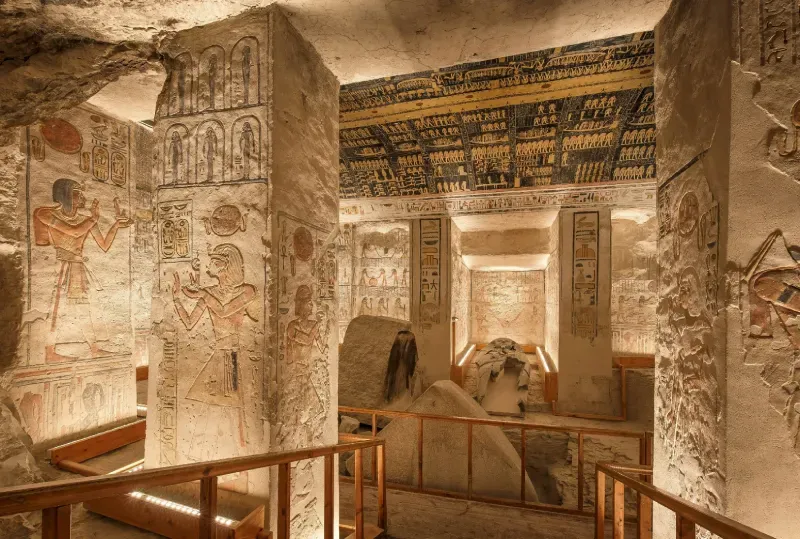
The burial chamber ceiling of KV9 (Ramesses V and VI) — covered entirely in the astronomical Book of the Heavens, showing the sun god Ra on his night journey through the underworld. The deep blue background and precise yellow astronomical figures have survived 3,100 years. Standing directly below this ceiling, which spans the full width of the chamber, is one of the most extraordinary visual experiences in Egypt.