
Abu Simbel — Complete Visitor Guide 2026
Abu Simbel is Egypt’s most remote and most dramatic ancient monument — and for many travelers who make the journey, the single most powerful site of their entire trip. Standing on the western shore of Lake Nasser, 280 kilometres south of Aswan and 40 kilometres from the border with Sudan, the two temples were carved directly into a sandstone cliff by Pharaoh Ramesses II between approximately 1264 and 1244 BC. The façade of the Great Temple is guarded by four seated colossal statues of Ramesses II, each 20 metres high — the largest royal statues of the ancient world still in their original location. The smaller Temple of Nefertari beside it is the only temple in ancient Egypt built by a pharaoh in honour of his wife. Both temples were rescued from the rising waters of Lake Nasser in one of the greatest engineering operations in history. This guide is written by Ahmed Emam with 15 years of arranging Abu Simbel visits for international clients.
The Two Temples of Abu Simbel
1. The Great Temple of Ramesses II
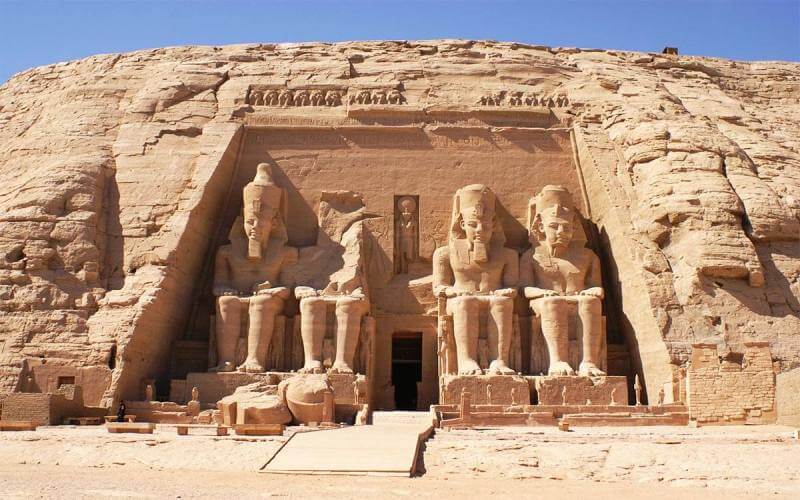
The Great Temple is carved 60 metres deep into the sandstone cliff. Its façade — 30 metres high and 35 metres wide — features four colossal seated statues of Ramesses II, each 20 metres from base to crown. Between and above their legs stand smaller statues of the royal family: his mother Tuya, his wife Nefertari and his children. The temple was dedicated to the sun gods Ra-Horakhty, Amun and Ptah, and to the deified Ramesses II himself — one of the rare instances in Egyptian history where a living pharaoh was worshipped as a god.
Inside, a great hypostyle hall leads through a second pillared hall and antechamber to the innermost sanctuary, where four statues sit in eternal darkness: Ptah (god of creation and darkness), Amun (king of the gods), the deified Ramesses II, and Ra-Horakhty (the sun god). Twice a year, the rising sun penetrates the full 60-metre depth to illuminate three of the four statues — Ptah, the god of darkness, remains in shadow always.
2. The Temple of Queen Nefertari
The smaller temple to the north is dedicated to the goddess Hathor and to Queen Nefertari, the Great Royal Wife of Ramesses II. It is the only temple in ancient Egypt built by a pharaoh in direct honour of his queen. The façade features six standing colossi — four of Ramesses II and two of Nefertari — each approximately 10 metres high. The inscription above the entrance contains one of the most famous love declarations in ancient history: “Nefertari, for whom the sun shines”. Inside, the painted reliefs of Nefertari making offerings to the gods are among the finest examples of New Kingdom art. For honeymooners and couples, this temple carries particular resonance — a 3,200-year-old declaration of love carved into a cliff at the edge of the world.
The Solar Alignment — 22 February and 22 October
The most celebrated phenomenon at Abu Simbel is the solar alignment — twice a year, on 22 February and 22 October, the rising sun at dawn aligns precisely with the temple axis and sends a shaft of light 60 metres into the innermost sanctuary, illuminating the four statues on the back wall for approximately 20 minutes. The dates correspond to significant moments in the ancient calendar: 22 February is believed to mark the birthday of Ramesses II, and 22 October his coronation day (though scholars continue to debate the precise significance). What is beyond doubt is that this alignment was intentionally engineered by the ancient builders with a precision that modern surveyors have confirmed.
Note: When the temples were relocated in the 1960s, the axis was shifted slightly and the event now occurs one day later than the original dates — on 23 February and 23 October. Several thousand visitors travel specifically to Abu Simbel for the solar alignment event each year. If you plan to visit on these dates, contact Best Nile Cruises well in advance as accommodation at Abu Simbel and Aswan fills completely.
The UNESCO Relocation — One of History’s Greatest Engineering Feats
When the Aswan High Dam was completed in 1970, the rising waters of Lake Nasser threatened to submerge Abu Simbel permanently. In response, UNESCO launched the most ambitious archaeological rescue in history. Between 1964 and 1968, both temples were cut into approximately 20,000 individual blocks — some weighing up to 30 tonnes — and reassembled on an artificial hill 65 metres higher and 200 metres further from the river than their original position. The operation involved engineers, archaeologists and workers from 50 countries, cost $80 million (approximately $700 million in 2024 values), and was completed with such precision that the solar alignment still functions — shifted by one day from the original due to the change in orientation. The domed artificial mountain above the temples, constructed to replicate the original cliff, is visible from a distance and conceals a network of concrete support structures inside. The relocation is considered one of the greatest engineering achievements of the 20th century and was the catalyst for the creation of the UNESCO World Heritage Convention in 1972.
Practical Information
How to Visit Abu Simbel — Two Options
Ahmed Emam’s Insider Tips
- Fly rather than drive if time is limited — the Desert Road from Aswan to Abu Simbel is 280km of flat desert. The domestic flight takes 45 minutes and lands almost at the temple entrance. The extra cost is significant but the time saving gives you a much more relaxed visit.
- Arrive at the temples before 9 AM — the convoys of day-trip buses from Aswan arrive between 9 and 11 AM. The first hour at Abu Simbel, before the crowds, is when the site feels truly remote and extraordinary.
- Stand directly in front of the fourth colossus — the second colossus from the left is the most photographed, but the proportions of all four are best appreciated from a specific distance. Your guide will position you for the photograph that shows all four colossi in frame.
- The Nefertari Temple is often rushed — do not let this happen — most visitors spend 80% of their time at the Great Temple and rush through Nefertari’s temple in 15 minutes. Allow equal time. The interior paintings are among the most vivid in all of Egypt and the story of Ramesses’ devotion to his queen is one of the most human narratives in the ancient world.
- For the solar alignment, book 6 months in advance — the accommodation at Abu Simbel village is extremely limited. For the 22-23 February and 22-23 October events, book flights, hotels and tours at least 6 months ahead. Contact Best Nile Cruises and we handle all arrangements for you.
- Look for the damage on the first colossus — the upper body of the second statue from the left collapsed in antiquity, probably from an earthquake. The fallen blocks remain in place at the statue’s feet, exactly as they fell. Your guide explains when this likely happened and what it reveals about the temple’s history.
Frequently Asked Questions
When is the solar alignment at Abu Simbel?
The solar alignment at Abu Simbel occurs on 22–23 February and 22–23 October each year, at sunrise. On these two days, the rising sun penetrates 60 metres through the temple entrance and illuminates three of the four statues in the innermost sanctuary for approximately 20 minutes. The fourth statue, Ptah (the god of darkness and the underworld), remains in shadow on both dates — an intentional detail of the original design preserved through the UNESCO relocation. Several thousand visitors travel to Abu Simbel specifically for this event each year.
Is Abu Simbel worth the journey from Aswan?
Yes — emphatically. Abu Simbel is consistently described by visitors who make the effort as the most powerful ancient site in Egypt. The colossi are on a scale that the Pyramids of Giza approach from distance but Abu Simbel delivers at close range — you walk within metres of the 20-metre statues of Ramesses. The remoteness adds to the experience: arriving at a site of this scale in the middle of a desert by Lake Nasser, with no other monument visible in any direction, creates a sense of the ancient world that the more accessible sites in Luxor and Cairo cannot fully replicate.
What is the difference between a day trip to Abu Simbel and a Lake Nasser cruise?
A day trip from Aswan (by road or flight) gives you 2–3 hours at Abu Simbel and returns you to Aswan the same day. It is the right choice for travelers on a standard Nile cruise who want to add Abu Simbel without extending their trip. A Lake Nasser cruise travels between Aswan and Abu Simbel over 3–5 nights, stopping at Nubian temples that are only accessible by water and arriving at Abu Simbel by lake at sunrise — one of the great travel experiences in Egypt. The Lake Nasser cruise is the superior experience; the day trip is the practical choice.
Why were the Abu Simbel temples moved?
When the Aswan High Dam was constructed between 1960 and 1970, the rising waters of the newly created Lake Nasser would have submerged Abu Simbel permanently within a few years. In response to an international appeal by UNESCO, an engineering project was launched in 1964 to dismantle both temples, cut them into approximately 20,000 blocks and reassemble them 65 metres higher on an artificial hill above the flood line. The operation, completed in 1968, involved engineers and workers from 50 countries and is considered the greatest archaeological rescue mission in history. It directly inspired the creation of the UNESCO World Heritage Convention in 1972 — the international legal framework that now protects over 1,000 sites worldwide.
Who built Abu Simbel and why?
Abu Simbel was built by Pharaoh Ramesses II (reigned 1279–1213 BC) during the 19th Dynasty of the New Kingdom period. Ramesses II reigned for 66 years and built more monuments than any other pharaoh in Egyptian history. Abu Simbel served several simultaneous purposes: it demonstrated Egyptian power to the Nubian peoples living to the south; it celebrated the Battle of Kadesh (1274 BC, the world’s first recorded peace treaty) with reliefs inside showing Ramesses in battle; it served as a religious complex for the worship of the sun gods Ra-Horakhty and Amun; and it established the divine status of Ramesses II himself, whose seated statue appears alongside the gods in the innermost sanctuary. The smaller Nefertari Temple was built simultaneously as a unique tribute to his wife.
We arrange Abu Simbel as a Lake Nasser cruise (arriving by water at sunrise) or as a day trip by flight from Aswan, added to any Nile cruise or Egypt package. For the solar alignment dates (22–23 February and 22–23 October), contact us as early as possible — accommodation fills 6 months ahead.
Written by Ahmed Emam — Egypt travel specialist since 2010, founder of Around Egypt Tours. Has arranged over 200 client visits to Abu Simbel including multiple solar alignment events.