
Colossi of Memnon — Complete Visitor Guide 2026
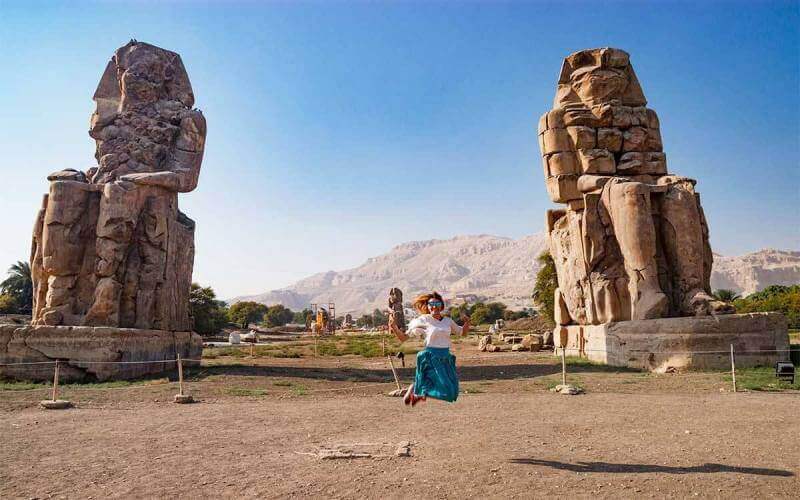
On the flat plain of the West Bank of Luxor, where the agricultural fields meet the desert and the road leads toward the Valley of the Kings, two enormous seated figures rise from the ground with nothing around them. No temple walls. No columns. No roof. Just two massive stone pharaohs sitting in a field — alone, silent, facing east toward the Nile since approximately 1350 BC. The Colossi of Memnon are the last visible remnant of the Mortuary Temple of Amenhotep III — which was not a modest structure. At its peak it was the largest religious building in ancient Egypt, covering approximately 350,000 square metres — an area larger than the Karnak complex, larger than any temple before or since. The temple is gone, systematically quarried for its stone over centuries by builders who needed material for other projects. The two gigantic guardian statues were too heavy to move, so they were left standing in the fields as the temple behind them was dismantled stone by stone over a thousand years. They are all that remains. This guide is written by Ahmed Emam with 15 years of bringing visitors to this site.
The Statues — What You Are Actually Looking At
Each colossus depicts Amenhotep III in the sed-festival posture — seated on a throne, hands flat on his knees, wearing the double crown and the nemes headcloth. Each statue is carved from a single block of quartzite sandstone quarried at Gebel el-Ahmar near modern Cairo — approximately 670km north of Luxor — and transported down the Nile by boat. Their current height is approximately 18 metres from the base to the crown; originally, with the double crown intact, they would have stood taller. Smaller side figures flank each throne: on the north statue (right as you approach), the queen mother Mutemwia stands to the left of the throne leg and his wife Queen Tiye to the right. On the south statue (left as you approach), the same figures appear in a similar arrangement. Between the legs of each statue, a carved figure represents the Hapy — the god of the Nile inundation — binding the symbols of Upper and Lower Egypt in the sema-tawy (union of the Two Lands) motif.
Why Are They Called the “Colossi of Memnon”?
The name “Memnon” is a Greek mistake — one of the most persistent cases of mistaken identity in the ancient world. Memnon was a legendary figure in Greek mythology: the king of Ethiopia and son of the dawn goddess Eos, who came to Troy to fight alongside the Trojans and was killed by Achilles. When Greek and Roman travelers visited the Theban plain and saw the massive statues, they connected the taller (northern) colossus — which emitted a musical sound at dawn (see below) — with the myth of Memnon greeting his mother Eos (the dawn) each morning. The Greeks and Romans therefore called the statues “the Colossi of Memnon” without any archaeological basis for the identification. The statues have nothing to do with Memnon. They represent Amenhotep III (c. 1388–1351 BC), one of Egypt’s greatest and wealthiest pharaohs, who built the vast temple behind them. The Greek name stuck, as Greek names tend to.
The Singing Colossi — What the Ancient World Heard
In 27 BC, a significant earthquake damaged the northern colossus, cracking its upper body and causing it to fall in sections. After the earthquake, the damaged statue began to emit a musical humming sound at dawn — which ancient visitors described variously as singing, sighing, the sound of a lute string being plucked, or a whistling note. The phenomenon became famous across the Roman world. Roman emperors travelled to the Theban plain specifically to hear the sound: Hadrian visited in 130 AD with his wife Sabina and his companion Antinous, who drowned in the Nile shortly afterwards and was deified by Hadrian in one of the great acts of imperial grief in ancient history. Over 100 ancient “tourist inscriptions” were carved into the legs of the colossi by visitors recording that they had heard the sound. The modern explanation is straightforward: the moisture that condensed in the cracks of the damaged stone during the cool night expanded as the sun heated the statue at sunrise, producing a vibrating sound as the stone contracted and expanded. In 199 AD, Emperor Septimius Severus had the statue repaired with additional stone courses. The singing stopped. The repaired statue has been silent ever since.
The Lost Temple of Amenhotep III
The colossi are all that remains above ground of the Mortuary Temple of Amenhotep III — which, at its completion around 1350 BC, was the largest religious building in Egyptian history. At approximately 350,000 square metres (35 hectares), it exceeded even the Karnak complex in area. It contained three massive pylons, multiple courtyards, a sacred lake, dozens of sphinxes and hundreds of colossal royal statues. It was destroyed not in one event but gradually, over centuries: Merenptah (Ramesses II’s successor) quarried it for his own temple. Later rulers did the same. By the time Greek travelers arrived, most of the superstructure had already been removed. Ongoing excavations by a German-Egyptian archaeological team (the Amenhotep III Project) have been revealing the buried remains of the temple since the 1990s, recovering colossal statues, sphinx avenues and architectural elements that demonstrate the extraordinary scale of the original structure. A large quartzite statue of Amenhotep III excavated nearby in 2014 has been re-erected close to the main colossi and is visible on the site today — a third giant now joining the original pair.
Practical Information
Ahmed Emam’s Insider Tips
- Walk around to the north side of the statues — most visitors photograph from the road in front. Walk around to the northern side and look at the colossi from an angle that shows the depth of the carved side panels on the throne. The Hapy figure between the legs — binding the lotus and papyrus of Upper and Lower Egypt together — is clearest from this angle.
- Look for the inscription on the north statue legs — the ancient tourist inscriptions carved by Roman visitors who came to hear the singing colossus are still visible on the lower legs of the north statue. Your guide points out the Latin and Greek texts. Standing where Hadrian stood in 130 AD is a quietly extraordinary historical connection.
- The third statue is worth finding — the large quartzite colossus re-erected near the main pair after its excavation in 2014 is visible from the main viewing area but is often missed. It represents Amenhotep III in the same posture, from the same temple, and gives a sense of how many similar statues originally lined the temple approach.
- The floods still come — in wet years, the agricultural plain around the colossi floods in the inundation season, briefly recreating the ancient vision of the statues standing in water — exactly as ancient Egyptians and Greek travelers saw them for centuries. If you visit in late summer you may see this.
- Take 5 minutes to think about what used to stand behind them — the colossi are facing the entrance to the largest temple ever built in Egypt. It covered 35 hectares. There was nothing behind you when you look at them from the front except open plain — but 3,400 years ago, that plain held a structure larger than anything else in the ancient world. Your guide helps you visualise what was there.
Colossi of Memnon on a Nile Cruise
The Colossi of Memnon are the last stop on the West Bank morning of every Nile cruise from Luxor to Aswan. After the Valley of the Kings at dawn and the Temple of Hatshepsut mid-morning, the West Bank car stops at the Colossi for a 20–30-minute visit before returning to the ship for lunch as it begins to sail south. Entry is free; the stop requires no additional ticketing. Your private Egyptologist guide gives the full context — the lost temple, the singing phenomenon, the Hadrian visit, the ongoing excavations — turning a brief roadside stop into one of the most intellectually satisfying moments of the cruise.
Frequently Asked Questions
Why are the Colossi of Memnon called Memnon?
The name “Memnon” is a Greek mistake. The statues actually represent Pharaoh Amenhotep III (18th Dynasty, c. 1350 BC). When Greek and Roman travelers visited the West Bank and heard the northern statue emitting a musical sound at dawn, they connected it to the Greek mythological hero Memnon — the son of the dawn goddess Eos — and assumed the sound was Memnon greeting his mother at sunrise. The name stuck despite having no connection to the actual pharaoh depicted. The statues have been called the Colossi of Memnon for 2,000 years despite the identification being entirely incorrect.
Why did the Colossi of Memnon sing?
The northern colossus was damaged in an earthquake in 27 BC, which cracked the stone. The crack allowed moisture to enter the statue at night; as the sun heated the stone at dawn, the moisture expanded and the stone contracted, producing a musical humming or vibrating sound. Ancient visitors described it variously as singing, sighing or a lute-string sound. The phenomenon lasted from 27 BC until 199 AD, when Emperor Septimius Severus had the cracked stone filled with additional courses of masonry. The repair eliminated the sound permanently. The phenomenon drew Roman emperors, including Hadrian and his wife Sabina, to the Theban plain specifically to hear it.
What temple did the Colossi guard?
The colossi stood at the entrance to the Mortuary Temple of Amenhotep III, which was at the time of its construction (c. 1350 BC) the largest religious building in ancient Egypt — covering approximately 350,000 square metres. The temple was systematically quarried for its stone by later rulers, beginning with Merenptah (son of Ramesses II), and gradually disappeared. The two colossi were too large to move and were left standing as the temple behind them was dismantled. Ongoing excavations (the Amenhotep III Project) continue to uncover buried architectural remains and statues from the lost complex.
How tall are the Colossi of Memnon?
The Colossi of Memnon currently stand approximately 18 metres (60 feet) high from the base to the top of the surviving heads. Originally, with intact double crown headdresses, they would have been taller. Each statue weighs approximately 720 tonnes and was carved from a single block of quartzite sandstone quarried near modern Cairo (Gebel el-Ahmar), approximately 670km north of Luxor, and transported south by barge on the Nile.
Is there a ticket to visit the Colossi of Memnon?
No — the Colossi of Memnon are free to visit. They stand in an open area beside a public road on the West Bank of Luxor and require no entrance ticket. Visitors can approach closely, walk around them and photograph freely. They are included as a standard stop on all Best Nile Cruises West Bank itineraries at no additional cost.
Included in all our Nile cruise itineraries as part of the West Bank morning tour — Valley of the Kings, Temple of Hatshepsut and Colossi of Memnon with private Egyptologist guide. Cairo and Nile cruise packages from $899. Contact us for a free personalised itinerary.
Written by Ahmed Emam — Egypt travel specialist since 2010, founder of Around Egypt Tours and Egypt For Travel Has visited the Colossi of Memnon over 500 times with international Nile cruise clients.