
Temple of Hatshepsut — Complete Visitor Guide 2026
At the end of a long straight causeway, with the desert floor flat and pale around it and the vertical cliff of the Theban hills rising immediately behind, the Temple of Hatshepsut appears to have grown from the rock rather than been built against it. Its three colonnaded terraces — each one set back from the other in perfect diminishing sequence — fit the cliff face so precisely that the boundary between human construction and natural formation is almost impossible to define. This is Djeser-Djeseru — “Holy of Holies” in ancient Egyptian — and it is one of the great architectural achievements of the ancient world. It was built by a woman: Hatshepsut, who ruled Egypt for 22 years as pharaoh, commanded armies, directed one of the greatest trading expeditions in ancient history and left behind a monument that 3,500 years have been unable to diminish. This guide is written by Ahmed Emam with 15 years of guiding international visitors through the temple.
Who Was Hatshepsut?
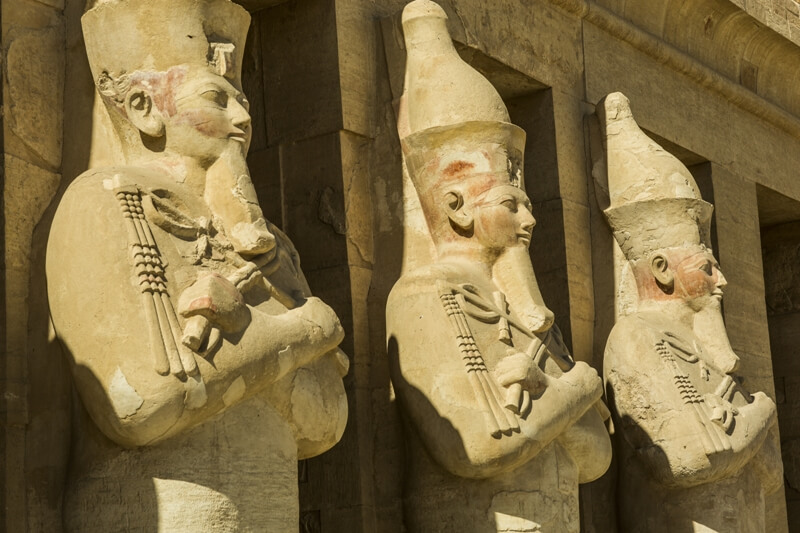
Hatshepsut (c. 1507–1458 BC) was the daughter of Pharaoh Tuthmosis I and the wife of his successor Tuthmosis II. When her husband died, the heir to the throne was Tuthmosis III — a child from a lesser wife — and Hatshepsut was appointed regent to govern until he came of age. Within a few years she had done something unprecedented: she declared herself pharaoh — not regent, not queen consort, but full pharaoh — and had herself depicted in royal regalia including the double crown and the false beard of kingship. She ruled Egypt for approximately 22 years, during which she directed the famous trading expedition to Punt, erected the tallest obelisks in Egypt (at Karnak), rebuilt the processional way at Karnak and constructed Djeser-Djeseru at Deir el-Bahri. After her death, her successor Tuthmosis III systematically removed her image and name from monuments throughout Egypt — chiselling out her cartouches and replacing her likeness with that of her father or himself. The reasons for this remain debated: political necessity, personal resentment, or the need to restore the male succession after her unprecedented reign. Her identity was only fully re-established by modern archaeology in the 19th and 20th centuries.
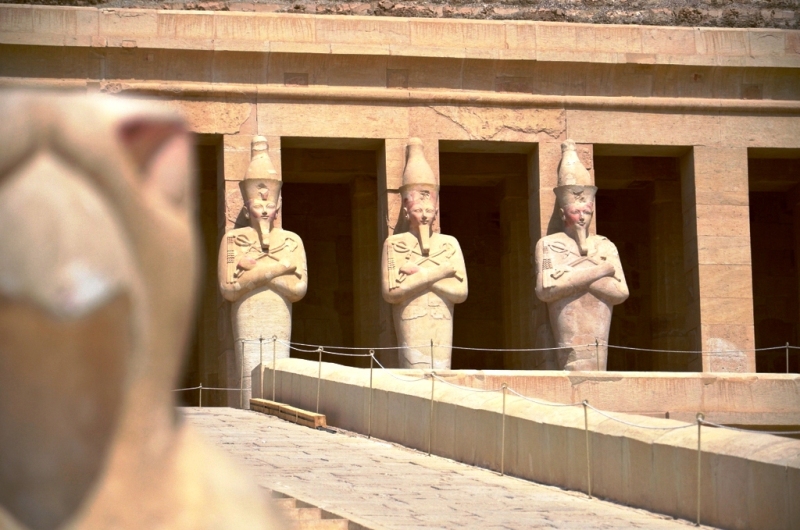
What to See Inside the Temple
The Architecture: A Cliff Face as a Canvas
The temple was designed by Senenmut, Hatshepsut’s chief steward and the most powerful non-royal official in Egypt at the time. His design was revolutionary: instead of the standard Egyptian temple format — a sequence of pylons leading to a sanctuary — Senenmut created three colonnaded terraces on a horizontal axis, each connected by ramps and set back against the cliff in diminishing depth. The limestone cliff forms the back wall of the uppermost terrace; the sanctuary is cut directly into the rock. The orientation is precise: the temple faces east, and on the summer solstice, the rising sun aligns with the central axis and illuminates the sanctuary of Amun. The valley immediately to the north was already occupied by the earlier mortuary temple of Mentuhotep II (2055 BC) — Hatshepsut chose Deir el-Bahri specifically to associate her monument with this sacred precursor, and the visual contrast between the two structures across the millennia remains part of what makes the site so extraordinary.
Practical Information
Ahmed Emam’s Insider Tips
- Enter the Anubis Chapel — most visitors walk past it — the north end of the second terrace contains a small chapel to Anubis with painted ceiling reliefs in deep blue and red that are among the best-preserved colours in the entire complex. Your guide will take you inside.
- Look for the chisel marks in the sanctuary — in the innermost rooms you can see where Tuthmosis III’s workmen chiselled out Hatshepsut’s image. In some panels the ghost of her figure is still visible beneath the erasure. Your guide shows you the exact panels where both versions coexist.
- The best photograph is taken from the bottom of the first ramp — standing at the base of the lower terrace ramp and shooting upward, you capture all three terraces against the cliff in a single frame. Go early before tour groups fill the causeway.
- Ask your guide about the Queen of Punt — the Punt Colonnade contains a remarkable portrait of the Queen of Punt, whose body shape is depicted in a way unlike any other figure in Egyptian art. Scholars have debated for over a century what condition she may have had. Your guide presents the current theories.
- The Hathor columns are worth stopping at — the Hathor-head capitals in the southern chapel are a completely different architectural form from anything in the main temple. The cow-eared face of the goddess on a sistrum-handle column is one of the distinctive images of Egyptian architecture.
Hatshepsut’s Temple on a Nile Cruise
The Temple of Hatshepsut is visited on the West Bank morning of every Nile cruise from Luxor to Aswan. The standard sequence is: Valley of the Kings at dawn, Temple of Hatshepsut mid-morning, Colossi of Memnon before midday — returning to the ship for lunch as it begins to sail south toward Edfu. Hatshepsut takes approximately 1.5–2 hours with a private guide. Optional add-ons for those with a deeper interest in Hatshepsut: the Tomb of Nefertari (QV66) in the Valley of the Queens (a separate ticket) contains some of the finest painted reliefs on the West Bank, and the visit to Karnak Temple the previous evening allows you to see the two obelisks Hatshepsut erected there — completing the picture of her extraordinary building programme.
Frequently Asked Questions
Who was Hatshepsut and why is she important?
Hatshepsut (c. 1507–1458 BC) was one of ancient Egypt’s most successful rulers and the most powerful woman in Egyptian history. She began as regent for her stepson Tuthmosis III and declared herself pharaoh within a few years, ruling for approximately 22 years. During her reign she directed the famous Punt trading expedition, doubled the wealth of Egypt through trade rather than conquest, erected the tallest obelisks in Karnak and built Djeser-Djeseru at Deir el-Bahri. Her importance lies not only in her achievements but in her defiance of the Egyptian convention that only men could be pharaoh — and in the systematic attempt by her successor to erase her from history, which failed utterly and has made her story one of the most compelling in the ancient world.
Why did Tuthmosis III erase Hatshepsut’s image?
The erasure of Hatshepsut’s name and image from monuments across Egypt was once interpreted as personal revenge by Tuthmosis III, who had been kept from power during her 22-year reign. Modern Egyptological opinion has shifted toward a more pragmatic explanation: Tuthmosis III erased Hatshepsut to ensure that the male succession appeared unbroken — from Tuthmosis I to Tuthmosis II to Tuthmosis III, with no female interruption that might invite future queens to claim the same precedent. The erasures were carried out late in his reign, long after any personal grievance would have been relevant. Whatever the reason, the paradox is absolute: by trying to erase Hatshepsut from history, Tuthmosis III ensured that every visitor to Deir el-Bahri asks about her.
What was the Land of Punt?
The Land of Punt was a trading partner of ancient Egypt from at least the Old Kingdom (2600 BC), known as “God’s Land” for the luxury goods it supplied: myrrh, frankincense, ebony, gold, leopard skins and living animals including baboons and exotic birds. Its precise location has been debated for over a century. Current archaeological consensus places it in the region of modern Eritrea, Djibouti and northern Somalia on the Red Sea coast. Hatshepsut’s expedition (c. 1493 BC) was the largest and best-documented in Egyptian history, recorded in extraordinary detail in the Punt Colonnade reliefs. The expedition returned with 31 live myrrh trees, which Hatshepsut had planted in terraced gardens outside the temple — the first recorded attempt at transplanting trees from a foreign land.
How long does it take to visit the Temple of Hatshepsut?
A guided visit covering all three terraces, the Punt Colonnade, the Divine Birth Colonnade, the Hathor Chapel and the Anubis Chapel takes 1.5–2 hours. Visitors with a particular interest in Hatshepsut’s story or in Egyptian art may want to allow 2.5 hours. The temple is visited on the same morning as the Valley of the Kings on all Nile cruise West Bank itineraries, with the Valley at dawn and Hatshepsut mid-morning.
Is the Temple of Hatshepsut safe to visit?
Yes — the Temple of Hatshepsut is completely safe to visit and is visited by thousands of international tourists every week as part of standard Nile cruise itineraries. The site has significant security presence and is one of Egypt’s most professionally managed tourist destinations. All Best Nile Cruises packages include the West Bank excursion as a standard element, and our guides manage all logistics. Egypt’s major tourist sites are monitored and protected by the Tourist Police and the Egyptian Army.
Included in all our Nile cruise itineraries and Cairo and Nile cruise packages from $899. Private Egyptologist guide and all entrance fees included. Contact us for a free personalised itinerary.
Written by Ahmed Emam — Egypt travel specialist since 2010, founder of Around Egypt Tours and Egypt For Travel. Has guided over 450 visits to the Temple of Hatshepsut with international clients.