
Citadel of Saladin — Complete Visitor Guide 2026
Rising from the Mokattam Hills on Cairo’s eastern edge, the Citadel of Saladin has dominated the city’s skyline for 850 years. Built by the great general Salah El Din (Saladin) beginning in 1176 AD as a military fortress against Crusader aggression, it became the seat of Egyptian government and royal residence for every ruler from Saladin himself through the Mamluk sultans, the Ottoman governors and the modernising dynasty of Mohamed Ali Pasha — a continuous span of nearly 700 years (1183–1874 AD). Every major event in medieval and early modern Egyptian history was decided or announced from this hill: Saladin’s campaigns against the Crusaders, the Mamluk resistance to the Mongols, Napoleon’s occupation, Mohamed Ali’s massacre of the Mamluk beys and the construction of the mosque that now bears his name. From its eastern terrace, the twin symbols of Egyptian civilisation — the Pyramids of Giza to the west and the minaret-studded cityscape below — are visible on clear days in a single view. This guide is written by Ahmed Emam with 15 years of bringing international visitors to the Citadel.
Saladin — The Man Who Built the Citadel
Salah El Din Yusuf ibn Ayyub (1137–1193), known in the West as Saladin, was a Kurdish-Muslim general from Tikrit (in modern Iraq) who came to Egypt as a military commander for the Fatimid caliphate and ended by deposing it. He founded the Ayyubid sultanate, reunified Egypt and Syria under one rule and defeated the Crusaders at the Battle of Hattin in 1187, recapturing Jerusalem from Christian rule after 88 years. He is celebrated in both Islamic and Western sources for his chivalry and personal honour — Richard I of England (Richard the Lionheart), his principal Crusader opponent, reportedly admired him. The Citadel he began in Cairo in 1176 was designed to protect the city from a Crusader assault that ultimately never came — but the fortress outlasted its builder by 700 years.
What to See at the Citadel
The Mohamed Ali Mosque — and the Clock That Never Worked
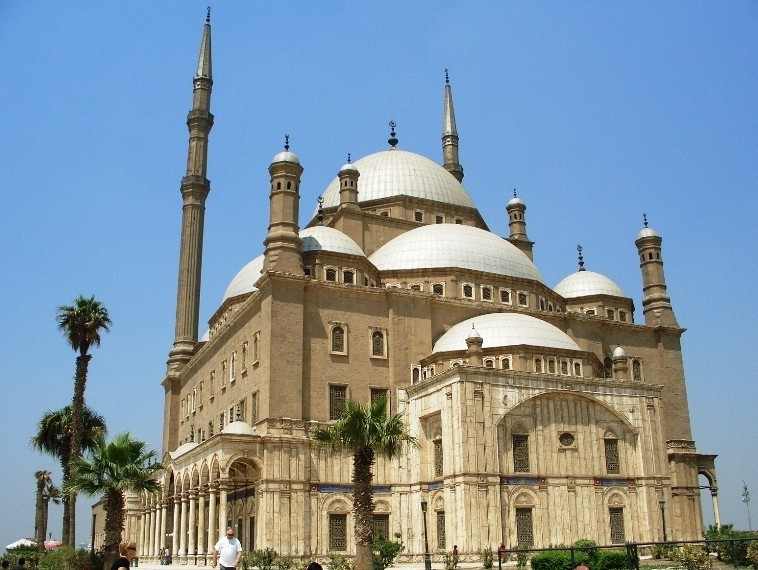
The Mohamed Ali Mosque — officially the Mosque of Muhammad Ali Pasha, built between 1830 and 1848 — is the most visible structure in Cairo after the Pyramids. Its twin pencil minarets rise 82 metres and are visible from virtually every elevated point in the city; its Ottoman dome, modelled on the Yeni Cami (New Mosque) in Istanbul, dominates the Citadel skyline. The interior is clad entirely in alabaster brought from Luxor — giving the mosque its popular name, the “Alabaster Mosque” — and the light that filters through the alabaster panels creates a warm, luminous quality unlike any other mosque in Egypt. In the courtyard stands a French clock tower, housing an ornate clock given to Egypt by King Louis-Philippe of France in 1845 in exchange for the obelisk now standing in the Place de la Concorde in Paris (the twin of the Luxor Temple obelisk). Mohamed Ali is said to have felt the exchange was deeply unfavourable to Egypt. The French clock, installed with great ceremony, never worked properly and has been broken since shortly after its installation. It stands in the courtyard today, still displayed, still stopped — one of history’s more pointed diplomatic ironies.
The Mamluk Massacre of 1811 — The Citadel’s Darkest Day
On 1 March 1811, Mohamed Ali Pasha invited the Mamluk beys — the military caste that had ruled Egypt alongside the Ottomans for centuries — to a celebration banquet at the Citadel honouring his son Tusun Pasha before his campaign in Arabia. As the Mamluk procession descended the narrow passage known as Darb al-Gamamiz inside the Citadel walls, Mohamed Ali’s troops closed the gates and opened fire from the walls. In minutes, approximately 500 Mamluk beys and their retinues were killed in an ambush that ended the Mamluk political power in Egypt permanently. According to legend, only a single Mamluk survived: Amim Bey, who spurred his horse off the Citadel wall and survived the fall — though historians debate whether this actually occurred. The massacre secured Mohamed Ali’s undivided rule over Egypt and opened the path to his programme of military and economic modernisation. The passage where the massacre occurred is still within the Citadel complex.

Practical Information
Ahmed Emam’s Insider Tips
- Go to the panoramic terrace before the mosque — arrive at the Citadel early and go directly to the eastern terrace before the tour buses unload. The view of Cairo in the morning light, with the minarets of Islamic Cairo below and the Pyramids visible in the western haze on clear days, is the best elevated view of the city available to any visitor.
- Find the French clock in the courtyard of the Mohamed Ali Mosque — it is in the clock tower on the right side of the mosque courtyard. Look carefully: the pendulum is visible through the glass but the clock face shows a time it reached centuries ago. Your guide explains the obelisk-for-clock exchange and why the broken clock is now considered one of history’s most satisfying diplomatic reversals.
- Look at the alabaster panels from the side, not straight on — the translucency of the Luxor alabaster is best appreciated by standing at an angle to the wall panels and observing how the light passes through rather than reflecting off the stone. Your guide positions you for this.
- Visit the Al-Nasir Muhammad Mosque — most tourists walk past it — the majority of Citadel visitors go directly to the Mohamed Ali Mosque and miss the Al-Nasir Mosque entirely. The Gothic portal taken from the Crusader church at Acre is one of the most unusual architectural details in Cairo: European Gothic stonework incorporated into a Mamluk mosque as a deliberate trophy of Islamic victory.
- The Well of Joseph is underrated — 90 metres of hand-cut shaft through solid limestone, with a spiral animal ramp around the inside. The engineering required to cut this well in the 12th century, using only iron tools, human labour and animal power, is extraordinary. The viewing platform above the well gives a sense of the depth.
Frequently Asked Questions
Who was Saladin and why did he build the Cairo Citadel?
Salah El Din (Saladin) (1137–1193) was a Kurdish-Muslim general who came to Egypt as a military commander, deposed the Fatimid caliphate and founded the Ayyubid sultanate. He is most famous in the West for defeating the Crusaders at the Battle of Hattin in 1187 and recapturing Jerusalem. He built the Cairo Citadel beginning in 1176 as a military fortress to protect Cairo from potential Crusader attack — the Crusaders had already raided the Egyptian coast and the threat was considered real. He also demolished several smaller pyramids at Giza to use their limestone for the Citadel walls, which is why some of the smaller Giza pyramids show signs of quarrying on their outer casing.
What happened at the Mamluk Massacre of 1811?
On 1 March 1811, Mohamed Ali Pasha invited the leading Mamluk beys to a celebration at the Citadel. As the procession moved through the narrow passage of Darb al-Gamamiz inside the Citadel walls, the gates were locked and Mohamed Ali’s Albanian troops opened fire from the walls above. Approximately 500 Mamelukes were killed, ending 700 years of Mamluk political power in Egypt in a single morning. The massacre was entirely premeditated and secured Mohamed Ali’s undivided control over Egypt, enabling his programme of military modernisation. A lone survivor, Amim Bey, allegedly escaped by jumping his horse off the Citadel walls — an episode that may be legend but has become part of the Citadel’s enduring story.
Why is the Mohamed Ali Mosque called the Alabaster Mosque?
The Mohamed Ali Mosque is known as the Alabaster Mosque because its interior walls, columns and lower surfaces are clad entirely in alabaster brought from quarries near Luxor in Upper Egypt. Alabaster is a translucent limestone with a warm, glowing quality that gives the interior a luminous character unlike any other mosque in Cairo. The stone reflects and diffuses light rather than absorbing it, creating an interior that feels simultaneously grand and intimate. The building was designed by the Greek architect Youssef Boushnaq and modelled on the Ottoman mosques of Istanbul, particularly the Yeni Cami and the Hagia Sophia.
Can you see the Pyramids from the Citadel?
Yes — on clear days. From the eastern terrace of the Citadel, the Pyramids of Giza are visible approximately 23km to the west. The best visibility is on winter mornings (November to February) when the air is clearest. Summer haze and Cairo’s pollution can obscure the view on many days. When the Pyramids are visible, the view from the Citadel is one of the most extraordinary in Egypt: the medieval minarets of Islamic Cairo in the foreground and the ancient world’s greatest monuments on the horizon.
What is the Well of Joseph at the Citadel?
The Well of Joseph (Bir Yusuf) is a 90-metre well cut through solid limestone by Saladin’s engineers around 1183 AD to supply the Citadel with water from the Nile without requiring a supply chain from the river. It is named after Saladin (whose Arabic name was Yusuf) rather than the biblical Joseph, despite the popular association. The well has a spiral ramp around its interior shaft along which animals walked to power the water-raising mechanism — essentially a vertical treadmill inside a limestone cylinder 90 metres deep. A viewing platform at the top allows visitors to look down into the shaft. It remains one of the most impressive engineering achievements of medieval Cairo.
The Citadel is included in extended Cairo programmes. Combined with Khan El Khalili and Islamic Cairo as part of the complete Cairo experience before your Nile cruise. Contact us to plan your Cairo days.
Written by Ahmed Emam — Egypt travel specialist since 2010, founder of Around Egypt Tours. Has guided over 400 visits to the Citadel of Saladin with international clients.