
Khan El Khalili — Complete Visitor Guide 2026
In the heart of Islamic Cairo, in a district of medieval minarets and medieval streets built on the site of the Fatimid royal city, Khan El Khalili has been open for business for 640 years. Founded in 1382 by the Mamluk Emir Djaharks el-Khalili, it began as a caravanserai — a combined warehouse and trading post serving merchants on the overland spice and silk routes between East Africa, the Arabian Peninsula, Persia, India and the Mediterranean. It grew into one of the most important commercial centres in the medieval Islamic world, and although the global trade routes have long since changed, the bazaar itself has barely. The same families trade from the same stalls in some cases; the same copper-beating sounds come from the same workshops; El Fishawy Café, founded in 1773, has not closed its doors in over 250 years. Khan El Khalili is the one place in Cairo where you feel the full weight of the city’s extraordinary age — not in stone or hieroglyphics but in the living, breathing commerce of a medieval city that never stopped. This guide is written by Ahmed Emam with 15 years of bringing international visitors through the bazaar’s alleys.
History: From Royal Cemetery to Commercial Heart of Cairo
The site beneath Khan El Khalili was originally a Fatimid royal cemetery — the burial ground of the Fatimid caliphs who founded Cairo in 969 AD. The tombs of the caliphs were cleared in 1382 by the Mamluk Sultan Barquq’s amir (commander), Djaharks el-Khalili, who demolished the mausoleums to build his caravanserai. The act was controversial — the destruction of royal graves was a serious matter — but the commercial opportunity was decisive. Within decades, the Khan had attracted merchants from every corner of the Islamic world: Venetian glass traded for Egyptian cotton, Yemeni coffee met Persian spices, Sudanese gold was weighed against Indian pepper. The lane names in the bazaar still reflect the specialisations of that medieval commerce: the Goldsmiths’ Alley, the Spice Street, the Copperworkers’ Quarter.
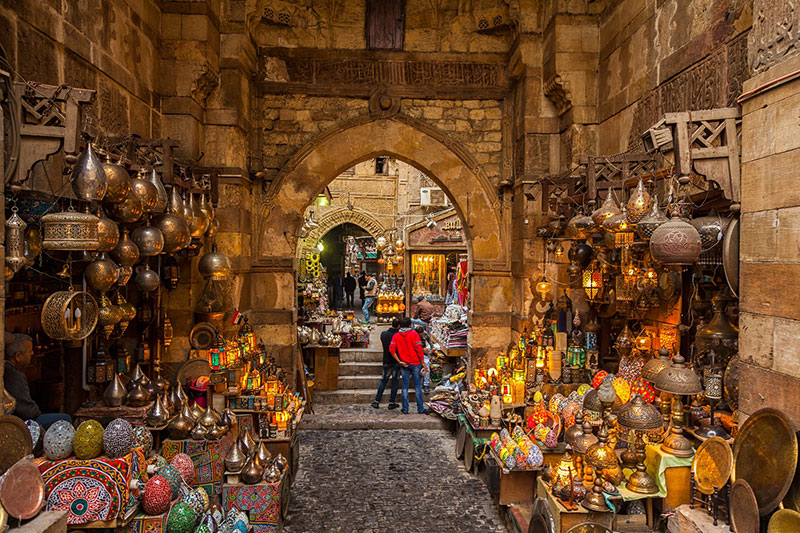
What to See and Buy at Khan El Khalili
El Fishawy Café — 250 Years and Never Closed
At the heart of Khan El Khalili, in a narrow alley between the Al-Hussein Mosque and the main bazaar lanes, stands El Fishawy Café — founded in 1773 AD and said to have not closed its doors for a single day in the 250 years since. It operates 24 hours a day, seven days a week, through wars, revolutions, epidemics and every upheaval Cairo has endured. The café is lined with antique mirrors, brass lamp fittings and wooden screens; the tables spill into the alley; the waiters carry ornate tea glasses and shisha (water pipes) through the narrow space between seated customers. The Nobel Prize-winning Egyptian novelist Naguib Mahfouz — who won the Nobel Prize in Literature in 1988 and set his great Cairo Trilogy in the streets surrounding Khan El Khalili — spent decades writing here, observing the characters who populate his fiction. Albert Camus visited. Countless Egyptian intellectuals, artists and revolutionaries have held court at its tables. You can drink tea, mint lemonade or Turkish coffee here for the price of an ordinary Cairo café, sitting in the same chair that has been occupied by more of Cairo’s history than any other seat in the city.

Practical Information
Ahmed Emam’s Insider Tips
- Let your guide lead the first 20 minutes — Khan El Khalili is a genuine labyrinth and the logical entrance points are not obvious. Let your guide take you in through the al-Hussein side, orient you to the layout and identify the areas worth your time before you browse independently.
- Decline the carpet and “free tea” invitation — some shops will invite you in for “free tea” with no obligation. There is always an obligation. These are high-pressure sales environments for carpets, papyrus and alabaster. If you want to visit one, go with your guide. If a stranger approaches you uninvited, decline politely.
- The first price is never the real price — but do not insult the seller — bargaining is a social ritual, not a battle. Counter-offer at 40% of the asking price, expect to settle at 50–60%. Smile throughout. Walking away is a legitimate tactic and often results in the price dropping further. Aggressive bargaining is considered rude; cheerful persistence works.
- Sit at El Fishawy at dusk, not midday — the café is atmospheric at any time but extraordinary at dusk when the alley fills and the lanterns come on. Order karkadé (dried hibiscus tea, served hot or cold) or ahwa sada (unsweetened Turkish coffee). Sit for as long as you like — Egyptian café culture does not rush its guests.
- Walk to Al-Azhar Mosque before or after the bazaar — founded in 970 AD and one of the world’s oldest continuously operating universities, Al-Azhar is two minutes from the bazaar entrance. Non-Muslims are welcome to enter the courtyard (remove shoes, women cover hair). The covered courtyard with its medieval minarets, five minutes walk from the noise of the bazaar, is one of the most serene spaces in Cairo.
- Look up as you walk — the streetscape above the shop fronts in Khan El Khalili is medieval: 14th and 15th-century mashrabiyya (carved wooden screens), Mamluk stonework, Ottoman minarets and 19th-century iron balconies layered on top of each other. Most visitors never look up. The view above the commerce is the actual history of the place.
Khan El Khalili on a Nile Cruise Cairo Day
Khan El Khalili is visited on Day 2 of the Cairo programme in all Best Nile Cruises packages. Day 1 covers the Pyramids of Giza and the Grand Egyptian Museum. Day 2 follows this sequence: Saqqara Step Pyramid in the morning (Egypt’s oldest pyramid, 2650 BC), lunch in Islamic Cairo, Coptic Cairo in the early afternoon (Hanging Church, Ben Ezra Synagogue), then Khan El Khalili in the late afternoon for 2–3 hours of browsing and coffee at El Fishawy before the evening flight to Luxor and embarkation on the Nile cruise ship. The bazaar visit is not only shopping — it is the best way to experience a completely different Cairo from the pharaonic monuments: medieval, Islamic, living and inexhaustible.
Frequently Asked Questions
What is Khan El Khalili famous for?
Khan El Khalili is famous as Cairo’s great medieval bazaar — a labyrinth of covered alleys and open workshops that has been trading continuously since 1382 AD. It is particularly known for gold and silver jewellery (sold by weight, with cartouche pendants a popular personalised souvenir), Egyptian spices and herbs, essential oils and perfume, hand-beaten copper and brass, genuine papyrus art and alabaster and stone figurines. It is also famous for El Fishawy Café, founded 1773 and never closed, where the Nobel Prize-winning novelist Naguib Mahfouz spent decades writing his Cairo novels.
Is bargaining expected at Khan El Khalili?
Yes — bargaining is expected and is part of the cultural experience. The initial asking price for most items is set significantly higher than the expected selling price. The standard approach is to counter-offer at approximately 30–40% of the asking price and expect to settle at 50–60%. Do this with a smile and good humour — bargaining in Khan El Khalili is a social interaction, not a confrontation. Exceptions: packaged food, drinks at cafés, and gold jewellery (sold by weight at the daily gold rate, leaving limited room for negotiation on price-per-gram though you can negotiate on the weight and design). Your Best Nile Cruises guide advises on fair prices for specific items before you enter.
Who was Naguib Mahfouz and what is his connection to Khan El Khalili?
Naguib Mahfouz (1911–2006) was Egypt’s greatest novelist and the first Arabic-language writer to win the Nobel Prize in Literature, which he received in 1988. He was born and raised in the al-Gamaliya district adjacent to Khan El Khalili and spent decades of his life writing in El Fishawy Café and the surrounding streets. His most celebrated work, the Cairo Trilogy (1956–1957) — comprising Palace Walk, Palace of Desire and Sugar Street — is set almost entirely in the streets of Islamic Cairo and Khan El Khalili between 1917 and 1944. His novel Khan el-Khalili (1945) takes the bazaar as its central setting. Walking through the bazaar with Mahfouz’s descriptions in mind adds a literary dimension available in very few markets in the world. There is a café bearing his name in the bazaar as well.
What should I avoid buying at Khan El Khalili?
Three categories warrant caution. Papyrus: Much of what is sold as papyrus is banana leaf or other plant material. Genuine papyrus bends and flexes without cracking; fake papyrus cracks when folded. Your guide tests it in the shop before you buy. Antiquities: It is illegal to export genuine ancient Egyptian antiquities. Anything sold as a “real antique” at a market stall is either fake or illegal. Buy reproduction pieces openly sold as reproductions. Carpets and high-value textiles: Some shops use high-pressure techniques including “free tea” invitations. If you are not specifically shopping for carpets, these shops are best declined.
Is Khan El Khalili safe to visit?
Yes — Khan El Khalili is a well-established international tourist destination visited by millions of people each year and is safe for international visitors. The main safety considerations are practical rather than physical: keep valuables in a front pocket or secure bag in crowded alleys; be aware that persistent touts and unofficial “guides” operate in the area; and be cautious about accepting invitations to “see a special shop” from strangers. All of these situations are managed when you visit with a Best Nile Cruises private guide, who knows the bazaar thoroughly and deflects unwanted attention without confrontation.
Khan El Khalili is included in the Cairo Day 2 programme in all our Cairo and Nile cruise packages from $899 — private guide, transport and 2–3 hours in the bazaar including El Fishawy Café. Contact us for a free personalised itinerary.
Written by Ahmed Emam — Egypt travel specialist since 2010, founder of Around Egypt Tours and Egypt For Travel. Has guided over 600 international visitors through Khan El Khalili bazaar.