
Luxor Temple — Complete Visitor Guide 2026
Luxor Temple — known in ancient Egyptian as Ipet-resyt, “The Southern Sanctuary” — is the only major Egyptian monument that stands at the living centre of a modern city. While Karnak and the West Bank temples are reached by road from town, Luxor Temple is in town — its entrance pylon faces the Nile Corniche, its colonnade visible from the deck of your cruise ship, its illuminated columns reflecting in the river on every clear night. It has been this way for 3,400 years. The site has been continuously occupied as a place of worship since the reign of Amenhotep III (c. 1380 BC): as an Egyptian temple, a Roman legionary shrine, an early Christian church, a mosque and a living Islamic sanctuary. Each layer is still visible. It is the most humanly continuous monument in Egypt — and at night, lit against a dark sky with the Nile beside it, it is the most beautiful. This guide is written by Ahmed Emam with 15 years of bringing international visitors to Luxor Temple by day and by night.
What to See at Luxor Temple
1. The First Pylon and the Obelisk of Ramesses II
The entrance to Luxor Temple is framed by the First Pylon of Ramesses II — a 24-metre high gateway carved with reliefs of the Battle of Kadesh, the decisive engagement between Egypt and the Hittite Empire in 1274 BC which Ramesses turned into one of history’s earliest propaganda campaigns. Before the pylon stands a single pink granite obelisk, 25 metres high, its surfaces covered in hieroglyphic texts praising Ramesses II. Originally two obelisks stood here. The missing twin was given to France in 1833 by the Ottoman Viceroy Muhammad Ali as a diplomatic gift, and now stands in the Place de la Concorde in Paris, where it was erected in 1836. It is the oldest monument in Paris. If you have ever stood in the Place de la Concorde, you have stood beside a 3,200-year-old Egyptian obelisk — and its exact twin is waiting for you here in Luxor.
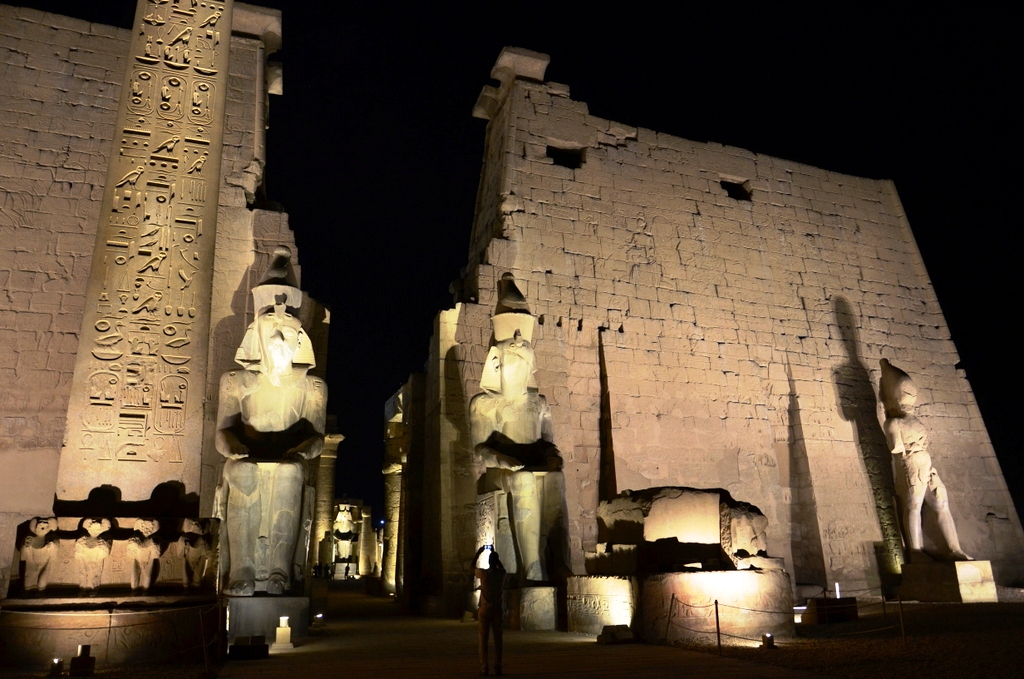
2. The Great Court of Ramesses II
Beyond the pylon, the Great Court of Ramesses II is surrounded by a double colonnade of 74 papyrus-bud columns. Standing in the court are colossal statues of Ramesses II in seated and standing positions, each carrying his cartouche and wearing the double crown. At the north-west corner of the court, visible from below and embedded into the older structure of the court, is the Abu el-Haggag Mosque — one of the most remarkable architectural curiosities in Egypt.
3. The Abu el-Haggag Mosque — A Mosque Inside an Ancient Temple
The Mosque of Abu el-Haggag is a still-active Islamic mosque built inside the Great Court of Luxor Temple — and it is one of the most striking examples of how the layers of Egyptian history accumulate in a single place. The mosque was built in the 11th century AD on top of the debris that had accumulated over the temple over two millennia. At that time, the First Pylon was completely buried under sand and rubble — the mosque’s floor is approximately 12 metres above the original temple floor level. When the French Egyptologist Gaston Maspero excavated the temple in the 1880s and cleared the debris, the mosque was left in place out of respect for the active Muslim community that worshipped there. It remains open and in use today, its minaret visible above the ancient columns. The mosque is dedicated to Abu el-Haggag, a 12th-century Islamic holy man whose tomb is within, and the annual Moulid of Abu el-Haggag festival — held during the Islamic month of Sha’ban — fills the temple precinct with processions and celebrations that echo the ancient Opet Festival in ways that no scholar has fully explained.
4. The Colonnade of Amenhotep III
The architectural heart of Luxor Temple is the Colonnade of Amenhotep III: a processional corridor of 14 columns, each 16 metres high with open papyrus-flower capitals, creating one of the most elegant colonnaded spaces in the ancient world. The walls of the colonnade carry reliefs recording the Opet Festival — the annual procession in which the sacred statues of Amun, Mut and Khonsu were carried by boat from Karnak to Luxor Temple and back, accompanied by musicians, dancers, soldiers and the entire population of Thebes. These are the most detailed records of the Opet Festival in existence, and your guide narrates the procession scene by scene as you walk through.
5. The Chapel of Alexander the Great
In the innermost sanctuary of Luxor Temple, a small chapel was built by Alexander the Great after his conquest of Egypt in 332 BC. Having visited the Oracle of Amun at Siwa Oasis and been declared the son of the god, Alexander sought to legitimise his rule by presenting himself in the Egyptian tradition — making offerings to Amun in the sacred temples. The reliefs in this chapel show Alexander depicted in full pharaonic regalia: double crown, false beard, kilt and was-sceptre. It is one of only a handful of places in Egypt where Alexander is shown as pharaoh rather than as a Greek king.
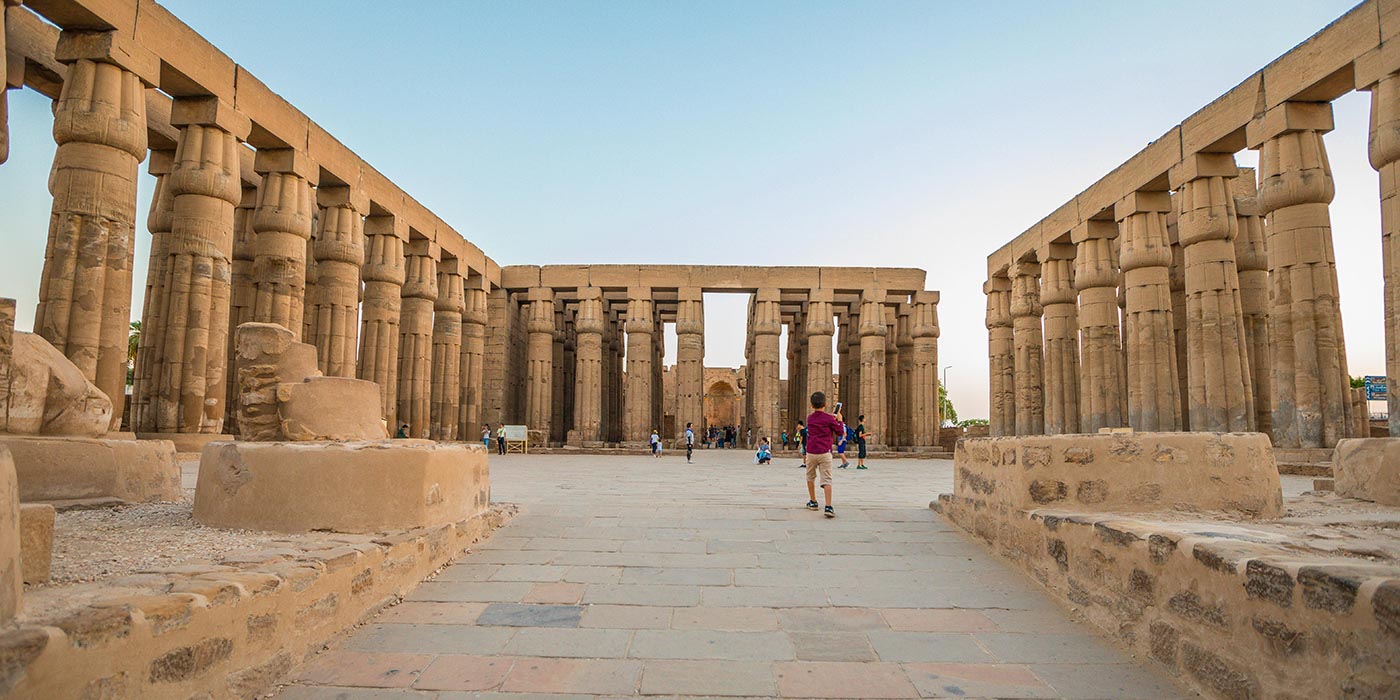
What to See — At a Glance
The Opet Festival and the Avenue of Sphinxes
Luxor Temple was built specifically for the Opet Festival — the most important annual religious celebration of the New Kingdom. Each year during the second month of the Nile inundation season, the sacred statues of Amun, Mut and Khonsu were lifted from their shrines at Karnak Temple, placed aboard gilded sacred barques and carried in a great procession along the Avenue of Sphinxes to Luxor Temple. Here, behind closed doors in the innermost sanctuary, the divine ka (spirit) of the reigning pharaoh was renewed and merged with the spirit of Amun — recharging the king’s divine authority for another year. The festival lasted 11 days in the reign of Tuthmosis III, growing to 27 days by the time of Ramesses III. The Avenue of Sphinxes — 3km of sphinx-lined processional road connecting Karnak to Luxor Temple — was excavated and restored between 2011 and 2021 and is now fully walkable, offering the most authentic recreation of the ancient processional route available today.
Practical Information
Ahmed Emam’s Insider Tips
- Visit at dusk, not at midday — Luxor Temple is one of the few ancient monuments in Egypt that is genuinely better in the evening than in the day. The afternoon light on the obelisk and pylon is warm and beautiful; the illuminated temple after dark is extraordinary. Almost every Nile cruise itinerary schedules Luxor Temple in the late afternoon to catch both.
- Walk the Avenue of Sphinxes from Karnak to Luxor — rather than driving between the two temples, ask your guide to arrange the 3km sphinx-lined walk from Karnak as the sun drops. The avenue was completed in 2021 and is the closest thing to the ancient Opet Festival procession that exists today.
- Look up at the Abu el-Haggag Mosque floor level — standing in the court and looking at the mosque entrance, you can see how far above the original temple floor the mosque sits. The column drums and capitals that rise above the mosque floor were completely buried when it was built in the 11th century.
- Find Alexander the Great in the inner sanctuary — most visitors do not know the chapel exists. Your guide takes you into the innermost rooms where Alexander is shown in full pharaonic regalia. Standing in a 3,000-year-old Egyptian temple looking at a relief of Alexander the Great dressed as a pharaoh is a uniquely improbable historical moment.
- The best night photograph is from the Corniche, not the entrance — walk south along the Nile Corniche about 100 metres past the temple entrance and photograph back toward the illuminated obelisk and pylon. This angle shows the full height of the monument against the sky with the Corniche in the foreground.
Luxor Temple on a Nile Cruise
Luxor Temple is visited on the first evening of every Nile cruise from Luxor to Aswan. After boarding the ship and visiting Karnak Temple in the late afternoon, your private guide takes you to Luxor Temple at dusk for a 1–2 hour illuminated visit as the lights come on. The temple is a short walk or calèche (horse carriage) ride from the cruise ship docking area along the Corniche. Entrance fees are included in all Best Nile Cruises packages.
Frequently Asked Questions
Why is the Luxor Temple obelisk in Paris?
Originally two obelisks of Ramesses II stood before the entrance pylon of Luxor Temple. In 1833, the Ottoman Viceroy of Egypt Muhammad Ali Pasha gave one of the obelisks to France as a diplomatic gesture, in exchange for a mechanical clock which still hangs — broken and unrepaired — in the Citadel of Cairo. The obelisk was transported to Paris on a specially built ship and erected in the Place de la Concorde on 25 October 1836, where it remains the oldest monument in Paris. In 1998, France officially renounced any claim to the second obelisk, acknowledging that it belongs to Egypt. The remaining obelisk at Luxor Temple is 25 metres high and stands in its original position after 3,200 years.
What is the difference between Luxor Temple and Karnak Temple?
Both are on the East Bank of Luxor and were connected in antiquity by the 3km Avenue of Sphinxes. Karnak is much larger — 100 hectares, built over 2,000 years by 30+ pharaohs, with the Great Hypostyle Hall as its centrepiece. Luxor Temple is a single coherent design, primarily by Amenhotep III and Ramesses II, smaller and more architecturally unified. Karnak is best visited in the afternoon; Luxor Temple is best visited in the evening. Both are included in all Nile cruise East Bank itineraries, usually on the same day.
Why is there a mosque inside Luxor Temple?
The Mosque of Abu el-Haggag was built in the 11th century AD on top of accumulated debris inside the Great Court of Luxor Temple. At that time, the original temple was completely buried under centuries of sand and rubble — only the upper sections of the columns were visible above the surface. The mosque sits approximately 12 metres above the original temple floor. When French archaeologists excavated the temple in the 1880s and cleared the debris, the mosque was left in place as an active place of worship — a decision respected by every subsequent administration. It remains active today and is one of the most remarkable examples of religious continuity in Egypt.
Is Luxor Temple open at night?
Yes — Luxor Temple is one of the very few ancient monuments in Egypt open for evening visits. The floodlighting system illuminates the obelisk, pylon, columns and inner courts after sunset, creating one of the most dramatically beautiful temple experiences in Egypt. Evening hours vary seasonally — confirm current closing time with your guide on arrival in Luxor. All Best Nile Cruises itineraries schedule Luxor Temple in the evening to take advantage of the illumination.
What was the Opet Festival?
The Opet Festival was the most important annual religious celebration of ancient Egypt’s New Kingdom period (c. 1550–1070 BC). Each year during the inundation season, the sacred statues of the Theban Triad — Amun, Mut and Khonsu — were carried in procession from Karnak Temple to Luxor Temple along the 3km Avenue of Sphinxes, accompanied by the pharaoh, priests, soldiers, dancers and musicians. At Luxor Temple, behind closed doors, the divine spirit (ka) of the pharaoh was merged with and renewed by the spirit of Amun — recharging the king’s divine authority for another year. The reliefs in the Colonnade of Amenhotep III record the festival in extraordinary detail. The procession lasted 11 days under Tuthmosis III and grew to 27 days under Ramesses III as its importance increased.
Included in all our Nile cruise itineraries and Cairo and Nile cruise packages from $899 — evening visit with private Egyptologist guide and all entrance fees included. Contact us for a free personalised itinerary.
Written by Ahmed Emam — Egypt travel specialist since 2010, founder of Around Egypt Tours and Egypt For Travel. Has guided over 500 evening visits to Luxor Temple with international clients.