
The Unfinished Obelisk — Complete Visitor Guide 2026
The most common question visitors ask after seeing the obelisks of Karnak, Luxor or Rome is: how did they make them? The answer is in Aswan, lying in a granite quarry 1 kilometre from the centre of the city, exactly where it was abandoned approximately 3,500 years ago. The Unfinished Obelisk was the most ambitious obelisk ever attempted in ancient Egypt — 41.75 metres tall if completed, weighing an estimated 1,168 tonnes — and it was never finished because a crack appeared in the granite during cutting, making it structurally unusable. The workers stopped. The tools were left. The obelisk remained attached to the bedrock where it was born. It has been there ever since, a 3,500-year-old construction site frozen at the moment of failure, and it is the single most informative monument in Egypt for understanding how the ancient world’s greatest builders actually worked. This guide is written by Ahmed Emam with 15 years of explaining the Unfinished Obelisk to international clients.
The Numbers — Scale of What Was Attempted
How Ancient Egyptians Made Obelisks — Explained by the Evidence Here
The Unfinished Obelisk is the best answer in existence to the question how did they do it? Every stage of the process is visible in the quarry around you:
- Selection and marking — Workers identified a section of the granite cliff that was free of cracks and faults. The outline of the obelisk was marked on the rock surface.
- Pounding with dolerite balls — Workers used spherical balls of dolerite (a volcanic rock harder than granite) weighing 5–12kg each as pounding tools. They knelt at the quarry face and pounded the dolerite balls against the granite, gradually abrading channels around three sides of the obelisk outline. No metal tools were used for this stage — only stone on stone. Dozens of these dolerite balls are still scattered around the Unfinished Obelisk.
- Deepening the channels — The channels around three sides were gradually deepened until the obelisk stood on a narrowing base. Workers in the channels had limited space to move; the deeper the channel, the harder the work.
- Undercutting the base — The final stage was cutting the base free from the bedrock using wooden wedges: holes were cut in the base channel, dry wooden wedges were inserted and soaked with water. As the wood expanded, it cracked the granite along the base line, freeing the obelisk.
- Loading and transport — The freed obelisk was slid on lubricated wooden sledges to the Nile bank during the high flood season, when the water reached close to the quarry face. It was loaded onto a massive barge and floated to its destination. The barge technology required for a 1,000-tonne stone is itself a significant engineering achievement.
- The Aswan obelisk never got past step 2 — The crack appeared during the pounding phase. The project was abandoned. The obelisk never moved.
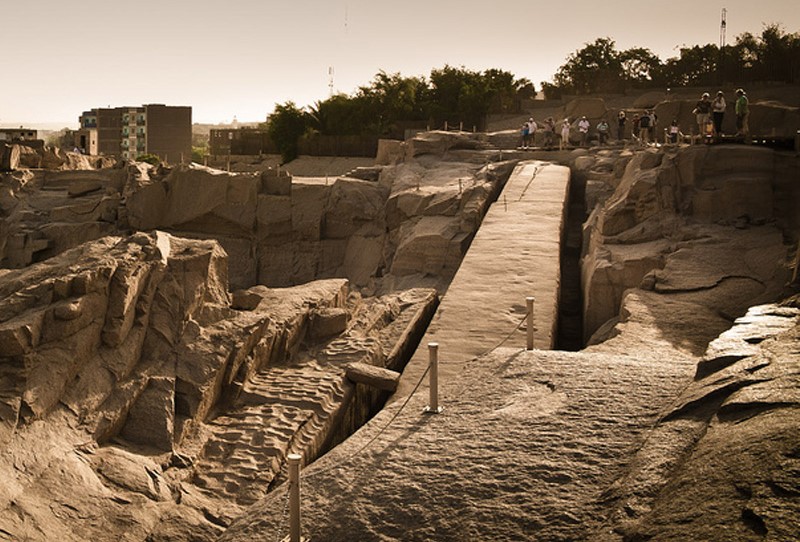
The Crack — 3,500 Years of Frozen Failure
The crack in the Unfinished Obelisk is clearly visible to visitors standing above the quarry pit. It runs diagonally through the upper section of the obelisk shaft — a natural flaw in the granite that was not apparent at the surface when work began but became visible as the workers cut deeper into the rock. Ancient Egyptian granite workers were expert at reading stone and selecting crack-free sections; this crack defeated their inspection. When it appeared, the decision to abandon was probably immediate. A cracked obelisk would have failed during transport or erection. The investment of months or years of labour was simply lost. The workers laid down their dolerite pounders. They walked away. And the obelisk remained exactly where you see it, waiting for 3,500 years for someone to explain what happened.
The Dolerite Pounders — The Tools That Built Ancient Egypt
Scattered around the Unfinished Obelisk and throughout the quarry are the dolerite pounders — spherical balls of dark volcanic rock, each weighing between 5 and 12 kilograms, worn smooth on their working surfaces from repeated impact against granite. These are the actual tools used by the ancient workers. They have been lying here for 3,500 years. Modern experimental archaeologists have recreated the pounding technique and confirmed that it works exactly as the quarry evidence suggests: a person kneeling or crouching, lifting the dolerite ball and dropping it repeatedly against the granite, producing a powdery abrasion one millimetre at a time. To cut a channel deep enough to free an obelisk required millions of such impacts. The workers who did this are completely anonymous — no name, no rank, no individual identity in the surviving records. The dolerite balls they held are the only physical trace of their work. You can stand next to one and look at it directly.
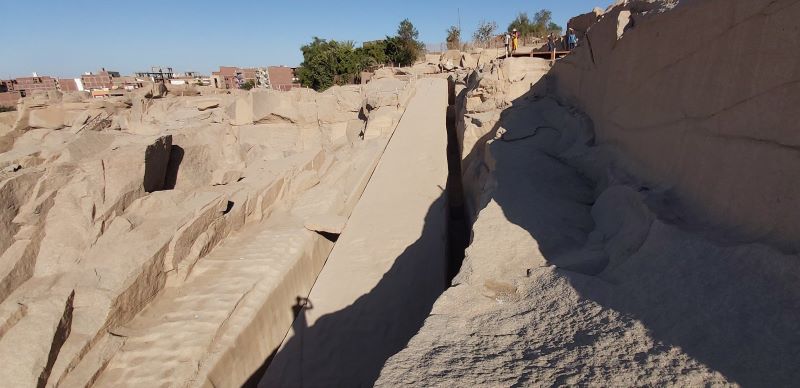
Aswan Pink Granite — The Stone of the Pharaohs
The Unfinished Obelisk sits in the most important granite quarry in the ancient world. Aswan pink granite — technically a syenite — is the distinctive red-pink stone that appears in monuments throughout Egypt and the ancient Mediterranean: the colossal statues at Abu Simbel, the obelisks now in Paris, London, New York and Rome, the sarcophagi in the Valley of the Kings, the floor of the inner sanctuary at Karnak, the columns at Luxor Temple. Every piece of red-pink granite in the ancient world either came from Aswan or is a local imitation of Aswan stone. The quarry that produced this material — working continuously from the Old Kingdom through the Roman period, a span of over 3,000 years — surrounds the Unfinished Obelisk on all sides. The marks of that 3,000-year operation are visible in every direction from where you stand.
Practical Information
Ahmed Emam’s Insider Tips
- Look for the dolerite balls before you look at the obelisk — the spherical dark-rock pounders scattered around the quarry floor are the most humanly immediate objects at the site. They are the actual tools. Pick one up with your eyes if not your hands and feel the weight. Then look at the channel beside you and understand what 3,500 years of pounding one grain of granite at a time would take.
- Find the crack before your guide points it out — it is visible in the upper section of the obelisk from the viewing platform. Try to find it yourself first. When you do, you understand immediately why the project stopped: it is not a subtle geological nuance but a structural failure that any experienced stone-worker would have recognised immediately.
- The comparison table changes everything — when your guide tells you this obelisk at 41.75 metres would have been taller than the tallest obelisk in Rome (32.5 metres), and that the one in Paris (the Luxor Temple obelisk you have already seen) is 25 metres, the scale of the ambition becomes personal. This was not standard production. This was the largest thing anyone had ever tried to make from a single piece of stone.
- Look beyond the obelisk at the wider quarry — the surrounding quarry face contains other partially cut blocks, ramp scars and ancient graffiti from workers and overseers across different periods. The Unfinished Obelisk is the centrepiece but the quarry itself is 3,000 years of Egyptian industrial history.
Frequently Asked Questions
Why is the Unfinished Obelisk important?
The Unfinished Obelisk is the most important monument in Egypt for understanding how the ancient Egyptians built their monuments. Every other monument shows the finished result; this one shows the process at the moment it was interrupted. The cutting channels, the dolerite pounders, the crack that caused abandonment and the obelisk’s continued attachment to the bedrock together constitute a complete record of ancient Egyptian quarrying technique that no textbook can replicate. Egyptologists have used the Unfinished Obelisk as the primary evidence for understanding how all ancient granite monuments — obelisks, colossal statues, sarcophagi — were manufactured.
How did the ancient Egyptians cut granite without metal tools?
The ancient Egyptians cut granite primarily using dolerite pounders — spherical balls of volcanic rock (dolerite or diabase) harder than granite, which were repeatedly dropped or struck against the granite surface to abrade it one grain at a time. The process was slow, physically exhausting and required enormous numbers of workers over long periods. Copper chisels were used for finer finishing work but could not cut hard granite efficiently. For the large-scale quarrying of obelisks and colossal statues, dolerite pounding was the primary technique, as proven by the physical evidence at Aswan and confirmed by modern experimental archaeology.
Who ordered the Unfinished Obelisk?
Most Egyptologists attribute the Unfinished Obelisk to Queen Hatshepsut (c. 1479–1458 BC), based on stylistic dating and the known scale of her obelisk-building programme at Karnak. Hatshepsut erected the two tallest obelisks at Karnak (including the surviving 29-metre obelisk still standing there) and was the most prolific obelisk builder of the 18th Dynasty. Some scholars have proposed Tuthmosis III as an alternative, as he also commissioned major quarrying at Aswan. No inscription naming the commissioner has been found on or near the Unfinished Obelisk, so the attribution remains based on circumstantial evidence.
How were obelisks transported after quarrying?
Once freed from the bedrock, an obelisk was slid on lubricated wooden sledges to the Nile bank, using teams of workers pulling on ropes. It was loaded onto a specially constructed barge during the annual Nile flood — when the high water brought the river closest to the quarry face and the current was strongest for downstream transport. The barge design needed to support a stone weighing hundreds of tonnes without bending or breaking; experimental reconstruction suggests the largest obelisk barges were among the most sophisticated watercraft of the ancient world. At the destination, the obelisk was raised using earthen ramps, pulling teams and counterweight systems whose exact mechanics remain partially debated among engineers.
Is the Unfinished Obelisk worth visiting?
Yes — it is one of the most intellectually rewarding sites in Egypt, even though it takes only 30–45 minutes to visit. It answers the question that every visitor to Egyptian temples eventually asks — how did they actually make these things? — with physical evidence rather than speculation. If you have already seen the obelisks at Karnak and the Luxor Temple obelisk, visiting the Aswan quarry gives those monuments a new dimension: you understand precisely what went into making each one and why the failure rate, though low, was catastrophic when it occurred. All Best Nile Cruises Aswan itineraries include the Unfinished Obelisk as part of the standard Aswan day.
Included in all our Nile cruise Aswan itineraries and Cairo and Nile cruise packages from $899 — combined with Philae Temple and the Aswan High Dam with a private Egyptologist guide. Contact us for a free personalised Aswan itinerary.
Written by Ahmed Emam — Egypt travel specialist since 2010, founder of Around Egypt Tours. Has visited the Unfinished Obelisk on over 500 Aswan excursions with international clients.