
Gebel el Silsila — Complete Visitor Guide 2026
There is a moment on the Dahabiya route between Edfu and Kom Ombo when the open agricultural plain narrows and the Nile suddenly tightens between two walls of golden sandstone that rise almost vertically from the water. The cliffs press in on both sides. The river accelerates slightly in the constriction. The boat moves through silence. And then you begin to see what is carved into the stone: the systematic gouging of block after block cut from the living rock over 2,000 years, the tool marks still fresh on surfaces that have not been touched since a quarry worker laid down his copper chisel in the last century BC. This is Gebel el Silsila — the Mountain of the Chain — and it is the quarry that built ancient Egypt. Every sandstone temple you have visited on this journey — Karnak, Luxor Temple, Edfu, Kom Ombo, Abu Simbel — was quarried from this gorge. For 2,000 years, the sandstone blocks that became Egypt’s temples were cut from these cliffs, floated downstream on the Nile and lifted into place by workers who never saw the finished buildings. This guide is written by Ahmed Emam with 15 years of bringing Dahabiya clients through the gorge.
Why Gebel el Silsila Is Where It Is
The location of Gebel el Silsila is not accidental — it is geological. This narrow gorge marks the precise point where Egypt’s geological substrate transitions: north of here, the bedrock is limestone (the material of the Old Kingdom pyramids and the cliffs of Luxor); south of here, the bedrock is Nubian sandstone (the material of every New Kingdom and Ptolemaic temple in Upper Egypt and Nubia). The ancient Egyptians quarried limestone from the north (at Tura, Mokattam and other sites near Cairo) and sandstone from the south, at Gebel el Silsila. Both materials were floated downstream by river. This geological boundary — visible in the colour change of the cliffs from white limestone to golden sandstone — is one of the fundamental facts of Egyptian architectural history, and Gebel el Silsila sits exactly on the line.
What to See at Gebel el Silsila
Every Temple You Have Visited Was Quarried Here
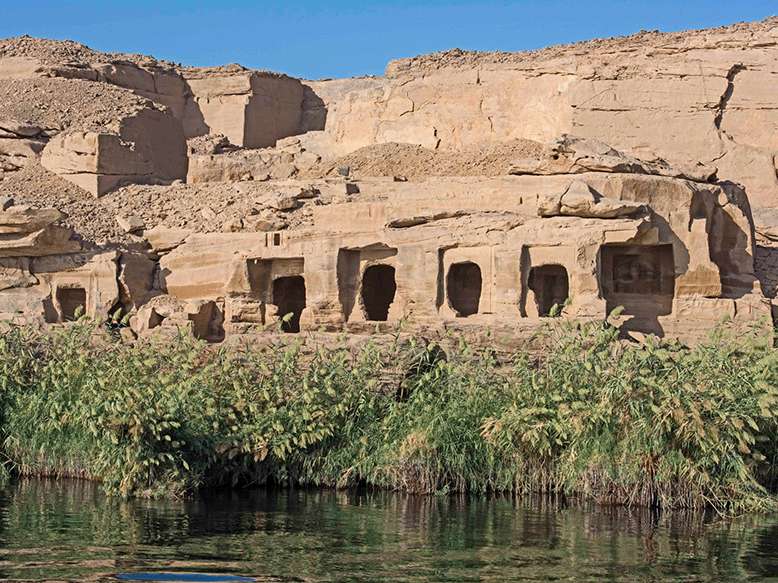
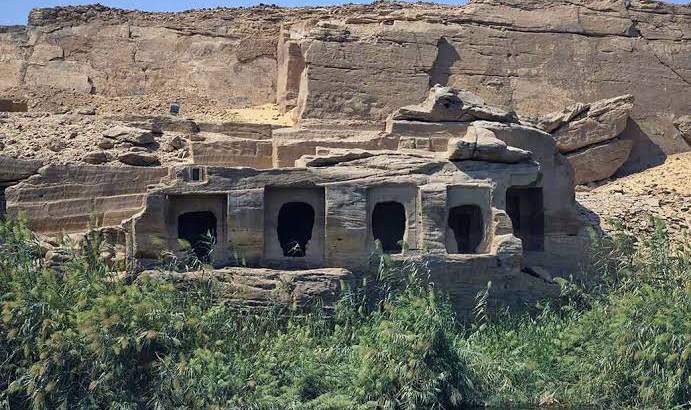
The most arresting thought available at Gebel el Silsila is a simple one. Stand at the west bank quarry face and look at the rectangular niches cut into the stone — each one the exact size and shape of the blocks that form the columns of Karnak, the pylons of Edfu and the walls of Abu Simbel. The blocks that became those temples were cut from holes exactly like these ones, in cliff faces exactly like this one, by workers whose names appear in graffiti scratched into the surfaces around you. The stone was cut in the flood season when the Nile was high, floated on timber rafts down the current, and unloaded at construction sites sometimes hundreds of kilometres away. The entire architectural achievement of New Kingdom Egypt passed through this gorge. There is no other quarry in the world — not Carrara, not Penteli, not Aswan granite — where a visitor can stand in the source material of so many monuments that they have already seen and understand them differently as a result.
The Speos of Horemheb — A Temple Hidden in the Quarry
Among the quarry niches, rock shrines and administrative stelae of the west bank cliff, one structure stands apart: the Speos of Horemheb — a rock-cut sanctuary carved into the cliff by Horemheb (c. 1323–1295 BC), the last pharaoh of the 18th Dynasty and the general who ruled Egypt after the chaotic Amarna period of Akhenaten and Tutankhamun. The speos is a single chamber cut directly into the sandstone, its rear wall carved with seven seated deities: Amun, Mut, Khonsu, Sobek, Taweret, the deified Amenhotep III, and Horemheb himself — receiving offerings from the pharaoh in the relief carved on the side walls. The interior retains traces of original colour. The small scale of the speos, tucked into the quarry cliff between industrial stelae and block-cutting niches, emphasises the dual sacred and utilitarian character of the site: this was a workplace and a sacred landscape simultaneously.
The Stelae — Two Thousand Years of Quarry Records
The cliff faces at Gebel el Silsila carry hundreds of commemorative stelae — carved tablets recording the quarry operations in extraordinary administrative detail. They name the pharaoh under whom the work was carried out, the overseer responsible, the quantities of stone extracted, the festival occasions that required particular quarrying campaigns, and sometimes the names of individual workers. Together these stelae constitute the most complete documentary record of ancient Egyptian industrial organisation in existence — more informative about the logistics of Egyptian construction than any papyrus archive. They span 2,000 years: from the 18th Dynasty campaigns of Tuthmosis III, through the massive Ramesside quarrying programmes, to the Ptolemaic period. Reading them with a guide is reading the supply chain of ancient Egyptian civilisation.
The Dahabiya Experience at Gebel el Silsila
Standard motor cruise ships pass through the Gebel el Silsila gorge without stopping — the site is not on any standard itinerary and the narrow channel makes extended mooring difficult for large vessels. The Dahabiya experience here is categorically different. The Dahabiya — under sail if the wind is right, engine-assisted if not — enters the gorge at sailing speed. As the cliffs close in on both sides, the crew moors directly against the west bank cliff face, the gangplank is laid over the bow rail to the rock, and passengers step out onto the ancient quarry floor. There are no other boats. There are almost certainly no other people. The only sound is the Nile current and the birds in the cliffs above. For clients accustomed to the crowded temple sites of the standard cruise route, the silence of Gebel el Silsila — arriving by sail into a gorge full of ancient inscriptions, with no queue, no commentary system and no competing tour groups — is often reported as the single most memorable moment of the entire journey.
Practical Information
Ahmed Emam’s Insider Tips
- Touch the quarry wall — the rectangular niches cut by ancient quarry workers are at hand height in many sections. Run your hand along the smooth interior surface of a quarry niche and feel the tool marks in the stone. You are touching the source material of the Karnak columns. No velvet rope. No sign saying do not touch. Just ancient sandstone and your hand on it.
- Find the workers’ graffiti — between the formal steles and the quarry niches are casual hieratic inscriptions scratched by workers — names, dates, notes. Your guide finds them. A worker scrawling his name on a cliff face 3,000 years ago is as human an act as any; here, those names survive.
- Look across the gorge at the east bank cliff — the east bank carries its own quarry marks, rock shrines and stelae, visible from the west bank. The sense of the Nile as a working river — this narrow gorge busy for 2,000 years with workers, rafts, overseers and stone — is strongest when you see both banks simultaneously.
- Time the visit for late afternoon light — the golden sandstone of Gebel el Silsila in late afternoon light — warm orange cliffs, the green Nile below, the Dahabiya moored in the gorge — is one of the most photogenic settings on the entire cruise route. The Dahabiya captain times the arrival where possible.
- Swim in the gorge if conditions permit — the Nile at Gebel el Silsila is clear, fast and cold by Nile standards. Some Dahabiya itineraries allow a swim from the boat in the gorge — one of the genuinely rare experiences on any Egypt itinerary and completely unavailable to motor cruise clients.
Frequently Asked Questions
What is Gebel el Silsila?
Gebel el Silsila (meaning “Mountain of the Chain” in Arabic) is a site on both banks of the Nile approximately 65km south of Edfu where the river narrows dramatically between vertical sandstone cliffs. It was the most important sandstone quarry in ancient Egypt — the source of stone for virtually every New Kingdom and Ptolemaic temple in the country, from Karnak to Abu Simbel. The cliff faces on both banks retain the evidence of 2,000 years of quarry activity: block-cutting niches, ramp scars, administrative stelae, workers’ graffiti and rock-cut temples and shrines.
Why did the ancient Egyptians quarry sandstone at Gebel el Silsila?
Gebel el Silsila sits precisely on the geological boundary between northern limestone and southern Nubian sandstone. South of this point, the entire bedrock is sandstone — the preferred building material for New Kingdom temples because it is softer and more workable than granite, more durable than limestone and available in large, regular blocks. The gorge location made transport straightforward: blocks were cut in the high flood season when the Nile reached the quarry face, loaded onto timber rafts and floated downstream to construction sites. The Nile current did most of the transport work.
Who was Horemheb and why did he build a temple at Gebel el Silsila?
Horemheb (c. 1323–1295 BC) was the last pharaoh of the 18th Dynasty — the general and administrator who came to power after the chaotic Amarna period (Akhenaten, Nefertiti, Tutankhamun) and restored traditional Egyptian religious order. He built the Speos of Horemheb (speos = Greek for “cave”) at Gebel el Silsila as a religious dedication at the most important quarry site in Egypt — the place where the stone for all his own building campaigns was sourced. Dedicating a temple at the quarry was both religiously appropriate (the site was sacred to Hapy, the Nile god) and practically strategic (it placed his name at the origin point of Egyptian temple construction).
Can Gebel el Silsila be visited on a standard Nile cruise?
Not in practice. Standard motor cruise ships pass through the Gebel el Silsila gorge as part of their sailing route but do not stop — the site is not on any standard Nile cruise excursion itinerary and the narrow gorge makes mooring a large vessel difficult. A Dahabiya can moor directly against the west bank cliff face and includes a dedicated guided excursion at the site. It is one of the defining experiences of the Dahabiya cruise that distinguishes it from the standard motor cruise route.
Why is Gebel el Silsila called the Mountain of the Chain?
The Arabic name Gebel el Silsila (“Mountain of the Chain”) refers to a tradition recorded by medieval Arab historians that a chain or iron bar was stretched across the Nile at this narrow point to stop river traffic and collect tolls from boats passing through. The narrowing of the Nile at the gorge — the tightest point between Luxor and Aswan — made it a natural control point for river commerce. Whether the chain actually existed in the form described is uncertain, but the geography makes the practice entirely plausible: at its narrowest, the Nile here is significantly tighter than anywhere else on the Luxor–Aswan route.
Gebel el Silsila is included in our Dahabiya Nile cruise itineraries — arriving by sail into the gorge with a private Egyptologist guide and the quarry face entirely to yourselves. Standard cruise ships pass through without stopping. Contact us to plan your Dahabiya cruise — this is what they see that others miss.
Written by Ahmed Emam — Egypt travel specialist since 2010, founder of Around Egypt Tours. Has visited Gebel el Silsila on over 120 Dahabiya cruises with international clients.