
Bissaw — Complete Visitor Guide 2026
Every other attraction on the Dahabiya route — El Kab, Gebel el Silsila, the temples of Luxor and Aswan — asks you to engage with the past. Bissaw asks you to engage with the present. This Nubian village on the Nile is not a monument. Its houses are painted in colours that have been refined over generations — cobalt blue, terracotta, white and gold. Its residents speak a language that predates Arabic in this region by several thousand years and maintain traditions that survived the forced displacement of the 1960s when the rising waters of Lake Nasser submerged their ancestral homeland. When the Dahabiya moors alongside the bank at Bissaw and the guests walk into the village, they are doing something that no standard cruise passenger does: they are entering a living Nubian community as visitors by invitation, not as tourists at a distance. The tea is real. The music is real. The conversation, with your guide translating, is real. This is the most emotionally memorable stop on the entire Dahabiya route for the majority of clients who experience it. This guide is written by Ahmed Emam with 15 years of bringing Dahabiya clients to Nubian communities along the Nile.
The Nubian People — Who They Are and Why They Are Here
The Nubians are the indigenous people of the Nile Valley south of Aswan and northern Sudan — one of the oldest continuous civilisations on earth, with a history stretching back at least 7,000 years. At their height, the Nubian kingdoms of Kerma, Napata and Meroe controlled the Upper Nile and challenged Egypt as a regional power. For several decades (c. 747–656 BC), Nubian pharaohs of the 25th Dynasty — the “Black Pharaohs” — ruled all of Egypt from Memphis. The Nubians speak Nobiin and Kenzi — languages in the Nilo-Saharan family, entirely distinct from Arabic — and maintain traditions of music, architecture, cuisine and communal life that are recognisably Nubian rather than Egyptian. When the Aswan High Dam was completed in the 1960s and Lake Nasser rose to submerge their ancestral Nile-side villages, approximately 100,000 Nubian people were displaced to new settlements inland. The communities that settled near the Nile — including villages like Bissaw on the river route between Kom Ombo and Aswan — have rebuilt their culture in proximity to the water that defined their civilization.
What to Experience at Bissaw
The Nubian House — Architecture as Cultural Statement
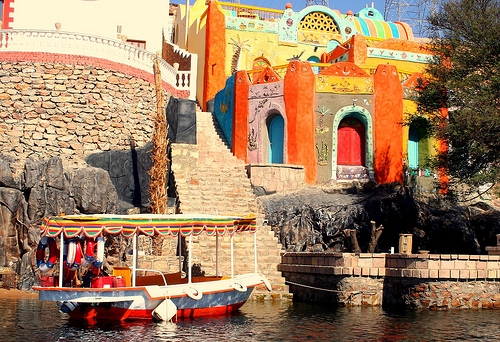
The most immediately striking feature of any Nubian village is its architecture. Nubian houses are painted in bold, vivid colours — the facades decorated with geometric patterns, fish, crocodiles, palm trees and Arabic calligraphy in combinations that are distinctly Nubian rather than pan-Egyptian. The painted facade is not decorative whimsy: it is cultural identity made visible. After displacement, when the Nubian communities were settled in new villages far from their submerged homeland, the painted house became one of the most important acts of cultural continuity — a way of marking Nubian space in a landscape that was not ancestrally theirs. Inside, the central courtyard is the social heart of the house: open to the sky, shaded in the afternoon by a reed awning, furnished with woven mats and low wooden benches. The kitchen is an open fire. The guest room — if the family has one — is the most decorated space in the house: the walls hung with photographs, certificates, haj memorabilia and decorative plates, assembled over generations. Walking through a Nubian house is reading a family history displayed in objects.
The Displacement Story — Heard From the People Who Lived It
In the 1960s, as the waters of Lake Nasser rose behind the Aswan High Dam, approximately 100,000 Nubian people were told to leave. Their villages — built on the Nile banks their families had occupied for generations — would be underwater within years. The relocation was swift and largely underfunded. The new villages had no Nile. No date palms by the water. No fish in the morning. No sound of the river. The elders of today’s Nubian communities remember these events directly or through parents and grandparents who described them. In a Bissaw courtyard, over tea, your guide facilitates these conversations — with the absolute respect that the topic demands and with the understanding that this is not a performance of grievance but a community choosing to share its story with people who have come to listen. For visitors who have already seen the Aswan High Dam, understood its engineering achievement and read its statistics, the human counterpoint available in a Nubian village is not simply moving — it is necessary. The dam and the village together constitute the complete truth of one of Egypt’s defining 20th-century decisions.
Why This Is Only Possible on a Dahabiya
The standard motor cruise ship carries between 40 and 120 passengers. It moors at constructed landing stages in Edfu, Kom Ombo and Aswan. It does not stop at Bissaw or any village like it — not because the community is unwilling but because the logistics are impossible: there is no dock for a large vessel, no infrastructure for 60 passengers arriving simultaneously and no way to make the visit genuine rather than performative at that scale. A Dahabiya carries 8–20 passengers. It draws shallow water. It can moor alongside the bank on a gangplank. It arrives quietly, at whatever time suits the community and the conditions. The group is small enough to sit in one courtyard together. The host family is genuinely hosting, not managing a crowd. The experience is real — not because Dahabiya clients are more deserving of authenticity than others, but because at this scale, authenticity is structurally possible in a way that it is not for a larger vessel. This is the most specific advantage of the Dahabiya over the motor cruise — and it is available at Bissaw.
Practical Information
Ahmed Emam’s Insider Tips
- Bring something to give — not money directly, but school supplies for children, quality coffee or tea for hosts, or a printed photograph from a previous visit (some families have been receiving Best Nile Cruises Dahabiya clients for years and value continuity). Ask Ahmed Emam before the cruise what would be most appreciated.
- Buy crafts directly from the maker — the handmade beaded jewellery, pottery and woven pieces sold in Bissaw are made by the women of the community. The price is lower than anything in Aswan bazaar and every pound goes directly to the family. This is one of the few genuinely fair-trade craft purchases available in Egypt.
- Listen more than you talk — the conversation facilitated by your guide is the experience. The elders of Nubian communities have things to say about the Nile, about displacement, about what was lost and what survived, that are not available in any book or museum. Reserve your questions for the moments between their words.
- If you see a crocodile in a home, do not be alarmed — some Nubian families keep a Nile crocodile as a household animal, following an ancient tradition linked to the Sobek cult. The crocodile is usually in a tank or enclosure and is fed and maintained by the family. It is sacred, not dangerous. Your guide contextualises this before the visit.
- The visit to Bissaw changes how you see the Aswan High Dam — if you have already visited the dam earlier in the cruise, Bissaw reframes it completely. The engineering achievement stays; the human cost becomes personal. If you have not yet visited the dam, Bissaw prepares you to understand it honestly.
Frequently Asked Questions
What is a Nubian village and why is it different from an Egyptian village?
The Nubian people are the indigenous inhabitants of the Nile Valley south of Aswan and northern Sudan, with a distinct language, culture, architecture and identity that predates the Arab settlement of Egypt by several thousand years. A Nubian village differs visually from an Egyptian village immediately: the painted house facades (cobalt, terracotta, white and ochre in geometric patterns), the courtyard-centred social life, the distinctive music and the traditional hospitality customs are all distinctly Nubian. The community’s relationship with the Nile — as sacred, as livelihood, as identity — is older and more intimate than in any other community on the river.
Why do Nubian families keep crocodiles?
The Nubian tradition of keeping crocodiles as household animals is rooted in the ancient cult of Sobek — the crocodile god of the Nile, whose main temple was at nearby Kom Ombo. For ancient Nubian and Egyptian communities living on the Nile, the crocodile was simultaneously feared and revered — a manifestation of the river’s dangerous power and a divine being to be propitiated. Some Nubian families maintain a crocodile in a home tank or enclosure as a sacred animal and a connection to this tradition. The crocodile is fed, named and cared for. It is not a tourist prop — it is a living religious and cultural practice that has continued for 3,000 years.
Is the Bissaw visit intrusive for the community?
Not when managed correctly. Best Nile Cruises visits Bissaw by arrangement with the community — with advance notice, a community contribution and a group size (8–12 people maximum) that is manageable for a host family. The visit is hosted by families who have chosen to welcome guests; it is not an unannounced arrival at a private village. Ahmed Emam has maintained relationships with Bissaw community members over many years, ensuring that the visits are genuinely mutual — beneficial to guests and respectful and financially supportive for the community.
What is karkadé and will I like it?
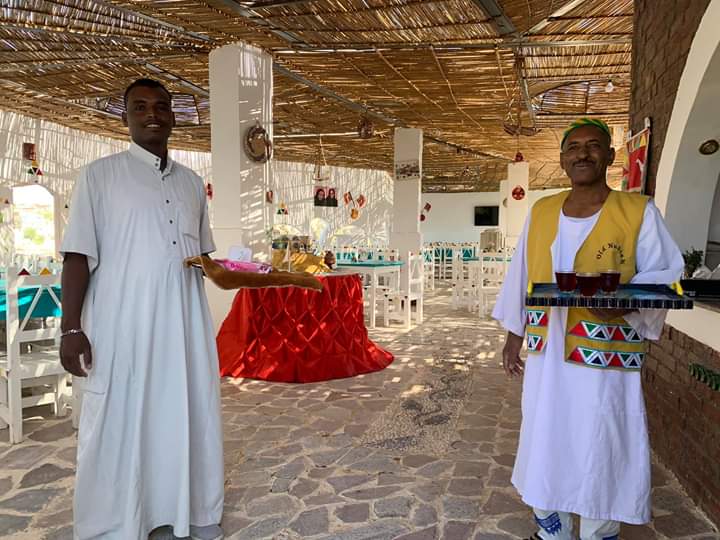
Karkadé is a tea brewed from dried hibiscus flowers — deep red in colour, tart and slightly fruity, served hot or cold and sweetened with sugar. It is the defining drink of Nubian hospitality and one of the most refreshing beverages in the Upper Egyptian heat. Almost everyone who tries it likes it. If you have already stopped at El Fishawy Café in Khan El Khalili and ordered karkadé there, you already know it. In Bissaw, it is made by the family whose garden grew the hibiscus.
Can the Bissaw visit be included on any Dahabiya cruise?
Yes — the Bissaw community visit is included in all Best Nile Cruises Dahabiya itineraries that sail between Luxor and Aswan. The timing of the visit is coordinated between the Dahabiya captain, the guide and the community in advance, and adjusted for weather and river conditions. The visit cannot be added to a standard motor cruise itinerary — it is structurally possible only on a Dahabiya.
Bissaw is included in our Dahabiya Nile cruise itineraries alongside El Kab, Gebel el Silsila and the Unfinished Obelisk — the complete Dahabiya experience that takes you beyond the temples to the living Nile. Contact us to plan your Dahabiya cruise — these are the experiences our clients remember for the rest of their lives.
Written by Ahmed Emam — Egypt travel specialist since 2010, founder of Around Egypt Tours and Egypt For Travel Has facilitated over 100 Nubian community visits on Dahabiya cruises with international clients.