
Egyptian Museum, Tahrir Square — Complete Visitor Guide 2026
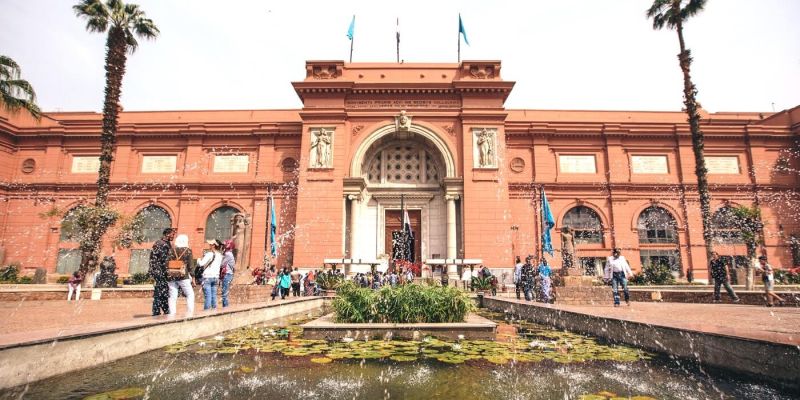
The Egyptian Museum at Tahrir Square opened its doors in 1902 and for over a century was the single most important repository of ancient Egyptian artifacts in the world. Its neoclassical pink facade has become as recognisable to Egyptophiles as the monuments it houses. Designed by the French architect Marcel Dourgnon and built to house a collection that had been growing since the establishment of the Antiquities Service in 1858, it opened with 50,000 objects. Today it holds over 170,000 artifacts — more than can be displayed at once — in 107 halls across two floors. The opening of the Grand Egyptian Museum (GEM) at Giza in 2024 has transferred many of the most famous pieces, including the complete Tutankhamun collection, to the new facility. But the Tahrir museum is not empty or redundant. It retains an irreplaceable collection of colossal statues, Old and Middle Kingdom masterpieces, royal portrait carvings, painted coffins, mummies and the largest papyrus archive in the world. This guide, written by Ahmed Emam, covers what remains at Tahrir, what has moved to the GEM, and how to plan the best Cairo museum experience.
Egyptian Museum Tahrir vs Grand Egyptian Museum (GEM) — What Is Where
What to See at the Egyptian Museum, Tahrir
Ground Floor — The Colossal Statues
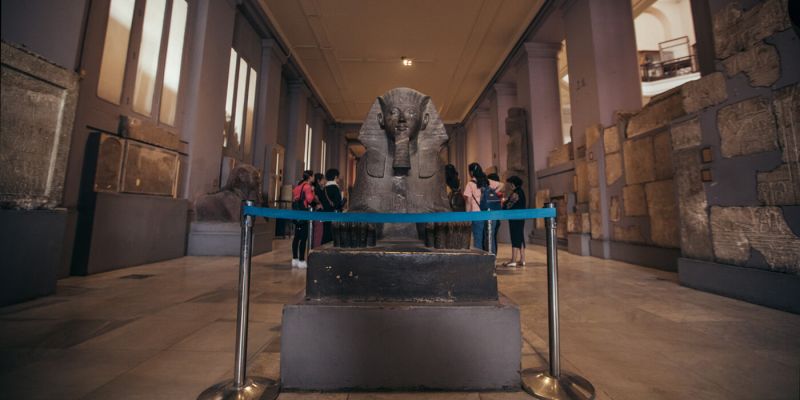
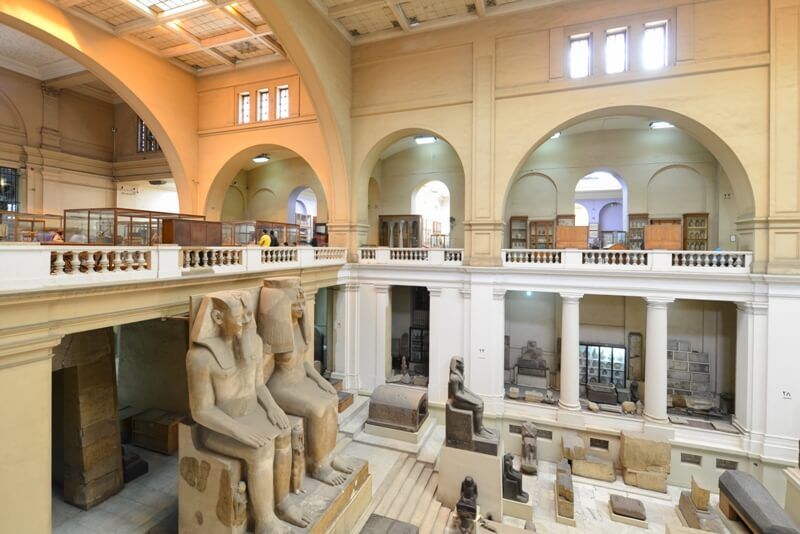
The ground floor of the Tahrir museum is organised around an atrium of colossal royal statues that fill the central hall with an overwhelming density of stone. Amenhotep III and Queen Tiye as a pair — the largest known royal group statue in existence before its discovery. The seated diorite statue of Khafre with Horus protecting him (Room 42) is considered one of the finest sculptures in the ancient world: the absolute geometric perfection of the face, the falcon wings of Horus folded around the back of the head, the body in a state of divine stillness that no photograph adequately captures. The painted limestone statues of Prince Rahotep and his wife Nofret (c. 2600 BC) stare at you with eyes of crystal and quartz that the ancient Egyptians believed carried the living soul. Their gaze has been making museum guards uncomfortable for decades.
.jpg)
The Narmer Palette and Predynastic Egypt
Among the most significant objects in the Tahrir museum is the Narmer Palette (c. 3100 BC) — a ceremonial slate palette commemorating the unification of Upper and Lower Egypt by the pharaoh Narmer. It is one of the earliest historical documents in existence and the first object to show a king of unified Egypt wearing the double crown. The palette is also the earliest known example of the Egyptian artistic conventions — the composite view of the human body, the hierarchical scale, the register composition — that would remain standard for 3,000 years. Finding it in the museum’s Predynastic gallery, understanding what it records, is one of the most intellectually satisfying moments available in Egyptian Egyptology.
The Meketre Models — A Complete Ancient Egyptian Estate in Miniature
In 1920, the American Egyptologist Herbert Winlock discovered a hidden chamber in the tomb of Meketre, a Middle Kingdom chancellor (c. 1981 BC), containing 24 wooden models of extraordinary completeness: a cattle count, a carpenter’s workshop, a bakery, a brewery, a weaving workshop, river boats with crews, garden scenes and a granary. Each model is a three-dimensional record of daily life in ancient Egypt, painted in vivid colours, with miniature human figures going about their work. They remain at the Tahrir museum and are one of the most humanly engaging exhibits in any museum in the world, particularly for children. Your guide brings these scenes to life by explaining what each workshop produced and how it fitted into the ancient Egyptian estate economy.
.jpg)
Practical Information
Ahmed Emam’s Insider Tips
- Go directly to Room 42 for the Khafre statue — if you have limited time, the diorite statue of Khafre with the Horus falcon in Room 42 is the single most important sculpture in the museum. The quality of the carving in this hardest of stones, the face modelled with absolute calm authority, is the standard against which all Egyptian royal portraits are measured.
- Find Rahotep and Nofret before the crowds arrive — the painted limestone couple from Meidum (c. 2600 BC) in Room 32 have crystal and quartz inlaid eyes that create a sense of living presence unlike anything else in Egyptian art. Their colours are 4,600 years old. See them early when the room is quiet.
- The Meketre models room is always quieter than the main halls — most visitors follow the main corridor without entering the side rooms. Ask your guide to take you to the Meketre models, which are in an upper-floor gallery. They are one of the most rewarding 20 minutes in the museum.
- Do not try to see everything — 107 halls is an impossible brief for a 2-hour visit. Work with your guide to identify the 8–10 pieces that matter most to you personally — based on whether your interest is Old Kingdom art, mummies, jewellery, or the story of daily life — and see those properly rather than rushing through everything superficially.
- The museum shop has the best reproduction scarabs in Cairo — the official museum shop (ground floor, before the exit) sells authenticated reproduction pieces and Egyptology books. The scarab reproductions are better quality than anything in Khan El Khalili.
Frequently Asked Questions
Is the Egyptian Museum at Tahrir still worth visiting now the GEM is open?
Yes — for visitors with two days in Cairo. The GEM is essential and should be visited first. But the Tahrir museum retains pieces that are not at the GEM: the Khafre diorite statue, the Narmer Palette, Rahotep and Nofret, the Meketre models, the Predynastic gallery and the papyrus collection. These are irreplaceable and are not duplicated at the GEM. For visitors with only one day in Cairo, prioritise the GEM and the Pyramids. For visitors with two days, add Tahrir on Day 2 with Old Cairo and Khan El Khalili.
What is the difference between the Egyptian Museum and the Grand Egyptian Museum?
They are two entirely separate institutions. The Egyptian Museum at Tahrir Square opened in 1902 in the centre of Cairo and houses 170,000+ objects across 107 halls. The Grand Egyptian Museum (GEM) opened in 2024 beside the Pyramids at Giza and is the world’s largest archaeological museum. The GEM holds the complete Tutankhamun collection, the Royal Mummies Hall and a purpose-designed display of 100,000+ artifacts. Pieces are gradually being transferred from Tahrir to the GEM, but the transfer is ongoing and the Tahrir museum remains open with its own significant collection.
What are the most important objects at the Egyptian Museum, Tahrir?
The most important pieces remaining at the Tahrir museum include: the diorite statue of Khafre with Horus (c. 2530 BC, Room 42), considered the finest example of Old Kingdom royal sculpture; the Narmer Palette (c. 3100 BC), the earliest historical document of Egyptian unification; the painted limestone statues of Rahotep and Nofret (c. 2600 BC) with their extraordinary inlaid eyes; the Meketre wooden models (c. 1981 BC); the papyrus collection including illustrated Books of the Dead; and several rooms of painted wooden coffins from multiple periods. Your guide selects the pieces most relevant to your interests.
When was the Egyptian Museum at Tahrir opened?
The Egyptian Museum at Tahrir Square opened on 15 November 1902 under the direction of the French Egyptologist Gaston Maspero. It was the fourth building constructed to house Egypt’s national collection since Mohammed Ali established the Antiquities Service in 1858 — previous collections had been housed in Boulaq and in a palace at Giza. The building was designed by Marcel Dourgnon, who won an international competition in 1895. The neoclassical pink facade, the central atrium of colossal statues and the organisation of objects chronologically across two floors established a museum model that influenced Egyptian exhibition design for a century.
Will the Egyptian Museum at Tahrir close when the GEM is fully open?
There are no confirmed plans to permanently close the Egyptian Museum at Tahrir Square. The Egyptian government has discussed converting the building — which is architecturally significant in its own right — into a dedicated museum of Egyptology and the history of excavation once the transfer of the main collection to the GEM is complete. As of 2026, the Tahrir museum remains fully open with its current collection. Your guide will have the most current information on any changes to its status and opening arrangements.
The Tahrir museum is included in our extended Cairo programmes. Combined with the Grand Egyptian Museum, Old Cairo and Khan El Khalili, it forms part of the complete two-day Cairo programme before your Nile cruise. Contact us for a free personalised Cairo itinerary.
Written by Ahmed Emam — Egypt travel specialist since 2010, founder of Around Egypt Tours. Has guided over 400 visits to the Egyptian Museum, Tahrir with international clients.