
El Kab — Complete Visitor Guide 2026
Most travelers on a Nile cruise between Luxor and Aswan pass El Kab without knowing it exists. Their ship follows the west bank itinerary — Edfu, Kom Ombo, Aswan — while on the opposite east bank, a site of extraordinary historical depth sits almost entirely without visitors. El Kab — ancient Nekheb — was one of the most important religious and administrative centres in ancient Egypt from the Predynastic period onward. Its rock-cut tombs contain some of the most significant personal testimonies in Egyptian history. Its enclosure walls are among the oldest monumental mud-brick structures surviving in Egypt. Its wadi is lined with rock engravings spanning five millennia. And it is visited by barely a fraction of the tourists who sail past it each year — because reaching it requires a Dahabiya: the shallow-draft wooden sailboat that can moor directly on the east bank where no standard cruise ship can land. Clients of Best Nile Cruises Dahabiya itineraries have El Kab to themselves. This guide is written by Ahmed Emam with 15 years of bringing Dahabiya clients to El Kab.
Nekhbet — The Vulture Goddess Who Protected Every Pharaoh
El Kab was the cult centre of Nekhbet — the white vulture goddess of Upper Egypt and one of the oldest and most important deities in the Egyptian pantheon. Nekhbet and Wadjet (the cobra goddess of Lower Egypt) together formed the “Two Ladies” — Nebty in Egyptian — whose emblems appeared on the royal headdress of every pharaoh from the earliest dynasties. The vulture spreading her wings over the king’s head, visible on virtually every royal carving in Egypt, represents Nekhbet in her protective role. Every time you see a pharaoh in royal regalia with a vulture above his head, you are seeing a reference to El Kab. The goddess’s name — Nekhbet — is derived from Nekheb, the ancient name of El Kab itself. The city and its goddess were interchangeable.
What to See at El Kab
The Tomb of Ahmose Son of Ibana — History Written by a Soldier
The most historically important feature of El Kab is a rock-cut tomb that most of the world has never heard of. The Tomb of Ahmose son of Ibana (tomb designation EK2) belongs to a naval officer named Ahmose — the son of a woman called Ibana, hence his distinguishing name — who served under three pharaohs: Ahmose I, Amenhotep I and Tuthmosis I. His tomb walls carry his own autobiography in hieroglyphic text — the longest first-person military narrative surviving from ancient Egypt. In it, Ahmose describes in specific detail his role in the naval campaigns that expelled the Hyksos from Egypt around 1550 BC, founding the New Kingdom. The Hyksos were West Asian rulers who had controlled Lower Egypt for over a century; their expulsion by Pharaoh Ahmose I is one of the defining events in Egyptian history. The biography of Ahmose son of Ibana is our primary first-person evidence for how that expulsion actually happened: the battles at Avaris (the Hyksos capital), the pursuit into Canaan, the rewards of gold and slaves given to victorious soldiers, and the personal experience of combat in ancient Egypt. For historians of the ancient Near East, this text is priceless. For the visitor to El Kab, it is on the wall of a quiet rock-cut tomb above the Nile — with no other tourists present.
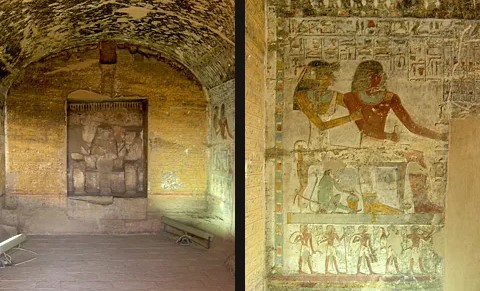
The Tomb of Paheri — The Finest Daily Life Paintings Between Luxor and Aswan
Immediately adjacent to the Ahmose tomb is Tomb EK3 — the Tomb of Paheri, which belongs to a mayor of Esna and El Kab who served under Tuthmosis III in the 15th century BC. Paheri was the grandson of Ahmose son of Ibana, and his tomb is the visual counterpart to his grandfather’s verbal history: where Ahmose recorded battles and military service, Paheri recorded the peacetime life of a prosperous administrator. The paintings cover agricultural cycles, harvest festivals, boat-building, fishing, family gatherings and banquets with extraordinary specificity and grace. The image of workers treading grapes to music while a harvesting song is inscribed above them — the lyrics visible in hieroglyphs — is among the most humanly immediate scenes in any New Kingdom tomb. The colour retention is excellent. The family groupings — Paheri with his wife and children, named and individualised — bring the people of 15th-century BC Upper Egypt startlingly close.
Why El Kab Is a Dahabiya Exclusive
El Kab sits on the east bank of the Nile — the opposite bank from Edfu and most of the standard cruise temple stops. Standard Nile cruise ships (motor vessels of 60–80 metres or more) require dedicated mooring infrastructure that exists on the west bank at Edfu but not on the east bank at El Kab. The site is approached across a short stretch of agricultural plain from the river; there is no modern landing stage for large vessels. A Dahabiya — the traditional wooden sailing boat, typically 25–35 metres long with a shallow draft — can moor directly alongside the east bank in the calm Nile here, deploying a simple gangplank. This is how travelers reached El Kab for 5,000 years, and it is how Best Nile Cruises Dahabiya clients reach it today. The result: a site of extraordinary historical importance visited in almost complete solitude, with a private guide and no competing tour groups.
Practical Information
Ahmed Emam’s Insider Tips
- Read the Ahmose autobiography text with your guide — the hieroglyphic inscription on the walls of EK2 covers his entire military career in first person. Your Egyptologist guide can read the text directly from the wall and translate it for you. Hearing an ancient Egyptian soldier’s own account of the battles that created the New Kingdom, read from the wall of his tomb, is an experience available almost nowhere else.
- Compare the two tombs side by side — the grandfather’s military biography (EK2) and the grandson’s painted peacetime life (EK3) tell two different stories of the same era and the same family. The contrast between the soldier’s text-heavy war record and the administrator’s colourful life scenes is one of the most interesting paired readings in Egyptian archaeology.
- Walk into the wadi for the prehistoric rock art — a 10–15 minute walk up the dry valley behind the tombs brings you to rock surfaces covered in engravings spanning 5,000 years: prehistoric animals, Predynastic boats, New Kingdom figures and later graffiti all layered on the same rock faces. Your guide identifies the oldest engravings and the different time periods.
- Look at the vulture symbol on the pylon reliefs you have already seen — if you have visited Karnak, Luxor, the Valley of the Kings or any other pharaonic site, you have already seen Nekhbet a hundred times: the white vulture spreading her wings over the king’s head. Standing in her actual home town, where her temple stood, gives those earlier images a new context.
Frequently Asked Questions
What is El Kab in ancient Egypt?
El Kab is the modern name for the ancient Egyptian town of Nekheb, capital of the 3rd nome (administrative district) of Upper Egypt and the primary cult centre of Nekhbet — the vulture goddess who was one of the two patron deities of the pharaoh. The site was inhabited from the Predynastic period (before 3100 BC) continuously through the Ptolemaic and Roman eras. Its rock-cut noble tombs, enclosure walls, prehistoric rock art and temple remains make it one of the richest multi-period archaeological sites between Luxor and Aswan.
Who was Ahmose son of Ibana?
Ahmose son of Ibana was an ancient Egyptian naval officer from El Kab who served under Pharaohs Ahmose I, Amenhotep I and Tuthmosis I (c. 1550–1480 BC). His rock-cut tomb at El Kab (EK2) carries a biographical text — the longest first-person military narrative surviving from ancient Egypt — in which he describes his service in the wars that expelled the Hyksos from Egypt and founded the New Kingdom. His autobiography is the primary first-person evidence for the Hyksos expulsion and provides unique testimony about naval warfare, battlefield rewards and military service in 16th-century BC Egypt.
Who were the Hyksos?
The Hyksos (from the Egyptian Heka Khasut — “Rulers of Foreign Countries”) were a people of West Asian origin who migrated into the Nile Delta from around 1800 BC onward and eventually seized control of Lower Egypt, ruling from their capital at Avaris (Tell el-Dab’a) for over a century (c. 1650–1550 BC). They introduced new military technologies to Egypt including the horse-drawn chariot, the composite bow and bronze weapons. Their expulsion by Pharaoh Ahmose I in c. 1550 BC reunified Egypt and launched the New Kingdom — the era of Ramesses, Tutankhamun, Hatshepsut and all the great temple builders. The Tomb of Ahmose son of Ibana at El Kab is the most detailed first-person account of how the expulsion was carried out.
Can El Kab be visited on a standard Nile cruise?
No — El Kab is accessible almost exclusively by Dahabiya. Standard motor cruise ships require dedicated mooring infrastructure that does not exist on the east bank at El Kab. The site is not on any standard Nile cruise itinerary. A Dahabiya — the traditional shallow-draft wooden sailing boat — can moor directly alongside the east bank and deploy a gangplank, exactly as river travellers have done at this site for thousands of years. It is one of the genuine privileges of the Dahabiya experience.
What is special about the Tomb of Paheri at El Kab?
The Tomb of Paheri (EK3) at El Kab belongs to an 18th Dynasty mayor who was the grandson of the soldier Ahmose son of Ibana. It is one of the finest examples of New Kingdom daily life painting between Luxor and Aswan — depicting agricultural cycles, harvests, boat-building, family life and banquets with exceptional colour and detail. A notable feature is a harvest scene where workers sing as they tread grapes, with the lyrics of their song inscribed in hieroglyphs above them — one of the few surviving ancient Egyptian song texts in its original performance context. The tomb is almost never visited by tourists.
El Kab is included in our Dahabiya Nile cruise itineraries — the only way to reach it from the Nile. Private Egyptologist guide, entrance fees and direct mooring on the east bank all included. Contact us to plan your Dahabiya cruise.
Written by Ahmed Emam — Egypt travel specialist since 2010, founder of Around Egypt Tours. Has visited El Kab on over 150 Dahabiya cruises with international clients.