
Great Sphinx of Giza — Complete Visitor Guide 2026
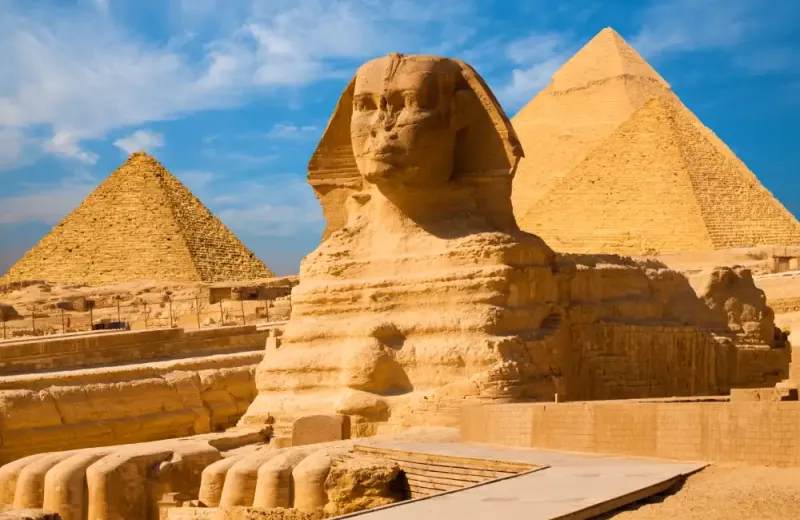
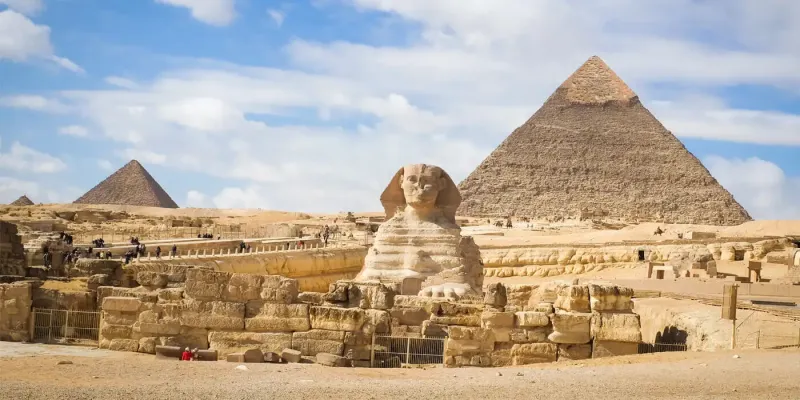
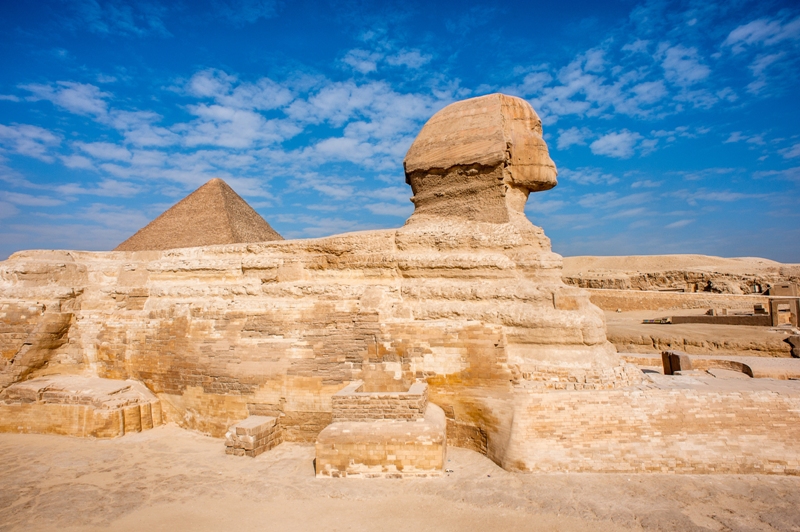
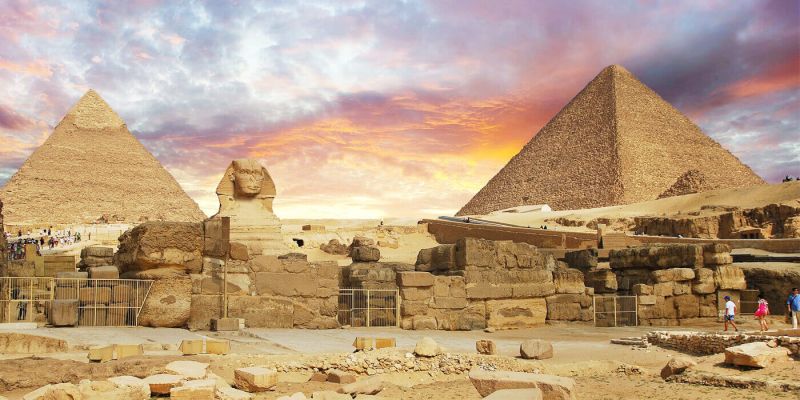
The Great Sphinx of Giza is the largest monolithic statue ever carved by human hands — a 73-metre recumbent lion with a human head, cut from a single natural limestone outcrop on the Giza plateau approximately 4,500 years ago. It faces due east, toward the rising sun, and has done so every morning for four and a half millennia. Ancient Egyptians called it Horemakhet — “Horus on the Horizon” — and in the New Kingdom it was worshipped as a god in its own right, with an active cult and pilgrims travelling from across Egypt to make offerings before it. It is the most instantly recognisable monument in the world after the Pyramids themselves, and yet almost everything most people believe about it — who built it, how old it is, who broke the nose — contains some degree of error. This guide, written by Ahmed Emam with 15 years of bringing international visitors to Giza, gives you the accurate version.
The Sphinx at a Glance
Who Built the Sphinx and What Does the Face Represent?
The mainstream archaeological consensus attributes the Great Sphinx to Pharaoh Khafre (c. 2558–2532 BC), the builder of the second pyramid at Giza. The evidence is circumstantial but substantial: the Sphinx sits directly in front of Khafre’s pyramid and causeway, facing his Valley Temple; the face shows stylistic similarities to known portraits of Khafre; and the Dream Stele (see below), while not naming Khafre explicitly, refers to “Khaf” in a partially damaged line. The body is that of a recumbent lion — the animal associated with royal power, the sun god Ra and the guardian of sacred thresholds in ancient Egyptian symbolism. The combination of a royal human head with a lion’s body represents the pharaoh as both man and divine protector: all-seeing, all-powerful, positioned to guard the pyramid complex for eternity.
.jpg)
The Missing Nose — The Truth
One of the most persistent myths in Egyptian tourism is that Napoleon’s soldiers shot off the Sphinx’s nose with a cannon during the French expedition of 1798. This is completely false. Medieval Arab traveller Muhammad al-Idrisi described the Sphinx’s face in 1200 AD and made no mention of a missing nose. However, al-Maqrizi, writing in the 15th century, records that a Sufi fanatic named Muhammad Sa’im al-Dahr destroyed the nose in 1378 AD in an act of religious iconoclasm — objecting to the Egyptian peasants making offerings to the Sphinx in hopes of a good harvest. Al-Maqrizi states that Sa’im al-Dahr was subsequently lynched by the local population for the act. Drawings made by the Danish explorer Frederic Louis Norden in 1737 — 61 years before Napoleon arrived — clearly show the Sphinx without its nose. Napoleon was not in Egypt for the damage. The myth was invented later. The nose was removed by a medieval religious extremist, not a European general.
The Dream Stele of Tuthmosis IV
Between the Sphinx’s front paws stands a granite stele erected by Tuthmosis IV (c. 1401 BC) — over a thousand years after the Sphinx was carved. The stele records a royal dream: a young prince (Tuthmosis, before he became pharaoh) was resting in the shade of the Sphinx during a hunt when the god Horemakhet — the deified Sphinx — appeared to him and spoke: “I am your father… I shall give you the kingdom… if you will do for me what my heart desires: clear away the sand that encumbers me.” Tuthmosis cleared the sand, became pharaoh and erected the stele to record the divine favour. The story tells us several things: by 1401 BC, the Sphinx was already so ancient that its builders had been forgotten; it was buried to the neck in sand; it was being actively worshipped as a god; and the relationship between piety toward the Sphinx and royal legitimacy was already firmly established.
Practical Information
Ahmed Emam’s Insider Tips
- Visit the Sphinx before or after the Pyramids, not between them — the standard itinerary visits the Pyramids first and the Sphinx after. Your guide may reverse this if crowds are already at the Sphinx enclosure early. Ask for whichever is quieter at 8 AM.
- Stand in the lower enclosure between the paws — the enclosure in front of the Sphinx, between the extended paws, gives you the closest legal approach and the best upward angle to the face. Your guide takes you down the steps to this level.
- Ask your guide to show you the Dream Stele — the granite stele of Tuthmosis IV stands between the paws and is often overlooked by visitors who are focused on the face above it. The stele is one of the oldest documented royal dreams in history.
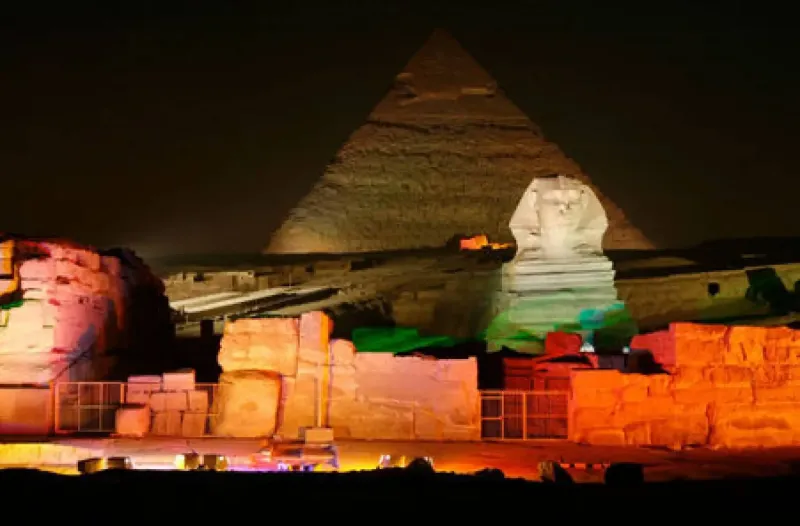
- The Sphinx Sound and Light Show — an evening Sound and Light Show is held at the Giza Plateau with the Sphinx as its focal point, the narration told as if from the Sphinx itself. The floodlit Sphinx with the Pyramids behind it is one of the most dramatic evening experiences in Egypt. Ask your guide to check the current schedule.
- Tell the Napoleon nose story — your guide will appreciate it — almost every visitor arrives at the Sphinx believing Napoleon broke the nose. Knowing the true story (the 1378 AD religious extremist) is a small but satisfying piece of historical accuracy to carry with you.
Combining the Sphinx with the Pyramids and GEM
The Great Sphinx is visited on the same day as the Pyramids of Giza — both are within the same plateau complex and covered by the same entrance ticket. A full Giza day with Best Nile Cruises follows this sequence: panoramic desert viewpoint at 8 AM (before crowds), Pyramids exterior and interior (c. 9–11 AM), Sphinx and Valley Temple (c. 11 AM–12 PM), lunch break, then the Grand Egyptian Museum in the afternoon (c. 2–5 PM). This sequence covers the complete Giza experience in a single day and is included in all Cairo and Nile cruise packages.
Frequently Asked Questions
Did Napoleon break the nose of the Sphinx?
No — this is a myth. The nose was damaged long before Napoleon arrived in Egypt. A 15th-century Arab historian named al-Maqrizi recorded that a Sufi fanatic named Muhammad Sa’im al-Dahr destroyed the nose in 1378 AD as an act of religious iconoclasm. Drawings made by Danish explorer Frederic Louis Norden in 1737 — 61 years before Napoleon’s campaign — clearly show the Sphinx with no nose. Napoleon arrived in Egypt in 1798 with a team of scientists and scholars who documented the monuments meticulously; none of them recorded any damage to the Sphinx. The myth appears to have been invented in the 19th century and has proven remarkably persistent.
How old is the Great Sphinx of Giza?
The mainstream Egyptological consensus dates the Sphinx to the reign of Pharaoh Khafre, approximately 2530 BC — making it around 4,550 years old. This is based on its stylistic relationship to known Khafre-period construction, its position beside his pyramid and causeway, and the Dream Stele of Tuthmosis IV (c. 1401 BC), which refers to the Sphinx as ancient even then. A minority of geologists, led by Robert Schoch, have argued that the erosion pattern on the Sphinx’s body suggests water erosion by rainfall rather than wind and sand, which would date the statue to a period of wetter climate — possibly 10,000 BC or earlier. This hypothesis, while interesting, is not accepted by the majority of Egyptologists, who point out that the head shows clear wind erosion consistent with the 2530 BC date.
What does the Sphinx face represent?
The face of the Great Sphinx is believed to represent Pharaoh Khafre, though the evidence is circumstantial rather than conclusive — no inscription at the site explicitly names him as the subject. The body is a lion, which in ancient Egyptian symbolism represents royal power, the sun god Ra and the guardian of sacred spaces. The combination of a royal human head with a lion’s body was a common royal image in Egyptian art — the androsphinx — symbolising the pharaoh as both mortal ruler and divine protector. The Sphinx at Giza is by far the largest example ever created.
Why was the Sphinx buried in sand?
The Great Sphinx sits in a natural depression on the Giza plateau and has been repeatedly buried to the neck by windblown desert sand throughout its history. The Dream Stele of Tuthmosis IV (c. 1401 BC) records the first clearance of the sand, ordered by a pharaoh after a divine dream. Clearances have been recorded in various periods, but the sand always returned. The Sphinx was fully buried from at least the 13th century AD until 1936, when French engineer Émile Baraize completed a comprehensive eight-year excavation that revealed the entire body for the first time in centuries. Today the enclosure is maintained clear of sand, but conservation of the deteriorating limestone remains an ongoing challenge.
What is the Sphinx’s original ancient Egyptian name?
In ancient Egyptian the Great Sphinx was called Horemakhet — meaning “Horus on the Horizon” — and was worshipped as a manifestation of the sun god Horus at the moment of sunrise. The name “Sphinx” itself is Greek, derived from the Greek myth of the Sphinx of Thebes (a different creature entirely, which posed riddles and killed those who could not answer). The Greek soldiers and travellers who visited Giza applied their own mythological vocabulary to the Egyptian monument. The ancient Egyptians would not have recognised the word “sphinx” — to them it was Horemakhet, the guardian of the horizon, the sun rising eternal.
The Sphinx is included in all our Cairo and Nile cruise packages from $899, visited on the same day as the Pyramids and Grand Egyptian Museum with a private Egyptologist guide. Contact us for a free personalised itinerary — response within 4 hours.
Written by Ahmed Emam — Egypt travel specialist since 2010, founder of Around Egypt Tours and Egypt For Travel. Has guided over 500 visits to the Great Sphinx with international clients.
 Close-up of the Great Sphinx face from the lower enclosure — filling the frame with the face detail, the eroded nose clearly visible, the Pyramid of Khafre rising behind