
Daraw Camel Market — Complete Visitor Guide 2026
At dawn on a Tuesday morning in the town of Daraw, 40 kilometres north of Aswan, something ancient happens. Sudanese herders in long white jellabiyas and coloured turbans lead strings of camels through the dust to pens that fill from before sunrise. The camels have walked for weeks — some for 40 days or more — from Darfur and beyond, along one of the oldest trade routes in Africa. Buyers from Cairo, dealers from Kom Ombo, farmers from Upper Egypt and meat traders from Aswan move between the pens. Tea is being brewed on open fires. Prices are called out and argued down. Camels are examined — teeth, legs, temperament. Money changes hands in cash. By noon, most of the business is done and the market empties. By the time most tourists in Aswan have eaten breakfast, it is almost over. The Daraw Camel Market is one of the most vivid, most unscripted and most historically resonant experiences in Upper Egypt — and almost no standard Nile cruise client ever sees it. It requires alignment with the market day, an early morning, and the willingness to engage with something that has not been arranged for tourists. This guide, written by Ahmed Emam, tells you what to expect, honestly and in full.
The Darb el-Arbain — The Forty Days Road
The camels at Daraw did not arrive by truck. They walked. The route they followed — the Darb el-Arbain or Forty Days Road — is one of the oldest trans-continental trade routes in history, running approximately 1,800km from Darfur in western Sudan northward through the Sudanese desert to Aswan and Daraw in southern Egypt. The route has been used for over 700 years in its documented form, though trans-Saharan trade along similar paths predates written records. It takes its name from the approximate walking time: forty days for a camel caravan, covering 40–50 kilometres per day through desert terrain with limited water points. The goods that moved north along this route through history included camels, slaves, ivory, ostrich feathers, gold dust and exotic animals for the pharaohs’ menageries. Today it is primarily camels — but the route, the rhythm and the people who walk it are essentially unchanged from the medieval period. The Bisharin, Ababda and Rashaida herding peoples who bring the camels north carry a relationship with this landscape and this trade that is generational, specific and irreplaceable. They are not farmers who happened to acquire camels. They are the inheritors of a 700-year commercial tradition.
What Happens at the Market
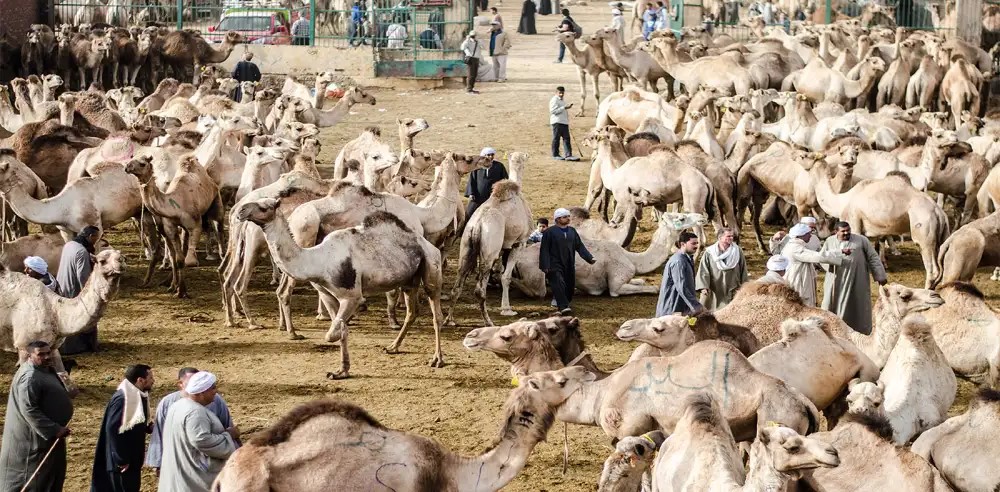
The market begins before sunrise and is most active between 6 and 9 AM. By 11 AM the main trading is over; by noon the pens are largely empty. Arriving by 7 AM is the minimum for a meaningful visit; arriving at 6 AM is ideal. What you encounter:
- Several hundred camels in rope pens or tied in lines, ranging from young animals to large adults. The variety of colours — beige, brown, white, dark — and the sheer number in a confined space create a visual and sensory experience unlike anything in the conventional Egypt itinerary.
- Sudanese and Nubian herders in traditional dress: long jellabiyas, turbans wound in the desert style, sandals. Many speak little or no English; the transaction language is Arabic and Nubian dialects. Your guide facilitates introductions and conversations if you want them.
- Egyptian dealers and buyers: meat traders, farmers needing draft animals, middlemen buying for resale to the larger Birqash market near Cairo.
- Tea and food: small fires with tea brewing, flat bread, falafel from portable stalls serving the market workers. The market has its own economy of refreshment.
- The transaction itself: camel trading follows protocols of examination, counter-offer and handshake that are essentially unchanged from the medieval souks. A sale is concluded by a handshake witnessed by others — no paperwork, no receipt.
An Honest Note — This Is a Working Livestock Market
Ahmed Emam believes in honest travel guidance. The Daraw market is not a curated experience. It is a working livestock market where animals are bought and sold commercially, primarily for meat, agricultural work and resale. The conditions are those of any working animal market in a developing country: dust, noise, crowding, the physical reality of large animals in commercial transactions. Some visitors find it one of the most vivid and life-affirming experiences of their Egypt trip. Others are uncomfortable with the conditions of working livestock markets. Both reactions are completely valid. Before including Daraw in your Dahabiya itinerary, please discuss with Ahmed Emam what you want from the visit and whether it is the right choice for you and your travel companions. Children can find it exciting and memorable; some adults find the commercial reality of livestock trading difficult. The honest answer is: you will not know until you have been, and the guide you go with makes a significant difference to how the experience unfolds.
Practical Information
Ahmed Emam’s Insider Tips
- Arrive at 6 AM, not 7 — the first hour of the Daraw market is the most atmospheric: the light is horizontal, the dust is golden, the pens are at their fullest and the herders are in full negotiation. By 7:30 the market is still active but the dawn quality has gone. The early start is the experience.
- Accept the tea — if a herder offers you a small glass of sweet tea at his fire, accept it. This is a gesture of hospitality that crosses every language barrier. Sit for a few minutes. Your guide translates if conversation develops. This is the moment the market becomes something personal rather than something observed.
- Ask your guide to explain the Forty Days Road — before you enter the market, ask Ahmed Emam to describe the journey the herders have made: the route from Darfur, the 40-day walk, the water sources, the challenges. When you understand that the man offering you tea has walked 1,800 kilometres with these animals to stand in this market, the experience shifts completely.
- Watch a transaction, not just the setting — the negotiation between buyer and seller at Daraw follows an ancient commercial protocol: the opening price, the counter, the body language, the pause, the handshake. Your guide positions you near an active transaction and explains what is happening. The handshake that closes a sale — witnessed by bystanders, no paper, immediate and absolute — is an act of commerce unchanged from the medieval Arab souks.
- This is not suitable for animal welfare-sensitive visitors — the market is a commercial livestock operation. If you or anyone in your group is distressed by working livestock conditions, Daraw is not the right choice. The experience is valuable and extraordinary for those who can engage with it; it is uncomfortable for those who cannot. Ahmed Emam assesses this honestly with every group before scheduling the visit.
Daraw on a Dahabiya Itinerary
The Daraw market can be included in a Best Nile Cruises Dahabiya itinerary when the cruise schedule brings the boat through the Daraw area on a Tuesday or Sunday morning. The typical sequence: the Dahabiya moors overnight near Kom Ombo after visiting Kom Ombo Temple the previous evening. At 5:30 AM on a Tuesday, guests who have opted in are collected by vehicle (7km south to Daraw), arriving at the market for the 6 AM dawn session. They spend 1–1.5 hours at the market and return to the Dahabiya as the boat prepares to sail the final stretch to Aswan. The Daraw visit adds no time to the overall itinerary — it uses the early morning window before the boat departs. The visit is optional within the Dahabiya programme — not all guests will want to participate, and the itinerary accommodates both those who go and those who prefer to stay aboard.
Frequently Asked Questions
What is the Daraw Camel Market?
The Daraw Camel Market (sometimes written Daraw, Darao or Daraw) is a working livestock market held primarily on Tuesday mornings in the town of Daraw, 40km north of Aswan. It is one of the most significant camel markets in Egypt and the principal northern terminus of the Darb el-Arbain (Forty Days Road) — the ancient trans-African trade route from Darfur in Sudan. Sudanese and Nubian herding peoples bring camels that have walked the route over 40+ days to sell to Egyptian dealers, farmers and meat traders. The market has operated continuously for centuries and follows commercial protocols largely unchanged from the medieval period.
What is the Forty Days Road (Darb el-Arbain)?
The Darb el-Arbain (“Forty Days Road”) is one of the oldest trans-African trade routes in history, running approximately 1,800km from Kobbei in Darfur (western Sudan) northward through the Sudanese desert to Aswan and Daraw in Egypt. The name derives from the approximate travel time for a camel caravan walking 40–50km per day. The route has been documented in written sources since at least the 13th century AD and was used continuously for trans-Saharan trade in camels, slaves, ivory, gold and exotic goods through the medieval period. Today it is used primarily by camel herders bringing livestock to Egyptian markets, most notably Daraw and the larger Birqash market near Cairo.
When is the Daraw Camel Market held?
The primary market day at Daraw is Tuesday morning, active from before sunrise until approximately noon. A smaller market is sometimes held on Sunday as well. The market is most active between 6 and 9 AM — arriving after 10 AM means missing the peak trading period. The size and activity of the market varies week to week depending on how many herders have arrived along the Forty Days Road. Best Nile Cruises confirms market activity before scheduling Dahabiya itineraries to include the Daraw stop.
Is the Daraw Camel Market suitable for children?
For most children above age 8 or 9, Daraw is genuinely exciting: hundreds of large animals, unusual people in distinctive dress, a market atmosphere unlike anything in Western experience. Younger children and those sensitive to large animals or livestock conditions may find it overwhelming or distressing. The market is dusty, noisy and the physical reality of a working livestock market is unfiltered. Parents should discuss with Ahmed Emam before deciding whether to include it for their children. The honest assessment: adventurous children love it; anxious ones do not.
How does the Daraw market fit into a Dahabiya itinerary?
The Daraw market is included as an optional early morning excursion in Best Nile Cruises Dahabiya itineraries when the schedule aligns with a Tuesday or Sunday. The Dahabiya moors overnight near Kom Ombo after visiting Kom Ombo Temple. Guests who opt in are collected at 5:30 AM for the 7km road trip to Daraw, arriving for the 6 AM dawn session. After 1–1.5 hours at the market they return to the Dahabiya as it prepares to sail to Aswan. Guests who prefer not to attend remain on the boat. There is no additional charge for the Daraw excursion when it is included in the itinerary.
The Daraw Camel Market is available as an optional dawn excursion on Best Nile Cruises Dahabiya itineraries when the schedule aligns with a Tuesday or Sunday morning. Contact Ahmed Emam to plan your Dahabiya cruise and confirm which departures include the Daraw market in the itinerary.
Written by Ahmed Emam — Egypt travel specialist since 2010, founder of Around Egypt Tours and Egypt For Travel Has visited the Daraw Camel Market on over 80 early morning Dahabiya excursions with international clients.