
Alexandria — Complete Visitor Guide 2026
Alexandria is a city that carries the weight of its own mythology. Founded in 331 BC by Alexander the Great on the narrow strip of land between the Mediterranean Sea and Lake Maryut, it became within a generation the most important city in the world — the capital of Ptolemaic Egypt, home of the Great Library and the Lighthouse of Alexandria (two of the Seven Wonders of the Ancient World), intellectual centre of Greek philosophy, Jewish theology and early Christianity simultaneously, and the court of Cleopatra VII — the last pharaoh of Egypt. The ancient city was gradually buried beneath the modern one; the library burned (at least partially, at least once); the Lighthouse collapsed in earthquakes; the Mediterranean reclaimed much of the ancient royal quarter. What remains is a city of enormous historical depth, a Mediterranean temperament, the best seafood in Egypt and a series of monuments that reward serious visitors far more than their relative obscurity would suggest. This guide is written by Ahmed Emam with 15 years of bringing international clients to Alexandria.
What to See in Alexandria
The Ancient Library of Alexandria — What Happened to It?
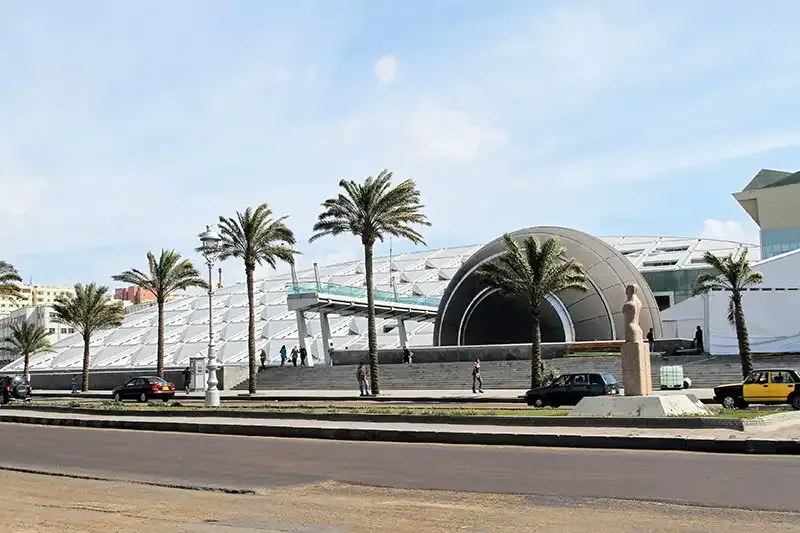
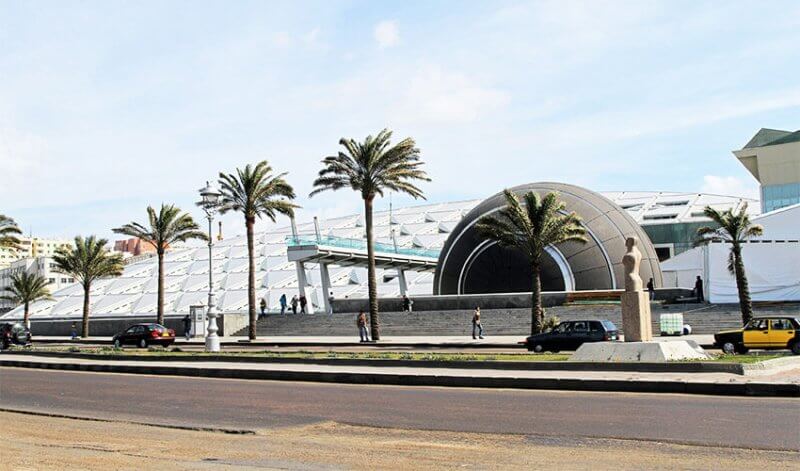
The Great Library of Alexandria was founded by Ptolemy I Soter around 300 BC as part of a complex called the Mouseion (the original “museum” — a shrine of the Muses). At its height it housed between 400,000 and 700,000 papyrus scrolls representing the accumulated knowledge of the ancient world. Scholars of every discipline — Euclid, Archimedes, Eratosthenes (who calculated the circumference of the earth with remarkable accuracy), Hipparchus, Galen — worked here. The question of what destroyed the library is one of history’s great unresolved debates. Multiple events damaged or reduced it over centuries: Julius Caesar accidentally burned ships in the harbour in 48 BC and fire may have spread to the docks where some scrolls were stored; Aurelian damaged the Brucheion (royal quarter) during fighting in 270 AD; the library may have been gradually run down by reduced funding and political neglect through the Roman period. The most dramatic single-event narrative — that Caliph Omar ordered it burned in 642 AD (“if the books agree with the Quran they are redundant, if they disagree they are heretical”) — is now considered by most historians to be a later fabrication. The honest answer is that the library declined and disappeared gradually over several centuries, and no single dramatic moment of destruction is historically confirmed. The Bibliotheca Alexandrina (2002) is not a reconstruction of the ancient library — it is a new institution built in the ancient library’s spirit and approximate location.
The Catacombs of Kom el Shoqafa — A Unique Fusion of Three Civilisations
The Catacombs of Kom el Shoqafa are the most extraordinary underground monument in Egypt outside the Valley of the Kings — and they are one of Alexandria’s least-known attractions among international tourists. Discovered in 1900 when a donkey fell through the ground into the upper chamber (and was found alive and uninjured at the bottom), the catacombs descend through three underground levels cut into solid rock, used as a family tomb and later expanded into a public necropolis from the 2nd century AD onward. What makes them unique is their artistic style: the tomb decorations blend Roman, Greek and ancient Egyptian iconography in a fusion that exists nowhere else. Egyptian gods are shown wearing Roman armour; mummies lie in Roman-style niches decorated with Greek architectural columns; Medusa shields guard pharaonic symbols. It is the physical record of a society in which three great civilisations existed simultaneously and gradually merged. The triclinium — a rock-cut dining room where families ate ritual meals in the presence of their dead during commemorative festivals — gives an extraordinary insight into Roman funerary practice. Named one of the Seven Wonders of the Middle Ages.
Practical Information
Ahmed Emam’s Insider Tips
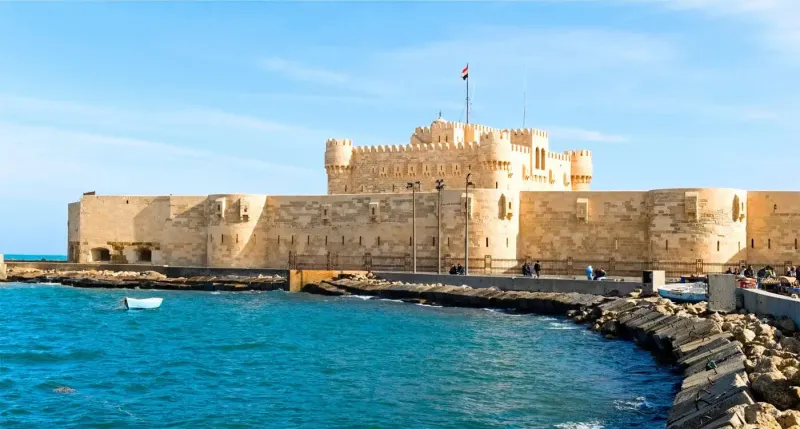
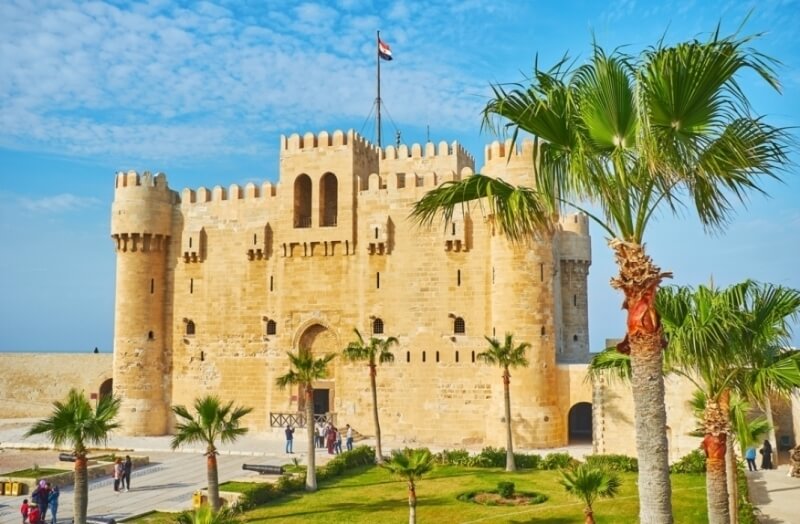
- Start with Qaitbay Citadel at 9 AM — the citadel opens early and the light on the Mediterranean harbour in the morning is beautiful. Standing on the citadel walls, on the exact site of one of the Seven Wonders of the Ancient World, with the sea on three sides, is the defining Alexandria moment. Go before the cruise groups arrive.
- The Catacombs are the most underrated attraction in Alexandria — most day-trip visitors skip them in favour of the Bibliotheca. This is a mistake. The Greco-Roman-Egyptian fusion in the tomb carvings is unique in Egypt and the underground space, cool and quiet, has an extraordinary atmosphere. Allow 45 minutes.
- Pompey’s Pillar is not worth a long visit on its own — it is impressive in scale (30 metres of solid Aswan granite) but there is limited context unless your guide explains the Serapeum site it stands on. Visit it on the way between the Catacombs and the Bibliotheca rather than as a separate stop.
- Spend at least 90 minutes in the Bibliotheca Alexandrina — the building itself is worth an hour: the vast main reading room under the tilted glass roof, the ancient manuscripts display, the Impressions of Alexandria permanent exhibition of archaeological finds from the underwater excavations of the ancient harbour. Rushing through in 30 minutes misses everything.
- Eat fish on the Eastern Harbour for lunch — the fish restaurants between the Bibliotheca and Qaitbay Citadel serve the freshest Mediterranean seafood in Egypt. The process is: choose your fish at the counter (shrimp, sea bass, calamari, mullet), agree a price per kilo, have it cooked. This is the authentic Alexandria lunch that every Egyptian knows but few guidebooks mention.
Alexandria as Part of an Egypt Trip
Alexandria combines naturally as an extension before or after a Cairo and Nile cruise package. The most common sequence is: arrive in Cairo, spend 1 day in Alexandria (or 2 nights for a relaxed visit), then 2 days in Cairo (Pyramids, GEM, Old Cairo), then fly to Luxor and board the Nile cruise. Alternatively, Alexandria makes a satisfying final day before international departure from Cairo International Airport — the drive from Alexandria to the airport is approximately 3 hours. Contact Best Nile Cruises and we build an Alexandria extension into any Egypt itinerary.
Frequently Asked Questions
What happened to the ancient Library of Alexandria?
The Great Library of Alexandria was not destroyed in a single dramatic event — it declined over several centuries. The most commonly cited destruction events include Julius Caesar’s fire in the harbour (48 BC), Roman Emperor Aurelian’s attack on the Brucheion district (270 AD) and Theophilus’s destruction of the Serapeum temple (391 AD). The popular story that Caliph Omar burned it in 642 AD is now considered a medieval fabrication by most historians. The library probably declined gradually through reduced royal funding and political neglect during the later Roman period. The modern Bibliotheca Alexandrina (opened 2002) is not a reconstruction — it is a new institution commemorating the ancient library’s spirit on or near its ancient site.
Where was the Lighthouse of Alexandria?
The Lighthouse of Alexandria — one of the Seven Wonders of the Ancient World, built c. 280 BC and standing approximately 120–137 metres high — stood on the island of Pharos in the Eastern Harbour of Alexandria. The island is now a peninsula connected to the mainland. The lighthouse was damaged by earthquakes in 956, 1303 and 1323 AD, and its remains were used to construct the Qaitbay Citadel in 1477 AD. The citadel’s foundation and walls incorporate the lighthouse’s original limestone blocks. Standing on the citadel today, you are standing on the ruins of the ancient wonder. In 1994, French underwater archaeologists discovered fallen stone blocks, sphinxes and statues in the harbour, confirming the lighthouse’s precise location.
Is Alexandria worth visiting as a day trip from Cairo?
Yes — but an overnight stay is better. A day trip (7 AM departure, 8 PM return) covers the Qaitbay Citadel, Bibliotheca Alexandrina, Catacombs and Pompey’s Pillar comfortably. However, Alexandria’s real character — the seafront cafés at dusk, the fish dinner on the Eastern Harbour, the Corniche in the evening, the leisurely pace of a Mediterranean city — requires staying overnight. For travelers with more than 10 days in Egypt, an overnight in Alexandria before the Nile cruise adds a completely different dimension to the trip.
Did Alexander the Great actually visit Alexandria?
Yes — he founded and partially designed it. Alexander the Great arrived in Egypt in 332 BC, was welcomed as a liberator from Persian rule and was declared pharaoh at Memphis. He then travelled to the site of the future Alexandria and personally directed the initial layout of the city — reportedly using grain to mark out the street grid when chalk ran out. He then departed for the Oracle of Siwa Oasis in the Western Desert, where he was declared the son of Zeus-Ammon — a declaration that transformed his self-image and political claims. He never returned to Alexandria; he died in Babylon in 323 BC. His body was brought to Alexandria and buried in a tomb that was venerated for centuries but whose location is now one of archaeology’s great unsolved mysteries.
What is Pompey’s Pillar and why is it named after Pompey?
Pompey’s Pillar is a 30-metre monolithic red granite column standing on the site of the ancient Serapeum temple in Alexandria. It was not erected for Pompey — it was built in 297 AD to honour the Roman Emperor Diocletian after he suppressed a revolt in Alexandria and generously distributed grain to the population. The incorrect name comes from medieval Crusader pilgrims who assumed the column marked the tomb of Pompey the Great (who was indeed assassinated in Egypt in 48 BC), and the erroneous name stuck. It is the tallest ancient monument in Alexandria and the largest ancient monolithic column in Egypt after the obelisks — cut from a single block of Aswan red granite.
We arrange Alexandria as a day trip or overnight extension before or after any Cairo and Nile cruise package — private guide, transport from Cairo and all entrance fees included. Contact us to add Alexandria to your Egypt itinerary.
Written by Ahmed Emam — Egypt travel specialist since 2010, founder of Around Egypt Tours. Has arranged over 300 Alexandria visits for international clients.